
How Lilo Teaches Children to Truly Understand
Lilo uses teaching methods proven to work for young children. Your child starts with real objects, then pictures, and only then symbols. They read through the sound of letters, break word problems into drawings, and move up one stage at a time. The result is a child who truly understands, feels confident, and loves to learn.
Learning from Real Objects (CPA)
CPA stands for Concrete, Pictorial, Abstract. This approach is used in Singapore, one of the countries with the best mathematics education in the world, and it grows from the research of child learning expert Jerome Bruner. Your child builds understanding from things they can touch, so they grasp the meaning of numbers deep down.
- 1
Concrete
Your child counts with blocks and beads they can hold. The meaning of numbers grows from real objects.
- 2
Pictorial
Once they understand, the objects become pictures on the worksheet. Your child can see how the numbers relate while the meaning stays clear.
- 3
Abstract
When your child truly understands, they write only the numbers and signs, with full understanding behind them.
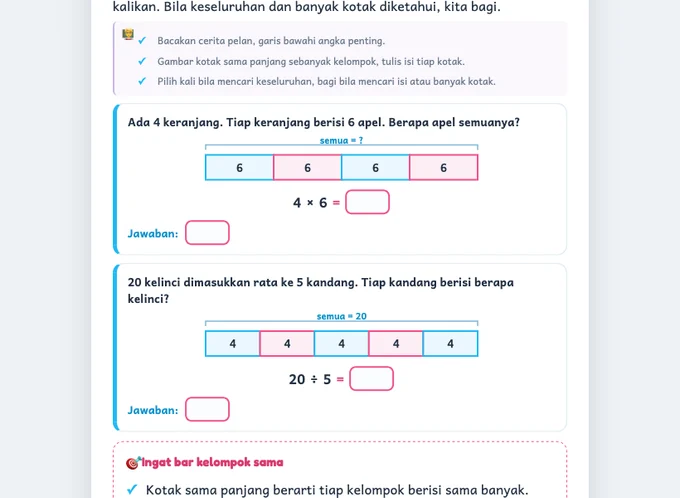
Word Problems Become Drawings That Are Easy to Solve
The Bar Model turns a confusing word problem into a simple drawing of bars. When your child reads a problem like "Ana has 8 candies and gives 3 to her little brother. How many are left?", they draw a long bar for 8, then cut off a part for 3. Once it is drawn, the answer is easy to see.
Your child learns to read a problem calmly, sort out what is known and what is asked, then build the steps to the answer on their own. This ability to break a problem into small parts stays useful for life.
7-Level Phonics, from Letter Sounds to Understanding Passages
Phonics teaches your child to read through the sound of letters, so your child reads smoothly without getting stuck spelling words out. This approach skips naming the letters one by one, which is the habit that slows many children down, so your child reads straight from the sounds and grows more confident. Your child moves up a level only after truly mastering one stage, so their reading ability grows solid with no gaps.
- L0 Letter Sounds know each letter sound
- L1 Syllables ma, bi, tu
- L2 Words mama, ball, cat
- L3 Closed Sounds closed words
- L4 Blends ng, ny, ai
- L5 Sentences read smoothly
- L6 Passages understand the story
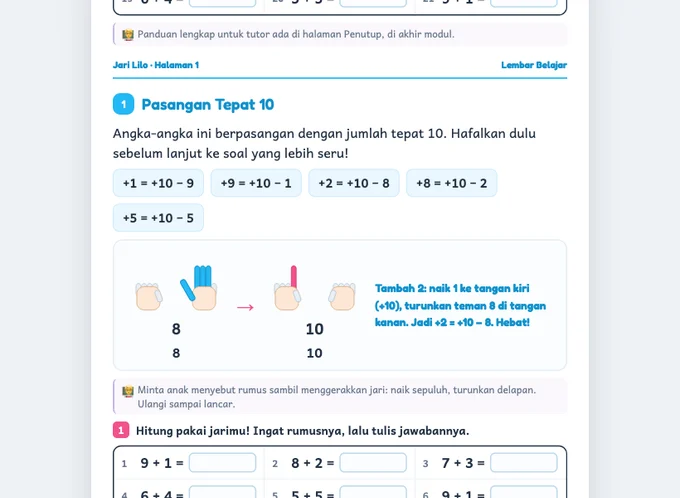
Master One Stage, Then Move On
Your child learns through a leveled curriculum of 122 modules, from the easiest to the more challenging. Each track has its stages: Numeracy L0 to L13, Reading L0 to L6, Writing L0 to L13, Jarimatika J0 to J11, and Sempoa S0 to S18.
Your child moves up to the next stage only after truly mastering the current one. They feel small progress every day, and each success grows their confidence and a habit of perseverance they carry with them.
See the Full CurriculumThe Level Code on Each Track, Where It Starts and Where It Ends
Every Lilo track uses its own level code, so you always know exactly where your child stands. The full map, stage by stage, is on the curriculum page.
| Track | Codes | First stage | Final stage |
|---|---|---|---|
| Reading | L0-L6 | L0: Letters and Sounds | L6: I Can Read |
| Writing | L0-L13 | L0-L1: Ready to Write and Basic Strokes | L12-L13: Composition |
| Counting | L0-L13 | L0: Recognising Quantity | L10-L13: Multiplication, Division, and the Bar Model |
| Jarimatika | J0-J11 | J0: Finger Numbers | J11: Finger Capstone |
| Sempoa (Abacus) | S0-S18 | S0-S1: Meet the Abacus | S18: Mental Capstone |
| Lilo Logic | A0-A9, B0-B7, C0-C6 | A0-A3: Track A Basic: Patterns and Groups | C4-C6: Track C Advanced: Bar Model and Puzzles |
Why Young Children Learn from Objects, then Pictures, then Symbols
This order follows the way children build understanding. Knowing why it works makes practice at home calmer, more effective and more enjoyable for your child.
To a child aged three to seven, the numeral 5 is only a squiggle. It gains meaning once your child has held five things, felt their weight, and seen that five stays five whether the objects sit in a row or in a pile. This hands-on experience is the foundation of understanding. Young children think through their bodies: they slide, touch, move things around, and then draw a conclusion. When a child is asked to write 2 + 3 straight away, they may answer correctly from memory, and that answer is fragile. Change the problem a little and the memorised answer has nothing to hold. Real objects give your child something to return to whenever doubt appears.
The picture stage is the bridge that often gets skipped. Here your child learns that one circle can stand for one marble, and one bar can stand for a whole group of things. This ability to represent matters enormously, because all of mathematics and reading is built on it. Letters, after all, are pictures that stand for sounds. A child who spends enough time at the picture stage usually begins to imagine objects without needing to hold them. They see three dots and know the amount at once, or see a long bar and know it holds eight candies. From there, the step toward symbols feels natural.
The symbol stage is the goal, and your child arrives there carrying everything that came before. When they write 8 minus 3, an image of candies taken from a bar appears in their head. The symbol becomes a summary of something they already understand. The same order works for reading. Your child hears and feels a sound in their mouth, then sees a picture of something whose name begins with that sound, and only after that reads the letter. Moving between stages also happens again and again. Every new topic, from addition to multiplication, is strongest when it begins once more with objects.
What does this mean for you at home? When your child gets a written problem wrong, invite them to step back one stage. Ask gently whether they can show it with spoons. Most children find their own mistake once the objects are in front of them. Try to avoid rushing your child toward pages full of numbers simply because they can already write them. Let them explain the answer with objects and pictures first. Your home is full of learning materials: buttons, spoons, socks and the steps on the stairs. Ten minutes with the right objects often means more than a page of problems answered by guessing.
Signs Your Child Is at the Object, Picture or Symbol Stage
Every child stands at one of three learning stages. The signs below help you sense where your child is today, so practice at home can connect with the way the tutor teaches in each session.
Needs objects in hand
- Your child touches or slides each object one by one while counting, so nothing gets skipped.
- Your child knows five cookies are more than three, yet feels lost when seeing 5 and 3 on paper.
- Your child often starts counting again from one, even after counting part of the pile.
- Your child remembers letter sounds more easily after shaping the letter from clay or fingers.
Ready to move to pictures
- Your child can say how many dots are on a card without pointing to each one.
- Your child happily draws small circles to stand for the marbles they just held.
- When seeing a picture of a ball, your child names its first sound, /b/, straight away.
- Your child can retell a simple problem while pointing to the picture that matches the story.
Ready for symbols
- Your child writes 4 + 2 and can show what it means with objects when you ask.
- Your child reads a new syllable by blending sounds, without naming the letters first.
- Your child draws a bar on their own when a word problem feels hard, then returns to numbers.
- Your child can check their own answer by picturing the objects in their head.
Five Steps the Lilo Method Takes with Your Child
A good method shows itself at the learning table. Here is the path your child follows, from the first conversation to the day they move up to the next module.
- 1
Telling us about your child and choosing a tutor
You tell us on WhatsApp about your child: what they can already do, what makes them hesitate, and how they usually like to play. From that story the Lilo team matches a tutor who is used to teaching step by step from objects to symbols. You can view the tutor's profile first, so you already know who will sit beside your child before the first session.
- 2
A game that finds your child's stage
The first session feels like play. The tutor invites your child to count objects, match pictures, or guess the first sound of a word, with no written test. From the way your child answers, the tutor sees whether they need objects, feel at home with pictures, or are ready for symbols. Your child's starting point among Lilo's 122 modules comes from this calm observation.
- 3
Objects, pictures and symbols in one session
Within a single session the tutor often moves through all three stages. Your child holds blocks to find the answer, draws those blocks on a worksheet from the module they are studying, then writes the numbers. This order gives every symbol something to hold on to. When your child hesitates, the tutor steps back to the objects for a moment, then climbs again with more confidence.
- 4
A short recap and one small task
As the session ends, the tutor sums up what your child mastered that day in a simple sentence your child can repeat on their own. Your child then receives one small task of about ten minutes, often using things you already have at home. The task keeps the bridge between objects and symbols alive until the next meeting, so your child picks up right where they left off.
- 5
Moving up once the idea is truly understood
Your child moves to the next module once they can explain an answer with objects, pictures and symbols alike. The tutor records this progress carefully, and the weekly report can show you, for example, that your child has let go of the blocks for addition up to ten. You can see which stages are already solid and which ones are just forming.
Five Home Activities That Follow the Object, Picture, Symbol Order
These activities use things from your kitchen and your child's desk. Each one mirrors the order the tutor uses, so your child meets the same way of thinking at home.
A jar of buttons and two bowls10 minutes
Pour a handful of buttons onto the table. Ask your child to split them into two bowls, then count each bowl while touching every button. Ask which bowl has more and by how many. Let your child slide the buttons around to prove the answer. This activity strengthens the object stage, where the meaning of numbers first takes shape in your child's mind.
Buttons or bottle caps, two small bowls
Drawing what was just held10 minutes
After playing with the buttons, invite your child to draw what is in both bowls as small circles on paper. Ask them to count the circles and match them with the real buttons. If the numbers differ, check again together calmly until you find out why. This simple step practises the move from objects to pictures, the moment numbers start to live on paper.
Paper, coloured pencils
Paper strips for word problems15 minutes
Cut coloured paper into long and short strips. Tell a short problem, such as seven apples in a basket and two get eaten. Ask your child to pick a strip for seven, then fold or cut off a part for two. Afterwards they draw the same bar on paper and write the numbers. A strip they can hold makes the bar drawing feel sensible.
Coloured paper, child-safe scissors, pencil
A sound hunt around the house10 minutes
Say one sound, for example /s/, then go with your child to find things at home whose names begin with it: sock, spoon, soap. Collect them in a basket and say their names together, stressing the first sound. Then show the letter S on a card. A sound your child discovers on real objects is easier to remember when they meet the letter.
Basket, homemade letter cards
Letters made of dough10 minutes
Shape dough or modelling clay into the letter your child is learning. Let them trace its shape with a finger while saying its sound, then put two letters together into a syllable such as ma or bo. Finally, ask them to write that syllable on paper. Hands that build a letter help your child hold its sound and shape in one complete memory.
Modelling clay or flour dough, paper, pencil
Your Child's Journey from Holding Objects to Writing Symbols
Every child moves at their own pace. The picture below shows changes often seen in a child who learns about twice a week, offered as a sketch of the journey, with no fixed timeline promised.
- Week 1
Your child warms up to the tutor and the objects
Your child starts to trust the tutor and the objects on the table. They count, arrange and sort while playing. By now the tutor has found your child's stage on each track they follow, so the next sessions go straight to the right level, challenging enough and still fun.
- Month 1
Objects begin to move onto paper
Your child becomes willing to draw what they just held. Five marbles turn into five circles, and the /m/ sound they feel on their lips becomes a letter they circle on the worksheet. At this stage they often go back to the objects, and that is completely natural.
- Month 2
Your child explains their own way
Your child begins to tell how they reached an answer. They might say, 'I took away three, so five are left.' Being able to explain is a sign that understanding has taken root, and the tutor starts using fewer objects for problems your child already grasps well.
- Month 3
Symbols feel light for what has been mastered
For material they have mastered, your child writes numbers, signs or words with confidence. When new material arrives, they return to objects without feeling shy, because they know that is how they learn. This rise and return repeats with every new module.
- Month 6
Your child carries the method beyond the session
Your child starts using the same approach in other places. They draw a bar while reading a word problem, blend sounds when they see a shop sign, or count the plates on the dinner table. Understanding built from objects has become their own habit of thinking.
Every child's pace is different. Ask about your child's stage through a WhatsApp consultation to get a picture that fits them.
Six Questions for Judging How Your Child Will Learn Reading, Writing and Counting
When choosing where your child learns, questions about the teaching method matter more than the thickness of the workbook. These six questions help you see whether your child will truly understand.
Does the tutor bring real objects into the lesson?
Young children build meaning from what they can touch. When a lesson starts straight from numbers on paper, your child may answer correctly from memory, then feel lost once the problem changes slightly. At Lilo, the tutor starts every new topic with objects, then moves to pictures and symbols.
How is my child's starting stage decided?
A child placed too high feels anxious, and a child placed too low gets bored. The way the stage is found also needs to be friendly, because young children often freeze in front of a test. Lilo finds your child's starting point through play in the first session, with no written test.
When is my child considered ready to move up?
Moving up because the calendar says so, or because the worksheets ran out, leaves gaps in understanding. A small gap early on feels large once the material gets harder. At Lilo, your child moves to the next module after mastering the current stage and explaining the answer in their own words.
How will my child learn to read their first syllables?
A child who reads by naming each letter one at a time often stumbles when it is time to join them. Reading through letter sounds lets your child hear the word they are reading right away. Lilo teaches reading from letter sounds across seven levels, from single sounds to understanding a story.
What does the tutor do when my child gets an answer wrong?
The way a tutor responds to mistakes decides whether your child dares to try again. A good tutor helps your child check the answer themselves, usually by going back to objects or pictures. Lilo tutors, many with backgrounds in primary teaching, early childhood education, psychology and mathematics, are used to stepping back a stage together.
What can I do at home after each session?
Your child learns best when home and session use the same approach. Without guidance, home practice easily turns into worksheets that make a child tense. At the end of every Lilo session, the tutor gives one small task of about ten minutes that connects with the day's material.
A Method That Prepares Your Child for Their Time
Reading, writing, and counting are the doorway. Behind it, your child learns to reason through the Bar Model, to grasp meaning through CPA, and to persevere stage by stage. In this age of artificial intelligence, the most valuable abilities are thinking clearly, understanding problems deeply, and staying willing to learn. That is exactly what the Lilo Method nurtures from an early age.