7-Level Phonics Curriculum

Kids Reading Classes Indonesia - From Letter Sounds to Fluent Reading

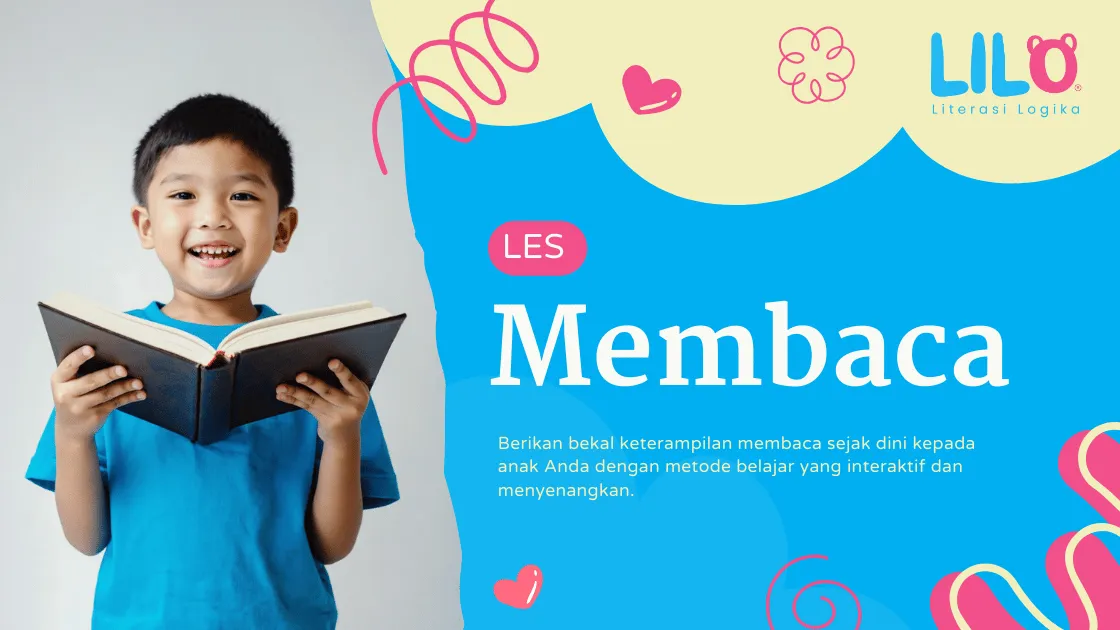
A seven-level reading curriculum using No-Spelling Phonics, walking your child from letter sounds all the way to understanding what they read. Private 1-on-1, in person or online, moving at your child's own pace.

4.9from 3,218 parent reviews
Guided by 5,000+ handpicked Lilo teachers
  • Learning from sounds, your child reads new words on their own
  • Steady level-by-level progress, a foundation with no gaps
  • Free consultation, online and in person
  • Seven levels, from letter sounds to understanding a passage
  • One teacher per child, moving at your child's pace
  • Sound cards and practice sheets from our own curriculum
Lilo learning illustration
7 LevelsStep-by-Step Curriculum
L0-L6Letters to Reading
PhonicsNo-Spelling Method
SASSentences and Meaning
Ages 3-10Prime Years for Reading
What It Is

What is Reading Classes?

Lilo reading lessons are one-to-one tutoring for children aged 4 to 10, at home or online, built on a seven-level phonics curriculum and Lilo's own 29 reading modules. Lilo matches and supervises the tutor, sends a weekly report and replaces tutors free of charge, with lessons from IDR 76,865 per session.

Reading classes are guided learning that helps children aged 3 to 10 learn to read, arranged across 7 levels. Your child begins with letter sounds, then blends syllables, reads sentences fluently, and finally understands what a passage means. Because they learn from the sounds, your child can read new words on their own while growing to love reading.

Learn each letter's sound first
Blend whole syllables without spelling out
Read sentences fluently
Understand a passage and retell it
Who Is This For

When Reading Lessons Become the Right Step for Your Child

Lilo places your child at the level that fits, from knowing letters to understanding a passage, then walks beside them one step at a time.

When Your Child Still Spells Out Each Word

Your child knows the letter names, yet still spells every word out one by one, c-a-t cat, which makes reading slow and tiring. Through the no-spelling phonics method, your child learns from letter sounds and reads whole syllables right away.

When Your Child Stumbles on the Final Letter

Your child reads open syllables fluently, yet stumbles on closing consonants, reading cat as ca or top as to. At Level 3, your child is trained to read the final letter with care through fast-reading sheets and similar-word pairs.

When Your Child Is Working Through Letter Blends

Your child stops progressing at ng, ny, tr, or ai, and starts to lose heart. This level truly is the hardest, so Lilo trains each pattern separately with dense practice and on-the-spot sound correction until your child gets through it with confidence.

When Your Child Reads Smoothly but Hasn't Grasped the Meaning

Your child sounds out word after word smoothly, yet looks puzzled when asked what the story was about. At Level 6, your child reads short passages, answers 5W questions, and retells them, until they truly understand what they read.

Classes

Reading Class Options

In Person

Private In-Person

60, 90, or 120 minutes

Contact us

  • Tutor comes to your home
  • Full focus, 1-on-1
  • Sound corrections right on the spot
In Person

Small Group Class

60, 90, or 120 minutes

Contact us

  • Learning alongside friends
  • More affordable
  • Motivating each other to read
Online

Private Online

60, 90, or 120 minutes

Contact us

  • Learning from home
  • Interactive sound cards
  • Flexible schedule
Levels

Seven Levels from Letter Sounds to Understanding a Passage

Seven reading levels in sequence. Your child moves up one level after truly mastering every sound pattern that level covers.

  1. Level 0: Letters and Sounds

    Age 4
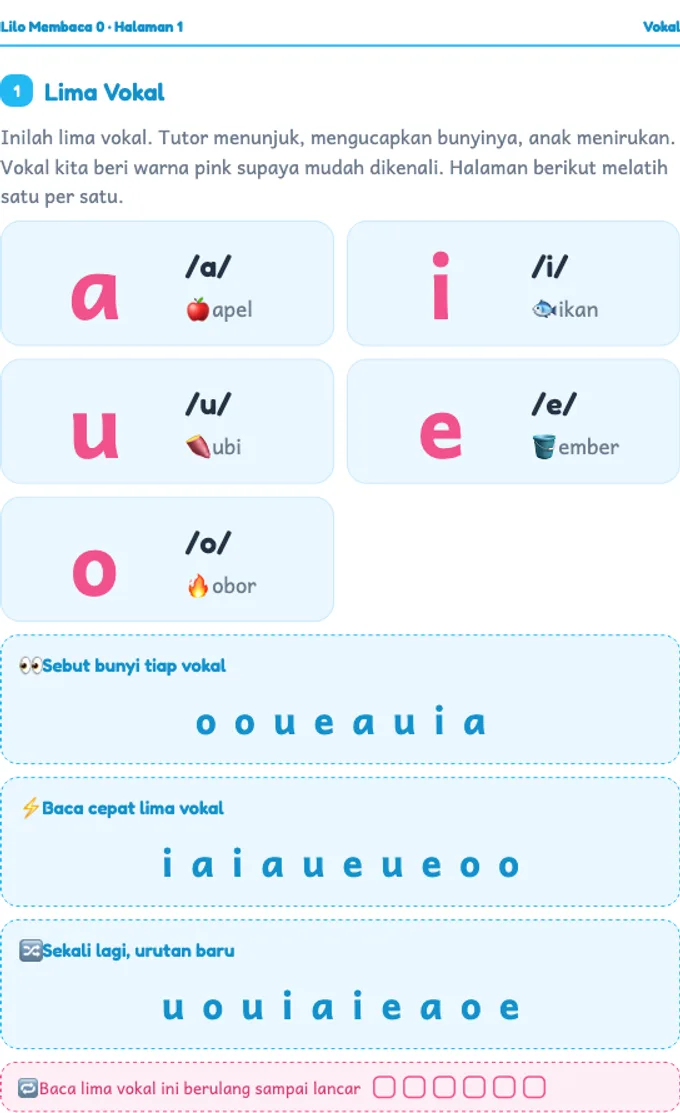
    • Sounds of the 5 vowels a i u e o
    • Common consonants: m b p t n s
    • Phonics through songs and cards
  2. Level 1: Open Syllables

    Ages 4-5
    • Joining sounds into syllables (ma, bi, tu)
    • Syllables into words: mama, mata, sapi
    • Reading whole words without spelling out
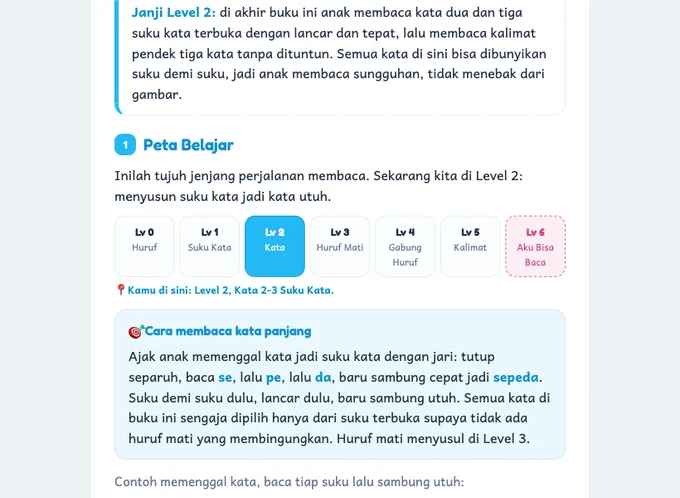
  3. Level 2: Words and Short Sentences

    Age 5
    • Adding consonants c h w y v z f
    • Two and three syllable words
    • Short three-word sentences
  4. Level 3: Closing Consonants

    Ages 5-6
    • Closed syllables CVC: cat, top
    • Reading the final letter carefully
    • Similar pairs: cap and cab
  5. Level 4: Letter Combinations

    Age 6
    • Digraphs ng ny kh sy
    • Consonant clusters tr kr st
    • Diphthongs ai au oi
  6. Level 5: Fluent Sentences

    Ages 6-7
    • Sentences of 4 to 10 words
    • Punctuation and intonation
    • The SAS method
  7. Level 6: I Can Read

    Ages 7-8
    • Reading short passages
    • 5W comprehension and main idea
    • Independent reading graduation
Seven Levels, 29 Modules

Level by Level: The Modules, the Sticking Points, and How to Get Past Them

29 modules across seven levels: which modules each level uses, where children usually get stuck, what the tutor does, and what you can do at home.

LevelModules usedSticking pointTutor's approachAt home
L0Letters and Soundsaround age 4Modules 1 to 4: the vowels a i u e o, consonants b c d g h, j k l m n, then p r s t w y.Your child gives the letter name ("em") when asked for the sound (/m/). Look-alike letters such as b, d and p get swapped.Sound cards, finger tracing and timed fast reading as a game, with look-alike letters introduced on different days.Play "I spy something that starts with /s/" around the house. Stick one letter on the fridge each week.
L1Open Syllablesages 4-5Modules 5 to 10: syllables ba-bi-bu, ca, da, through sa-si-su, ta, wa, ya, closing with fast reading of every syllable.The habit of spelling out "bee-ay ba, bee-oo bu" breaks words apart and your child forgets how they began.The tutor models the whole syllable, your child copies it while pointing. Two syllables join into real words: mama, bola, sapi.Write syllables on cards and play matching: ba + ju makes baju. Praise every word read whole.
L2Words and Short Sentencesaround age 5Modules 11 to 13: two-syllable words, three-syllable words, fast word reading.Your child reads the first syllable and guesses the rest from the picture, so "se..." becomes "sepatu" (shoe) when the word is "sepeda" (bicycle).The picture stays covered until the word is read to the last syllable, then uncovered to check. Texts use only patterns already taught.Read food names on menus or packets together. Let your child finish the word before you help.
L3Final Consonantsages 5-6Modules 14 to 17: final -n and -m, -r -s -t, -k -l -h -p, then closed words.The last letter drops away: "tas" becomes "ta", "botak" becomes "bota", the most common sticking point after open syllables.Word pairs are read side by side (bola and botak, pita and pintu). A finger covers the final letter, then lifts as it is sounded.Hunt for words ending in a consonant around the house: pintu, lampu, sendok. Ask your child to point to the last letter.
L4Letter Blendsaround age 6Modules 18 to 20: the blends ng and ny, vowel pairs ai au oi, clusters pr tr st bl."Nyanyi" is read as "n-yanyi", "truk" becomes "teruk", "pantai" gets cut short. This level asks for the most patience.Each pattern gets its own focused drills, spaced apart, and blends are voiced as one sound from the start.Sing songs full of ng and ny. Collect words with the same pattern on one card, such as bunga, dengan, pisang.
L5Fluent Sentencesages 6-7Modules 21 to 23: short sentences, punctuation and intonation, fluent reading.Your child reads word by word in a flat voice, or races past full stops and question marks.The SAS method breaks a sentence into words and syllables and builds it back up. The tutor models the intonation, your child copies it, then reads alone.Take turns reading, one sentence each. Show the different tone of a question and an exclamation.
L6I Can Readages 7-8Modules 24 to 29: comprehension of who, what and where, story order, main idea, conclusions, information texts, then I Am an Independent Reader.Your child reads fluently but cannot retell what the text was about.5W questions follow each paragraph, then your child retells in their own words. The level closes with the I Can Read graduation.After reading together, ask for a favourite part and why. Keep thin storybooks nearby that your child can finish alone.

Your child moves up a level once every sound pattern at that level is mastered. The current level is written in the weekly report.

Six-Month Targets

The Reading Journey, Month by Month

A picture for a 5 year old starting at Level 0 with two sessions a week. Children who know letter sounds usually start from month two, and 4 year olds follow the same path more gently.

  1. Month 1L0

    Every letter sound known

    Your child voices vowels and consonants from sound cards, tells first sounds apart, and traces letters with a finger.

  2. Month 2L1

    Syllables read whole

    Open syllables such as ma, bi and tu are read without spelling. Your child joins two syllables into a first real word.

  3. Month 3L2

    Two and three syllable words

    Words such as sapi, sepeda and boneka are read to the end. Your child reads three-word sentences from texts built for their level.

  4. Month 4L3

    No more dropped endings

    Closed words such as tas, pintu and lampu are read in full, and your child starts reading labels and signs around them unprompted.

  5. Month 5L4

    Letter blends mastered

    Your child reads ng, ny, ai, au and clusters such as tr and pr. Thin storybooks start to feel within reach.

  6. Month 6L5

    Fluent sentences with intonation

    Your child reads sentences of 4 to 10 words, pauses at full stops and lifts the voice for questions. The way to Level 6 and the I Can Read graduation opens.

Every child moves at their own speed, and a Lilo tutor holds your child at a level until they are ready. The weekly report shows where they are on this journey.

Method

Lilo's Step-by-Step Reading Method

Lilo's seven-level reading curriculum, Level 0 to Level 6, teaches your child through letter sounds. Each stage is mastered before the next, with steady levelled practice, from knowing letters to understanding a story.

  1. Letter Sounds First (Phonics)

    Your child learns each letter's sound, /m/, /a/, /t/, through songs, sound cards and playful games, starting with the vowels and the most common consonants.

  2. No-Spelling Syllable Blending

    The tutor models a whole syllable such as ma, bi or tu, and your child copies it, then reads it alone while pointing at the letters. Two syllables become a word: mama, mata, sapi.

  3. Climbing the Seven Levels in Order

    Letters at Level 0, then open syllables, words, closing consonants, letter combinations, sentences, and passages at Level 6. Your child moves up once a stage is truly mastered.

  4. Steady, Regular Practice

    Every level has its own practice sheets: random reading, timed reading as a game, fill in the letter, and matching similar words.

  5. Sentences with SAS, then Passage Comprehension

    At the sentence level the SAS method (Structural Analytic Synthetic) breaks a sentence into words and syllables, then rebuilds it with the right intonation. The final level adds 5W questions and retelling, closing with the I Can Read graduation.

Lilo Expertise

Reading from Letter Sounds, Your Child Can Work Out New Words on Their Own

Lilo's reading expertise rests on phonics straight from letter sounds: your child turns sounds into words, then climbs seven levels to full comprehension.

A child who masters the sounds inside words can read a word never seen before, assembling it from sounds already known.

Phonics Through Letter Sounds

Your child learns each letter's sound, /m/, /a/, /t/, and reads it straight away, which lets them work out new words on their own.

Blending Whole Syllables

Syllables are read whole, ma, bi, tu, and two of them join into a word like mama or sapi, so reading flows without spelling out.

Texts Your Child Can Read Alone

Every word in the reading material uses only the patterns already taught. Your child succeeds in reading from the very first day, then moves up with confidence.

Extra Care at Letter Combinations

Combinations like ng, ny, tr and ai are where many children get stuck. Lilo trains each pattern separately with dense practice and on-the-spot sound correction.

The Real Curriculum Stages
  1. L0Letter Sounds
  2. L1Open Syllables
  3. L2Words
  4. L3Closing Consonants
  5. L4Letter Combinations
  6. L5Sentences
  7. L6Passages

Your child moves up after truly mastering each stage, so the reading foundation has no gaps.

Common Mistakes

Reading Struggles That Often Show Up and How Lilo Phonics Solves Them

Here are the four reading struggles children run into most often, along with how Lilo's seven-level phonics curriculum guides your child through each one.

Your child memorizes word shapes and guesses from the picture, then freezes the moment a new word appears.

Why it happensA child who does not yet know the sounds that build a word can only lean on shape memory. Every word becomes a fresh thing to memorize, and the list of words to remember piles up with no key to work them out alone.

How Lilo helpsAt Level 0 your child learns each letter's sound, /m/, /a/, /t/, with sound cards and songs, then at Level 1 blends them into whole syllables. Because they read from the sounds, your child can work out a word they have never seen on their own.

Your child spells out the letter names first, em-bee-ay, then gets confused trying to join them into a word.

Why it happensLetter names (em, bee, ay) differ from their sounds (/m/, /b/, /a/), so spelling the names actually cuts off the path to the word's sound. Your child slows down on every word and loses their reading rhythm.

How Lilo helpsLilo's No-Spelling Phonics method skips the step of memorizing letter names. The tutor models a whole syllable like ma, bi, tu, your child copies it and reads it alone while pointing at the letters, so the slow habit of spelling out is cleared away from the start.

Your child drops the letter at the end of a word, reading cat as ca, and mixes up cap with cab.

Why it happensClosed syllables that end in a consonant ask your child to read carefully all the way to the last letter. A child used to open syllables tends to stop at the vowel, and similar-looking word pairs then trip them up.

How Lilo helpsLevel 3 trains closed syllables CVC like cat and top specifically, with fast-reading sheets and similar-pair drills such as cap and cab. The tutor corrects any wrong sound right on the spot, so your child gets used to reading the final letter with care.

Your child reads aloud fluently, yet cannot answer what the story was about.

Why it happensWorking out sounds and understanding meaning are two different skills. When all of your child's effort goes into sounding out words, there is little room left to take in the meaning, so fluent reading does not always come with comprehension.

How Lilo helpsAt Level 5 the SAS method breaks a sentence down and rebuilds it whole with intonation, so reading feels light. At Level 6 your child answers 5W questions and retells the passage, so fluency and comprehension grow together up to the I Can Read graduation.

Curriculum

Inside the Reading Curriculum, from Sound Cards to Passages

Modul 1

Phonics and Sound Awareness

The foundation of reading: your child learns each letter's sound and notices the sounds that build a word, the key to working out new words on their own.

  • Vowel sounds
  • Consonant sounds
  • Sound cards and letter tracing
Modul 2

Syllable Blending

Joining sounds into open syllables and then into meaningful words with the no-spelling method that speeds up your child's fluency.

  • Open syllables CV
  • Two and three syllable words
  • Timed fast reading
Modul 3

Closing Consonants and Letter Combinations

The hardest stage: closed syllables, digraphs, consonant clusters, and diphthongs, where many children need extra support to get through.

  • Closed syllables CVC
  • Digraphs and consonant clusters
  • Diphthongs
Modul 4

Sentence Fluency

Your child reads whole sentences with the SAS method, following punctuation and the right intonation.

  • Sentences of 4 to 10 words
  • Punctuation and intonation
  • Reading with rhythm
Modul 5

Passage Comprehension

The final stage of reading: understanding a passage, answering 5W questions, finding the main idea, and retelling the story.

  • Short themed stories
  • 5W questions
  • Main idea and retell
Sample Material

Real Worksheets from the Lilo Curriculum

A real curriculum arranged level by level, neat and complete. Here are actual practice sheets from several reading levels.

Level 0

Letter Sound Cards

Cuplikan worksheet asli Letter Sound Cards
Real sheet
/a/a/i/i/u/u/e/e/o/o/m/m/b/b/s/s

Five vowels with their sounds plus fast reading. Your child learns each letter's sound, /a/ and /m/, before its name. This is the heart of the phonics method.

Level 1

Build a Syllable

Cuplikan worksheet asli Build a Syllable
Real sheet
  • ma+mamama
  • bo+labola
  • sa+pisapi
  • ro+tiroti

The seven-level map and how to break a word into syllables. The tutor models the whole syllable, your child joins them into a meaningful word without spelling out.

Level 3

Fast Reading Sheet

Cuplikan worksheet asli Fast Reading Sheet
Real sheet
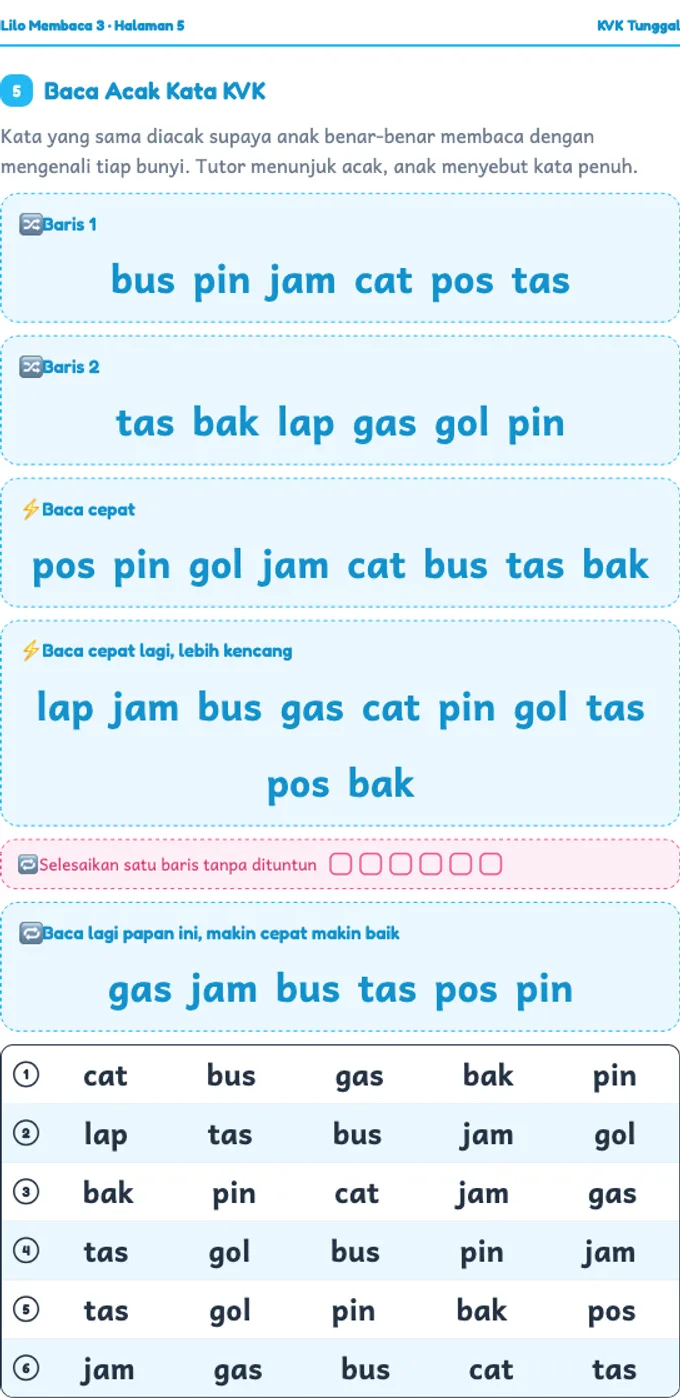
1tas2pos3jam4bus5pintu6lampu7kasur8sabun9motor10botak11batuk12pita

Random word reading and fast reading. Steady, regular practice with timed reading as a game trains your child to read the final letter of a word with care.

Level 6

Passage and 5W Comprehension

Cuplikan worksheet asli Passage and 5W Comprehension
Real sheet

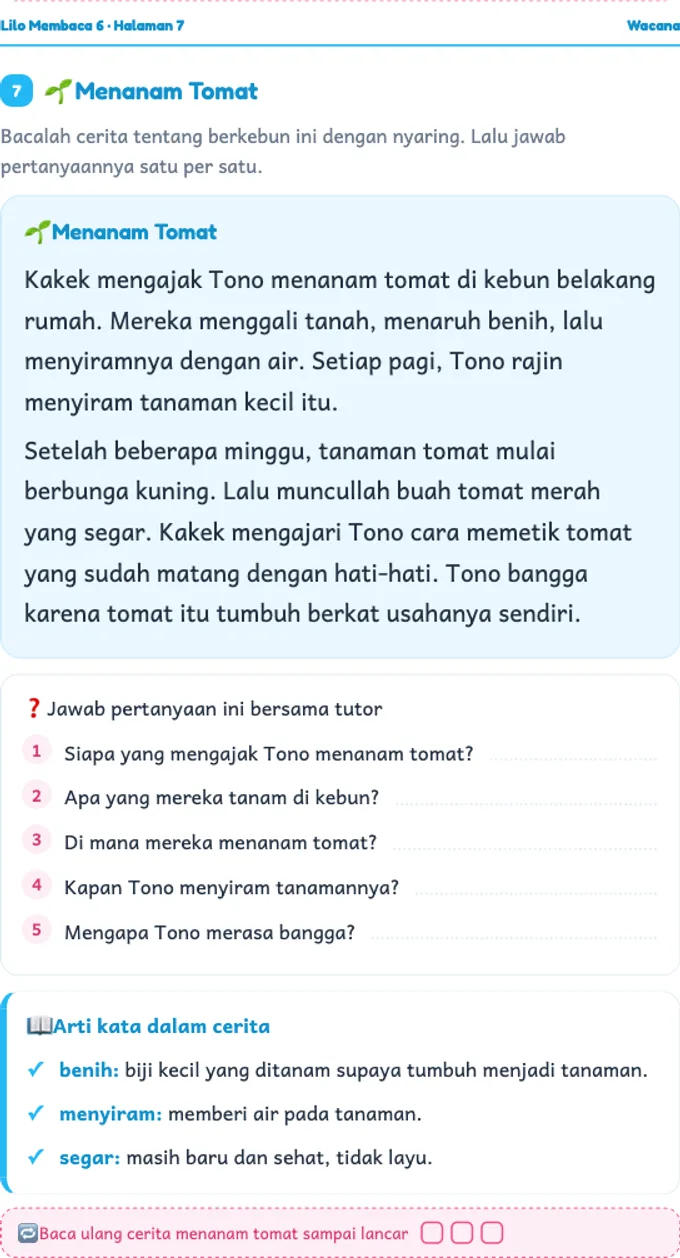
Grandma's Garden

That morning Tono went to the garden with Grandma. Grandma planted spinach and tomatoes. Tono watered the plants. They garden every Sunday. Tono is happy because Grandma's garden is thriving.

  1. Who went to the garden?
  2. What did Grandma plant?
  3. Where did they garden?
  4. When did they garden?
  5. Why does Tono feel happy?

One of 18 short stories with its questions and word meanings. Your child reads the passage then answers 5W questions, building comprehension until they can retell it.

Level 1

Themed Two-Syllable Words

Cuplikan worksheet asli Themed Two-Syllable Words
Real sheet

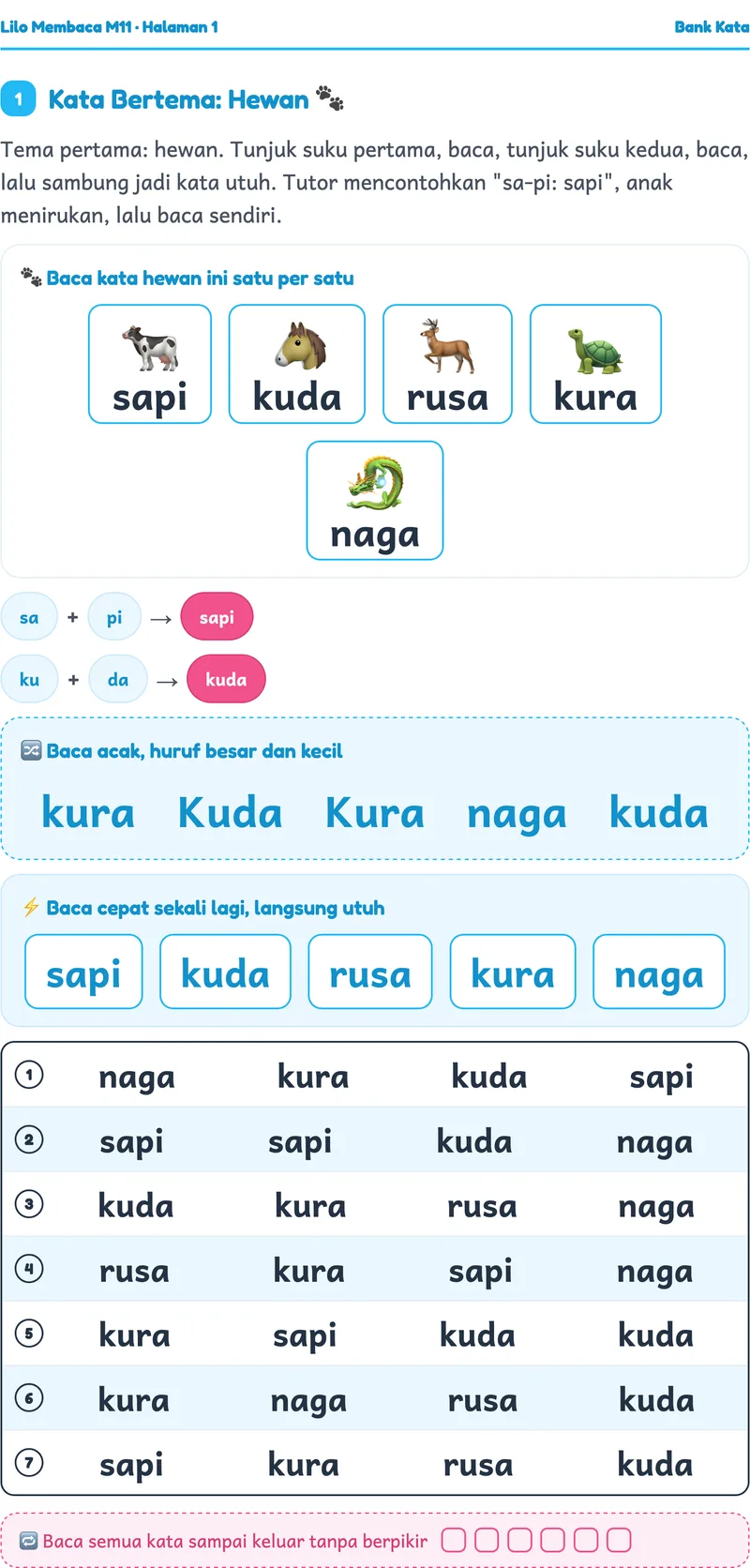
A real page from module 11: your child points at each syllable, reads it, then blends it into a whole word. A fast-read round makes the words come out smoothly.

Level 4

ng and ny Letter Combinations

Cuplikan worksheet asli ng and ny Letter Combinations
Real sheet

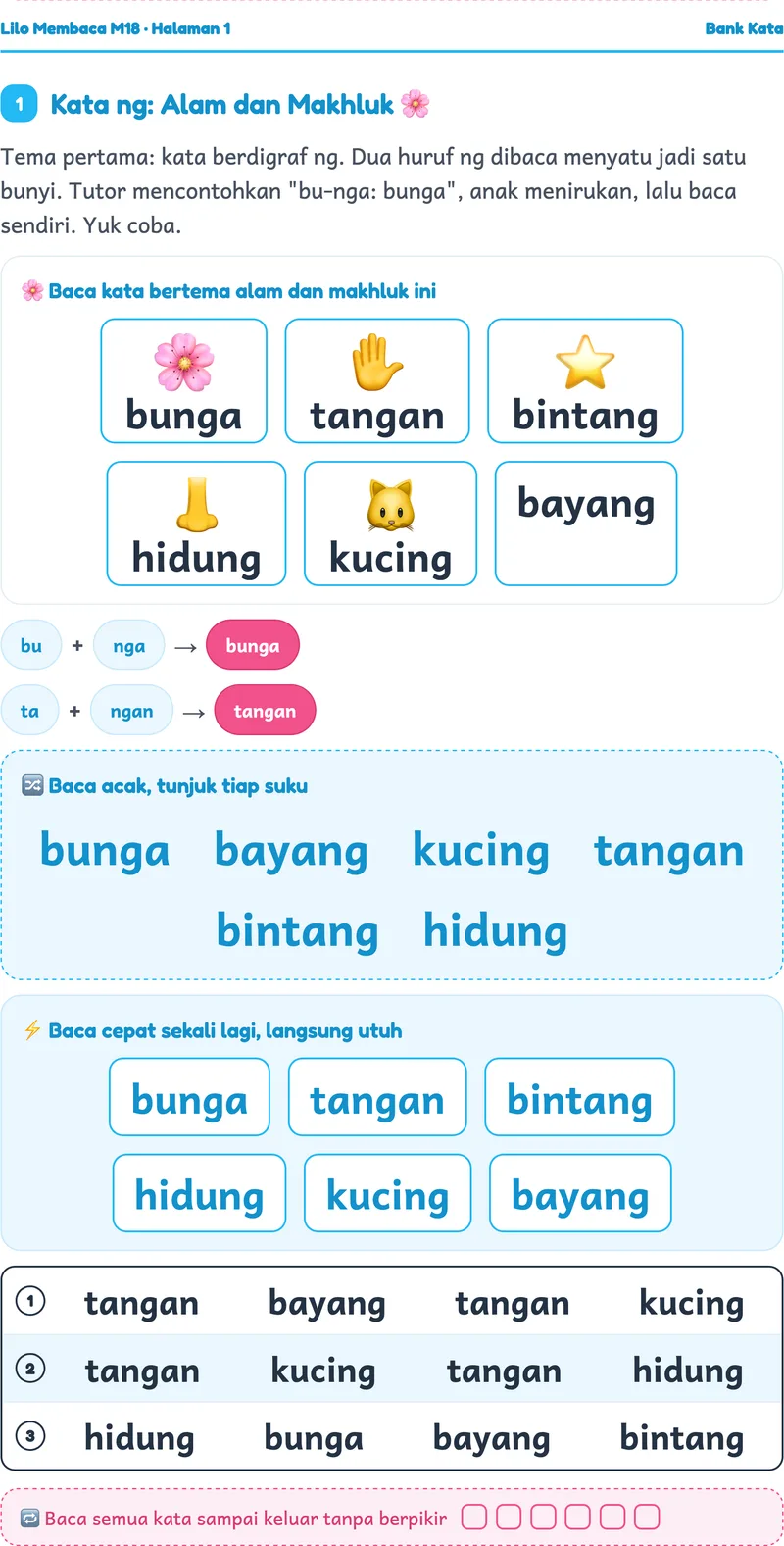
A real page from module 18: words with the ng and ny combinations, the stage where most children get stuck. Lilo gives extra care right here.

Level 5

Punctuation and Intonation

Cuplikan worksheet asli Punctuation and Intonation
Real sheet

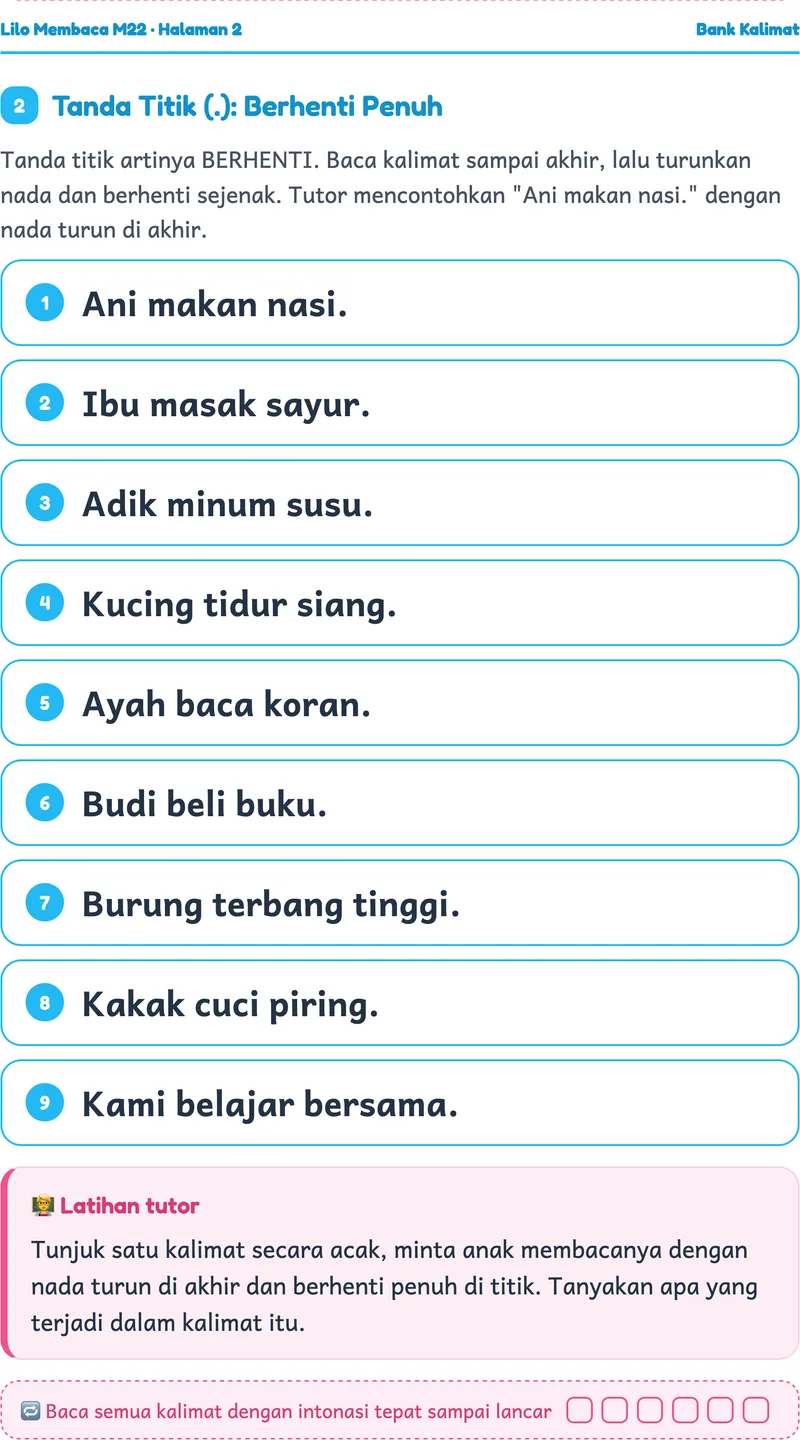
A real page from module 22: your child practices a full stop at each period and reads sentences with lively intonation, the bridge to fluent reading.

Level 6

Story Sequencing

Cuplikan worksheet asli Story Sequencing
Real sheet

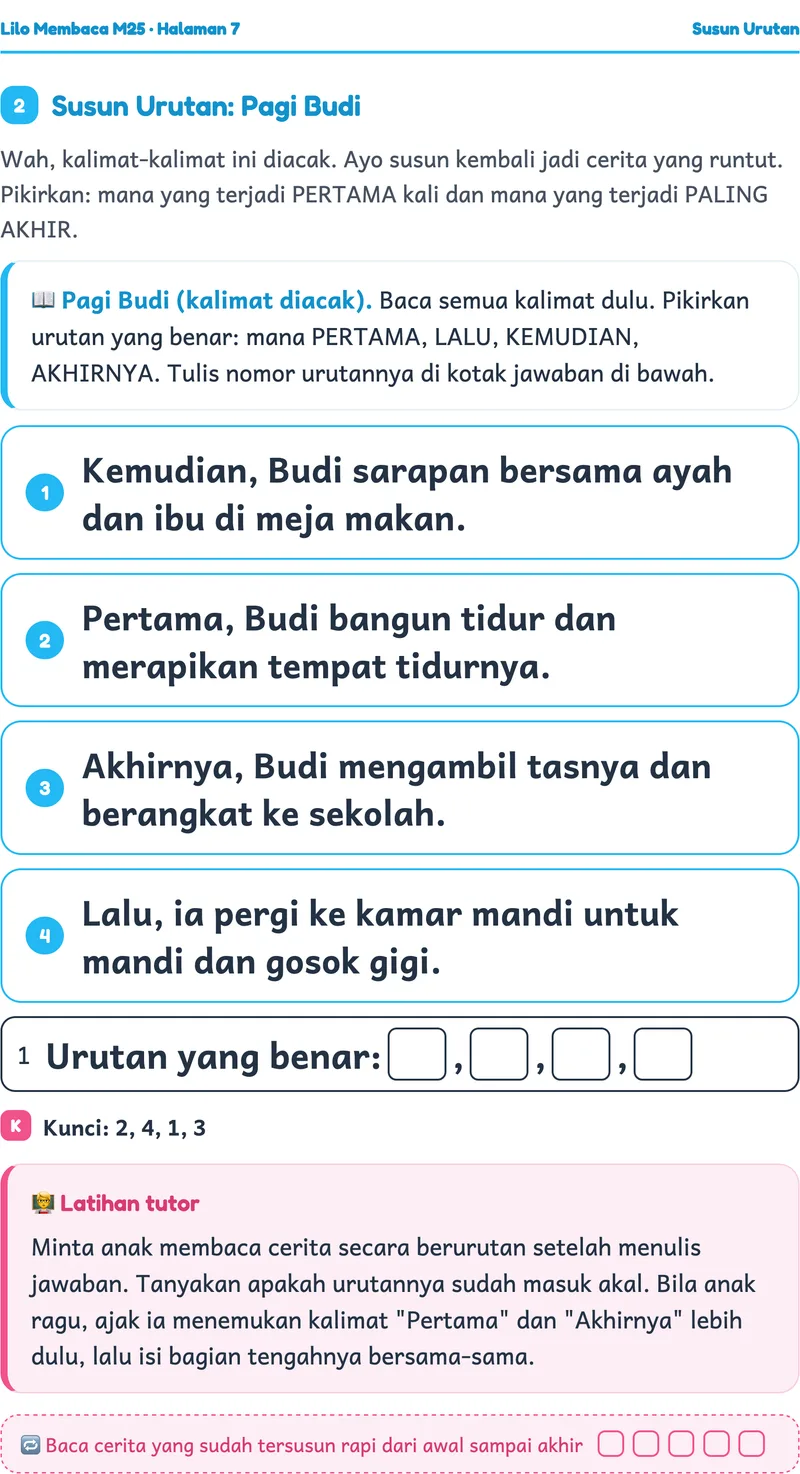
A real page from module 25: your child puts the events of a short story in order, training real comprehension before the independent reading graduation.

Samples from Lilo's original curriculum. The full A5 materials are prepared by the tutor at each session.

Child Readiness

Signs Your Child Is Ready to Learn Reading

Every child has their own rhythm, and that is perfectly normal. This list helps you recognize the stage your child is at right now, so your support fits just right. Lilo places your child at the level that suits them and follows their pace.

Early Stage (Age 4)

  • Enjoys being read story books
  • Curious about the letters around them
  • Recognizes the letters in their own name
  • Can copy simple sounds

Developing Stage (Ages 5-6)

  • Knows most letter sounds
  • Starting to blend open syllables
  • Reads short words with help
  • Asks the meaning of new words they meet

Ready-for-School Stage (Ages 6-8)

  • Reads sentences fluently
  • Reads closing consonants and letter combinations
  • Understands the content of a short passage
  • Reads comfortably for 20 minutes
Tutor

Lilo's Phonics Reading Guides

Verified tutors trained in our reading, writing, counting, and finger-math methods for young children.

Jihan D.Medan

Guides young children through reading, writing, counting, and jarimatika in small, cheerful steps.

  • Reading
  • Sempoa Abacus
  • Counting
  • Literacy and Numeracy
  • School Readiness
  • Writing
  • Jarimatika
Mutiara S.Medan

Takes children from letter sounds to fluent reading through small, enjoyable steps.

  • Sempoa Abacus
  • Counting
  • Reading
  • Literacy and Numeracy
  • School Readiness
Nanda R.Sleman

Carries children from letter sounds to fluent reading with friendly, regular practice.

  • Reading
  • School Readiness
  • Writing
  • Literacy and Numeracy
  • Counting
Tri W.Surakarta

Warmly guides children from letter sounds to fluent reading in a comfortable classroom.

  • Reading
  • Literacy and Numeracy
  • School Readiness
  • Writing
Ahmad R.Sleman

Takes children from letter sounds to fluent reading, then adds neat handwriting and counting.

  • Reading
  • Literacy and Numeracy
  • Writing
  • Counting
Gareth N.Pekanbaru

Patiently carries children from letter sounds to fluent reading with a gentle, structured approach.

  • Reading
  • Literacy and Numeracy
  • School Readiness
  • Writing
Lilo Tutors

Who Teaches Your Child

5,000+ selected tutors for young readers, at home or online.

  • 5,000+ selected tutors across Indonesia
  • 250+ tutors from Primary Teacher Education (PGSD)
  • 200+ tutors from Mathematics
  • 200+ tutors from Psychology

Tutor academic backgrounds

  • Islamic Primary Teacher Education (PGMI)
  • Mathematics
  • Early Childhood Teacher Education (PG-PAUD)
  • Special Education
  • Psychology
  • Guidance and Counselling
  • Primary Teacher Education (PGSD)
  • Indonesian Language and Literature

Graduates and active students.

Campuses most of our tutors come from

  • UIN Sunan Kalijaga
  • Universitas Negeri Yogyakarta
  • Universitas Gadjah Mada
  • Universitas Pendidikan Indonesia
  • Universitas Negeri Malang
  • Universitas Negeri Surabaya
  • Universitas Negeri Semarang
  • Universitas Diponegoro

How We Select Tutors

  1. Every application reviewed

    Our team reads every application.

  2. Identity and degree checked

    Diploma and ID are reviewed.

  3. Experience and hours recorded

    Teaching experience and hours are recorded.

  4. Trained in the Lilo method

    Phonics and CPA come first.

  5. Chosen for your child

    The team scores every answer.

You review the tutor profile before the first session.

Want a different tutor? Free tutor replacement, here is how

Reading and School Entry

Must My Child Read Before Primary School? Here Is What the Rules Say

The admission regulation in force since February 2025 answers this directly: reading is not tested at grade 1 registration, and age is what counts. Quotations are our English translations of the Indonesian text.

  1. No reading test when registering for grade 1

    Grade 1 applicants “are not required to take a test of reading, writing, counting and/or any other form of test”.

    Ministerial Regulation No. 3 of 2025 on the New Student Admission System, Article 11(5)

  2. What selection uses: age

    Grade 1 selection “is based on the age requirements”. The main age is 7 on 1 July of the admission year, children aged at least 6 may apply, and children aged 7 and above come first. When the residence-track quota is full, the order is age, then distance from home to school.

    Ministerial Regulation No. 3 of 2025, Article 11(1), (2), (4); Article 42; Article 43(1)

  3. Starting early, at 5 years and 6 months

    This exception is only for children with exceptional intelligence and/or talent and psychological readiness, shown by a written recommendation from a professional psychologist, or from the school's board of teachers where no psychologist is available. Early reading is not listed as a condition.

    Ministerial Regulation No. 3 of 2025, Article 11(3), (6), (7)

  4. From preschool to primary school with no reading test

    Director General Circular No. 0759/C/HK.04.01/2023 on strengthening the transition from early childhood education to the early grades underpins the national transition movement. According to the Directorate of Primary Schools, one of its targets is removing reading, writing and counting tests from new student admissions.

    Directorate of Primary Schools, 31 January 2024

What this means for a child learning to read

Your child does not need to chase a reading target to pass registration. The time you have can go into the right foundation: letter sounds, whole syllables, then words and sentences, without rushing and without the spelling-out habit.

In grade 1 your child reads instructions, textbooks and the whiteboard every day. A child at Level 2 or 3 of the Lilo curriculum, reading words and short sentences, follows lessons comfortably and dares to try new words.

Comparison

Lilo Reading Classes Compared to Other Ways

What matters most is how your child works out a word: from letter sounds, reading on their own, or by slow spelling of letter names. This table shows where each path leads.

AspekLiloLearning at Home AloneLearning Apps
Learning orderSeven levels in order and measuredTrial and error with no clear mapFollowing the app's module flow
Sound approachNo-spelling phonics led by a tutorOften slips back to spelling letter namesLimited audio with no correction
Sound correctionCorrected on the spot when wrongMistakes often slip byCannot recognize your child's sounds
PersonalizationMatched to each child's readinessDepends on the parent's free timeOne set of material for everyone
Child's motivationKept up through interaction and Achievement CardsEasy to get bored and give upDepends on interest in a screen
Progress reportsA weekly report to parentsNot structuredLimited to a score inside the app
Best fit whenYour child needs sounds corrected on the spot by a tutor and you want a measured seven-level pathYou have regular time every day and your child is already blending syllablesYou want short extra practice alongside a tutor or a parent
Pricing

Kids Reading Classes Tuition

A session runs 60, 90, or 120 minutes. The prices above are for 60 minute sessions, and longer sessions are priced accordingly. Lessons happen at your home or online. Larger packages cost less per session.

Each session works out to IDR 76,865 for online or private in-home sessions. Payment is made per package.

Lilo Guarantee

What Every Package Includes

Included in every lesson package.

  1. Free tutor replacement

    Just tell us, any time.

    The steps:

    1. Message the official Lilo WhatsApp.
    2. Say what is not working.
    3. The replacement costs nothing extra.
    Ask for a new tutor: WhatsApp +62 823-1341-9308
  2. Tutor notes after every session

    Plus a monthly progress report.

Reviews

Stories from Parents Whose Children Now Read Fluently

4.9From 3,218 parent reviews
Keira now loves pointing at shop signs and sounding them out slowly. Her tutor is so patient, and there is a report after every session so I always know how far along she is.
Keira's MomParent of a Reading Student
After classes here my child can now read fluently thanks to patient and professional guidance, and their confidence has grown too.
Mrs. NurhayatiParent of Adrian
Kinan has started reading short stories on his own. He often refuses to stop at one page and keeps asking to continue until the story is finished.
Kinan B.'s DadParent of a Reading Student
Nadhira is getting fluent at sounding out syllables. What puts me at ease is that the lessons go step by step without pushing her. She actually looks forward to her lesson every week.
Nadhira Z.'s DadParent of a Reading Student
Lilo Reading Classes made such a difference for my child. The method really works, and their reading has come on so much. We're so happy with it.
Mr. YusranFather of Mursanah
FAQ

Parent Questions About Learning to Read

My child is 6 and not reading fluently. Should I worry?
Not yet. Many 6 year olds are still reading syllables and short words. What matters is the foundation: knowing each letter sound and blending syllables without spelling them out. A Lilo tutor checks this in the first session and places your child at the right level, where children this age usually move quickly.
My child knows the letter names but cannot read words. What is missing?
Usually the bridge from letter names to letter sounds. Reading uses sounds: /s/ and /a/ make "sa", while the names "ess" and "ay" never produce "sa". Lilo teaches the sound of every letter at Level 0, then whole syllables at Level 1.
My child swaps b and d when reading. Is it dyslexia?
Swapping b and d is normal until about age 7, while children learn that a letter's direction changes its sound. A Lilo tutor introduces the two letters on different days and practises their stroke direction. If the swaps stay frequent after age 7 despite regular practice, see a psychologist or developmental paediatrician, and the tutor keeps supporting your child alongside that assessment.
My child is in grade 2 and still spells words out. Can they catch up?
Yes. These children usually know their letters and have not yet learned to read whole syllables. A Lilo tutor often places them straight into Level 1 or 2, trains whole syllables with timed fast reading, then moves on to final consonants and blends. With the basics already there, progress shows within weeks.
At what age can my child start reading lessons at Lilo?
From around 4, at Level 0, which introduces letter sounds through songs and cards. Children who already know their letters are placed higher after a friendly first session. Lilo reading lessons run up to age 10.
What is the no-spelling phonics method Lilo uses?
Your child learns the sound of each letter first, /m/ and /a/, then joins them straight into the whole syllable "ma". Reading comes from the sounds, so your child can decode words they have never seen. Indonesian is written almost exactly as it is spoken, which makes this approach work very well.
My child gets stuck on blends like ng and tr. Why?
The blends level is the most demanding: two letters must be read as one sound, or two consonants spoken back to back. Lilo drills each pattern separately in Modules 18 to 20, with focused practice and on-the-spot sound correction, until the pattern feels easy.
How long until my child reads fluently?
A 5 year old starting from zero with two sessions a week usually reads two-syllable words by month three and fluent sentences by month six. Level 6, comprehension and the I Can Read graduation, comes after that, as shown in the Six-Month Targets section.
How many reading sessions a week are ideal?
Two a week suits most children: the Regular package, 8 sessions a month. Children who are behind in grade 1 or 2 often take three a week for a month or two, then return to two. Ten minutes of reading at home on lesson-free days keeps the sounds fresh.
We speak English or a regional language at home. Will my child be late reading Indonesian?
Children who grow up with two languages learn to read Indonesian well. They need extra vocabulary, and the letter sounds need to be told apart from those of the other language. A Lilo tutor marks the sounds that differ, such as c and e, and adds everyday words in each session.
How is the tutor chosen, and can we change?
Lilo tutors pass selection and a background check, then train in Lilo phonics. We match the tutor to your child's age, level, schedule and location, and send you the profile before the first session. You can change tutors any time at no cost, and the new tutor continues from your child's progress notes.
What if my child gets bored easily while learning to read?
Tutors keep children engaged with games, songs, timed fast reading and an Achievement Card at every level. Texts use only patterns already taught, so your child succeeds from the start and stays motivated.
Why Lilo

Why Choose Reading Classes at Lilo?

A Seven-Level Reading Curriculum

Level 0 to Level 6, from letter sounds to passage comprehension, one mastered stage at a time.

No-Spelling Phonics Method

Letter sounds and whole syllables let your child read new words alone, free from slow spelling out.

Decodable Texts, Step by Step

Every word uses only patterns already taught, so your child succeeds from the very first day.

Steady, Regular Practice

Timed reading games on regular, levelled sheets build fluency step by step.

Personal 1-on-1 Guidance

The tutor matches the material and pace to each child's readiness, and corrects any mistaken sound right on the spot.

Reports and Achievement Cards

A weekly progress report, an Achievement Card at every level, and an I Can Read graduation.

Lilo mascot cheering your child on

Let's Help Your Child Read on Their Own in Indonesia

Tell us how far your child has come with letters, and the Lilo team will place them at the right phonics level so they can soon read new words on their own. Free WhatsApp consultation, in person or online.

Ask us anything on WhatsApp first, the consultation is free.

Sign Up