Reading, Writing and Counting in Indonesia, A Confident Start to School
Learn reading, writing, and counting in a way that feels fun. We offer private classes, small group classes, and online classes, all following your child's own pace.
Lilo is one-to-one reading, writing and counting tutoring for children aged 3 to 8, with a tutor who comes to your home or teaches online. Lilo manages everything: tutor matching, scheduling, a weekly report and free tutor replacement. Your child learns from Lilo's own curriculum of 122 leveled modules, from IDR 76,865 per session.
Reading, writing and counting are the first skills children ages 3 to 10 build before and during their early school years. With these in place, your child's first day of school feels happy and full of confidence.
Recognizing and blending letters
Writing correctly
Basic counting
Understanding simple reading
Who Is This For
When Reading, Writing and Counting Help Your Child Most
Lilo's reading, writing and counting follows your child's own pace, from those just meeting their letters to those about to start school.
When Your Child Is Getting to Know Letters and Numbers
Your child is starting to enjoy picture books and points to a few letters from their name, yet cannot read or count yet. Lilo begins with objects they can hold and the sounds of letters, so their first step feels happy.
When Your Child Is Getting Ready for School Next Year
Your child will start primary school soon and you want their first day to feel light. Lilo builds reading, writing, and counting step by step, so they arrive at school calm and confident.
When Your Child Knows Letters and Is Learning to Blend Them
Your child knows their letters A to Z, yet still gets stuck putting them together into syllables like ba, bu, or ma. Lilo trains letter sounds one step at a time until they can blend them into words with ease.
When Your Child Reads Well and Is Warming Up to Counting
Your child can start to read words, yet goes quiet and unsure when asked to add or subtract. Lilo guides them through counting with real objects and Bar Models, so they understand numbers from their own experience.
Classes
The Class Options We Offer
In Person
Private In-Person
60, 90, or 120 minutes
Contact us
Tutor comes to your home
Full 1-on-1 focus
Material matched to your child's needs
In Person
Group Class
60, 90, or 120 minutes
Contact us
Learn together with friends
More affordable
Builds self-confidence
Online
Private Online
60, 90, or 120 minutes
Contact us
Learn from home
Interactive and fun
Session recording available
Levels
Four Stages, from Knowing Letters at Age 3 to Reading Fluently at Age 8
Four stages for children aged 3 to 8. Your child steps up once the current stage feels easy, following their own readiness.
1
Introduction Level
3-4 years
Recognizing letters A-Z
Recognizing numbers 1-10
Basic writing motor skills
2
Foundation Level
4-5 years
Blending syllables
Counting 1-20
Writing letters and numbers
3
Intermediate Level
5-6 years
Reading simple sentences
Addition and subtraction
Writing words
4
Advanced Level
6-8 years
Reading fluently and understanding passages
More advanced counting
Ready to start primary school with confidence
Stage Map
Lilo's Four Stages: What Your Child Learns, Where They Stumble, and How It Gets Fixed
Each stage draws modules from three Lilo curriculum tracks at once: Reading (Levels 0 to 6), Writing (L0 to L13) and Counting (L0 to L13). The letter codes in each row match the stage ladder on this page.
The vowel sounds a i u e o, then consonants (Reading Modules 1 to 4). Ready to Write: hand paths, grip, straight, slanted and round strokes. More and less, seeing 1 to 5 at a glance, counting 1 to 10.
Your child says the letter name "bee" when the sound is /b/. The pencil is held in a fist. The mouth counts faster than the finger pointing at objects.
Sound cards and letter tracing with short, clear sounds. Paths that grow narrower train the grip before the first letter. Each object slides across as it is counted, one object for one number.
Say the first sound of things at home: /s/ for spoon, /m/ for mat. Offer chunky crayons and play dough for finger strength. Count the spoons together when setting the table.
S · T · BFoundation Levelages 4-5 · Reading Level 1 · Writing L2-L4 · Counting L2-L4
Open syllables from ba-bi-bu to ya, then fast reading of every syllable (Modules 5 to 10). Straight-line capitals, lowercase letters, curved and diagonal capitals, digits 0 to 9. Writing numbers, 11 to 20 and up to 100, splitting numbers, number bonds to 10.
Your child spells out "bee-ay, ba" and forgets how the word began. b and d, and 3 and 5, face the wrong way. They can recite 1 to 20, then hesitate when asked "how many?".
The tutor models the whole syllable, and your child copies it and reads it alone without spelling. Every letter gets a starting dot and an arrow, and a, d, g, q are practised together as one family. Ten frames and buttons make quantities visible.
Play syllable spotting on shop signs. Write your child's name in the air with a finger, then in sand or flour. Split 10 marbles between two bowls and find every pair that works.
K · T · BIntermediate Levelages 5-6 · Reading Levels 2-3 · Writing L5-L6 · Counting L5-L7
Two and three syllable words, fast word reading, final consonants -n -m -r -s -t -k -l -h -p, closed words (Modules 11 to 17). Writing syllables, two and three syllable words, short sentences from pictures. Adding and subtracting within 5, 10 and 20, fact families, the make-ten strategy.
The last letter gets dropped, so "tas" (bag) is read as "ta". Words run together with no spaces. Your child gets stuck on 8 + 5.
The final letter is covered with a finger, then uncovered slowly as it is sounded. Look-alike word pairs are read side by side. A finger-width space marks each gap. 8 + 5 becomes 8 + 2 + 3 on a ten frame.
Read kitchen labels that end in a consonant. Ask your child to write a three-word shopping list. During play, ask "how many more to make ten?".
The blends ng and ny, the vowel pairs ai au oi, clusters pr tr st bl, short sentences, punctuation and intonation, then comprehension: who, what, where, story order, main idea (Modules 18 to 29). Neat handwriting, joined letters, full sentences with because, but, so. Tens and ones, two-digit adding and subtracting with carrying and borrowing.
Your child reads fluently, then goes quiet when asked to retell. "Twenty-three" is written as 203. Long sentences arrive with no full stop.
Who, what and where questions follow each paragraph. Tens and ones blocks come first, then the place value chart. Your child reads their own sentence aloud and hears where the breath stops.
Read a story, pause in the middle and ask what happens next. Count the change after a small purchase. Ask for one sentence about the day before bed.
Your child moves up once the current stage is truly mastered. The tutor records the stage in the weekly report, so you always know which row your child is on.
The First Six Months
What You Can Expect, Month by Month
This picture is for a 5 year old starting from zero with two sessions a week, the Regular package of 8 sessions a month. Younger children follow the same path at a gentler pace, and children who already know their letters usually join at month three.
Month 1
Letter sounds and a comfortable grip
The first session finds the starting point through play. By the end of the month your child voices the vowels and several consonants, draws straight lines and circles, and counts objects to 10.
Month 2
First syllables read aloud
Your child reads open syllables such as ba, mi and su without spelling them out, and writes straight-line capitals and the digits 0 to 9 following the arrows.
Month 3
Real words and their own name
Two-syllable words such as mama, bola and sapi are read whole. Your child writes their name neatly and finds the pairs that make 10 with buttons.
Month 4
Final consonants and three-word sentences
Closed words such as tas and pintu are read in full, then short three-word sentences. Adding and subtracting within 10 grows steady with the help of pictures.
Month 5
Writing words from pictures
Your child writes two and three syllable words from pictures, leaves a space between words, and adds up to 20 with the make-ten strategy.
Month 6
Reading a short story with understanding
Your child reads sentences with intonation, answers who, what and where about a short story, writes one sentence of their own, and solves word problems with objects. Grade 1 will feel familiar.
Every child has their own pace. A Lilo tutor holds your child at a stage until they are ready, and the weekly report shows where they are on this timeline.
Method
Lilo's Step-by-Step Reading, Writing and Counting Method
Reading begins with letter sounds, one step at a time, and counting starts with objects your child can hold before moving to numbers. This approach, used in Singapore, builds understanding that lasts.
1
A Warm First Hello
The tutor plays with your child while finding out which letters they know and how far they can count, then prepares material that fits. There is no scary test.
2
Start with Real Objects
Your child learns with things they can hold, like buttons or sticks, while hearing letter sounds, then meets numbers and how to write them, understanding from their own experience.
3
Climb One Step at a Time
Reading climbs from recognizing letters to reading short stories. Counting climbs from recognizing numbers to larger sums. Your child masters one step first, then moves on with confidence.
4
Practice Through Everyday Stories
Word problems are drawn as easy-to-see Bar Models, and your child reads words around them and counts with objects at home.
5
You Always Know How Your Child Is Doing
A weekly progress update shows what your child has mastered and what comes next, so you can cheer them on at home.
Reading, writing and counting are woven into one journey where each strengthens the others, step by step, until your child is ready and confident to start school.
When these three skills grow together, every gain on one side helps the others, so your child's foundation stands strong and whole.
Start with Real Objects First
Things to hold first, like buttons or sticks, then pictures, then numbers and letters: the Singapore way that makes understanding stick.
Reading Through Letter Sounds
Reading begins with recognizing the sound of each letter, then blending them into syllables and words. Your child reads with understanding from the very first step, until they can enjoy short stories.
Word Problems Through Bar Models
Word problems are drawn with easy-to-see Bar Models. Your child learns to break a big problem into small steps and find the answer on their own.
Friendly Regular Practice
Regular, levelled practice that stays warm and fun, with each step mastered before the next.
The Real Curriculum Stages
HRecognizing Letters
SBlending Syllables
KReading Words
TWriting Neatly
BBasic Counting
PReading Comprehension
Each child moves up a step when they are truly ready, so learning feels light and fun.
Common Mistakes
Reading, Writing and Counting Struggles, and How Lilo Solves Them
When your child learns reading, writing, and counting at once, a few habits often get in the way, and each one has a clear way out at Lilo.
Your child memorizes whole word shapes and spells out letter names (bee, ay, ba) before they can actually read.
Why it happensSpelling letter names piles up sounds that do not connect, so your child guesses words from pictures or memorizes how they look without truly reading.
How Lilo helpsLilo uses the sounds of letters, not their names. Your child climbs from stage H (recognizing letter sounds) to S (blending syllables), sounding words out directly and reading with understanding from the very first step.
Your child reads sentences aloud smoothly, yet looks puzzled when asked what the story was about.
Why it happensReading and understanding are two separate skills. When all of your child's effort goes into sounding out words, the meaning of the sentence slips away.
How Lilo helpsOnce your child is fluent at stage K (reading words), Lilo guides them to stage P (reading comprehension) through short stories and retelling questions. Your child reads while understanding, so they are ready to answer what they read.
Your child knows facts like 7 plus 5 by heart, yet panics and guesses the moment a word problem appears.
Why it happensMemorizing numbers does not teach your child to turn a sentence into a calculation, so they get confused about whether to add or subtract.
How Lilo helpsLilo draws word problems with the Singapore Bar Model. Your child sees the problem become a clear picture, breaks a big problem into small steps, and then finds the answer on their own.
Your child jumps to writing numbers and letters while their pencil grip is still stiff and their letters come out reversed.
Why it happensYour child's small hand muscles are not ready for complex shapes yet, so pushing them to write early makes the writing messy and they give up quickly.
How Lilo helpsLilo uses the Singapore way that starts from real objects. Your child practices lines and patterns first in the basic writing stage, then climbs to upright letters (stage T), so their hand grows strong before writing words neatly.
Curriculum
Reading, Writing, and Counting Your Child Works Through Step by Step
Modul 1
Reading
From recognizing letters and blending syllables, all the way to reading fluently and understanding what they read.
Letter recognition
Syllables
Reading sentences
Reading comprehension
Modul 2
Writing
Training your child's hand to write letters and numbers neatly, starting from simple line strokes.
Lines and patterns
Upright letters
Writing words
Writing sentences
Modul 3
Counting
Understanding the idea of numbers and basic operations in a fun way.
Recognizing numbers
Addition
Subtraction
Word problems
Modul 4
Character
Growing your child's focus, patience, independence, and self-confidence.
These sheets come straight from Lilo's original modules. Reading, writing, and counting are trained side by side, step by step at your child's level.
Introduction Level
Vowel Sounds
Real sheet
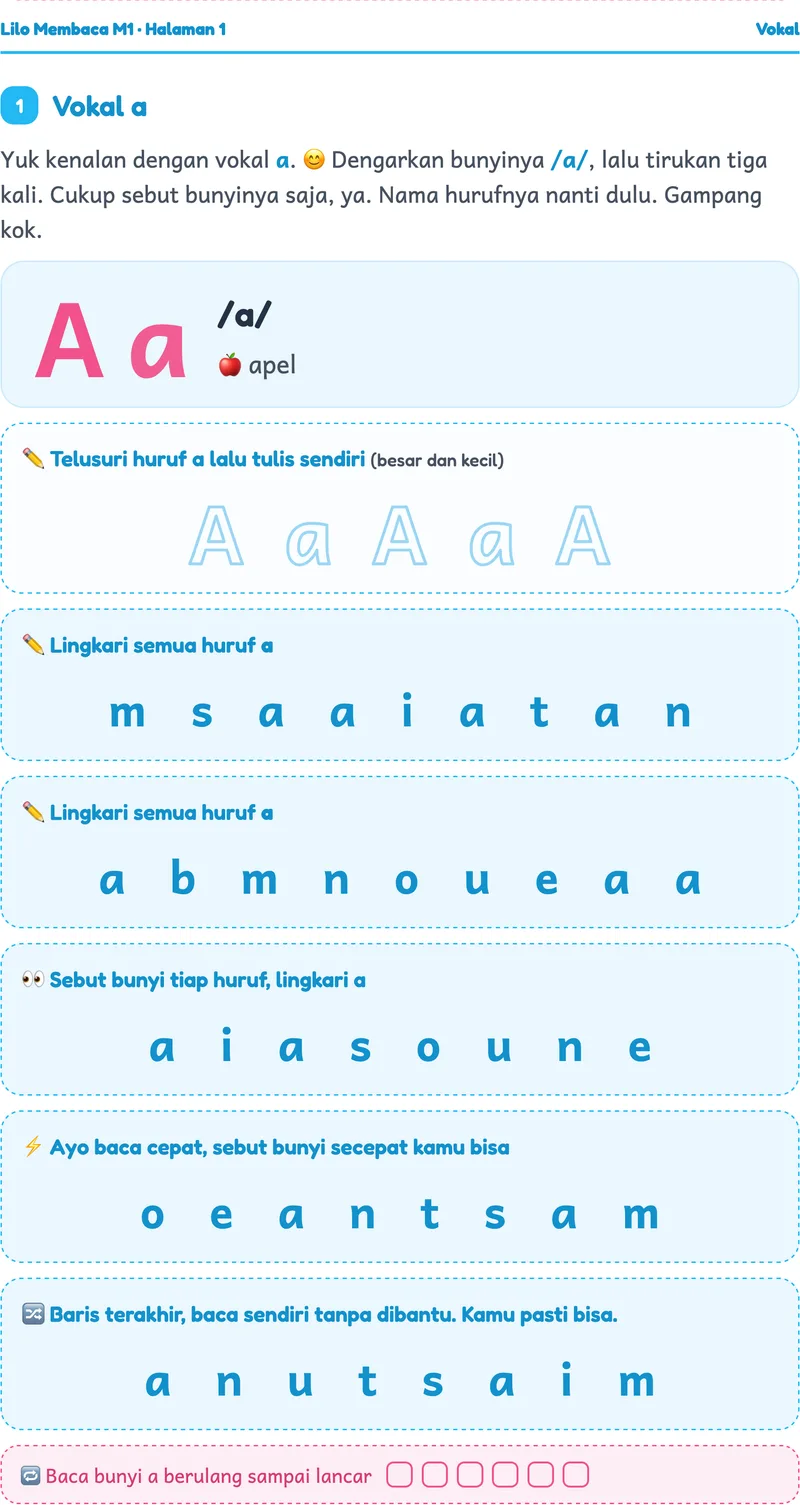
A real reading-module page: your child sounds out the vowel a with cards and point-and-read practice, the first door into reading.
Introduction Level
Straight and Flat Lines
Real sheet
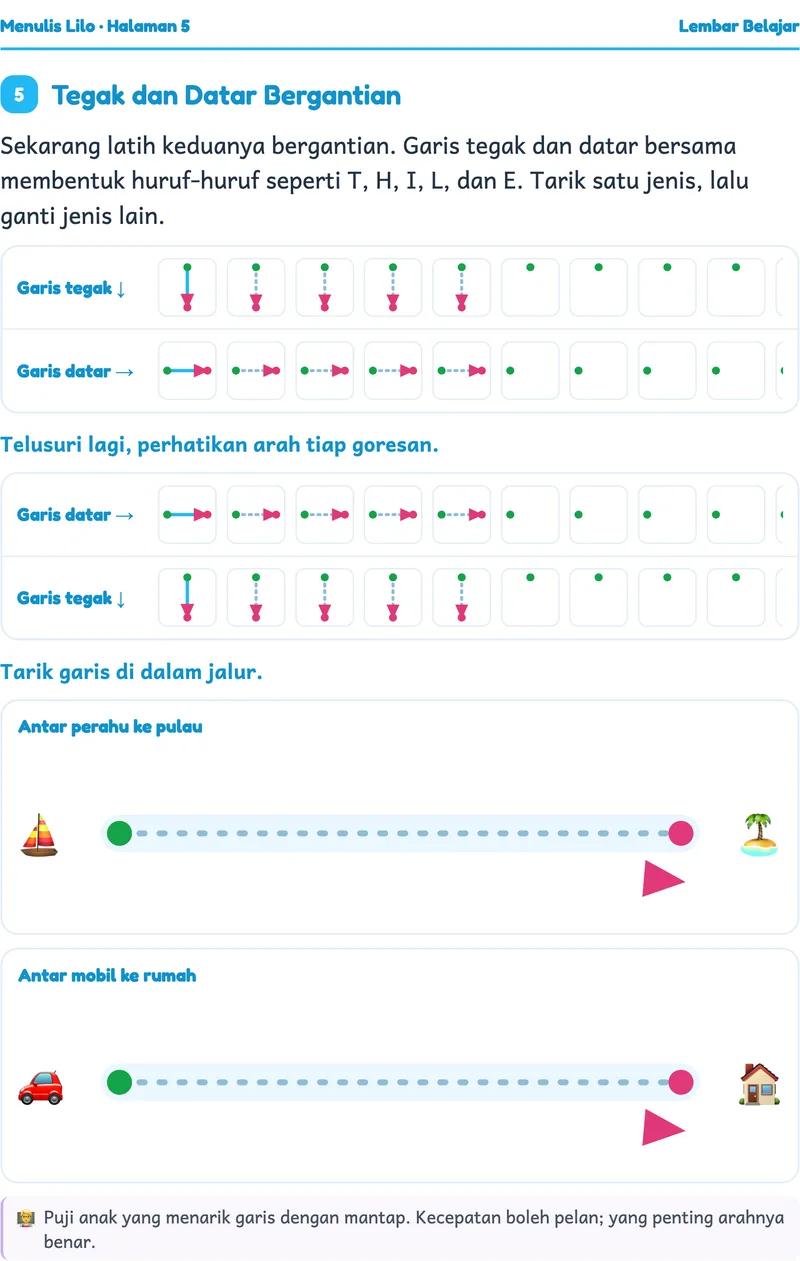
A real writing-module page: alternating straight and flat strokes train small hand muscles before the first letters.
Introduction Level
Counting 1 to 5
Real sheet
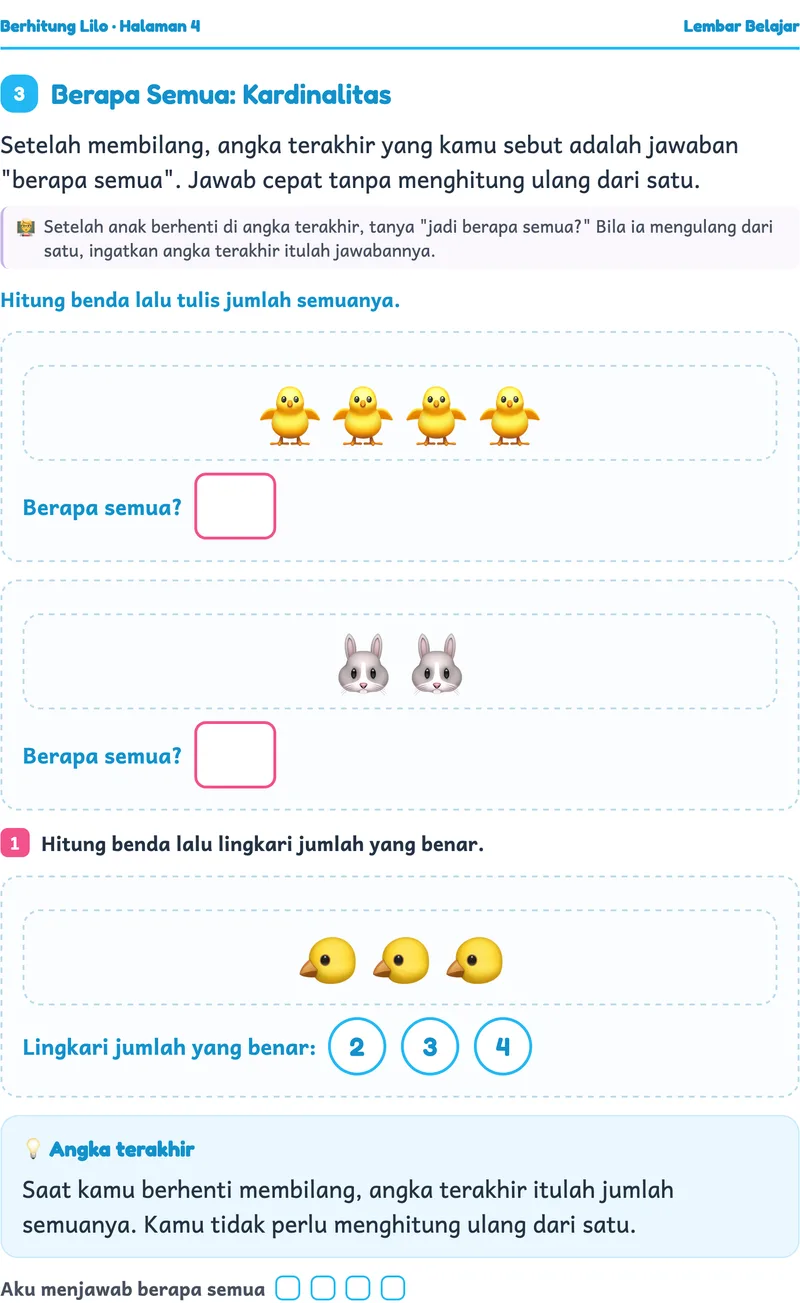
A real counting-module page: your child counts real objects one by one and names the total, a solid, concrete feel for numbers from the very start.
Foundation Level
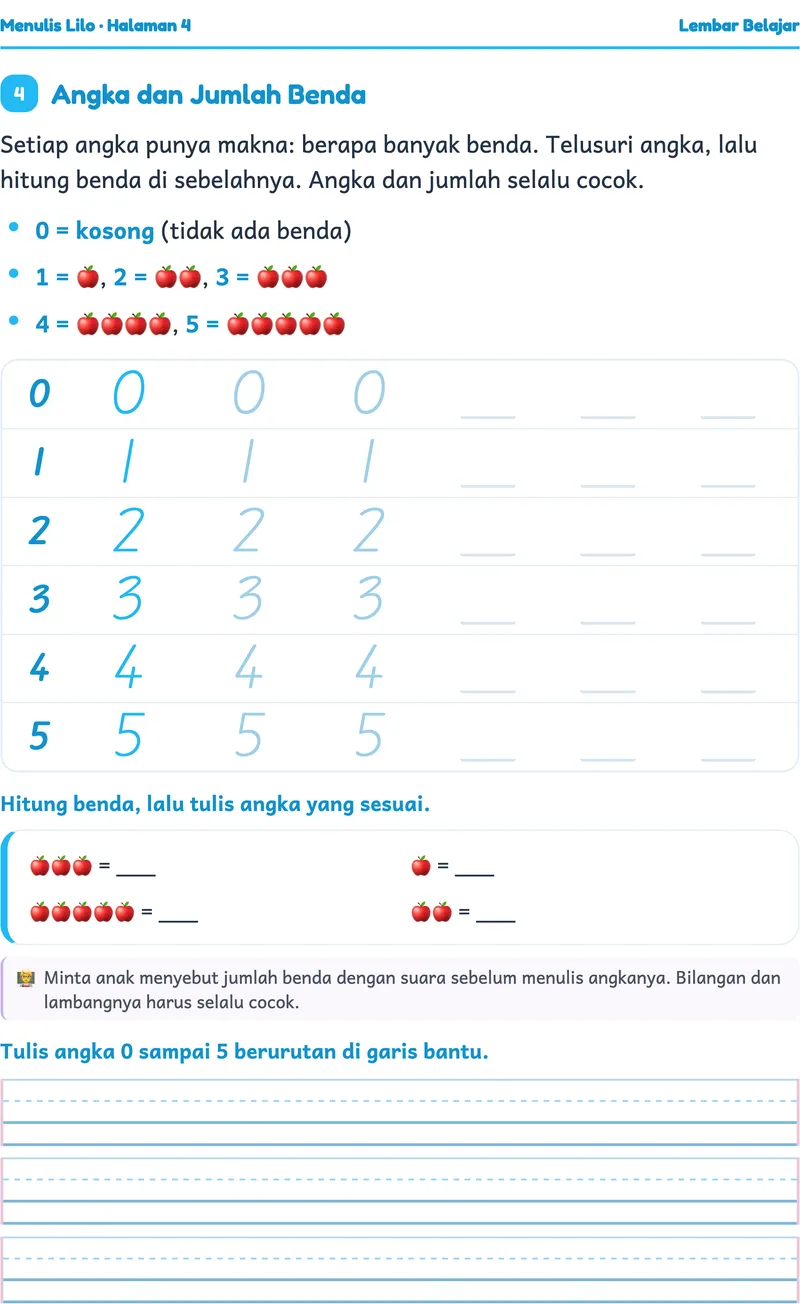
Writing Numbers 0 to 9
Real sheet
A real writing-module page: your child matches numbers to quantities and writes them neatly along guided paths.
Intermediate Level
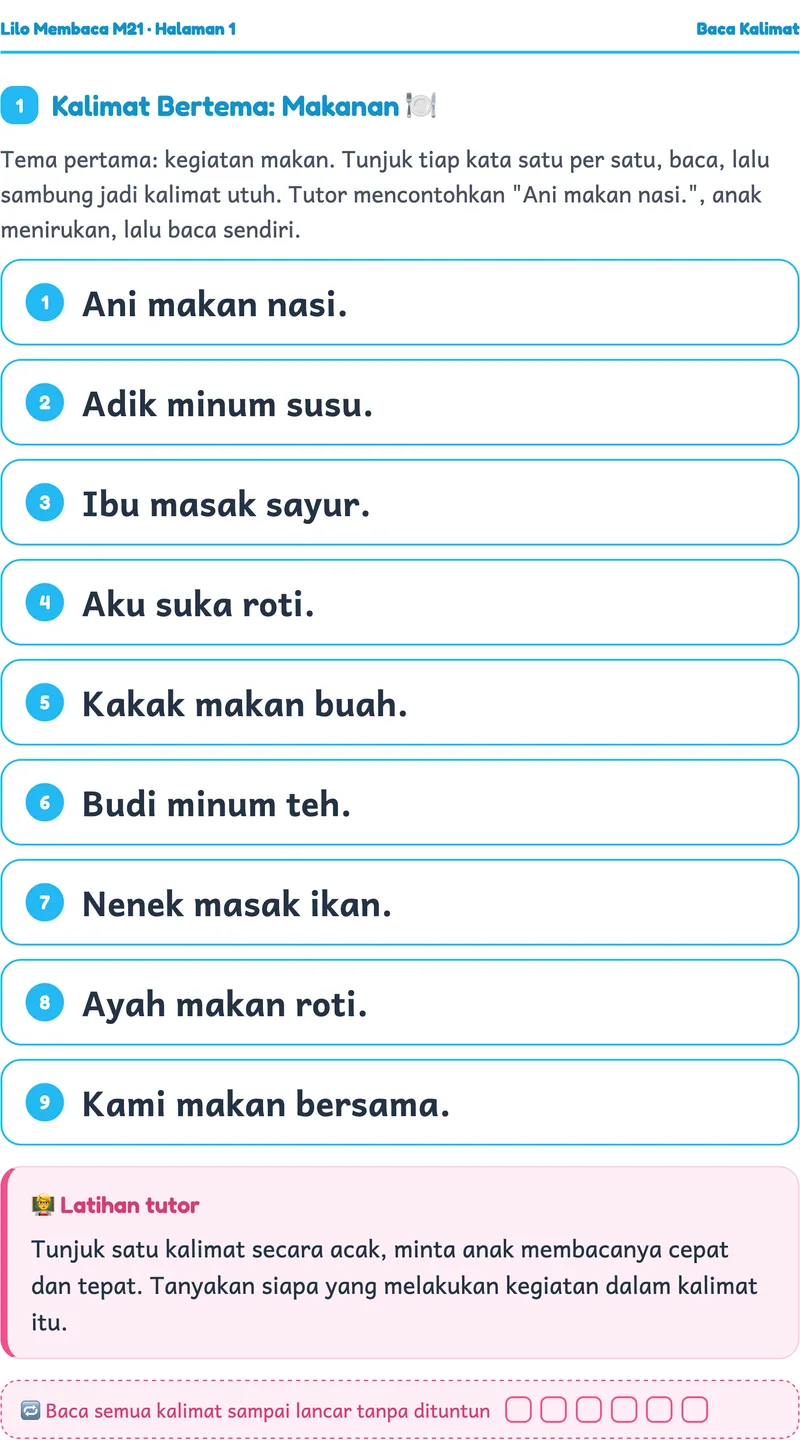
Reading Short Sentences
Real sheet
A real reading-module page: short food-themed sentences read in full, combining everything from letter sounds to syllables.
Intermediate Level
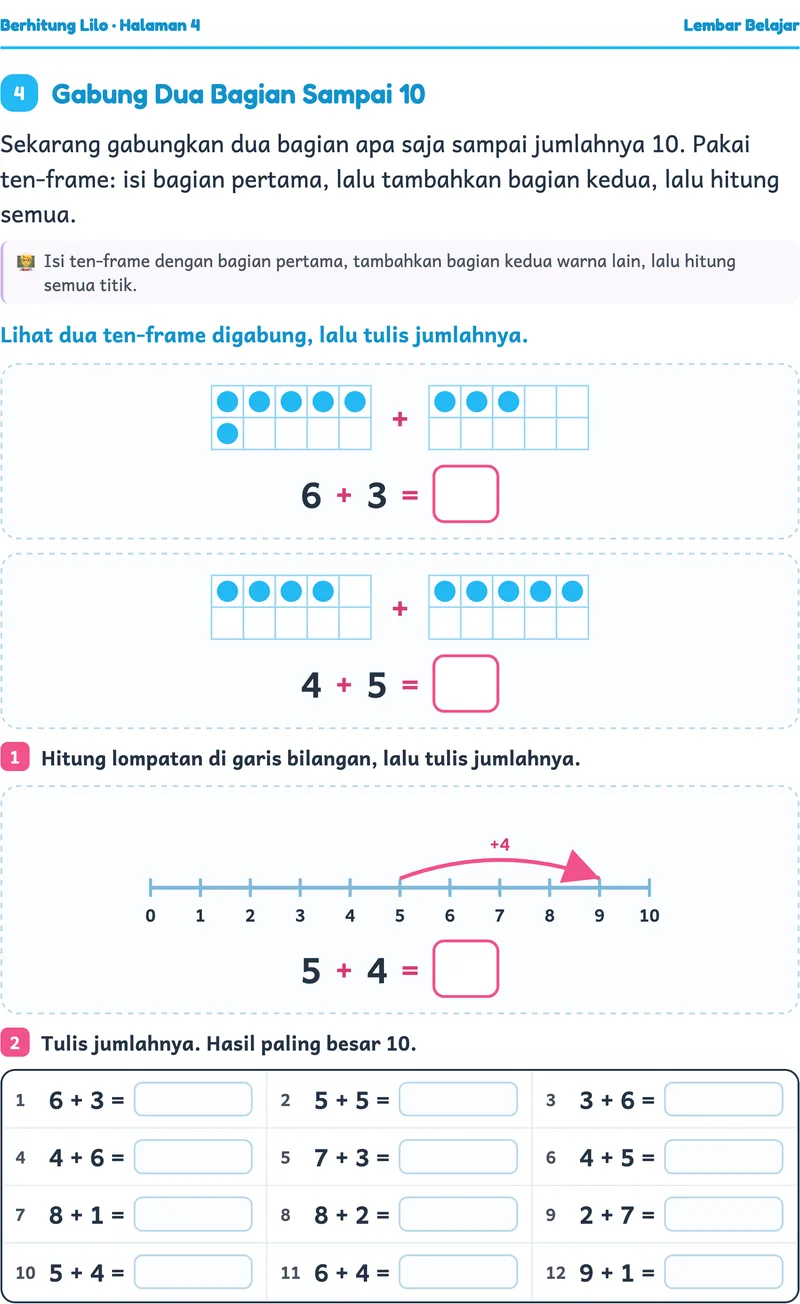
Addition Within 10
Real sheet
A real counting-module page: addition through ten-frames and a number line, seeing first and then counting, the concrete Lilo way.
Snippets from Lilo's own 122 leveled modules, from first letters and numbers to being ready for primary school.
Child Readiness
Is Your Child Ready to Learn Reading, Writing and Counting?
Every child is ready at a different point in each age, and that is perfectly normal. Use this list to recognize where your child is right now. Lilo will match the material to their pace, so they learn with ease.
Ages 3-4 (Introduction)
Enjoys looking at picture books and asks to be read to
Starts to recognize a few letters from their own name
Can hold a pencil or crayon to scribble
Knows the numbers 1 to 10 out loud
Ages 4-5 (Foundation)
Recognizes most letters A to Z
Starts to blend two letters into a syllable
Writes lines, circles, and simple letters
Counts objects 1 to 20 by pointing
Ages 5-6 (Intermediate)
Reads syllables and short words
Writes their own name neatly
Understands simple addition and subtraction
Retells what a short passage was about
Ages 6-8 (School Ready)
Reads sentences fluently and understands them
Writes simple words and sentences on their own
Handles more advanced counting and word problems
Focuses comfortably through a full session
Tutor
Lilo Reading, Writing and Counting Tutors
Verified tutors trained in our reading, writing, counting, and finger-math methods for young children.
J
Jihan D.Medan
Guides young children through reading, writing, counting, and jarimatika in small, cheerful steps.
Reading
Sempoa Abacus
Counting
Literacy and Numeracy
School Readiness
Writing
Jarimatika
A
Aisyah M.Bekasi
Trains focus through sempoa and jarimatika practice, while preparing reading, writing, and counting before primary school.
Sempoa Abacus
Counting
School Readiness
Literacy and Numeracy
Writing
Jarimatika
R
Rendra S.Malang
Walks children through reading, writing, and counting in a warm, unhurried classroom.
Sempoa Abacus
Counting
Jarimatika
Literacy and Numeracy
School Readiness
M
Mutiara S.Medan
Takes children from letter sounds to fluent reading through small, enjoyable steps.
Sempoa Abacus
Counting
Reading
Literacy and Numeracy
School Readiness
L
Lika N.Bandung
Leads children through reading, writing, and counting one step at a time.
Sempoa Abacus
Counting
School Readiness
Writing
Literacy and Numeracy
F
Fany D.Padang
Patiently guides reading, writing, and counting using games and objects children can hold.
Sempoa Abacus
Counting
Literacy and Numeracy
School Readiness
Writing
Who Teaches
Lilo Tutors Across Indonesia
5,000+ selected reading, writing and maths tutors, at home or online.
5,000+selected tutors across Indonesia
250+tutors from Primary Teacher Education (PGSD)
200+tutors from Mathematics
200+tutors from Psychology
Where our tutors studied
Mathematics
Psychology
Indonesian Language and Literature
Early Childhood Teacher Education (PG-PAUD)
Guidance and Counselling
Islamic Primary Teacher Education (PGMI)
Special Education
Primary Teacher Education (PGSD)
Graduates and active students.
Our tutors studied at
UIN Sunan Kalijaga
Universitas Negeri Yogyakarta
Universitas Gadjah Mada
Universitas Pendidikan Indonesia
Universitas Negeri Malang
Universitas Negeri Surabaya
Universitas Negeri Semarang
Universitas Diponegoro
The Lilo Tutor Selection
1
Application screening
Each file is read by our team.
2
Identity and degree checked
Diploma and ID are reviewed.
3
Teaching profile completed
We know when each tutor is free.
4
Learning the Lilo method first
Phonics and CPA come first.
5
Matched to your child
The team scores every answer.
You review the tutor profile before the first session.
No Reading, Writing or Counting Test to Enter Primary School: What the Rules Say
Since 2025 Indonesia's admission regulation states it plainly: a child enters grade 1 of primary school (SD) by age, and schools may not require a reading, writing or counting test. Below are the provisions, quoted from the documents themselves (English translations are ours).
No reading, writing or counting test for grade 1
Article 11(5): grade 1 applicants “are not required to take a test of reading, writing, counting and/or any other form of test”.
Ministerial Regulation No. 3 of 2025, Article 11(5)
Grade 1 selection is by age
Article 42 states that grade 1 selection “is based on the age requirements” and “is not based on the results of a reading, writing, counting or any other test”. When applicants on the residence track exceed the quota, Article 43 sets the order: age first, then the shortest distance from home to school.
Ministerial Regulation No. 3 of 2025, Articles 42 and 43(1)
Entry age: 7, and no younger than 6
Grade 1 applicants are 7 years old on 1 July of the admission year. Children who are at least 6 on that date may apply, and children aged 7 and above are given priority.
Ministerial Regulation No. 3 of 2025, Article 11(1), (2) and (4)
The 5 years and 6 months exception
The minimum age of 6 may drop to 5 years and 6 months for a child with exceptional intelligence and/or talent and psychological readiness, shown by a written recommendation from a professional psychologist. Where no psychologist is available, the school's board of teachers may give the recommendation.
Ministerial Regulation No. 3 of 2025, Article 11(3), (6) and (7)
Kindergarten entry has no such test either
For kindergarten (TK) the regulation sets ages 4 to 5 for group A and 5 to 6 for group B. The ministry has confirmed that early childhood admissions for the 2026/2027 school year may not require a reading, writing or counting test.
Ministerial Regulation No. 3 of 2025, Article 10; PAUDPEDIA, 15 June 2026
A joyful move from preschool to primary school
Director General Circular No. 0759/C/HK.04.01/2023 set out how to strengthen the transition from early childhood education to the early grades. The Directorate of Primary Schools lists two of its targets: removing reading, writing and counting tests from new student admissions, and running a school orientation period (MPLS) for new pupils.
Directorate of Primary Schools, 31 January 2024
So why take reading, writing and counting lessons?
The test is gone, and the lessons still arrive on day one. Grade 1 brings books, a whiteboard, worksheets and word problems from the first week. A child who already knows letter sounds, holds a pencil comfortably and understands how many objects are in a group settles into that first week with calm confidence.
That readiness is what Lilo builds: through play, real objects and small steps that suit your child's age. There are no mock exams, because what grows is the skill itself.
If your child was born mid-year, work out their age on 1 July of the year they start school. That tells you how many months you have, and a Lilo tutor plans the learning around that window.
It comes down to one question: does your child memorize letters and numbers, or truly understand them by starting from real objects the Singapore way? At Lilo, reading, writing, and counting grow together into one school-ready foundation. The table below makes that difference clear.
Aspek
Lilo Private Tutoring (1-on-1, managed)
Group Learning Center
Regular Private Tutoring
Learning approach
Personal, following your child's readiness
Leveled worksheets for each learner
Follows the class curriculum
Atmosphere
Play and stories, never boring
Regular independent practice at a desk
Depends on the tutor's style
Tutor focus
One child per private session
One assistant for several children at once
Can be private or group
Tutor management
Chosen, monitored, and replaced free of charge
Arranged by the learning center
Found and arranged on your own
Place of learning
At home or online
Come to a learning center
At home or at the tutoring place
Reports to parents
Weekly progress report
Notes on worksheet progress
Varies
Local context
Indonesian phonics and school readiness
The same material package for every learner
Follows the school book
Best fit when
You want one-to-one learning at home or online, with a leveled curriculum, weekly reports and a managed tutor
Your child enjoys learning with friends and you can take them to a centre regularly
You already know a tutor who suits your child and you are happy to arrange the materials and schedule yourself
Pricing
Reading, Writing and Counting Tuition
A session runs 60, 90, or 120 minutes. The prices above are for 60 minute sessions, and longer sessions are priced accordingly. Lessons happen at your home or online. Larger packages cost less per session.
What Parents Ask About Getting Their Child Ready to Read, Write, and Count
4.9From 3,624 parent reviews
I never expected Katrisha to actually enjoy learning to count. At home she often plays number guessing games with her little brother. Her handwriting is starting to stay on the lines too.
Razka wrote his own name for the first time on his grandma's birthday card. I even kept the card. His counting is getting more confident too, we are so grateful.
Aisyah loves counting our groceries when she comes along to the shop. Her reading is starting to flow too, she sounds out the names of items on the shelves one by one.
I love the personal approach they use. My child, who used to struggle to focus, can now learn with real enthusiasm.
Latifah really looks forward to her lessons, she says they are fun. She is starting to understand addition using things around the house, like counting spoons while helping set the table.
FAQ
Parent Questions About Getting Your Child Ready for Reading, Writing and Counting
Is a reading, writing and counting test still required to enter primary school?
No. Ministerial Regulation No. 3 of 2025 (Article 11(5)) removes the test for grade 1 applicants, and selection is by age. The Primary School Entry Rules section on this page quotes the provisions and sources.
If the test is gone, does my child still need these lessons?
Yes, because grade 1 lessons start in the first week. A child who knows letter sounds, holds a pencil comfortably and understands quantities follows the class with ease. Lilo builds that readiness through play and real objects, with no exam pressure.
My child is 6 and cannot read yet. Is that normal?
Many 6 year olds are only beginning to blend syllables, well within the normal range. What matters is the foundation: knowing letter sounds and hearing the first sound of a word. A Lilo tutor checks this in the first session and starts at the right stage, and children this age move quickly once their sounds are solid.
My child knows the alphabet but still cannot read. Why?
Your child knows the letter names, "bee", "see", "dee", while reading uses the letter sounds, /b/, /k/, /d/. Blending names gives "bee-ay", and your child cannot find "ba" in that. A Lilo tutor bridges the gap with sound cards, then whole syllables like ba, bi, bu, until your child reads a first word alone.
My child mixes up b and d. Is that normal or a sign of dyslexia?
Mixing up b and d, or p and q, is normal until about age 7. A Lilo tutor practises the starting point and direction of each stroke. If the mix-ups stay frequent after age 7 despite regular practice, consult a psychologist or developmental paediatrician, and the tutor keeps supporting your child alongside that assessment.
My child is left-handed. How does the tutor teach writing?
Left-handed children learn to write with their left hand, and nobody asks them to switch. The tutor tilts the paper a little to the right, teaches a grip slightly further from the pencil tip so the writing stays visible, and orders the strokes so the hand does not smudge them. The result is neat writing and a hand that does not tire quickly.
Is it true that learning to read and count too early harms a child's brain?
What weighs on young children is pressure: long sitting, rote drilling and exams. Children aged 3 to 5 enjoy discovering sounds, shapes and quantities through songs, objects and short games. Lilo follows each child's readiness: the youngest start with fine motor skills and sounds, and sentences and word problems arrive when they are ready.
How many sessions a week are ideal?
Two a week, the Regular package of 8 sessions a month, gives most children aged 4 to 7 the right rhythm with room left for play. Three a week (Intensive) suits a child starting school within a few months, and the 4-session Starter package is a good way to meet the tutor first.
How long until my child reads, writes and counts confidently?
A 5 year old starting from zero with two sessions a week usually reads two-syllable words by month three and a short story with understanding by month six, as The First Six Months section shows. Children who already know their letters move faster.
Where do Lilo tutors come from, and how are they chosen?
Lilo tutors pass selection and a background check, then train in the Lilo method: phonics for reading, CPA for counting, and stroke order for writing. We match the tutor to your child's age, stage, schedule and location, and send you the profile before the first session.
What if my child does not get along with the tutor?
You can change tutors any time, free of charge: message the Lilo team on WhatsApp and we arrange a replacement. The new tutor reads your child's progress notes first, so learning continues from the last stage, as written in the Lilo Terms of Service.
What does the progress report look like?
Every week the tutor sends a short report: the stage being practised, what your child has mastered, what still needs repeating, and one small activity for home. You can find your child's position on the stage table and timeline on this page.
How much do lessons cost?
From IDR 307,460 for the Starter package of 4 sessions a month, or IDR 76,865 per 60-minute session. The Regular package of 8 sessions a month is IDR 604,782, and larger packages cost less per session, down to IDR 70,529 per session on the 24-session package. Home lessons in some large cities are adjusted for city costs, and each city page shows its own price. The Fees section on this page has the details.
How do I sign up?
Fill in the sign-up form or message the Lilo team on WhatsApp. Tell us your child's age, what they can already do and the schedule you would like. The consultation is free. We match a tutor, send the profile, and the first session starts at the right stage for your child.
Why Lilo
Why Choose Lilo?
The Singapore Way of Learning
Objects, then pictures, then numbers: the Concrete, Pictorial, Abstract approach that helps understanding last.
Material That Builds Step by Step
Reading and counting run neatly from easy to harder, one mastered step at a time.
Learning to Think Through Stories
Bar Models turn word problems into pictures your child can reason through.
Tailored to Each Child
Every child is special. The material and learning speed are set to follow their own needs and pace.
You Always Know Your Child's Progress
You receive a progress update on your child every week, so you can cheer them on at home.
Flexible Schedule
Learning time follows your child's best moments, available in person or online.
Picture your child's first day of school feeling easy because they can already sound out letters, write their name neatly, and count starting from objects they hold. Reach out to the Lilo team on WhatsApp for a free consultation, and we will help map a reading, writing, and counting path that fits your child's readiness.