




Little explorers aged 3-4
At this age everything goes through the hands. Your child meets letters and numbers through play with real things, with zero pressure, building curiosity long before any formal writing appears.
Your child starts by holding real things, moves on to pictures, and only then meets letters and numbers. Understanding comes first, so reading, writing and counting feel natural and stay for good.
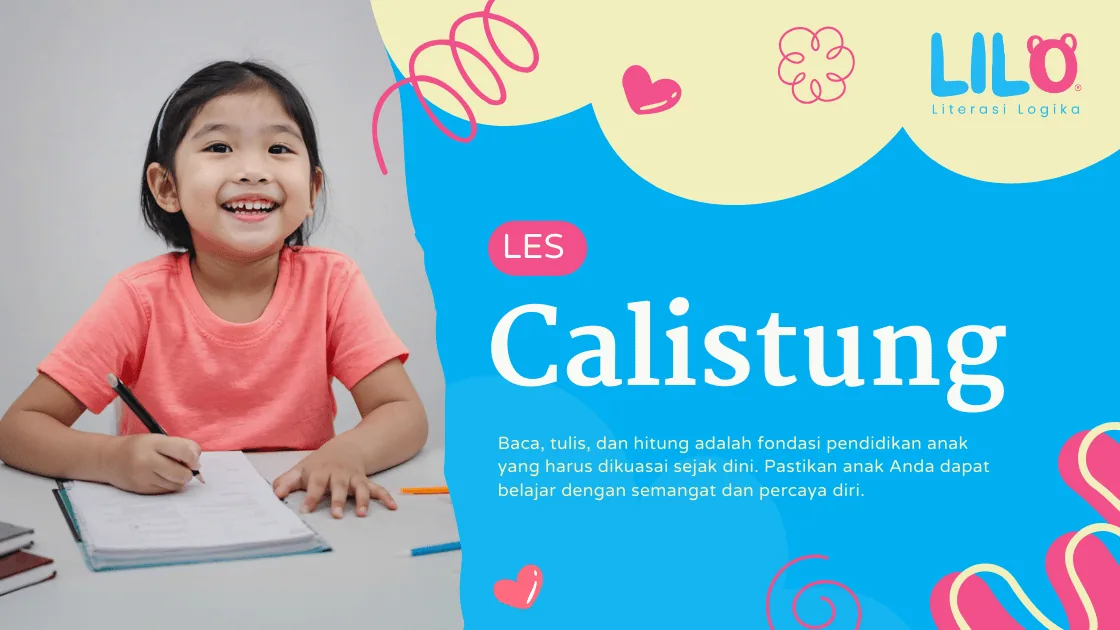
Reading, Writing and Counting in Bandung is a Lilo program for children aged 3-8 that teaches the three skills as one connected journey, guided by a tutor at home, online, or in a small group. Every idea begins with real objects your child can hold, then pictures, then letters and numbers, so each new symbol carries real meaning.
Every child walks their own path to letters and numbers. The placement assessment at the start tells us exactly where your child stands, so lessons begin at the right spot.
At this age everything goes through the hands. Your child meets letters and numbers through play with real things, with zero pressure, building curiosity long before any formal writing appears.
These are the getting-ready years. Your child blends syllables, counts with objects they can touch, and practices writing, so the first day of primary school feels exciting instead of scary.
School has started and the pace picks up. Your child strengthens all three skills together, reads with real understanding, and grows the confidence to keep up happily in class.
Some children simply need a restart at the right level. The tutor finds the exact step where understanding stopped, rebuilds it with real objects, and lets your child climb again at a kind pace.
Readiness shows in small everyday moments. Use these signs before lessons begin and again when the next rung of the ladder comes into view.
Bandung and its surroundings have 500+ reading, writing and maths tutors.
Some still studying, others graduated.
Application screening
Role and city are checked first.
ID card and diploma verified
ID card, diploma and photo are checked.
Tutor profile filled in
Teaching history goes into the portal.
Learning the Lilo method first
Lilo guides and materials are provided.
Chosen for your child
The team scores every answer.
Tutor not quite right? See our free tutor replacement promise
Young children show their real ability when relaxed, so the first session is a game, and through it the tutor finds the rung where your child begins.
Reading the instructions is itself one of the skills being checked. Play clears that hurdle, so the tutor sees counting and writing honestly.
Nervous children go quiet or guess. Sorting buttons or matching sound cards, your child forgets anyone is watching and answers naturally.
Does your child count seven buttons one by one, or already know five and two make seven? That small difference decides the next module.
The tutor places your child on the H, S, K, T, B and P ladder, perhaps steady at S while still building T, and picks worksheets from the matching module.
Symbols are the last stop, never the first. Every concept travels the same gentle road, from something your child can hold, to something they can see, to the letters and numbers themselves.
Lessons open with objects your child can touch and move. Counting means grouping real items, and letters connect to things your child already knows, so ideas take root in real experience.
Next, the objects become drawings. Word problems turn into simple bar pictures your child can read at a glance, which quietly trains reasoning while the sums still feel like stories.
Only now do bare numbers and letters appear. Because your child already understands what they stand for, reading works through letter sounds and counting means real thinking instead of empty recital.
Steady practice in small portions, built level by level, locks each skill in place. Your child levels up only after mastery, so confidence grows with every worksheet.
Every stage stands on the one before it, so the foundation has no gaps.
From recognizing letters to understanding whole stories, your child learns through letter sounds, so new words become something to figure out instead of memorize.
Writing starts with lines and patterns that train small hand muscles, then grows into print letters, words, and finally full sentences your child is proud of.
Numbers begin as real objects in your child's hands. Addition, subtraction and word problems all grow out of that understanding, drawn as simple bar pictures.
Alongside the three skills, every session quietly builds concentration, independence and confidence, the habits that carry your child through school and beyond.
These four signatures shape every session, from the first hello to the last worksheet, and they all serve one idea: understanding before symbols.
A child who has held ten beans before seeing the number 10 will never treat that number as an empty shape.
Every new concept begins as something your child can pick up and move around. Only after the idea is solid do pictures appear, and symbols come last of all.
Your child learns the sounds letters make and blends them into words. There are no letter-name spelling drills, so reading becomes a skill your child owns, ready for any new word.
Story sums are drawn as simple bars, the Singapore way. Your child sees the problem before solving it, which trains real reasoning instead of guesswork.
Short, steady portions of practice, warm and built level by level, build fluency without tears. Mastery decides when your child moves up, never the calendar.
Each rung comes from Lilo's own curriculum of 122 leveled modules, so your child always knows the next step.
Most struggles with early reading, writing and counting come from a handful of well-meaning shortcuts. Here is what we see most often, and how Lilo does it differently.
Why it happensPages recited from memory feel like progress, but nothing is anchored to meaning, so the skill fades fast and learning starts to taste sour.
How Lilo helpsLilo builds every concept from real objects up, so what your child learns is understood first and remembered as a natural result.
Why it happensSmall hand muscles need training first. Pushing letter writing too early breeds frustration and can make a child dread the pencil.
How Lilo helpsWe begin with lines and patterns that strengthen the hand, then move to letters when your child is ready to succeed at them.
Why it happensA child who only chants numbers is reciting sounds. Without objects behind them, the symbols stay empty and later math wobbles.
How Lilo helpsNumbers arrive last in a Lilo lesson, after your child has counted, grouped and compared real things they can hold.
Why it happensSqueezing three skills into a few rushed months creates stress for the whole family and produces shallow results that crumble in class.
How Lilo helpsA steady, leveled journey started early lets your child arrive at primary school ready and confident, with no last-minute panic.
Why it happensReading, writing and counting feed each other. Taught apart, one skill races ahead while another lags, and progress turns lopsided.
How Lilo helpsLilo weaves the three together in every session, so a word read becomes a word written and a story becomes a sum.
Number pairs let your child see one number as two joined parts, the idea behind addition, subtraction and later carrying and borrowing.
A child new to numbers sees seven as a long line to count from one, every single time. Number pairs change that picture: seven becomes five and two, four and three, six and one. A number turns into something that splits apart and joins back together. This is the key shift in stage B, basic counting, because the sums that follow rest on it.
The tutor lays seven ice cream sticks on the table, and your child shares them between two plates: five and two, then four and three. Each split is drawn as one circle holding seven above two circles for the parts. Once the drawing feels easy, numbers appear alone. Objects, then pictures, then symbols, so every written number has meaning behind it.
Months later the payoff shows. Knowing that seven and three make ten, your child solves eight plus five by splitting five into two and three, filling eight up to ten, then adding three. At home, lay out seven buttons, hide some under your palm and ask how many are hiding. A child who has mastered the pairs answers confidently without peeking.
A picture for a five-year-old learning face to face at home in Bandung on Intensive, twelve sessions a month or about three a week, using Lilo's official stage codes.
A first-session game finds the starting point. Letter sounds then grow through cards and household objects, kept fresh by three meetings a week.
Sounds join into syllables like ba, bu and ma, then into short words, while numbers to ten arrive through sticks and buttons.
Your child splits objects into two groups, finds that seven is five and two, and practises the pairs that make ten on picture worksheets.
Two-syllable words read smoothly and link into short sentences, chosen from things your child already knows so they carry meaning at once.
Your child writes their name and newly read words in straight-lined capitals, then reads two or three sentences and answers questions about them.
Every child keeps their own rhythm, and the weekly report shows the stage in practice.
Clean laundry and a shopping bag hold plenty of practice. Each short activity uses things already at home and targets one clear stage.
| Activity | Time | What you need |
|---|---|---|
Seven shirts, two pilesYour child splits seven shirts into two piles and names each count. Move one shirt across and five and two become four and three. This is number pairs at stage B, just like the sticks in lessons. | 10 minutes | Seven clean T-shirts or small towels |
Name labels for the clothes drawerYour child writes their name on paper and tapes it to their drawer, then short words like baju or kaus for other drawers. Watch the grip and stroke direction. This builds neat writing at stage T. | 10 minutes | Paper, pencil and tape |
A picture shopping listBefore going to the market, you draw each item and your child writes or reads its word, such as gula, roti or telur. At the shop they tick items off. This strengthens reading words at stage K. | 15 minutes | Paper, crayons and a shopping bag |
Counting the shopping bagBack home, count the tomatoes and shallots, then put them together. Make up a tiny story: five tomatoes, two go in the soup, how many are left? This is the thinking later drawn as a bar model. | 10 minutes | Vegetables and fruit from the shop |
choose 60, 90, or 120 minutes
Contact us
60, 90, or 120 minutes per session
Contact us
duration of 60, 90, or 120 minutes
Contact us
These steps prepare the first session, at home in Bandung or online through app.lilo.id.
Share your child's age and habits and choose home or online. The team helps you pick 60, 90 or 120 minutes and a monthly package.
The matched tutor's profile is ready before the first session. Many Lilo tutors studied early childhood or primary teaching, psychology or mathematics.
Choose a table and chair that fit your child, good light and a spot away from the television, with pencils and an eraser ready.
The team sends the link and worksheets before class via app.lilo.id. Print the sheets and point the camera at your child's book and hands.
Each session ends with a recap and one ten-minute task, so leave room for it in your child's day.
Bandung is the capital of West Java Province, set in the cool Priangan highlands. The city has long carried proud nicknames such as the City of Flowers and Paris van Java, and it is widely recognized as a creative city where curiosity and new ideas flourish. Its reputation as one of Indonesia's respected centers of learning is a source of pride for its people, and the fresh mountain air makes it a pleasant place to grow and study.
Your Lilo teacher travels to your house anywhere in our Bandung service areas. At a familiar desk in a quiet corner, your child settles in to learn, and you see up close how each session goes.
Online sessions run live with a teacher, using the same materials and levels as face-to-face lessons. This option gives your child's study schedule in Bandung more room to flex.
Your child begins where their skills stand today and climbs gently, one small step after another, with regular practice that feels like fun. Every stage is built so the idea is fully clear to your child before the next one opens.
Every approach has its place. Here is a fair picture of how guided, concept-first learning compares with two common alternatives.
| Aspek | Lilo | Learning Apps | Learning at Home Alone |
|---|---|---|---|
| How new ideas are introduced | Real objects first, then pictures, then symbols | Usually starts on the screen with symbols | Depends on the materials parents can find |
| Who guides the child | A verified tutor, live, adjusting every session | The app follows its fixed script | A parent, juggling many other duties |
| Finding the right starting point | Placement assessment before lessons begin | Often one fixed track for every child | Trial and error at home |
| When the child moves up | Only after mastery is shown | Often after finishing a set of screens | Hard to measure without a benchmark |
| Hands-on learning | Central to every lesson | Limited to taps and swipes | Possible, with plenty of preparation |
“Roughly how much should we set aside?” is the question we hear most during consultations. A session starts at IDR 76,865 online and IDR 107,611 at home, the Regular package of 8 sessions comes to IDR 846,694, and each package is paid up front in one go. During sessions your child moves between reading, writing a sentence and counting, with real objects before numbers, at home or online through app.lilo.id.
Curious to sample learning with a Lilo tutor before committing.
IDR 430,444Already convinced and wanting steady weekly practice for your child.
IDR 846,694Working toward a specific goal and needing sessions packed closer together.
IDR 1,248,751Wanting a complete calistung foundation built from the ground up.
IDR 2,369,758From the very first session.
One WhatsApp message is enough. Valid for as long as the package runs.
The steps:
A full report follows each month.
Two things are easy to miss when comparing calistung lessons: the order of the material and where the materials come from. Ask any provider these questions.
Coded stages show where your child stands and what comes next, so sentences arrive once syllables are steady. At Lilo, the H, S, K, T, B and P ladder guides every tutor.
Materials from one curriculum let each sheet prepare the next. Lilo uses its own 122 coded modules, and worksheets come from the module your child is studying.
The right start protects a child from boredom and from discouragement. Ask whether young children sit a written test. At Lilo the starting point is found through play.
A useful report names the stage being practised. Lilo's weekly report covers that stage, what is mastered, what needs repeating, and one small home activity.
The bond with a tutor shapes a young child's attitude to learning. Lilo replaces the tutor free of charge whenever the match is not right, as a firm service promise.
Lilo runs on 122 leveled modules of our own original curriculum, so every worksheet fits the level before it and prepares the one after.
For in-person lessons, a verified tutor travels to your home anywhere in Bandung, including Dago, Setiabudi, Buah Batu and Antapani, so learning happens where your child feels safest.
Because every symbol is built on objects and pictures first, what your child learns stays learned. There is no cramming and no fading after the test.
Lessons can run in Indonesian or English, a natural fit for bilingual and national-plus families across Bandung, a city with a proud tradition of education in West Java.
Reading, writing and counting reinforce each other in every session. Words your child reads become words to write, and stories become sums, so progress stays balanced.
Concentration, independence and confidence are part of the curriculum itself, so your child gains study habits along with letters and numbers.
Aisyah loves counting our groceries when she comes along to the shop. Her reading is starting to flow too, she sounds out the names of items on the shelves one by one.
Reading, writing and counting tutoring in Bandung really helped my child understand letters and numbers in a fun way. The tutor is very patient and creative in teaching.
These are original sheets from Lilo's calistung materials. Reading, writing, and counting are trained side by side at each level, so all three grow together from first steps to mastery.
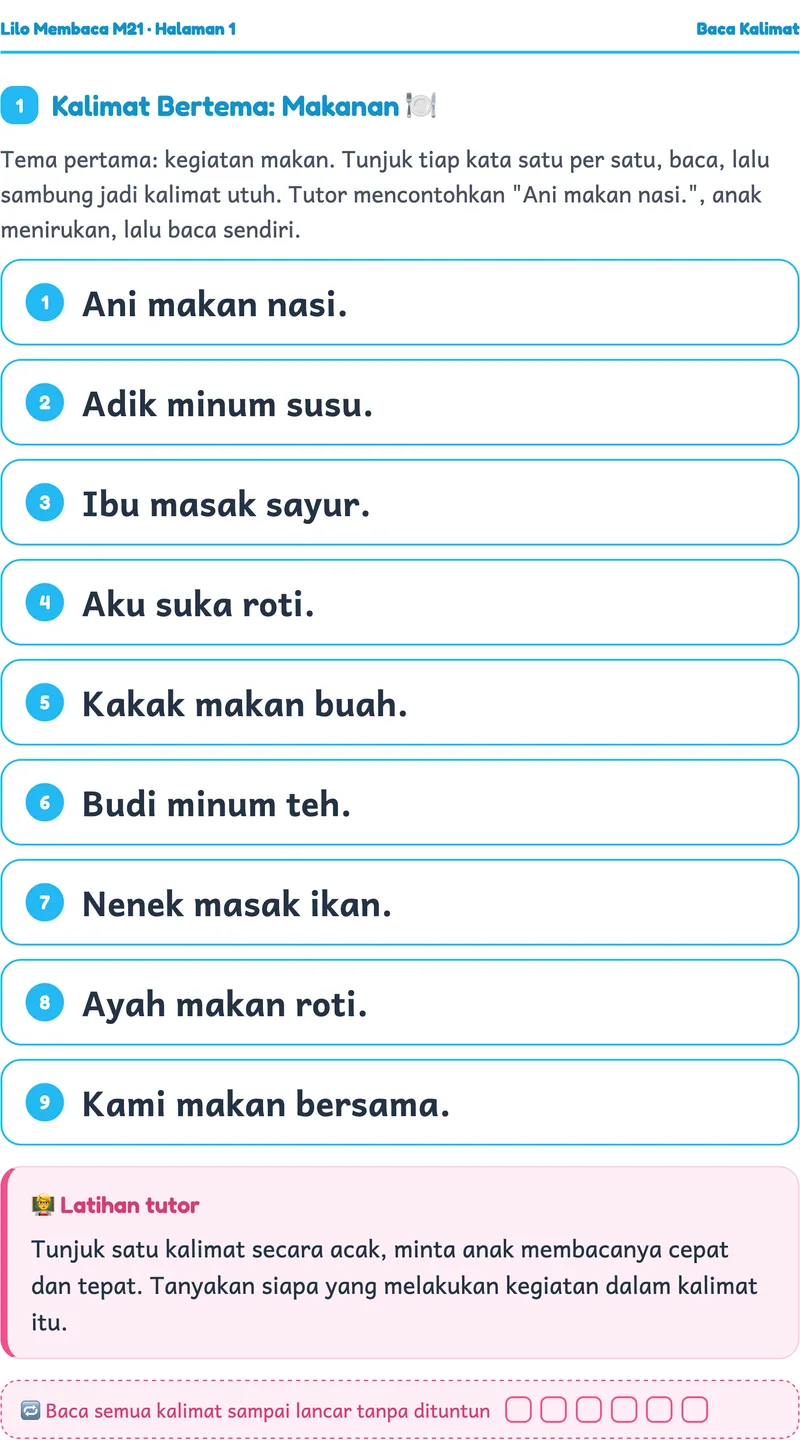
This Intermediate Level sheet from the reading module holds short sentences about food, read from start to finish. All the earlier sound and syllable practice comes together here as the child's first meaningful reading.
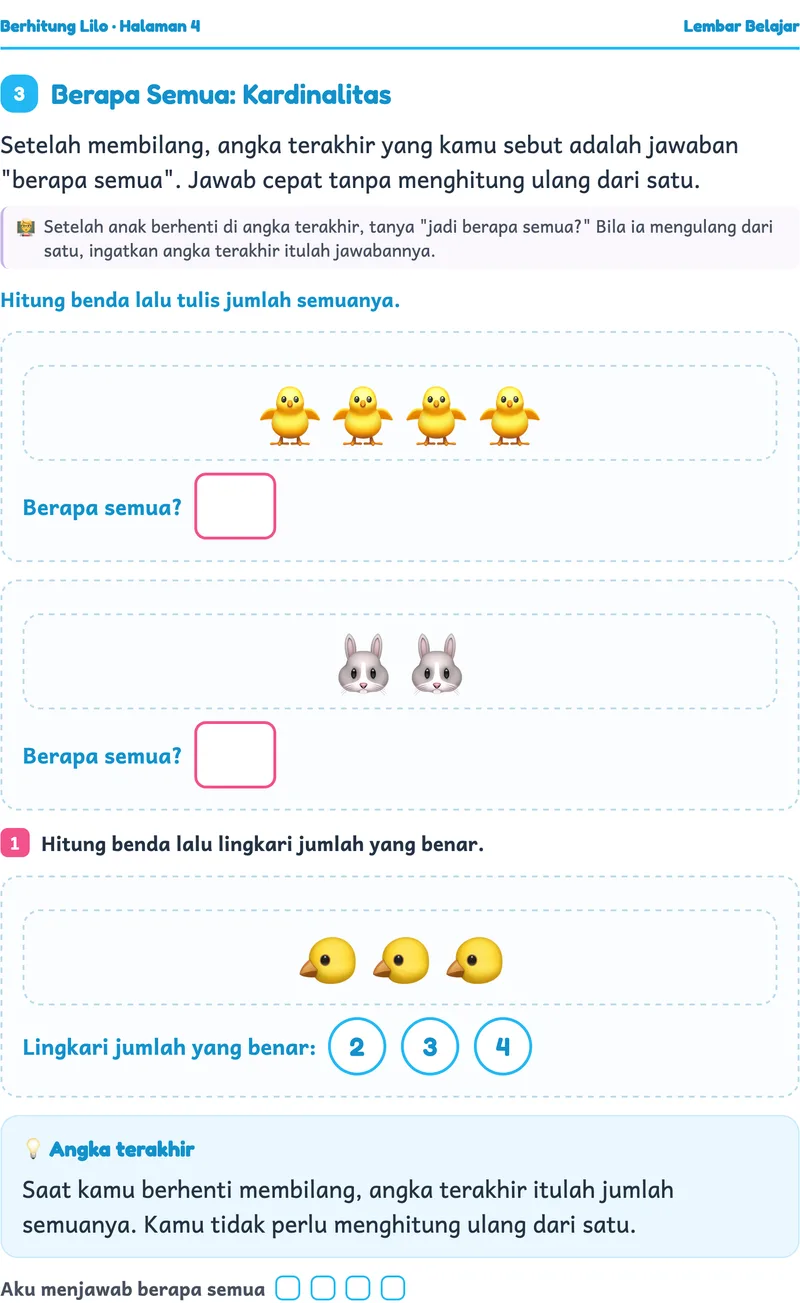
On this sheet, Introduction Level children learn to count with real objects. Each object is counted one by one, and the child then says how many there are in all. Everything starts from the concrete.
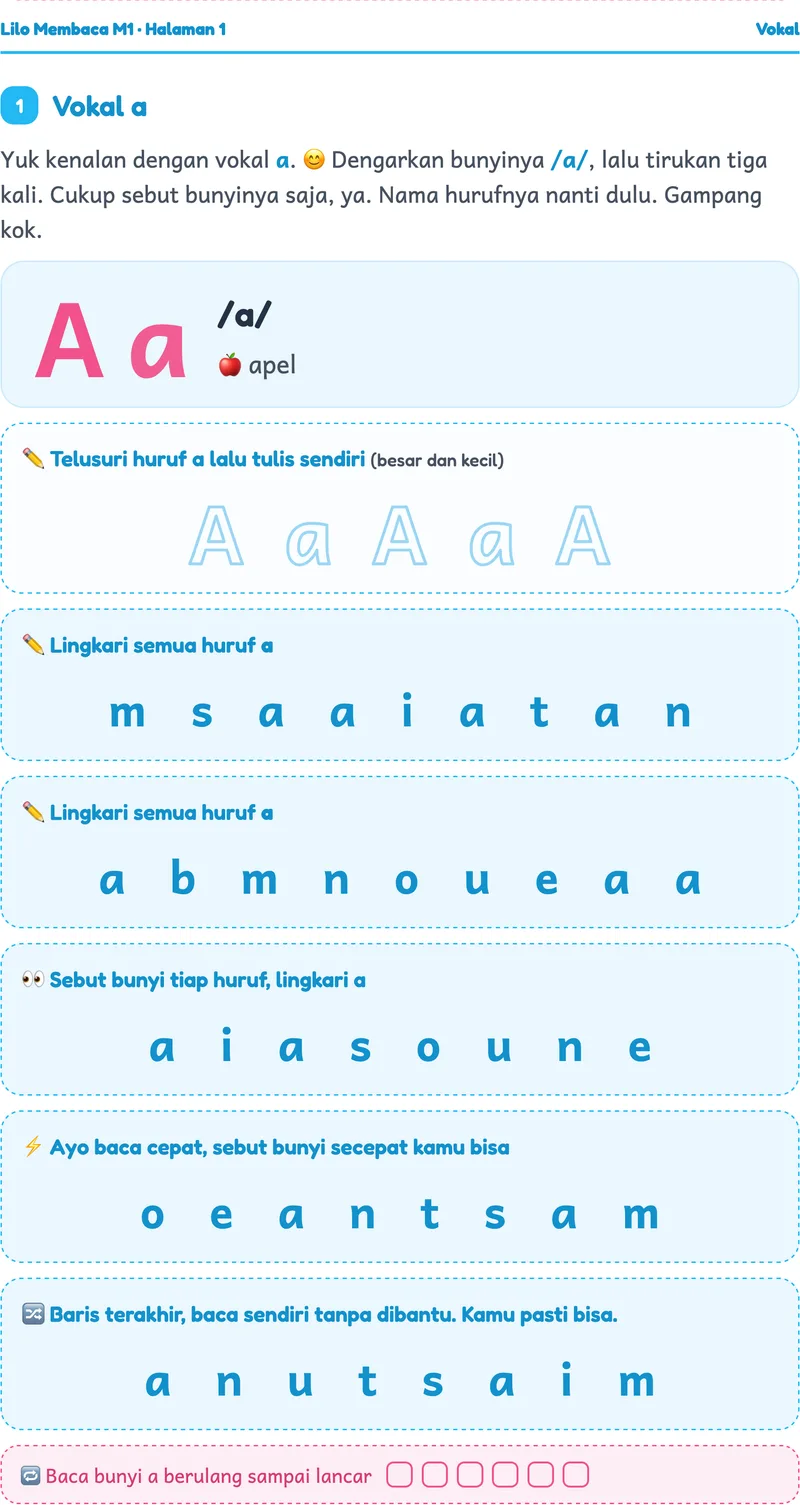
This Introduction Level sheet from the reading module introduces the vowel sound a through cards and point-and-read activities. It is the very first door a child opens on the way to reading.
Every sheet above is part of Lilo's own progressive curriculum, a complete set of 122 modules.

Start with a free consultation on WhatsApp. Tell us about your child, and we will suggest the right level and service for your family in Bandung, with no obligation.
Starting level set in the first lesson