
Little Explorers, Ages 3 to 4
Your child is meeting letters and numbers for the first time. Sessions feel like guided play with real objects, songs and letter sounds, with zero pressure and plenty of smiles.
Your child learns to read by hearing what each letter says, counts with objects they can actually hold, and writes when their little hand is ready. One tutor guides all three skills as a single journey.
Reading, Writing and Counting in Banjarmasin is Lilo's home and online tutoring program that teaches children aged 3 to 8 the three core school skills as one connected journey. Reading begins with letter sounds instead of spelling drills, counting begins with real objects, and writing grows step by step. Your child moves up a level only after they truly understand.
Every child arrives at letters and numbers on their own timeline. The placement assessment finds your child's true starting point, so lessons feel doable from the very first session.
Your child is meeting letters and numbers for the first time. Sessions feel like guided play with real objects, songs and letter sounds, with zero pressure and plenty of smiles.
Your child is in kindergarten and primary school is on the horizon. This stage builds blending syllables, counting to 20 and writing letters, so the transition feels calm and natural.
Your child has started primary school and needs all three skills to feel solid. Lessons strengthen reading with understanding, adding and subtracting, and writing full sentences with confidence.
Your child feels behind their classmates and it hurts their confidence. The tutor starts exactly at their real level, rebuilds the missing steps, and lets small wins restore their courage.
The method follows how young children genuinely learn. Ideas start in the hands, move to pictures, and only then become letters and numbers on paper.
New ideas begin with real objects your child can touch, the Singapore Math way. Beads, blocks and cards make counting and letters feel physical and obvious before any symbol shows up.
Instead of chanting letter names, your child learns the sound each letter makes and blends those sounds into syllables and words. Reading becomes something they figure out, and that feels wonderful.
Word problems get sketched as simple bars, the Singapore bar model. Your child sees what the question is really asking, which quietly trains reasoning alongside counting.
Each session ends with short, friendly practice in small portions, steady practice built level by level. Your child levels up only after true mastery, so nothing is built on shaky ground.
Your child moves to the next stage once the current one is truly mastered.
From recognizing letters by their sounds to blending syllables, reading sentences and understanding what a story actually says. Your child reads to make meaning, never to memorize.
The journey starts with lines and patterns that warm up little hand muscles, then moves to print letters, whole words and finally full sentences your child is proud of.
Your child gets to know numbers through objects they can hold, then learns addition, subtraction and word problems drawn as simple bars, so every answer comes with understanding.
Woven through every session are habits that carry your child far beyond one lesson: sitting with focus, working independently, and trusting themselves to try.
A sum like 8 + 5 often sends children back to their fingers. Pairs that make ten offer a steadier crossing.
Children new to adding usually count on: eight, nine, ten, eleven, twelve, thirteen, folding a finger each time. It slips once the fingers run out or a count is skipped. Pairs that make ten close the gap: one and nine, two and eight, three and seven, four and six, five and five. Once they stick, ten becomes a safe resting point.
The tutor starts with objects. Ten buttons sit in two rows of five, a palm covers some, and your child guesses how many are hidden. Next come dot pictures, and only then numerals. Object, picture, then symbol lets your child keep the reason: eight needs two because they once saw two empty spots in that row.
Then the bridge stands. For 8 + 5, your child thinks eight needs two to reach ten, so five splits into two and three, and ten plus three makes thirteen. It works backwards too: 13 take away 5 becomes take away 3, then take away 2. This splitting later carries place value, when ten sticks are bundled into one ten, and carrying and borrowing.
This picture fits a four year old who knows no letters or numbers yet: Starter's four sessions a month first, then Regular's eight once a rhythm forms.
A few letter sounds arrive through the names of loved things, like bola and sapu. Weekly lessons start to feel welcome.
Your child counts spoons while touching each one, and sees that the last number said tells how many.
With two sessions a week, sounds join into ba, bo and bu, and closer lessons keep yesterday's sounds fresh.
Small hands practise upright lines and circles, then straight stroke capitals such as L, T and E.
Your child reads sapi and buku by joining syllables, and splits seven buttons into five and two.
Each child moves through these months at their own pace, rising once a stage is mastered.
Chalk and clean laundry, found in most homes, are enough for short practice that trains one stage at a time.
Draw big lines, curves and circles. Your child traces them with a finger, then walks along them. Wide arm movements ready the hand for small letters on paper at stage T.
chalk, a porch floor or board
Draw two rows of five circles, fill some with caps, and ask how many stay empty. Answering two when eight are filled is stage B at work.
chalk and ten bottle caps
Your child finds each sock's partner, then you count the pairs and the socks together. Seeing three pairs hold six builds early adding.
clean socks from the basket
With each fold, your child says the first sound of its Indonesian name: baju starts with b, handuk with h. Then they hunt the house for matches, building stage H.
dry shirts, trousers and towels
A teacher's attention and clear news about progress shape early learning most. Ask any provider these questions.
| Question to ask | Why it matters |
|---|---|
How many children does one teacher handle at a time? | Young children lose focus waiting their turn. One teacher for one child catches every pencil grip and misread sound, and Lilo's private lessons run exactly that way. |
How do you decide my child is ready to move up? | Moving up by the calendar rushes some children and bores others. Lilo raises a stage once the last one is mastered, guided by its own 122 coded modules. |
How often will I hear about progress? | Weekly news lets you adjust home practice while a difficulty is just forming. Lilo tutors report every week, for example noting that your child now finds seven's partner to make ten. |
What happens if my child and the teacher do not click? | Fit shapes a child's courage to try, so the way out should be clear. At Lilo the tutor is swapped at no cost when the fit is wrong, a firm service promise. |
Can I see the teacher's profile before the first session? | A teacher's background helps you feel settled. Lilo tutor profiles are open before the first session, and many tutors studied primary teaching, early years education, psychology or maths. |
These four signatures shape every Lilo lesson, whether the tutor sits at your table in Banjarmasin or meets your child online.
A child who understands why letters make sounds and why numbers grow can learn anything that comes after.
Every new idea enters through the hands before it reaches the page. Your child counts beads and sorts cards first, so numbers and letters arrive already full of meaning.
Your child learns what each letter says, then blends those sounds into syllables and words. There are no spelling drills to memorize, only the quiet thrill of decoding a word alone.
Story problems become simple bar drawings your child can see and compare. This habit turns confusing sentences into clear pictures and trains careful reasoning from an early age.
Short daily portions beat long cram sessions every time. Steady practice built level by level keeps skills fresh while sessions stay warm, encouraging and pressure free.
These stages come directly from Lilo's own 122 leveled modules, written and refined by our curriculum team.
Most of these come from love and good intentions. Knowing them early saves your child months of frustration and keeps learning joyful.
Why it happensMemorized answers fade fast because nothing anchors them, and the child starts to associate learning with a sour, anxious feeling.
How Lilo helpsLilo builds every idea from real objects and letter sounds first, so answers grow out of understanding and stay for good.
Why it happensSmall hand muscles need warming up first. Pushing letters too early causes cramped grips, messy results and tears on both sides.
How Lilo helpsOur writing path starts with lines and patterns that strengthen the hand, then moves to letters when your child can succeed.
Why it happensA child who chants numbers without touching real quantities is reciting, and the emptiness shows the moment problems get harder.
How Lilo helpsCounting at Lilo begins with objects your child can hold and group, so the symbols that follow always mean something.
Why it happensSkills built in a panic sit on thin foundations, and the pressure can sour a child on school before it even begins.
How Lilo helpsStart earlier with short, friendly sessions. Steady weekly practice builds the same skills calmly, with confidence intact.
Known across the country as the City of a Thousand Rivers, Banjarmasin serves as the capital of South Kalimantan province. Its rivers run straight through the center of town and shape the rhythm of daily life, while the Floating Market at Kuin remains a point of pride whose fame reaches well past Indonesia's borders. The city spreads over Banjarmasin Tengah, Banjarmasin Utara, and Banjarmasin Selatan, reaching neighborhoods like Kayu Tangi, Sungai Andai, Teluk Dalam, and Sungai Jingah. Lilo helps children aged 3 to 10 in Banjarmasin grow in reading, writing, and math. Your child can begin private online lessons wherever you live in the city, paired with a teacher from Lilo's nationwide network. Once the Lilo team finds a teacher based close by, lessons at home can be added.
In Banjarmasin, your child can begin at once with a teacher drawn from Lilo's nationwide network, learning privately online at times you pick. When the Lilo team confirms a teacher living close to you, sessions at home can follow.
Your child first handles real things, then works with pictures, and only after that meets letters and numbers. Each stage makes the idea genuinely clear, so your child gains the confidence to solve problems alone.
Live online sessions bring the teacher to your child's own desk. The materials and stages match in-person lessons, and each child is guided one on one with clear worksheets.
60/90/120 minutes
Contact us
duration of 60, 90, or 120 minutes
Contact us
60, 90, or 120 minutes
Contact us
Readiness shows in small daily habits, grouped here by age so you can match what you notice.
From Banjarmasin, your child connects to 5,000+ selected tutors.
Graduates and current students alike.
Applications screened
Role and city are checked first.
Documents verified
Diploma and ID are reviewed.
Teaching profile completed
Teaching experience and hours are recorded.
Trained in the Lilo method
The step-by-step method is learned first.
Chosen for your child
Questions come from the child’s needs.
Tutor not quite right? Read the tutor replacement guarantee
The first session is a game with no written test. While playing, the tutor notes what decides your child's starting point.
Short activities take turns to keep your child fresh. In Banjarmasin lessons run online, with the class link and worksheet sent ahead.
The tutor asks about your child's day and names one game waiting inside the lesson.
Your child handles buttons, straws or letter cards, feeling each new idea before meeting its symbol.
Your child hops, stands or copies the tutor's stretch for a moment, and a body that moves brings attention back full.
The sheet, arranged in app.lilo.id and printed before class, comes from the module in progress while the tutor watches each step.
The tutor sums up what your child now holds firmly and sets one small home task, roughly ten minutes long.
Lilo teaches from its own original curriculum of 122 leveled modules. Every worksheet and activity was designed in-house, so lessons connect smoothly from one level to the next.
Because reading is taught through letter sounds, your child decodes new words independently instead of waiting to be told. That independence is the whole point of learning to read.
Real objects come first, pictures second, symbols last. Your child knows why an answer is right, which makes every later topic at school easier to grasp.
Every tutor is verified, and instruction is available in Indonesian or English. Your child meets a tutor from Lilo's national network online, and for homes from Teluk Dalam to Sungai Jingah we arrange visits after confirming a tutor who lives nearby.
A placement assessment at the start finds your child's true level, and they move up only after mastery. No child is rushed, and no child is left coasting.
The Lilo team first matches your child with a tutor whose background fits, then online classes in Banjarmasin begin. Payment is made upfront per package: one session costs IDR 76,865, while Regular, the most popular choice, costs IDR 604,782. In each session your child takes turns reading, writing and doing sums, and home lessons follow once a nearby tutor is ready.
A compact opening package where your child meets the flow of reading, writing and sums.
IDR 307,460Twice as long as Starter, giving time to build a weekly learning habit.
IDR 604,782Closer together than Regular, strengthening writing and maths with sessions packed tighter.
IDR 891,965The longest stretch after Intensive, covering full calistung up to simple word problems.
IDR 1,692,684At home or online, the same.
We find a replacement for free. Ask at any point in your package.
The steps:
Topped up by a monthly report.
Razka wrote his own name for the first time on his grandma's birthday card. I even kept the card. His counting is getting more confident too, we are so grateful.
Elzio used to struggle to focus while studying. Now he can sit calmly and finish his worksheets on his own. His numbers and letters look much neater too.
See for yourself the original sheets children work on in Lilo's calistung classes. Every level trains reading, writing, and counting side by side, climbing one step at a time.
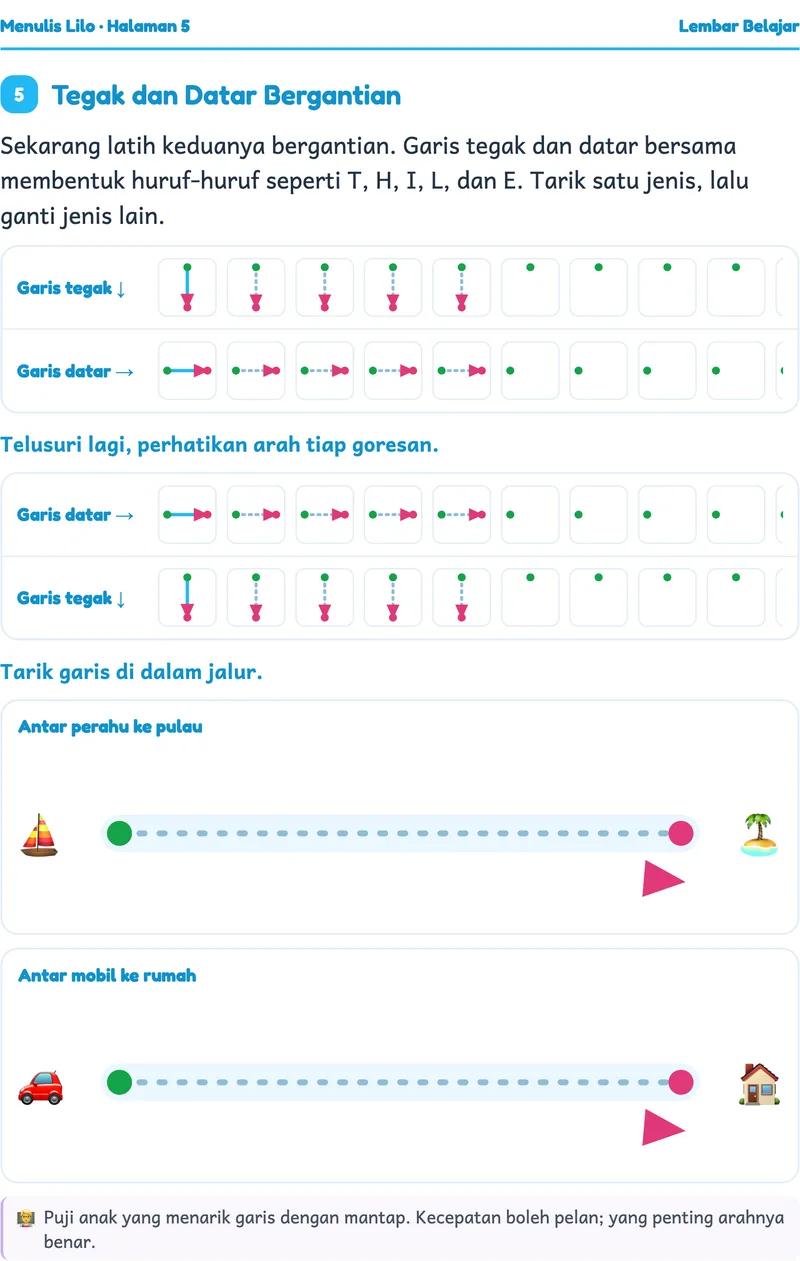
A real writing-module page: alternating straight and flat strokes train small hand muscles before the first letters.
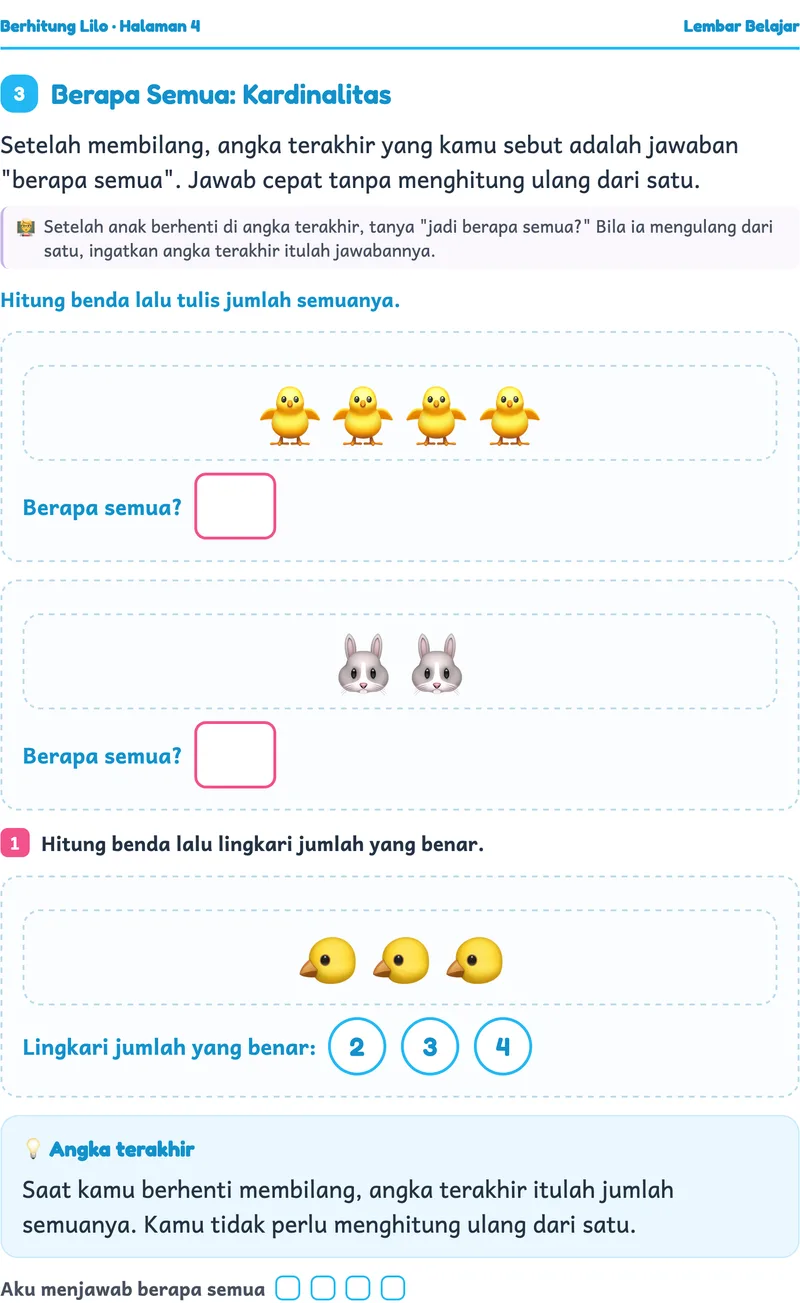
On this sheet, Introduction Level children learn to count with real objects. Each object is counted one by one, and the child then says how many there are in all. Everything starts from the concrete.
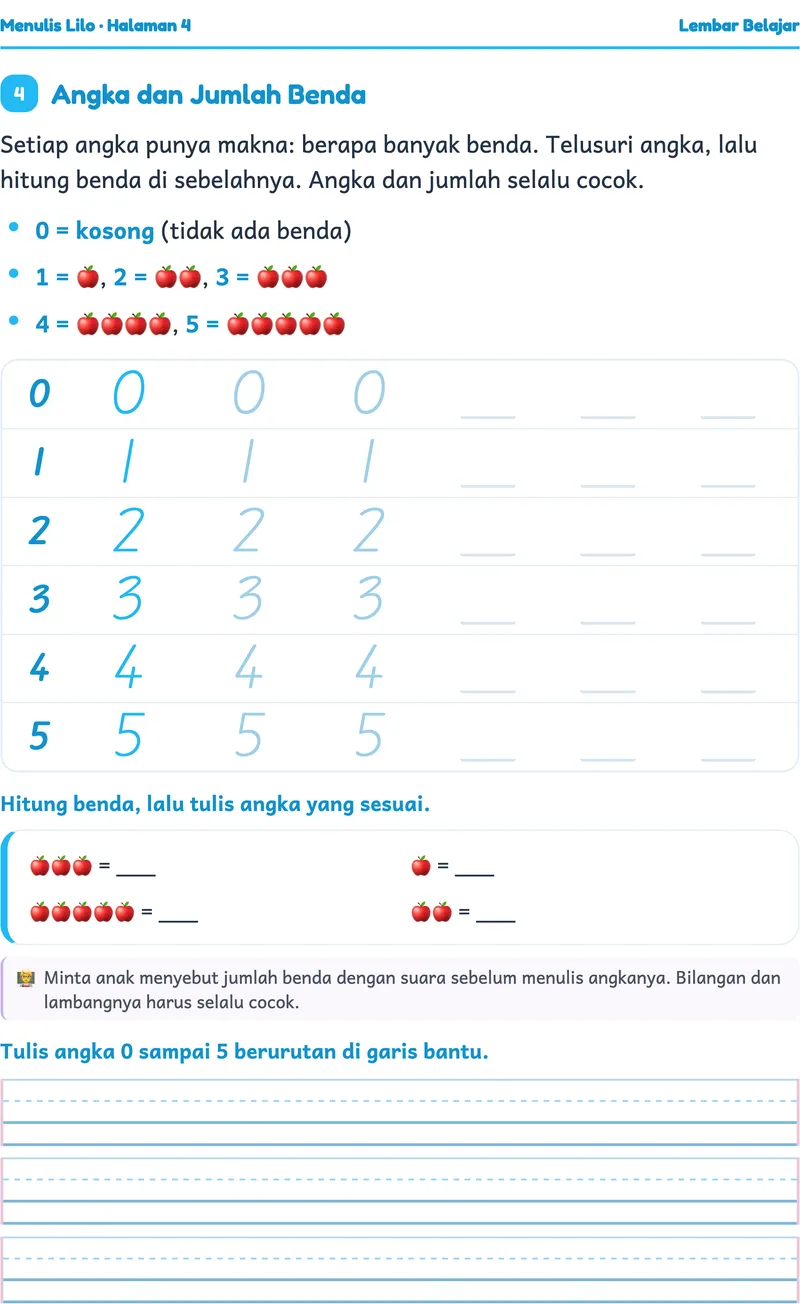
A real writing-module page: your child matches numbers to quantities and writes them neatly along guided paths.
Each sheet you see here comes from Lilo's progressive curriculum, one connected journey built from 122 modules.

Few moments beat hearing your child blend letter sounds into a real word for the first time. Tell us about your child on WhatsApp and we will suggest the right level and service.
Free consultation on WhatsApp