

Little explorers aged 3 to 4
Your child meets letters and numbers through play and real objects, with zero pressure. Sessions feel like guided playtime, and curiosity is the only requirement for starting.
Your child learns to read, write and count as one connected journey, and story problems become simple bar diagrams your child can see, draw and solve with confidence.
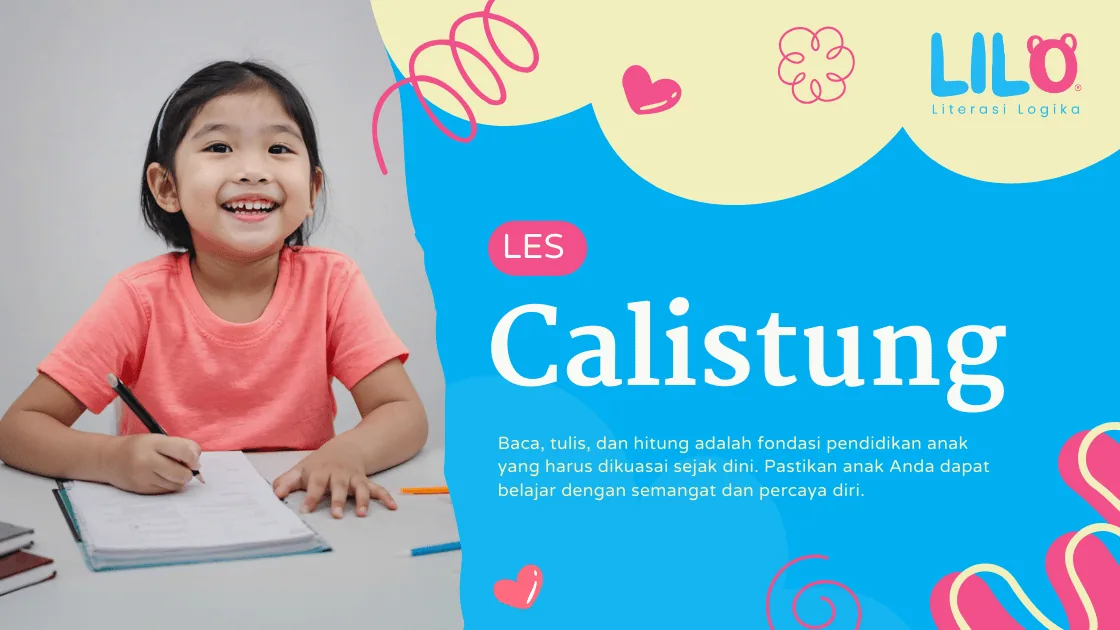
Reading, Writing and Counting in Banyuwangi is Lilo's guided program where children aged 3 to 8 learn all three skills as one connected journey, at home or online. Every idea starts with real objects, then pictures, then symbols, and story problems are drawn as simple bar diagrams so your child learns to reason. A placement assessment sets the right starting level for each child.
Every child arrives at letters and numbers on their own timeline. The placement assessment finds your child's true starting point, so lessons feel doable from the very first session.
Your child meets letters and numbers through play and real objects, with zero pressure. Sessions feel like guided playtime, and curiosity is the only requirement for starting.
Your child is getting ready for primary school. Lessons build blending, counting and early writing step by step, so the first day of school feels familiar and calm.
Your child already attends school and wants firmer footing. We strengthen reading with understanding, tidy writing and counting, then use bar diagrams to make word problems click.
If your child feels behind, the assessment finds the exact level where things still make sense. From there, steady small wins rebuild both skill and confidence.
Our lessons follow the Singapore Math path from hands to eyes to symbols, so your child understands each idea before ever memorizing it.
New ideas begin with real objects your child can touch and move, like beads or blocks. Counting five real things makes the number five mean something before the symbol appears.
Next, the same idea appears as pictures. For story problems we draw simple bar diagrams, so your child sees which part is known, which is missing, and why.
Only after the picture makes sense do letters and numbers take over. Reading grows through letter sounds, so your child sounds out new words instead of memorizing them one by one.
Each session ends with short, friendly practice built level by level. Your child levels up only after truly mastering the current step, which keeps progress honest and morale high.
Readiness shows up in small daily habits. The points below are grouped by skill, so you can match them against your child at home before lessons start in Banyuwangi.
Children in Banyuwangi draw on 1,100+ reading, writing and maths tutors across East Java. Home visits in Banyuwangi follow the nearest tutor.
Some still studying, others graduated.
Applications screened
Each file is read by our team.
ID card and diploma verified
ID card, diploma and photo are checked.
Teaching profile completed
Teaching history goes into the portal.
Trained in the Lilo method
Teaching starts after training.
Matched to your child
The team scores every answer.
Want a different tutor? Free tutor replacement, here is how
Your child moves to the next stage once the current one is truly mastered.
At the end of the first session, the tutor sums up what they saw during play. That short note is your child's opening map, and here is how to read it.
As your child picks picture cards, guesses sounds or counts buttons, the tutor notices what flows easily and where your child pauses. Those small pauses point to the stage that is just forming.
The note names the stage code where your child begins, for example S for blending syllables or B for basic counting. That code tells you which module the next worksheets come from.
A child who starts one stage below your guess is building solid footing. A firm stage makes the next step feel light, and your child feels successful from the very first week with the tutor.
The note ends with a short piece of home practice, roughly ten minutes long. It comes from the stage just identified, so your child practises something almost mastered and finishes it alone, happily.
This first note is then carried forward by the weekly report, so you can watch your child's stage code move from week to week.
From recognizing letters to understanding whole passages. Your child learns through letter sounds, blends syllables, reads sentences, and then talks about what the story actually means.
Hands get ready first with lines and patterns, then print letters take shape. Step by step your child moves from single letters to words and full sentences.
Numbers begin as real objects, grow into addition and subtraction, and mature into word problems. Bar diagrams turn each story problem into a picture your child can reason about.
Alongside the skills, every session quietly trains concentration, independence and confidence. Your child learns to sit with a task, try alone first, and trust their own thinking.
Two digit numbers are a big leap for a young child. A bundle of ten sticks lets your child see one object standing for ten at once.
A child who counts smoothly to thirty may still have no idea what 23 means. To them, the 2 and the 3 can look like two digits that happen to sit side by side. The key is one new idea: ten things can be counted as one. That idea is hard to picture, so the tutor brings it in through the hands. Your child counts sticks up to ten, wraps them with a rubber band and calls the result one bundle. Now they hold a single object with ten inside.
Next the tutor sets two bundles and three loose sticks on the table. Your child counts ten, twenty, twenty one, twenty two, twenty three, and writes the result in a two column table headed tens and ones. Bundles go on the left, loose sticks on the right. In Indonesian the name helps, since dua puluh tiga says two tens and three. The teens need extra care, because thirteen starts with the sound of three and children sometimes write 31.
The same bundles lead straight into carrying and borrowing. For 18 plus 5, the loose sticks reach thirteen, so your child ties ten of them into a bundle and ends with two bundles and three loose. For 32 minus 7, two loose sticks are too few, so your child unties one bundle first. That hand movement is what your child later pictures when writing a small digit above the column. At home, progress shows when your child explains any number using the words bundle and loose.
This picture fits a six year old starting primary school next year on the Intensive package, 12 sessions a month or about three a week. Children this age usually know some letters already, so the journey begins with blending sounds.
Your child blends sounds into whole syllables such as ma, mi and bu, then reads short two syllable words. The hand practises straight line capital letters on the worksheets of each session.
Your child reads short words found around the house and writes their own name with the letters in the right order. On the counting side, they find pairs of numbers that make ten using buttons.
Your child ties ten sticks into one bundle and reads two digit numbers from the bundles and loose sticks. Numerals are written following the arrows, so their shapes stay consistent and neat.
Your child writes a simple sentence about their day with clear spaces between words. Addition with carrying begins with bundled sticks, before moving to numbers written in columns on paper.
Your child reads a short story and answers who and why in their own words. Simple word problems are drawn as bar diagrams, so your child sees clearly what is known and what is missing.
By the end of month five, your child steps into primary school with reading, writing and counting that support one another.
Home practice stays short and feels like play. These four activities use things you already have, and each one trains a clear stage.
You say a starting sound, such as b, and your child hunts the room for objects that begin with it, like a ball, a book or a bag. Then your child sets the riddle for you. This game sharpens listening for the letter and syllable stages.
Things in the living room, nothing extra
Your child hides a few bundles and loose sticks under the paper, then gives a spoken clue such as two bundles and four loose. You guess twenty four. Then you swap roles, so your child practises building and reading tens and ones from both directions.
Ice cream sticks, rubber bands, a sheet of paper
Your child writes a short note for someone at home, such as come and eat or thank you, and sticks it on the fridge door. The reply comes back as a short note too, so your child reads it alone. This trains word reading and neat writing together.
Sticky notes or paper scraps, a pencil
Your child draws something from their day, then writes one or two sentences underneath, like I played ball. You read the letter together before it is posted or handed over in person. Your child discovers that writing has a reader, and the wish to write grows.
Paper, crayons, a used envelope
Our approach comes from Lilo's own curriculum of 122 leveled modules, built so children understand each idea before they are asked to use it.
A child who can draw a problem as a bar diagram has already done the hardest part of solving it.
Story problems are drawn as simple bars, so your child sees the whole, the parts, and the missing piece. This trains reasoning that carries into every subject at school.
Every new idea begins with something your child can hold. Real beads and blocks make numbers concrete, so symbols arrive later as names for things your child already understands.
Your child learns the sounds letters make and blends them into words. This unlocks new words independently, so reading grows on its own instead of stalling at memorized lists.
Short, warm practice built level by level builds a steady habit. Small portions done often beat long cramming sessions, and your child levels up only after real mastery.
These stages come directly from Lilo's own module ladder, so you can always see where your child stands and what comes next.
Most of these come from love and hurry at the same time. Knowing them early saves your child months of frustration and keeps learning sweet.
Why it happensFacts learned by rote have nothing to hang on to, so they fade fast and the child starts to find learning sour.
How Lilo helpsLet every idea start concrete. When your child can show five with beads and draw it, the symbol 5 finally has meaning that sticks.
Why it happensSmall hand muscles need preparation. Pushing letter writing before the hand is ready produces shaky results and real frustration.
How Lilo helpsBegin with lines, curves and patterns. Once the hand moves comfortably, letters form almost naturally and your child feels proud instead of pressured.
Why it happensA child who chants one to ten without touching real objects is reciting sounds. The counting is empty, and word problems later feel impossible.
How Lilo helpsCount real things first, then pictures, then symbols. Later, drawing problems as bars keeps that concrete understanding alive at every level.
Why it happensA few rushed months cannot replace a gradual build. The child enters school tense, with thin skills sitting on no foundation.
How Lilo helpsStart earlier with short, regular sessions. Steady practice in small portions builds skill and calm together, so day one of school feels easy.
Why it happensReading, writing and counting feed each other. Taught in isolation, one races ahead while the others lag, and progress turns lopsided.
How Lilo helpsWeave them together the way Lilo does: a word read becomes a word written, and a story read becomes a problem counted.
60/90/120 minutes
Contact us
choose 60, 90, or 120 minutes
Contact us
60, 90, or 120 minutes per session
Contact us
The way in is short. Your child needs no preparation at all, and you only need to describe how they learn day to day.
You message the Lilo team on WhatsApp and tell us your child's age, what they can already do, and what makes them lose interest quickly. This free consultation is the first input for finding the right tutor.
The team matches your child with a tutor who covers your area, or an online tutor if you prefer. You can read the tutor's profile before the first session, so the person at the table already feels familiar.
You choose the learning days and a session length that suits your child's rhythm, then pick a monthly package by the number of sessions. Payment is made per package, and the first date is agreed together.
The tutor arrives at your home or greets your child on screen, then starts a game. Through that game the tutor finds your child's starting point with no written test, so the first meeting feels fun from the opening minutes.
Families in Banyuwangi have several good ways to help a child learn. Here is a fair look at how they differ.
Real objects first, then pictures, then symbols
Drawn as bar diagrams so the child reasons it out
Placement assessment, level up only after mastery
A live tutor watches, asks and adjusts in real time
Reading, writing and counting woven into one journey
After a month, your child brings home a neater handwritten name, a handful of words they can now read, and sums they worked out alone. Payment comes in packages, and each session costs less as the package gets longer. The Regular package of 8 sessions, the most popular choice, costs IDR 604,782, whether with a tutor at home or in an online class.
The tutor observes how your child learns and finds what keeps them engaged.
IDR 307,460The tutor rotates letters, handwriting and numbers in balanced weekly portions.
IDR 604,782The tutor traces the gaps and fills them with step-by-step practice.
IDR 891,965The tutor guides your child from first letters to solving picture word problems.
IDR 1,692,684Written into the Lilo Terms of Service.
Just tell us, any time.
The steps:
Topped up by a monthly report.
These five questions are worth asking any tutoring provider in Banyuwangi. The answers show whether your child will learn at a fitting pace in a comfortable setting.
Young children grow at very different speeds. Healthy lessons move a child up once a stage is truly mastered, whenever that happens. At Lilo, your child advances after the stage beneath is solid, and you can follow the stage code yourself.
Fair pressure keeps a child curious, while fear of mistakes pushes them away from books. Ask how each session ends. At Lilo, the tutor closes every session by summing up what your child has mastered, so success is what they remember.
Young children need something to hold even when learning through a screen. Ask whether materials are ready before class starts. For Lilo online classes, the link and worksheets arrive beforehand through app.lilo.id, so your child is ready from the first minute.
A five year old and an eight year old hold attention for very different stretches. A good provider offers a choice of lengths and adjusts as the child grows. Lilo sessions run 60, 90 or 120 minutes, chosen to fit your child.
The bond with a teacher shapes how eager a young child feels about learning. Ask whether a teacher can be changed and what it costs. At Lilo, a new tutor is matched at no cost if the fit is not right yet, and this service promise is kept firmly.
Bar diagrams, concrete objects and letter sounds all point the same direction: a child who understands. Skills learned with understanding stay, and they transfer to everything at school.
Reading, writing and counting reinforce each other in every session. A word your child reads becomes a word to write, and a story to count with.
Lilo teaches from its own library of 122 leveled modules. Your child follows a tested ladder, and you can see exactly which rung comes next.
Verified tutors teach one on one at your home, whether you live in Banyuwangi Kota, Rogojampi, Genteng or nearby areas. Online sessions reach every family in Banyuwangi.
Lessons can run in English or Indonesian, whichever suits your family. English here is the language of instruction, and the subject is always reading, writing and counting.
A placement assessment starts every journey, so your child begins where things make sense. Moving up requires mastery, which keeps confidence growing alongside skill.
Banyuwangi is a regency of East Java Province, set on the far eastern edge of Java. People call it the Sunrise of Java, since the first light of day reaches the island here. Its proudest possessions are the Osing culture that people still live every day, oral traditions passed on through the years, and natural wonders like Pulau Merah and Plengkung that have spread its name far beyond the region. Kemiren Village is cherished as a guardian of local heritage. Here, in a place so rich in culture, Lilo supports every child in Banyuwangi. Your child can study with a teacher who visits your home, or join an easy online class.
A teacher meets your child at your home, anywhere in our Banyuwangi service areas. Lessons follow a clear set of materials, move one small step at a time, and slow down or speed up to match what your child can do.
Every lesson builds on the one before, starting from the simplest basics. Your child goes up a level only once the current one is truly understood, so reading, writing, and arithmetic rest on firm ground from day one.
If your home is far from our service areas, your child can still learn through live online classes with a teacher, with the same complete materials and guidance as at home.
Elzio used to struggle to focus while studying. Now he can sit calmly and finish his worksheets on his own. His numbers and letters look much neater too.
Latifah really looks forward to her lessons, she says they are fun. She is starting to understand addition using things around the house, like counting spoons while helping set the table.
These are original sheets from Lilo's calistung materials. Reading, writing, and counting are trained side by side at each level, so all three grow together from first steps to mastery.
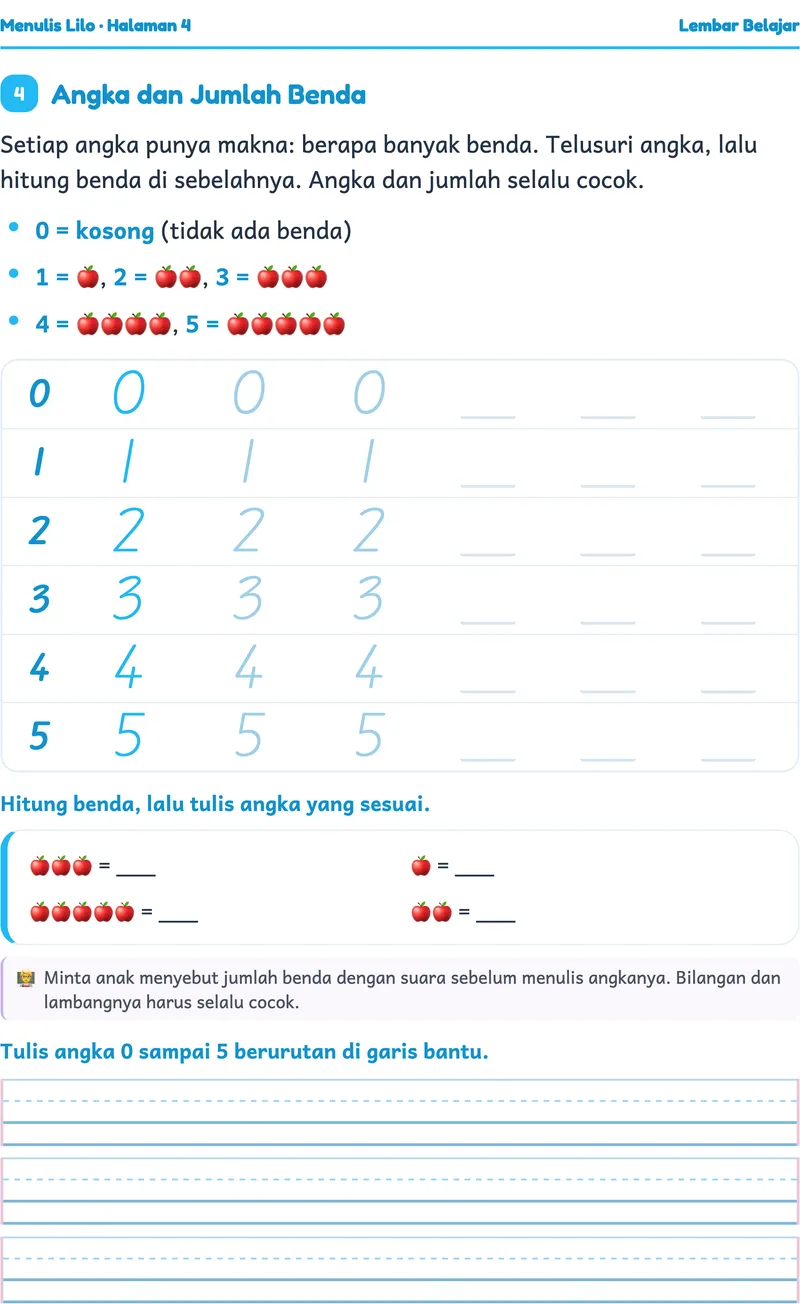
This Basic Level sheet from the writing module pairs two activities: matching numerals to the right quantity of objects, then writing each numeral neatly along a guided path. Hand and understanding train together.
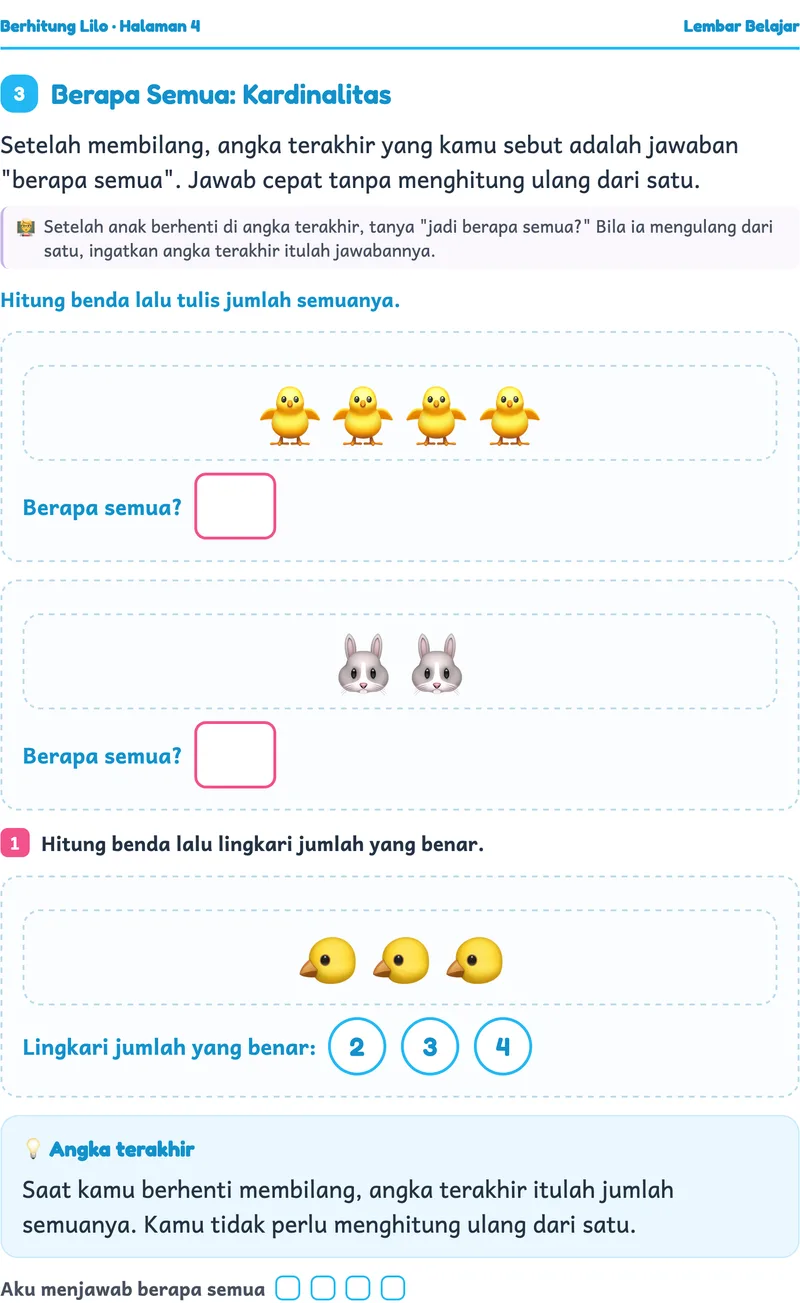
On this sheet, Introduction Level children learn to count with real objects. Each object is counted one by one, and the child then says how many there are in all. Everything starts from the concrete.
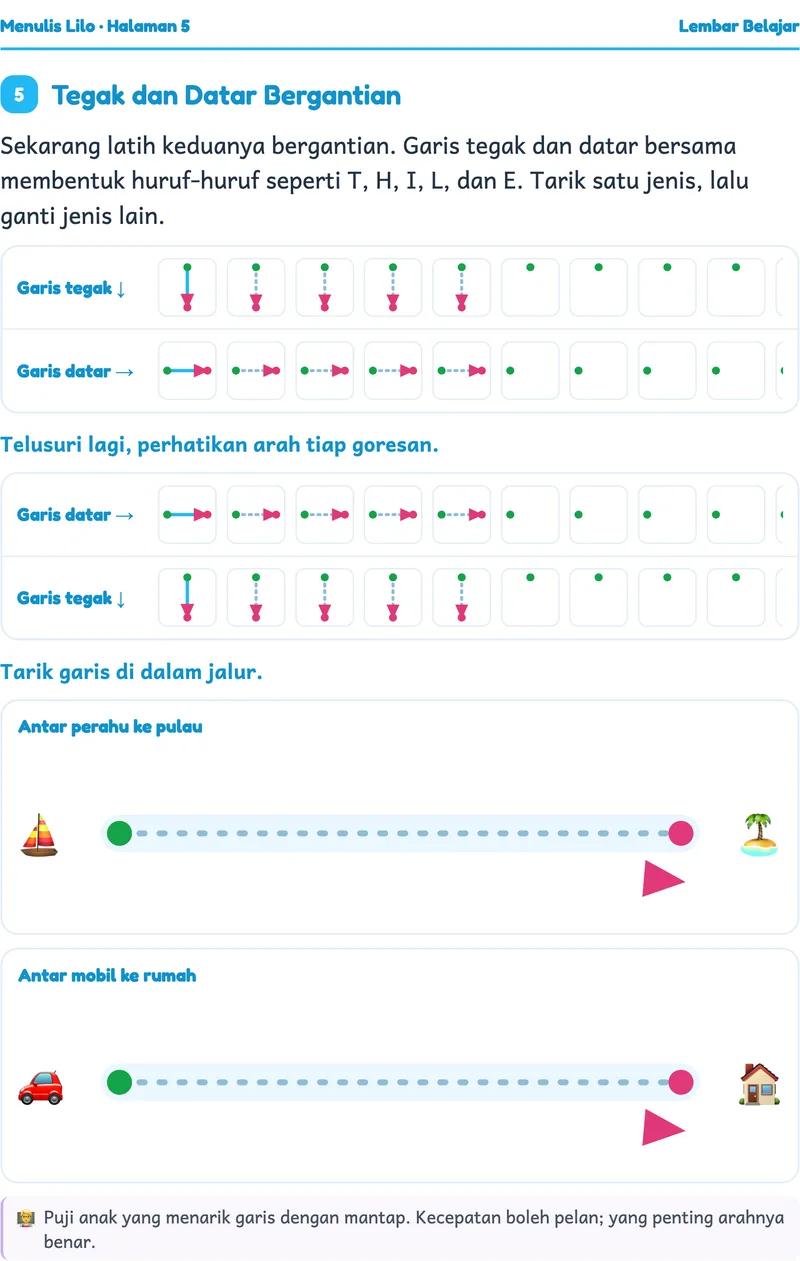
This Introduction Level sheet from the writing module has children draw vertical and horizontal strokes in turn. The simple exercise strengthens the small muscles of the hand before letter writing begins.
Snippets from Lilo's own 122 leveled modules, from first letters and numbers to being ready for primary school.

Tell us about your child in a free WhatsApp consultation. We will suggest the right level and service, and you decide the pace from there.
Free consultation on WhatsApp