


Little explorers, ages 3 to 4
Your child is meeting letters and numbers for the very first time. At the Introduction Level everything happens through play: songs, real objects and simple patterns, with zero pressure to perform.
One placement check shows where your child stands today. From there, four levels guide the journey from first letters and numbers to confident reading, neat writing and solid counting before primary school.
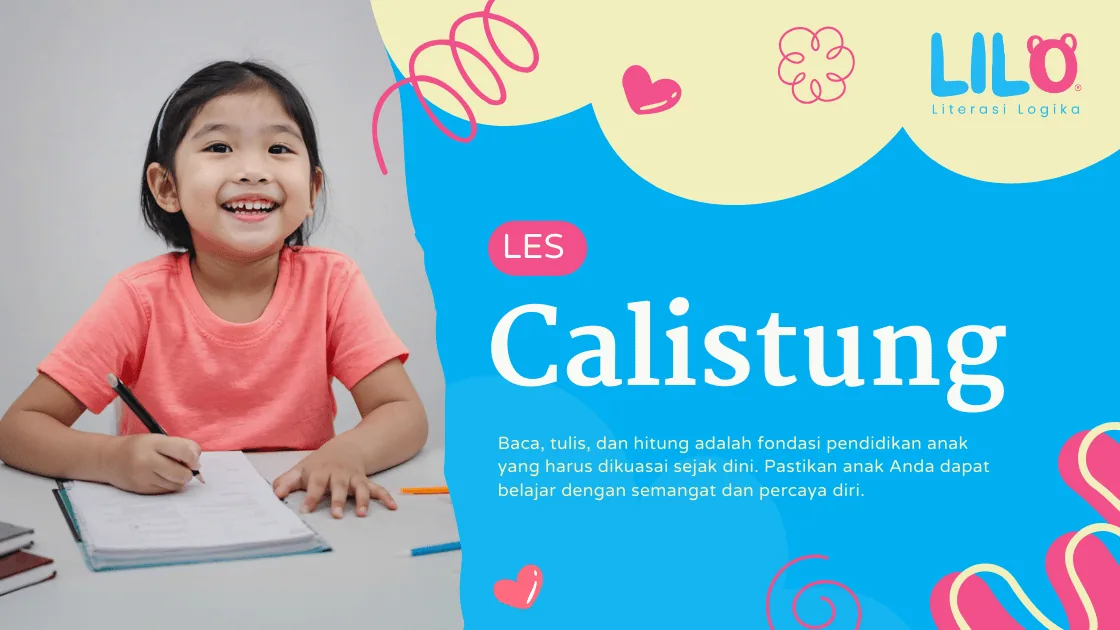
Reading, writing and counting in Batam is a Lilo program that teaches the three skills together as one journey, arranged in four levels for children aged 3 to 8. Lessons begin with real objects your child can hold, move to pictures, and only then to letters and numbers. A placement check decides the starting level, and your child moves up after true mastery.
Lilo meets your child at their current stage. These are the children who thrive in this program, each one starting at the level that truly fits.
Your child is meeting letters and numbers for the very first time. At the Introduction Level everything happens through play: songs, real objects and simple patterns, with zero pressure to perform.
Primary school is on the horizon. Your child practices joining syllables, counting and early writing, building calm confidence so the first day of school feels exciting to look forward to.
School has started and the three skills now carry every subject. Your child strengthens fluent reading with understanding, steadier writing and solid counting, so homework feels lighter week by week.
If your child sits behind classmates, the placement check finds the level where learning actually works. Starting at the right step turns frustration into small wins that add up quickly.
Your child advances one stage at a time, with a check at every move.
Every session follows the same gentle path that helps ideas truly stick, whether your tutor comes to your home in Batam or teaches online.
New ideas arrive as things your child can touch: beads, blocks, cards. Once the idea feels familiar in the hands, we move to pictures, and only then to written numbers and letters, the way Singapore Math builds understanding.
Reading starts with the sound each letter makes. Your child blends those sounds into syllables and words, gaining a key that opens any new word on any page independently.
Story problems become simple bar drawings. Your child sketches what the question says, sees the parts and the whole, and reasons a way to the answer with growing logic.
Practice comes in short, friendly portions built level by level. Your child masters one step completely before climbing to the next, so every level up is earned and remembered.
From recognizing single letters to enjoying whole passages with understanding, this module walks your child through syllables and sentences one confident step at a time.
Hands get strong before letters get neat. Your child traces lines and patterns, forms print letters, then builds up to writing full words and sentences.
Numbers begin as objects your child can count and move. Addition and subtraction grow from there, until story problems can be solved with real understanding.
Learning habits matter as much as skills. Each session quietly trains concentration, independence and the confidence to try, make mistakes and try again.
Carrying and borrowing is where many children start memorising rules they do not understand. The key sits in ten sticks held together with a rubber band.
The small digit written above the tens column stands for one bundle of ten. A child who has never bundled ten sticks by hand sees it as a mysterious mark and memorises the instruction to carry one, a rule that wobbles the moment a sum looks different. So the tutor holds the numbers back. Your child gets a handful of ice cream sticks and rubber bands, ties every ten into a bundle, recounts each bundle to be sure, then puts bundles on the left of the table and loose sticks on the right.
For 27 plus 15, your child sets out two bundles and seven sticks, then one bundle and five sticks. The loose sticks add up to twelve, too many for the right side. Your child takes ten of them, ties a new bundle and slides it to the left. Now there are four bundles and two sticks, which makes 42. Along the way, the tutor has your child draw each bundle as a circled line. When the small carried digit finally appears on paper, your child recognises it as the bundle they just moved.
Borrowing runs the other way. In 32 minus 17, your child has only two loose sticks yet needs to take away seven. They untie one bundle, and the loose pile becomes twelve. Seven go, five stay, and one of the two remaining bundles goes too, leaving 15. A child who only memorised often writes 25, because in each column they took the smaller digit from the larger one. The sign of understanding you can watch for at home is simple: your child explains in their own words why the bundle had to be opened.
Four signatures shape every Lilo session, drawn from our own curriculum of 122 leveled modules and refined for children aged 3 to 8.
Beads, blocks and picture cards come out before any worksheet. When your child can show an idea with their hands, the written version makes sense instantly and stays understood.
Your child learns what each letter says, then blends those sounds into syllables and words. This gives them a key that unlocks new words on their own, anywhere.
A tricky story problem turns into a simple drawing of bars. Your child sees the parts, sees the whole, and learns to reason toward the answer step by step.
Short, regular portions built level by level keep skills sharp and spirits high. Mastery decides when your child climbs to the next level, so progress is always real.
These codes come straight from the leveled modules your child will actually use in class.
Many well-meaning habits slow children down. These are the patterns we see most often, and how the Lilo approach quietly fixes each one.
Why it happensChants and drills can sound impressive, yet knowledge that was never understood fades within weeks and leaves a sour feeling about learning.
How Lilo helpsLilo builds every concept with real objects first, so what your child learns is understood, remembered and enjoyed.
Why it happensWhen hand muscles are still developing, long writing drills bring pain and frustration, and children start avoiding the pencil altogether.
How Lilo helpsThe Introduction Level trains little hands with lines and patterns first, so letters arrive once the hand is ready.
Why it happensA child who only recites numbers can count aloud without knowing what the numbers mean, and word problems later become a wall.
How Lilo helpsCounting starts with objects your child can hold and move, then pictures, then symbols, so meaning always comes first.
Why it happensSqueezing three skills into a few rushed months creates pressure and shallow results at exactly the wrong moment.
How Lilo helpsStarting earlier lets your child climb the four levels calmly, in small steady portions, and arrive at the first school day relaxed.
This picture follows a four-year-old learning online at home, eight sessions a month on the Regular package, roughly two a week. Each session moves through short, changing activities, so a child this age stays happy in front of the screen.
Your child meets letter sounds through objects they lift toward the camera, such as a ball for the b sound. Sitting and listening to a tutor on screen while holding something real soon feels natural.
Your child practises gripping the pencil, drawing lines and making circles on worksheets printed before class. Straight-line capital letters such as L, T and E begin to appear on the page.
Familiar sounds now join into whole syllables like ba, bi and bo. Your child reads them by their sounds, without naming each letter one by one, and lights up every time a new syllable appears.
Your child counts buttons or spoons up to ten, then meets number pairs, for example five buttons that split into two and three. The written digit arrives once the objects make sense.
Syllables join into short words such as buku and bola. Your child also writes their own name with every stroke going the right way, an achievement they will probably want to show you straight away.
Your child moves on once the current stage feels solid, so the order stays fixed while the pace follows your child.
The plants on your porch, the fish in the tank and the kitchen counter are practice spaces that never close. Each of these four short activities uses what you already have and trains one clear stage.
| Activity | Time | What you need |
|---|---|---|
Name signs for plants and petsYour child writes the name of a plant or pet, perhaps MELATI or MIMI, in straight-line capitals. You write a faint model first and your child traces over it. The sign goes on the pot or cage, so your child reads their own writing every day. Stage practised: neat writing. | 10 minutes | card, crayons, tape |
Count the leaves before wateringBefore watering, your child counts the leaves on one stem, touching each as they say the number. Then they pour the number of cups you agreed on together, say three. Touching while counting teaches one object for one number. Stage practised: basic counting. | 5 minutes | a potted plant, a small cup of water |
Bundle ten chopsticks in the kitchenTip out a few dozen chopsticks and ask your child to band them in tens. Bundles go in the left bowl and loose ones in the right, then ask for the total. For an older child, add loose sticks until there are more than ten and let them decide to make a new bundle. Stage practised: counting and place value. | 15 minutes | chopsticks or straws, rubber bands, two bowls |
Syllable hunt on spice packetsWhile you cook, your child picks a packet and hunts for a syllable they know, such as ga in garam or gu in gula. They read it by sound, then try joining the next syllable. Every word they manage can be announced proudly to the whole kitchen. Stage practised: joining syllables. | 10 minutes | spice packets, a flour bag, an egg carton |
duration of 60, 90, or 120 minutes
Contact us
60, 90, or 120 minutes
Contact us
60/90/120 minutes
Contact us
Two things shape your child's experience most: feeling at ease with the teacher and attention aimed entirely at them. These questions are fair to ask any tutoring provider.
| Question to ask | Why it matters |
|---|---|
What happens if my child and the teacher do not click? | Young children learn through feeling safe. A shy child goes quiet even when they know the answer, so ask what the provider does when the fit is wrong. At Lilo, a replacement tutor is arranged at no cost whenever the match does not feel right, and that is a firm service promise. |
Does one teacher stay focused on one child for the whole session? | With one teacher beside one child, every small hesitation is visible, like a finger pausing halfway through a count. Mistakes get fixed on the spot, before they turn into habits. Lilo private lessons are built around one tutor working with one child. |
How is my child's starting point decided? | A child who starts too high gives up quickly, and one who starts too low gets bored. A good provider has a clear way to find the first stage. At Lilo, the starting point comes from games in the first session, with no written test involved. |
Can I learn about the teacher before the first lesson? | Knowing the teacher's name and background helps you prepare your child. At Lilo, you can read the tutor's profile before the first meeting, and tutors come from a national network of more than 5,000 active tutors, many trained in primary teaching, early childhood education, psychology or mathematics. |
What material is used from week to week? | Ordered material keeps a child from skipping stages, so ask where the worksheets come from. Lilo uses its own curriculum of 122 coded modules, and every worksheet is drawn from the module your child is working on right now. |
Readiness rarely shows up as reciting the alphabet. It appears in small habits around the house, in the way your child plays alone, and in the questions they bring to you.
Tutors for Batam are chosen from 200+ teachers in Sumatra. Home visits in Batam follow the nearest tutor.
Some still studying, others graduated.
Application screening
Each file is read by our team.
Documents verified
Identity and diploma are matched.
Tutor profile filled in
Teaching history goes into the portal.
Learning the Lilo method first
The step-by-step method is learned first.
Matching per child
Candidates answer questions about the child.
Want a different tutor? See our free tutor replacement promise
The first session runs without a written test. Your child plays a few short games with the tutor, who quietly notes what flows easily and where your child pauses to think.
Your child pulls a card from a cloth bag and says the sound it makes. The tutor notes which letters come instantly, which get mixed up, and whether two sounds already join into a whole syllable.
Your child builds a tower and counts the blocks, then the tutor removes two and asks how many remain. The tutor watches whether your child recounts from one or already sees small amounts at a glance.
Your child draws a line from a cat to its bowl, makes a circle, then tries writing their own name. The way the fingers grip the pencil tells the tutor how ready that small hand is for letters.
The tutor lays out three pictures in order and asks your child to tell the story in their own words. A child who already reads words gets a short caption to read, then one question about what happened.
Here is how the first week usually unfolds after you get in touch. The order is the same whether the tutor comes to your home or teaches online, and every step has a clear purpose for your child.
You tell us your child's age, habits and where you live in Batam, perhaps Tiban or Bengkong. The consultation is free, and from that conversation the team starts matching your child with a tutor who suits them.
You can read the tutor's profile before the first session. Knowing who will arrive at your door or appear on screen lets you mention the name to your child in advance, so the first hello feels familiar.
Your child plays with letter cards, blocks and pencil trails, and the tutor uses those games to find the first stage. At the end, the tutor sums up what your child handled well and leaves one short practice to try.
The tutor's first weekly report reaches you. It can be as simple as news that your child now knows six letter sounds and is ready to join them into syllables at the next meeting.
The journey from age 3 to 8 is mapped into four clear levels. A placement check finds the right starting point, and your child climbs only after true mastery.
Lilo lessons draw on 122 leveled modules of our own original curriculum, so every session follows a tested sequence with a clear next step.
Every tutor is verified before meeting your child. Lessons can run in Indonesian, in English, or bilingually, matching how your family speaks at home.
Tutors travel to homes in Batam Centre, Nagoya, Sekupang, Batu Aji and beyond, so quality lessons happen at your own table at hours that suit your family.
Real objects and pictures come first, so letters and numbers arrive with meaning attached. What your child understands today still works next year and the year after.
The first week usually has your child getting to know the tutor while handling objects, writing a first letter and sounding out short words. Each meeting is priced at IDR 76,865 and up, settled as a bundle of sessions. The Regular bundle of eight meetings at IDR 604,782 is the most chosen option in Batam, held at home or online.
By the end, sitting and listening for a whole session feels normal.
IDR 307,460Opening the worksheet each week becomes a habit without reminders.
IDR 604,782Sketching a word problem before writing numbers becomes second nature.
IDR 891,965A little reading, writing and sums every day becomes routine.
IDR 1,692,684At home or online, the same.
No extra fee, whenever you ask.
The steps:
A full report follows each month.
Batam is an island city in the Riau Islands Province, widely known as one of Indonesia's international gateways thanks to its location close to Singapore. The city has grown into a modern industrial island city, with the Barelang Bridge standing as a proud icon connecting its chain of islands. Its neighborhoods stretch from Batam Centre and Nagoya to Sekupang, Batu Aji, and Nongsa.
Lessons happen in the comfort of your own home, in many parts of Batam. At the time you pick, the teacher shows up with materials sorted by level and walks your child through each idea, one step at a time, until it truly clicks.
Every level is built for children from 3 to 10 years old. Your child first handles real objects in their hands, then works with pictures, and finally meets numbers and letters. Each stage rests on the one below it, so what they learn holds firm.
The teacher keeps you posted on how your child is doing, week after week. Each little step forward goes on record, so you can see which skills are already secure and which exercises are worth a little extra practice at home.
Hamish can now write his letters neatly and is starting to read short words. His tutor patiently taught him the proper way to hold a pencil.
Barra started primary school feeling well prepared. His teacher said he already knows his letters and numbers well. We are thankful we began lessons before school started.
These sheets come straight from Lilo's original modules. Reading, writing, and counting are trained side by side, step by step at your child's level.
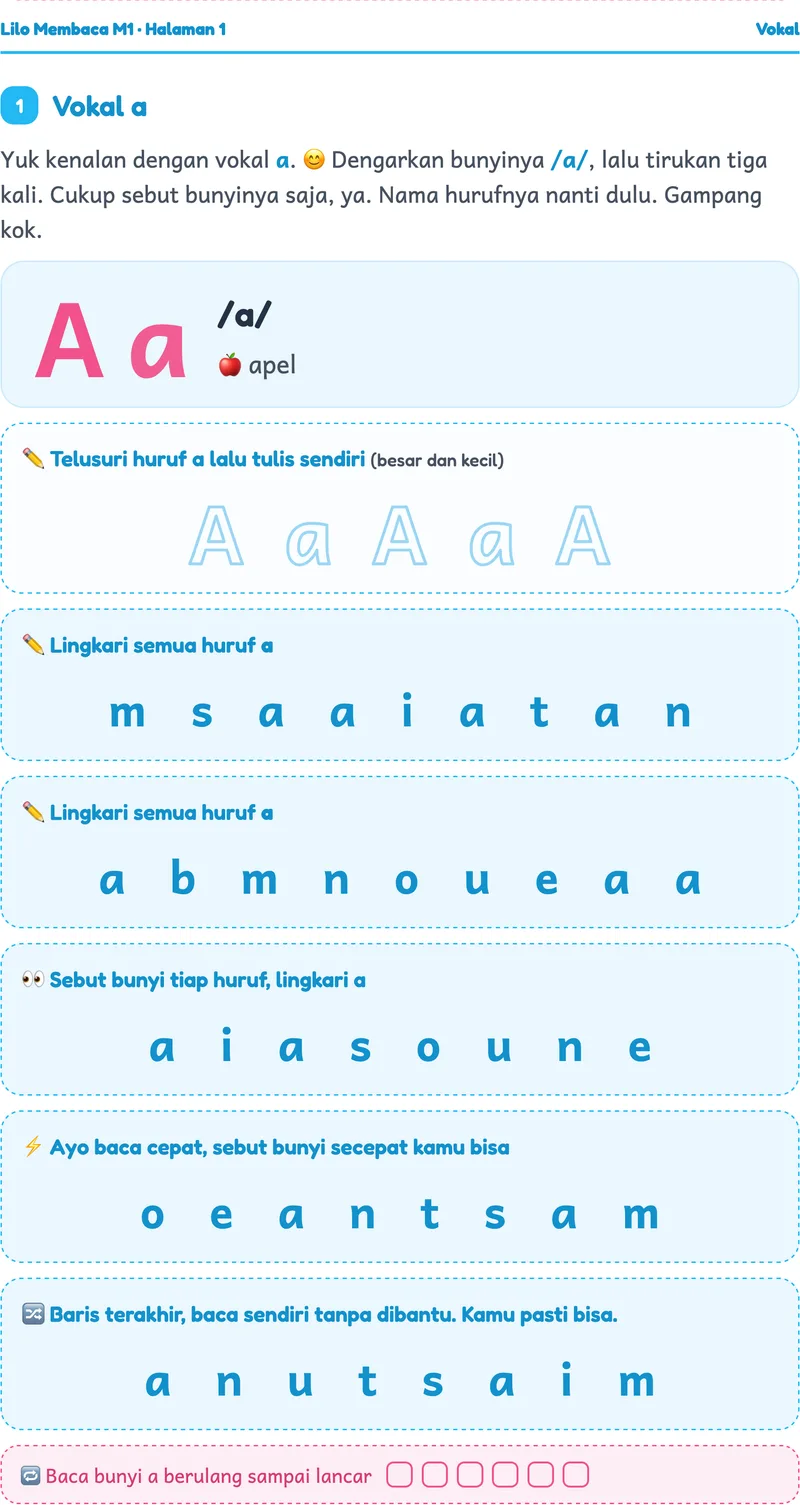
A real reading-module page: your child sounds out the vowel a with cards and point-and-read practice, the first door into reading.
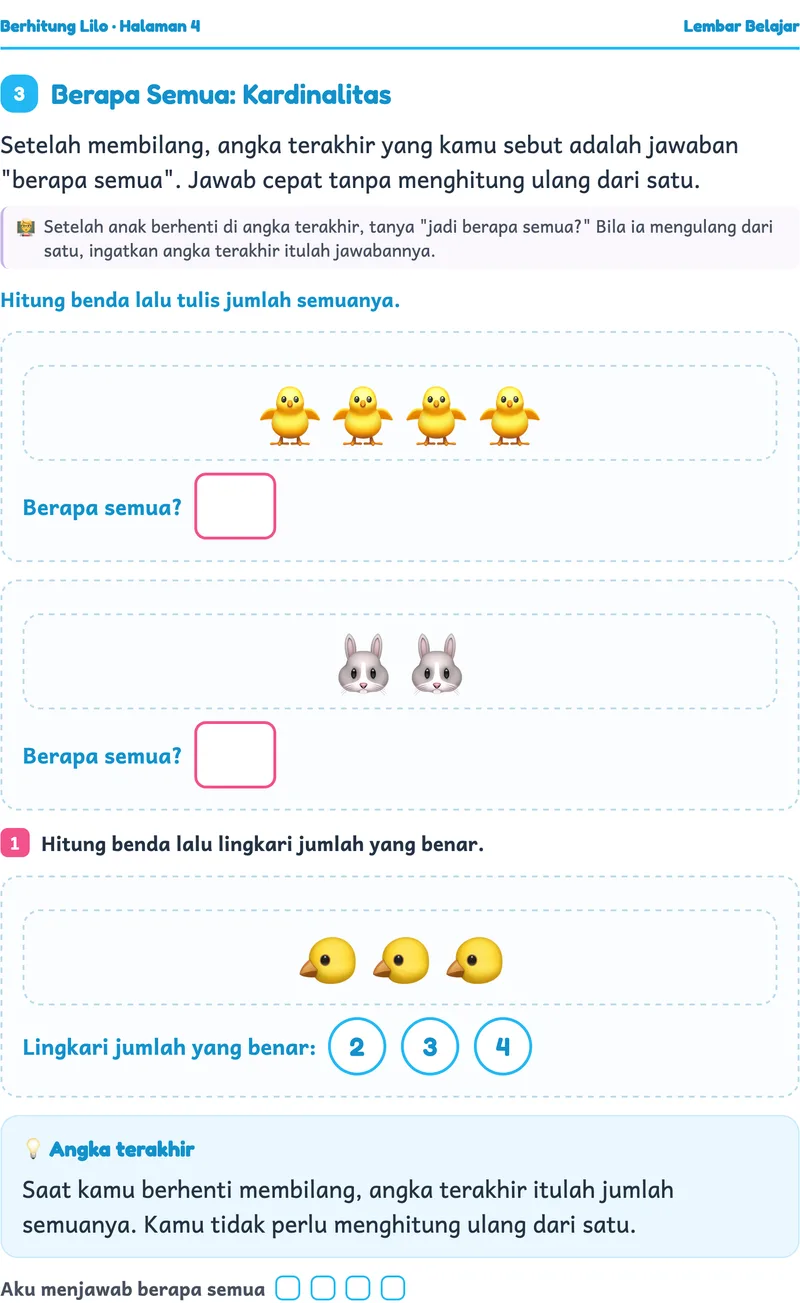
One, two, three. Children count real objects one at a time on this counting-module sheet at Introduction Level, then name the total. From this simple activity, a feel for quantity begins to grow.
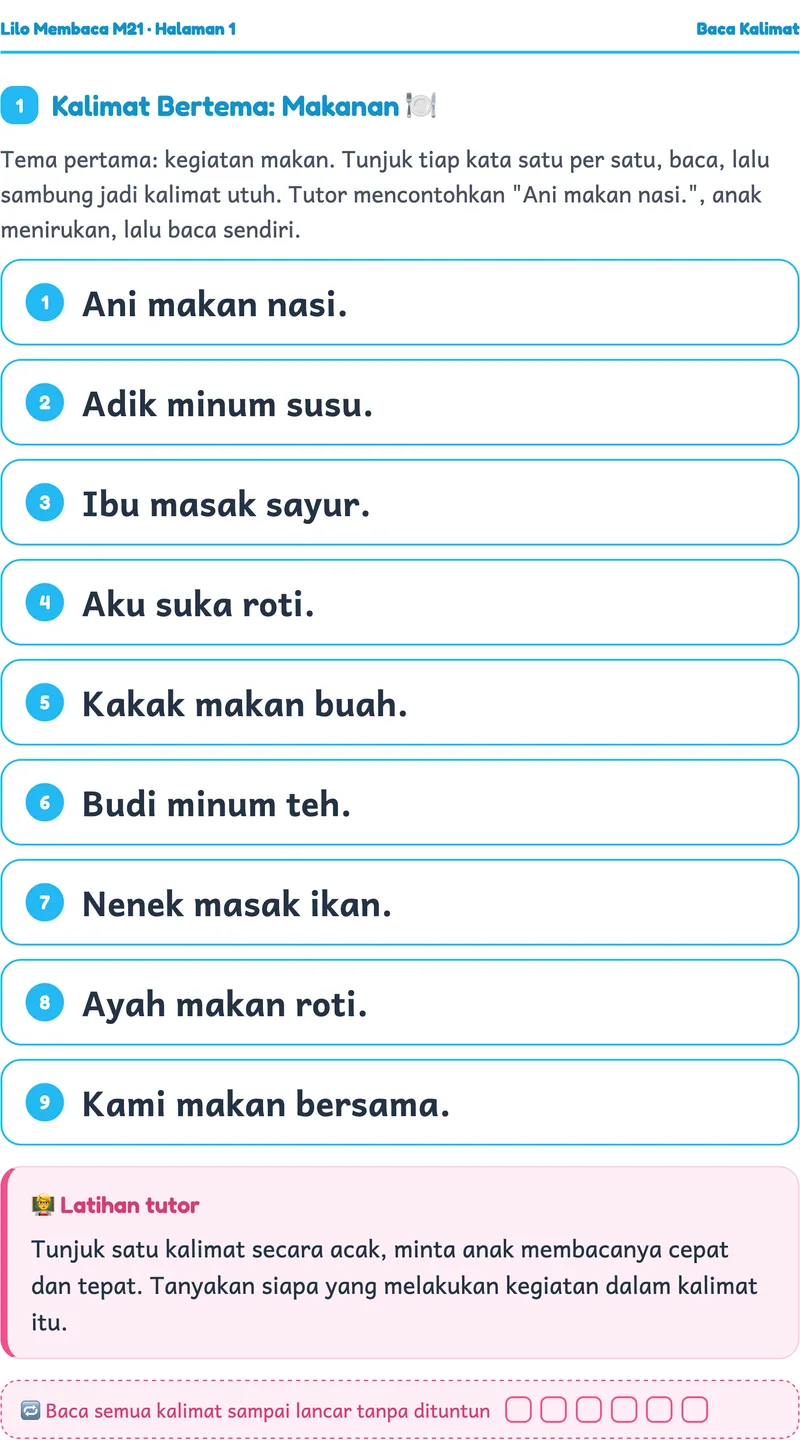
A real reading-module page: short food-themed sentences read in full, combining everything from letter sounds to syllables.
Snippets from Lilo's own 122 leveled modules, from first letters and numbers to being ready for primary school.

Message us on WhatsApp for a free consultation. We will walk you through the four levels, answer your questions and match a tutor for your child in Batam, who finds the right level in the first lesson.
Free consultation, no obligation