

Ages 3 to 4, first hellos to letters and numbers
Your child meets letters A to Z and numbers 1 to 10 through play and real objects. Sessions feel like guided fun, and small hands practice lines and patterns that prepare them for writing.
A friendly tutor comes to your home in Bekasi and works with your child one on one, weaving reading, writing and counting into a single journey with four clear levels.
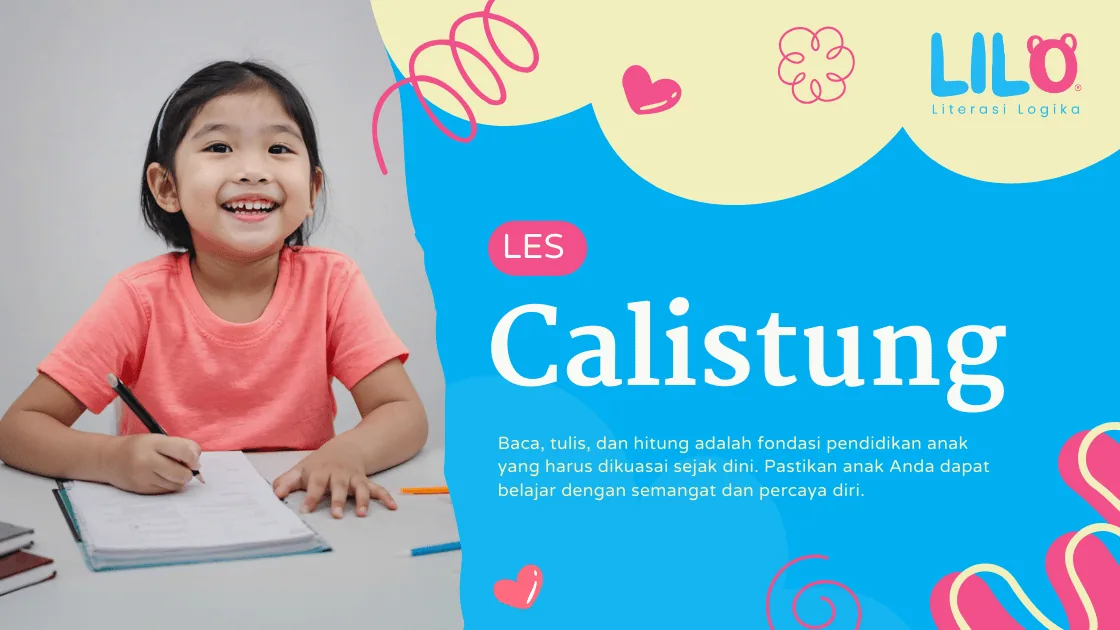
Reading, writing and counting in Bekasi is a home lesson program from Lilo where one tutor teaches your child all three skills together, from age 3 to 8. The tutor comes to your house, begins with real objects your child can hold, and moves up through four clear levels only after each skill is truly mastered.
Every child arrives at letters and numbers on their own timetable. The placement assessment finds your child's true starting point, so lessons feel right from day one.
Your child meets letters A to Z and numbers 1 to 10 through play and real objects. Sessions feel like guided fun, and small hands practice lines and patterns that prepare them for writing.
Your child learns to blend syllables, count to 20 and beyond, and write letters and numbers with growing confidence, so the step into primary school feels calm and familiar.
Your child reads with understanding, handles addition and subtraction, and writes full sentences. The tutor deepens each skill so schoolwork feels manageable and enjoyable.
The placement assessment finds the exact level where your child is comfortable, and lessons rebuild from there. Working at the right level restores confidence, and catching up follows naturally.
60, 90, or 120 minutes per session
Contact us
duration of 60, 90, or 120 minutes
Contact us
60, 90, or 120 minutes
Contact us
The method follows one simple idea: understanding comes first. Your child touches, sees and then writes, and every step is small enough to feel like a win.
Before lessons begin, the tutor runs a short placement assessment. It shows what your child already knows, so the first session starts at a level that feels comfortable and encouraging.
Your child starts with real objects like blocks and beads, moves on to pictures, and only then meets letters and number symbols. This is the Singapore Math way, and it makes ideas stick.
Reading grows from the sounds letters make, so your child can work out new words alone. Story problems are drawn as simple bars, which trains your child to reason step by step.
Steady practice in small portions, built level by level, keeps learning light and regular. Your child moves to the next level only after truly mastering the current one.
Your child moves to the next stage once the current one is truly mastered.
Readiness shows up in small daily habits. These three groups of clues help you see when your child can begin guided lessons and when a stage code is about to change.
80+ early literacy and numeracy tutors live in and around Bekasi.
Some still studying, others graduated.
Every application reviewed
Our team reads every application.
Documents verified
The team checks identity and education.
Teaching profile completed
Available hours are noted down.
Learning the Lilo method first
Lilo guides and materials are provided.
Matched to your child
Each candidate answer is reviewed.
Tutor not quite right? Read the tutor replacement guarantee
The first session feels like play. With no written test involved, the tutor watches what your child does with cards, objects and a pencil, then turns it into stage codes.
The tutor spreads picture cards and asks your child to find things that begin with /m/, such as mango. This shows whether your child sits at stage H or is ready to blend syllables at stage S.
Counting one at a time, or grabbing small groups at a glance, tells the tutor how secure basic counting at stage B already is, and whether the number words come out in order.
Pencil grip, stroke direction and letter shapes in your child's name point to where stage T, neat writing, should begin, including whether the hand needs line practice first.
Each skill gets its own stage code. Your child might sit at stage K in reading and early stage B in counting, and modules are chosen to match that uneven map.
Matching begins with what you tell us about your child. Age, habits and the way you want lessons to run guide the team toward the tutor who fits best.
The consultation is free. Share your child's age, what they already know, and whether you prefer a tutor at home or an online class. Your part of Bekasi is noted so travel works smoothly.
Over 5,000 active tutors are available, many trained in early childhood education, primary teaching, psychology and mathematics. For a child new to guided learning, the team favours tutors at ease with very young learners.
Before the first session you can open the tutor's profile and learn about their background, so the first meeting already feels familiar.
You see how comfortable your child feels. If the match is off, you get a different tutor at no extra cost. That promise is part of the service, so your child always learns with someone they enjoy.
From recognizing single letters to understanding whole passages, your child climbs one small step at a time and learns to enjoy the meaning behind the words.
Hands get ready first with lines and patterns, then your child shapes print letters, builds words, and finally writes tidy sentences with pride.
Your child gets to know numbers through real objects, then learns addition and subtraction, and finally solves word problems by drawing them out and reasoning through them.
Alongside the three skills, every session quietly builds concentration, independence and confidence, habits that carry your child through school and far beyond it.
Many children add with ease yet stall once numbers sit inside a story. The bar model gives them a bridge: draw the problem first, then calculate.
A word problem asks a young child to do two jobs at once, holding the whole story in mind while choosing the right operation. That load is heavy at five or six, so many children guess, grabbing the two visible numbers and adding them. Drawing moves the load onto paper. The story becomes a long box and a short box, and your child's mind is free to think about how the parts relate.
Take an example. Dina has 7 marbles and Raka has 3 more. How many does Raka have? Your child draws one bar for Dina and writes 7 inside. Underneath goes a bar of the same length with a small extra piece marked 3. Now the problem reads itself: Raka's bar is 7 plus 3. Your child discovers that more here means adding, and spots that 7 and 3 complete ten, a pair learned back at basic counting.
The path runs from objects to pictures to symbols. Before any drawing, your child lays real marbles or sticks in two rows; later the rows become boxes, and the number sentence 7 + 3 = 10 arrives last. At home, watch for the habit of drawing first. The weekly report captures that shift, from bars drawn together with the tutor to bars your child draws alone, whether lessons happen in Bekasi or online.
The bathroom and the garden already hold plenty of learning material. Each activity is short, uses what you have, and trains one clear stage.
| Activity | Time | What you need |
|---|---|---|
Foam letters on the bath wallWet foam letters cling to the tiles. You say a sound such as /s/, and your child finds the letter and presses it to the wall. This trains stage H, and warm water keeps your child playing happily. | 5 minutes | foam letters or cut sponge shapes |
Pouring and comparing cupsYour child pours water into two cups, counting each scoop. Which cup is fuller? How many more scoops make them equal? These questions train stage B with real objects, the step before drawing bars. | 10 minutes | two plastic cups and a small scoop |
Leaf and pebble story problemsGather six leaves and two pebbles. Tell a short story, then help your child scratch two boxes in the soil, a long one for leaves and a short one for pebbles. The drawing makes counting easier. | 10 minutes | leaves, pebbles and a stick |
Writing a name in the dirtYour child writes the capital letters of their name with a stick. Big movements on the ground strengthen shoulder and arm before small fingers work on paper, training stage T through play. | 5 minutes | a stick and damp soil or sand |
This picture follows a three year old meeting guided learning for the first time, on the Starter package of four sessions a month, roughly once a week. The pace is gentle, and each month brings one step you can notice.
Your child learns to sit with the tutor, traces raised letter cards and says the sound that opens their own name. Big lines and circles fill wide sheets of paper.
Your child links a few letter sounds to things around the house, counts to five with buttons and learns to wait for a turn in a game.
The crayon grip steadies. Your child draws upright and slanted lines that later become capital letters, and spots the first letter of their name on book covers.
Your child lines up objects to ten and sees that four and one equal five. These small number pairs carry the counting that comes next.
Your child starts joining sounds into short syllables such as ba and ma. Here you and the tutor can decide whether once a week still suits or the rhythm should grow.
This timeline is a general picture for a three year old on four sessions a month. The tutor shapes each step around your own child along the way.
Lilo teaches from its own original curriculum of 122 leveled modules, so every session at your home follows a tested path.
Every new idea begins with something your child can hold, like beads or blocks. Pictures come next, and symbols come last, so numbers and letters always carry real meaning.
Your child learns the sound each letter makes and blends those sounds into words. This gives them a key that opens any new word, on any page, without help.
Story problems are drawn as simple bars so your child can see what the question is really asking. Drawing before answering trains calm, clear reasoning.
Short, warm practice sessions built level by level build a habit of showing up. Small daily wins add up to a child who believes in their own effort.
These stages come directly from the leveled modules your child will actually use at home.
Most of these come from love and good intentions. Knowing them early saves your child months of frustration and keeps learning joyful.
Why it happensMemorized facts fade quickly and leave a sour feeling about learning, because the child never saw why the answer was true.
How Lilo helpsLilo builds every idea from real objects and pictures first, so your child owns the concept before practicing it.
Why it happensHand muscles develop gradually. Pushing letters too early leads to cramped grips, messy results and tears on both sides.
How Lilo helpsWe begin with lines and patterns that strengthen the hand, so real letters arrive when your child can actually enjoy forming them.
Why it happensA child who only recites numbers is repeating sounds. Without objects to count, the symbols stay empty.
How Lilo helpsCounting starts with things your child can touch and move. The symbols come later, already full of meaning.
Why it happensSqueezing years of foundation into a short sprint creates pressure, and pressure is a poor teacher for a young child.
How Lilo helpsStart earlier with short, friendly sessions. A gentle, steady climb gets your child to school ready and genuinely confident.
Bekasi sits in West Java Province, right on the Jakarta border, and is a key piece of the wider Greater Jakarta region. People here proudly call it Kota Patriot, the Patriot City, a title earned through a long history of struggle that residents still hold close. The city spreads across Bekasi Selatan, Bekasi Timur, Pondok Gede, Jatiasih, Harapan Indah, Mustikajaya, Rawalumbu, and Tambun. Here, a love of learning passes forward and grows stronger with each new generation.
Lessons happen where your child feels most at ease: at home. A Lilo tutor travels to your part of Bekasi at the times you pick, so your child settles in calmly and opens up to learning fast.
Lessons are arranged in clear stages, starting from the simplest. Children begin with real objects, move to pictures, then to letters and numbers. Each stage is mastered first, so understanding and confidence grow together.
Every session is recorded carefully. You receive regular progress reports, so you know exactly which skills are already strong and which parts your child is currently practicing with the tutor.
Lessons happen at your own home, one tutor with one child. Your child learns in a familiar place, and you can see the progress with your own eyes.
Lilo wrote its own materials. Every session follows a real, leveled path, so today's lesson always builds on yesterday's and points toward tomorrow's.
Real objects, pictures and bar models mean your child grasps why an answer works. Knowledge built this way stays, and your child can use it in new situations.
Every tutor is verified before teaching. Lessons can run in Indonesian, in English, or in a mix of both, whichever suits your family best.
Your child starts where the placement assessment says they should and moves up only after mastery. Progress is real, visible and worth celebrating.
Every approach has its place. Here is an honest look at how a Lilo home tutor compares with two common alternatives.
Real objects first, then pictures, then symbols
One tutor beside your child, at your home
Placement assessment, level up after mastery
Drawn as bar models and talked through together
Your own home, anywhere in Bekasi
The package chosen most often is Regular, eight sessions for IDR 1,149,085. You pay for the whole package at once, and each session blends reading practice, writing practice and number work, with a tutor at home or in an online class. Weekly reports show which skills are already solid and which still need more practice.
Four sessions a month, about one a week; tutor and learning style get mapped.
IDR 584,174Roughly a month at two sessions weekly; the practice routine settles in.
IDR 1,149,085A month at about three sessions weekly; neater writing and clearer word problems.
IDR 1,694,733A month at about six sessions weekly; all three core skills grow evenly.
IDR 3,216,100At home or online, the same.
Just tell us, any time.
How it works:
A full report follows each month.
The materials a lesson uses and the homework a child brings home reveal what the lessons contain. Ask these of any provider you consider.
Worksheets drawn from a stepped curriculum connect to that day's session, while random sheets make a child hop between topics. Ask who writes them. At Lilo, each worksheet comes from the module your child is studying, one of Lilo's own 122 coded modules.
Young children grasp numbers through things they can hold. Ask which objects are used and when your child moves on to pictures and symbols. A clear answer shows a teacher who understands how children learn.
Long homework easily turns into a battle at the kitchen table. Good homework is brief, doable with little help, and practises one new thing. Every Lilo session closes with a single light task that takes around ten minutes.
Meaningful homework bridges two sessions. Ask whether the teacher looks at it and uses it to plan the next step, so your child's effort at home always counts.
Young children learn in short pieces. A good session moves between a greeting, hands-on practice, a movement break, a worksheet and a closing. That shape decides whether your child leaves happy.
Barra started primary school feeling well prepared. His teacher said he already knows his letters and numbers well. We are thankful we began lessons before school started.
Latifah really looks forward to her lessons, she says they are fun. She is starting to understand addition using things around the house, like counting spoons while helping set the table.
These sheets come straight from Lilo's original modules. Reading, writing, and counting are trained side by side, step by step at your child's level.
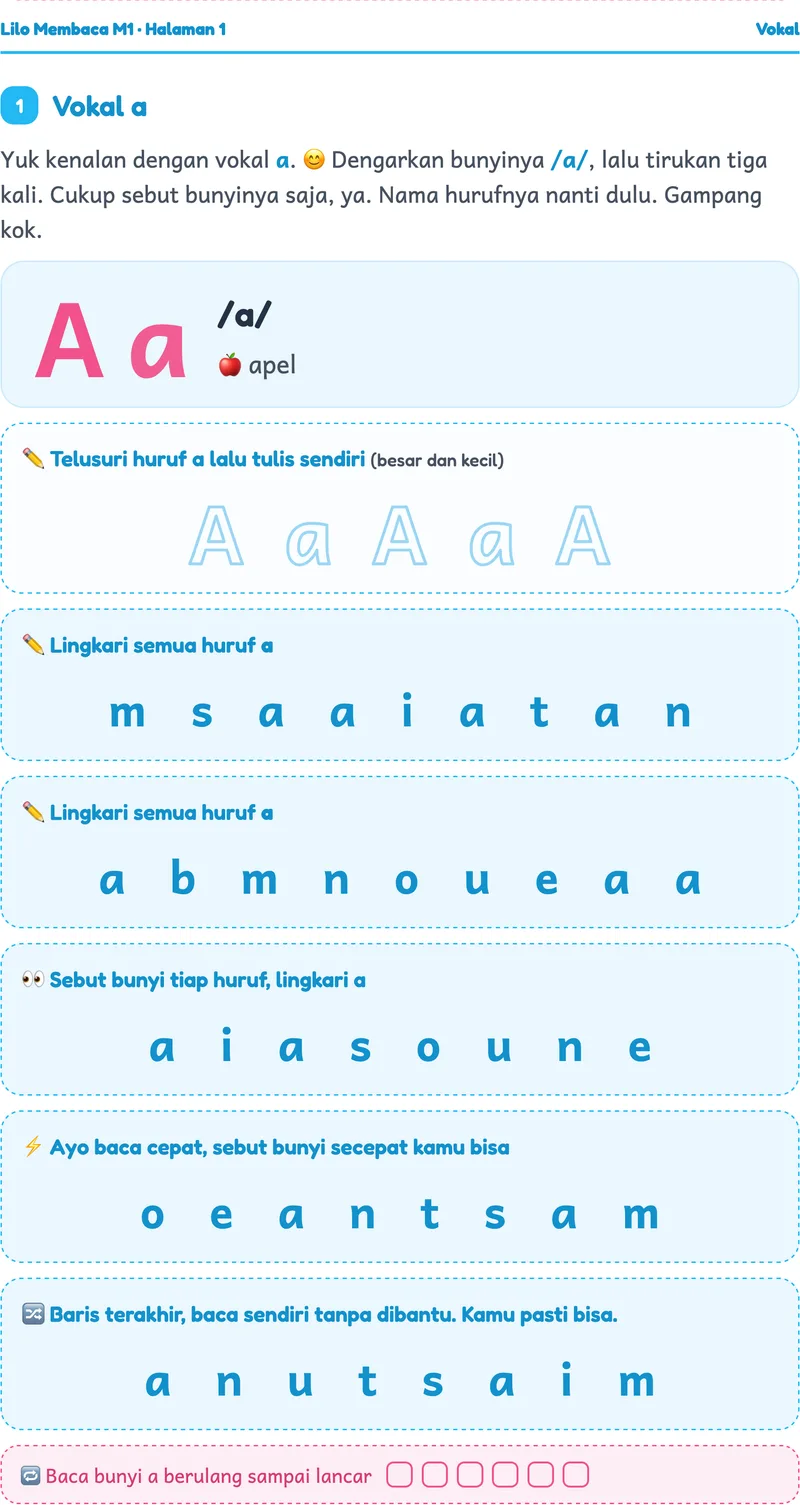
The vowel sound a opens the very first door to reading. On this Introduction Level sheet from the reading module, children meet it through cards, then point and read it again and again until it sticks.
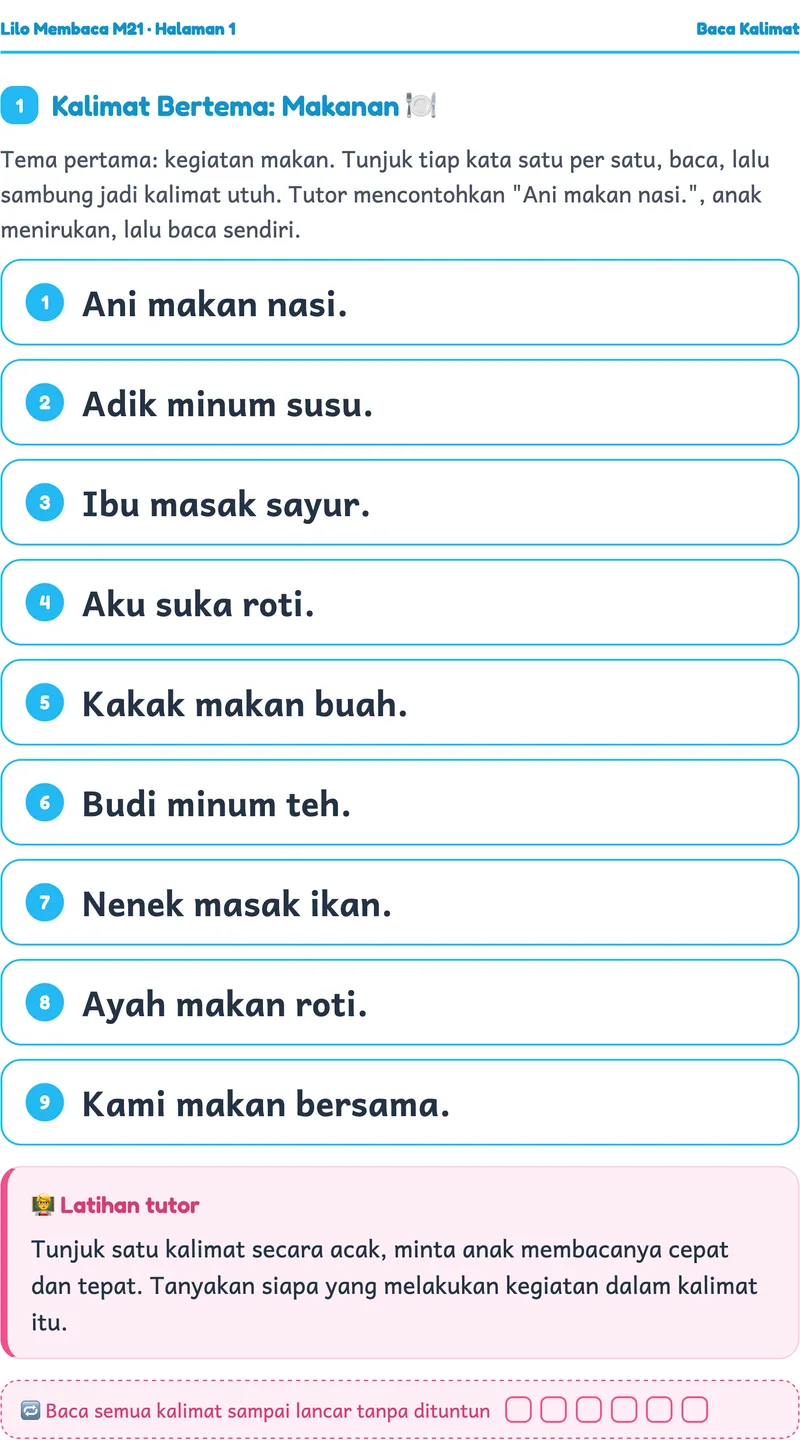
Short sentences about food are waiting on this reading-module sheet at Intermediate Level. Each sentence is read whole, the reward of all the sound and syllable practice the child has gathered so far.
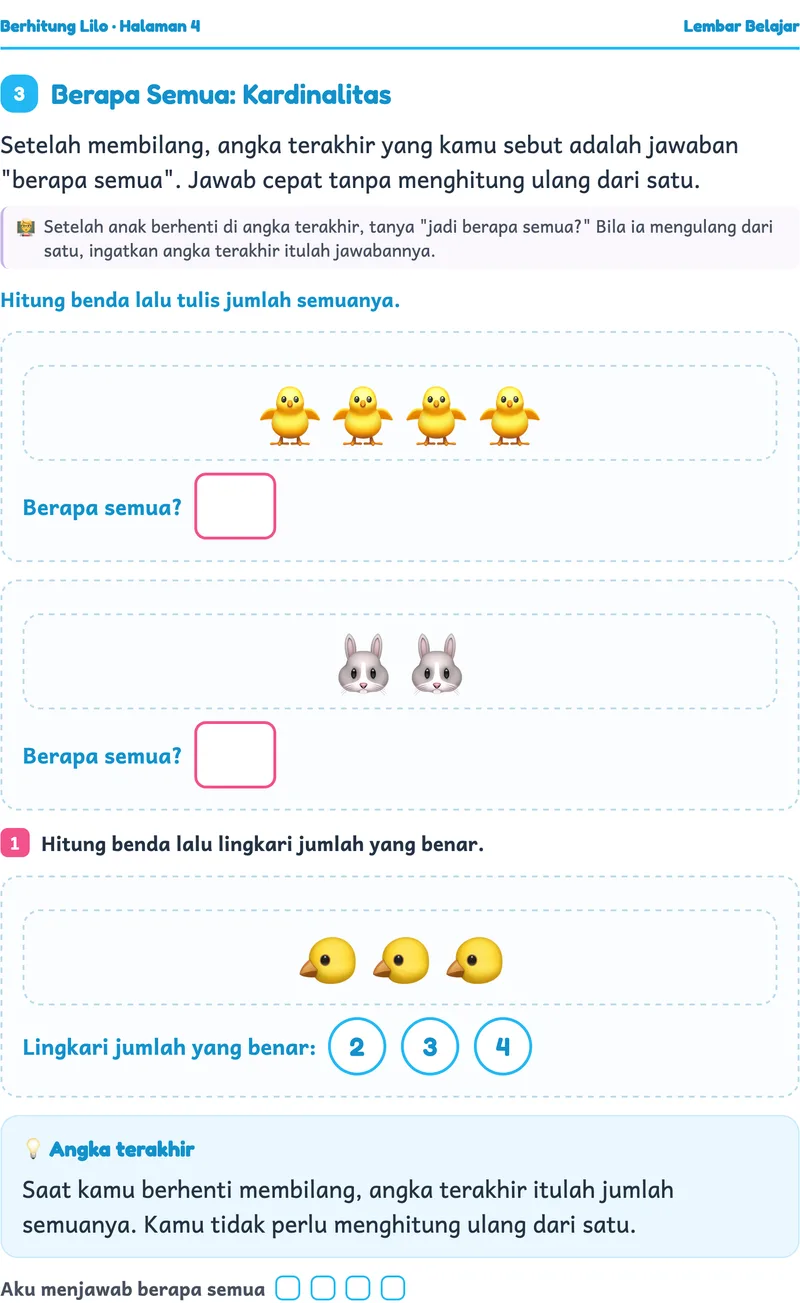
This Introduction Level sheet from the counting module invites children to count real objects one by one, then say the total out loud. It is the most natural way for a child to meet numbers.
These sheets are a small glimpse of Lilo's own progressive curriculum, carefully arranged across 122 modules.

Start with a free consultation on WhatsApp. Tell us about your child, and we will suggest the right level and a schedule that fits your family.
Free consultation, no obligation