
Little explorers, ages 3 to 4
Your child meets letters and numbers through play and touch, with zero pressure. Sorting, stacking and tracing build the small hand muscles and the curiosity that reading grows from.
A tutor comes to your home in Bogor and guides your child through reading, writing and counting as one journey, with real objects first and four clear levels for ages 3 to 8.
Reading, Writing and Counting in Bogor is a Lilo tutoring program for children aged 3 to 8 that teaches the three skills together as one journey. Your child holds real objects first, then works with pictures, then meets letters and numbers, climbing four clear levels at a pace set by true mastery, so the first day of primary school feels familiar and calm.
Every child arrives at this journey from a different point. The placement assessment tells us where yours is, and the lessons meet them exactly there.
Your child meets letters and numbers through play and touch, with zero pressure. Sorting, stacking and tracing build the small hand muscles and the curiosity that reading grows from.
These are the getting-ready years. Your child blends syllables, counts with confidence and writes letters and words, so the step into primary school feels like a natural next chapter.
Your child is already in school and now strengthens all three skills together: reading with real understanding, writing tidy sentences and solving word problems by drawing them out.
If your child has fallen behind classmates, we start at the level where they feel capable again. Small wins stack up, confidence returns and the gap closes steadily.
Understanding comes first in every session. Your child touches, sees and only then writes, so each new symbol lands on a meaning they already own.
Lessons begin with things your child can pick up: beads, blocks, cards. Counting five buttons or building a word from letter tiles gives ideas a physical shape before any symbol appears.
Next, the real objects turn into pictures. Your child counts drawn apples and matches picture cards to sounds, a gentle bridge between things they can touch and marks on a page.
Only when the idea is solid do letters and numbers take over. Reading grows from letter sounds blended into words, and tricky word problems get drawn as simple bars so your child can reason them out.
Short, friendly portions of practice built level by level keep skills warm without tiring your child. They move to the next level only after the current one is truly mastered.
The sequence is tight, so nothing gets skipped as your child moves up.
From recognizing single letters to understanding whole passages, your child learns to read through letter sounds, blending them into syllables, words and finally sentences they truly grasp.
Writing starts with playful lines and patterns that train the hand, then moves through print letters into words and full sentences your child is proud to show you.
Your child gets to know numbers through real objects, then builds addition and subtraction on that understanding, and finally reasons through word problems drawn as simple bars.
Woven through every session are habits that outlast any worksheet: sitting with a task, trying again after a mistake and the quiet confidence of a child who understands.
These four habits shape how every Lilo tutor teaches, whether the lesson happens at your dining table in Bogor or over a video call.
Beads, blocks and cards come out before any book opens. When your child has counted real things and built real words, the symbols that follow already mean something.
Your child learns what each letter says and blends those sounds into words. Every new word becomes a puzzle your child can solve on their own.
Story problems get drawn as simple bars, so your child can see what is known and what is missing. Drawing the problem trains reasoning that lasts far beyond one exercise.
Small daily portions, offered warmly and built level by level, keep every skill fresh. Your child finishes each set feeling capable and ready to come back tomorrow.
Each step comes from our own leveled modules, so you can always see exactly where your child stands and what comes next.
Most struggles with early reading, writing and counting trace back to a handful of well-meaning shortcuts. Here are the ones we see most, and how Lilo handles them.
Why it happensFacts learned by rote fade fast and make learning taste sour, because the child has nothing to rebuild the answer from when memory slips.
How Lilo helpsWe build every skill from real objects first, so your child owns the idea behind the answer and can find it again on their own.
Why it happensHand muscles develop on their own schedule, and pushing letters too early turns writing into a source of frustration and tears.
How Lilo helpsOur Introduction Level trains lines and patterns first, strengthening the hand playfully so real letters arrive when the child is physically ready.
Why it happensA child who chants numbers without ever grouping real things is reciting sounds. The symbols stay empty and word problems later become a wall.
How Lilo helpsCounting starts with beads and blocks your child can hold. By the time digits appear, each one already stands for something real.
Why it happensSqueezing three skills into a rushed sprint pressures the child and skips the mastery that makes learning stick past the entrance gate.
How Lilo helpsStarting earlier with small, steady portions lets each level settle. The first day of school then arrives as a milestone your child is genuinely ready for.
Why it happensReading, writing and counting feed each other. Taught apart with no bridges, one skill races ahead while another quietly falls behind.
How Lilo helpsLilo weaves the three together in one journey, so a word your child reads becomes a word they write and a quantity they can count.
Neat handwriting starts long before the first letter, with three fingers learning to work together and tiny hand muscles built through play.
In a three-finger grip, the thumb and index fingertip pinch the pencil while it rests on the side of the middle finger. The ring and little fingers curl into the palm as support, so the fingertips steer with small, light movements. A child who grips with a fist writes from the arm, which brings large, shaky letters and a hand that aches quickly.
Grip develops in stages: a fist first, then several fingers pointing down, then three fingers. The shift depends on small palm muscles and on the gap between thumb and index finger opening into an O. When those muscles are weak, your child presses hard enough to tear paper or snap pencil tips, a sign the fingers are overworking.
Tutors build that strength through play: picking up beads with tongs, squeezing play dough, tearing paper and colouring with short crayons. A crayon the length of a finger joint leaves no room for a fist, so three fingers take over. Lines, circles, straight-line capitals such as E and T, and numbers that follow arrows come next. In Bogor, the visiting tutor adjusts the grip with a light touch at the start of each writing activity.
The best materials are already around your home. These short activities link to the stage your child is working on with their tutor.
Your child picks up leaves and pebbles with thumb and index fingertip, sorts them into two bowls, then counts each bowl while touching every item. The pinch builds grip and the counting trains stage B.
Dry leaves, pebbles, two bowls
Your child scratches straight-line capitals such as L, T and E into the ground. Big, free movements fix the top-to-bottom stroke order before lined paper arrives, supporting stage T.
A small stick, damp soil or sand
Ask your child to split ten peanuts across two plates in different ways, seven and three, then six and four. They discover the total stays ten, a pairing that helps later with carrying.
Ten peanuts, two small plates
Write the Indonesian names of tableware in syllable pieces, such as pi-ring and ge-las, and set them beside each item. Before eating, your child sounds out each piece and joins them into a word, building stages S and K.
Spoon, plate, glass, paper slips
This picture fits a five-year-old who already knows some letters or numbers and takes the Regular package, about two sessions a week. Each new stage opens once the previous one is truly mastered.
Letters your child recognises by shape now pair with their sounds. Lines and circles build the three-finger grip, readying the hand for its first self-written letters.
Your child blends sounds into whole syllables like ma, bo and ku, then pairs syllables into short words. Counting holds steady up to twenty objects.
Words such as buku, meja and topi are read without spelling out letter names. Your child starts reading labels around the house with real pride.
Straight-line capitals and numbers that follow arrows now stand tall. Your child's name appears with even spacing, and the hand rarely aches anymore.
Your child splits ten into pairs, then adds with objects and pictures. Words they read are now words they write, so all three skills move together.
These months describe this profile. A child who moves faster steps straight to the next stage, and one who needs longer gets fitting review.
Four steps cover your child's first week in Bogor, from the first WhatsApp message to a report that shows progress.
Share your child's age, habits and what you want to strengthen. The consultation is free, and here you choose a tutor at home or online classes through app.lilo.id.
The Lilo team matches a tutor to your child's needs and your home's location, then builds the schedule. You simply confirm the days and times that suit your child.
After a playful first session, each lesson closes with a recap of what your child now owns, plus one small piece of homework, around ten minutes long, to keep practice warm.
At the end of week one, the tutor's report reaches you. For a child working on pencil grip, it might note that the ring and little fingers have started curling on their own.
duration of 60, 90, or 120 minutes
Contact us
60, 90, or 120 minutes
Contact us
60/90/120 minutes
Contact us
These questions are fair to ask any tutoring provider, especially when a teacher will enter your home and sit close to your child.
| Question to ask | Why it matters |
|---|---|
Can I read the tutor's profile before the first session? | Children settle faster when their parents already feel at ease. Knowing a tutor's background ahead of time lets you prepare your child. At Lilo, tutor profiles are open before the first session. |
Where in the home should lessons take place? | A bright dining table or family room within sight of where you go about your day feels safe for everyone. A fixed spot also helps your child focus quickly. |
What happens if my child and the tutor do not click? | An uneasy child goes quiet, and progress stalls. Ask whether a change is possible and who arranges it. At Lilo, a new tutor comes at no cost when the match is off, and the team finds them. |
Does the tutor understand how young children grow? | Teaching a five-year-old means reading signs of tiredness, boredom or doubt. Lilo's network holds over 5,000 active tutors, many trained in primary teaching, early childhood education, psychology or mathematics. |
What comes before writing letters? | Many five-year-olds lack a steady grip, and lined books tire them fast. Lilo tutors start with finger strength through play, then lines, then letters. |
Readiness shows up in small daily habits. These age groups help you spot them, so the consultation starts from the right place.
50+ early literacy and numeracy tutors live in and around Bogor.
Graduates and current students alike.
Application screening
Our team reads every application.
ID card and diploma verified
Identity and diploma are matched.
Teaching profile completed
Teaching history goes into the portal.
Trained in the Lilo method
The step-by-step method is learned first.
Chosen for your child
Questions come from the child’s needs.
Tutor not quite right? Read the tutor replacement guarantee
Hand a young child a test sheet and you mostly see nerves. Through play, what your child truly knows comes out on its own.
Letter cards, blocks and crayons open the first session. As your child plays, the tutor notes which letter sounds they know and how many objects they count without skipping.
When your child draws a circle or copies their name, the tutor watches the fingers. A whole-fist grip signals that finger strength comes first.
With no score at stake, your child guesses, slips and tries again. That relaxed trying shows where learning feels challenging and still within reach.
What the tutor sees becomes a curriculum code. Reading might begin at H while counting already sits at B, since children rarely progress evenly.
Lilo teaches from 122 leveled modules of our own original curriculum, so every lesson follows a tested, connected path from the first session to the last.
Real objects, then pictures, then symbols. Your child grasps what numbers and letters mean, which makes every later skill easier to build.
Our tutors are verified and come to homes across Bogor, from Bogor Tengah and Tanah Sareal to Sentul and Cibinong, so lessons fit into family life.
The placement assessment sets the starting point, and your child advances only after truly mastering a level. Progress is visible and honest.
Lessons can run in Indonesian, English or both, a natural fit for bilingual and national-plus families who want English as the language of instruction.
Reading, writing and counting are taught together so they reinforce each other. A word read becomes a word written, and a story becomes a counting problem.
The level code on each weekly report tells you which stage your child is practising, from copying letters and counting objects to taking apart word problems. Payment is made per package, and the Regular package of 8 sessions costs IDR 1,149,085. Lessons happen with a tutor who visits your home in Bogor and nearby areas, or online with practice sheets sent ahead of class.
Your child is curious about letters and numbers but has never taken lessons.
IDR 584,174Your child knows letters, yet writing and sums still need steady practice.
IDR 1,149,085Your child forgets easily when gaps between sessions grow long and needs a closer rhythm.
IDR 1,694,733Your child is ready for the long road from counters to word problems.
IDR 3,216,100From the very first session.
One WhatsApp message is enough. Request it whenever you need.
The steps:
Topped up by a monthly report.
Bogor sits in West Java Province and proudly carries the name Rain City. Its air stays cool, its streets feel green and calm, and its best-known treasure is the Bogor Botanical Gardens, counted among the oldest and most respected botanical gardens in Southeast Asia. Mount Salak rises gently behind the city and can be seen from many neighborhoods. The city covers Bogor Tengah, Tanah Sareal, Bogor Utara, Bogor Selatan, Bogor Barat, and Bogor Timur, and it extends to Sentul and Cibinong. Lilo welcomes every young learner in Bogor. A teacher can visit your child at home, and online classes are open whenever your child learns better on a screen.
Across Bogor's service areas, a Lilo teacher comes straight to your door. Your child learns in familiar surroundings, and you settle the schedule with the teacher right at the start.
Lessons follow a clear order. Your child starts with things to hold, moves on to pictures, and then works with symbols. Each stage is secure before the next one begins, so understanding runs deep and confidence grows.
You receive regular notes on your child's development from the teacher. What has been mastered, what is being practiced, and the next step, all explained in language that is easy to follow.
Aisyah loves counting our groceries when she comes along to the shop. Her reading is starting to flow too, she sounds out the names of items on the shelves one by one.
Elzio used to struggle to focus while studying. Now he can sit calmly and finish his worksheets on his own. His numbers and letters look much neater too.
The sheets below come straight from Lilo's original materials. Reading, writing, and counting move forward side by side at every level, helping children develop evenly in all three.
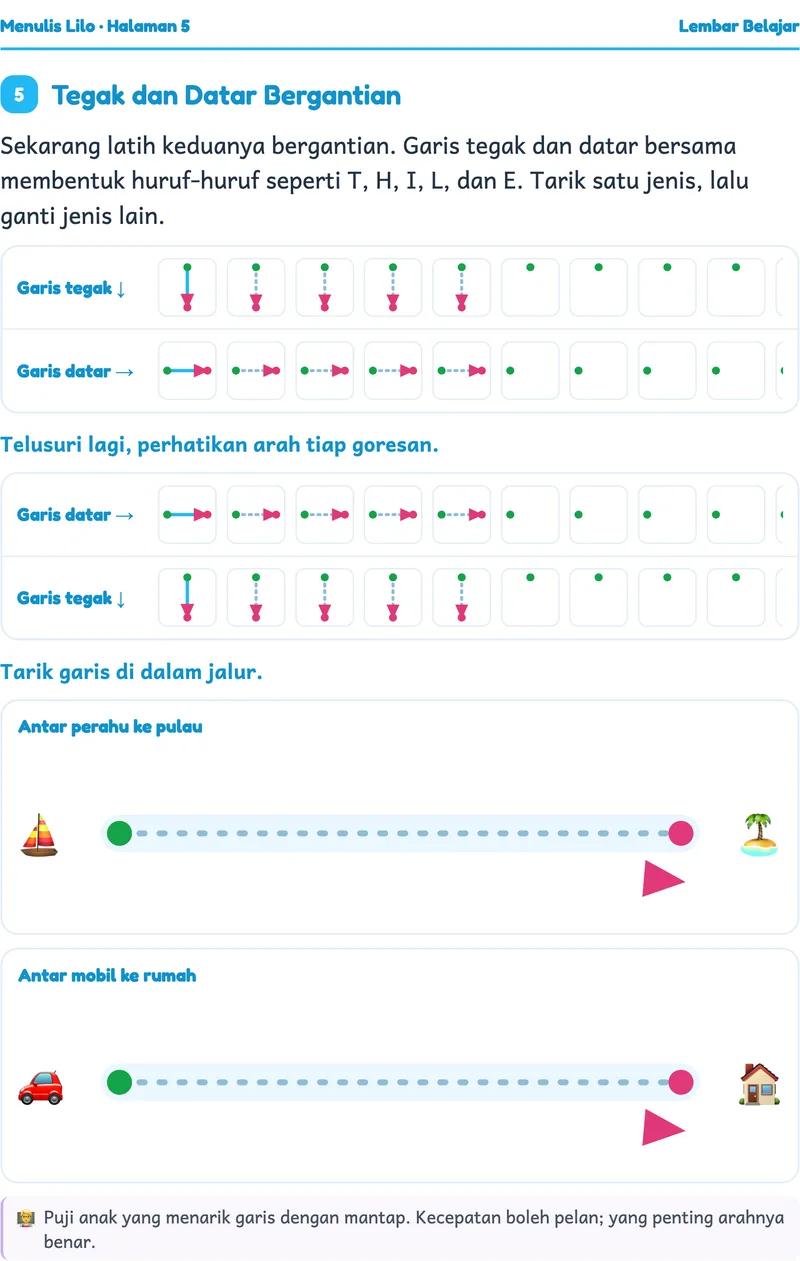
A real writing-module page: alternating straight and flat strokes train small hand muscles before the first letters.
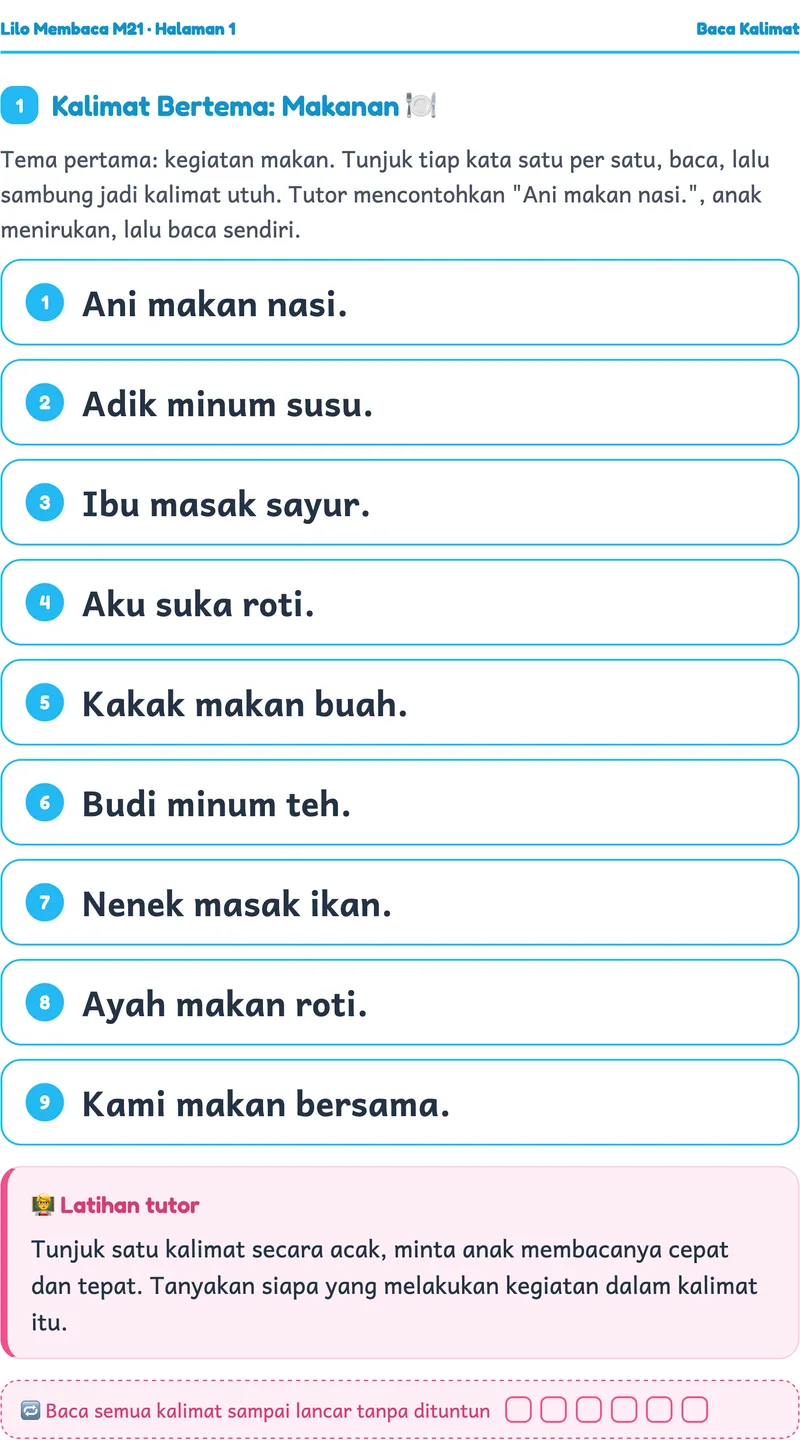
Short sentences about food are waiting on this reading-module sheet at Intermediate Level. Each sentence is read whole, the reward of all the sound and syllable practice the child has gathered so far.
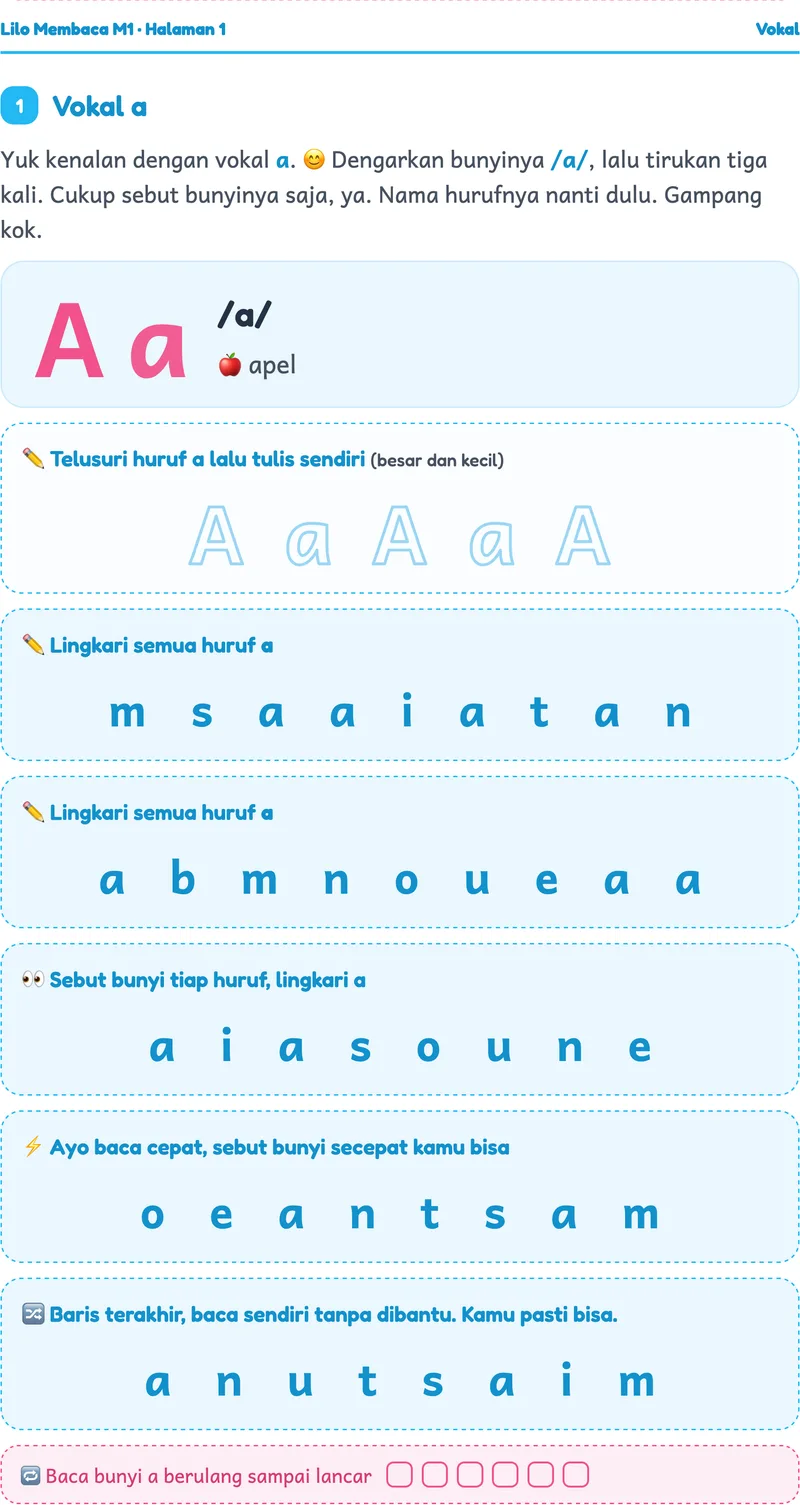
Through cards and point-and-read practice, Introduction Level children get to know the vowel sound a on this reading-module sheet. One small sound that starts the whole journey toward loving to read.
Snippets from Lilo's own 122 leveled modules, from first letters and numbers to being ready for primary school.

Tell us about your child on WhatsApp and we will suggest the right level and service. The consultation is free, warm and completely without obligation.
Free consultation on WhatsApp