


Little explorers aged 3 to 4
Your child meets letters and numbers through play, songs and things they can touch. There is no pressure at this age, only curiosity, warm routines and happy first encounters with learning.
Short, friendly sessions built level by level help your child learn to read, write and count with real understanding, climbing four clear levels one small step at a time.
Reading, writing and counting in Cilegon is a Lilo program for children aged 3 to 8 that teaches all three skills together as one connected journey, at home, online, or in a small group. Your child begins with real objects they can hold, moves on to pictures, then to letters and numbers, and rises through four clear levels at a comfortable pace.
Every child arrives at their own point in the journey. A short placement assessment at the start shows us exactly where to begin, so lessons feel right from day one.
Your child meets letters and numbers through play, songs and things they can touch. There is no pressure at this age, only curiosity, warm routines and happy first encounters with learning.
Your child blends syllables, counts with confidence and practices writing letters and numbers. Step by step, they build the calm, solid foundation that makes the move to primary school feel natural.
Your child strengthens all three skills together, reading with understanding, writing full sentences and solving word problems. Lessons deepen what school has started and fill any gaps quietly.
Some children simply need to restart at the level that fits them. We find that level, rebuild confidence with small wins, and let steady practice close the gap without shame or rush.
Our method follows the way young children naturally understand the world. Hands first, then pictures, then symbols, with small friendly portions of practice holding it all together.
Your child starts every new idea with real objects they can touch, like beads or blocks. Next come pictures of those objects, and only then the letters and numbers themselves. Understanding arrives before symbols do.
We teach reading through the sounds letters make, so your child blends sounds into syllables and syllables into words. There are no tiring letter-name spelling drills, just sounds that click into place.
Word problems are sketched as simple bars, the Singapore bar model, so your child can see what the story is asking. Drawing the problem first trains real reasoning, and the answer follows naturally.
Each session ends with a small, doable portion of practice built level by level. Your child moves up a level only after truly mastering the current one, so nothing is built on shaky ground.
The pace of moving up follows your child, so learning stays calm.
Four small skill areas show readiness, and a few items appearing in each group are already a good sign.
Tutors for Cilegon are chosen from 110+ teachers in Banten. Online classes in Cilegon are always open.
Graduates and current students alike.
Application screening
Each file is read by our team.
Documents verified
ID card, diploma and photo are checked.
Experience and hours recorded
We know when each tutor is free.
Learning the Lilo method first
Lilo guides and materials are provided.
Chosen for your child
Each candidate answer is reviewed.
Not the right fit? Read the tutor replacement guarantee
The first session is a game with no written test, and the tutor quietly notes a few things that set the starting point.
As your child draws or writes their name, the tutor sees where each line begins, at the top or the bottom.
In a guessing game, the tutor hears whether B is called by its name or by its short sound.
Counting buttons, the tutor checks for one touch per number word and for known pairs that make ten.
The tutor notes how long your child stays settled and how a wrong answer is met.
Small preparations help the first session in Cilegon start warmly, at home or on screen.
In the free consultation, share your child's age, what they already know and where they hesitate.
You can view the tutor's profile before day one, and telling your child the tutor's name makes meeting friendlier.
For home sessions, prepare an elbow-high table with good light, a comfortable pencil and small objects to count.
The link and worksheets arrive beforehand through app.lilo.id. Print the sheets, set the device at eye height and test the sound.
From recognizing letters to reading with understanding, your child follows a gentle staircase where every step is mastered before the next one begins.
Little hands warm up with lines and patterns first, then shape print letters, whole words and finally full sentences, neatly and without frustration.
Your child gets to know numbers through real objects, then learns addition and subtraction, and finally solves word problems drawn as simple bars.
Alongside the three skills, every session quietly builds concentration, independence and the happy confidence of a child who knows they can learn.
Stroke direction shapes whether handwriting grows neat and readable. Here is what happens in your child's hand and mind.
Each time your child writes, the hand stores a sequence. An H made as two lines down from the top, then one across from the left, becomes a single movement that runs by itself. When the order keeps changing, effort goes into shaping letters and spelling falls behind.
Starting at the top gives one fixed anchor, because nearly every capital and numeral begins on the top line. Pulling down toward the body suits the arm, so lines come out straighter and letters stand evenly. When two shapes look alike, that top start becomes your child's guide.
Left to right ties writing to reading, since the eye travels the same way across syllables and sentences. Numbers have direction too: a 7 begins with a line across, then slants down, and a 3 starts at the top and curves right twice. On Lilo worksheets, numbers follow arrows, and the tutor points to where each letter begins.
The tutor watches strokes as they happen, since a neat letter can hide a backward start. When your child begins at the bottom, the tutor traces a big letter in the air with them before returning to paper. Straight-line capitals like L, T, E and H come before curves. At home, ask your child to write their name and watch where the pencil touches down first.
Behind every warm session stands an original curriculum of 122 leveled modules and a handful of teaching signatures we hold to in every home.
Small portions, done often, in a warm atmosphere. Practice built level by level builds a quiet daily habit, and your child levels up only after true mastery, never by the calendar.
Beads, blocks and everyday things come before any symbol. When your child has counted real objects with their own hands, the written number finally means something real to them.
Your child learns the sounds letters make and blends them into words. Reading grows from hearing and building, so new words become something to figure out with confidence.
Story problems are drawn as simple bars before anyone reaches for an answer. Your child learns to see the structure of a problem, which is the seed of real reasoning.
These stages come straight from our own leveled modules, so you can always see where your child stands and what comes next.
Most struggles with early reading, writing and counting come from a handful of well-meaning mistakes. Knowing them early spares your child months of frustration.
Why it happensA child can chant letters and numbers without knowing what they mean. Memorized material fades quickly and leaves a sour taste that makes the next lesson harder.
How Lilo helpsWe start every concept with real objects and pictures, so your child understands first. What is understood is remembered, and remembered happily.
Why it happensWriting needs hand muscles that are still developing at ages 3 and 4. Pushing a pencil too soon turns writing into a battle and the child into a reluctant writer.
How Lilo helpsWe begin with lines, patterns and playful tracing that strengthen little hands, then move to letters only when the hand is ready.
Why it happensWhen a child meets the symbol 5 before ever counting five real things, counting becomes empty recital. The numbers are said, and nothing is understood.
How Lilo helpsYour child counts beads, blocks and everyday objects first. Symbols arrive later, as names for quantities the child already knows by hand.
Why it happensSqueezing three skills into the final months before enrollment overwhelms a child and replaces curiosity with anxiety right when school is about to begin.
How Lilo helpsWe spread learning into small regular portions over time, so your child walks into primary school calm, ready and genuinely confident.
Why it happensReading, writing and counting reinforce each other. Taught apart, with no bridges between them, progress turns lopsided and gaps hide until school exposes them.
How Lilo helpsOur sessions weave the three skills together, so a story read becomes words written and quantities counted, all in one connected journey.
For a 7 year old who reads short words and wants fluency, on the Intensive package of twelve sessions a month.
Your child reads words like sepatu and jendela without pausing, and three meetings a week help the eye catch whole words.
Lines start at the top or the left, and the letters in your child's name begin to stand evenly.
Bundles of ten sticks show tens and ones, so carrying in 27 plus 15 makes sense before symbols.
Texts grow to several sentences, and your child retells them, answering who, where and why.
Your child reads a word problem alone, draws the bars and finds the missing number.
The tutor adjusts this order to the rhythm each session reveals.
Old cardboard, potted plants and a pet make lively practice, each activity training one clear stage.
Write one syllable per card, such as ku, cing, ba and bek, and let your child build and read words. Stages S and K.
cardboard, scissors, marker
Draw a big capital with a start dot and stroke arrows. Your child traces it with a finger, then writes it. Stage T.
cardboard, two markers
Your child writes a plant's name, such as MAWAR, on a pot label and reads it at every watering. Stages T and K.
ice cream sticks, pencil
Split ten pieces of pet food between morning and evening, such as seven and three, and find every pair. Stage B.
pet food, small bowl
choose 60, 90, or 120 minutes
Contact us
60, 90, or 120 minutes per session
Contact us
duration of 60, 90, or 120 minutes
Contact us
Every approach has its place. Here is an honest look at how guided lessons with Lilo sit beside two common alternatives.
A verified tutor guides live, adjusting to your child in the moment
Real objects first, then pictures, then letters and numbers
Placement assessment and four clear levels with mastery checks
Lessons happen at the table with paper and real objects
The tutor notices, steps back a level and rebuilds understanding
A free WhatsApp consultation comes first, where you can ask about schedules and the nearest tutor. The Regular calistung package in Cilegon is IDR 604,782, a single online session is IDR 76,865, and billing happens per package. In each meeting your child reads, writes and counts objects before moving on to numbers, with a visiting tutor or online.
A light rhythm of about one session a week to meet the tutor.
IDR 307,460Two sessions a week keep calistung fresh from one meeting to the next.
IDR 604,782Three sessions a week give closer practice across all three calistung skills.
IDR 891,965A steady weekly rhythm makes progress visible from month to month.
IDR 1,692,684At home or online, the same.
No extra fee, whenever you ask.
How it works:
And a progress report every month.
Five fair questions to ask any tutoring provider in Cilegon.
| Question to ask | Why it matters |
|---|---|
How do online classes work for a child aged five to seven? | Young children drift from a screen with nothing to hold, so Lilo sessions switch between objects, movement and worksheets. |
What does the teacher do when my child makes a mistake? | A reversed letter is a clue. Good teachers find the cause, and Lilo tutors turn each mistake into the next lesson. |
Which curriculum do you follow? | Order shapes fluency, and Lilo's own 122 coded modules keep your child's stage clear. |
How will I hear about progress? | Concrete detail helps most, like Lilo's weekly tutor report noting a 5 that now starts correctly. |
What if the tutor and my child do not click? | Fit affects how bravely a child tries, and Lilo promises a free tutor change whenever the match is not right. |
Reading, writing and counting are woven together in every session, so each skill strengthens the others and your child grows evenly, without a lopsided start to school.
Lilo teaches from its own 122 leveled modules. Every lesson has a place on a ladder, so you always know what your child has mastered and what comes next.
Verified tutors teach one-on-one at your home across Cilegon, from Cibeber and Jombang to Citangkil and Grogol, so learning happens where your child feels safest.
Your child moves up only after truly understanding the current level. This protects confidence, because every new step rests on ground that is already solid.
Lessons can run in Indonesian or English, a natural fit for bilingual and national-plus families who want the language of instruction to match home and school.
Sessions are calm and encouraging on purpose. A child who feels safe asks questions, tries again and slowly discovers that learning is something they are good at.
Cilegon is a city on the western tip of Java, located in Banten Province. It is widely known as Indonesia's steel industry city and serves as the gateway between Java and Sumatra through Merak Port on the shore of the Sunda Strait. Its districts stretch from Cibeber to Pulomerak, making Cilegon one of the key cities in western Banten. The city continues to grow with a proud spirit and a strong regard for education.
A tutor visits you in Cilegon, so your child can learn in the comfort of home. Surrounded by familiar things, children find the courage to ask questions, and each session lets you see closely how far they have come.
Each lesson moves through clear stages. Your child first handles real objects, then looks at pictures, and finally works with letters and numbers. A new idea is added once the last one is fully grasped.
Prefer to learn on a screen? Online classes are live two way sessions, and the teachers give the same close attention. Times stay flexible, so lessons slot easily into your child's week in Cilegon.
I love the personal approach they use. My child, who used to struggle to focus, can now learn with real enthusiasm.
Latifah really looks forward to her lessons, she says they are fun. She is starting to understand addition using things around the house, like counting spoons while helping set the table.
See for yourself the original sheets children work on in Lilo's calistung classes. Every level trains reading, writing, and counting side by side, climbing one step at a time.
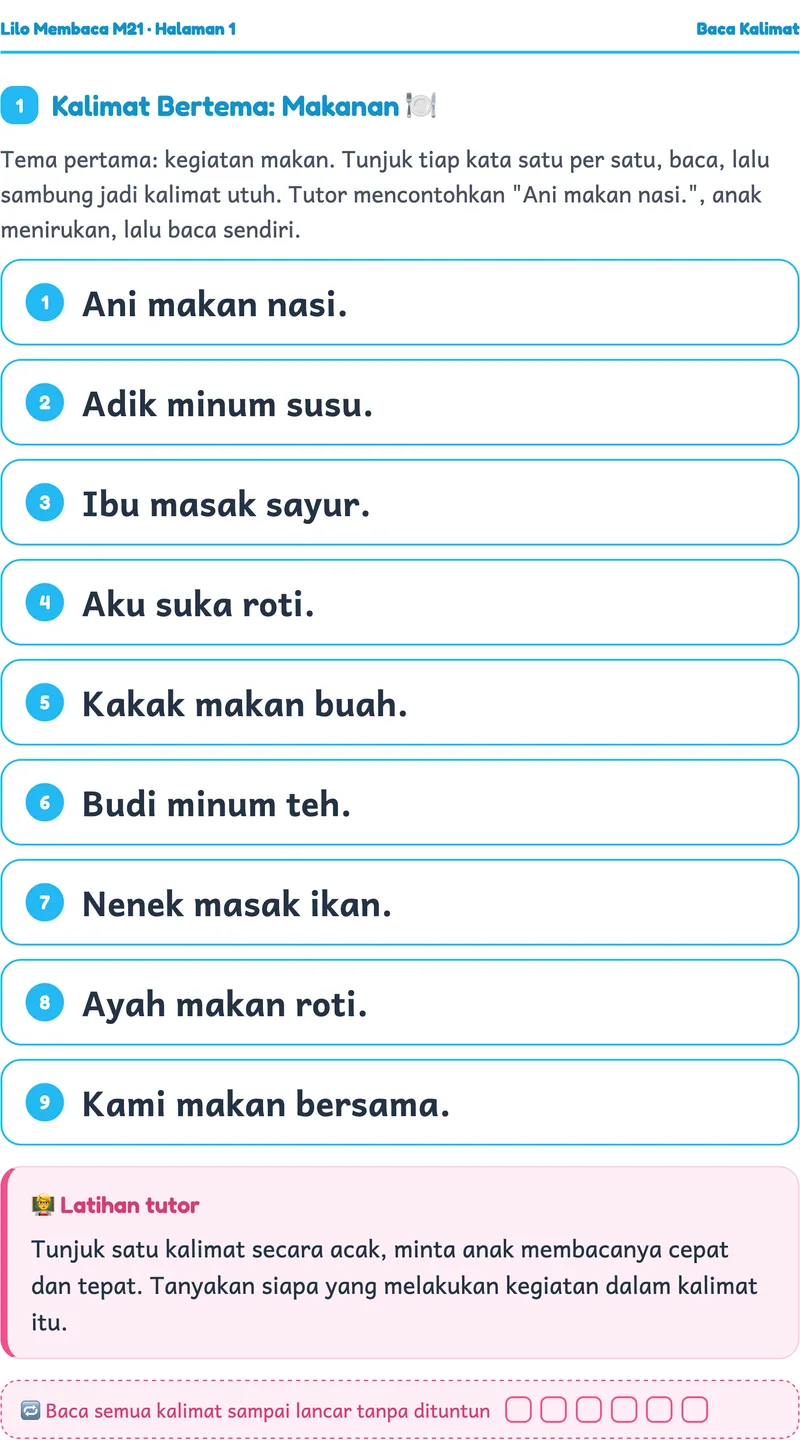
Here is where sound practice and syllable practice meet their result. On this Intermediate Level sheet from the reading module, children read short food-themed sentences in full, from the first word to the final period.
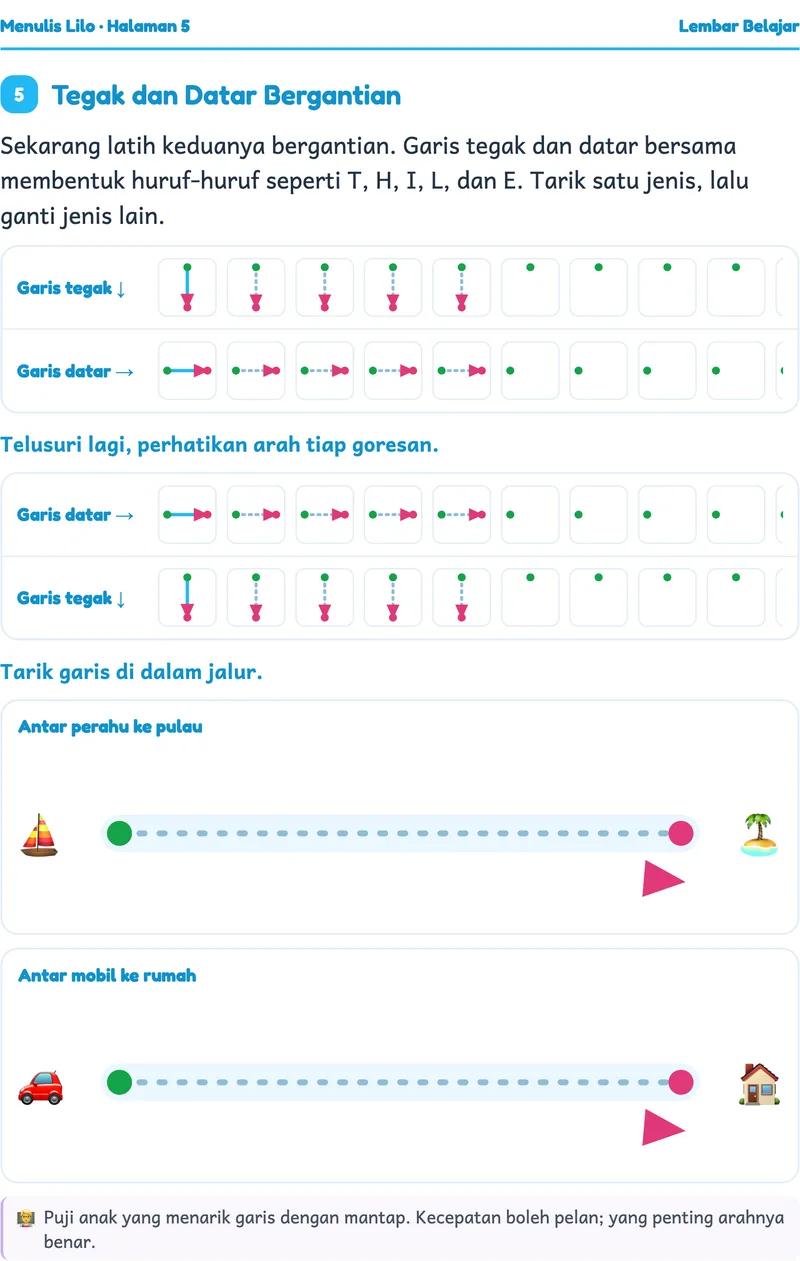
A vertical line, then a horizontal one, then back again. On this writing-module sheet at Introduction Level, children build up their hand muscles through simple strokes, important groundwork before their first letters.
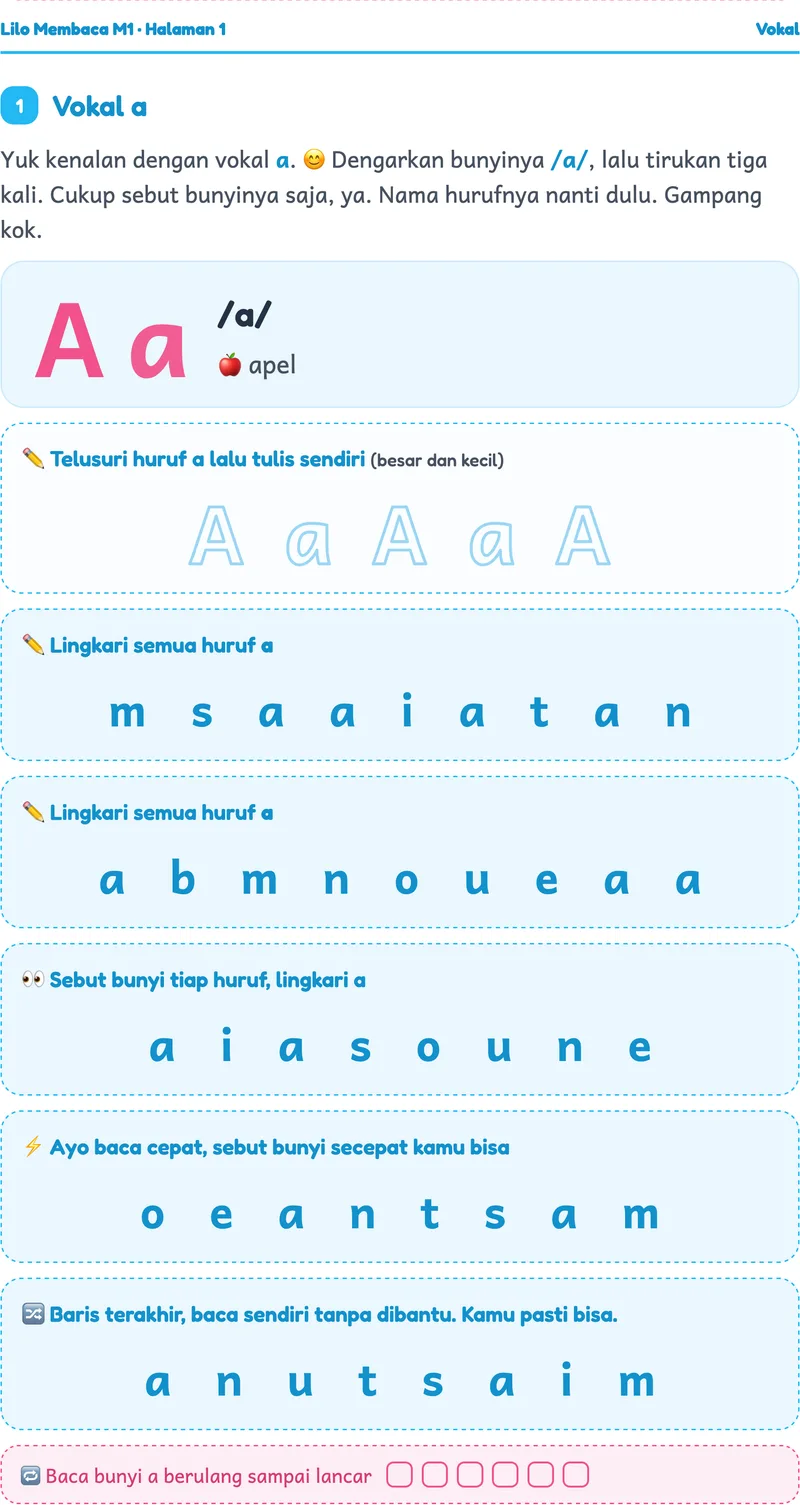
A real reading-module page: your child sounds out the vowel a with cards and point-and-read practice, the first door into reading.
Each sheet you see here comes from Lilo's progressive curriculum, one connected journey built from 122 modules.

Tell us about your child in a free WhatsApp consultation. We will suggest the right level and the right way to learn, and you decide from there.
Free consultation, friendly advice