
Little explorers, ages 3 to 4
Your child is meeting letters and numbers for the very first time. Sessions feel like play, with real objects to hold, songs, and gentle tracing games that wake up the writing hand.
A Lilo tutor guides your child through all three skills as one journey, beginning with steady hand movements on paper and growing into confident reading, tidy writing and thoughtful counting.
Reading, writing and counting in Cirebon is a home learning program from Lilo where children aged 3 to 8 build all three skills as one connected journey. A tutor meets your child at the right level, starts with real objects the child can hold, and patiently trains the writing hand from simple lines and patterns all the way to complete sentences.
Every child arrives at letters and numbers on a different day. The program meets your child exactly where they are and moves at their pace.
Your child is meeting letters and numbers for the very first time. Sessions feel like play, with real objects to hold, songs, and gentle tracing games that wake up the writing hand.
Your child is getting ready for primary school. The tutor builds syllable blending, counting to twenty, and letter writing in small, cheerful portions that end with a smile.
Your child already reads a little and now needs strength across all three skills. Sessions deepen comprehension, sharpen counting, and polish handwriting into full, tidy sentences.
Your child feels a step behind classmates. The placement assessment finds the exact gap, and the tutor rebuilds confidence from a level where your child succeeds every session.
The method follows how young children truly learn, moving from things they can touch toward symbols they can read and write on their own.
Every new idea begins with real objects in your child's hands, like beads or blocks. Then come pictures, and only after that the abstract letters and numbers, the Singapore Math way.
Your child learns the sound each letter makes and blends those sounds into syllables and words. Reading clicks naturally, without tiring letter-name spelling drills.
Story problems are sketched as simple bars on paper, the Singapore bar model. Your child sees what the question is really asking and learns to reason instead of guessing.
Practice comes in short, friendly portions built level by level. A placement assessment sets the starting point, and your child moves up only after truly mastering a level.
Your child moves to the next stage once the current one is truly mastered.
From recognizing letters to understanding whole passages, your child climbs one clear step at a time, always reading through sounds so words make sense.
The writing journey begins with lines and patterns that build hand strength, then moves through print letters and words until your child writes full sentences.
Numbers start as objects your child can hold and count. Addition, subtraction and word problems follow, each one understood before the next step begins.
Alongside the three skills, every session quietly grows concentration, independence and confidence, so your child sits down to learn with a calm, willing heart.
Of all words, their own name is the one children hear and see most. Tutors use it as the doorway into writing and reading.
A name is a word your child owns. It appears on the school bag, the water bottle and birthday cards, and it is spoken many times a day. That is why the letters in a child's name are usually recognised before other letters. A boy called Dimas will often point at a D on a shop sign and announce that it is his letter. This sense of ownership gives learning a strong reason, since the first word he writes already means something.
Writing the name also trains the hand. Tutors begin with capital letters, because most of them are built from straight strokes that growing fingers control easily. In DIMAS, the letters I, M and A need only straight lines, while D and S ask for curves. The tutor marks a small arrow at the starting point of each letter, so strokes travel from top to bottom. A reversed S facing left is common at this age, and the tutor simply points back to the arrow.
From writing, the name turns into reading material. The tutor splits it into Di and mas, and your child claps twice and hears two parts. Later the piece di turns up again in padi, and mas in emas, and your child realises that a sound can travel into other words. At home, progress appears in small places: a name in the corner of a drawing, on a book label, on a greeting card. When it is written without a model, that first word truly belongs to your child.
The profile is an 8 year old who already reads and counts and wants to feel solid: tidy writing, understood stories, finished word problems. With the Regular package of 8 sessions a month, about twice a week, the path usually looks like this.
The tutor refines the pencil grip and the direction of every stroke. Your child copies short sentences into a lined book, keeps space between words, and then begins writing sentences about favourite things.
Your child reads short paragraphs aloud and learns to pause at full stops and commas, so the voice begins to follow the meaning. Long words are split into syllables, then joined again with confidence.
Ice cream sticks are tied in tens. Your child sees that 34 means three bundles and four loose sticks, then uses those bundles to carry and borrow when adding and subtracting.
A problem such as "Rani has 18 marbles and her brother has 7 fewer" becomes two bars on paper. Your child sees the missing part before calculating, and so knows when to add and when to subtract.
Your child reads a one-page story and retells it in their own words, answering who, what and why. A short summary of two or three written sentences closes the activity.
This is a general picture for that profile. Your child moves to each next stage once the previous one is truly secure.
Home practice lasts longest when it attaches to habits you already have. These four activities use small notes for people at home and a few minutes before the lights go out.
Your child writes one short message for someone at home, such as DRINK YOUR WATER. The sounds are whispered while writing, and your child sticks the note up alone. This trains neat writing (T) and blending sounds into words (K). Leave imperfect spelling be for now; celebrate that the message arrived.
sticky notes or scrap paper, a pencil
Write your child a two-sentence letter and slip it into an envelope bearing their name. Your child reads it and replies in one or two sentences. For older children, tuck a question into your letter so the meaning has to be understood before answering (P).
a sheet of paper, an old envelope, coloured pencils
Once the lights are dim, name something in the room, like bantal or selimut. Your child claps it apart, ban-tal, se-li-mut, then says how many claps were heard. This paper-free game trains syllable blending (S) and closes the day gently.
nothing needed, just two hands
Before sleep, open seven fingers and ask how many are folded. Your child answers three, then gets a turn to quiz you. Pairs that make ten, like 7 and 3, become a handhold later when adding across ten (B).
your child's ten fingers and yours
Behind every session stands an original curriculum of 122 leveled modules and a handful of teaching signatures we hold to in every home.
New ideas arrive as things your child can pick up and move. Only when the idea is solid do pictures and symbols take over, so nothing is ever empty memorization.
Your child learns what each letter says and blends sounds into words. This path leads to reading that flows, because every word is decoded with understanding.
Story problems become simple bar drawings. Your child learns to see the shape of a question, a habit of reasoning that pays off far beyond early counting.
Short, steady practice built level by level keeps skills warm without exhausting a young learner. Sessions end while your child still wants a little more.
These steps come directly from our own leveled modules, so you can always see where your child stands and what comes next.
Most early learning struggles trace back to a handful of well-meaning shortcuts. Knowing them early saves your child months of frustration.
Why it happensFacts learned by rote fade quickly, and the child starts to see learning as a chore with no meaning behind it.
How Lilo helpsWe build every concept with real objects first, so your child understands what a number or word means before ever memorizing it.
Why it happensSmall hand muscles need time to develop. Pushing letters before the hand is ready produces cramped grips and tears.
How Lilo helpsOur writing ladder starts with lines and patterns that strengthen the hand, then moves to letters only when your child is truly ready.
Why it happensA child who chants numbers without touching real quantities is reciting, and the recital collapses the moment a real problem appears.
How Lilo helpsCounting begins with objects your child can hold and move. Symbols arrive later, carrying real meaning with them.
Why it happensReading, writing and counting feed each other. Kept apart, one skill races ahead while another quietly falls behind.
How Lilo helpsLilo weaves all three into one journey, so a word your child reads today becomes a word they write tomorrow.
60, 90, or 120 minutes per session
Contact us
duration of 60, 90, or 120 minutes
Contact us
60, 90, or 120 minutes
Contact us
These questions are fair to ask any tutoring provider. The answers reveal how each one holds a young child's attention and keeps your home feeling safe.
Young children grasp ideas through their hands and movement, then secure them on paper. All-seated sessions tire them quickly, and all-play sessions rarely produce tidy writing. A Lilo session alternates real objects, a movement break and a worksheet.
Knowing who will sit beside your child is the foundation of feeling safe. A profile shows education and experience in advance. Lilo shares tutor profiles before the first session, drawn from a network of more than 5,000 active tutors, many trained in primary or early childhood teaching, psychology or mathematics.
Comfort decides whether a child dares to try something hard. A good provider has a clear path when the match is off. At Lilo, a tutor who does not fit is swapped at no cost, and the team handles finding the new one.
Regular news lets you reinforce learning at home. Ask what form it takes and how often it arrives. Lilo tutors send a report every week, for example noting that your child now writes their name without a model and is ready for the next word.
A written test can make a young child tense, so their ability looks lower than it truly is. Watching them play gives a clearer picture. The first Lilo session uses games to find your child's stage.
Readiness tends to show up far from the study table: in the kitchen, on a floor scattered with toys, or in a chat before bed. Watch for these three groups of clues over one week.
Cirebon belongs to our West Java network: 800+ calistung tutors. Online classes in Cirebon are always open.
Graduates and current students alike.
Every application reviewed
Suitable applicants move forward.
ID card and diploma verified
Diploma and ID are reviewed.
Tutor profile filled in
Available hours are noted down.
Learning the Lilo method first
The step-by-step method is learned first.
Matched to your child
Questions come from the child’s needs.
Not the right fit? Free tutor replacement, here is how
The first session is made of games, with no written test. From those games the tutor writes a first note, which becomes the opening map of your child's journey.
Young children focus best when short activities take turns. So each session is built from a few parts, and every part has its own job.
The tutor says hello and invites your child to share a little about the day. This easy chat settles your child and reveals the mood of the moment, so the tutor knows how to open the next activity.
Your child bundles ice cream sticks into tens or lays syllable cards on the floor. Then comes a short stand-up break, hopping while counting or tracing letters in the air, so attention feels fresh again.
Back at the table, your child works on a worksheet drawn from the module being studied. What the hands just held now appears as pictures and symbols, and the tutor watches how each item gets solved.
Together with your child, the tutor sums up what was conquered today and leaves one light task that fits into roughly ten minutes. The session ends while your child feels successful.
Reading, writing and counting are woven together in every session, so a word your child reads becomes a word they can write and even count with.
We train the hand before the letter, moving from lines and patterns to print letters, words and sentences. Writing grows sturdy instead of frustrating.
Lilo teaches from its own library of 122 leveled modules. Your child follows a measured ladder, and you can see exactly which step comes next.
Our verified tutors visit homes across Cirebon, from Kejaksan and Kesambi to Harjamukti and Sunyaragi, bringing the same careful method to every table.
Sessions can run in Indonesian or English, a natural fit for bilingual and national-plus families who want both languages alive in learning.
A placement assessment opens the journey, and your child levels up only after truly mastering each stage. Progress is real, never rushed.
Weekly reports from the tutor show you exactly how your child is progressing in arithmetic, reading and writing. A Regular package holds 8 sessions for IDR 604,782, while a single online session costs IDR 76,865. Payment is made per package, and each session can take place at home or through app.lilo.id, whichever you prefer.
By the end, your child writes their own name neatly.
IDR 307,460Your child finishes able to add numbers up to ten without objects.
IDR 604,782Your child closes the package reading and writing simple sentences alone.
IDR 891,965Your child ends the package solving short word problems by drawing a Bar Model.
IDR 1,692,684From the very first session.
No extra fee, whenever you ask.
The steps:
Plus a monthly progress report.
Cirebon is a coastal city on the northeastern edge of West Java, long known as a meeting point of Javanese and Sundanese culture. The city preserves a living palace heritage, including Keraton Kasepuhan and Keraton Kanoman, along with a batik tradition that gave the world the celebrated mega mendung motif. The patient craft of the batik makers of Trusmi reflects a spirit of careful learning passed down through generations. From Kejaksan to Harjamukti, Cirebon holds its traditions with pride while staying open to progress.
Your child learns in the space they know best. A Lilo teacher comes to your home in Cirebon, brings printed step by step materials, and guides your child until each concept truly makes sense.
Every child starts at the point that fits their ability. Materials move up in small, careful steps, so your child advances with confidence and you can follow their progress through a report after each session.
Your child handles real objects, looks at pictures, then meets the written symbols. This gradual sequence helps children understand each concept fully and enjoy every learning session at home.
Latifah really looks forward to her lessons, she says they are fun. She is starting to understand addition using things around the house, like counting spoons while helping set the table.
Gracia was so proud when she finished reading a whole thin book and counted the pictures on every page. Her tutor always cheers her on, so she is never afraid of making mistakes.
The sheets below come straight from Lilo's original materials. Reading, writing, and counting move forward side by side at every level, helping children develop evenly in all three.
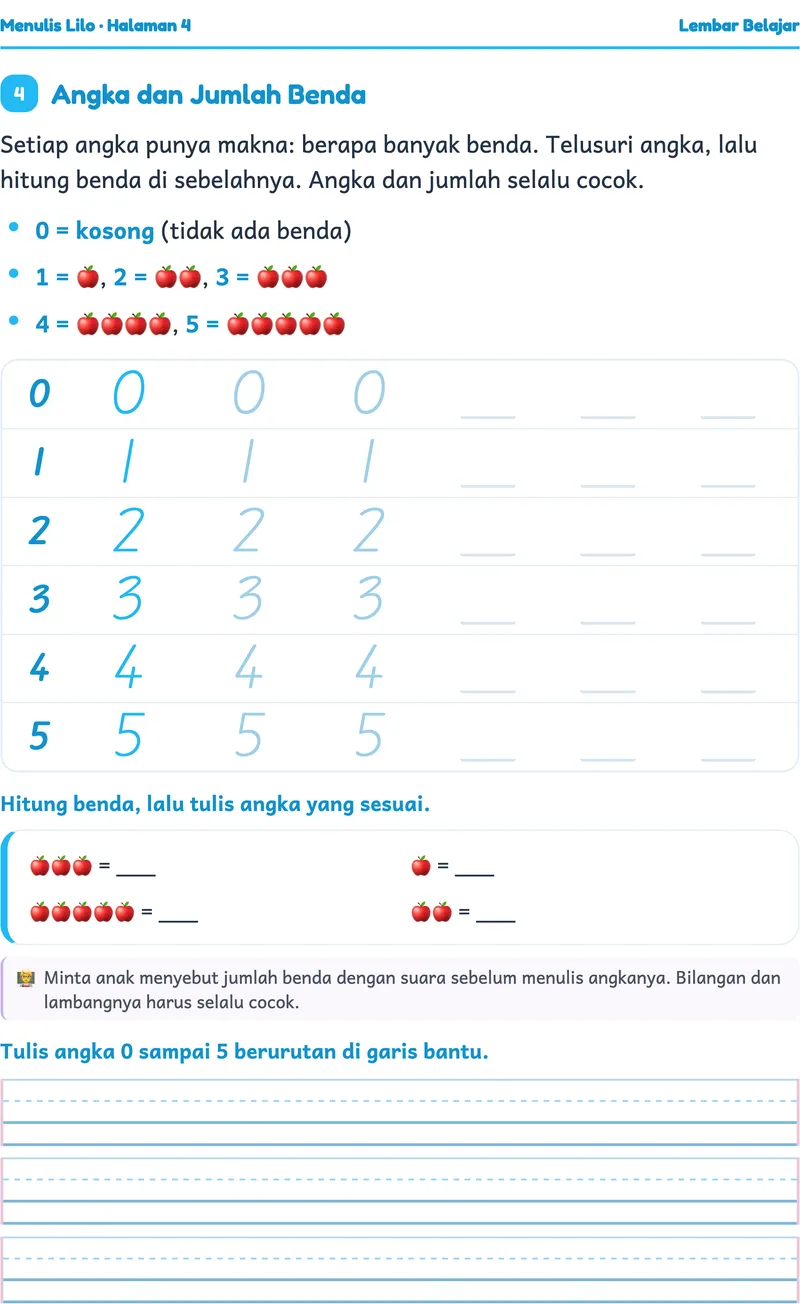
A real writing-module page: your child matches numbers to quantities and writes them neatly along guided paths.
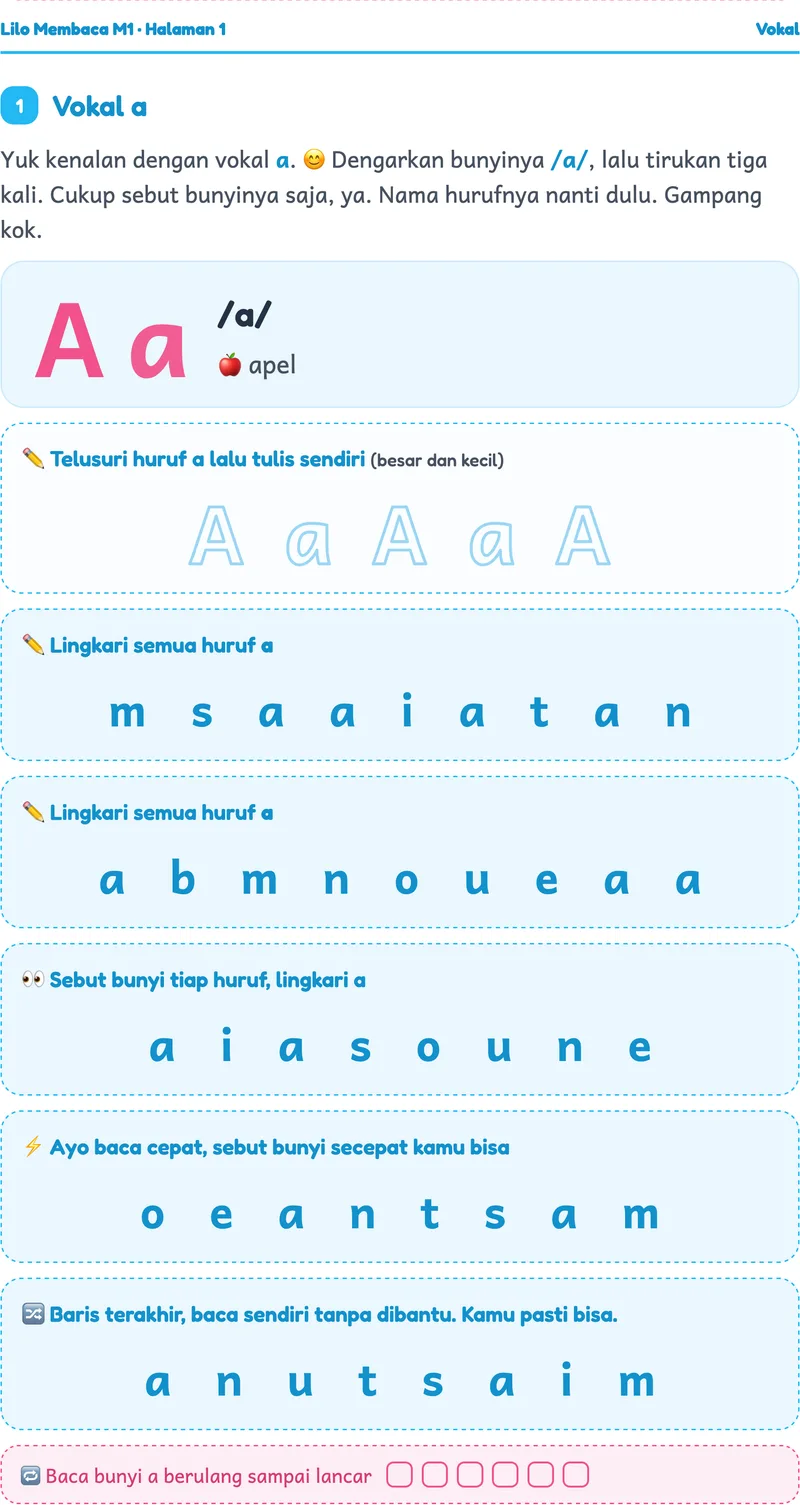
The vowel sound a opens the very first door to reading. On this Introduction Level sheet from the reading module, children meet it through cards, then point and read it again and again until it sticks.
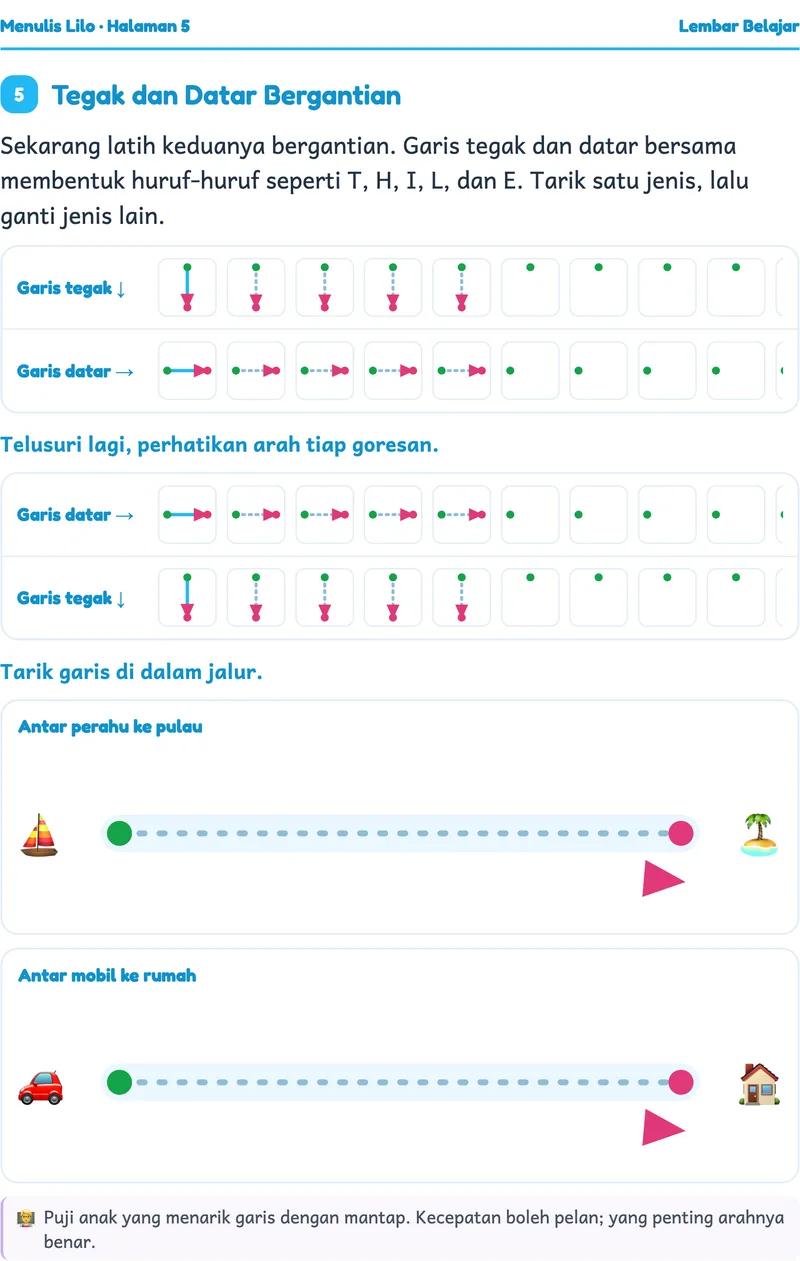
A real writing-module page: alternating straight and flat strokes train small hand muscles before the first letters.
Every sheet above is part of Lilo's own progressive curriculum, a complete set of 122 modules.

Every confident sentence your child will one day write begins with a single traced line. Tell us about your child on WhatsApp and we will find the right level together.
Free consultation on WhatsApp