


Ages 3 to 4, first hellos to letters and numbers
Your child meets letters A to Z and numbers 1 to 10 through play and real objects, with warm sessions and zero pressure, building curiosity long before any formal drill.
Every child begins with a friendly placement assessment, so lessons start exactly where your child is today. Reading, writing and counting then grow together, step by step, with a tutor who guides in English.
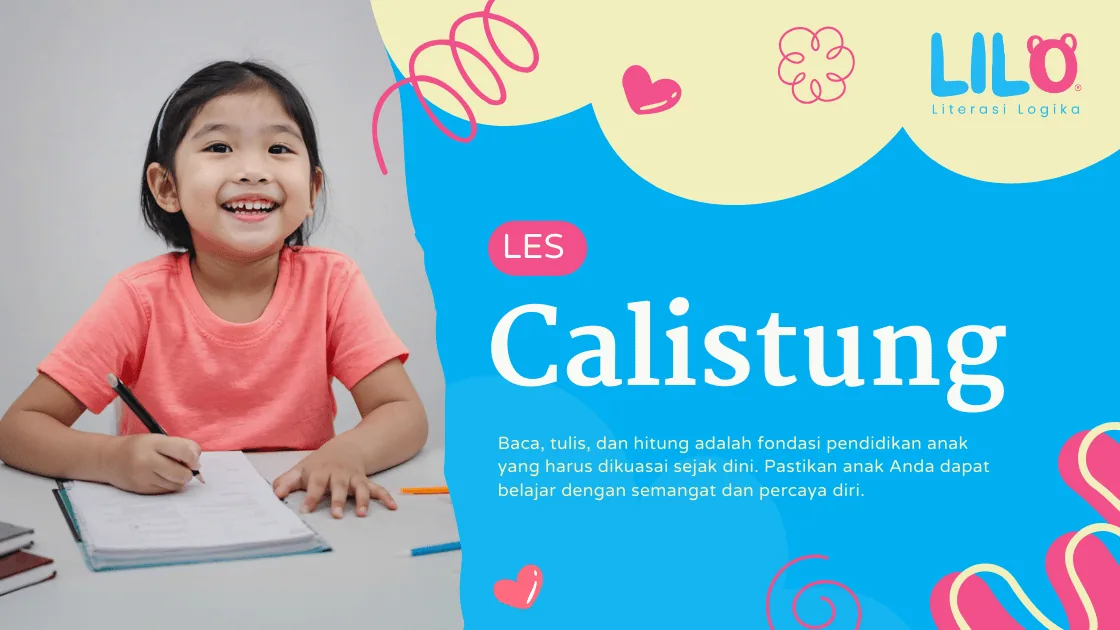
Reading, writing and counting in Denpasar is a Lilo program for children aged 3 to 8 that teaches all three skills as one connected journey, with English as the language of instruction. Each child takes a placement assessment first, begins at the level that truly fits, and moves up only after real mastery, starting with 1-on-1 online lessons from our national tutor network.
The placement assessment tells us precisely where to begin, and these are the stages of children who usually join the program.
Your child meets letters A to Z and numbers 1 to 10 through play and real objects, with warm sessions and zero pressure, building curiosity long before any formal drill.
Your child blends syllables, counts with confidence and practices writing letters and numbers, so the move into primary school feels calm and familiar instead of sudden.
Your child strengthens all three skills together, reading with understanding, writing full words and sentences, and solving counting problems with clear reasoning.
The assessment finds the exact gap, and your child restarts from a level that feels doable, rebuilding confidence while the missing pieces are filled in one by one.
You can spot these signs at home on an ordinary day. The first group shows a child ready to begin, and the next two show a child ready for the stage above.
Online classes bring 5,000+ Lilo tutors to Denpasar. In-person tutors in Denpasar are available too.
Graduates and active students.
Every application reviewed
Suitable applicants move forward.
ID card and diploma verified
ID card, diploma and photo are checked.
Experience and hours recorded
Teaching experience and hours are recorded.
Learning the Lilo method first
Lilo guides and materials are provided.
Chosen for your child
Questions come from the child’s needs.
Not the right fit? Free tutor replacement, here is how
The path is short and clear. You tell us about your child, our team makes the match, and your child meets the tutor on screen with everything ready.
The consultation is free. Share your child's age, what they already recognise, and the times that suit your home. This short story helps our team choose the tutor and a session length that fits your child's stamina.
Your child is matched with a tutor from a national network of more than 5,000 active tutors, many trained in early childhood education, primary teaching, psychology or maths. You can view the tutor's profile before the first session.
In Denpasar, learning begins online. The class link and the worksheet from the first module arrive before the lesson, and the schedule lives in app.lilo.id. You only need a table, a pencil and a few small objects.
The tutor says hello, then invites your child into games that reveal where to begin. At the end, the tutor sums up what your child has shown today and leaves one short piece of practice for home.
Lessons at home come later, once our team confirms a tutor who lives close to you.
The first session feels like playing together, with no written test. Each game shows the tutor which stage your child already holds and where the next step lies.
The tutor makes a sound, such as sss, and your child hunts for something nearby that begins with it, like a spoon, sendok in Indonesian. This shows whether letter sounds are familiar or whether stage H is the right start.
Your child reads cards showing ba and mi, then a short word such as bola. The tutor notices whether each syllable is read whole, guessed, or read smoothly, which places your child in stage S or K.
Your child draws lines and circles, then tries writing their own name. The tutor watches the pencil grip, the direction of each stroke and the height of the letters, which together set the starting point in stage T.
Your child gathers toys or buttons from around the house, counts them, and splits them into two piles. The tutor watches whether a finger touches every object and whether number pairs make sense, for stage B.
Your child advances one stage at a time, with a check at every move.
Four habits shape every session, from the very first assessment to the day your child reads a whole story alone.
Before lessons begin, a placement assessment maps what your child already knows in reading, writing and counting. Lessons then start at the level that fits, so nothing is skipped and nothing feels impossible.
New ideas arrive as real objects your child can touch, then as pictures, and only then as letters and numbers. This is the Singapore Math way, and it makes concepts stick because your child understands them.
Your child learns the sounds letters make and blends them into syllables and words. There are no letter-name spelling drills, so reading grows naturally from sound to word to sentence.
Steady practice in small portions, built level by level, keeps every session light and winnable. Your child levels up only after real mastery, and word problems are drawn as simple bars to train reasoning.
From recognizing single letters to blending syllables, reading full sentences and truly understanding what a story says, one small win at a time.
Little hands warm up with lines and patterns, then print letters neatly, write whole words and finally put their own sentences on paper.
Your child gets to know numbers with real objects, learns addition and subtraction with understanding, and solves word problems drawn as simple bars.
Woven through every session, your child practices sitting with a task, trying independently and finishing with pride, habits that outlast any worksheet.
Letters that bounce up and down usually mean a child's eye has no height reference yet. Guide lines supply one, and calistung tutors in Denpasar teach your child how to use them.
A ruled writing book splits each row into three bands. The middle band is home to the body of letters such as a, m and o. The top band holds the tall stems of b, d, h and l. The bottom band holds the tails of g, j, p and y. An adult reads this layout at a glance, while a five-year-old sees a stack of identical lines. So the tutor gives each band a name: attic, house and basement.
Inside a young child's head, letter size is still judged by eye. Each letter comes out as big as it feels at that moment, so one word can mix large and small letters side by side. Guide lines move that judgement onto the paper. The tutor starts with wide rows on the worksheet and narrows them as the hand grows more fluent. Straight-line capitals come first, because vertical and horizontal strokes anchor most easily between two lines.
Take the word gajah, meaning elephant. While writing, your child names where each letter lives: g drops to the basement, a stays in the house, j drops again, a returns home, h climbs to the attic. Every letter starts from the same point each time, and the tutor keeps that order steady, so the movement becomes habit. At home you can see the result in three ways: letters sit on the base line, bodies share one height, and tails stop at the bottom line.
These teaching signatures come from Lilo's own curriculum of 122 leveled modules, refined so every child understands before moving on.
Beads, blocks and cards come before any symbol on paper. Your child counts and builds with real things, then meets the pictures, then the numbers, so every concept has something solid underneath it.
Your child learns what each letter sounds like and blends those sounds into syllables and words. Reading becomes decoding a code your child owns, and new words stop being scary.
Story problems are drawn as simple bars, the Singapore way, so your child sees the problem before solving it. This trains reasoning that carries far beyond counting lessons.
Short, steady portions built level by level, delivered warmly. Your child practices a little every session, masters each step fully, and climbs to the next level with confidence.
Your child's placement assessment shows exactly which rung to start from.
Most struggles with early reading, writing and counting come from a handful of well-meaning habits. Here is what we see, and how the program answers each one.
Why it happensFacts learned by rote fade fast, and the drilling often leaves a sour feeling about learning itself.
How Lilo helpsEvery concept starts with real objects your child can touch, so understanding comes first and memory follows naturally.
Why it happensWhen hand muscles are still developing, pushing letter writing brings frustration and shaky, tiring strokes.
How Lilo helpsThe Introduction Level builds motor skills through lines and patterns first, so letters arrive when hands are ready.
Why it happensA child who chants numbers without touching quantities is reciting, and the counting stays empty underneath.
How Lilo helpsBeads and blocks come before written numbers, so five means five real things before it means a symbol.
Why it happensSqueezing years of foundation into a few rushed months creates pressure exactly when your child needs calm confidence.
How Lilo helpsStarting earlier at the right level lets skills grow gently, and the assessment shows honestly how much runway remains.
Picture a child of five in Denpasar who does not yet know letters or numbers, learning on the Regular package of about two sessions a week. Each month your child climbs one curriculum stage and builds from there.
Your child meets letter sounds through everyday things, such as mmm for meja, the word for table. Little hands practise lines and circles, and toys get counted up to five with a touch for each one.
Familiar sounds come together as ba, bi and bu. Your child reads each syllable whole, without spelling out letter names, and begins splitting five objects into two groups, such as two and three.
Straight-line capitals such as L, F and E are written between guide lines, and numbers follow the direction of the arrows. The high point is your child writing their own name with letters of even height.
Your child adds and takes away with real objects, then moves the same sums onto pictures. Pairs that make ten appear as ten buttons shared between two bowls in every possible way.
Mastered syllables now join into words such as buku, sapu and kaki. Your child reads each word, writes it, then counts its syllables, so all three skills meet in a single activity.
After stage K your child moves on to short sentences and their meaning in stage P, with the pace tuned by the tutor from one session to the next.
The calendar and the clock already hang on your wall, and one stick of chalk is enough for the porch. These four activities carry each session forward with no extra worksheets.
Point to today's date and ask your child to find the same number. Circle a birthday or a holiday, then count together how many boxes remain, with a small finger hopping box by box. Stage B grows through numbers your child sees every day.
wall calendar and a marker
Write 1 to 12 on scraps of paper. Your child matches each card to the number on the clock, then says them in order going clockwise. Once that feels easy, ask which number the short hand points to. This ordering strengthens stage B.
wall clock and paper number cards
Draw three long lines with wide gaps, like one row of a writing book made huge. Your child writes the capitals L, T and E in chalk, making each letter touch the top line and the base line. These big movements prepare the hand for stage T.
chalk and a porch floor or board
Write ba, bu, ku and ki inside chalk circles. Call out one sound and let your child jump to the matching circle. Then ask for two hops in a row and read the word they make, such as buku, the word for book. This builds stage S.
chalk and a roomy patch of floor
Denpasar is the capital of Bali Province and a center of government and education on the island. The city is widely known for its banjar community tradition that keeps neighbors closely connected, and for a rich calendar of ceremonies that colors everyday life. Its districts stretch from Denpasar Selatan with the well known Sanur area, through Renon, Sesetan, and Panjer, to Denpasar Barat, Denpasar Timur, and Ubung. Learning in Denpasar grows side by side with a strong cultural tradition passed down through generations.
In Denpasar, your child begins with one-to-one lessons on screen, guided by a teacher drawn from Lilo's network across Indonesia. Each session lets you see how they grow. Hoping for a teacher at your home? Our team will first find one who lives close by.
Online classes still feel face to face through the screen, guided by the same patient teachers. Schedules follow your child's activities, including seasons full of ceremonies and community events.
Materials build up gradually from the very basics, so your child moves up each level with real understanding. Every session uses structured worksheets and steady practice suited for children aged 3 to 10.
duration of 60, 90, or 120 minutes
Contact us
choose 60, 90, or 120 minutes
Contact us
60, 90, or 120 minutes per session
Contact us
An honest look at three common paths, so you can pick what genuinely suits your child and your family.
| Aspek | Lilo | Learning Apps | Learning at Home Alone |
|---|---|---|---|
| Where lessons begin | A placement assessment finds the exact right level | Usually one fixed sequence for every child | Parents guess the starting point themselves |
| How new ideas are introduced | Real objects first, then pictures, then symbols | Mostly on-screen pictures and taps | Depends on the books and time available at home |
| Guidance during practice | A live tutor watches, corrects and encourages | Automatic feedback from the app | A parent helps whenever there is time |
| Moving to the next level | Only after real mastery is shown | Often unlocked by finishing screens | Hard to measure without a clear ladder |
| The three skills together | Reading, writing and counting woven into one journey | Usually separate mini-games per skill | Often practiced separately when materials allow |
Session length can be set to match your child's stamina, one online session is priced at IDR 76,865, and the Regular package comes to IDR 846,694. Payment covers a whole package at once, which keeps your child's weekly slots secured for several weeks. Each lesson mixes reading, writing and maths, starting from objects your child can touch. Classes in Denpasar run online first, with home lessons to follow.
You want to see first how your child takes to a tutor.
IDR 430,444You are already sure and want a steady weekly rhythm.
IDR 846,694A near goal is coming up, so sessions sit closer together.
IDR 1,248,751You want the foundations finished completely in one long stretch.
IDR 2,369,758Included in every lesson package.
No extra fee, whenever you ask.
The steps:
Plus a monthly progress report.
These five questions are fair to put to any provider. The answers show whether your child will practise with a clear direction and homework that makes sense.
| Question to ask | Why it matters |
|---|---|
How much homework is set, and what is it for? | Young children learn best through short, regular practice, and a pile of homework turns a calm afternoon into a chore. Ask how long one task takes and which stage it trains. At Lilo, every session closes with one short task that continues that day's lesson. |
Does the material follow a coded sequence I can track? | A coded sequence tells you which rung your child stands on and what comes next, so progress can be read with certainty. Lilo's curriculum is built from 122 coded modules, and its calistung stages carry letters that are easy to remember. |
How is my child's starting point decided? | A child who starts too high soon feels defeated, and one who starts too low soon feels bored. A good provider has a friendly way of finding the right spot. At Lilo, that spot is found through games in the very first session. |
When does my child begin writing letters on ruled lines? | Writing needs a ready hand. A provider who understands this trains pencil grip, lines and circles first, then straight-line capitals. That order keeps your child confident on the first page of the book. Lilo tutors follow the same order from the Writing module. |
How is reading taught to a child who does not know letters yet? | Spelling out letter names such as be and a often confuses a child at the moment sounds must blend. Learning letter sounds, then whole syllables, carries your child sooner to words that mean something. Ask which first word your child will read. Lilo follows the letter-sound path from day one. |
A placement assessment comes before the first lesson, so your child starts where success is possible and frustration is designed out from the beginning.
Lessons come from Lilo's own curriculum, built level by level, so every session connects to the last one and to the next.
Your child meets a verified tutor from Lilo's national network one on one online. In areas such as Denpasar Selatan, Renon, Denpasar Barat or Ubung, lessons at home can follow once our team confirms a tutor who lives nearby.
Reading, writing and counting are taught as one journey, so what your child reads gets written, and what gets counted turns into stories to solve.
Sessions run in English, and tutors can support in Indonesian too, a comfortable fit for bilingual and national-plus families.
Your child climbs the four levels only after each step is truly owned, so progress is real and confidence grows with it.
Gracia was so proud when she finished reading a whole thin book and counted the pictures on every page. Her tutor always cheers her on, so she is never afraid of making mistakes.
Aisyah loves counting our groceries when she comes along to the shop. Her reading is starting to flow too, she sounds out the names of items on the shelves one by one.
The sheets below come straight from Lilo's original materials. Reading, writing, and counting move forward side by side at every level, helping children develop evenly in all three.
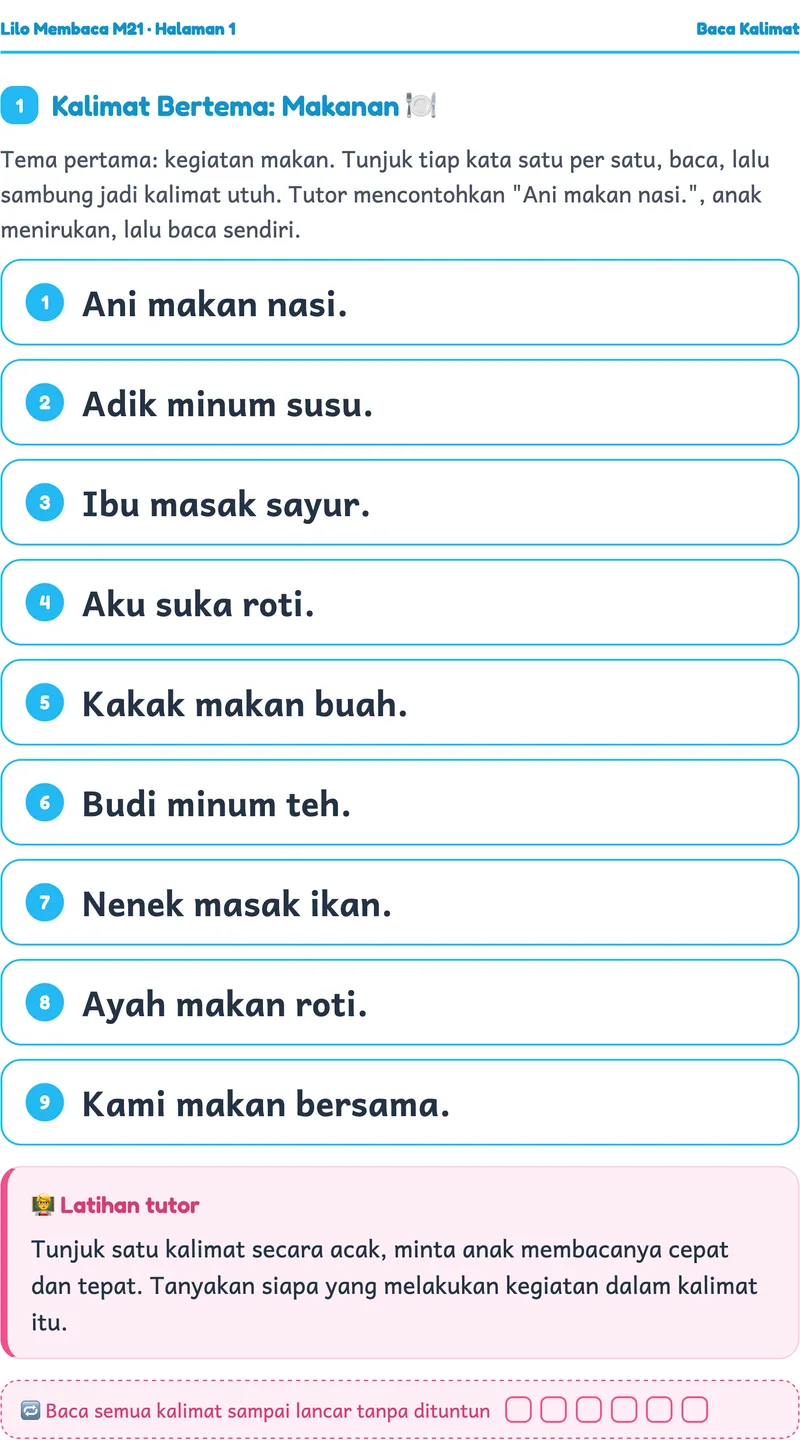
This Intermediate Level sheet from the reading module holds short sentences about food, read from start to finish. All the earlier sound and syllable practice comes together here as the child's first meaningful reading.
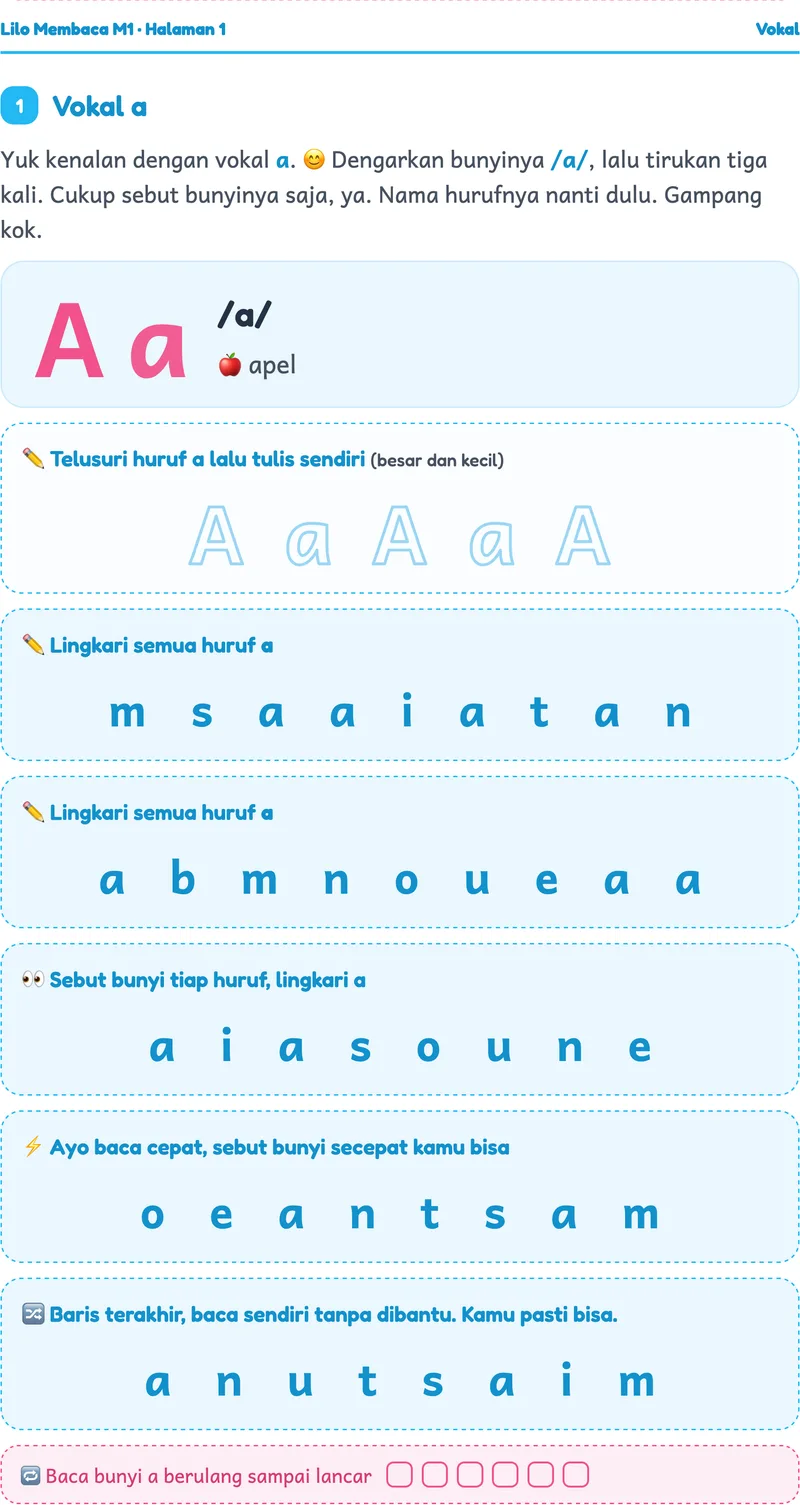
This Introduction Level sheet from the reading module introduces the vowel sound a through cards and point-and-read activities. It is the very first door a child opens on the way to reading.
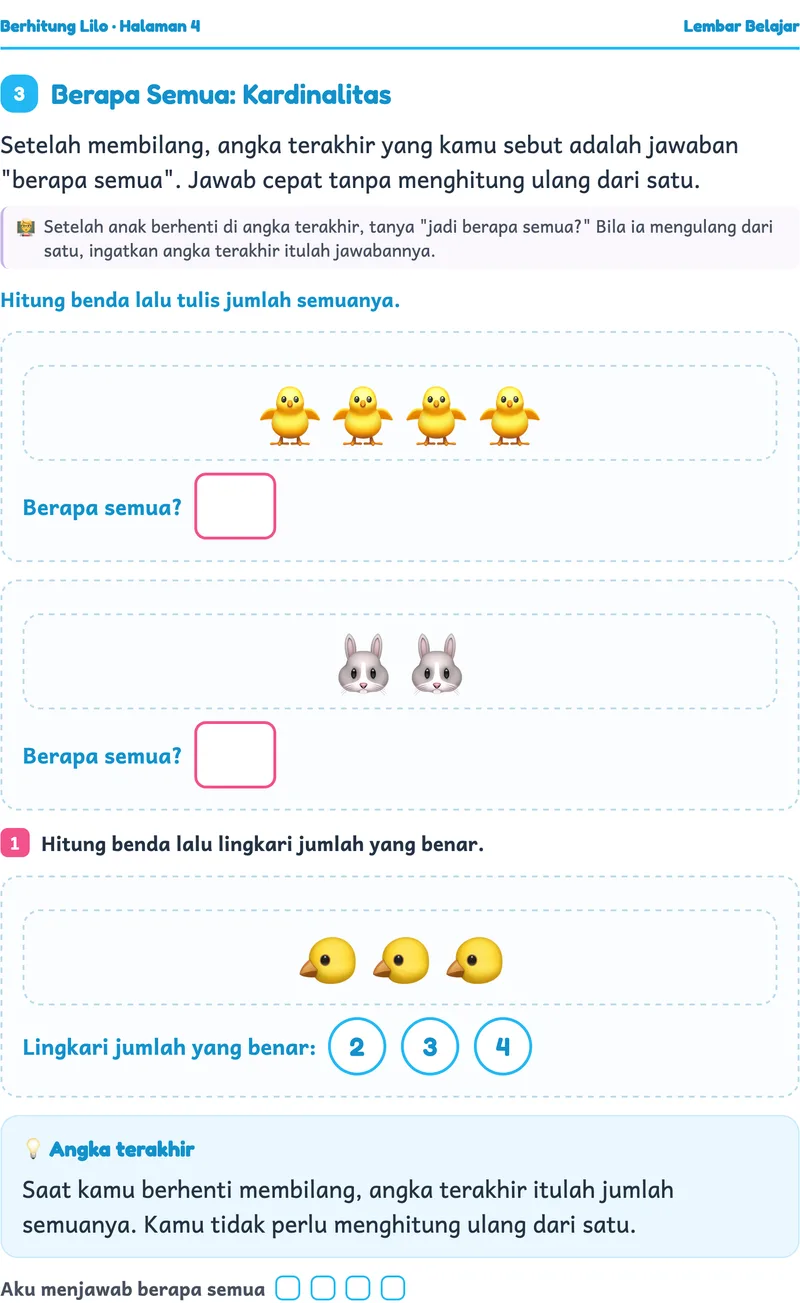
This Introduction Level sheet from the counting module invites children to count real objects one by one, then say the total out loud. It is the most natural way for a child to meet numbers.
Every sheet above is part of Lilo's own progressive curriculum, a complete set of 122 modules.

One free chat on WhatsApp is all it takes to get started. In the first lesson the tutor finds where success is waiting for your child, and you watch the ladder climb from there.
Free consultation on WhatsApp