


Ages 3 to 4, first meetings with letters and numbers
Your child explores letters A to Z and numbers 1 to 10 through play, with no pressure at all. Short, cheerful activities let curiosity lead while little hands practice lines and patterns.
One connected program for children aged 3 to 8 in Depok. Your child learns to read, write and count step by step, and every session quietly builds focus, independence and confidence.
Reading, writing and counting lessons in Depok are one connected Lilo program for children aged 3 to 8, taught at your home or online with English as the language of instruction. The three skills grow together through real objects, pictures and steady practice, and every session also strengthens your child's focus, independence and confidence.
Every child arrives at a different point. The placement assessment at the start tells us exactly where your child is, so lessons begin at a level that feels right.
Your child explores letters A to Z and numbers 1 to 10 through play, with no pressure at all. Short, cheerful activities let curiosity lead while little hands practice lines and patterns.
Your child blends syllables, counts with real objects and starts writing letters and numbers. Session by session, the pieces come together so primary school feels like a natural next step.
Your child reads with understanding, writes words and sentences, and works through addition and subtraction. Lessons strengthen all three skills together so schoolwork feels lighter and more enjoyable.
Some children simply started later or moved too fast past the basics. We find the level where your child is truly solid and rebuild from there, so confidence returns along with the skills.
Our approach follows how young children actually learn: touch first, then see, then understand the symbols. Along the way, your child practices sitting with a task and finishing it.
Your child starts with real objects they can touch, moves to pictures of those objects, and only then meets numbers and letters. This is the Singapore Math way, and it means your child understands what the symbols mean.
Your child learns the sound each letter makes and blends those sounds into words. There are no letter-name spelling drills, so reading clicks as something meaningful instead of a memory chore.
Story problems are drawn as simple bars, the Singapore bar model. Your child sees the problem before solving it, which trains careful thinking that lasts far beyond the worksheet.
Practice comes in small daily portions built level by level. Your child moves up only after truly mastering a level, and that habit of finishing well feeds independence and confidence.
Your child advances one stage at a time, with a check at every move.
Readiness shows in small daily habits. These clues help you start at a moment when your child is keen to try something new.
Depok and its surroundings have 60+ reading, writing and maths tutors.
Some still studying, others graduated.
Every application reviewed
Our team reads every application.
Identity and degree checked
ID card, diploma and photo are checked.
Tutor profile filled in
We know when each tutor is free.
Trained before teaching
Teaching starts after training.
Matched to your child
Candidates answer questions about the child.
Not the right fit? Read the tutor replacement guarantee
Your child simply plays, and the play shows which calistung stages are already solid.
A calm week: your child meets the tutor, plays, and ends up looking forward to the next visit.
In a free consultation you share your child's age, school year and sticking points, and a tutor is matched to them, near you in Depok for home lessons.
You can read the tutor's profile beforehand. Say the name to your child, so the visitor already feels familiar at the door.
Sound cards and small objects open the session. Your child plays while the tutor notes which letters and numbers are secure, then sums up for you.
Worksheets now come from the module matching your child's starting point, so the work feels challenging and winnable.
From recognizing letters to understanding what a sentence says. Your child builds each step on the last, so reading grows into a skill they trust.
Little hands warm up with lines and patterns before forming print letters, then words, then full sentences. Writing becomes comfortable instead of tiring.
Your child meets numbers through real objects, then adds, subtracts and solves word problems drawn as simple pictures. Counting means understanding, never empty recital.
Woven into every session: the patience to concentrate, the courage to try alone, and the quiet pride of finishing. These habits carry your child through school and beyond.
These signatures come straight from our own curriculum of 122 leveled modules, built so that understanding always arrives before symbols do.
Every new idea begins with something your child can hold, from counters to letter cards. Once the idea is solid in their hands, pictures and symbols follow naturally and stick.
Your child learns what each letter sounds like and blends sounds into words. This route builds real readers who can meet a new word and work it out themselves.
Story problems become simple drawn bars, so your child can see what is being asked. It is early training in careful, structured thinking that serves them for years.
Short, warm, consistent practice built level by level. Your child levels up only after mastery, so progress is real and confidence has a solid floor under it.
Each rung is a real stage in our own modules, so you can always see where your child stands and what comes next.
Most of these come from good intentions and hurry. Knowing them early saves your child months of frustration and keeps learning a happy thing.
Why it happensFacts learned by rote fade fast, and the child starts to associate learning with pressure and sour feelings.
How Lilo helpsBegin with real objects and pictures so the idea is understood first. What a child understands, a child keeps.
Why it happensHand muscles at 3 or 4 are still developing, so forced letter drills bring cramped grips and tears.
How Lilo helpsWarm up with lines, curves and patterns first. When the hand is ready, letters arrive almost by themselves.
Why it happensWithout objects to count, numbers become sounds recited in order, empty of meaning.
How Lilo helpsCount real things first, then pictures, then digits. The Singapore Math sequence exists for exactly this reason.
Why it happensA rushed final sprint piles pressure on a child and skips the layers that make skills stick.
How Lilo helpsStart earlier with a calm, steady rhythm of small portions. Slow and consistent beats fast and forgotten.
Why it happensReading, writing and counting feed each other; taught apart, progress turns lopsided and gaps hide.
How Lilo helpsChoose a program that weaves the three together, so each lesson quietly reinforces the other two.
Spelling be, o, el, a often leaves a child stuck. Here is why, and how the tutor helps sounds melt into words.
Letter names carry extra sound: b is called be, l is called el. Spelling bola by names leaves be, o, el, a in your child's head, pieces that never sound like bola. Stripping the extras while holding the order overloads a six year old's working memory, so many children guess from the first letter.
The sound route lifts that load. The tutor teaches b as a short pop and m as a hum you can hold. Stretchable sounds like m, s and l come first because they glide into a vowel: hold mmm, release into a, and ma appears. Indonesian letters keep nearly one sound each, so from ma and ta your child reaches mata alone.
In the session, a finger slides under the letters as the sounds stretch, then squeeze into a word. Once sounds run smoothly, the tutor moves to whole syllables, the building blocks of Indonesian words. The sign at home: your child reads a new word, a street name or a snack label, without asking.
This picture follows a six year old in Grade 1 catching up with classmates, on Regular's eight sessions a month, about twice a week.
Swapped letters such as b and d are sorted out with cards and gestures, and guessing gives way to certainty.
Sounds blend into whole syllables, and the weekly report starts noting words read in one go.
Your child reads short sentences from the school book while stage T shapes neat letters on lined paper.
With sticks tied in tens, 14 becomes one bundle and four loose sticks, and school addition makes sense.
Your child answers questions about a passage, draws word problems as bars, and keeps pace with the class.
Each child climbs this ladder at their own stride, paced by what is truly mastered.
The warung, the calendar and the wall clock are already full of letters and numbers. Put them to work.
Say the list aloud: gula, telur, sabun. Your child writes each first letter from its sound, then ticks items off at the warung. Stages H and T.
paper and a pencil
Put in seven and ask how many more fill it. Your child reads the empty holes without recounting, building pairs of ten for stage B.
a ten-egg tray, paper balls
Each morning your child reads the date, crosses it off and counts the boxes to Sunday. Day names read in syllables, Se-nin, Se-la-sa, add reading.
wall calendar, marker
Pick bath, dinner and bed. Your child reads the hour hand, writes its number following the arrow and labels each activity. Stages T and K.
wall clock, paper, pencil
Depok sits in West Java Province, sharing a border with Jakarta, and many people know it as one of the capital's buffer cities. It is also proud to be a campus city, where academic life hums along and learning feels woven into the day. The city reaches from Margonda and Beji out to Sawangan, Cinere, and Tapos, while Sukmajaya, Cimanggis, and Pancoran Mas fill the space between. With that love of education in the air, Depok is a lovely place for a child to start enjoying learning early.
Your child begins by handling real objects, then works with pictures, and only after that meets symbols. Each idea settles in before the next one arrives, so learners across Depok move up a level feeling calm and sure of themselves.
A companion teacher travels to your home anywhere in Depok's service areas. Your child learns where they feel most at ease, and every session gives one child the undivided attention of one teacher.
Every session uses worksheets arranged in careful levels that follow your child's progress. Steady, regular practice helps skills grow little by little and stay with your child for the long run.
60, 90, or 120 minutes
Contact us
60/90/120 minutes
Contact us
choose 60, 90, or 120 minutes
Contact us
Every path has its place. Here is an honest look at how guided Lilo lessons compare with learning at home alone and with learning apps.
A verified tutor guides live, adjusting to your child in the moment
Real objects first, then pictures, then symbols
Placement assessment at the start, level up only after mastery
Reading, writing and counting woven into one journey
A tutor patiently trains concentration and independent work
Two sessions a week, say Tuesday and Friday afternoon, is the rhythm many learners in Depok settle into. You pay one package at a time: Regular holds eight sessions for IDR 1,149,085, about a month at that pace, and a single online session is IDR 76,865. Each meeting blends letters, numbers and handwriting, at home with a visiting tutor or in an online class.
Four opening sessions to see whether the tutor and the rhythm feel right.
IDR 584,174Twice the length of Starter, long enough to settle into a weekly habit.
IDR 1,149,085Denser than Regular, so letters, numbers and handwriting move forward together.
IDR 1,694,733The longest stretch, double Intensive, carrying the foundations through until they feel secure.
IDR 3,216,100Included in every lesson package.
No extra fee, whenever you ask.
Here is how:
Topped up by a monthly report.
Fair questions for any provider, showing whether lessons connect with class and suit a body that wants to move.
| Question to ask | Why it matters |
|---|---|
How do your lessons connect with how my child's school teaches? | Clashing approaches confuse a Grade 1 child. Lilo starts from what your child can do today, with worksheets from the module in progress. |
How much of a session is seated, and how much is moving? | All sitting drains attention; all play loses direction. A Lilo session alternates a greeting, hands-on practice, a movement break, a worksheet and a wrap-up. |
How do you decide where my child starts? | Too high, a child gives up; too low, boredom sets in. Lilo's first session uses games, and the result maps onto a stage code. |
What background do your tutors have? | Young learners need people who understand them. Lilo's 5,000+ active tutors come largely from primary teaching, early childhood, psychology and mathematics. |
How will I see real progress? | Progress is what your child can show, like reading a new word. Each Lilo stage has a code, so you see where your child stands. |
Lessons draw on 122 original leveled modules built by Lilo. Your child follows a mapped path, and you can always see the next step clearly.
Concentration, independence and confidence are part of the curriculum itself. Your child gains skills on paper and steadiness inside, both at the same time.
For in-person lessons, a verified tutor comes to your home anywhere in Depok, from Margonda and Beji to Cimanggis, Sawangan and Cinere.
Lessons run in English, a natural fit for bilingual and national-plus families. Instruction in Indonesian is also available whenever you prefer it.
A placement assessment opens the journey, and your child moves up only after truly mastering each level. Progress is real, never rushed for show.
Reading, writing and counting reinforce each other in every session, so your child grows evenly instead of racing ahead in one skill and stalling in another.
Qiana loves counting the stairs every time she goes up to the second floor. Her reading is coming along too. The report after each session tells us what to review at home.
Razka wrote his own name for the first time on his grandma's birthday card. I even kept the card. His counting is getting more confident too, we are so grateful.
The sheets below come straight from Lilo's original materials. Reading, writing, and counting move forward side by side at every level, helping children develop evenly in all three.
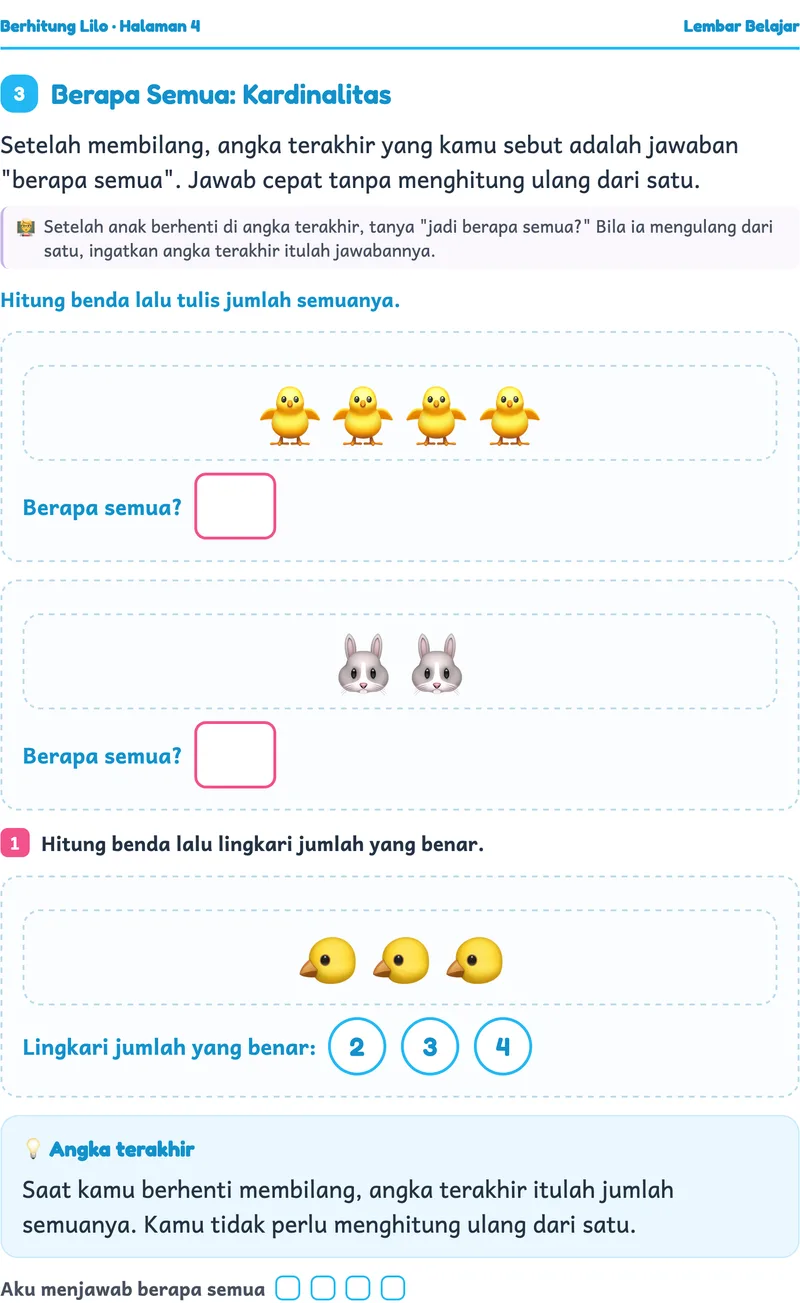
One, two, three. Children count real objects one at a time on this counting-module sheet at Introduction Level, then name the total. From this simple activity, a feel for quantity begins to grow.
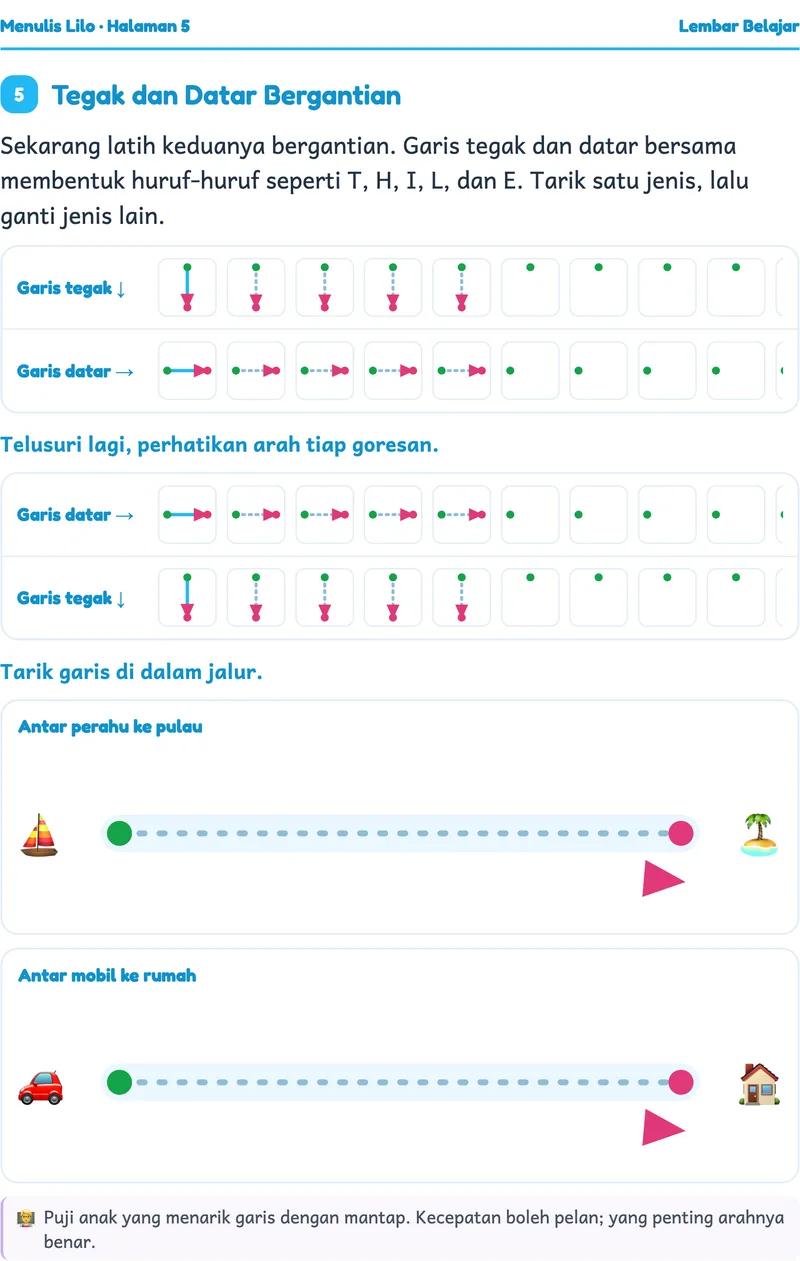
This Introduction Level sheet from the writing module has children draw vertical and horizontal strokes in turn. The simple exercise strengthens the small muscles of the hand before letter writing begins.
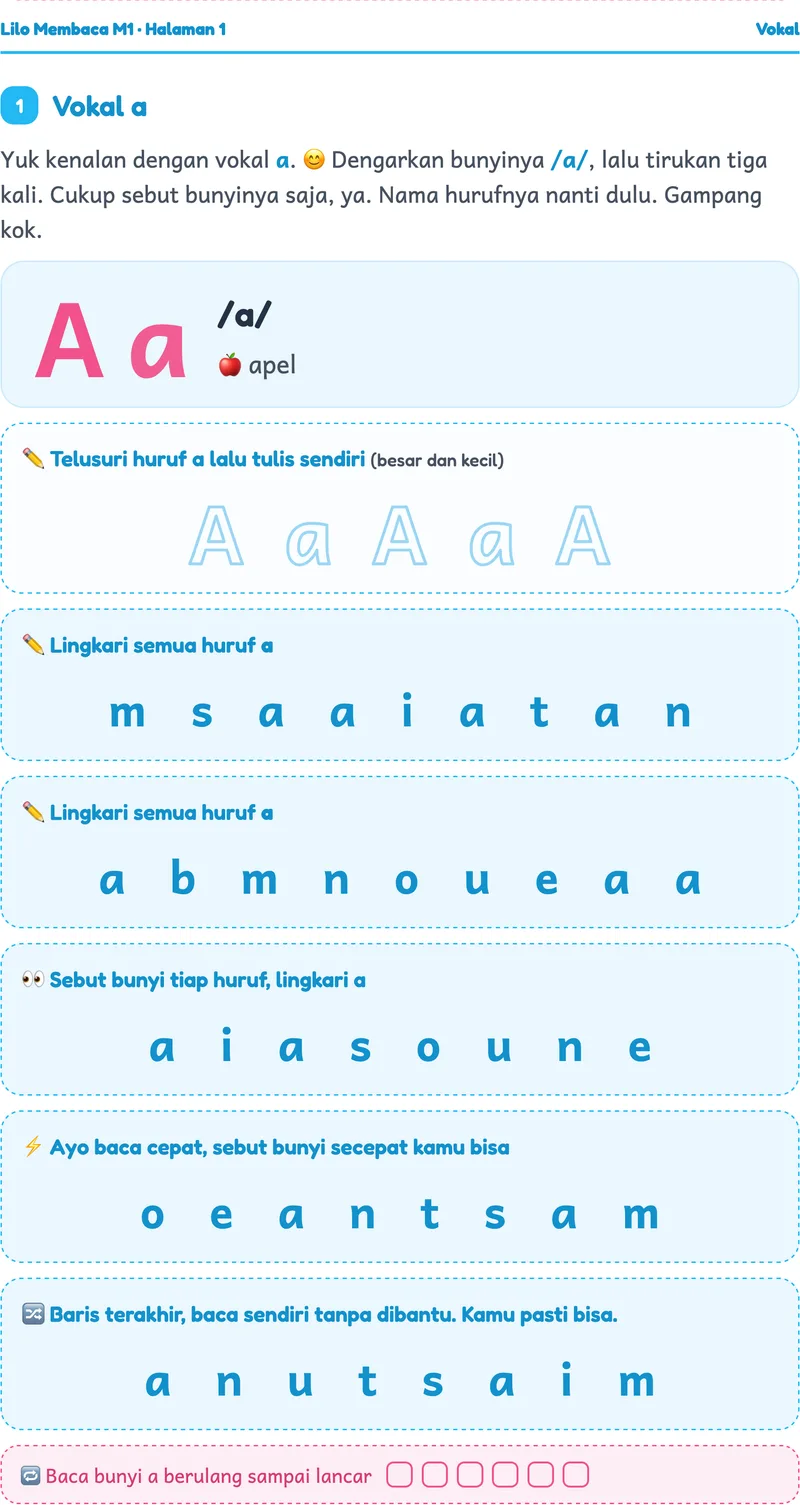
The vowel sound a opens the very first door to reading. On this Introduction Level sheet from the reading module, children meet it through cards, then point and read it again and again until it sticks.
These sheets are a small glimpse of Lilo's own progressive curriculum, carefully arranged across 122 modules.

Tell us about your child in a free WhatsApp consultation. We will suggest the right level and service, and you decide at your own pace, anywhere in Depok.
Free consultation, no obligation