


Ages 3-4, first hellos to letters and numbers
Your child is curious about the world and ready to meet letters A to Z and numbers 1 to 10 through play, with warm sessions and zero pressure to perform.
One connected journey through the three skills every child needs, taught in English by a verified tutor. Pick lessons at your home in Jakarta or meet online, whichever fits your week.
Reading, writing and counting in Jakarta is a Lilo program that teaches all three skills together as one journey for children aged 3-8, at your home or online. Your child starts with real objects, moves to pictures, then arrives at letters and numbers, so every new step rests on true understanding instead of memorized answers.
Every child arrives at letters and numbers on their own timetable. We meet your child at their real starting point and build from there, calmly and steadily.
Your child is curious about the world and ready to meet letters A to Z and numbers 1 to 10 through play, with warm sessions and zero pressure to perform.
Your child is blending syllables, counting further, and learning to write. We shape these growing skills into a steady foundation so the first day of primary school feels exciting.
Your child can already read and count a little, and now needs all three skills to grow together, reading with understanding, writing full sentences, and solving word problems with confidence.
If lessons at school moved faster than your child, we find the exact level where things still make sense and rebuild from there, so confidence returns along with the skills.
Whether the tutor sits at your table in Jakarta or meets your child on screen, every lesson follows the same careful path from real things to symbols.
Your child first handles real objects, then works with pictures of them, and only then meets the bare numbers and letters. This is the Singapore Math way, and it makes symbols feel meaningful.
Instead of spelling drills with letter names, your child learns the sound each letter makes and blends those sounds into syllables and words, which is how real reading takes off.
Story problems become simple bar drawings your child can see and reason about. The picture does the heavy lifting, and your child learns to think through a problem instead of guessing.
Practice comes in short, friendly portions built level by level. A placement check sets the starting level, and your child moves up only after truly mastering each step.
Each stage carries its own mark of completion, so progress stays visible.
From recognizing single letters to understanding whole passages, your child climbs one small step at a time until reading feels natural and enjoyable.
Hands get ready first with lines and patterns, then your child shapes print letters, writes words, and finally puts full sentences on paper with pride.
Your child gets to know numbers with real objects, then learns addition and subtraction with understanding, and finally reasons through word problems using bar drawings.
Alongside the three skills, every session quietly builds concentration, independence, and the confidence to try, which carry your child far beyond the lesson table.
A Lilo session weaves the three skills around the same material, so your child reaches one word or number from several directions.
Take the word ten. Your child reads it by its sounds, t, e, n, then writes it in capitals made only of straight lines, T, E and N. Next they lay out ten buttons and write the numeral 10 following the arrows. One idea is now stored as sound, hand movement and quantity. Memory with several ways in is easier to recall, so your child spots the word again in a storybook.
Writing slows reading down in a useful way. Copying a word makes your child notice every letter in order, including the ones that are easy to swap. Clapping syllables trains the ear to hear the parts of a word, which helps again when blending new ones. Counting adds care: one number word for one object is the same habit as one sound for one letter.
Switching activities also protects attention. A 5-year-old tires of one kind of task quickly, so the tutor moves from reading to writing to counting objects, with a movement break between. Story problems are where all three meet: your child reads a short sentence, draws a bar model and writes the answer. At home you see it when your child reads numbers and words nearby, then counts or writes them unprompted.
These four signatures shape every session, at home in Jakarta or online, and they come from our own curriculum of 122 leveled modules.
A child who understands why an answer is right will still know it next year, which is why we always build understanding before speed of any kind.
New ideas begin with things your child can hold and move, then pictures, then symbols. By the time numbers and letters appear, your child already knows what they mean.
Your child learns the sound each letter makes and blends sounds into words. This route skips tiring letter-name drills and leads straight to real, joyful reading.
Story problems turn into simple bar drawings, the Singapore way. Your child sees the parts and the whole, and reasoning becomes something they can literally look at.
Short, regular portions built level by level keep skills fresh without tears. Your child ends each session wanting a little more, which is exactly the point.
Each rung is a real stage in our own modules, so you can always see where your child stands and what comes next.
Most struggles with early reading, writing and counting come from a handful of well-meaning mistakes. Here is what we see most often, and how we handle it differently.
Why it happensMemorized facts fade fast because nothing holds them up, and lessons start to feel sour and pointless to the child.
How Lilo helpsWe build every idea from real objects and pictures first, so when your child gives an answer, they can also explain it.
Why it happensHand muscles need preparation. Pushing letters too early brings frustration, messy pages, and a child who dreads the pencil.
How Lilo helpsWe begin with lines and patterns that strengthen the hand, then move to letters when your child can form them with ease and pride.
Why it happensWithout real objects behind them, numbers become empty recital. A child may chant to twenty yet have no idea what seven means.
How Lilo helpsYour child counts real things first, then pictures, then symbols, so every number carries meaning before it appears on paper.
Why it happensRushing three skills into a short window produces stress and shallow results, right when a child needs calm confidence most.
How Lilo helpsWe pace the journey across levels from age 3, so readiness for school grows steadily instead of arriving in a panic.
Why it happensWith no bridges between reading, writing and counting, progress turns lopsided, strong in one skill and stuck in another.
How Lilo helpsOur lessons weave the three together, so each skill keeps lifting the other two week after week.
Readiness shows up in four small skills. Your child only needs some of the signs in each group, and the tutor builds the rest from the first sessions.
Our Jakarta network holds 350+ early literacy and numeracy tutors.
Graduates and current students alike.
Application screening
Suitable applicants move forward.
Identity and degree checked
ID card, diploma and photo are checked.
Teaching profile completed
Teaching history goes into the portal.
Learning the Lilo method first
Phonics and CPA come first.
Matched to your child
Questions come from the child’s needs.
Tutor not quite right? Free tutor replacement, here is how
Young children show what they can really do when they feel they are playing. So the first session is a game, and the tutor takes notes while joining in.
A child who cannot yet grip a pencil well can look like a non-reader on paper, when the real struggle is writing the answer down. Play keeps those two skills apart.
The tutor spreads letter cards and asks your child to catch the one that says /m/. It becomes clear whether they know sounds, blend syllables or read whole words like map.
Buttons are counted, split into two groups and joined again. Whether your child counts one by one or sees the total at a glance shows the right counting stage.
To finish, your child writes their own name. The pencil grip, the direction of each line and any swapped letters show where handwriting practice should begin.
Matching starts with what you tell us about your child. The team weighs their stage, your neighbourhood and their temperament before proposing one tutor.
A free WhatsApp consultation comes first. You share your child's age, the letters and numbers they already know, your address, and traits such as shyness or quick boredom.
The team draws on a national network of more than 5,000 active tutors, many with backgrounds in early childhood or primary teacher training, psychology or mathematics, matched to your child's stage and your location.
You can view the tutor's profile before the first session, so your child can hear the tutor's name and see their face early, and the first meeting feels familiar.
Once you agree, a regular home schedule is set together. How well your child and the tutor get along keeps being watched through the early weeks.
choose 60, 90, or 120 minutes
Contact us
60, 90, or 120 minutes per session
Contact us
duration of 60, 90, or 120 minutes
Contact us
This picture follows a 5-year-old taught face to face at home on the Intensive package, 12 sessions a month or about three a week. Children this age usually know a few letters, so the journey opens with syllables.
Three sessions a week help your child settle into blending sounds into syllables, then short words like sun and map. Counting runs alongside, touching each object up to ten.
Your child reads words such as cat, bed and pig by their sounds. Buttons bring in number pairs: five splits into two and three, or four and one.
Your child writes straight-line capitals like E, F and H, then numbers following the arrows. Their own name now appears on paper without a model to copy.
Adding and taking away within ten moves from objects to pictures to numerals. Pairs such as seven and three start to come without counting again from one.
Your child reads two or three short sentences and answers who and what. Simple story problems begin to be drawn as bar models with the tutor.
The tutor adjusts this order to your child's progress at each stage, so every new step stands on one that is already solid.
Bedtime and time in the car are already part of your child's day, and both fit a short practice. Each activity trains one clear stage.
While reading aloud, pause on one page and ask your child to point to things that begin with the same sound as their name. A child called Sara hunts for sun and sock. Letter recognition grows through sound.
a picture storybook at bedtime
Trace one straight-line capital on your child's back, slowly following its strokes. Your child guesses the letter, then traces one on your palm. Neat writing grows through the feel of the movement.
your fingertip and your child's back
In the car or on public transport around Jakarta, name what passes and clap each syllable. Mo-tor-bike gets three claps, tree gets one. Your child learns to break words into parts, ready for blending.
things seen from the window
Pick two digits from the plate of the vehicle ahead and let your child add them on their fingers. When the total passes ten, look for the pair that makes ten first. Basic counting grows from numbers your child spots.
the number plate ahead
Jakarta sits on the northwest coast of Java and serves as Indonesia's capital, anchoring the Province of DKI Jakarta. Government and education for the whole nation are run from here, so the city holds a wide spread of schools, starting with early childhood classes and reaching all the way to university. Many of the country's most respected places of learning have called Jakarta home for generations. You can feel that love of study in Menteng, in Kebayoran Baru, and out in Kelapa Gading. Lilo serves every child in Jakarta two ways: a teacher who visits your home, or online lessons with the same careful guidance. Whichever part of the city you live in, your child learns in comfort at home.
In Jakarta, your child sits at their own table while the teacher arrives with materials sorted by level. Each step is guided, and the speed of every lesson follows what your child can do.
Your child begins at a level that fits what they already know, then moves up in small, steady steps. Their growth is easy for you to follow, from the first look at an idea to handling it on their own.
Your child meets each idea with objects to hold and pictures to see, and only then turns to numbers and letters. Learning this way helps your child really understand each lesson.
Tutors come to homes across Jakarta, from Menteng and Tebet to Kebayoran Baru and Kelapa Gading, or your child can meet the same quality of lesson live online.
Reading, writing and counting are taught together, so what your child reads feeds their writing, and counting stories feed their reading. Progress stays balanced on all fronts.
Lessons come from Lilo's original library of 122 leveled modules, built around real objects, letter sounds, and bar drawings, and refined level by level.
Every tutor is verified before meeting your child. Instruction is in English, and bilingual support in Indonesian and English is available whenever your family prefers it.
A placement check finds your child's honest starting point among four levels for ages 3-8, and your child moves up only when a skill is truly solid.
Here is an honest look at how Lilo compares with two other common paths, so you can pick what truly fits your child.
| Aspek | Lilo | Worksheet Tutoring | Learning Apps |
|---|---|---|---|
| How new ideas are introduced | Real objects first, then pictures, then symbols, so understanding comes before answers | Usually starts directly on the printed page with written exercises | Starts on screen with taps and animations |
| Who guides your child | A verified tutor, live, who adjusts the lesson the moment your child hesitates | A tutor guides, with the worksheet setting the pace | The app responds automatically, with no adult watching how your child thinks |
| How the three skills connect | Reading, writing and counting are woven together and reinforce each other | Often practiced as separate subjects on separate sheets | Usually split into separate games and tracks |
| How progress is measured | A placement check at the start, then level up only after true mastery | Progress follows the number of sheets completed | Progress follows points, stars, and streaks |
| Where learning happens | Your home anywhere in Jakarta, a small group class, or live online | Usually at a fixed desk or center | Anywhere with a screen, without a live guide |
Can my child work on letters, handwriting and numbers in one schedule? That is the question we hear most from people enrolling in Jakarta, and the answer is yes. All three are practised in one flow, with an eight-session package at IDR 1,149,085. You pay for a whole package at once, and sessions run at home with a tutor or online through app.lilo.id, where a single online session is IDR 76,865.
The tutor observes your child's starting skills and sets the first steps.
IDR 584,174The tutor rotates letters, handwriting and numbers each week, with steady reports.
IDR 1,149,085The tutor tightens the schedule and adds practice where skills still wobble.
IDR 1,694,733The tutor guides your child from the first letter through to story problems.
IDR 3,216,100At home or online, the same.
One WhatsApp message is enough. Request it whenever you need.
Here is how:
Topped up by a monthly report.
How a teacher reacts when your child slips, and whether the pace follows your child, shape the whole experience. These questions are fair to ask any provider in Jakarta.
| Question to ask | Why it matters |
|---|---|
What does the teacher do when my child misreads a word? | A misread word shows which sound is still shaky. A good teacher has your child reread slowly until they find the slip themselves. Lilo tutors note the pattern for the next session. |
How are repeated mistakes followed up week to week? | Letters swapped again and again form a pattern, and patterns need their own practice. Ask whether such patterns are recorded and shared with you. The weekly report from a Lilo tutor names them clearly. |
Who decides when my child moves to the next stage? | A rigid calendar moves children on before they are ready, and small gaps pile up. Healthy pacing follows mastery, quick where things come easily and slower where they are hard. Lilo learners move up once the stage below is solid. |
How does the teacher notice tiredness or pressure? | The right challenge helps a child grow, while too much pressure makes them shut down. Ask what happens when your child gets restless. Lilo sessions switch between short activities with movement breaks, so your child comes back fresh. |
What happens if my child and the teacher do not click? | Temperament decides whether a child dares to make mistakes in front of a teacher. A good provider has a clear way forward. At Lilo, a new tutor comes at no cost when the match is off, a service promise we hold firmly. |
Latifah really looks forward to her lessons, she says they are fun. She is starting to understand addition using things around the house, like counting spoons while helping set the table.
Barra started primary school feeling well prepared. His teacher said he already knows his letters and numbers well. We are thankful we began lessons before school started.
See for yourself the original sheets children work on in Lilo's calistung classes. Every level trains reading, writing, and counting side by side, climbing one step at a time.
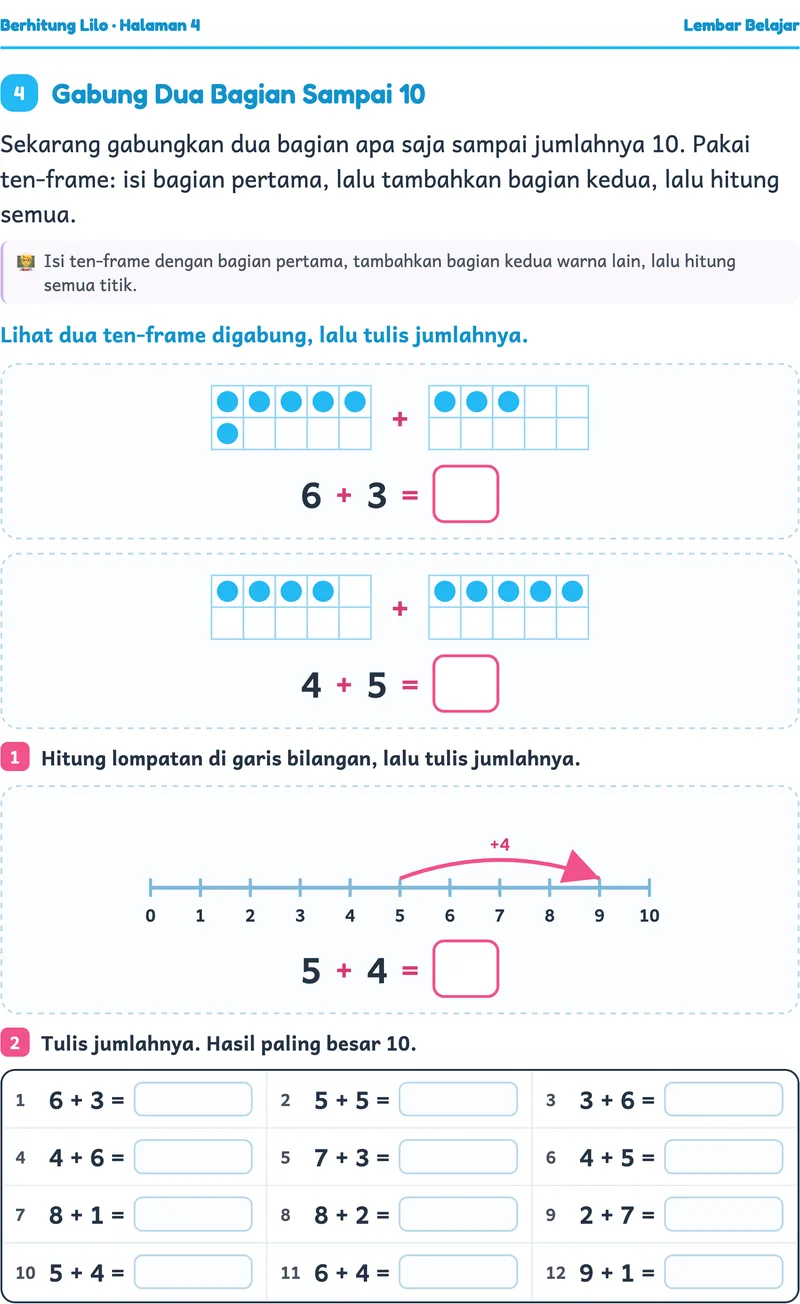
On this sheet, Intermediate Level children practice addition with two helpers: the ten-frame and the number line. They see the picture first and count afterward, so addition feels real and concrete.
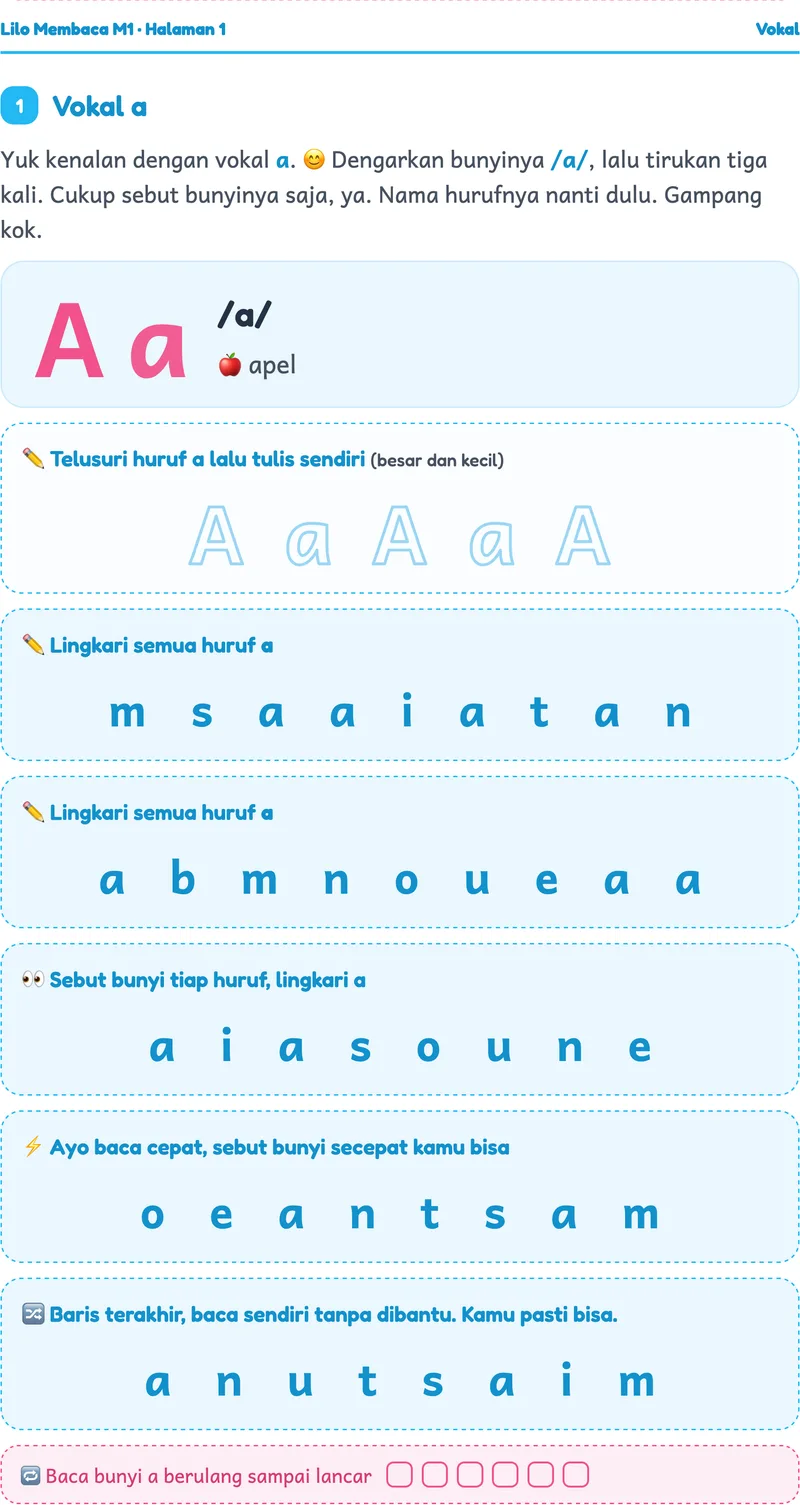
A real reading-module page: your child sounds out the vowel a with cards and point-and-read practice, the first door into reading.
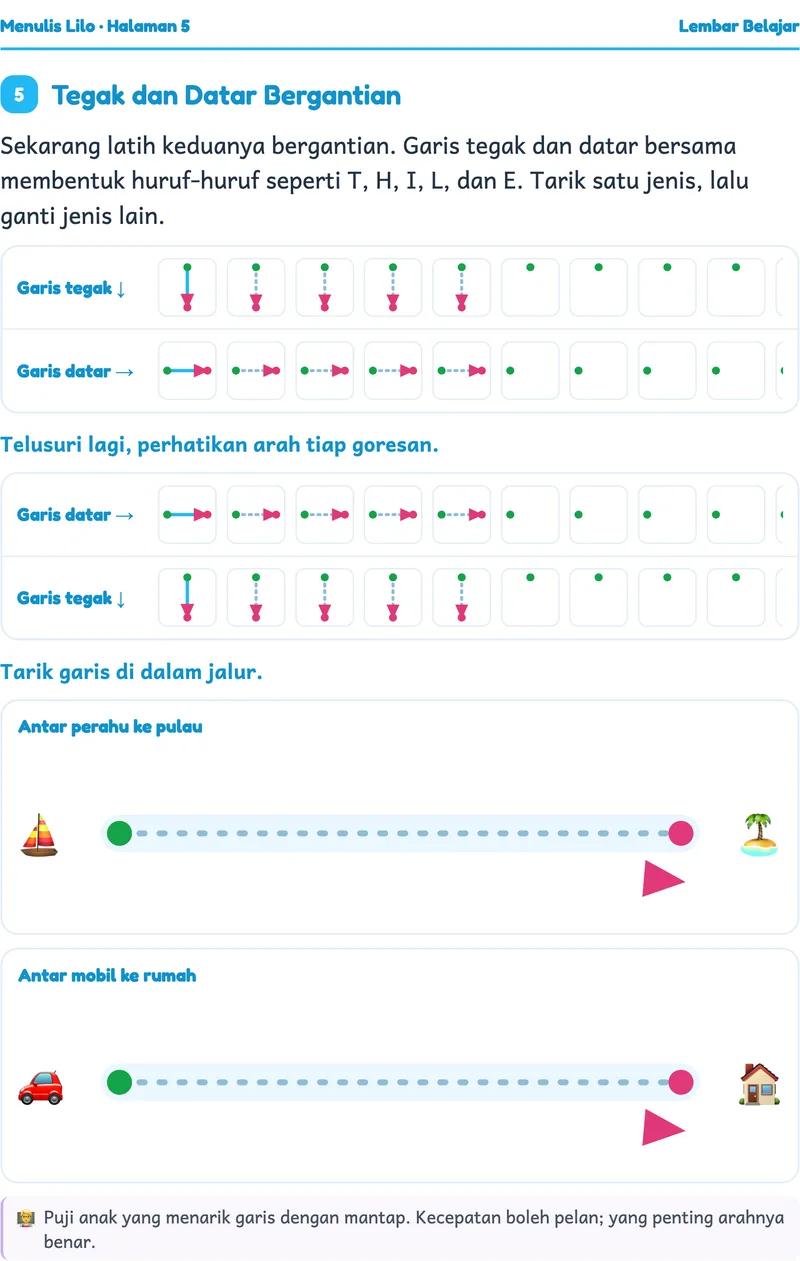
A vertical line, then a horizontal one, then back again. On this writing-module sheet at Introduction Level, children build up their hand muscles through simple strokes, important groundwork before their first letters.
Each sheet you see here comes from Lilo's progressive curriculum, one connected journey built from 122 modules.

Tell us about your child in a free WhatsApp consultation. We will suggest the right level and the format that fits your family in Jakarta, with no obligation at all.
Free consultation, friendly answers