




Ages 3-4, meeting letters for the first time
At this age everything is play. Your child gets to know letters and numbers through objects they can touch and games they enjoy, with zero pressure and plenty of smiles.
Lilo guides children aged 3-8 through reading, writing and counting as one connected journey. Every new skill begins with real understanding, so practice feels light and progress actually lasts.
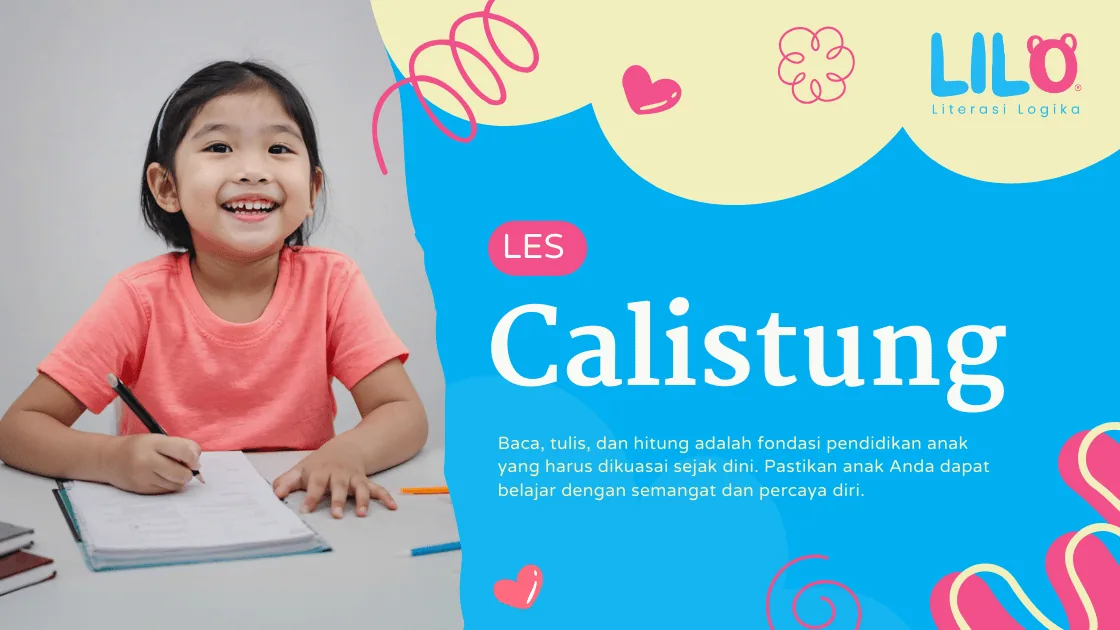
Reading, writing and counting in Jambi is a Lilo program where children aged 3-8 learn all three skills together as one journey, with English as the language of instruction. Each idea starts with real objects your child can hold, moves to pictures, and only then to letters and numbers, so understanding comes before any drill.
Every child arrives at letters and numbers on their own timeline. Lilo begins with a placement assessment, so your child starts exactly where understanding begins.
At this age everything is play. Your child gets to know letters and numbers through objects they can touch and games they enjoy, with zero pressure and plenty of smiles.
Kindergarten years are the perfect window. Your child builds a real grasp of sounds, quantities and pencil control, so the first day of primary school feels exciting instead of scary.
Early primary students deepen reading comprehension, tidy handwriting and confident counting at the same time, because the three skills feed each other when they grow together.
The placement assessment finds the exact level where understanding stopped. Your child restarts from solid ground, catches up step by step, and rebuilds confidence along the way.
Lilo follows the Singapore Math way of teaching. A concept is only practiced after your child can see it, touch it, and explain it.
New ideas begin with real objects your child can pick up, sort and move around. Counting means real beads and blocks before it ever means a written number.
Next, the same idea appears as pictures. Word problems become simple bar drawings, so your child can see what a question is really asking before solving it.
Only after the idea is clear do letters and numbers take over. Because the symbol now carries meaning, reading and arithmetic stop being memorized noise.
Steady practice in small portions, built level by level, locks each skill in. Your child levels up only after true mastery, never on a fixed calendar.
Each stage carries its own mark of completion, so progress stays visible.
Readiness for reading, writing and counting shows up in small everyday habits. A child who shows a few of these already has footing, and the first session finds the exact starting point.
Tutors for Jambi are chosen from 200+ teachers in Sumatra. Some of them already live in Jambi.
Some still studying, others graduated.
Applications screened
Role and city are checked first.
Documents verified
Diploma and ID are reviewed.
Teaching profile completed
Available hours are noted down.
Trained in the Lilo method
Lilo guides and materials are provided.
Matching per child
Questions come from the child’s needs.
Want a different tutor? Read the tutor replacement guarantee
Your child thinks it is playtime. Meanwhile the tutor is watching four things that set the starting point, with no test sheet anywhere on the table.
While your child colours, the tutor notices whether the crayon sits in a fist or between the fingertips. That tells the tutor whether to begin with lines and circles or move straight to forming letters.
The tutor points to a picture of a ball and asks for its first sound. A child who answers with the sound /b/ already holds the key to reading, while a child who says the letter name meets letter sounds first.
Your child is asked to fetch five blocks for a doll. The tutor checks that each spoken number lands on exactly one block, and whether your child trusts that five stays five when the blocks are spread apart.
The tutor notes how long your child stays with one activity and what happens when a tower topples. These small notes decide how long each activity runs in the sessions that follow.
These four steps take your child from the first WhatsApp message to the first written note on progress, and at every step you know what comes next.
You tell us your child's age, habits, and the way you would like lessons to run, with a tutor at your home in Jambi or in an online class. We also ask when your child is freshest for learning.
Our team picks a tutor who covers your area and suits your child's age. You can read the profile before the first session. For online classes, the link and worksheets arrive in advance through app.lilo.id.
The first meeting is blocks, cards and stories. Through that play the tutor finds your child's starting point with no written test, then closes with a short recap of the day and one light task for home.
At the end of week one, the tutor sends a written note naming your child's stage with a curriculum code, such as H for recognising letters. From that week on you can follow the journey closely.
From recognizing letters to understanding what a story says, your child climbs through syllables and sentences until reading becomes a source of joy.
Small hands are trained gently, starting with lines and patterns, growing into print letters, then words, then whole sentences written with pride.
Numbers begin as things your child can hold. Addition, subtraction and word problems then grow from that solid, touchable understanding.
Alongside the three skills, each session quietly builds concentration, independence and the confidence to try, stumble and try again.
These teaching signatures come straight from our own curriculum of 122 leveled modules, refined so understanding always arrives before practice.
A child who understands a concept needs far less drilling to master it, and keeps it far longer.
Every new idea is introduced through something your child can hold and move. Meaning is built by hand before any symbol appears on paper.
Your child learns the sounds letters make and blends them into words. Reading grows from hearing and understanding, so new words open up naturally.
Story problems are drawn as simple bars, the Singapore way. Your child sees the whole situation at a glance and reasons a path to the answer.
Short, warm, consistent sessions built level by level. Small daily wins pile up into skills that stay, without tears at the study table.
Each rung is a real stage in our own modules, and your child climbs to the next one only after mastering the current one.
These patterns show up in many well-meaning homes. Knowing them early saves your child months of frustration and keeps the joy in learning.
Why it happensA memorized answer has no roots. It fades within weeks, and the child starts to associate learning with a sour, anxious feeling.
How Lilo helpsBuild the idea with real objects first. Once your child can show you why 2 and 3 make 5, the fact stays for good.
Why it happensWriting needs hand muscles that develop gradually. Pushing letters too early produces cramped grips, messy strokes and tears.
How Lilo helpsStart with lines, curves and patterns that strengthen the hand playfully. Letters come easily once the muscles are prepared.
Why it happensA child who chants one to ten without touching real quantities is reciting a song. The numbers stay empty of meaning.
How Lilo helpsCount real things first, beads, spoons, toy cars. Attach each symbol to a quantity your child has actually held.
Why it happensA few rushed months cannot replace years of gentle building. Pressure this late often plants a fear of school itself.
How Lilo helpsBegin earlier with short, friendly sessions. Steady small steps make the transition to primary school calm and confident.
Why it happensReading, writing and counting share the same roots. Kept apart, one skill races ahead while another quietly falls behind.
How Lilo helpsChoose a program that weaves them together, so a reading session strengthens writing and a counting story strengthens reading.
Many children aged 4 to 6 write a 3 or a 7 like a mirror image. There is a clear reason behind it, and tutors follow a set order of practice to straighten it out.
From infancy, a child's brain learns to recognise objects from any side. A cup with its handle on the left is still a cup when the handle swings to the right, which is a very useful skill in daily life. Numbers follow a different rule, because the direction they face is part of their shape. A child who writes a backwards 3 sees a form that still looks like three to their eyes. They recognise the number correctly and have yet to store its direction. That is why reversals appear more often in writing than in reading.
In 2, 3, 7 and 9, the main body of the shape sits on the right. A child without a fixed starting point often begins the stroke on whichever side feels natural, and once the start is wrong, the whole figure flips. Tutors correct this through a start point and arrows. Your child writes big numbers in the air with the whole arm, then in sand or a tray of rice, and only then on lined paper. Each number gets a spoken path, so 9 becomes "ball first, then a stick on the right".
At home, the improvement arrives gradually. First your child pauses before writing, as if looking for the starting dot. Later they begin fixing their own numbers without a reminder. Sharp correction tends to make a child hesitant every time the pencil comes out, so simply point to the model card and let your child compare. If reversals still show up often in early primary school alongside other reading struggles, mention it during a consultation in Jambi so the tutor can plan a more gradual sequence.
The best materials are already in your house: toy blocks and old cardboard boxes. Each of these four activities trains a clear stage and ends before boredom sets in.
Your child builds a tower of seven red blocks and three blue ones. Ask how many are red and how many are blue, then swap to six and four. The tower stays the same height, so your child sees that ten splits in many ways. This trains stage B.
ten stacking blocks in two colours
Write 2, 3, 7 and 9 large on palm sized pieces of cardboard. Stick a green dot where each stroke begins and draw arrows for the direction. Your child traces every number with a finger while saying the path aloud, such as "across, then slide down" for 7.
old cardboard, marker, round green stickers
Write syllables such as bu, ku, sa and pi on small cardboard cards. A toy car stops at two cards, and your child sounds them out in order until the word buku or sapi appears. Sounds blend whole, with no letter names, building from stage S toward K.
cardboard pieces, marker, toy car
Tell a short problem: the doll has five blocks, and a friend gives three more. Your child lines the blocks up in two coloured rows, much like a bar model, then counts them all. Change the story a little, perhaps two blocks fall. Your child learns to draw a story before solving it.
stacking blocks, a doll or toy figure
This picture follows a 4 year old who knows no letters or numbers yet. The journey opens with the Starter package, about once a week, then moves up to Regular twice a week once your child starts asking for lesson days.
Your child meets the sounds of letters in their own name and in the names of things around the house. One session a week builds the habit of sitting with a tutor, taking turns, and tidying cards after play.
Small hands practise standing lines, lying lines and big circles, and the pencil starts to sit in a three finger grip. At home your child enjoys tracing letter cards with a fingertip before bed.
Two sessions a week make room to blend sounds into syllables such as ba, bi and bu. Your child starts reading syllables on food packaging and proudly shows them to anyone nearby.
Your child counts blocks one at a time while touching each, then matches the total to a number card. Three blocks and two blocks begin to join into five without counting again from the start.
Familiar syllables join into whole words such as buku, sapi and meja. Your child also writes 1 to 5 following the arrows, and a 3 that occasionally faces backwards is perfectly normal at this age.
The tutor moves your child up only after the current stage is truly mastered. That steady pace is what makes progress last.
60, 90, or 120 minutes
Contact us
60/90/120 minutes
Contact us
choose 60, 90, or 120 minutes
Contact us
Jambi serves as the capital of Jambi Province and sits along the Batanghari, among the longest rivers on the island of Sumatra. People here value a quiet pace of life and a courtesy passed down over generations. Across the water, Seberang Kota keeps a cultural legacy that locals hold dear. With its roomy streets and tidy layout, the city gives children a relaxed setting in which to grow up and study.
Your child starts at the point that fits them, then climbs one level at a time. Every session in Jambi follows a clear ladder, so progress is visible and easy for you to track.
The teacher works with your child personally, observes how they learn, and adjusts the pace of each session. This full attention helps children grow confident and willing to try.
Your child first handles real objects, moves on to pictures, and only then meets written symbols. Each step rests on the one before it, so the understanding runs deep and lasts for years.
An honest look at three common paths, so you can choose what truly fits your child.
| Aspek | Lilo | Worksheet Tutoring | Learning Apps |
|---|---|---|---|
| Where learning starts | Real objects your child holds, then pictures, then symbols | Printed exercises from the first session | Taps and animations on a screen |
| How reading is taught | Letter sounds blended into real words | Depends on the worksheet series used | Often letter names and repetition |
| Guidance during learning | A live tutor who sees hesitation and adjusts on the spot | A tutor checks completed sheets | Automated hints without a human eye |
| Moving to the next stage | Only after mastery, confirmed by the tutor | Usually after finishing a set of sheets | Often after finishing a game level |
| The three skills | Woven together so they reinforce each other | Typically practiced as separate tracks | Usually separate apps or modules |
Our team matches a tutor to your home location in Jambi and to your child's needs, and the lessons then run at home or in an online class. Each session begins at IDR 76,865, while the Regular package costs IDR 604,782. Payment is made one package at a time, and a larger package brings the session rate down.
By month's end, your child is used to sitting and listening to a tutor weekly.
IDR 307,460Your child gets used to laying out pencils and practising twice every week.
IDR 604,782Three sessions a week build the habit of trying a problem alone first.
IDR 891,965Learning becomes part of your child's day, as scheduled as meals and sleep.
IDR 1,692,684Written into the Lilo Terms of Service.
Just tell us, any time.
The steps:
And a progress report every month.
Two things are easy to forget when choosing lessons: how you will know your child is growing, and how well the lessons fit their school. These five questions are fair to ask any provider.
News that arrives only at the end of a term lets small hurdles grow large. Regular written updates give you time to help at home while a hurdle is still light. At Lilo, that update comes every week from the tutor who teaches your child.
A line like "doing well" is hard to act on. An update naming a concrete stage, such as blending syllables and now practising whole words, is something you can verify at home. Lilo's curriculum runs on 122 coded modules, so every update points to a clear stage.
A child can get muddled when lessons use letter names while school blends syllables, or the other way round. Ask what the very first step is. Lilo teaches reading through letter sounds and then whole syllables, a path that lets your child read new words independently.
Different stroke directions at lessons and at school leave a child holding two versions of the same number. Ask to see a sample worksheet. At Lilo, worksheets come from the module your child is studying, capitals are built from straight lines, and numbers follow arrows.
The fit between child and tutor decides whether your child looks forward to the next session or dreads it. Ask whether a change is possible and what it costs. At Lilo, a tutor who is not the right fit is swapped at no cost, chosen from a network of 5,000+ active tutors.
Your child practices something only after grasping it. That order makes every worksheet lighter and every skill last far beyond the next test.
Lessons come from 122 leveled modules built by Lilo itself, so every session follows a tested path instead of improvised material.
Verified tutors come to homes across Jambi, from Telanaipura and Kotabaru to Jelutung and Alam Barajo, so learning happens where your child is most comfortable.
Sessions can run in English or Indonesian, a natural fit for bilingual and national-plus families who want both languages to feel like home.
The placement assessment at the start finds your child's true starting point, so lessons never bore a quick learner or overwhelm a careful one.
Reading feeds writing, writing feeds counting stories, counting feeds reading of numbers. Growing them together keeps progress balanced and steady.
I never expected Katrisha to actually enjoy learning to count. At home she often plays number guessing games with her little brother. Her handwriting is starting to stay on the lines too.
Elzio used to struggle to focus while studying. Now he can sit calmly and finish his worksheets on his own. His numbers and letters look much neater too.
These are original sheets from Lilo's calistung materials. Reading, writing, and counting are trained side by side at each level, so all three grow together from first steps to mastery.
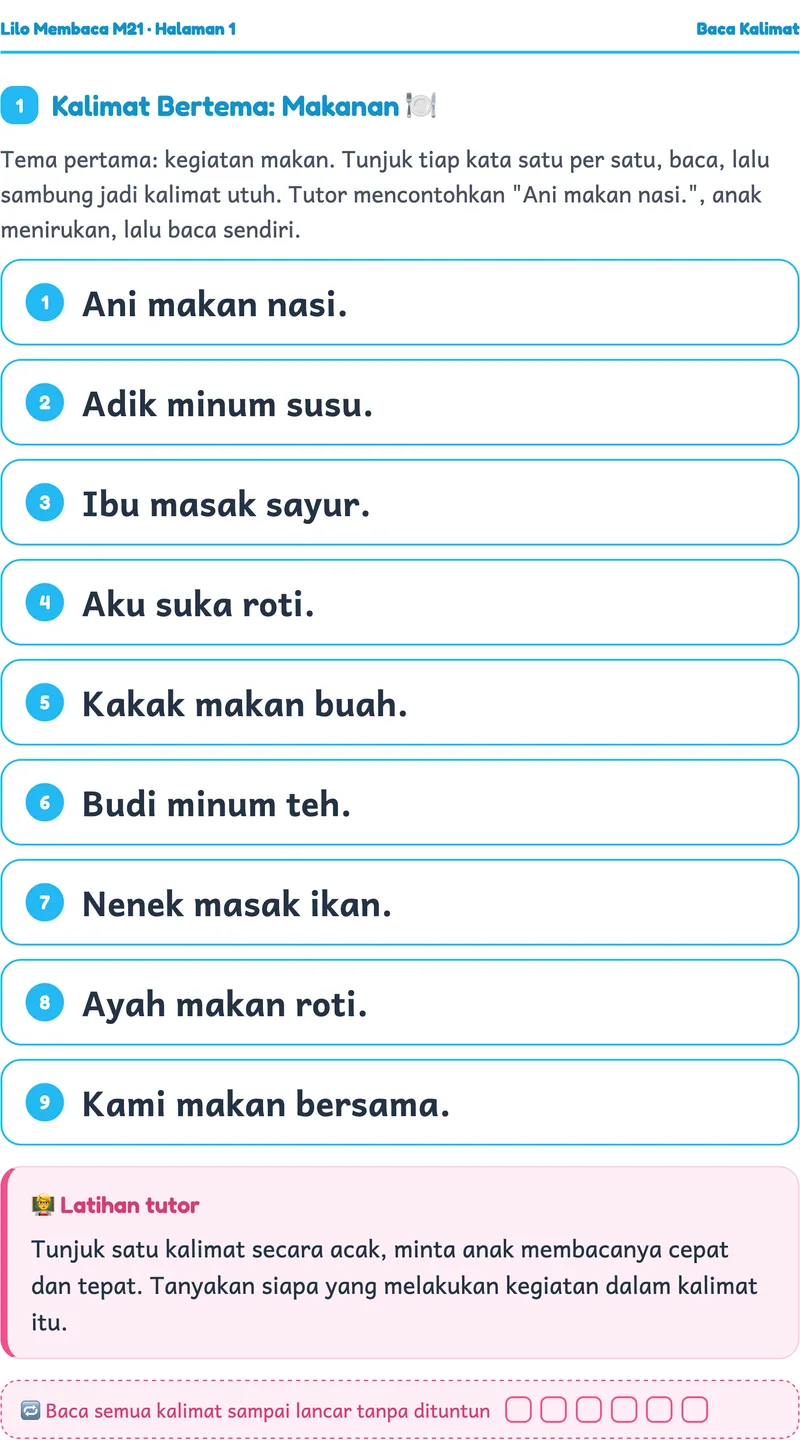
Here is where sound practice and syllable practice meet their result. On this Intermediate Level sheet from the reading module, children read short food-themed sentences in full, from the first word to the final period.
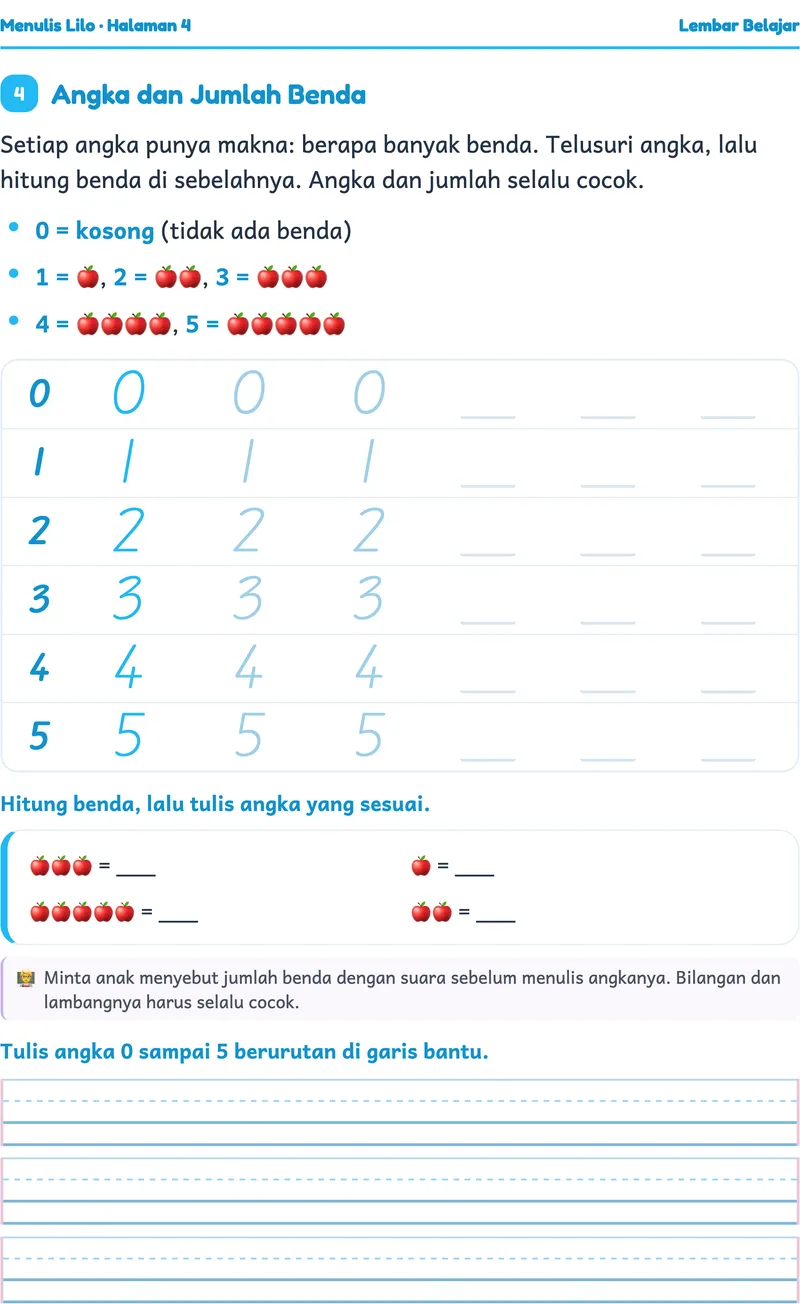
Which numeral matches this many objects? Children make the match on this writing-module sheet at Basic Level, then practice writing each numeral neatly by following the path prepared for them.
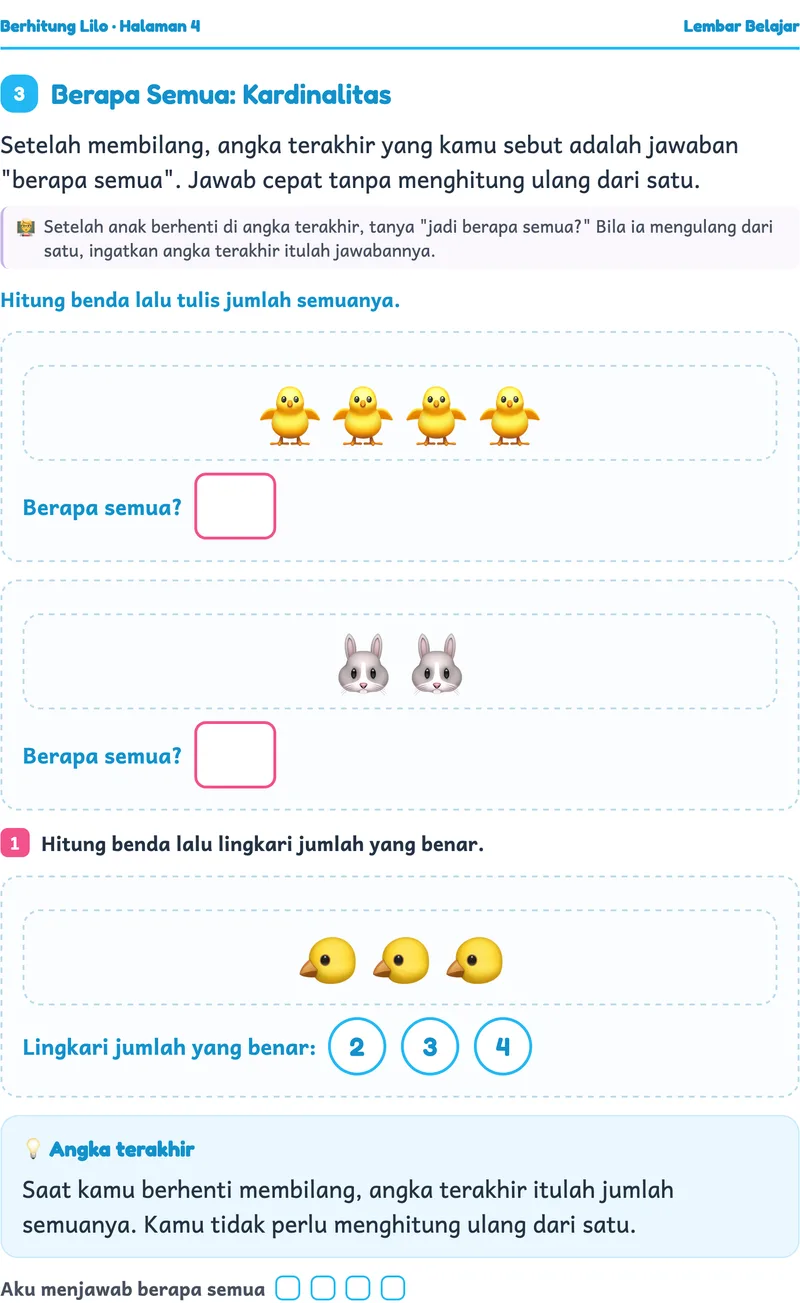
On this sheet, Introduction Level children learn to count with real objects. Each object is counted one by one, and the child then says how many there are in all. Everything starts from the concrete.
These sheets are a small glimpse of Lilo's own progressive curriculum, carefully arranged across 122 modules.

Start with a free consultation on WhatsApp. Tell us about your child, and we will suggest the right level and the way of learning that fits your family in Jambi.
Free consultation, no obligation