

Little explorers, ages 3 to 4
Your child meets letters A to Z and numbers 1 to 10 through play and objects they can touch, with warm encouragement and zero pressure to perform.
Lilo tutors guide children aged 3 to 8 through reading, writing and counting as one connected journey, beginning with real objects in small hands and steady practice in friendly portions.
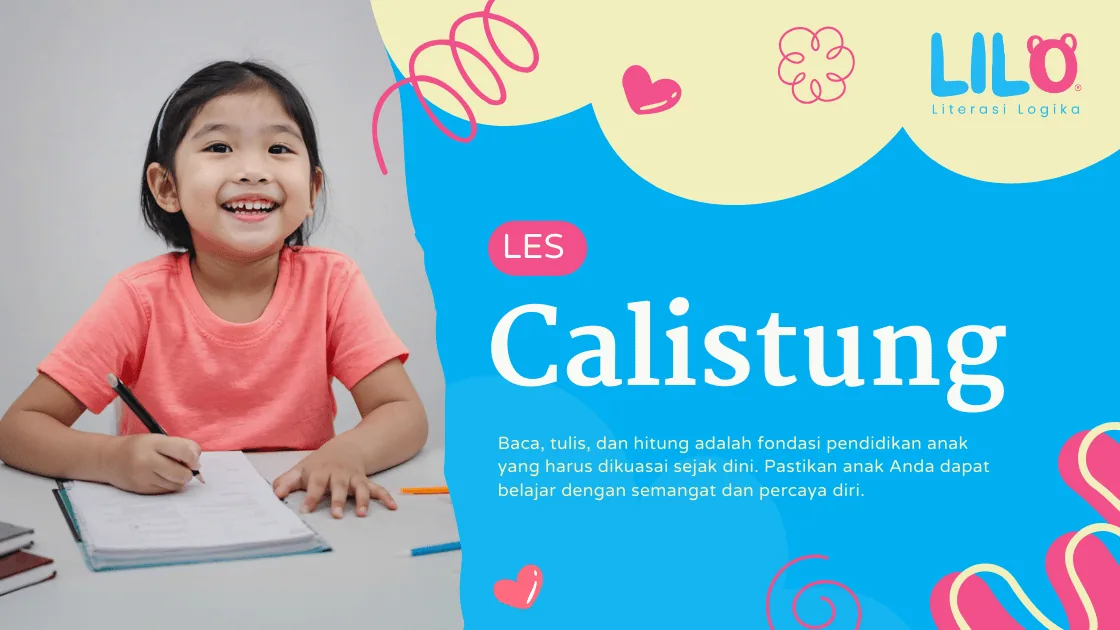
Reading, writing and counting in Jayapura is Lilo's guided program for children aged 3 to 8 that teaches the three skills as one connected journey, taught 1-on-1 online. Your child begins with real objects they can hold, moves to pictures, and only then meets letters and numbers as symbols, so every idea is understood before it is written.
Every child arrives at letters and numbers on their own timetable. Lilo begins with a placement assessment, so your child starts at the level that truly fits them today.
Your child meets letters A to Z and numbers 1 to 10 through play and objects they can touch, with warm encouragement and zero pressure to perform.
Your child blends syllables into words, counts with things they can hold, and forms letters with growing control, building calm and steady readiness for primary school.
Your child already reads a little and counts a little. Lilo deepens all three skills together, so reading carries meaning and counting carries real understanding.
If your child has fallen behind classmates, the placement assessment finds the level where learning feels possible again, and mastery there rebuilds confidence step by step.
At the far eastern edge of Indonesia, Jayapura serves as the capital of Papua Province and rests along the quiet waters of Yos Sudarso Bay. Green hills slope straight down into a deep blue sea here, and the well-loved Lake Sentani lies close by, which gives the city views that visitors rarely forget. Often called the eastern doorway of the archipelago, Jayapura has become a key hub for schooling and government in Papua, and a hopeful, future-minded energy runs through its streets. Lilo welcomes every child in Jayapura who is eager to discover the joy of learning. One-on-one online lessons with a tutor from Lilo's nationwide network can begin wherever you live in the city, and in-person lessons at your home follow as soon as the Lilo team confirms a tutor based near you.
In Jayapura, your child climbs a clear series of levels. The tutor begins at your child's current point, then adds one small step after another, so each idea settles firmly before the next arrives.
Every session includes short, regular practice that climbs one level at a time and stays warm and friendly. Children work on engaging worksheets, so a steady learning habit grows naturally.
Updates on your child's growth reach you often. The tutor shares which skills your child now handles with ease and which ones come up in the next sessions, so the whole path stays easy for you to follow.
Our method follows the Singapore Math way: understanding grows from things a child can hold, and every new step rests on a step that is already solid.
Counting starts with buttons, sticks and beads in your child's own hands. Three means three real things before it ever means a squiggle on paper, so numbers carry meaning from day one.
The objects become drawings. Story problems turn into simple bar models your child sketches, which trains reasoning: the picture shows what is known, what is missing, and how they connect.
Letters arrive through the sounds they make, blended into syllables and words. Numerals arrive as names for quantities your child already understands, so symbols feel like old friends in new clothes.
Short, regular practice built level by level keeps every session light and winnable. Your child moves up to the next level after they have truly mastered the current one.
Your child advances one stage at a time, with a check at every move.
From recognizing letter shapes to understanding what a story says. Your child moves through letters, syllables and sentences at a pace set by real mastery.
Small hands warm up with lines and patterns before forming print letters, then words, then full sentences that say something your child wants to say.
Numbers begin as objects your child can hold and count. Addition, subtraction and word problems all grow out of that solid, touchable start.
Alongside the lessons, your child practices sitting with a task, working on their own, and trusting their own thinking a little more each week.
The program stands on a curriculum we wrote ourselves, 122 leveled modules across Lilo, all built around ideas a child can touch before they name them.
Every new counting idea begins with things your child can pick up and move around. Understanding settles in through the fingers first, and the written numeral comes afterwards as a label.
Your child learns the sound each letter makes and blends those sounds into syllables and words. This turns reading into a skill your child can use on any new word they meet.
A story problem becomes a simple drawing of bars. Your child sees the whole and its parts at a glance, which quietly trains logic and reasoning inside everyday counting practice.
Short daily portions, built level by level, keep practice warm and doable. Small wins pile up, and your child starts to see themselves as someone who can learn anything.
These stages come straight from our own leveled modules, the same pages your child will actually work through.
Most of these mistakes come from love and hurry mixed together. Knowing them early saves your child months of frustration and keeps learning sweet.
Why it happensFacts memorized without meaning fade quickly, and the drilling itself can turn learning sour for a young child.
How Lilo helpsLet your child handle real objects until an idea makes sense, then practice it. Understanding first makes the memory stick and keeps the mood bright.
Why it happensWriting needs hand muscles that develop gradually. Pushing letters too early produces shaky results and a frustrated child.
How Lilo helpsStart with lines, curves and patterns as playful warm-ups. When the hand is ready, letters come out cleaner and the child feels proud.
Why it happensA child who chants one to ten without touching real things is reciting sounds. The numerals stay empty of meaning.
How Lilo helpsCount real objects together every day. Once three always means three things, the written numeral becomes a simple label for something already understood.
Why it happensSkills built in a rush sit on thin foundations, and the pressure of cramming often becomes a child's first memory of school.
How Lilo helpsBegin earlier and go gently. Small regular portions over a longer stretch build skills that hold, and your child walks into primary school calm.
A child of five or six who counts on their fingers is walking through a normal stage. Here is how it works, and when fingers quietly stop being needed.
To add five and three, your child must hold two numbers in mind while counting. A young child's short term memory holds only a little, so numbers slip away halfway through. Fingers keep those numbers outside the head. Five fingers stand up on one hand, three follow on the other, and the answer is right there to see. Moving fingers also helps a child feel how big an amount is, which is why nearly every child counts on fingers before counting moves inside.
The shift happens in steps. At first your child counts every finger from one to eight. Next they count on from the larger number: five stays in mind, and the fingers only count six, seven, eight. Then they recognise finger shapes at a glance, knowing that a full hand plus three makes eight. At that point fingers become a checking tool. You can watch this at home by noticing whether your child still starts at one or jumps to the first number.
The tutor keeps this bridge strong while slowly moving it inside. Your child forms pairs that make ten on their fingers, such as seven raised and three folded. For eight plus five, they split five into two and three, so eight becomes ten and the remaining three makes thirteen. A bundle of ten sticks shows the same idea with objects. Once the pattern settles, the tutor asks your child to picture their fingers with eyes closed before answering.
Readiness shows up in small daily habits. These three groups help you see when your child can start, when they can move up, and when a stage deserves a little more time.
Children in Jayapura learn online with 5,000+ Lilo tutors.
Some still studying, others graduated.
Applications screened
Each file is read by our team.
Identity and degree checked
Identity and diploma are matched.
Tutor profile filled in
Teaching experience and hours are recorded.
Trained before teaching
The step-by-step method is learned first.
Matched to your child
The team scores every answer.
Want a different tutor? Read the tutor replacement guarantee
The first session is a game with no written test. Afterwards the tutor writes notes on where your child begins. Here is how to read each part.
These notes become the baseline. Each weekly report after that shows how far your child has moved from it.
In Jayapura, learning starts with online classes. A little preparation at home helps the first session run smoothly and lets your child settle in quickly.
Set up a low table with light from the front or side, away from the television. Place the screen at your child's eye height so the tutor can see their face and hands while they write.
The class link and worksheets arrive before each class and are kept in app.lilo.id. Print the sheets a day early and keep them in one folder, so your child always knows where their materials are.
Collect about twenty small matching items such as bottle caps, buttons or ice cream sticks. The tutor uses a similar set on screen while your child moves their own across the table.
You can view the tutor's profile before the first session. Show your child the tutor's photo and name, so the face on screen feels familiar and your child feels brave enough to say hello first.
Home lessons follow once a nearby tutor is confirmed. The table corner and counting set you prepare now will serve those sessions too.
This picture describes a six year old about to start primary school, learning on the Intensive package of twelve sessions a month, about three a week. The close rhythm revisits each stage often enough for it to settle.
Your child, who already knows most letters, begins blending sounds into syllables such as ba, bu and ma. On the counting side, they count objects up to twenty and write the numerals down.
Using fingers and bottle caps, your child finds pairs that make ten, such as seven and three. Their fingers still move a lot this month, and that is a healthy stage to be in.
Your child reads words like sapu, meja and buku without guessing from a picture. They also write their own name in straight line capitals with tidy spaces between the letters.
Your child writes short sentences such as ini meja ibu. Numerals follow the arrows, and sums up to twenty get done with fingers appearing less and less often.
Your child reads three or four sentences and answers who and where. Simple word problems are drawn as bar models, so your child sees the parts and the whole for themselves.
Grade 1 admission uses age and asks for no reading or counting test. This timeline helps your child walk into that first classroom feeling at ease.
60, 90, or 120 minutes
Contact us
60/90/120 minutes
Contact us
choose 60, 90, or 120 minutes
Contact us
The dinner table and the kitchen shelf offer practice material every day. These four short activities each train one clear stage with no extra worksheets.
Ask your child to set a spoon for everyone at the table, then ask how many more are needed to make it right. Let them use fingers if they like, then check together by pointing at each plate. The B stage grows with objects they really hold.
spoons, plates and glasses on the table
Take three packets from the kitchen and say one letter sound, such as mmm. Your child hunts for that letter on the labels and points to it. Big printed letters are easy to spot, so the H stage becomes a small detective game.
milk carton, noodle packet, soy sauce bottle
Pick labels with two syllable words such as gula, kopi or sabun. Your child joins the first and second syllables, then matches the word to what is inside the packet in their hand. Reading a real object builds pride at the K stage.
spice labels or packets with short words
Your child copies two or three product names from packets onto paper in straight line capitals, then writes how many to buy. Stick the list on the fridge door, because writing that gets used for real gives the T stage meaning.
paper, pencil and empty packets as models
Families in Jayapura have several good paths for early learning. Here is how they compare on the things that matter most.
| Aspek | Lilo | Learning at Home Alone | Learning Apps |
|---|---|---|---|
| How new ideas are introduced | Real objects first, then pictures, then symbols | Depends on the materials parents can find | Mostly pictures and taps on a screen |
| Guidance during practice | A live tutor watches, corrects gently, and adjusts | A parent helps when time and energy allow | Automatic hints without a human eye |
| Matching the child's level | Placement assessment, then level up after mastery | Hard to judge without a measuring stick | Fixed difficulty settings chosen by menus |
| Connecting the three skills | Reading, writing and counting woven into one journey | Usually practiced separately when time permits | Separate games for each skill |
| Keeping motivation warm | Small portions and steady wins build real confidence | Depends on the day and the mood at home | Fun at first, attention can fade |
After one month, your child brings home neater worksheets, a handful of new words they can read alone, and sums they understand through real objects. You pay by package, with one online session at IDR 76,865 and the Regular package at IDR 604,782. Online classes come first, and home lessons follow once a tutor near you in Jayapura is ready to start.
Four weeks, once a week, meeting the tutor and finding a starting point.
IDR 307,460Four weeks, twice weekly, letters, writing and sums settle into a routine.
IDR 604,782Four weeks, three times weekly, word reading and symbol sums grow smoother.
IDR 891,965Four weeks, six sessions weekly, solid foundations through to simple word problems.
IDR 1,692,684Written into the Lilo Terms of Service.
We find a replacement for free. Request it whenever you need.
The steps:
Topped up by a monthly report.
You can ask these questions of any tutoring provider. The answers show whether your child will walk a path that has been properly planned.
A coded order tells you where your child stands today and what comes next. Without one, sessions drift with the mood of the day. At Lilo, every stage carries a code and a recorded module, so progress always has a clear address.
Materials gathered from many sources often clash in style and difficulty, which confuses a young learner. Materials from one curriculum keep language and order consistent. Lilo worksheets come from the module your child is working on right now.
A good answer names real objects first, then pictures, then symbols. That order gives your child something firm to hold when a question changes shape. Lilo tutors begin counting with objects your child moves with their own hands.
A written test can make a young child tense and hide what they truly know. Watching a child play shows how they think far more honestly. At Lilo, the first session is a game that sets your child's starting point.
The bond with a tutor shapes how readily a child asks questions and tries new things. A good provider has a clear answer from day one. If the match is off, Lilo finds a new tutor at no cost, as a firm service promise.
Lilo runs on 122 original leveled modules built around the concrete-to-symbols journey, so every worksheet your child touches belongs to one coherent, carefully ordered path.
Children in Abepura, Waena, Entrop, Hamadi, or elsewhere in Jayapura learn live online with a verified tutor from Lilo's national network. If you would like lessons at home, the Lilo team first confirms a tutor who lives nearby.
Lessons can run in Indonesian or English, a natural fit for bilingual and national-plus families who want the language of instruction to match home and school.
Because every idea starts with something your child can hold, learning sticks. Your child can explain why an answer is right, and that understanding lasts.
A placement assessment opens the journey, and your child moves up only after mastering a level. You always know exactly where they stand and what comes next.
Within a few weeks, my child started recognizing letters and numbers. The tutor always gives progress reports that are very helpful.
Qiana loves counting the stairs every time she goes up to the second floor. Her reading is coming along too. The report after each session tells us what to review at home.
See for yourself the original sheets children work on in Lilo's calistung classes. Every level trains reading, writing, and counting side by side, climbing one step at a time.
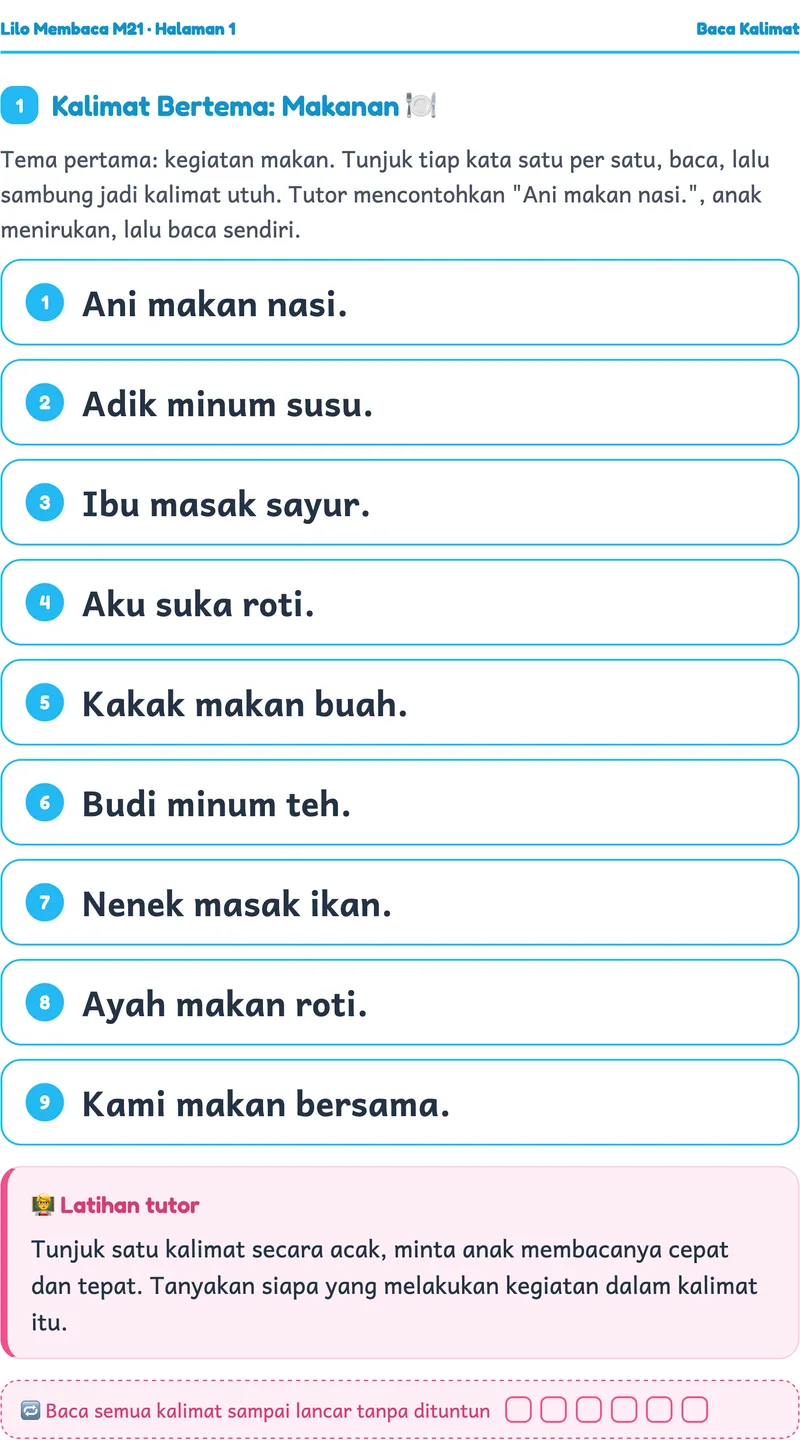
This Intermediate Level sheet from the reading module holds short sentences about food, read from start to finish. All the earlier sound and syllable practice comes together here as the child's first meaningful reading.
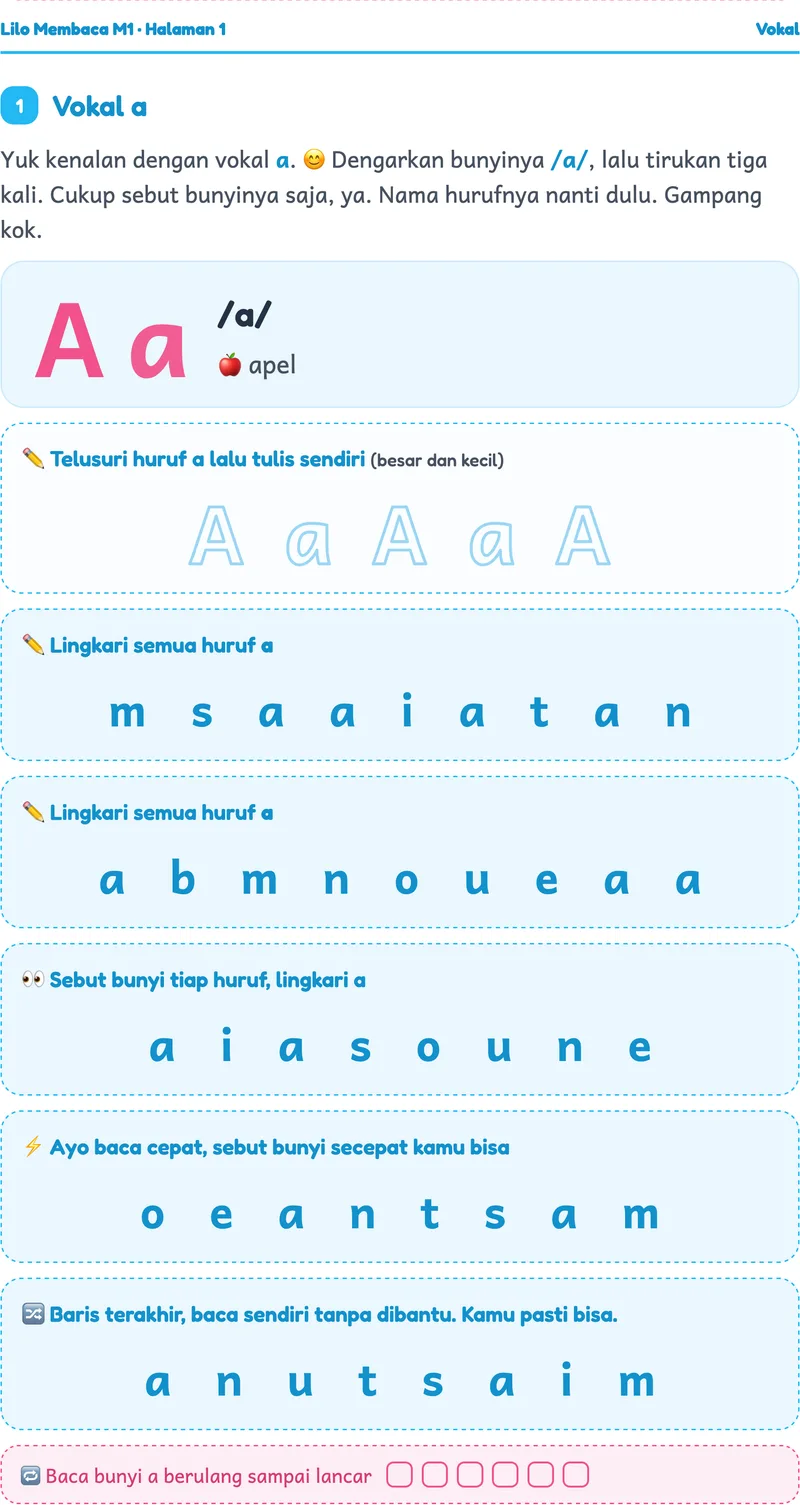
The vowel sound a opens the very first door to reading. On this Introduction Level sheet from the reading module, children meet it through cards, then point and read it again and again until it sticks.
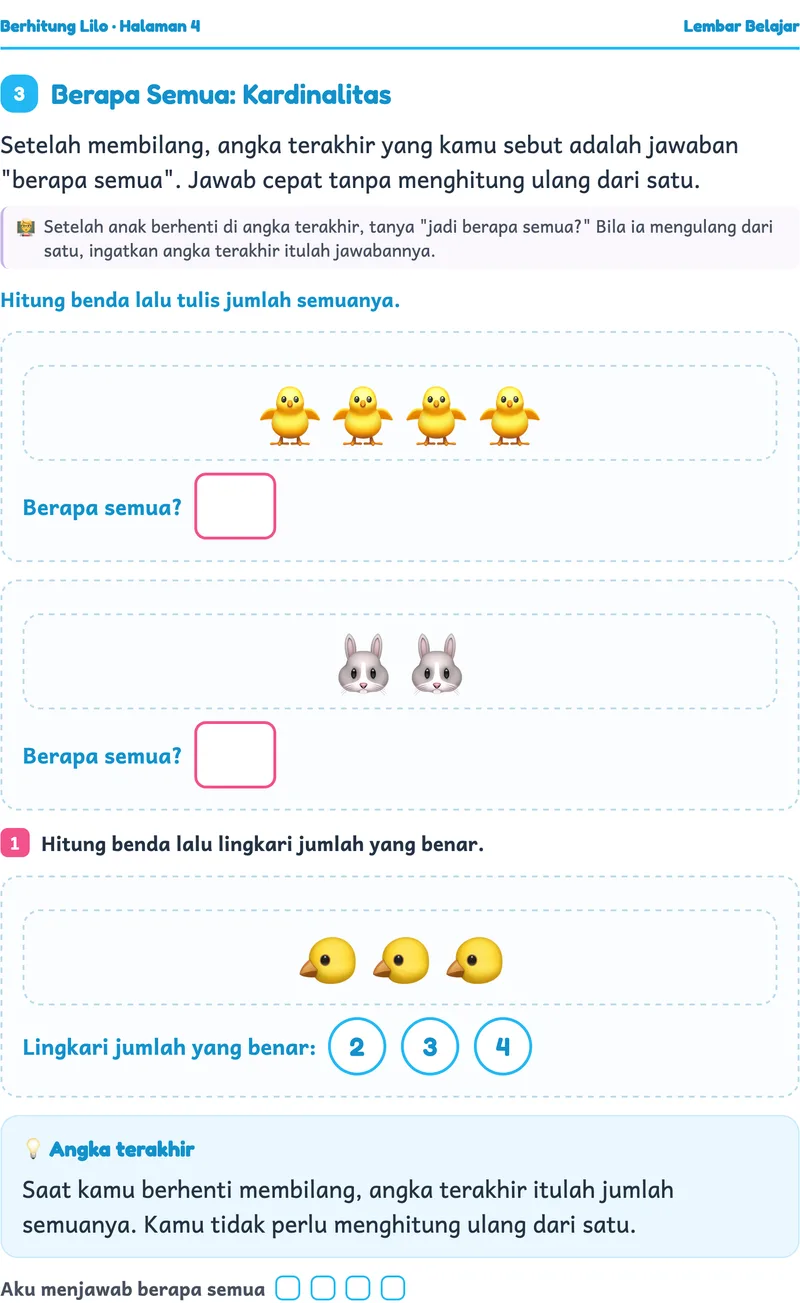
On this sheet, Introduction Level children learn to count with real objects. Each object is counted one by one, and the child then says how many there are in all. Everything starts from the concrete.
These sheets are a small glimpse of Lilo's own progressive curriculum, carefully arranged across 122 modules.

Start with a free consultation on WhatsApp. Tell us your child's age and where you live in Jayapura, and we will suggest a level and a schedule that fits your family.
Free consultation, friendly advice