



Ages 3-4, meeting letters and numbers
Your little one is just getting curious about letters and numbers. Lessons feel like play, with real things to touch and lines to trace, and there is no pressure at all.
One tutor guides reading, writing and counting as a single journey for children aged 3-8 in Kediri, and every page of neat, careful handwriting becomes something your child loves to show you.
Reading, writing and counting in Kediri is one guided program where a Lilo tutor teaches all three skills together to children aged 3-8, at home or online. Lessons begin with real objects your child can hold, move to pictures, then to letters and numbers. Writing gets special care, so tidy letters grow into pages your child is genuinely proud of.
Every child in Kediri starts from a different point. The placement assessment finds that point, and the tutor builds from there with calm, steady steps.
Your little one is just getting curious about letters and numbers. Lessons feel like play, with real things to touch and lines to trace, and there is no pressure at all.
Kindergarten years are the sweet spot for building all three skills. Your child blends syllables, counts with objects, and practices forming letters neatly before the first day of school arrives.
Your child already reads and counts a little, and now wants to read with understanding, solve word problems, and write sentences in handwriting that looks clean and confident.
Some children simply need lessons pitched at the right level. The tutor starts exactly where your child is comfortable, rebuilds the shaky parts, and confidence returns step by step.
Our method follows the way young children naturally understand the world: touch first, see pictures next, then read and write the symbols with confidence.
Your child counts beads, sorts blocks, and handles real things before any symbol appears. This is the Singapore Math way: when hands understand first, numbers and letters make sense later.
Instead of chanting letter names, your child learns the sound each letter makes and blends those sounds into syllables and words. Reading clicks sooner and feels like solving a friendly puzzle.
Story problems are sketched as simple bar pictures, so your child can see what the question is really asking. This trains reasoning, and the answer stops feeling like a guess.
Each session ends with short, friendly practice built level by level. Neat writing and sure counting grow from many small wins, and your child levels up only after true mastery.
The pace of moving up follows your child, so learning stays calm.
From recognizing letters to understanding whole stories, your child climbs one careful step at a time, sounding out syllables and reading sentences with growing confidence.
Little hands warm up with lines and patterns before forming print letters, then words, then full sentences, until every page looks neat enough to pin on the fridge.
Your child meets numbers through real objects, then learns addition and subtraction with understanding, and finally untangles word problems by drawing them as simple pictures.
Alongside the three skills, each session quietly builds concentration, independence, and the happy confidence of a child who knows their own work is good.
These signatures come from our own original curriculum of 122 leveled modules, built so reading, writing and counting support each other in every session.
Every new idea begins with something your child can hold and move. Understanding is built in the hands first, so the symbols that come later carry real meaning.
We teach the sound each letter makes and blend sounds into words. Your child decodes new words independently, and reading becomes a skill they own instead of a script they repeat.
Story problems become simple bar drawings. Your child sees the parts and the whole at a glance, reasons through the question calmly, and explains the answer in their own words.
Short, cheerful practice built level by level keeps skills fresh without tears. Neat handwriting especially grows this way, one tidy line at a time, until careful work becomes a habit.
Each rung is a real stage in our own modules, and your child climbs it in order, at their own pace.
Most struggles with early reading, writing and counting come from a handful of well-meant shortcuts. Here is what we see most, and how we fix it.
Why it happensMemorized facts fade fast because nothing underneath holds them up, and lessons start to feel sour and pointless to the child.
How Lilo helpsWe build understanding first with real objects and pictures, so facts stick because your child knows why they are true.
Why it happensSmall hand muscles need training before they can steer a pencil. Pushing letters too early produces messy pages and a child who dreads writing.
How Lilo helpsWe begin with lines, patterns, and playful tracing to strengthen the hand, then introduce letters when tidy strokes come easily.
Why it happensA child who chants numbers without handling real objects is reciting sounds. The counting is empty, and it collapses when problems get harder.
How Lilo helpsEvery counting idea starts with objects your child can move and group, so the symbols stand for something real.
Why it happensReading, writing and counting reinforce each other. Taught apart, one races ahead while another lags, and the lopsided gap widens quietly.
How Lilo helpsOne tutor weaves all three skills together in each session, using each skill as a bridge into the others.
Why it happensRushed drilling right before school entry piles pressure on a child and produces shallow skills that wobble in the first semester.
How Lilo helpsStart earlier with calm, small portions. Steady practice over time builds skills that hold, and school begins with confidence instead of panic.
Zero looks simple, and it is the number children take longest to grasp. Here is what happens in your child's mind and how the tutor guides it.
For a young child, counting means touching objects one at a time while saying numbers. Zero has nothing to touch. Ask about an empty plate and a child usually says there is nothing, then stops. Emptiness has yet to become an amount with a name and a symbol, which is why many children count smoothly to ten and go quiet when asked how many marbles an empty hand holds.
The tutor brings zero in through objects, then pictures, then the symbol. Your child hands over three buttons one by one, naming what remains: two, one, zero. The empty hand gives the word its feeling. A drawing of an empty plate with 0 beneath it comes next, and a rocket countdown makes zero sound like the natural step after one.
Later, zero keeps a place. Ten sticks are tied into one bundle and written as 10, meaning one bundle and zero loose sticks. This heads off a common early school slip, writing one hundred and five as 1005. At home you will notice your child saying zero when the biscuit jar is empty, writing 0 in empty boxes, and reading 20 as two bundles with no loose sticks.
Your home is full of learning material. Labels train reading eyes, and bath water trains counting and writing hands.
| Activity | Time | What you need |
|---|---|---|
Letter hunt on food boxesPick one letter, perhaps the first of your child's name, and hunt for it across the kitchen packaging, saying its sound at every find. Spotting letters on real things builds stage H. | 10 minutes | milk carton, soap wrapper, tea box |
Peeling open a word on a labelCover a word like gula with your finger and reveal one syllable at a time. Your child sounds gu, then la, then joins them, which suits stages S and K. | 5 minutes | a label with large print |
Bucket countdown to zeroAt bath time your child lifts toys out one by one, naming what is left: four, three, two, one, zero. The empty bucket makes zero real at stage B. | 5 minutes | bucket, scoop, five rubber toys |
Letters on foamy tilesYour child writes straight-stroke capitals with a finger on foamy tiles. Water wipes them away in a moment, so trying again feels easy. This prepares stage T. | 5 minutes | bathroom wall, soap foam |
This picture follows a four-year-old learning online twice a week on the Regular package of 8 sessions a month. Class links and worksheets arrive beforehand through app.lilo.id.
Your child learns the sounds in their own name, then runs around the house to find things that start the same way.
Spoons and toys get one touch each. Your child sees that the last number said is the total, and that an empty plate means zero.
Your child traces lines and circles along the arrows, then tries straight-stroke capitals such as L, T and E.
The sounds m and a melt into ma, and ma and ma become mama, built by sliding cards in front of the camera.
Your child reads bola and susu and writes their own name, and that pride makes the next session worth waiting for.
Each child keeps their own pace, and the next stage opens once the current one is truly secure.
choose 60, 90, or 120 minutes
Contact us
60, 90, or 120 minutes per session
Contact us
duration of 60, 90, or 120 minutes
Contact us
These questions are fair to ask any tutoring provider in Kediri, and the answers show how closely your child will be known.
A 5 written backwards needs fixing in the moment, and a teacher with one child sees every stroke. Lilo's private sessions always pair one tutor with one child.
Rare updates let a stuck stage hide for weeks. Lilo sends a report every week, which might mention your child now writing 0 in empty boxes.
An update that names a stage, such as blending syllables, tells you what to practise at home. Lilo's coded curriculum stages keep every update clear.
Placed too high, a child gives up, and placed too low, a child gets bored. Lilo spends the first session playing to find the right point.
The bond with a teacher drives enthusiasm, and fit can take time to show. Lilo changes the tutor at no cost whenever the match feels wrong.
Readiness shows up differently at three, five and seven. A few clues are enough, since the first session finds the real starting point through play.
Tutors for Kediri are chosen from 1,100+ teachers in East Java. In-person tutors in Kediri are available too.
Graduates and active students.
Application screening
Role and city are checked first.
Identity and degree checked
Identity and diploma are matched.
Tutor profile filled in
We know when each tutor is free.
Trained before teaching
Teaching starts after training.
Matched to your child
Questions come from the child’s needs.
Tutor not quite right? Free tutor replacement, here is how
The first session is a game. As your child plays, the tutor sees which stages are solid and which need building, with no written test.
Young attention fades when one activity drags on, so each session is cut into short parts that take turns.
The tutor greets your child and asks about the day. The little chat settles your child and lets the tutor read the mood and tune the pace.
New ideas arrive through things in the hand: bottle caps for counting, sound cards for reading, play dough for shaping letters. Busy hands keep attention alive.
A quick hop or an animal walk, and the body is ready to sit again for a worksheet from the module your child is working through.
Tutor and child name what was learned today, and your child receives one tiny practice job that fits into roughly ten minutes before the next session.
Reading, writing and counting are woven together in every session, so progress in one skill lifts the other two instead of leaving gaps between them.
We build neat writing patiently, from lines and patterns to full sentences, so your child hands in work they are proud to sign their name on.
Lessons come from Lilo's original, carefully leveled modules. Every session has a clear place on the ladder, and you can always see where your child stands.
Verified tutors teach one-on-one at your home across Kediri, from Mojoroto and Bandar Lor to Ngronggo and Pesantren, or online if that suits your family better.
Lessons can run in Indonesian or English as the language of instruction, a natural fit for bilingual and national-plus families in Kediri.
A placement assessment starts the journey at the right level, and your child only advances after truly mastering each stage, so confidence is built on solid ground.
In the first week, the tutor watches how your child holds a pencil, recognises letters and counts objects, then plans the steps ahead. You pay once for each monthly package, with sessions starting at IDR 76,865 and the Regular package at IDR 604,782. Your child learns at home with a tutor or in an online class, and Lilo replaces the tutor free if the match feels wrong.
Your child is curious about letters and numbers but not yet used to long study.
IDR 307,460Your child is happy with routine and benefits from a steady twice-weekly rhythm.
IDR 604,782Your child forgets quickly after long gaps, so three sessions a week help.
IDR 891,965Your child is eager every day and ready to finish the basics in one run.
IDR 1,692,684Included in every lesson package.
One WhatsApp message is enough. Ask at any point in your package.
Here is how:
Topped up by a monthly report.
Kediri sits in East Java Province, and the city took shape along the banks of the Brantas River. People know it for a quiet, unhurried pace and for a long love of learning. Lirboyo is one example: the name has been honored for generations as a home of study and scholarship. Here, patient daily study is a habit that parents hand down to their children, year after year. Lilo teaches young learners across Kediri, from Mojoroto to Ngronggo, with tutors who come to your home and with online classes. Your child, aged 3 to 10, builds reading, writing, counting and reasoning skills gently, one small stage at a time.
Your child begins with real things to touch and hold, moves on to pictures, and only then meets numbers and letters. A stage is fully mastered before the next one opens, so every skill rests on real understanding.
The teacher works with your child personally, watches how they learn, then adjusts the pace and the practice. A child who is shy in a big class becomes brave enough to try at home in Kediri.
Sessions are designed to be short, regular, and enjoyable, a friendly daily routine that moves up step by step. Little by little, day by day, your child's skills grow strong and lasting.
I love the personal approach they use. My child, who used to struggle to focus, can now learn with real enthusiasm.
Aisyah loves counting our groceries when she comes along to the shop. Her reading is starting to flow too, she sounds out the names of items on the shelves one by one.
These are original sheets from Lilo's calistung materials. Reading, writing, and counting are trained side by side at each level, so all three grow together from first steps to mastery.
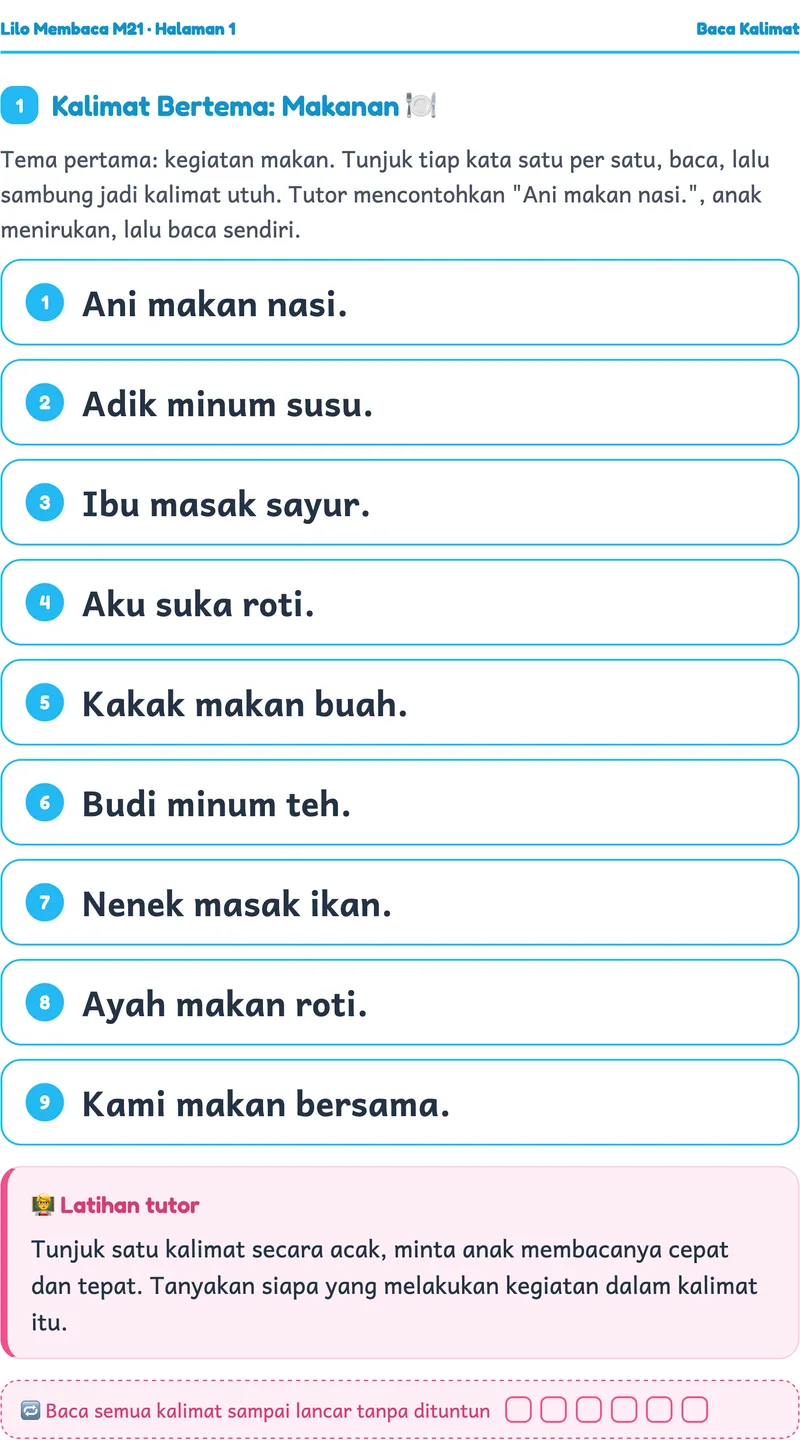
Here is where sound practice and syllable practice meet their result. On this Intermediate Level sheet from the reading module, children read short food-themed sentences in full, from the first word to the final period.
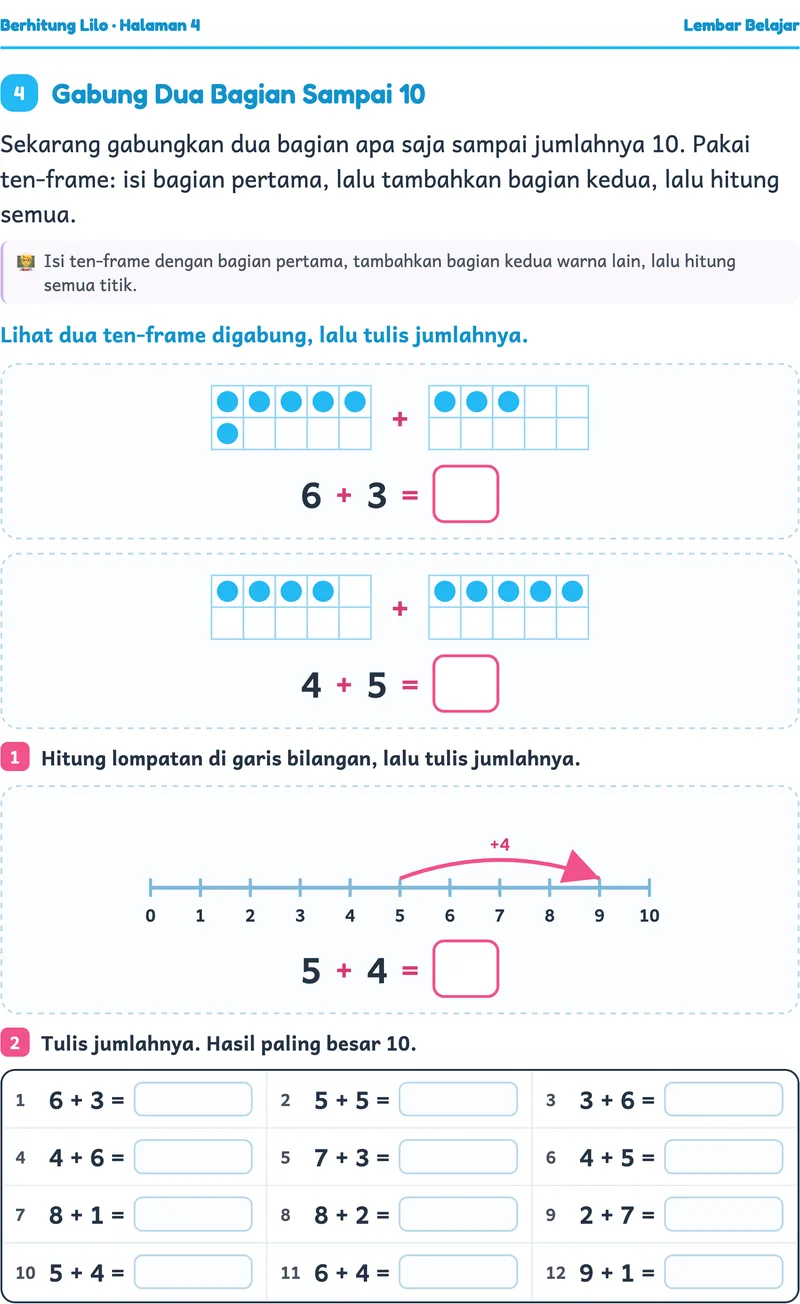
This Intermediate Level sheet from the counting module introduces addition through the ten-frame and the number line. Children look first, then count, so addition makes concrete sense from the very beginning.
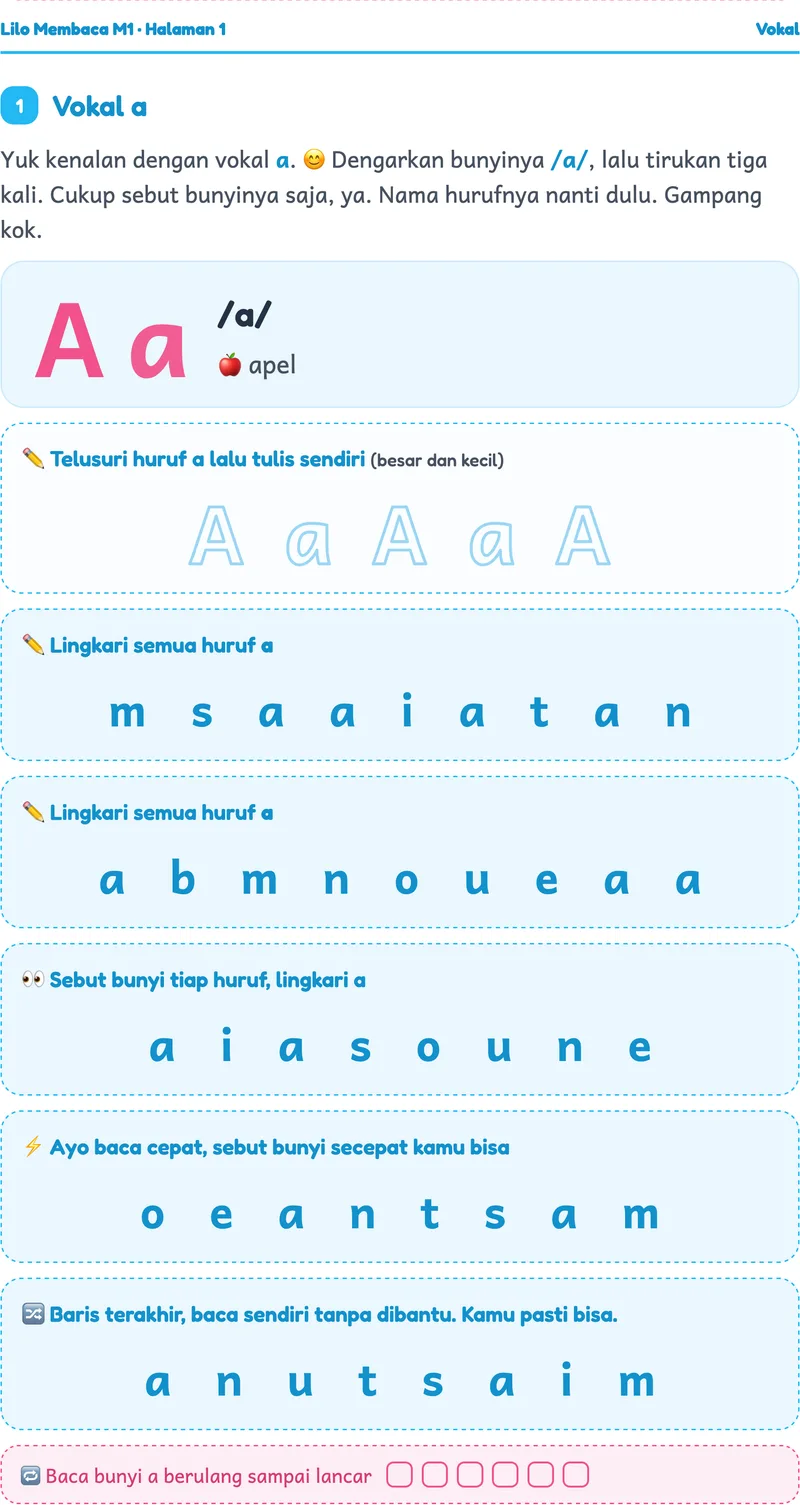
A real reading-module page: your child sounds out the vowel a with cards and point-and-read practice, the first door into reading.
Each sheet you see here comes from Lilo's progressive curriculum, one connected journey built from 122 modules.

Start with a free consultation on WhatsApp. Tell us about your child, and we will suggest the right level and the way of learning that fits your family in Kediri.
Free WhatsApp consultation today
More to explore, from Bandar Lor to Pesantren and online.