Kendari, Sulawesi Tenggara

Reading Writing and Counting Kendari: Our 122-Module Program

Your child learns to read, write and count as one connected journey, guided step by step through Lilo's own leveled curriculum, with a verified tutor and lessons that always start from real objects.

5.0from 82 parent reviews
5,000+ Lilo teachers
Lilo classes in Kendari
In PersonMandonga and nearby
What It Is

A Short Look at Reading, Writing and Counting

Reading, writing and counting in Kendari is a Lilo learning program where children aged 3 to 8 master all three skills as one connected journey, built on Lilo's own curriculum of 122 leveled modules. Every lesson begins with real objects your child can hold, moves to pictures, and only then to letters and numbers, so understanding comes before memorizing.

Three skills taught together, so each one strengthens the others
Built on Lilo's own curriculum of 122 leveled modules
Lessons start with real objects before letters and numbers appear
A placement assessment finds the right starting level for your child
Who Is This For

Which Stage Is Your Child At?

Every child arrives at letters and numbers on their own timeline. The placement assessment at the start places your child exactly where they are today.

Ages 3 to 4, first meetings with letters and numbers

At this age everything happens through play. Your child gets to know the shapes of letters, counts small groups of objects, and trains little hand muscles with lines and patterns, all without pressure.

Ages 4 to 6, kindergarten years

Your child blends syllables, counts with confidence, and starts writing letters and numbers. This is the stage where a calm, steady routine quietly builds everything primary school will ask for.

Ages 6 to 8, early primary school

Your child reads with understanding, handles addition and subtraction, and writes full sentences. Lessons strengthen all three skills together so schoolwork feels lighter and more enjoyable.

Children who have fallen behind classmates

The placement assessment finds the exact level where learning broke down, and your child rebuilds from there. Catching up happens through understanding, so confidence returns along with the skills.

Method

How a Lilo Lesson Works

Our method follows how young children actually learn: hands first, then eyes, then symbols. Each step below is written into our 122 modules.

  1. Real objects come first

    Your child counts beads, sorts blocks, and touches letter shapes before seeing anything on paper. This is the Singapore Math way: the hands teach the idea, and the symbols come later.

  2. Reading grows from letter sounds

    Your child learns the sound each letter makes and blends those sounds into syllables and words. We skip letter-name spelling drills entirely, because sounds are what unlock real reading.

  3. Word problems become simple pictures

    When a story problem appears, the tutor helps your child draw it as a simple bar picture. Seeing the problem laid out trains reasoning, and the answer stops feeling like a guess.

  4. Small portions, steady rhythm

    Practice comes in short, friendly portions built level by level. Your child moves up a level only after truly mastering the current one, which the tutor checks lesson by lesson.

Levels

Four Levels, One Clear Path

Every stage stands on the one before it, so the foundation has no gaps.

  1. Introduction Level

    3-4 years
    • Getting to know letters A-Z
    • Numbers 1-10 through objects and play
    • Early writing motor skills with lines and patterns
  2. Foundation Level

    4-5 years
    • Blending syllables from letter sounds
    • Counting 1-20 with real objects
    • Writing letters and numbers with growing control
  3. Intermediate Level

    5-6 years
    • Reading simple sentences
    • Addition and subtraction with understanding
    • Writing whole words neatly
  4. Advanced Level

    6-8 years
    • Fluent reading with real comprehension
    • Further counting and word problems
    • Confident and ready for primary school
Curriculum

Inside Our 122-Module Curriculum

Modul 1

Reading

From recognizing single letters to understanding what a whole passage says, your child climbs one small, satisfying step at a time.

  • Letter recognition
  • Syllables
  • Reading sentences
  • Comprehension
Modul 2

Writing

Hand muscles come first with lines and patterns, then print letters, then words and full sentences your child is proud to show you.

  • Lines and patterns
  • Print letters
  • Writing words
  • Writing sentences
Modul 3

Counting

Numbers begin as things your child can touch and group, then grow into addition, subtraction, and word problems solved with simple bar pictures.

  • Knowing numbers
  • Addition
  • Subtraction
  • Word problems
Modul 4

Character

Woven through every lesson: sitting with a task a little longer, trying before asking, and the quiet pride of finishing a page well.

  • Concentration
  • Independence
  • Confidence
Our Method

What Makes Lilo Lessons Different

These signatures come straight from the 122 modules we wrote ourselves, and they shape every single session your child has.

A child who understands the idea behind a letter or a number keeps that skill for life, while a child who only memorized forgets by the next holiday.

Start with Real Objects First

Beads, blocks, and everyday things become the first teachers. Your child builds the idea with their hands, sees it in pictures, and only then meets the symbol on paper.

Reading Through Letter Sounds

Your child learns what each letter says, then blends those sounds into syllables and words. Reading becomes decoding they can do alone, and new words stop being scary.

Word Problems Through Bar Models

Story problems are drawn as simple bars so your child can see what is known and what is missing. This trains reasoning that lasts far beyond one worksheet.

Friendly Regular Practice

Short, warm practice sessions built level by level build a habit your child actually enjoys. Levels rise only after mastery, so nothing is built on shaky ground.

Straight from Our Curriculum
  1. HRecognizing Letters
  2. SBlending Syllables
  3. KReading Words
  4. TWriting Neatly
  5. BBasic Counting
  6. PReading Comprehension

Each rung is a real stage in our own modules, so you can always see exactly where your child stands and what comes next.

Worth Knowing

Common Mistakes We Help You Avoid

These patterns show up in many well-meaning homes. Naming them early saves months of frustration for both you and your child.

Memorizing before understanding

Why it happensA child can chant letters and numbers without knowing what they mean. The knowledge fades fast, and learning starts to feel sour and pointless.

How Lilo helpsStart with real objects and letter sounds so meaning comes first. Our modules are sequenced this way from the very first page.

Forcing writing before the hand is ready

Why it happensSmall hand muscles need training before they can control a pencil. Pushing letters too early produces tears and a child who dreads the pencil.

How Lilo helpsBegin with lines and patterns that build strength playfully. Letters arrive when the hand is ready, and writing becomes a pleasure.

Jumping straight to number symbols

Why it happensWithout objects to touch and group, counting becomes empty recital. The child says the words but cannot use them to solve anything.

How Lilo helpsCount real things first, then pictures, then symbols. This order is built into every counting module we teach.

Cramming in the final months before primary school

Why it happensSkills rushed under pressure sit on shaky foundations. The child may pass the entry gate yet struggle the moment lessons speed up.

How Lilo helpsStart earlier with a calm, steady rhythm. Short regular sessions build durable skills and spare everyone the last-minute panic.

Teaching the three skills in separate boxes

Why it happensReading, writing and counting reinforce each other. Taught apart, one skill races ahead while another lags, and progress turns lopsided.

How Lilo helpsChoose a program that weaves the three together. In our lessons a reading exercise feeds the writing task, and counting stories feed both.

Child Readiness

Readiness Clues in Your Child's Ears, Eyes, Hands and Attention

Readiness shows up in ordinary moments, and your child needs no letters yet. One or two of these clues is plenty for a tutor to begin.

Ears and eyes

  • Answers when called from another room
  • Guesses an object from its first sound
  • Finds two matching pictures among several

Hands

  • Enjoys scribbling with crayons on paper
  • Stacks three or four blocks into a tower
  • Picks up a small button with fingertips

Attention

  • Stays with one toy for a few minutes
  • Joins a turn-taking game with simple rules
  • Returns to a task after glancing away
Tutor

Lilo Reading, Writing and Counting Tutors in Kendari

Lulu A.
  • Literacy and Numeracy
  • School Readiness
  • Writing
Clara M.
  • Literacy and Numeracy
  • Writing
  • Reading
Dewi N.
  • Literacy and Numeracy
  • Writing
  • School Readiness
Lika N.
  • Literacy and Numeracy
  • Sempoa Abacus
  • Counting
Venda L.
  • Literacy and Numeracy
  • School Readiness
  • Writing
Naurah N.
  • Literacy and Numeracy
  • Reading
  • Jarimatika
The Lilo Teaching Team

The Lilo Tutor Network for Kendari

Tutors for Kendari are chosen from 100+ teachers in Sulawesi. Home visits in Kendari follow the nearest tutor.

  • 100+ calistung tutors in Sulawesi
  • 5,000+ tutors in the national Lilo network

Where our tutors studied

  • Mathematics
  • Primary Teacher Education (PGSD)
  • Psychology
  • Other teacher training programmes

Some still studying, others graduated.

Sulawesi tutors studied at

  • Universitas Hasanuddin
  • Universitas Negeri Makassar
  • UIN Alauddin

Five Steps of Tutor Selection

  1. Applications screened

    Each file is read by our team.

  2. Documents verified

    Identity and diploma are matched.

  3. Teaching profile completed

    Teaching experience and hours are recorded.

  4. Trained before teaching

    Lilo guides and materials are provided.

  5. Matching per child

    Questions come from the child’s needs.

Tutor not quite right? Read the tutor replacement guarantee

Starting Point

From Play to a Stage Code: How the Tutor Sets Your Child's Starting Point

To your child, the first session is a game. Behind it, the tutor notes what is already secure and turns it into a stage code.

Sound games for letters and syllables

The tutor says the first sound of a nearby object and watches your child point, then moves on to joined sounds like ma or bu.

A road for a toy car

Your child draws a road, straight then curving, while the tutor watches grip, finger strength and direction for the neat writing stage.

Two stacks of blocks

Asked which stack has more, children count, pair the blocks or judge by height, and each answer marks a different counting stage.

Stage codes choose the first worksheet

The notes become a code for each skill, such as H for letters and B for counting, and that code picks the matching module.

Expert Insight

More, Fewer, the Same: Why Comparing Comes Before Adding

Before adding, your child needs to trust what a quantity means. Comparing two groups is the doorway, and the tutor trains it on purpose.

Children of three to five often judge quantity by the length of a row. Lay five buttons close together and five spread apart, then ask which row has more. Many point to the longer row, because their eyes read length as amount, a normal stage of growth. The certainty that a number holds when its arrangement changes forms slowly, and it gives written numbers their meaning.

The bridge is one-to-one pairing. Your child puts one spoon beside each plate, or parks one car in each box. Whatever lacks a partner stands out at once, and your child names it: more, fewer, the same. Pairing needs no counting, so comparing starts early, and counting both groups afterwards confirms what the pairing showed.

The habit returns at later stages. The same becomes the meaning of the equals sign, so 3 + 2 = 5 reads as two balanced sides. How many more seeds subtraction as difference: towers of seven and four blocks differ by three, later drawn as two bars in a Bar Model. Progress shows when your child asks, how many more do I have?


Timeline

The First Five Months for a Three Year Old on the Starter Package

This picture follows a three year old new to focused learning, seeing the tutor once a week on the Starter package. Each gentle month adds one skill you can see.

  1. Month 1

    Settling into the rhythm

    Your child learns the shape of a session: hello, play, a movement break, a close. Staying with one activity for a few minutes starts to feel easy.

  2. Month 2

    The first sound of their own name

    Your child hears the first sound of their name and spots it around the house. Two or three new sounds make a happy month.

  3. Month 3

    Straight lines and circles

    Small hands practise straight lines and circles, and the crayon grip moves from a whole fist toward a fingertip pinch.

  4. Month 4

    More or fewer

    Your child pairs two groups object by object and points to the bigger one before counting to five comes easily.

  5. Month 5

    Counting to five with real things

    One touch for each number word, and the last word tells how many. The tutor's report this month mentions buttons your child counted alone.

Keen for more? Moving up to the Regular package can be discussed on WhatsApp whenever your child is ready.

Home Practice

Kitchen and Block Games for Early Reading, Writing and Counting

Your kitchen and toy box hold the best teaching tools, and each short game here trains one clear stage.

  1. Two plates of peanuts5 minutes

    Put peanuts on two plates, one with a few extra. Your child pairs them across one to one, and the plate with leftovers has more, a basic counting step that needs no number words.

    two small plates and some peanuts

  2. Twin block towers10 minutes

    Build a four block tower and ask for one with the same number beside it. Match them level by level, add a block to yours, and ask which has more now.

    toy blocks or empty milk cartons

  3. Sound hunt on the kitchen shelf5 minutes

    Say a short s sound and your child hunts for something that starts with it, like salt or a spoon. Letters are learned by ear first.

    salt, spoon, sieve, cup, pan

  4. Writing in a flour tray10 minutes

    Sprinkle flour thinly on a tray. With one finger, your child draws a line from top to bottom, then a circle. A gentle shake wipes it clean for another go.

    a tray and two spoons of flour

Getting to Know Your City

Lilo Reading, Writing and Counting in Kendari

Kendari is the capital of Southeast Sulawesi Province, standing on the shore of Kendari Bay, the beautiful bay that has become the face and pride of the city. Rising above the bay is Al-Alam Mosque, a landmark known far beyond the region. As the center of government and education in Southeast Sulawesi, Kendari keeps growing and is home to many schools and universities. Its districts stretch from Kendari Barat to Poasia, including Kambu, Anduonohu, Mandonga, Kadia, Wua-Wua, and Baruga.

KambuAnduonohuMandongaKadiaWua-WuaBarugaKendari BaratPoasia

Home Lessons Around Kendari

A Lilo teacher visits your home anywhere in our Kendari service areas. Your child sits at a familiar desk in a room they know, so settling in is easy and attention stays on the lesson from the first minute.

Leveled Materials, Small Steps

The first lesson finds where your child is today, and that becomes the starting point. Each small step comes when they are ready, each worksheet is one they can finish, and their belief in themselves rises with every new skill.

Understand First, Fluency Follows

Real things and pictures come first, and numbers and letters follow once the idea makes sense. Your child builds a solid grasp of each concept, and quick, easy recall grows out of that understanding.

Classes

Three Ways to Learn with Lilo

in-person

Private In-Person

choose 60, 90, or 120 minutes

Contact us

  • The tutor comes to your home anywhere in Kendari
  • Fully one-on-one, paced entirely to your child
  • Real objects and worksheets on your own table
group

Group Class

60, 90, or 120 minutes per session

Contact us

  • Learning alongside a few friends adds warmth and motivation
  • Same leveled curriculum, guided by one tutor
  • A friendly option for children who light up in company
Online

Private Online

duration of 60, 90, or 120 minutes

Contact us

  • Live one-on-one sessions from wherever you are
  • Simple props you have at home keep lessons concrete
  • Flexible scheduling around your family's day
Getting Started

From Your First WhatsApp Message to the First Session in Kendari

You tell us about your child, and the Lilo team prepares the rest, right up to a tutor sitting beside your child.

  1. Tell us about your child on WhatsApp

    Share your child's age, what they love right now, and whether you want a tutor at home or an online class. The consultation is free.

  2. Read your matched tutor's profile

    The team picks a tutor suited to your child's age and needs, and you can read the profile before the first session.

  3. Prepare a table or the class link

    Home sessions need a low table in a quiet corner. Online classes get the link and worksheets beforehand, all managed in app.lilo.id.

  4. The first session opens with play

    Sounds, blocks and crayons set your child's starting point, so the second session already works at the right stage.

Comparison

Comparing Your Options Honestly

Families in Kendari have several good ways to help a child learn. Here is a fair look at how they differ.

AspekLiloWorksheet TutoringLearning Apps
How a new idea is introducedReal objects first, then pictures, then symbolsUsually starts directly on the printed pageStarts on a screen with animations
Who guides the childA verified tutor, live, adjusting to your child in the momentA tutor guides, with the worksheet setting the paceThe app responds, with no adult watching how the child thinks
How the three skills connectReading, writing and counting woven into one journeyOften practiced as separate subjectsUsually separate games per skill
How progress is measuredPlacement assessment, then level up only after masteryProgress follows the workbook sequencePoints and streaks, which may reward speed over understanding
Where learning happensAt your home in Kendari, online, or in a small groupAt a center or at home, depending on the providerAnywhere there is a device
Pricing

Kendari Lesson Fees

Regular is the package most learners choose: eight sessions a month, roughly twice a week, for IDR 604,782. Payment is settled package by package, and we take care of the timetable and the weekly report. A single online session to begin with is priced at IDR 76,865, and your child gets straight to letters, words and numbers with the tutor.

Starter4 sessions

Once a week, a relaxed session mixing letters, words and numbers.

IDR 307,460
Intensive12 sessions

Three sessions a week keep letters and numbers fresh.

IDR 891,965
Complete24 sessions

About six sessions a week, nearly a lesson every day.

IDR 1,692,684
Lilo Guarantee

What Every Package Includes

Written into the Lilo Terms of Service.

A note after each lesson

And a progress report every month.

Choosing Well

Judging a Program by Its Pace and Its Online Readiness for Young Children

Fair questions for any provider, and the answers show whether lessons follow your child's pace with healthy pressure.

Question to askWhy it matters

When is a child ready to move up a stage, and who decides?

Healthy pace follows mastery, since a child pushed up too early loses confidence. At Lilo, your child moves up after showing the skill comfortably in games and worksheets.

What does the teacher do when a child refuses partway through?

Young attention is short, so the teacher's response sets the mood. Lilo sessions switch between short activities with a movement break, and your child comes back fresh.

For online classes with a three to five year old, what arrives beforehand?

A small child on screen needs objects to hold and an adult nearby. Lilo sends the link and worksheets ahead of class, so you only set out a table.

How long is a session, and how is it divided for a three year old?

Long sessions feel light when the parts change often. Lilo sessions run 60, 90 or 120 minutes, split into a greeting, core practice, a movement break, worksheets and a close.

If the teacher turns out to be a poor fit, what happens next?

Fit between a young child and a teacher can show only after a few meetings, so ask early. At Lilo, a tutor who does not suit your child is swapped for another at no cost.

Why Lilo

Why Kendari Families Choose Lilo

A curriculum that is truly ours

We wrote our 122 leveled modules ourselves. Every lesson your child receives was designed as one coherent path, from first letters to reading with understanding.

Understanding before memorizing

The concrete-to-pictures-to-symbols approach means your child grasps why two and three make five, so skills stick long after the lesson ends.

Verified tutors who come to you

Our tutors are verified and come to your home, whether you live in Kambu, Mandonga, Baruga, or anywhere else in Kendari. Online sessions are available too.

Bilingual instruction available

Lessons can run in Indonesian or English, a natural fit for bilingual and national-plus families who want both languages alive in daily learning.

A clear starting point for every child

The placement assessment at the beginning removes guesswork. Your child starts at the level that fits today, and you can follow every step upward.

Reviews

From Lilo Parents

5.0From 82 parent reviews
Latifah really looks forward to her lessons, she says they are fun. She is starting to understand addition using things around the house, like counting spoons while helping set the table.
Latifah M.'s DadParent of a Calistung Student
Reading, writing and counting tutoring in Kendari really helped my child understand letters and numbers in a fun way. The tutor is very patient and creative in teaching.
Mrs. SantiHomemaker
FAQ

Questions Parents Often Ask

What age can my child start?
Lilo welcomes children from age 3 up to age 8 in this program. Threes and fours meet letters and numbers through play at the Introduction Level, while older children join at whichever level matches their placement assessment.
My child cannot read at all yet. Is that a problem?
That is exactly what the program is for. Your child begins with letter sounds and real objects, with zero assumption of prior skill. The placement assessment finds the right first step, and the tutor builds from there at your child's pace.
Do lessons happen at our home or online?
Both are available. A tutor can come to your home anywhere in Kendari, including Anduonohu, Wua-Wua, Kendari Barat, and Poasia, for one-on-one sessions of 60 minutes. Private online sessions run 60 minutes, and a group class option is also open.
How is this different from teaching my child at home myself?
Reading time with you at home is precious, and we encourage it. What Lilo adds is a structured path through 122 leveled modules, a tutor trained in the method, and a clear check that each level is mastered before the next begins.
How much does the program cost?
Fees vary with the service type and session frequency you choose, so the fairest answer comes from a quick conversation. Contact us on WhatsApp for a free consultation and we will lay out the options clearly, with no obligation.
Will my child be ready for primary school?
The Advanced Level is designed exactly for that: fluent reading with comprehension, confident counting, and tidy writing. We promise honest readiness and confidence built on real understanding, which is what carries a child through the first years of school.
My child gets bored quickly and sometimes refuses to learn. Will this still work?
Yes, because short, changing activities suit this child well. Refusal often means a task feels too hard, so the tutor steps back one stage and moves to a hands-on game until your child feels capable again.
Is this program still useful for children aged 8 to 10?
It is, especially for a child who reads haltingly, misses the meaning of a passage, or gets lost carrying and borrowing. The curriculum reaches age 10, with material that suits an older child, such as word problems about pocket money.
My child is left-handed. Will they be asked to switch hands?
The tutor follows the hand your child chooses. A left-handed child learns to tilt the paper and hold the pencil so the writing stays visible, while letters keep the same arrows that make writing neat.
My child reads well but counting lags behind. Can lessons focus on counting?
Yes. The starting point is set skill by skill, so counting can begin at an earlier stage while reading sits high. Short word problems your child reads and then draws turn reading into a bridge.
What should we do at home between sessions?
Do the short task the tutor sets at the close of each session, then let daily life carry the rest. Counting plates as you set the table or hunting first sounds on food labels is plenty of practice.
My child mixes up b and d. Should I worry?
Reversals are common at this age and usually fade with practice. The tutor anchors each letter in its movement: b begins with the tall line, and d begins with the round belly.
Sample Material

What the Material Looks Like

These are original sheets from Lilo's calistung materials. Reading, writing, and counting are trained side by side at each level, so all three grow together from first steps to mastery.

Introduction Level

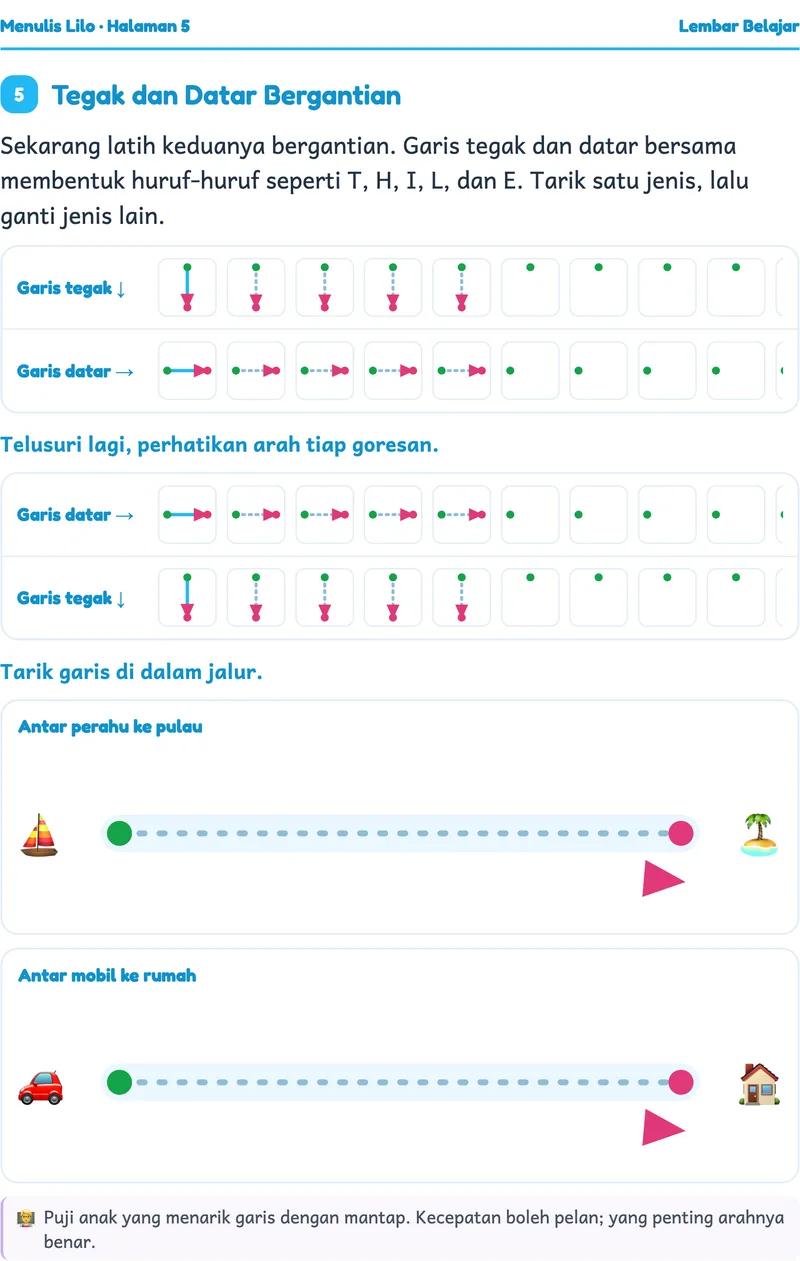
Straight and Flat Lines

Cuplikan worksheet asli Straight and Flat Lines
Real sheet

A real writing-module page: alternating straight and flat strokes train small hand muscles before the first letters.

Introduction Level

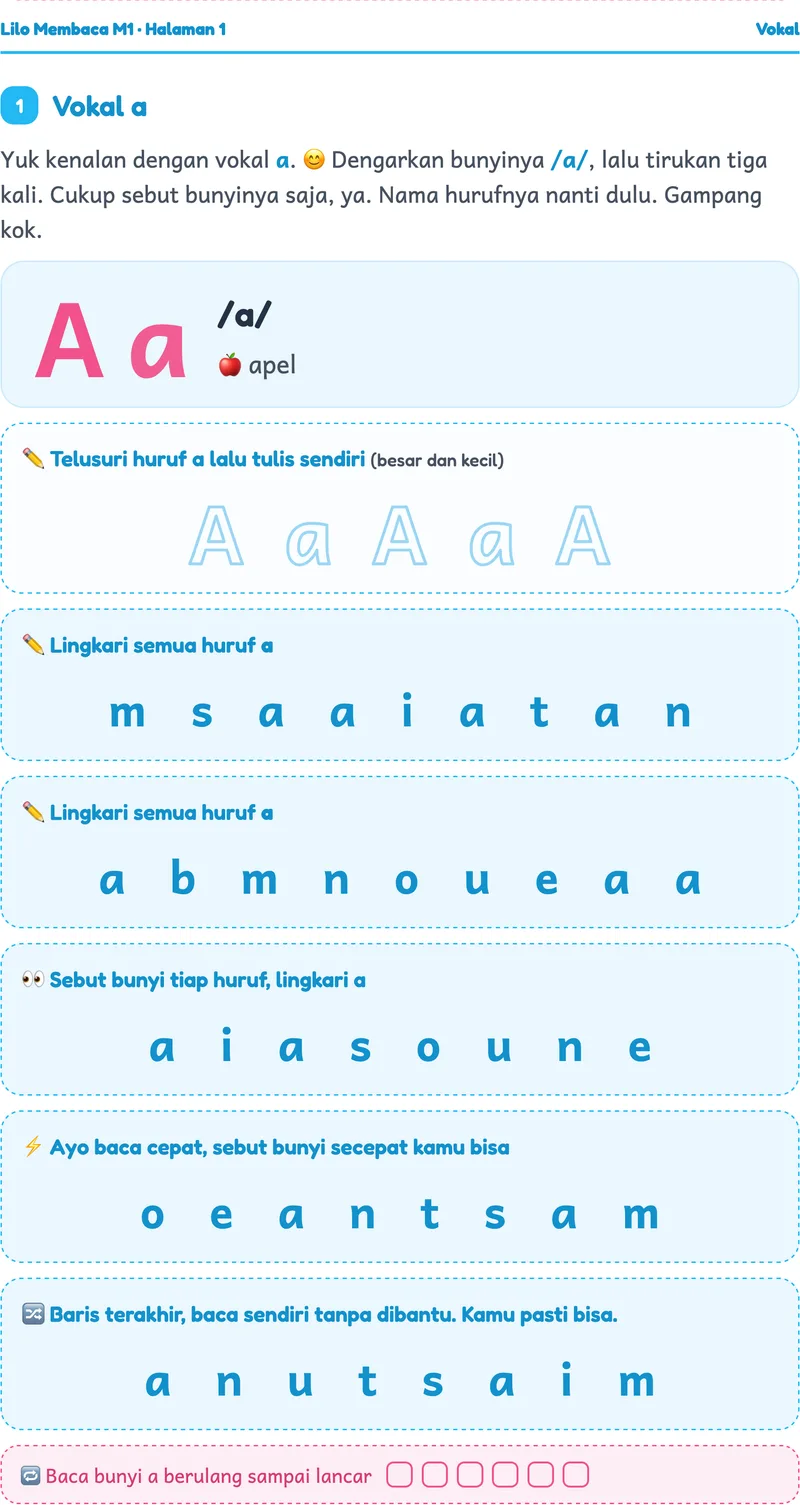
Vowel Sounds

Cuplikan worksheet asli Vowel Sounds
Real sheet

This Introduction Level sheet from the reading module introduces the vowel sound a through cards and point-and-read activities. It is the very first door a child opens on the way to reading.

Intermediate Level

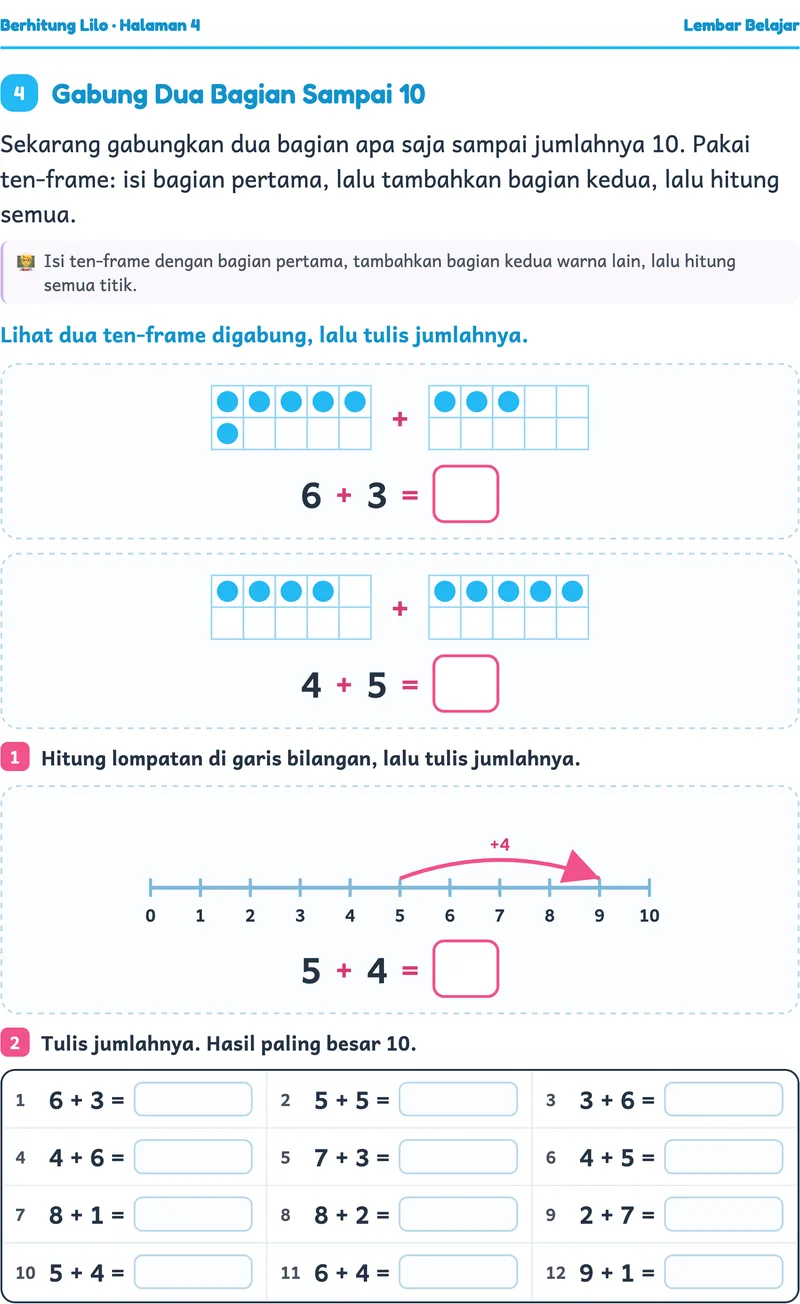
Addition Within 10

Cuplikan worksheet asli Addition Within 10
Real sheet

On this sheet, Intermediate Level children practice addition with two helpers: the ten-frame and the number line. They see the picture first and count afterward, so addition feels real and concrete.

Every sheet above is part of Lilo's own progressive curriculum, a complete set of 122 modules.

Lilo mascot cheering your child on

Give Your Child a Curriculum Built with Care

Start with a free consultation on WhatsApp. Tell us about your child, and we will recommend the right level and service from our 122-module curriculum, with no obligation.

The first lesson finds the right starting level

Sign Up