


Little explorers, ages 3-4
Your child is meeting letters and numbers for the very first time. Lessons feel like play, with real objects to touch and zero pressure, so curiosity stays bright and learning feels like a gift.
Your child learns to read, write and count in a single guided program for ages 3-8, starting with real objects they can hold and ending with real understanding.
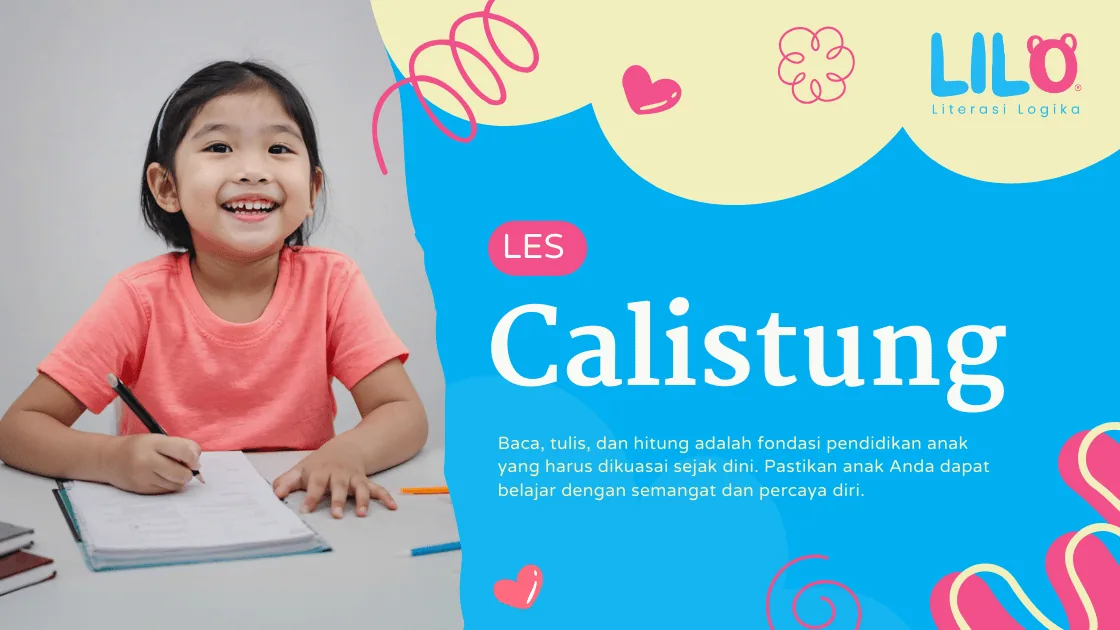
Reading, writing and counting in Makassar is Lilo's guided learning program for children aged 3-8, taught in English, where all three skills grow together as one journey. Your child holds real objects first, moves to pictures, then meets letters and numbers, so each skill supports the others from the very first lesson.
Every child arrives at learning from a different place. We meet your child exactly where they are and walk forward from there, one small step at a time.
Your child is meeting letters and numbers for the very first time. Lessons feel like play, with real objects to touch and zero pressure, so curiosity stays bright and learning feels like a gift.
Your child is in kindergarten and primary school is on the horizon. We build blending, counting and writing steadily so the first day of school feels exciting instead of scary.
Your child has started primary school and needs all three skills to hold firm. We strengthen reading with understanding, counting with reasoning, and writing that flows with confidence.
Your child feels a step behind at school. The placement assessment finds the exact level where learning works again, and steady wins at that level rebuild both skill and self-belief.
Makassar, capital of South Sulawesi Province, is a busy harbor city that has served for generations as the doorway to eastern Indonesia. People here are known for a sailor's spirit, a readiness to try what is new, and a friendly, open way with others. Losari Beach and the Tanjung Bunga area carry the city's name well past Sulawesi. Its districts run from Panakkukang, Rappocini, and Tamalate out to Biringkanaya, Tamalanrea, Manggala, Mariso, and Ujung Pandang. Lilo helps each child in Makassar aged 3 to 10 lay a firm base in reading, writing, and math. Your child can learn at home with a teacher who visits, or join an online class.
Each level has a clear aim, starting with naming letters and numbers and ending with word problems, so your child in Makassar climbs one small rung at a time and feels surer with every lesson.
Your child first handles real objects, then reads pictures, and only after that works with numbers and letters. Following this order, the ideas really sink in, and school tasks start to feel easier and plainer.
Sessions run on a steady schedule with structured worksheets and warm guidance from the teacher. Children in Makassar practice a little at a time until each skill truly sticks.
Readiness rarely shows up on paper. You will spot it in the kitchen, on the living room floor, and in games your child chooses.
Makassar and its surroundings have 90+ reading, writing and maths tutors.
Graduates and active students.
Application screening
Role and city are checked first.
ID card and diploma verified
ID card, diploma and photo are checked.
Tutor profile filled in
Teaching history goes into the portal.
Trained in the Lilo method
Teaching starts after training.
Matched to your child
Each candidate answer is reviewed.
Not the right fit? Free tutor replacement, here is how
Young children show their best when they feel safe and absorbed, so the first Lilo session is a game and the tutor reads your child's stage from it.
A written test demands a firm pencil grip and reading instructions. A five year old who knows many letter sounds can look blank on a worksheet because their hand is still getting ready.
Sorting letter cards or counting buttons for a teddy, your child uses what they truly know. The tutor watches for letter sounds, blended syllables, and touching each object while counting.
A child who freezes with a new adult usually relaxes once their hands are busy, so the tutor can observe while your child simply plays.
What the tutor sees is placed on the H, S, K, T, B and P ladder. Your child may be confident at H and just starting B, and the plan follows that map.
Grade 1 entry in Indonesia requires no such test (Permendikdasmen 3/2025 Article 11 paragraph 5); selection is by age.
The first week shapes how your child feels about learning. Here is what happens from your first message to the first weekly report.
You tell us on WhatsApp about your child's age, habits and your area of Makassar. The consultation is free, and we help you pick a format and package.
The Lilo team finds a tutor who fits your child and reaches your area, and you can view their profile first. For online classes, the link and worksheets arrive beforehand via app.lilo.id.
The tutor opens warmly and invites your child into games that reveal their starting point, then sums up what was mastered and leaves one task of about ten minutes.
The weekly report shows the stage practised, what is mastered, what needs repeating, and one home activity. If the fit is wrong, Lilo replaces the tutor free of charge.
We follow the Singapore Math path: real things first, then pictures, then symbols. Reading, writing and counting travel this path together, so understanding comes before memorizing.
Your child begins every new idea with objects they can touch and move. Counting beads, tracing shapes, sorting cards. When hands understand first, the head follows without a fight.
Next, the same idea appears as simple pictures. Word problems become bar models your child can draw, so reasoning grows naturally instead of guessing at numbers.
Only now do letters and numbers take over. Your child reads through letter sounds, without letter-name spelling drills, writes what they read, and counts what they see, all in one flowing lesson.
Practice comes in small friendly portions, steady practice built level by level. Your child moves up a level only after true mastery, so nothing is built on shaky ground.
Your child moves to the next stage once the current one is truly mastered.
From recognizing letters to understanding what a story means. Your child learns through letter sounds, so new words open up on their own.
Hands get ready first with lines and patterns, then print letters, then whole words and sentences. Writing grows at the pace of your child's muscles.
Numbers begin as real objects your child can hold. Addition, subtraction and word problems arrive later, built on understanding that lasts.
Woven quietly through every session: the concentration to stay with a task, the independence to try alone, and the confidence to say I can.
Beneath reading and counting sits one easily overlooked skill: spotting regularity and using it to predict what comes next.
Show your child beads going red, blue, red, blue, and ask which colour comes next. Answering red, your child observes, finds a rule and uses it to predict. Those three moves are the seed of reasoning. Children aged four to six are highly tuned to regularity and enjoy every correct guess, so Lilo tutors start there, with objects first, then pictures, then letters and numbers.
Reading by letter sounds is pattern work. In ba, bi, bu the b stays while the vowel changes, so a child who sees the rule can read bo untaught. Order matters too: the Indonesian words pita and tapi share every letter. Counting follows patterns as well. Five buttons split into two and three or one and four, and the total holds. Pairs that make ten become anchors, and bundled sticks show thirteen as one bundle and three loose sticks.
At home you will hear your child say that one is the same as before, or protest when a bedtime story goes out of order. Tutors deliberately build a wrong pattern and wait for your child to catch it, which trains carefulness and confidence. The habit returns later when your child draws a Bar Model, reading the structure of a word problem the same way.
This picture describes a five year old who knows some letters or numbers, learning on the Regular package of eight sessions a month, about twice a week.
Your child fills letter gaps through sounds and names the first sound of their own name, while their hand practises lines and circles.
Your child blends ma, mi and mu, spots the repeating pattern, and starts working out new syllables alone.
Your child touches each object while counting, then splits five objects into two groups, so simple addition makes sense.
Your child reads buku, sapi and meja by joining syllables, proud to read words they have never seen.
Your child writes their name in straight line capitals, copies short known words, and forms numbers by following arrows.
Stages can shift with your child's strengths, and the weekly report shows each step up.
Car rides and easy chats are learning moments that often slip by. These games need only eyes, ears and voices.
| Activity | Time | What you need |
|---|---|---|
Guess the first sound on shop signsSay the first sound of a visible sign, and your child hunts for another sign starting the same way. This trains stage H and reading the world around them. | 10 minutes | shop signs along the road |
Count the same colour vehiclesYour child picks a colour and counts matching vehicles to ten. At five, ask how many more until ten. Stage B and pairs that make ten grow quietly. | 5 minutes | vehicles passing by |
I am thinking of somethingGive three clues one by one: round, yellow, sour. Your child guesses after each. This builds stage P: listening, holding facts in mind, and drawing a conclusion. | 10 minutes | a friendly conversation |
Carry on the sound patternClap, clap, tap, and your child continues. Then switch to ba, ba, bi. Your child practises stage S and the habit of spotting regularity. | 5 minutes | hand claps and finger taps |
Pick one game per trip and stop while your child is still enjoying it.
Lilo teaches from its own original curriculum of 122 leveled modules, so every lesson your child receives has a clear place on a bigger map.
When reading, writing and counting are taught as one journey, each skill becomes a stepping stone for the other two.
Every new concept begins in your child's hands. Beads, cards and blocks come before any symbol on paper, so numbers and letters carry real meaning from day one.
Your child learns what each letter says, then blends sounds into words. There are no letter-name spelling drills, so reading clicks instead of stalling.
Story problems become simple bars your child draws and compares. This Singapore bar model habit trains reasoning that will serve your child far beyond arithmetic.
Short, warm, consistent sessions built level by level. Small daily portions beat marathon cramming, and your child levels up only after genuine mastery.
These stages come straight from the leveled modules your child will actually use in class.
Most early learning struggles come from well-meaning shortcuts. Here are the patterns we see most often, and how the Lilo approach quietly prevents each one.
Why it happensMemorized facts have no roots. They fade within weeks, and the child starts to feel that learning is a chore of forgetting and re-cramming.
How Lilo helpsWe build every concept from real objects your child can hold, so the understanding comes first and the facts stay because they make sense.
Why it happensHand muscles develop on their own timeline. Pushing letter writing too early turns each session into frustration and can sour a child on writing for years.
How Lilo helpsOur Writing module starts with lines and patterns that strengthen the hand playfully, and moves to letters only when your child's muscles are ready.
Why it happensA child who chants one, two, three without touching real objects is reciting, without counting. The numbers stay empty sounds with nothing behind them.
How Lilo helpsCounting begins with beads, blocks and everyday objects. Symbols arrive only after quantity is real to your child, so arithmetic grows from solid ground.
Why it happensSkills built in a rush sit shallow, and the pressure teaches your child that school is something to fear before it has even started.
How Lilo helpsWe spread learning into small, friendly, regular portions across the years before school, so readiness arrives calmly and your child walks in confident.
Why it happensWithout bridges between reading, writing and counting, a child can race ahead in one skill while another quietly falls behind, and progress turns lopsided.
How Lilo helpsLilo weaves the three skills into one journey, so every session touches all of them and each skill keeps pace with the others.
60/90/120 minutes
Contact us
choose 60, 90, or 120 minutes
Contact us
60, 90, or 120 minutes per session
Contact us
Every family weighs their options. Here is an honest look at how Lilo sits beside two common alternatives.
| Aspek | Lilo | Worksheet Tutoring | Learning Apps |
|---|---|---|---|
| How a new idea is introduced | Real objects first, then pictures, then symbols | Usually starts straight on the printed page | Starts on a screen with taps and animations |
| The three skills together | Reading, writing and counting woven into one journey | Often practiced as separate drill sheets | Usually split into separate apps or game modes |
| Guidance during learning | A live tutor watches, adjusts and encourages in the moment | A tutor checks completed sheets | Automatic hints, with no adult reading your child's face |
| Knowing when to move up | Placement assessment, then level up only after mastery | Moves with the worksheet sequence | Moves when a game level is cleared |
| Handwriting practice | Built in from lines and patterns to full sentences | Strong on repetition of written work | Limited, since fingers swipe instead of write |
The level code your child is currently practising, such as L2 for reading, opens every calistung session, with writing and counting following in the same meeting. The Regular package holds 8 sessions a month for IDR 604,782, and the full amount is paid per package up front. The tutor can visit your home, or your child can join online.
By the end, your child writes their own name in tidy letters.
IDR 307,460Your child finishes able to add up objects to twenty unaided.
IDR 604,782The month closes with your child reading short instructions and solving them alone.
IDR 891,965Your child leaves sketching a Bar Model to crack simple word problems.
IDR 1,692,684Included in every lesson package.
Just tell us, any time.
How it works:
A full report follows each month.
At this age the bond between child and tutor shapes almost everything. Ask any provider in Makassar these questions.
Fit is hard to predict before a first meeting. At Lilo, the tutor is replaced free of charge whenever the fit is wrong, and the team arranges it.
Full attention catches tiny hesitations, like a finger pausing mid count. In Lilo private lessons one tutor works with one child, at that child's pace.
Knowing the tutor helps you prepare your child. Lilo profiles are visible beforehand, and many tutors studied early childhood, primary teaching, psychology or mathematics.
A wrong starting point leaves a child bored or overwhelmed. Lilo finds it through play in the first session, with no written test, and maps it onto the code ladder.
Each weekly Lilo report covers the stage practised, what is mastered, what needs repeating, and one small activity to do together at home.
Your child learns reading, writing and counting in a single connected program, so progress in one skill lifts the other two along with it.
Lessons come from Lilo's own leveled modules. Your child's path is mapped, measured and consistent from the first session to the last.
Our verified tutors teach 1-on-1 at your home across Makassar, from Panakkukang and Rappocini to Biringkanaya, or online if that suits your family better.
Lessons can run in English or Indonesian. Families who want English as the language of instruction get exactly that, while the subject stays reading, writing and counting.
Before the first lesson, we find your child's true level. No child sits through material they already know or gets pushed past what they have mastered.
The Singapore Math path means your child understands why an answer is right. Understanding stays for years; memorized answers fade by next semester.
Aisyah loves counting our groceries when she comes along to the shop. Her reading is starting to flow too, she sounds out the names of items on the shelves one by one.
Razka wrote his own name for the first time on his grandma's birthday card. I even kept the card. His counting is getting more confident too, we are so grateful.
The sheets below come straight from Lilo's original materials. Reading, writing, and counting move forward side by side at every level, helping children develop evenly in all three.
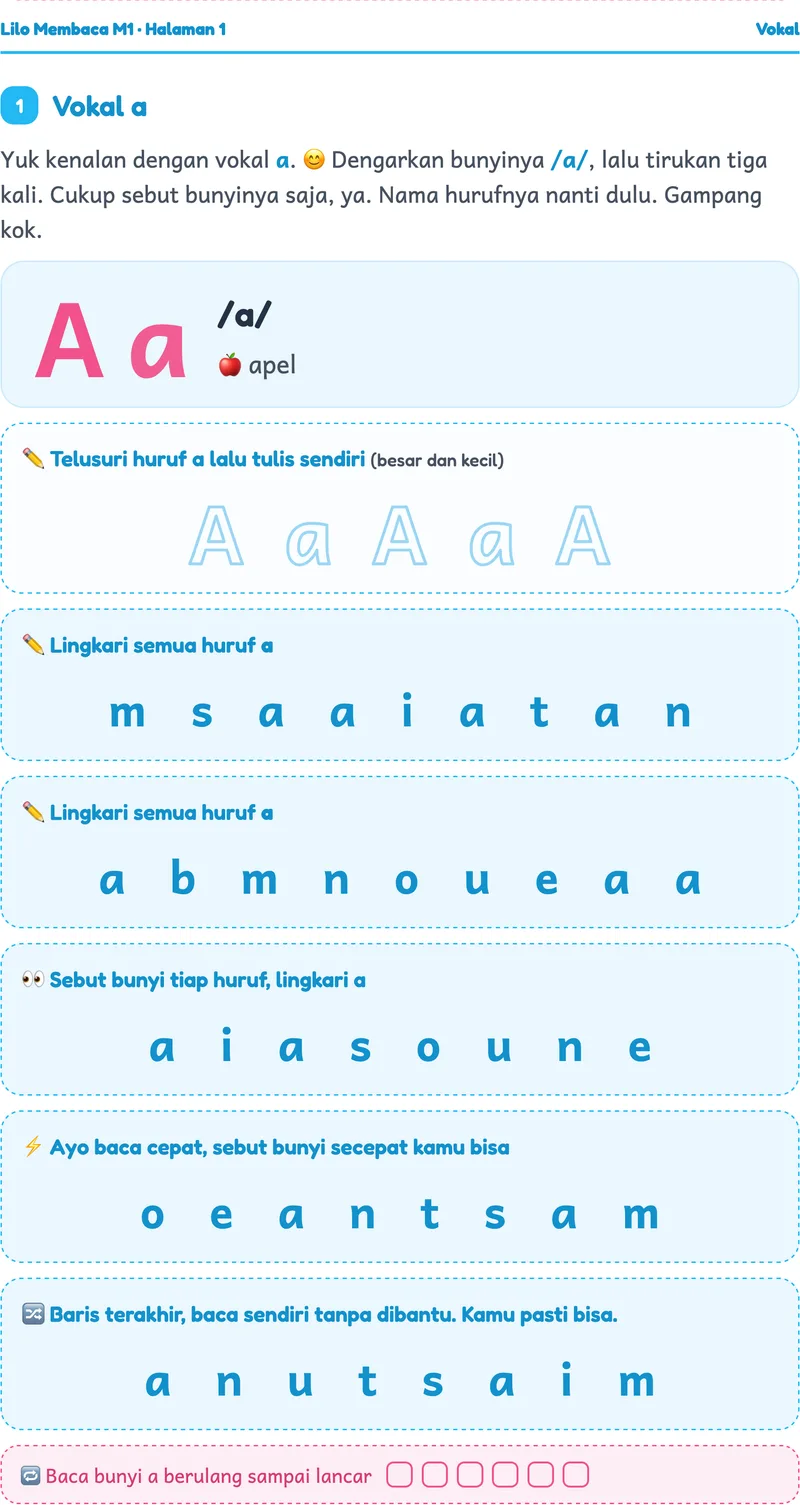
A real reading-module page: your child sounds out the vowel a with cards and point-and-read practice, the first door into reading.
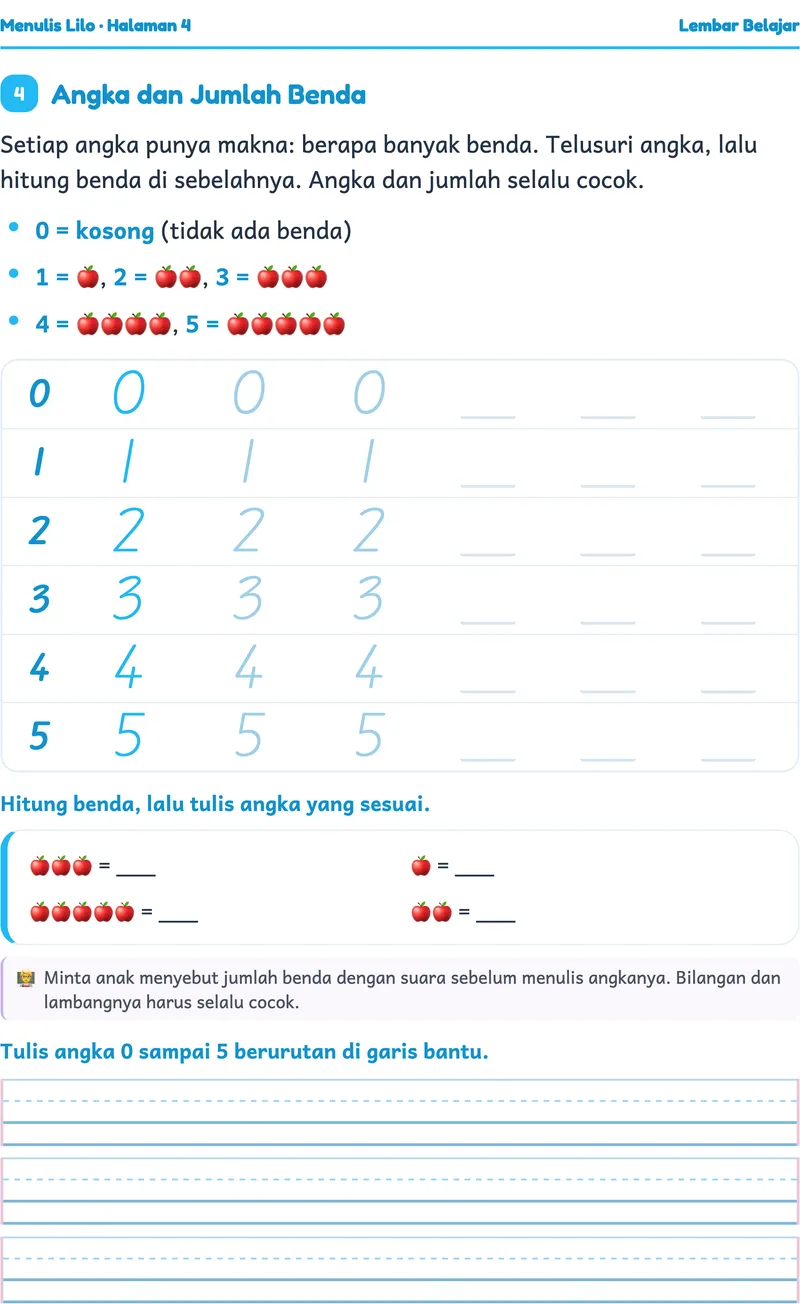
This Basic Level sheet from the writing module pairs two activities: matching numerals to the right quantity of objects, then writing each numeral neatly along a guided path. Hand and understanding train together.
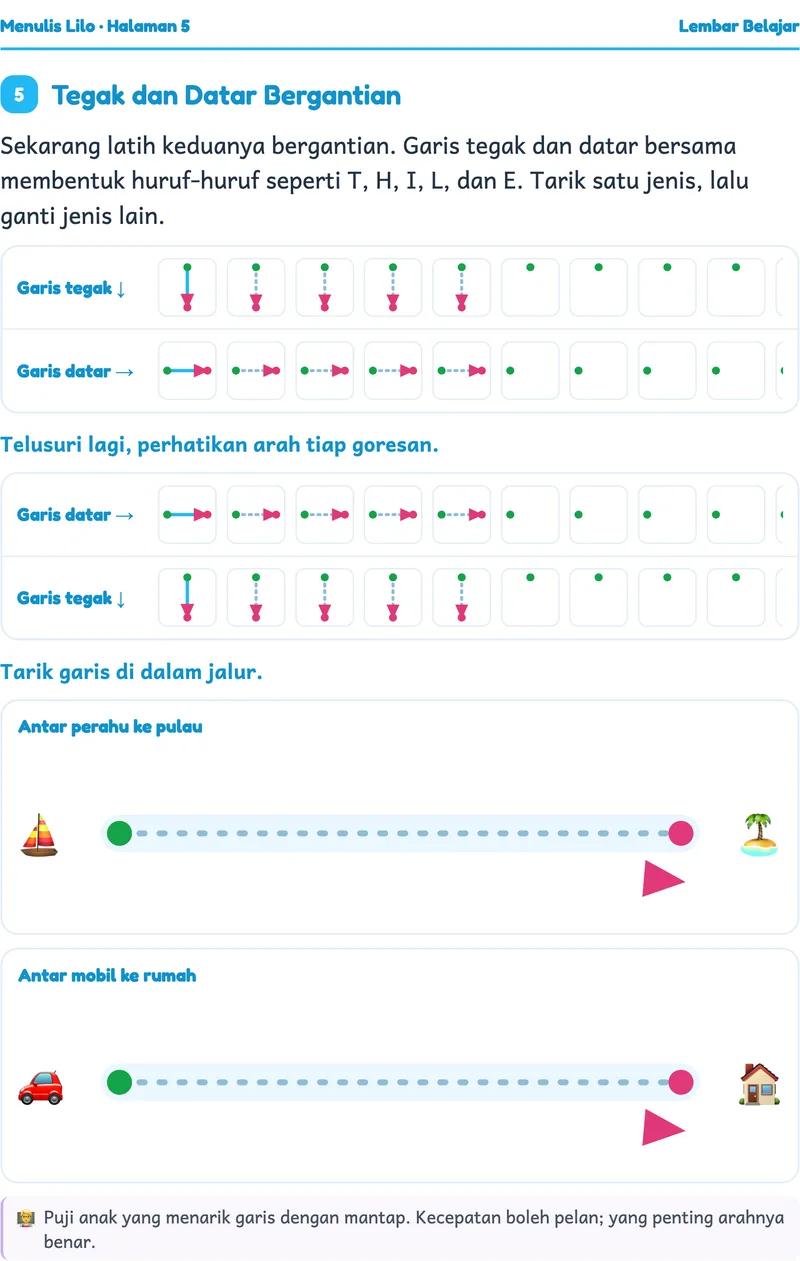
A vertical line, then a horizontal one, then back again. On this writing-module sheet at Introduction Level, children build up their hand muscles through simple strokes, important groundwork before their first letters.
Each sheet you see here comes from Lilo's progressive curriculum, one connected journey built from 122 modules.

Tell us about your child on WhatsApp and get a free consultation. We will recommend the right level and the right way to learn, with zero pressure to enroll.
Free consultation on WhatsApp