

Little Explorers, Ages 3-4
Your child meets letters and numbers the same way they meet toys, through play. Sessions are short and joyful, and early pencil strokes grow out of tracing lines and patterns.
Your child begins with things they can hold, moves on to pictures, and only then meets letters and numbers. A calm, leveled program for ages 3-8, at home in Malang or online.
Reading, writing and counting in Malang is a home and online tutoring program by Lilo Literasi Logika that teaches the three skills as one connected journey for children aged 3-8. Every idea starts with a real object your child can touch, then a picture, then the letter or number itself. A placement assessment sets the starting level, and your child moves up only after true mastery.
Children arrive at different ages and different starting points. The program meets each of them exactly where they are and builds upward from there.
Your child meets letters and numbers the same way they meet toys, through play. Sessions are short and joyful, and early pencil strokes grow out of tracing lines and patterns.
The years before primary school are golden for building all three skills. Your child blends syllables, counts real objects, and writes letters, so the first day of school feels familiar.
Your child strengthens reading with real understanding, counts further with confidence, and writes complete sentences. Schoolwork becomes lighter because the foundations underneath it are solid.
If your child has fallen behind classmates, the placement assessment finds the exact rung where learning works again. Progress restarts from a place of success, and confidence returns with it.
Every new idea travels the same gentle road, from something your child can hold, to something they can see, to the symbol on the page.
New ideas begin in your child's hands. Counting starts with beads, buttons or blocks on the table, and letters begin with familiar objects whose names your child already loves to say.
Once the real thing feels familiar, your child works with drawings of it. Word problems become simple bar drawings, so your child can see what a question is asking before writing anything.
Only when the idea is solid does the letter or number appear. Because the symbol now stands for something your child truly understands, reading and counting feel meaningful from the very first try.
Short, steady practice built level by level keeps skills warm while keeping your child fresh. A placement assessment sets the starting point, and your child levels up only after real mastery.
Your child moves to the next stage once the current one is truly mastered.
From recognizing letters to understanding whole passages. Your child learns the sounds letters make, blends them into syllables, then reads sentences and talks about what they mean.
Little hands warm up with lines and patterns before forming print letters. Step by step your child moves from single letters to words and finally complete sentences.
Numbers come alive through objects and pictures first. Your child learns to know numbers, to add and subtract with understanding, and to solve word problems drawn as simple bars.
Alongside the three skills, every session quietly builds concentration, independence and confidence, so your child sits down to learn feeling calm and capable.
Comparing a spoon with a sandal looks like play. Underneath, your child is building the thinking that later supports the number line and bar drawings in word problems.
The first step is direct comparison. Your child lays a spoon and a pencil side by side and decides which is longer. The usual slip looks small: your child checks only the right ends and forgets to line up the left ones. So the tutor asks for both objects to touch the edge of a floor tile first. Young children also tend to think a pencil pushed forward has grown, so the tutor slides it back and forth until your child says the length stayed the same.
Next comes measuring with units. Your child lays paper clips end to end along a book and counts them. The tutor watches for gaps and overlaps, since both throw the count off. When you and your child each measure the table in hand spans, the answers differ, perhaps eight of yours and twelve of your child's. From that surprise your child discovers that a smaller unit gives a bigger number, and that comparing needs the same unit.
Measuring is counting you can see. Each clip stands for one, and the row of clips is a number line made of objects. The same idea returns when your child draws bars for a word problem, because a longer bar means a bigger amount. Words such as longer, shorter and the same length get read and written too, so reading and writing join the game. At home, simply ask which one is longer and let your child prove it.
Four signatures shape every session in Malang, at home or online, and each one turns an abstract lesson into something your child can touch, see and understand.
Beads, blocks and everyday things carry every new idea before any symbol appears. Your child builds a picture in their mind that letters and numbers can later attach to.
Your child learns the sound each letter makes and blends those sounds into syllables and words. Reading grows naturally, and new words become puzzles your child can solve alone.
Story problems are drawn as simple bars, the Singapore way. Your child sees what a question is really asking and reasons toward the answer one visible step at a time.
Small portions, taken steadily built level by level, keep learning light. Your child finishes each session feeling successful, which makes the next session something to look forward to.
These rungs come straight from our own leveled curriculum, and your child climbs them one mastered step at a time.
Most struggles with early reading, writing and counting trace back to a handful of well meaning habits. Here is what we see most often, and how Lilo handles each one.
Why it happensFacts learned by heart without meaning fade fast, and the child slowly starts to feel that learning is sour and tiring.
How Lilo helpsWe anchor every fact to a real object and a picture first, so what your child learns has something solid to hold on to.
Why it happensHand muscles at ages 3 to 4 are still developing, and pushing letter writing before they are ready breeds frustration.
How Lilo helpsOur Introduction Level builds those muscles through lines and patterns, so real letters arrive when the hand is ready for them.
Why it happensA child who meets 7 only as a shape on paper can recite it without knowing what seven of anything looks like.
How Lilo helpsCounting starts with objects your child can group and move, so the symbol lands on solid ground when it finally appears.
Why it happensSqueezing three skills into a few months creates pressure at the exact moment learning should feel exciting.
How Lilo helpsStarting earlier with short, friendly sessions lets skills grow calmly, and your child walks into school ready and confident.
Tidying clothes and buying groceries already fill your week. Both can become short practice, and each activity below works on one clear stage.
| Activity | Time | What you need |
|---|---|---|
Finding sock pairsYour child matches every sock with its partner, then counts the pairs in twos while pointing. If a lone sock turns up, ask how many socks there are now. This works on stage B with things your child can hold. | 10 minutes | clean socks from the laundry basket |
Labels for the folded pilesOnce the clothes are folded, your child writes a label for each pile, such as baju, celana or handuk. Say each word slowly so the letters come from its sounds. Straight lined capitals are easiest to begin with. This builds stage T. | 10 minutes | small paper, pencil, folded clothes |
A shopping list in your child's handBefore visiting the warung, your child writes three items, such as telur, gula and tahu. At the shop your child reads the list and ticks off each item once bought, linking stages T and K in one short outing. | 15 minutes | paper, pencil, shopping bag |
Ten oranges in the market bagAt the market, ask your child to put in five oranges, then five more. Another day, ask how many more are needed when the bag holds seven. Pairs that make ten prepare stage B for carrying and borrowing. | 5 minutes | oranges or tomatoes while shopping |
This picture follows a seven year old who already joins syllables and counts the basics, and now wants fluency. Your child studies on the Intensive package, 12 sessions a month, roughly three times a week.
Close sessions mean your child reads every two or three days. Words of two and three syllables start coming out whole, including those ending in ng and ny.
Your child writes sentences of five to seven words with steady spacing and letters sitting on the line.
Ice cream sticks are tied in tens. Your child sees 34 as three bundles and four loose sticks, then uses that to add with carrying.
Word problems are drawn as bars. Your child marks what is known and what is asked, then tackles subtraction that needs borrowing.
Your child reads a one page story, retells it in their own words, and answers why questions about it.
Every child keeps their own tempo. A new stage opens once the previous one is truly mastered, and the tutor adjusts this order to what each session shows.
duration of 60, 90, or 120 minutes
Contact us
60, 90, or 120 minutes
Contact us
60/90/120 minutes
Contact us
Two things are rarely asked about and matter a great deal: where the materials come from, and what your child brings home. Put these questions to any tutoring provider in Malang.
| Question to ask | Why it matters |
|---|---|
Who wrote the learning materials, and is the sequence clear? | Materials written in sequence let each session pick up where the last one ended, while materials gathered from many sources tend to jump around. Lilo teaches from its own 122 coded modules in a fixed order. |
Are worksheets chosen to match the stage my child is on now? | A sheet that is too easy bores a child, and one that is too hard makes them anxious. At Lilo, worksheets come from the module your child is currently studying. |
Does my child handle real objects before the worksheet? | Paper is most useful once the idea makes sense. Moving from objects to pictures to symbols gives numbers clear meaning, and Lilo follows this order at every counting stage. |
What does the homework look like, and how long does it take? | Long homework turns the table into a tug of war, while light and meaningful homework is something a child looks forward to. Every Lilo session closes with one short piece of homework, around ten minutes long. |
How will I know what each homework task is for? | Homework whose purpose you understand is easier to support without taking over. At Lilo, the tutor's weekly report might explain that this week's shopping list practises writing words from their sounds. |
Malang, in East Java, has carried the name city of learning for a long time. Cool highland air and a busy academic spirit have drawn students here for generations, and people all over Indonesia respect its love of study. The city spreads over Klojen, Lowokwaru, Dinoyo, Blimbing, Sukun, Kedungkandang, Ijen, and Sawojajar. Lilo serves every young learner in Malang. A Lilo teacher can come to your home, and your child can also join online classes if that suits you better.
Your child studies where they feel most at ease: at home. A Lilo teacher arrives at the times you pick, so learning in Malang stays relaxed, regular, and fun.
Each child begins at a level fitted to what they can already do, then moves up in small steps. The worksheets they finish show that progress, so you can watch your child grow from one week to the next.
Your child first meets each idea with real objects and pictures, and after that works with letters and numbers. Going step by step like this builds real understanding, confidence, and a love of learning.
Reading, writing and counting are taught together, so each skill feeds the others. A word your child reads becomes a word they write and a story they can count with.
Lilo runs on 122 original leveled modules built in house across our programs. Your child follows a clear ladder, and you can see exactly which rung they stand on.
A placement assessment finds the honest starting point, and your child advances only after truly mastering a level. Confidence grows because nothing important gets skipped along the way.
Every tutor is verified, and instruction is available in Indonesian or English, a natural fit for bilingual families and national plus school students.
Tutors visit homes in Klojen, Lowokwaru, Blimbing, Sukun and nearby areas, and online sessions reach every family in Malang, a city long proud of its schools.
A free WhatsApp consultation comes first: tell us what your child needs and our team helps you pick a suitable package. Payment is made per monthly package, and the more sessions it holds, the lighter each session becomes. The Regular package, eight sessions a month, is IDR 604,782. In one session your child takes turns writing, reading and counting, at home with a tutor or in an online class.
Just curious to see how your child learns with a tutor.
IDR 307,460Already convinced and keen on steady practice twice a week.
IDR 604,782Chasing a target, such as writing full sentences before the term ends.
IDR 891,965Wanting solid basics in writing, reading and counting settled within one package.
IDR 1,692,684Included in every lesson package.
We find a replacement for free. Request it whenever you need.
How it works:
Topped up by a monthly report.
Readiness shows up in small everyday habits. These signs help you see when your child can begin, and when a stage is settled enough to climb to the next.
Malang and its surroundings have 450+ calistung tutors.
Graduates and active students.
Application screening
Our team reads every application.
Documents verified
The team checks identity and education.
Tutor profile filled in
Available hours are noted down.
Trained before teaching
Phonics and CPA come first.
Matching per child
Each candidate answer is reviewed.
Tutor not quite right? See our free tutor replacement promise
The first session is a game with no written test. While your child plays, the tutor notices a few small things that decide the right stage to start from.
Your child draws a winding road for a toy car. The tutor watches how the fingers hold the crayon and how steady the line is, then decides whether to open with lines and circles or go straight to letters.
The tutor makes an opening sound, such as mmm, and your child hunts for a matching object. A child who answers with the letter name, em, has yet to use sounds, so that stage gets strengthened first.
As your child picks up seven buttons, the tutor watches the fingers: each button touched exactly once, counting that stops at seven, and a total known without starting over.
The tutor slips in one question a little above your child's level. Some children try again, some ask, some give up. The reaction shapes how long each activity runs and how often a movement break comes.
The Lilo team handles the matching, so all you do is tell us about your child. The tutor is chosen around current needs, your preferred format and your home schedule.
The free consultation opens with simple questions: your child's age, what they can do, where they get stuck, and whether you want home visits or online classes. For home visits we also ask about your area, such as Lowokwaru.
The team weighs your child's needs against tutor backgrounds in a network of more than 5,000 active tutors, many trained in primary teaching, early childhood education, psychology and mathematics, so each child gets a fitting guide.
The tutor's profile is open to you before the first session. Your child can learn the tutor's name and face the day before, so the first meeting already feels familiar.
Some children click with their tutor at once, others need a different companion. If the match feels wrong, tell the team and Lilo arranges a new tutor at no extra cost. We keep this promise firmly.
Hamish can now write his letters neatly and is starting to read short words. His tutor patiently taught him the proper way to hold a pencil.
I never expected Katrisha to actually enjoy learning to count. At home she often plays number guessing games with her little brother. Her handwriting is starting to stay on the lines too.
These are original sheets from Lilo's calistung materials. Reading, writing, and counting are trained side by side at each level, so all three grow together from first steps to mastery.
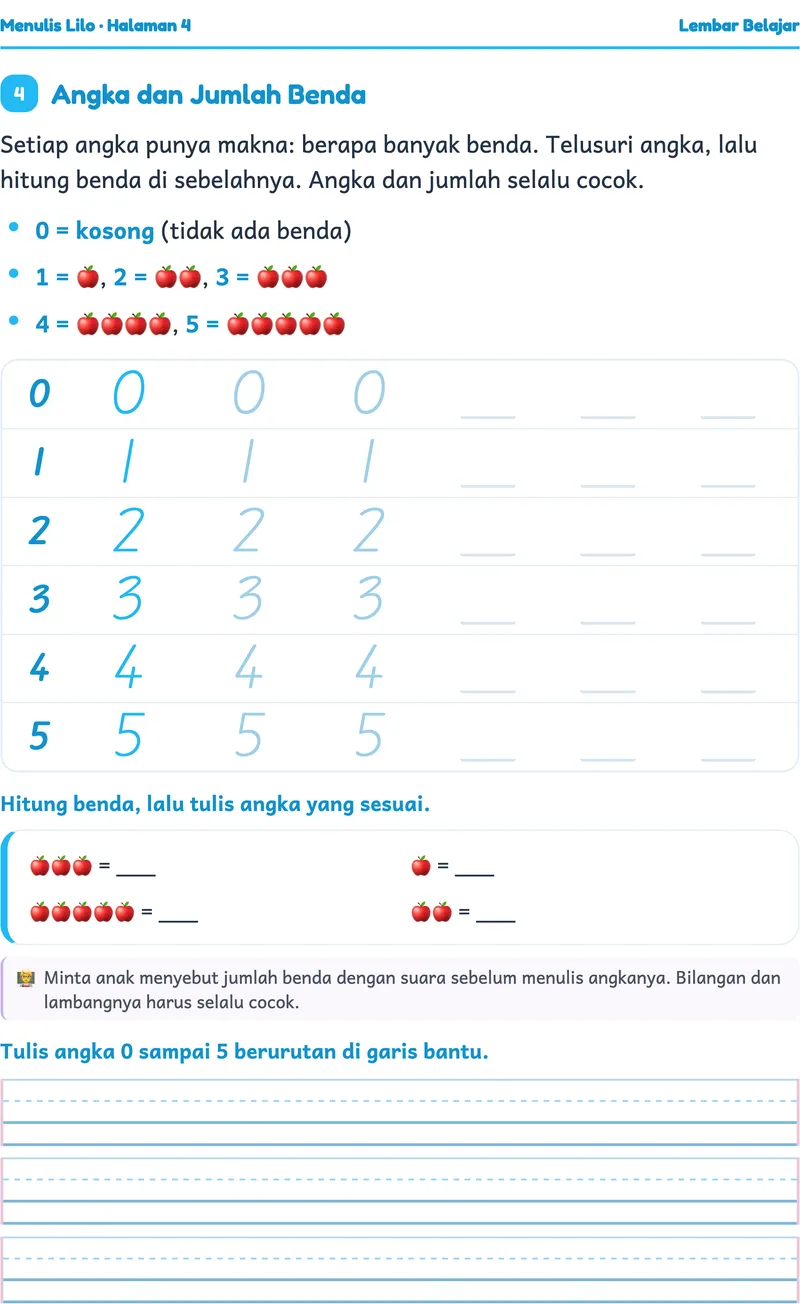
Which numeral matches this many objects? Children make the match on this writing-module sheet at Basic Level, then practice writing each numeral neatly by following the path prepared for them.
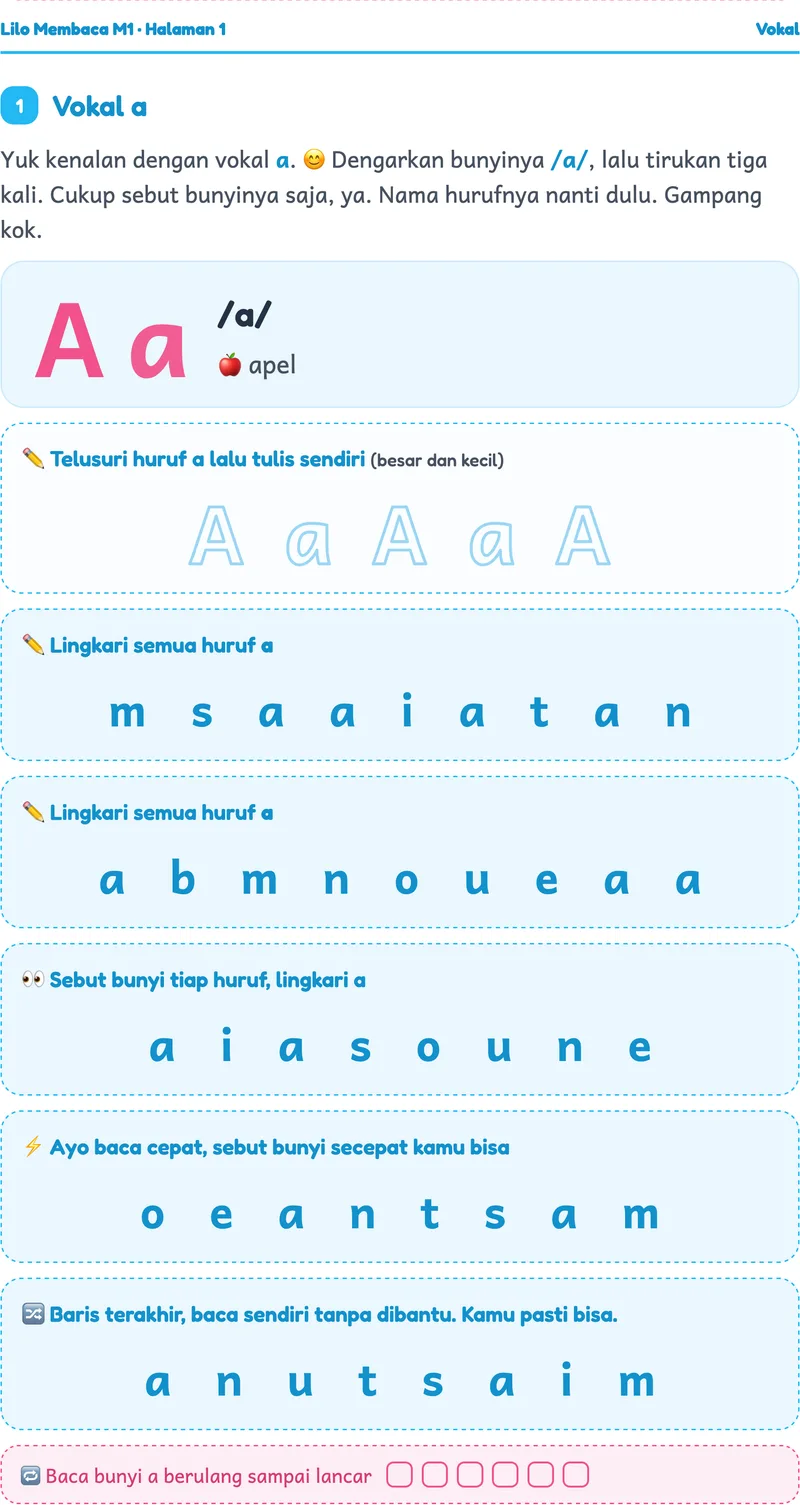
This Introduction Level sheet from the reading module introduces the vowel sound a through cards and point-and-read activities. It is the very first door a child opens on the way to reading.
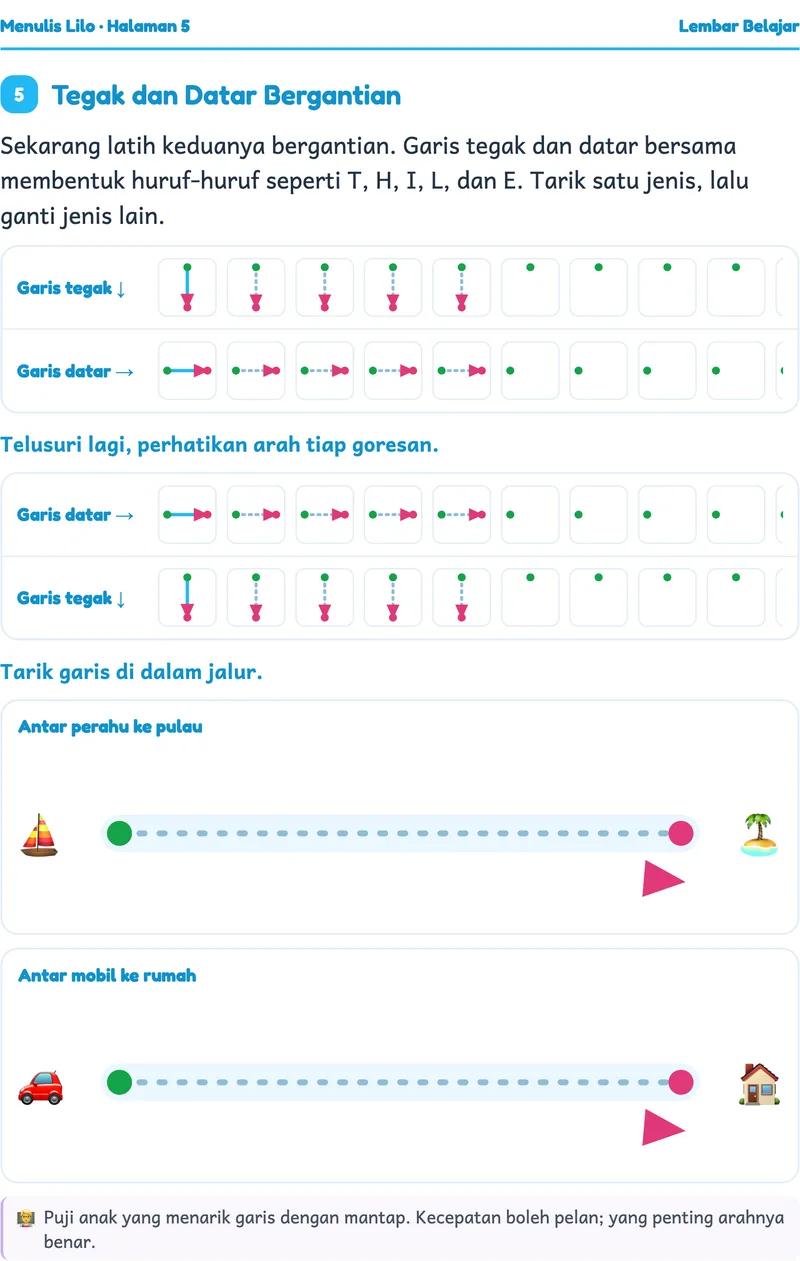
A real writing-module page: alternating straight and flat strokes train small hand muscles before the first letters.
Each sheet you see here comes from Lilo's progressive curriculum, one connected journey built from 122 modules.

Tell us about your child in a free WhatsApp consultation. We will suggest a level and a format, and your child can begin with a placement assessment at home in Malang or online.
Free consultation, friendly answers
Keep exploring while we teach around Blimbing and Ijen.