




Ages 3 to 4, meeting letters and numbers
Your child is just getting curious about letters A to Z and numbers 1 to 10. Everything happens through play and real objects, with warm encouragement and zero pressure.
Your child learns to read, write and count as one connected journey, guided step by step, and discovers how to think through a problem by drawing it out.
Reading, writing and counting in Manado is a guided learning program from Lilo Literasi Logika for children aged 3 to 8, where the three skills are taught together as one journey. Your child begins with real objects, moves on to pictures, then to letters and numbers, and learns to solve word problems by drawing simple bar diagrams that turn a confusing story into clear reasoning.
Every child arrives at a different point in the journey. A placement assessment at the start shows us exactly where your child stands, so lessons begin at the right level.
Your child is just getting curious about letters A to Z and numbers 1 to 10. Everything happens through play and real objects, with warm encouragement and zero pressure.
Your child is in kindergarten and building the foundations that matter: blending syllables, counting with understanding, and forming letters. Lessons keep the pace gentle and the progress steady.
Your child is in early primary and ready to read with understanding, write full sentences, and reason through word problems using bar diagrams. This is where thinking skills really take shape.
Some children simply missed a step along the way. The placement assessment finds that step, and your child catches up from the right level, with confidence growing lesson by lesson.
Our method follows how young children actually understand things: hands first, then eyes, then symbols. Each step earns the next one.
Your child starts with real objects they can touch and move, then works with pictures of those objects, and only then meets numbers and letters. Understanding comes first, so symbols carry real meaning.
Your child learns the sound each letter makes and blends those sounds into syllables and words. Reading grows naturally from sounds, so new words become something your child can work out alone.
When a word problem appears, your child draws it as a simple bar diagram. The picture shows what is known and what is missing, and the answer follows from clear reasoning.
Lessons move in small, friendly portions with steady practice built level by level. Your child levels up only after true mastery, so every new step stands on solid ground.
Every stage stands on the one before it, so the foundation has no gaps.
From recognizing single letters to blending syllables, reading full sentences, and understanding what a text actually says. Your child reads to comprehend, and enjoys it.
Hands warm up with lines and patterns first, then print letters, then words, then sentences. Fine motor readiness always comes before formal writing, so frustration stays away.
Your child gets to know numbers as real quantities, then builds addition and subtraction on that understanding, and finally reasons through word problems using bar diagrams.
Alongside the three skills, every session quietly trains concentration, independence and confidence, the habits that carry your child through school and far beyond it.
Readiness for reading, writing and counting shows up in ordinary moments at home. Watch your child skill by skill and bring your notes to the consultation. One or two signs are enough to begin.
Manado belongs to our Sulawesi network: 100+ early literacy and numeracy tutors. Home visits in Manado follow the nearest tutor.
Graduates and active students.
Applications screened
Role and city are checked first.
Identity and degree checked
Identity and diploma are matched.
Tutor profile filled in
Teaching experience and hours are recorded.
Trained in the Lilo method
The step-by-step method is learned first.
Matched to your child
Questions come from the child’s needs.
Not the right fit? Free tutor replacement, here is how
The first session feels like playtime. With no written test, the tutor watches your child through short games and decides which stage learning starts from.
The tutor says the first sound of an object, such as mmm, and your child picks the match from a basket. This shows how well your child already hears letter sounds.
Letter cards are spread on the floor and your child picks out the ones they know, often starting with their own initial. The tutor notes which letters feel familiar already.
Your child shares bottle caps between two plates, counts each, and says which has more. The tutor watches whether one object gets exactly one number word.
Your child draws straight and curved roads for a toy car, then tries writing their name. The pencil grip and line direction tell the tutor how ready the hand is.
A little preparation at home lets the first session flow. This list works for home lessons in Manado and for online classes alike.
Set up a low table and a chair where your child's feet rest on the floor. Keep the television and noisy toys away, since young children turn toward every sound in the room.
You can view the tutor's profile before the first session. Tell your child who is coming or who will appear on screen, so the first meeting already feels friendly.
The class link and worksheets arrive before each lesson through app.lilo.id. Print the sheets, set out a pencil and crayons, and place the screen at your child's eye height.
A small tub of bottle caps, blocks or spoons supports hands-on counting. Your child settles faster when the things being counted are familiar objects from home.
These are the teaching signatures we bring to every child in Manado, drawn from our own original curriculum of 122 leveled modules.
A story problem becomes a simple bar diagram in your child's own hand. The drawing shows what is known and what is asked, so the answer comes from thinking, and that thinking grows stronger every week.
Beads, blocks and everyday things come before any written number or letter. When your child finally writes a symbol, it stands for something they have held, so understanding runs deep.
Your child learns what each letter sounds like and blends sounds into words. There are no letter-name spelling drills, so reading feels like unlocking a code your child already owns.
Short, warm, consistent sessions built level by level build a habit your child actually likes. Small portions repeated well beat long sessions endured badly, every single time.
Each rung comes from our own leveled modules, and your child climbs only after mastering the rung below.
Most early learning struggles come from a handful of well-meaning mistakes. Knowing them early saves your child months of frustration.
Why it happensFacts learned by rote fade quickly and leave a sour taste, because the child never grasped what the numbers or letters actually meant.
How Lilo helpsWe build every symbol on real objects and pictures first, so your child understands before memorizing, and what is understood tends to stay.
Why it happensSmall hand muscles need preparation. Pushing letter writing too early produces messy results and a child who dreads the pencil.
How Lilo helpsOur writing path starts with lines and patterns that strengthen the hand playfully, so print letters arrive when your child can actually succeed at them.
Why it happensA child who chants numbers without touching quantities is reciting, and the recital collapses the moment a real problem appears.
How Lilo helpsCounting begins with objects your child can hold and move. Symbols come later, carrying the meaning already built by hand.
Why it happensSkills rushed under pressure sit shallow, and the pressure itself can turn a curious child away from learning right at the doorstep of school.
How Lilo helpsStart earlier, go gently. Small, regular sessions over a longer stretch build skills that are solid and a child who arrives at school calm.
Why it happensReading, writing and counting reinforce each other. Taught apart, progress turns lopsided, with one skill racing ahead while another quietly stalls.
How Lilo helpsOur curriculum weaves the three together in one journey, so a word read becomes a word written, and a story becomes a counting problem to reason through.
This picture follows a 5-year-old who does not yet know letters or numbers, learning about twice a week on the Regular plan of eight sessions a month, stage by stage through the official curriculum codes.
Your child learns the sounds in their own name, then other letter sounds through objects at home, while the hand practises lines and circles.
The grip steadies. Your child writes straight-line capitals such as L, T and E, and forms numbers by following the arrows.
Your child blends sounds into whole syllables like ma, bo and si, and starts spotting them on snack packets.
Your child matches numbers to real objects, finds the pairs that make ten with bottle caps, and moves them onto dot pictures.
Syllables become short words such as buku, sapu and mata. Your child reads labels around the house aloud, proudly.
Your child writes their name neatly and copies words they can already read, and the habit of finishing a sheet takes root.
Every child climbs these stages at their own rhythm, and the tutor adjusts the order from what each session shows.
Telling the time combines numbers, order and language in one task, so tutors break it into small steps your child can hold one at a time.
Before any clock hands appear, your child needs to feel that time has an order. The tutor starts from your child's own morning: wake up, bath, breakfast, leave for school. Your child lines up four picture cards from left to right and tells the story with first, then and last. Out of this come the words before and after, which later carry the whole idea of reading a clock.
Next comes a paper clock with only one hand, the short one. Your child learns that the short hand pointing straight at 7 means seven o'clock, and a hand sitting between 7 and 8 means seven has passed. The tutor holds back the long hand on purpose, because two hands with different rules overload a 5 or 6 year old's memory. Your child turns the hand, names the hour and matches it to activity cards.
Once whole hours feel easy, the long hand arrives to mark o'clock and half past. English says half past seven and names the hour already gone, while Indonesian says setengah delapan and names the coming hour, so bilingual children practise both with care. The tutor folds a paper plate in half to show half of the way to the next hour. You will see it at home when your child points at the wall clock and reads it aloud.
These activities use voices, paper and things already in your home. Pick one a day, when your child is fresh and playful.
Say the first sound of something close by and let your child guess it: a mug, a mat, a mango. Then swap roles so your child sets the riddle. The game tunes the ear to letter sounds, the doorway to reading.
your voice and nearby objects
Ask riddles like I am one more than four, who am I? Your child answers with fingers held up. Move gently toward pairs that make ten: seven needs how many to become ten?
fingers and your voice
Your child draws something from today and signs it with their name. A child already reading words adds one word, such as love or play. Deliver it together, so your child feels writing reach a real reader.
paper, crayons and a used envelope
Write a short note such as milk on the shelf and let your child read it and find the item. The next day your child writes a reply, a picture and one word. Real messages give real reasons to read and write.
small paper, tape and a pencil
60/90/120 minutes
Contact us
choose 60, 90, or 120 minutes
Contact us
60, 90, or 120 minutes per session
Contact us
Manado is the capital of North Sulawesi Province, a bayside city facing Manado Bay with open coastal air. The Boulevard along its waterfront is widely known as the face of the city, while the name Bunaken has carried Manado's reputation far beyond Indonesia. The city is also known for its warm culture of greeting one another and its strong sense of togetherness, a friendliness that makes everyone feel welcome. Its districts stretch from Wenang, Sario, and Wanea to Malalayang, Tikala, Mapanget, Singkil, and Bunaken.
Lessons happen where your child already feels at ease. Across our Manado service areas, a Lilo teacher arrives at your house with printed sheets prepared in advance, so each session stays relaxed and familiar.
Every level begins at the simplest starting point. Your child goes on to the next stage once the current one truly makes sense, and the finished worksheets let you follow each small gain along the way.
If you would like your child to learn at home with no visit, Lilo online classes are fully two way. The teacher says hello, leads the practice, and checks the worksheets live on screen as your child works.
Families in Manado have several honest options. Here is how they compare, so you can choose with clear eyes.
Real objects first, then pictures, then symbols, so your child understands before memorizing
Drawn as bar models so your child sees the logic of every problem
A live tutor watches, listens and adjusts in the moment
Placement assessment first, then measured levels, moving up only after mastery
Reading, writing and counting woven into one journey that reinforces itself
A single session can run for one hour, ninety minutes or two hours, shaped around how long your child stays focused. Sessions begin at IDR 76,865, and the Regular package comes to IDR 604,782. You settle each monthly package in one payment, and your child then rotates through reading, writing and maths at home in Manado or in an online class.
Once a week the tutor guides your child and records each skill code reached.
IDR 307,460Twice a week the tutor rotates reading, writing and maths practice with your child.
IDR 604,782Three times a week the tutor slips writing practice between reading and sums.
IDR 891,965Almost daily, the tutor coaches your child and revisits any code still shaky.
IDR 1,692,684At home or online, the same.
One WhatsApp message is enough. Request it whenever you need.
The steps:
And a progress report every month.
These questions are fair to ask any provider. The answers show how well young children are served on screen and at the study table.
Young children stay with a screen when their hands are busy too. Ask whether there are worksheets to hold and activities that change often. At Lilo, an online child still works on paper worksheets while the tutor guides each step.
A young child's mistake is a clue to how they think. A skilled teacher first asks how your child reached the answer, then returns to real objects. Hurried correction teaches a child to stop trying.
Knowing the teacher's background helps you prepare your child and judge the fit. At Lilo, tutor profiles are open before the first meeting, and many tutors studied early childhood, primary teaching, psychology or maths.
Young children learn best with someone who makes them feel at ease. Ask how a change works. At Lilo, switching to a new tutor costs nothing when the match is not right, a service promise we hold firmly.
Progress in young children is hard to see from outside without regular notes. Ask for a sample. A weekly Lilo tutor report might say, for example, that your child now reads whole hours with the short hand.
Lessons draw on 122 leveled modules built by Lilo, so your child follows a tested path with clear stages, never a loose collection of random exercises.
Bar models turn word problems into pictures your child can think about. The habit of drawing before answering builds a calm, logical mind that serves every subject later.
For in-person lessons, a verified tutor travels to your home anywhere in Manado, from Wenang and Sario to Malalayang and Mapanget, so learning fits naturally into family life.
Lessons can run in Indonesian or English, a natural fit for bilingual and national-plus families who want the language of instruction to match their home and school.
The placement assessment finds your child's true starting point, and each level is fully mastered before the next begins. Confidence grows because the ground never wobbles.
Concentration, independence and confidence are trained in every session. You will notice it at the study table first, then in everything else your child takes on.
I love the personal approach they use. My child, who used to struggle to focus, can now learn with real enthusiasm.
Latifah really looks forward to her lessons, she says they are fun. She is starting to understand addition using things around the house, like counting spoons while helping set the table.
The sheets below come straight from Lilo's original materials. Reading, writing, and counting move forward side by side at every level, helping children develop evenly in all three.
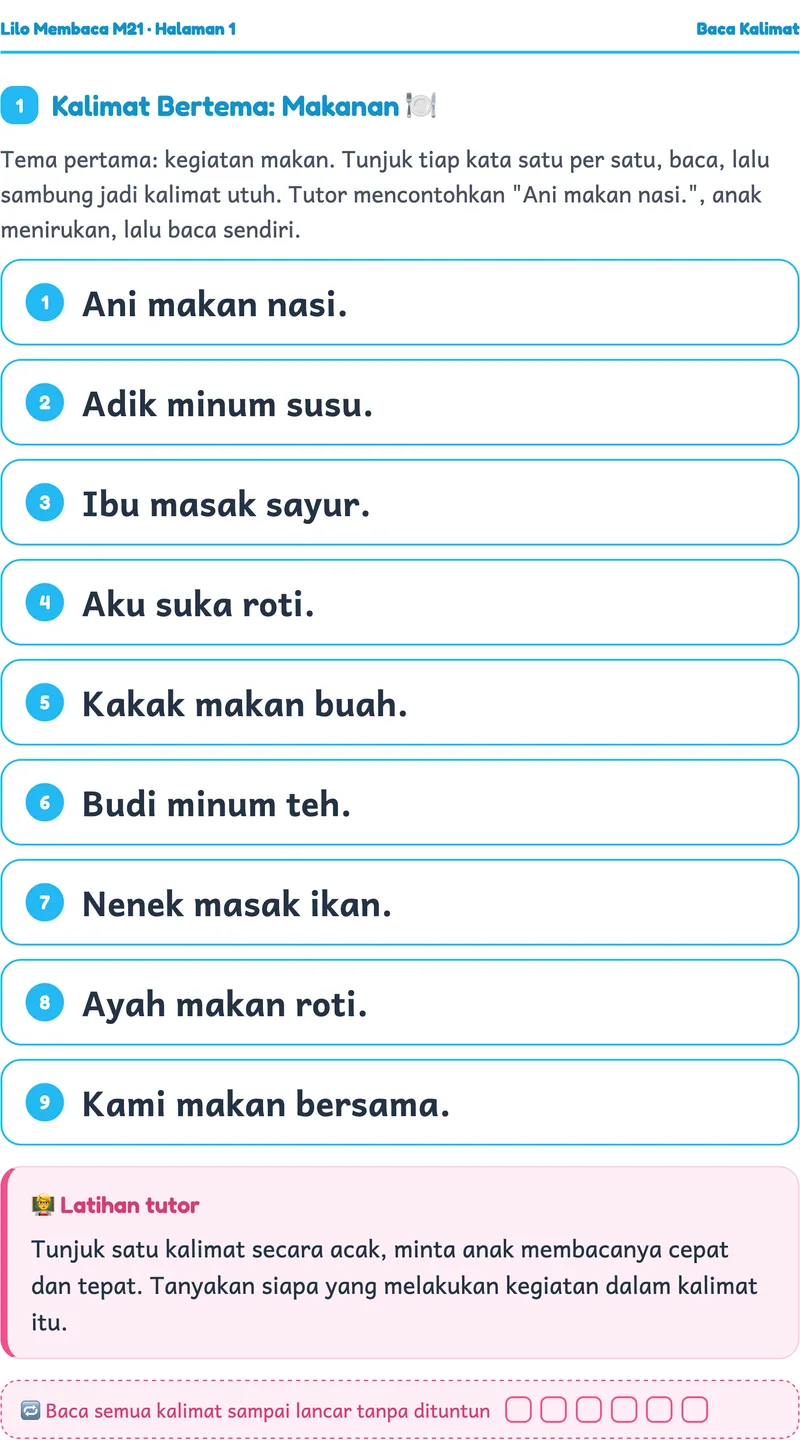
This Intermediate Level sheet from the reading module holds short sentences about food, read from start to finish. All the earlier sound and syllable practice comes together here as the child's first meaningful reading.
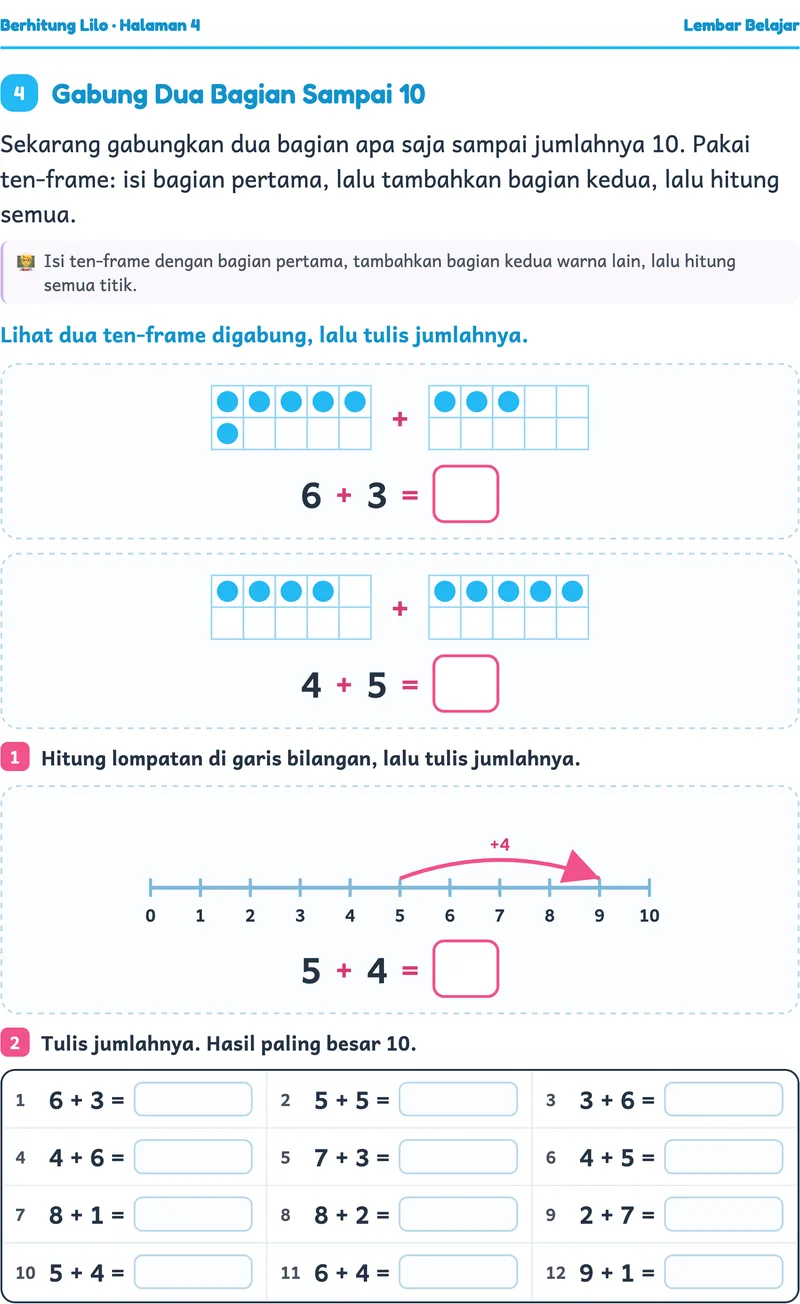
On this sheet, Intermediate Level children practice addition with two helpers: the ten-frame and the number line. They see the picture first and count afterward, so addition feels real and concrete.
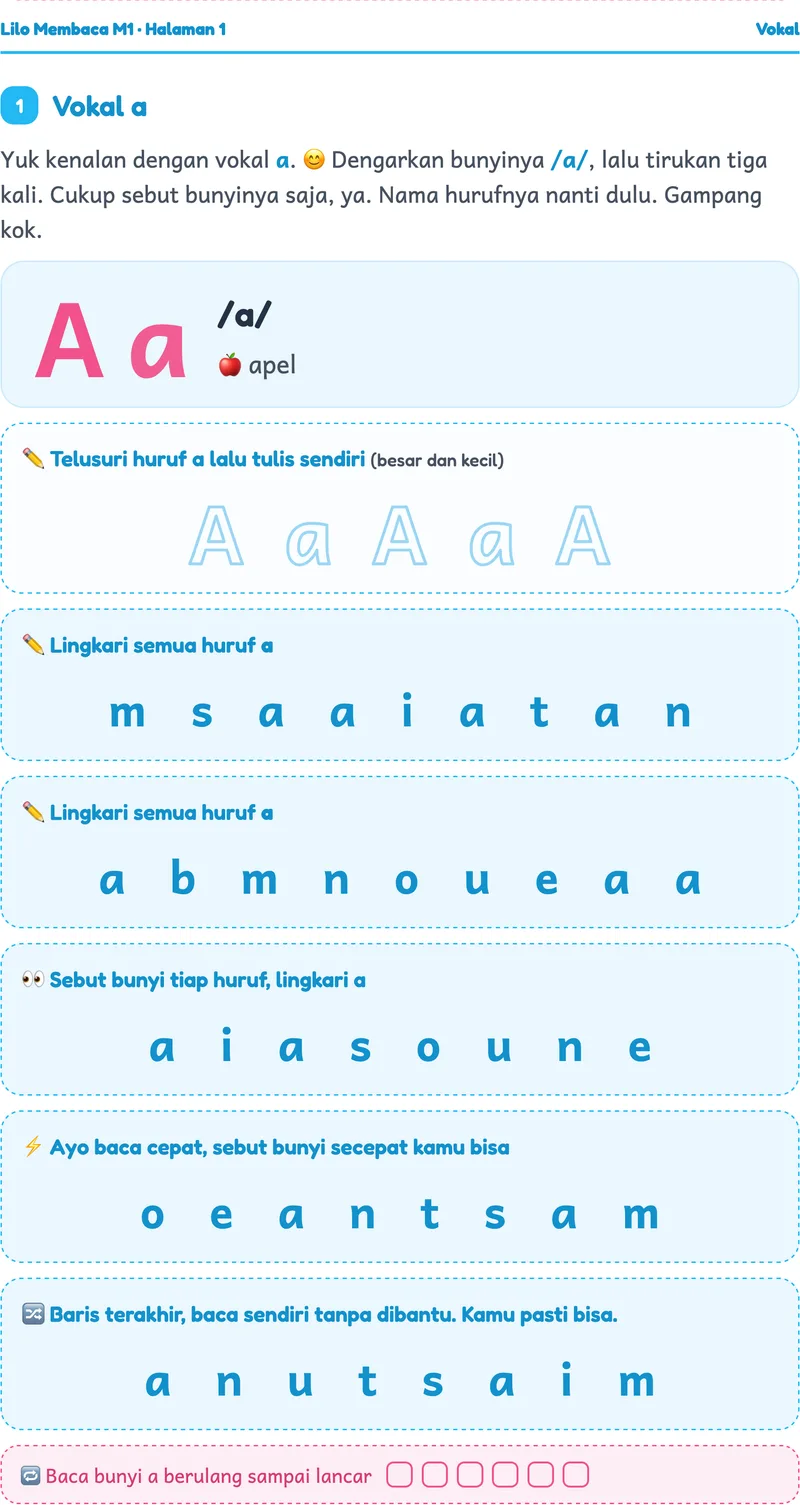
This Introduction Level sheet from the reading module introduces the vowel sound a through cards and point-and-read activities. It is the very first door a child opens on the way to reading.
These sheets are a small glimpse of Lilo's own progressive curriculum, carefully arranged across 122 modules.

Talk with us about your child's stage, ask anything about the method, and let the placement assessment find the perfect starting level. The consultation is free and friendly.
Free consultation on WhatsApp