
Ages 3 to 4, first hellos to letters and numbers
Your child meets letters A to Z and numbers 1 to 10 through play and real objects. Sessions feel like guided fun, and early writing starts with simple lines and patterns.
A calm, structured way for children aged 3 to 8 to learn reading, writing and counting together. Short, friendly sessions built level by level, guided by a tutor who meets your child at the right level.
Reading, writing and counting in Palembang is a Lilo program where children aged 3 to 8 learn all three skills as one connected journey, with English as the language of instruction. A tutor begins with a placement assessment, then builds each skill in small steady steps: real objects first, then pictures, then letters and numbers, supported by regular friendly practice built level by level.
Every child arrives at letters and numbers on their own timetable. The program meets your child exactly where they are today and moves forward one comfortable step at a time.
Your child meets letters A to Z and numbers 1 to 10 through play and real objects. Sessions feel like guided fun, and early writing starts with simple lines and patterns.
Your child blends syllables into words, counts with confidence and practices writing letters and numbers, so the first day of primary school feels familiar and welcome.
Your child reads with understanding, writes full sentences and solves word problems drawn as simple bars, so schoolwork feels manageable and confidence keeps growing.
The placement assessment finds the exact step where learning got wobbly. Your child restarts there, wins small victories every session and catches up on solid ground.
Every session follows a clear rhythm your child can trust. Understanding comes first, then short repeated practice makes each new skill feel easy and owned.
A placement assessment at the start shows exactly what your child already masters. Lessons begin from that point, so every session feels doable and your child moves up only after real mastery.
Your child holds real objects first, then works with pictures, and only then meets letters and number symbols. This is the Singapore Math way, and it makes ideas stick for good.
Your child learns the sound each letter makes and blends sounds into syllables and words. Reading grows naturally from sounds, so new words open up on their own.
Each skill is rehearsed in small friendly portions built level by level. Short regular practice builds fluency without tears and quietly turns learning into a daily habit.
Your child advances one stage at a time, with a check at every move.
Readiness shows in small daily habits. These four groups of signs point to the skill your child can start from.
Tutors for Palembang are chosen from 200+ teachers in Sumatra. Some of them already live in Palembang.
Graduates and current students alike.
Every application reviewed
Role and city are checked first.
Identity and degree checked
Identity and diploma are matched.
Tutor profile filled in
Teaching history goes into the portal.
Trained in the Lilo method
Teaching starts after training.
Chosen for your child
Each candidate answer is reviewed.
Not the right fit? Read the tutor replacement guarantee
Four signature practices shape how Lilo tutors teach, all drawn from our own curriculum of 122 leveled modules built for young learners.
A child who understands the idea behind a letter or a number keeps that skill for life.
Before your child ever sees the symbol 5, they count five real things they can hold. Meaning comes first, so numbers and letters arrive already full of sense.
Your child learns what each letter says and blends those sounds into words. New words become puzzles your child can solve alone, which makes reading feel powerful.
Story problems are drawn as simple bars, the Singapore way. Your child sees the problem, reasons about it and answers with understanding they can explain.
Small portions, repeated warmly and often, level by level. Each short session ends in success, so your child looks forward to the next one.
Each rung is a real stage from our own leveled modules, and your child climbs one rung at a time after true mastery.
Many well-meaning habits quietly make learning harder for young children. Here are the ones we see most often, and how the program handles each of them.
Why it happensFacts learned by pure memorization fade fast and make learning feel sour, because the child never grasped what the symbols mean.
How Lilo helpsLilo begins with real objects and pictures, so your child understands each idea first and remembers it because it makes sense.
Why it happensWhen hand muscles are still developing, long writing drills bring frustration and can make a child dread the pencil.
How Lilo helpsWriting starts with playful lines and patterns that strengthen little hands, then moves to letters only when your child is ready.
Why it happensA child who chants 1 to 10 without touching real quantities is reciting sounds, and the recital collapses when real problems appear.
How Lilo helpsYour child counts real objects first, then pictures, so the symbol 7 always stands for something they have held and seen.
Why it happensSqueezing three skills into a few rushed months piles pressure on a young child and leaves gaps under the surface.
How Lilo helpsShort regular sessions spread learning over comfortable steps, so your child arrives at primary school calm, ready and genuinely prepared.
From recognizing single letters to enjoying whole sentences, your child climbs sound by sound until reading with understanding feels natural and fun.
Little hands warm up with lines and patterns, then shape print letters, words and finally full sentences with growing neatness and pride.
Your child gets to know numbers through real objects, then learns addition and subtraction and finally reasons through word problems step by step.
Woven through every session are habits that last a lifetime: sitting with focus, working independently and finishing tasks with quiet confidence.
Admission to Grade 1 now runs on age. So why learn early? The classroom holds the answer.
Under the 2025 admission rules, Grade 1 has no reading, writing or counting test, and age decides. The question becomes how comfortably your child follows lessons. From week one the teacher uses the board, worksheets and spoken instructions, so a child at ease with letter sounds and a pencil can give full energy to what is new.
Take the word cat. A child taught letter names hears see, ay, tee, and wonders how that makes cat. A child taught sounds hears k, a and t slide together and builds the word alone. Each letter becomes a clue to a sound, so new words open without memorising. The tutor listens for blending without long pauses.
Counting works the same way. A child who memorises the number sequence often stalls at 8 plus 5. The tutor starts with eight buttons and five more, and your child moves two across to complete ten. Pictures follow, then symbols, until 8 plus 5 reads as ten and three, a habit of thought that lasts for years.
This picture fits a six year old starting Grade 1 soon on the Intensive package, 12 sessions a month. Some letters are known, so syllables come first.
Your child blends letter sounds into syllables like ba, bi and bu, and three meetings a week keep them fresh.
Syllables join into short words like sun and map, and your child begins reading labels on kitchen packets.
Pencil grip is steady, straight-line capitals come out neat, and your child writes their own name.
With sticks and rubber bands, your child bundles tens and sees that 14 means one bundle and four loose sticks.
Your child reads a simple sentence and answers a question about it, then walks into Grade 1 calm.
This is the general direction for this profile, and the tutor tunes each step to your child week by week.
Palembang is the capital of South Sumatra Province and one of the oldest cities in Indonesia, heir to the Srivijaya era when the city was a center of learning and trade. The Musi River divides the city into two banks, Ilir and Ulu, joined by the Ampera Bridge, a landmark its residents are proud of. Malay culture places family at the heart of daily life, giving Palembang a warm and familiar feel.
Lessons happen where your child already feels at ease. A Lilo teacher visits your home anywhere in Palembang's service areas, carrying structured materials and shaping every session around what your child needs.
Each new idea arrives in a clear order. Your child handles real objects, moves on to pictures, and then meets numbers and letters. Understanding sinks in, confidence builds, and practice turns into something your child looks forward to.
When you would like your child to learn from home with no teacher visiting, Lilo's online classes are live sessions where talk flows both ways. A teacher guides your child in real time, and worksheets get finished right at the desk.
60/90/120 minutes
Contact us
choose 60, 90, or 120 minutes
Contact us
60, 90, or 120 minutes per session
Contact us
Young children learn best from someone they like, so matching gets real care. Here is the path.
Share your child's age, current skills, and whether you prefer home visits or online lessons.
The team picks a tutor whose background and teaching manner suit your child, weighing your address for home visits.
The tutor's profile is open to you before the first session, so your child can hear about them early.
Letters, pictures and objects fill the first meeting. The tutor finds your child's starting point with no written test.
After the first session, the tutor notes where your child stands. Four pointers help you read that note well.
An old box, a plant and a pet can carry a session forward, one short activity a day.
Cut the box into cards and write ka, ki, ku, ma and mi. Your child pairs two cards and reads them aloud.
cardboard box, scissors, marker
Lay the cards face down. Your child turns two over and keeps them when they make ten, like 6 and 4, counting buttons when unsure.
cardboard cards numbered 1 to 9, buttons
Each morning your child counts the leaves on one plant and writes the number. A week later, ask how many are new.
one potted plant, paper, pencil
Your child writes the name of the cat, fish or plant on cardboard in capitals, straight strokes first. Taped near the cage or pot, the tag gets read daily.
cardboard scraps, pencil, crayons
Lessons come from original Lilo modules built level by level, so every session has a clear place in a bigger, carefully ordered journey.
Verified tutors teach 1-on-1 at your home across Palembang, including Ilir Barat I, Kemuning, Sako and Plaju, so learning fits gently into family life.
Sessions run in English for bilingual and national-plus families, with bilingual support available in Indonesian and English whenever your child needs it.
The placement assessment finds the right starting step, and your child moves up only after truly mastering each stage, so confidence grows on solid ground.
Friendly regular practice built level by level turns short sessions into a lasting learning habit that keeps serving your child long after the program.
Families in Palembang have several good paths. Here is an honest look at how they differ, so you can pick what fits your child.
Real objects first, then pictures, then symbols
A verified tutor, live and 1-on-1 or in a small group
Placement assessment, level up only after mastery
Reading, writing and counting woven into one journey
Pencil and paper every session, from lines to sentences
After a month, your child brings home neater worksheets, words they now read unaided, and a Bar Model sketch for tackling word problems. All of it is practised in 1-on-1 sessions at home or online. You pay package by package; the Regular package holds 8 sessions for IDR 604,782, and bigger packages bring each session's cost down.
About once a week, enough to get to know the tutor and the routine.
IDR 307,460About twice a week, the most chosen rhythm for keeping practice regular.
IDR 604,782About three times a week, so the basics firm up week after week.
IDR 891,965About six times a week, letters and numbers become part of nearly every day.
IDR 1,692,684At home or online, the same.
We find a replacement for free. Request it whenever you need.
Here is how:
Plus a monthly progress report.
Ask any provider in Palembang these five questions. The answers show how your child will be treated.
A mistake shows where understanding stops. A thoughtful teacher repeats the sound and invites another try. Lilo tutors treat each mistake as a pointer to the stage that needs work.
A child moved up too early piles up gaps that surface later. Ask what moving up rests on. At Lilo, the next stage opens once the current one is mastered.
Reasonable stretch helps a child grow. Lilo tutors close each session by naming what your child can now do, then set one short task that fits into roughly ten minutes.
Young children have light and heavy days. A perceptive teacher switches activity or adds a movement break, and Lilo sessions are built that way.
The match shapes how willingly a child sits down to learn. If it does not settle, Lilo provides a new tutor at no cost, a promise we keep firmly.
Qiana loves counting the stairs every time she goes up to the second floor. Her reading is coming along too. The report after each session tells us what to review at home.
Elzio used to struggle to focus while studying. Now he can sit calmly and finish his worksheets on his own. His numbers and letters look much neater too.
See for yourself the original sheets children work on in Lilo's calistung classes. Every level trains reading, writing, and counting side by side, climbing one step at a time.
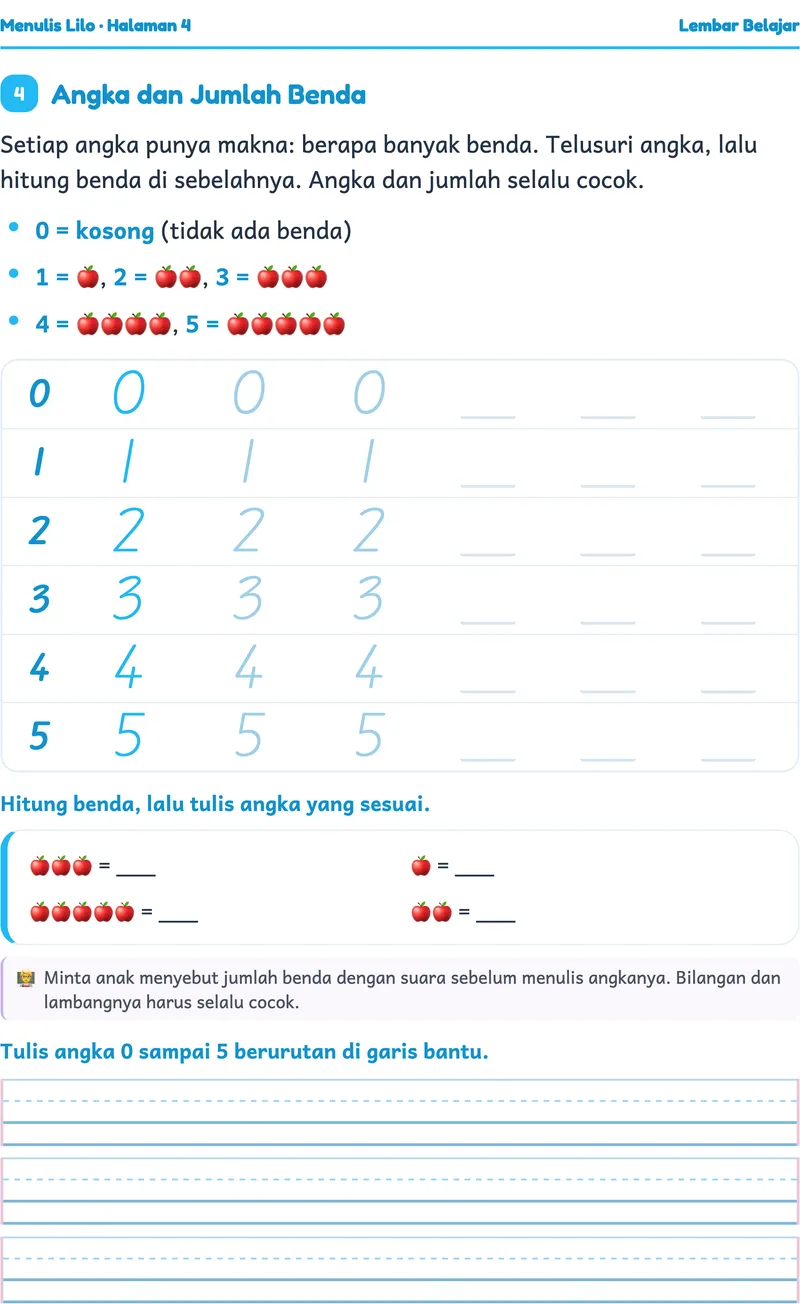
A real writing-module page: your child matches numbers to quantities and writes them neatly along guided paths.
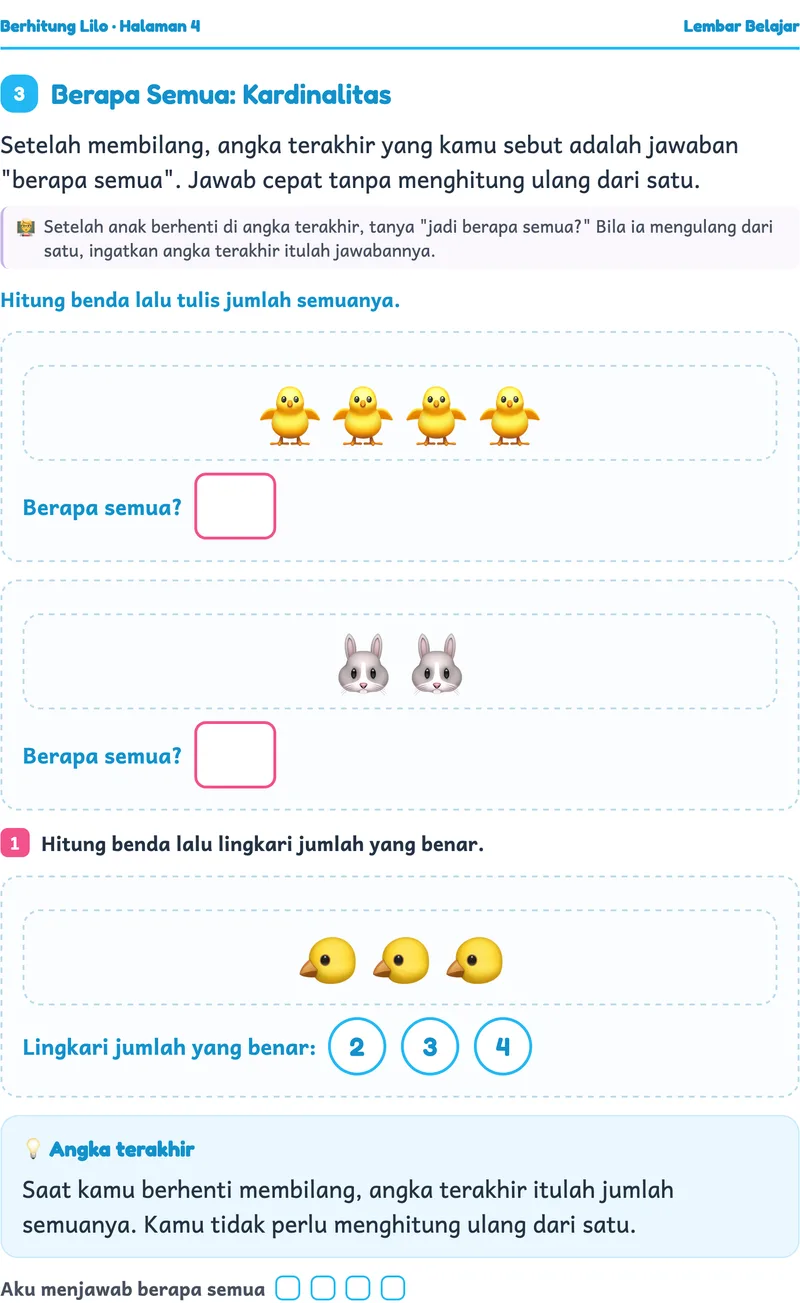
This Introduction Level sheet from the counting module invites children to count real objects one by one, then say the total out loud. It is the most natural way for a child to meet numbers.
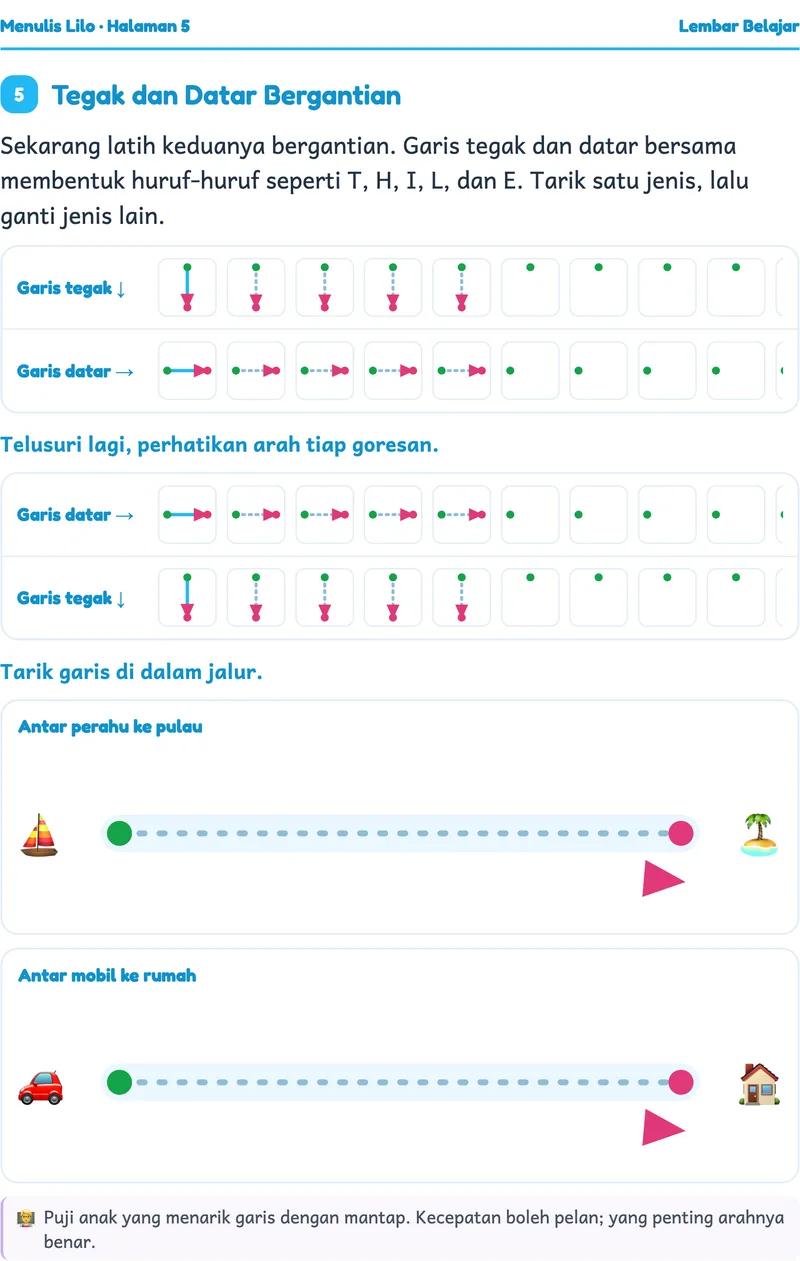
Little hands need strength before they can write letters. This Introduction Level sheet from the writing module invites children to draw vertical and horizontal strokes in turn until their hand movements feel steady and controlled.
These sheets are a small glimpse of Lilo's own progressive curriculum, carefully arranged across 122 modules.

Tell us about your child in a short WhatsApp chat. We will suggest the right level and service, and answer every question before you decide anything.
Free consultation on WhatsApp