


Little explorers aged 3 to 4
Your child meets letters and numbers through play and real objects. Small hands practice lines and patterns at their own pace, building the finger strength that writing will need later, with zero pressure.
Your child's hands learn to hold a pencil, trace steady lines, and grow into writing whole sentences, while reading and counting develop right alongside, guided one small step at a time.
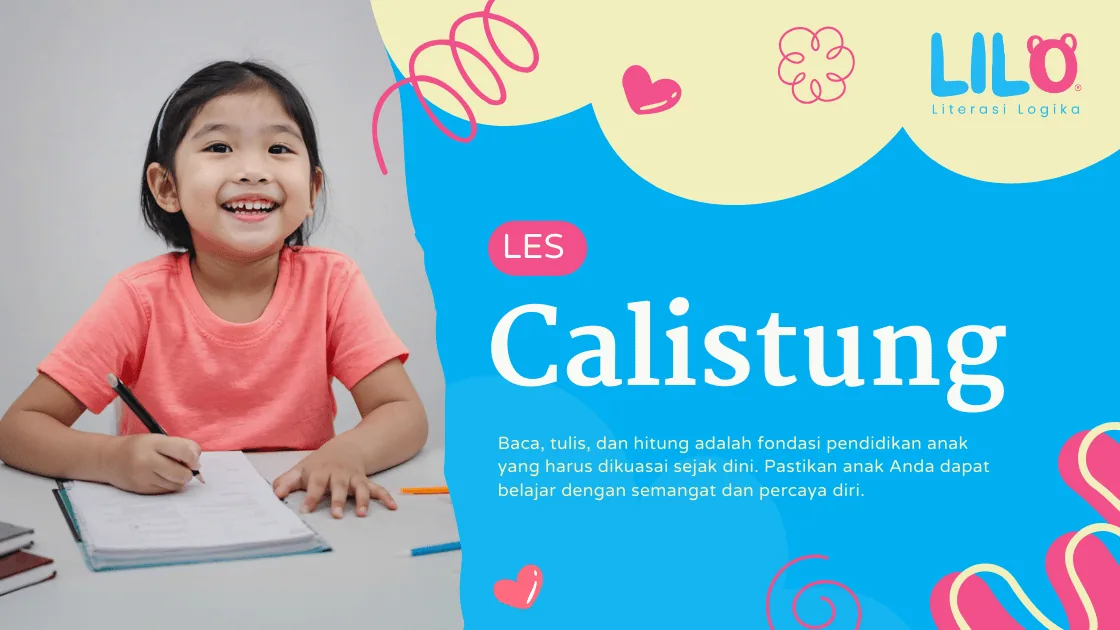
Reading, Writing and Counting in Palu is Lilo's guided program that teaches the three core school skills together as one journey for children aged 3 to 8, with English as the language of instruction. Writing starts with the hand itself: tracing lines and patterns, then letters, then words, then full sentences, while reading and counting grow beside it through four clear levels.
Every child arrives at a different point. A placement assessment at the start tells us exactly where your child stands, so lessons begin at the level that fits.
Your child meets letters and numbers through play and real objects. Small hands practice lines and patterns at their own pace, building the finger strength that writing will need later, with zero pressure.
Your child blends syllables, counts with confidence, and writes letters and numbers on paper. Each session prepares them steadily for primary school, so the first day of big school feels familiar instead of frightening.
Your child reads with understanding, handles addition and subtraction, and writes tidy words and sentences. Lessons strengthen all three skills together so schoolwork feels manageable and confidence keeps growing.
If your child feels behind at school, we start at the level where they are truly solid and rebuild from there. Steady wins at the right level bring back the joy of learning.
The sequence is tight, so nothing gets skipped as your child moves up.
Our method follows how young children naturally understand the world: touch first, see next, then symbols. Every step is small, clear, and mastered before the next one begins.
Before lessons begin, the tutor sits with your child to find out what they already know about letters, numbers, and pencil control. Your child starts exactly where they are, never too easy and never overwhelming.
Your child holds beads, blocks, and cards before meeting written numbers and letters, the Singapore Math way. Ideas take root in the hands first, so symbols on paper carry real meaning.
Your child learns the sound each letter makes and blends those sounds into syllables and words. Reading becomes something your child figures out independently, instead of a list of names to memorize.
Practice comes in short, friendly portions built level by level. Your child moves up a level only after truly mastering the current one, so every new page feels achievable.
Lilo teaches from its own original curriculum of 122 leveled modules, so every lesson your child receives in Palu follows a tested, measured path.
Beads, blocks, and everyday things come before any symbol on paper. When your child finally writes the number 5, they already know exactly what five of something feels like in their hands.
Your child learns what each letter sounds like and blends sounds into words. This gives them a key that opens every new word, including words nobody has taught them yet.
Story problems get drawn as simple bars, the Singapore way. Your child sees the problem before solving it, which trains real reasoning instead of guesswork.
Short, steady practice built level by level keeps skills warm without exhausting your child. A little every session, mastered fully, beats a mountain of drills done in tears.
Each rung is a real stage in our modules, and your child climbs them one mastered step at a time.
Many children arrive at Lilo after well-meaning approaches that backfired. These are the patterns we see most often, and how we set them right.
Why it happensWriting needs finger strength and control that develop gradually. Pushing letters onto a hand that can barely steer a pencil turns every session into frustration and tears.
How Lilo helpsWe begin with lines, patterns, and motor play that build strength first. Letters arrive when the hand can manage them, and writing stays something your child likes doing.
Why it happensA child can chant answers today and forget them next month, because nothing was ever truly understood. Learning built on memory alone fades fast and sours the mood toward study.
How Lilo helpsEvery concept starts with real objects your child can hold. Understanding comes first, and what is understood stays.
Why it happensWhen a child recites 1 to 10 without ever handling one, two, or three real things, counting stays an empty song, far from a skill they can use.
How Lilo helpsBeads, blocks, and everyday objects come before written numbers, so each symbol your child meets already means something real.
Why it happensSqueezing years of foundation into a few rushed months puts heavy pressure on a small child and produces shaky skills that wobble in the first school term.
How Lilo helpsWe build gradually across four levels, in small mastered steps. Starting earlier and going gently beats starting late and going hard.
Why it happensWhen reading, writing, and counting live in separate boxes with no bridges, one skill races ahead while another falls behind, and progress ends up lopsided.
How Lilo helpsOur sessions weave the three together: your child writes what they read and reasons about what they count, so all three grow in step.
Your child moves from recognizing letters to blending syllables, then reading full sentences and understanding what the words on the page actually say.
Small hands train on lines and patterns first, then print letters, then words, and finally complete sentences, with pencil grip and neatness improving at every stage.
Your child gets to know numbers through real objects, then learns addition and subtraction, and finally solves word problems by drawing them out as simple pictures.
Alongside the three skills, every session quietly trains concentration, independence, and the confidence to try, make mistakes, and try again.
This picture follows a 4 year old in Palu learning online on the Regular package, eight sessions a month, with class links and worksheets arriving beforehand in app.lilo.id.
Your child hears the first sound of their own name and finds objects in the room that share it.
Chunky crayons pull straight lines and closed circles, and capitals such as L and T start to appear.
Chunks like sun and set join up, and two-part words get guessed together with the tutor on screen.
Bottle caps are counted one at a time, and five splits into two and three with caps in hand.
Words like cat and map are read whole through their sounds, and their own name is written clearly.
The tutor reorders these stages to follow whatever your child masters first, so each month fits what they can do.
Practice sticks when it rides on habits you already have: little notes during the day and sound play before sleep.
Your child draws a note for a sibling or grandparent and signs their name in straight-line capitals, proud to see it read. This trains stage T.
scrap paper, crayons, tape
Before delivering picture letters around the house, your child counts letters and people, one letter for each person. Stage B grows here.
old envelopes, small paper
Say: I can see something starting with bbb. Your child guesses bed or bear, then sets you a riddle. Ears tuned to first sounds feed stage H.
objects around the bed
After the story, your child picks a short word from the last page, sounds out its parts while pointing, and makes it the goodnight word. Stages S and K meet.
a picture storybook
60, 90, or 120 minutes
Contact us
60/90/120 minutes
Contact us
choose 60, 90, or 120 minutes
Contact us
Readiness rarely shows at a desk. It appears in everyday habits and in the way your child plays, so watch both.
Palu belongs to our Sulawesi network: 100+ calistung tutors. Online classes in Palu are always open.
Graduates and active students.
Applications screened
Role and city are checked first.
Identity and degree checked
Identity and diploma are matched.
Experience and hours recorded
Available hours are noted down.
Trained in the Lilo method
Lilo guides and materials are provided.
Chosen for your child
Candidates answer questions about the child.
Want a different tutor? See our free tutor replacement promise
There is no written test. Your child plays, and each game shows the tutor a stage already mastered.
Your child pulls a spoon, ball or key from a cloth bag and says its first sound out loud, showing how firmly letter sounds have landed.
Cards reading sun and set line up like carriages, and your child tries sounding out the joined word.
Your child draws straight roads and roundabouts for a toy car while the tutor watches pencil grip and control.
Paying for three cakes with buttons, one at a time, shows whether each object gets counted exactly once.
Four steps cover your child's first week in Palu, from your first message to the first written update.
In a free consultation you share your child's age, habits, and choice of home or online lessons, which guides the tutor match.
The team matches a tutor suited to your child, and you can read that tutor's profile before the first session.
Sound games, drawing lines and counting objects fill the opening session, showing the tutor which stages your child already holds.
After week one the tutor's report arrives, noting for example that your child now hears the first sound of their own name.
At three, the groundwork grows from hands, ears and objects your child can touch. Here is how tutors prepare it through play.
A three year old still moves largely from the shoulder and elbow, so small fingers tire quickly on a thin pencil. Tutors start with big movements: tracing lines in a tray of flour, tearing paper, pinching buttons with a clothes peg. These build the small finger muscles, one short activity after another. At home you will see the crayon creeping toward the fingertips and wobbly lines slowly straightening.
Reading begins in the ear. Your child first needs to hear that words are built from sounds: ball opens with b, moon opens with m. Tutors play first-sound riddles, rhyming songs and syllable claps, such as two claps for rab bit. An ear tuned this way makes blending easier once letters arrive, and you hear it when your child notices that a friend's name starts like their own.
Many three year olds can already recite one to ten. Real counting rests on one-to-one matching, each object touched exactly once as its number is said. Tutors train it with one button in each hole of an egg carton, or one spoon for each doll. When your child says three just by glancing at a small group, the foundation for numbers is forming.
Lessons follow Lilo's own published modules, built level by level. Your child never gets random worksheets; every page has a place in a larger, carefully ordered journey.
We respect how small hands develop. Lines and patterns come first, letters follow, and sentences arrive when the hand is genuinely ready, so writing stays enjoyable.
Reading, writing, and counting reinforce each other in every session. What your child reads, they write; what they count, they reason about in word problems.
Our verified tutors teach at your home across Palu, from Palu Timur and Palu Barat to Mantikulore and Talise, or meet your child online if that suits your family better.
Instruction is available in English and Indonesian. Your child levels up only after real mastery, so the progress you see is progress you can trust.
In the first week, your child already traces letters, reads short words and counts objects within the same lesson. The Regular package of eight sessions a month, chosen most often, comes to IDR 604,782, and a session starts at IDR 76,865 on the four-session Starter package. One payment covers the whole package, after which our team books the tutor's home visits or the online classes around your child.
By month's end, your child writes their own name in neat letters.
IDR 307,460Your child finishes able to add two numbers using pictures and objects.
IDR 604,782By the last session, your child reads task instructions alone, without the tutor reading aloud.
IDR 891,965Your child closes the month drawing a Bar Model for simple word problems.
IDR 1,692,684At home or online, the same.
Just tell us, any time.
The steps:
And a progress report every month.
Palu serves as the capital of Central Sulawesi Province. It sits on a wide bay, and its scenery runs from the shoreline up into the green hills that ring the city. Down the middle flows the Palu River, a presence woven into how the city sees itself for generations. People here carry a spirit of rising again: hardworking, patient, and hopeful as they shape what comes next. In Palu Timur, Palu Barat, Mantikulore, Ulujadi and beyond, young learners keep finding new joy in learning.
Your child learns at home in Palu, in a calm and familiar setting. The teacher adapts each lesson to your child's needs, and you can follow the progress closely every session.
Your child first handles real things, then sees them as pictures, and finally meets them as symbols and numbers. Moving through this order lets each idea sink in properly, and your child feels surer with every stage.
Your child begins at a level fitted to what they can already do and climbs one small step after another. Progress reports reach you often, so you can follow each gain your child makes, lesson by lesson.
Five fair questions for any tutoring provider, about how progress is reported and how lessons connect with school.
| Question to ask | Why it matters |
|---|---|
How often will I hear about progress, and from whom? | Rare updates let small problems grow, while regular word from the teacher catches a wobbling stage early. Every Lilo session closes with the tutor summing up the day's gains. |
Do updates include real samples of my child's work? | Handwriting pages and newly read words make progress visible to your own eyes. Lilo worksheets come from your child's current module, so progress is easy to trace. |
Does the material reach children already in early primary school? | Grades one to three need work linked to class, such as understanding passages and solving word problems. Lilo's curriculum runs up to age 10. |
How does the counting method help with school word problems? | Word problems trip up many pupils because the sentence comes before the sum. At Lilo, problems are drawn as bar diagrams first, then calculated. |
What happens if my child does not click with the teacher? | Fit matters greatly for young children, so ask early how a change works. A Lilo tutor swap is free whenever your child is not yet comfortable, a firm service promise. |
Latifah really looks forward to her lessons, she says they are fun. She is starting to understand addition using things around the house, like counting spoons while helping set the table.
Aisyah loves counting our groceries when she comes along to the shop. Her reading is starting to flow too, she sounds out the names of items on the shelves one by one.
These sheets come straight from Lilo's original modules. Reading, writing, and counting are trained side by side, step by step at your child's level.
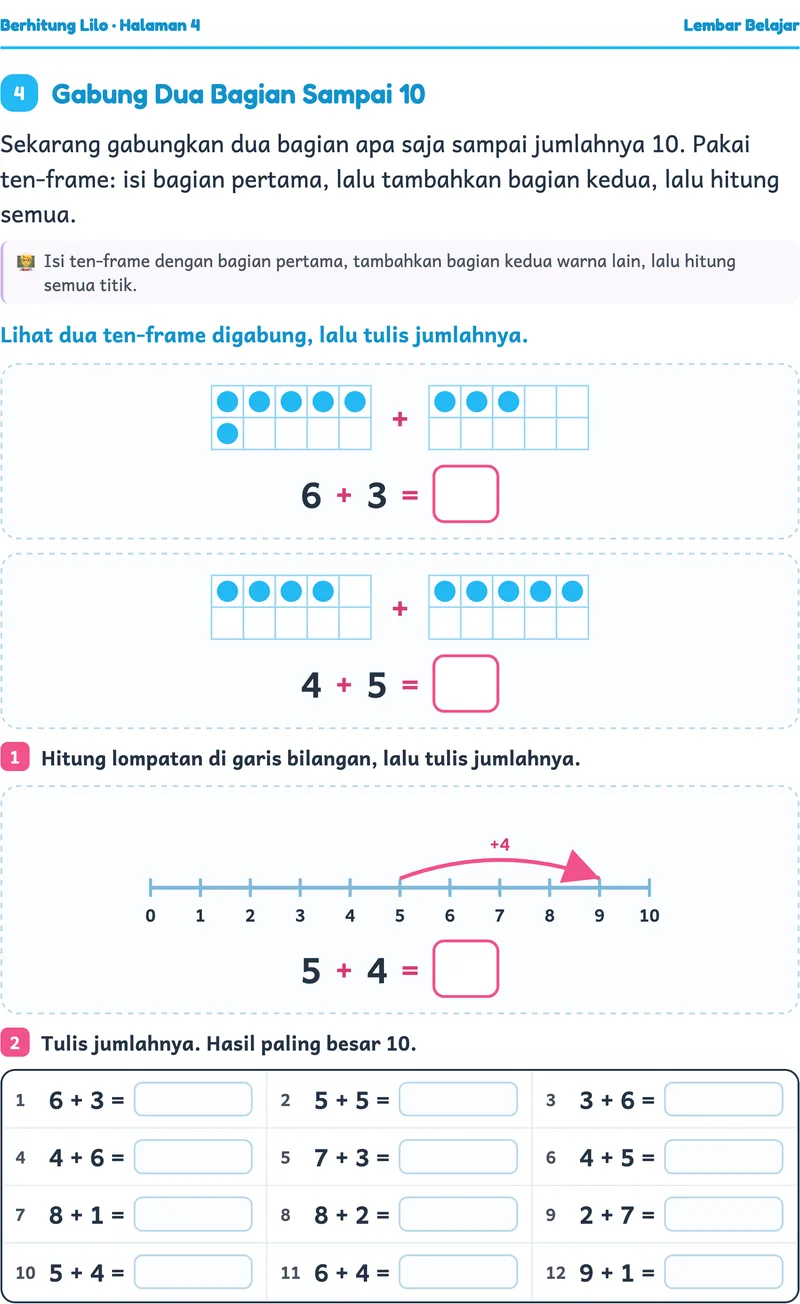
On this sheet, Intermediate Level children practice addition with two helpers: the ten-frame and the number line. They see the picture first and count afterward, so addition feels real and concrete.
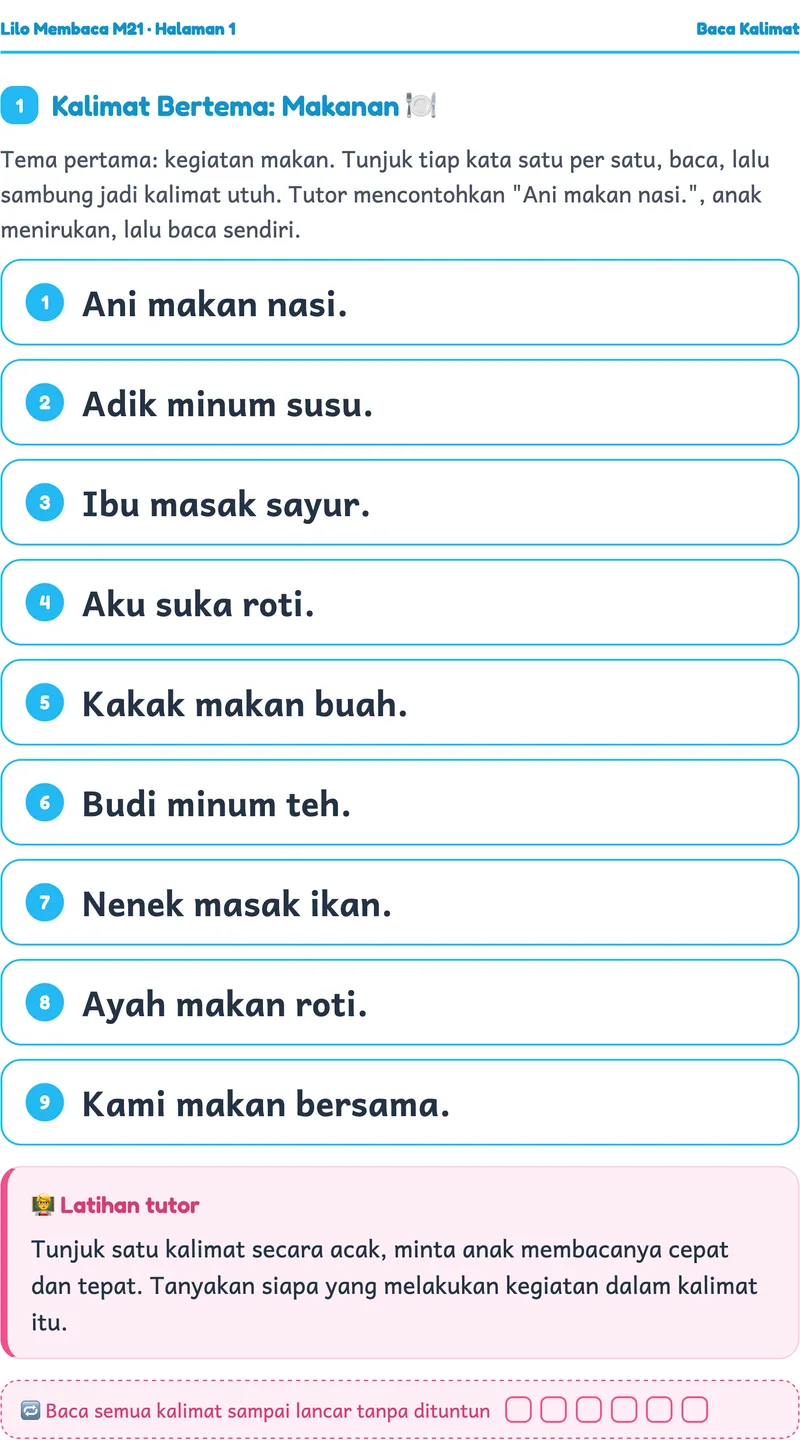
This Intermediate Level sheet from the reading module holds short sentences about food, read from start to finish. All the earlier sound and syllable practice comes together here as the child's first meaningful reading.
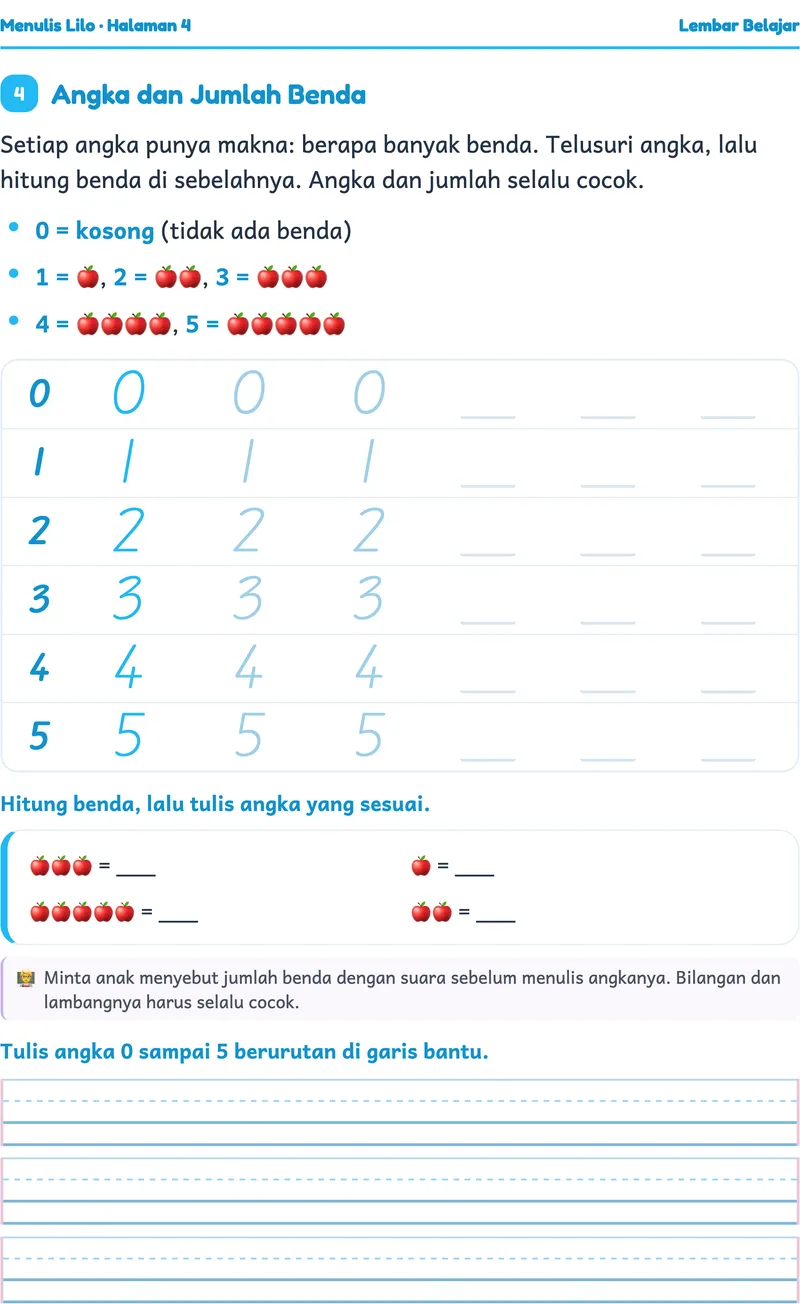
A real writing-module page: your child matches numbers to quantities and writes them neatly along guided paths.
Every sheet above is part of Lilo's own progressive curriculum, a complete set of 122 modules.

From the first pencil stroke to full sentences, from first sounds to real reading, Lilo walks beside your child through every level. Families across Palu can start with a free consultation.
Free WhatsApp consultation today