

Little explorers aged 3 to 4
At this age your child meets letters and numbers through play, with zero pressure. Sessions feel like games with real objects, and the assessment simply tells us which playful activities suit them best.
Before the first lesson, a simple placement assessment shows where your child truly stands. From that starting point, a Lilo tutor builds reading, writing and counting step by step, with calm and steady practice.
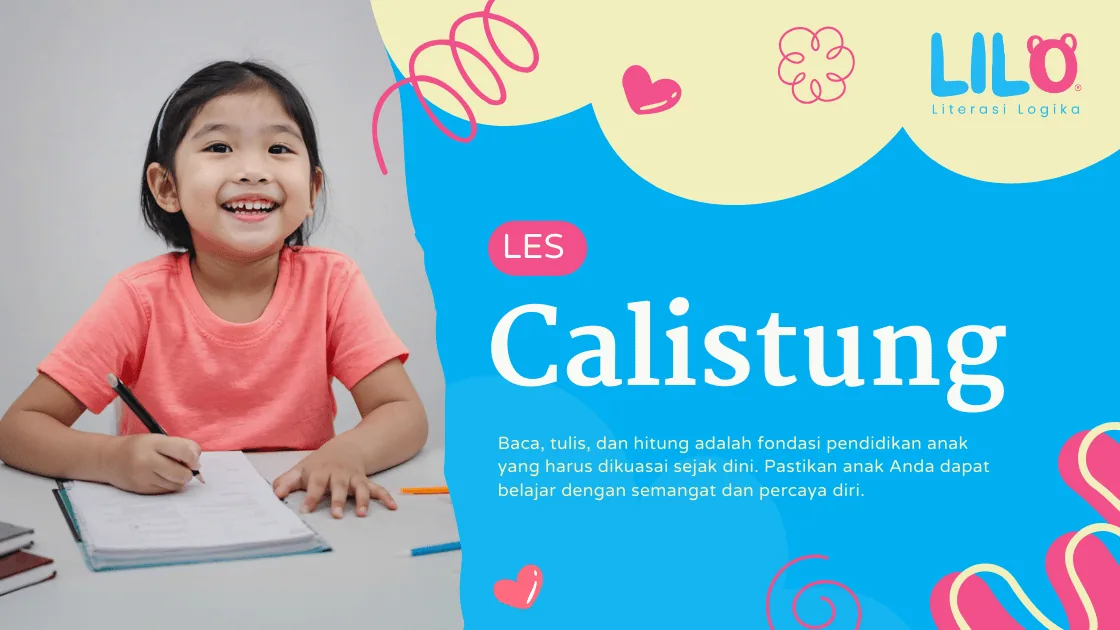
Reading, writing and counting in Pekanbaru is Lilo's home and online program that teaches the three skills together for children aged 3 to 8, beginning with a placement assessment so every child starts at the level that fits. Lessons move from real objects to pictures to symbols, and your child climbs to the next level only after true mastery.
Every child arrives at a different point. The placement assessment meets your child where they are, whether they are meeting letters for the first time or polishing skills for primary school.
At this age your child meets letters and numbers through play, with zero pressure. Sessions feel like games with real objects, and the assessment simply tells us which playful activities suit them best.
Your child is in kindergarten and primary school is on the horizon. The assessment maps what is already solid and what needs gentle building, so preparation feels steady instead of rushed.
In the first school years, reading, writing and counting need to work together smoothly. Lessons strengthen all three at once, so homework feels lighter and confidence in class grows.
If your child has fallen behind, the kindest move is to restart from the level they actually master. The assessment finds that level, and each small win from there rebuilds their courage.
choose 60, 90, or 120 minutes
Contact us
60, 90, or 120 minutes per session
Contact us
duration of 60, 90, or 120 minutes
Contact us
Watch for two moments: the day your child is ready to sit with a tutor for the first time, and the day they can step onto the next stage code.
Tutors for Pekanbaru are chosen from 200+ teachers in Sumatra. Online classes in Pekanbaru are always open.
Some still studying, others graduated.
Applications screened
Suitable applicants move forward.
Documents verified
ID card, diploma and photo are checked.
Teaching profile completed
Available hours are noted down.
Trained in the Lilo method
Teaching starts after training.
Chosen for your child
Questions come from the child’s needs.
Not the right fit? See our free tutor replacement promise
The first meeting feels like playtime, with no written test. While your child plays, the tutor notes which stages are already solid.
The tutor says a sound and your child picks the matching letter card from a small spread. Quick, sure choices tell the tutor that stage H is firmly in place.
Cards reading ma and ta slide side by side. A child who says mata at once already stands on stage S, while slow sound by sound reading shows where lessons will start.
Your child draws a house and writes their name in the corner. The tutor watches pencil grip and the direction of each stroke to judge readiness for stage T.
After your child counts a scattered handful of buttons, the tutor shares a starting point for reading, writing and counting. The three often differ, and each skill picks up from its own place.
Getting ready is light work. These four steps let the first session in Pekanbaru start smoothly, at your table or on a screen.
The consultation is free. Share your child's age, school year, district and whatever trips them up, such as b and d swapping places. This story guides the tutor match.
You can read the tutor's profile before the first session. Mention the tutor's name to your child the day before, so the visit feels like welcoming an expected guest.
A table at the right height, a chair that lets your child's feet rest flat, a pencil, and a handful of buttons or bottle caps for counting are all you need.
The class link and worksheets arrive before each lesson, all organised in app.lilo.id. Print the pages and angle the camera at the table so the tutor can see your child's hand while writing.
Our method follows how young children naturally understand new ideas: touch first, then see, then symbols. Each step below is simple on its own, and together they make learning stick.
We begin with a relaxed assessment that feels like play. It shows exactly which letters, sounds and numbers your child already owns, so the first real lesson lands at the right level.
Your child holds beads, blocks and cards before meeting written numbers and letters. This is the Singapore Math way: once hands understand an idea, the symbols on paper finally make sense.
Reading grows from letter sounds, so words unlock naturally without spelling drills. For counting stories, the tutor draws simple bars that turn a confusing question into a picture your child can reason about.
Practice comes in short, friendly doses built level by level. Your child moves up only after real mastery, so every level stands on solid ground and confidence keeps growing.
The teacher holds your child at one stage until the foundation is solid, then opens the next.
From recognizing letters to blending syllables, then reading sentences and understanding what they mean. Your child moves through each stage only when the previous one feels easy.
Hands warm up with lines and patterns before print letters appear. From there your child writes words, then whole sentences, with neat and comfortable handwriting as the goal.
Numbers start as things your child can hold and move. Addition and subtraction grow from that solid base, and word problems become pictures your child can think through.
Alongside the three skills, each session quietly trains concentration, independence and confidence. These habits carry your child through school long after the first lessons are done.
These four signatures shape every session, from the first placement assessment in Pekanbaru to the day your child reads a full story on their own.
Beads, cards and blocks come before any written symbol. When your child can show an idea with their hands, the numbers and letters that follow carry real meaning.
Your child learns the sound each letter makes and blends those sounds into words. With this key, any new word becomes a small puzzle your child can solve on their own.
Story questions are drawn as simple bars, the Singapore way. Your child sees what the question is really asking, and reasoning becomes something they can point to on paper.
Short, cheerful practice in small portions builds skill the way daily watering grows a plant. Your child levels up after mastery, so progress is always real and never rushed.
Each rung comes from our own 122 leveled modules, and your child steps onto the one the assessment points to.
Loving parents can still take paths that quietly slow a child down. These are the patterns our tutors meet most often, and how the right start prevents each one.
Why it happensChants and flashcards can look like progress, but meaning fades fast when it was never there, and learning starts to taste sour.
How Lilo helpsBegin with real objects your child can hold. Once the idea is understood, the memory holds itself.
Why it happensSmall hand muscles need warming up first. Pushing letters before the hand is ready turns writing into a battle of tears.
How Lilo helpsStart with lines, patterns and tracing games. When the hand is strong, letters arrive almost by themselves.
Why it happensA child can recite one to ten perfectly and still have no idea what seven means. Counting becomes empty sound.
How Lilo helpsCount real things first, beads, spoons, steps. Symbols come after the quantity is felt.
Why it happensSqueezing three skills into a few final months creates pressure and shaky foundations at the exact moment confidence matters most.
How Lilo helpsStart earlier at an easy pace. A placement assessment shows how much runway your child actually needs.
Why it happensReading, writing and counting feed each other. Kept apart, one skill races ahead while another quietly falls behind.
How Lilo helpsChoose a program that weaves them into one journey, so every session strengthens all three.
Plenty of children start primary school while still learning letters, and that is normal. Here is why the gap with classwork can widen, and how a tutor closes it.
Indonesia's 2025 school admission rules set no reading, writing or counting test for entering grade 1, because places are decided by age. One class therefore holds children starting from very different points, while lessons march on to sentences and story questions. A child who still spells out letter names, es, a, then sa, spends all their thinking power guessing sounds. By the end of a sentence the beginning has slipped away, so they appear to read without catching the meaning.
The tutor starts at the stage code where the gap sits, often S or B. For reading, your child learns to hear letter sounds and then whole syllables, so sa and pu turn straight into sapu. Once blending runs on its own, the mind is free to follow the story, and stage P opens up. Letters that keep flipping, such as b and d, are rewritten along guiding arrows until the movement settles in the hand.
Counting follows the same pattern. A child who adds 8 and 5 by counting fingers from one usually has not yet grasped the pairs that make ten. The tutor returns to real objects: eight sticks plus two make one bundle of ten, three sticks remain, so the answer is thirteen. The same bundles teach place value. At home you will notice the change when your child says ten first, then the rest, fingers resting still.
This picture fits a three year old meeting guided learning for the first time, on the Trial package of four sessions a month. A weekly rhythm gives every stage time to settle.
Your child learns to finish one game with the tutor. The first sound they recognise is usually the opening letter of their own name, the sound they hear most.
The crayon moves into a three finger grip. Upright lines, flat lines and big circles fill the page as a warm up for the hand.
Your child counts buttons one at a time and stops on the last one. They begin to see that the final number spoken tells how many there are altogether.
Your child points out familiar letters on a milk carton, the calendar or a shop sign. Their collection of known sounds grows from week to week.
Your child tries joining m and a into ma. This small step opens the door to blending syllables, the road to the first word they read alone.
This timeline reflects a once a week rhythm. When your child feels at home at the table, you can move to a package with sessions closer together.
What hangs on your wall, plus a stick of chalk, is enough for short practice. Choose one activity a day to match the stage your child is working on.
| Activity | Time | What you need |
|---|---|---|
How many days until SundayCircle today's date, then let your child hop a finger box by box to Sunday while counting each hop. An older child can work out how many more days make a full ten. This builds stage B. | 10 minutes | wall calendar and one marker |
Number hunt on the wall clockCall out a number and your child points to it on the clock. Then ask which number comes after 9, and which ones need two digits. Your child practises number order and glimpses place value. | 5 minutes | a clock with printed numbers |
Syllable hopscotch on the porchDraw six boxes on the floor holding ba, ju, bo, la, sa and pu. Your child hops onto two boxes and reads the word they make, such as baju or sapu. This strengthens stages S and K. | 15 minutes | chalk and a porch floor |
Straight line letters on a boardBegin with upright and flat lines as long as your child's arm, then write straight line capitals together, such as L, T, E and H. These big movements prepare the hand for stage T on paper. | 10 minutes | chalk and a small chalkboard |
Pekanbaru, the capital of Riau Province, sits along the Siak River and ranks among the larger cities on the trans Sumatra road. Trade keeps it growing, while its Malay heritage runs deep, carried in a courteous and refined way of speaking that elders hand down to the young. Old quarters like Senapelan and Pasar Bawah remain a source of local pride. Here, Lilo welcomes every young learner in Pekanbaru. Your child can study in person with a teacher who visits your home, or take part in online lessons wherever you are.
A Lilo teacher travels to your house anywhere in Pekanbaru. Your child studies in familiar surroundings where they feel at ease, and you can see how they are doing after each lesson.
Each child begins at a point that matches what they can already do. Lessons climb in gentle steps, moving from real objects to pictures and then to symbols, so every idea settles firmly before the next one arrives.
If you would like your child to study at home without a teacher visiting, live online lessons with a teacher are ready. You choose the schedule together with us, so each session slots neatly into your child's day.
Every journey opens with a placement assessment, so your child skips what they already know and never faces material far above their head.
Lilo teaches from an original curriculum of 122 leveled modules, so each session follows a clear, tested path from first letters to confident reading and counting.
Verified tutors teach one on one at your home across Pekanbaru, from Sukajadi and Tampan to Marpoyan Damai and Rumbai, so lessons fit into family life.
Lessons can run in English, Indonesian, or a comfortable mix of both, a natural fit for bilingual and national plus families.
Reading, writing and counting are taught together so each skill lifts the others. A word read becomes a word written, and a story becomes a counting question.
Families in Pekanbaru have several ways to teach reading, writing and counting. Here is an honest look at how the common paths differ.
| Aspek | Lilo | Learning Apps | Learning at Home Alone |
|---|---|---|---|
| Starting point | Placement assessment finds the exact level | Usually starts everyone at the same screen | Parents guess where to begin |
| How concepts are taught | Real objects first, then pictures, then symbols | Pictures and animations on screen | Depends on the books at hand |
| Guidance | A live tutor watches, corrects and encourages | Automated feedback | Parents guide as time allows |
| Moving up | Level up only after real mastery | Often unlocks by points or streaks | No clear measure of progress |
| The three skills | Woven together in one journey | Usually separate mini games | Often practiced separately |
The Regular package is the most popular choice: eight sessions a month, roughly twice a week, for IDR 604,782. Per-session rates begin at IDR 76,865. You pay once for the whole package, and your child practises reading, writing and maths with a tutor at home or in an online class, with progress reported every week.
Curious to see how a tutor works with your child, once a week for now.
IDR 307,460Already confident in Lilo and keen for practice twice every week.
IDR 604,782Chasing a clear goal, such as smooth addition before the semester ends.
IDR 891,965Wanting every calistung stage completed, with sessions on most days of the week.
IDR 1,692,684From the very first session.
One WhatsApp message is enough. Request it whenever you need.
Here is how:
A full report follows each month.
Put these five questions to any tutoring provider in Pekanbaru. The answers reveal whether your child will learn along a well built path.
| Question to ask | Why it matters |
|---|---|
Is the sequence of material written down, with stage codes I can see? | A coded sequence tells you where your child stands today and what comes next. At Lilo, the program runs on six stage codes, from recognising letters to understanding what is read. |
Where do the learning materials come from? | Worksheets gathered from many sources often jump in difficulty. Lilo writes its own curriculum of 122 coded modules, and every worksheet comes from the module your child is working on. |
How will my child's starting point be decided? | The right starting point protects your child from repeating what bores them and from material pitched too high. At Lilo, it is found through play in the very first session. |
Does my child handle real objects before meeting numbers and letters? | Young children grasp quantity through their hands first, then pictures, then symbols. Lilo tutors follow this order, including bundled sticks for place value. |
Do the same materials reach my child's table during online lessons? | A child holding a worksheet joins in, while a child without one tends to watch the screen. In Lilo online classes, pages from the same module arrive before the lesson. |
Razka wrote his own name for the first time on his grandma's birthday card. I even kept the card. His counting is getting more confident too, we are so grateful.
Reading, writing and counting tutoring in Pekanbaru really helped my child understand letters and numbers in a fun way. The tutor is very patient and creative in teaching.
See for yourself the original sheets children work on in Lilo's calistung classes. Every level trains reading, writing, and counting side by side, climbing one step at a time.
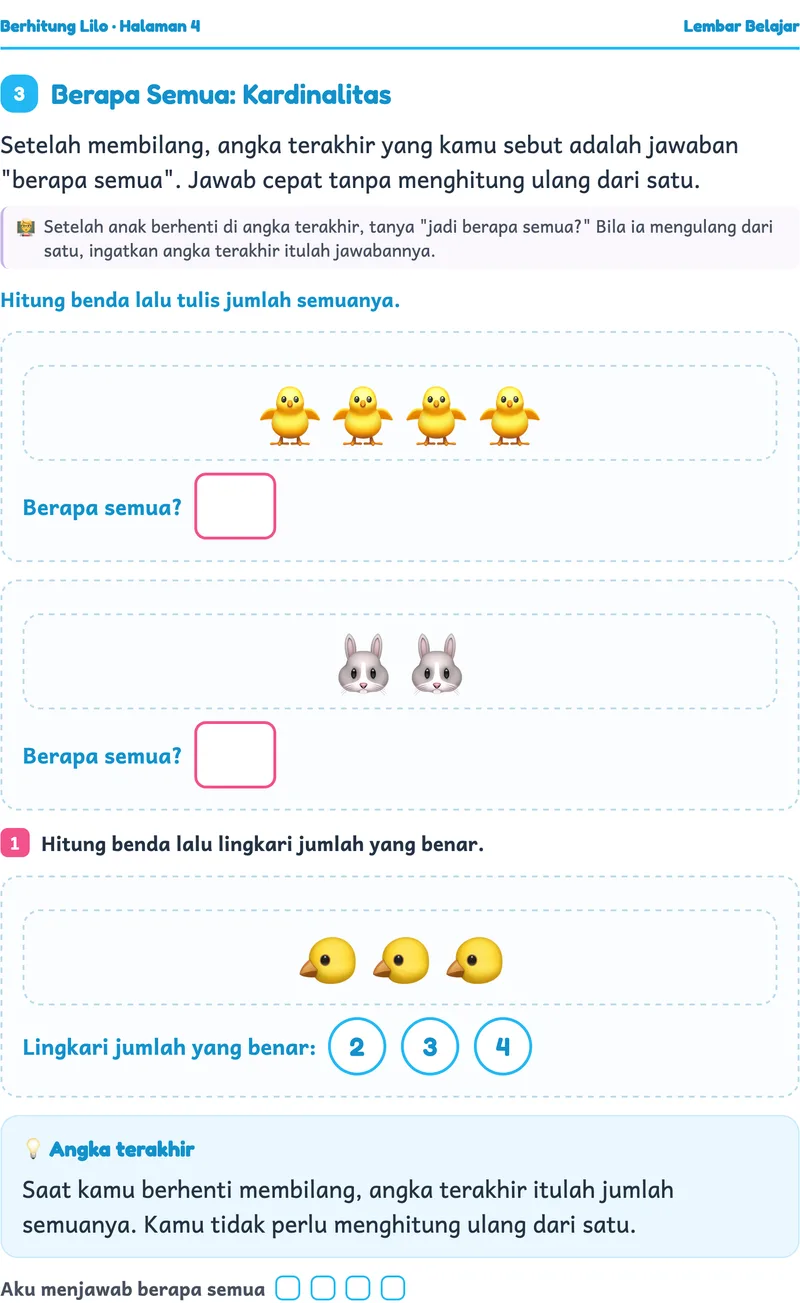
This Introduction Level sheet from the counting module invites children to count real objects one by one, then say the total out loud. It is the most natural way for a child to meet numbers.
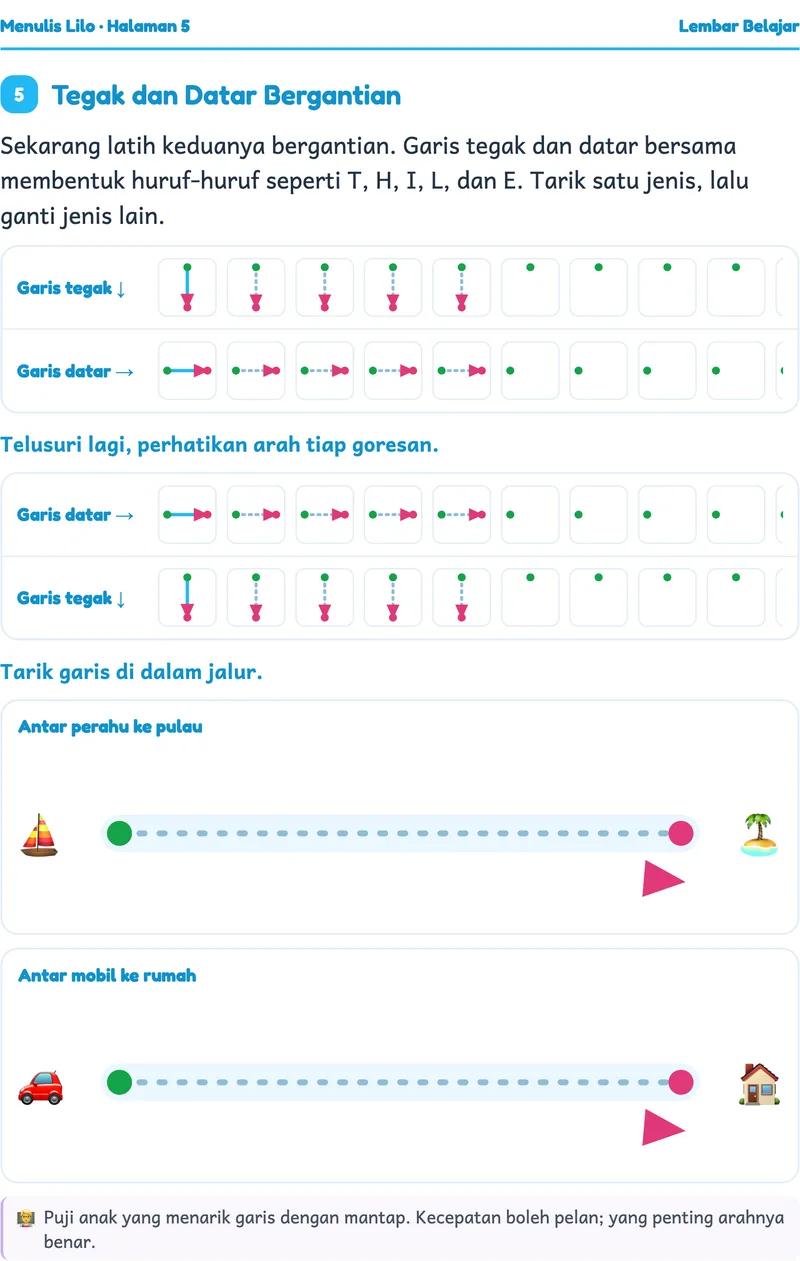
A vertical line, then a horizontal one, then back again. On this writing-module sheet at Introduction Level, children build up their hand muscles through simple strokes, important groundwork before their first letters.
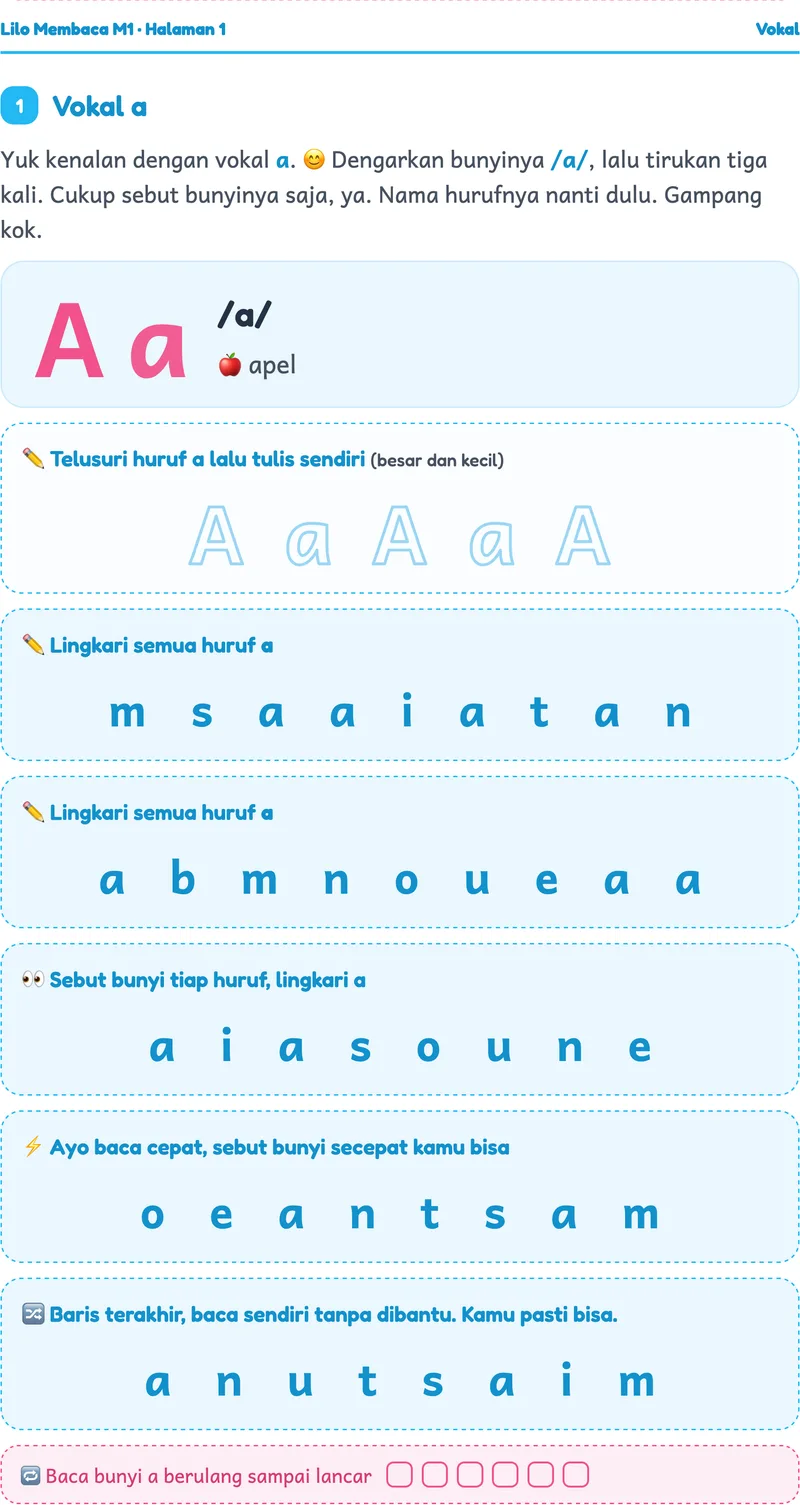
Through cards and point-and-read practice, Introduction Level children get to know the vowel sound a on this reading-module sheet. One small sound that starts the whole journey toward loving to read.
Snippets from Lilo's own 122 leveled modules, from first letters and numbers to being ready for primary school.

One free WhatsApp chat is all it takes to begin in Pekanbaru. The first lesson shows where your child stands today, and they climb from exactly there.
Free consultation, friendly and quick