


Ages 3-4, first steps
Your little one meets letters and numbers through play, songs, and things they can hold. There is zero pressure at this stage, only warm curiosity and happy first encounters with learning.
Your child starts at the level that truly fits, learns with real objects first, and climbs step by step. We move forward only when a skill is genuinely mastered, so confidence grows solid.
Reading, writing and counting in Serang is a Lilo program where children aged 3 to 8 learn the three core school skills together as one journey, taught in English at home or online. Every child begins with a placement assessment, practices in small steady portions, and moves to the next level only after truly mastering the current one.
Every child arrives at a different point in the journey. The program meets your child exactly where they are and builds upward from there, calmly and surely.
Your little one meets letters and numbers through play, songs, and things they can hold. There is zero pressure at this stage, only warm curiosity and happy first encounters with learning.
Your child blends syllables, counts with confidence, and shapes their first written letters. Each small win is secured before the next step, so primary school feels like a natural continuation.
Your child strengthens all three skills at once, reading with understanding, writing full words and sentences, and solving simple word problems. The goal is a child who feels capable in class.
If your child has fallen behind classmates, the placement assessment finds the exact level where learning feels doable again. From that honest starting point, progress becomes steady and morale returns.
The method is simple to see and powerful in practice. Your child understands each idea before symbols appear, and every level is earned through genuine mastery.
Before any lesson, we check what your child already knows in reading, writing and counting. Your child then starts at the level that fits, never one that overwhelms.
Your child holds and moves real things first, then works with pictures, and only then meets numbers and letters. This is the Singapore Math way, and it makes concepts stick.
Reading is built through letter sounds, so words unlock naturally. Word problems are drawn as simple bars, so your child can see the story and reason it out.
Practice comes in short, friendly portions, steady practice built level by level. Your child levels up only after showing real mastery, so nothing wobbly gets carried forward.
Every stage stands on the one before it, so the foundation has no gaps.
Readiness shows up in small daily habits at home. Match the signs below to your child's age, and bring what you notice to your first conversation with the Lilo team.
Serang belongs to our Banten network: 110+ calistung tutors. Home visits in Serang follow the nearest tutor.
Graduates and current students alike.
Every application reviewed
Role and city are checked first.
Documents verified
Diploma and ID are reviewed.
Experience and hours recorded
Teaching history goes into the portal.
Learning the Lilo method first
Phonics and CPA come first.
Matched to your child
Each candidate answer is reviewed.
Want a different tutor? Read the tutor replacement guarantee
The first session feels like playing together. Behind each game, the tutor notes how your child responds and maps it onto the stage codes of Lilo's curriculum.
The tutor lays out letter cards and asks your child for the one that says mmm or sss. The answer shows whether your child sits at recognising letters (H) or is ready to blend syllables (S).
Your child reads short words printed beneath pictures of a ball or a broom. When syllables join smoothly, the tutor tries longer words to check the reading words stage (K).
Your child draws a house and writes their name in the corner. Pencil grip, stroke direction and letter size tell the tutor where your child stands on writing neatly (T).
Your child shares buttons between two bowls and says how many are in each. Touching every button, or spotting small groups at a glance, reveals the basic counting stage (B).
Every observation is combined into one starting point per skill. Next week's worksheets come from the module that matches those codes.
These signatures come straight from our own 122 leveled modules, and each one exists so mastery is real before your child climbs higher.
Your child counts beads, sorts blocks, and touches shapes before any symbol appears on paper. Because the idea lives in their hands first, the written number later makes complete sense.
We teach the sounds letters make, so your child can unlock new words on their own. There are no tiring letter-name spelling drills, just the joy of words opening up.
Story problems become simple bar drawings your child can see and compare. This trains genuine reasoning, so your child solves problems by thinking, never by guessing at keywords.
Short, warm, consistent practice built level by level keeps skills fresh without exhausting your child. Mastery is checked at each step before the next level opens.
Each rung is a real stage in our own modules, and your child steps up only after the current rung is solid.
Many well-meaning approaches quietly work against a child. Knowing these patterns early saves months of frustration and keeps your child's love of learning intact.
Why it happensFacts memorized without meaning fade fast, and the child starts to associate learning with sour, empty repetition.
How Lilo helpsLilo builds every concept from real objects and pictures first, so when your child recites something, they genuinely understand what it means.
Why it happensWhen hand muscles are unprepared, writing hurts and frustrates, and a child can begin avoiding pencils altogether.
How Lilo helpsWe start with lines, patterns, and playful motor exercises, so letters arrive only when little hands are ready to form them comfortably.
Why it happensWithout real objects behind them, numbers become empty recital. A child can chant to twenty while understanding almost nothing.
How Lilo helpsYour child counts real things first, then pictures, then symbols. The written number then carries real meaning instead of empty sound.
Why it happensA few rushed months cannot replace a foundation, and the pressure often leaves a child anxious about school before it even begins.
How Lilo helpsStarting earlier with small, steady portions lets mastery accumulate calmly, so your child walks into primary school ready and confident.
From recognizing letters to understanding whole passages, your child climbs a clear reading ladder where every rung is secured before the next one begins.
Writing starts with lines and patterns that train small hand muscles, then grows into print letters, words, and finally complete sentences your child is proud of.
Your child first knows what numbers truly mean, then adds and subtracts with understanding, and finally solves word problems by drawing them out simply.
Woven through every session, your child practices sitting with a task, working independently, and trusting their own thinking a little more each week.
Young children learn in short waves of attention. A tutor who understands this builds each session from brief segments separated by movement.
Attention in early childhood works like a small battery that drains quickly while a child holds their body still. Reading a syllable or writing a letter asks for two things at once, remembering a shape and steering the hand. That double load tires the part of the brain that manages self control, which is just forming between three and eight. A four year old and a seven year old therefore stay with one activity for very different stretches, so the tutor sizes each segment to your child's age and mood that day.
Tiredness shows in the body first. Your child wriggles, taps the pencil, rests their head or stares out of the window. The tutor treats these as a cue to switch before boredom turns into refusal. A session moves through short activities in turn: a greeting, core practice with real objects, a movement break, a worksheet and a closing. Within a 60 minute session, this gives your child several fresh starts, and each one arrives with full attention.
Movement breaks at Lilo keep learning inside them. The tutor scatters syllable cards on the floor, and your child jumps onto ba, bi or bu when it is called. Another break counts ten jumps while clapping, or traces giant letters in the air with the whole arm. These big movements wake the body and prepare the shoulder before fingers return to the pencil. You can see the result yourself: a child who stopped after two letters now finishes a full line before asking to move.
This picture follows a six year old who has just started grade 1 and wants to catch up with classmates. The child learns on the Regular package, eight sessions a month, roughly twice a week.
Your child settles sounds that get swapped, like b and d, then joins open syllables. A movement break in every session keeps sitting time comfortable.
Your child reads short everyday words without naming each letter first. The same words start to look familiar in school books.
Your child writes short words with evenly sized letters and clear gaps between them. Copying from the board at school becomes lighter work.
Your child builds pairs that make ten with sticks, then bundles ten sticks into one ten. Sums that cross ten begin to feel calm.
Your child reads three sentences about a cat in the kitchen and answers who and where. Simple word problems start to appear as bar drawings.
Every child's starting point is set in the first session, so these months adjust to the stage your child already stands on.
Your home is full of learning material. Kitchen packaging and bathroom bottles are enough for short practice that carries on the tutor's lessons.
Say one sound, such as sss, and ask your child to find that letter on the packaging. Circle each find with a marker. This builds recognising letters by sound, and shows that print is everywhere.
milk carton, biscuit wrapper, tea box
At bath time, point to one big word on a bottle and help your child blend its syllables. Move on to the next bottle. Reading feels light while the body is warm and relaxed.
soap, shampoo and toothpaste bottles
Float ten toys in the bucket. Your child scoops some out with the dipper and guesses how many are left. Seven in the dipper means three in the bucket, which plants pairs to ten for basic counting.
ten small toys, a bucket, a dipper
Your child writes what each jar holds, such as sugar or salt, in straight-lined capital letters, then tapes it on. Writing that gets used in the kitchen makes your child proud and builds neat writing.
paper, pencil, tape, spice jars
Serang serves as the capital of Banten Province, and the city runs all the way from its seat of government out to the sea. Within it lies Banten Lama, a historic quarter, along with Karangantu, an old port that once linked merchants from across the archipelago. From that past the city carries courtesy and a steady love of study, paired with a welcome for new ideas, and residents still hold this learning spirit dear. Its districts include Kota Serang, Cipocok Jaya, and Curug, as well as Kasemen, Walantaka, and Taktakan.
In Serang, your child climbs a set of levels one step at a time, from the first simple skills up to full command. A step is secured before the next one opens, so understanding runs deep and your child feels sure of each new skill.
Anywhere in the Serang service area, a Lilo teacher travels to your house. Your child studies where they feel most at ease, and the teacher focuses on your child alone for the whole lesson.
Every session ends with a short, measurable practice set. Your child gets used to practicing a little every day, so skills grow steadily and a healthy learning habit forms early.
duration of 60, 90, or 120 minutes
Contact us
60, 90, or 120 minutes
Contact us
60/90/120 minutes
Contact us
Here is what happens between your first message to Lilo and the first written note about how your child is doing in Serang.
Share your child's age, habits and why you want to start now. The consultation is free, and the team helps you pick a level and a way of learning.
The team finds a tutor suited to your child's age and needs. You can view the profile first, so you know who is coming before the doorbell rings.
A tutor can visit your home, or your child can join an online class. Online links and worksheets arrive before each lesson, all organised in app.lilo.id.
The tutor brings cards, small objects and crayons, and reads your child's stage through games with no written test. Your child meets the tutor while simply having fun.
At the end of week one the tutor writes a progress note. It can be as specific as this: your child now writes five letters before a movement break, and ba, bi, bu sound steady.
Families in Serang have several good ways to help a child learn. Here is a fair picture of how the approaches differ.
A placement assessment finds the exact right level
Real objects first, then pictures, then symbols
Only after a tutor confirms real mastery
A tutor notices, adjusts, and reteaches on the spot
Reading, writing and counting woven into one journey
Twice a week is the rhythm of the Regular package, the most popular choice: 8 sessions a month for IDR 604,782. Payment covers the whole package at once. Each session in Serang lets your child switch between reading, writing and sums, with counting that starts from real objects, then pictures, then symbols, guided by a visiting tutor or an online class.
Your child is curious about the letters and numbers all around.
IDR 307,460Your child can sit for a while and enjoys steady practice.
IDR 604,782Your child still hesitates over reading or counting and needs closer support.
IDR 891,965Your child is keen to learn almost daily and ready to secure every basic.
IDR 1,692,684From the very first session.
We find a replacement for free. Ask at any point in your package.
How it works:
A full report follows each month.
You can put these questions to any tutoring provider in Serang. The answers show how safe your child feels learning at home and how quickly the provider acts when something needs to change.
| Question to ask | Why it matters |
|---|---|
Can I see the tutor's profile before they come to my home? | A new adult entering your home is someone you should know first, and your child settles faster when you feel sure. At Lilo, you can view the tutor's profile before the first session. |
How does the tutor open the very first meeting? | A child handed a test straight away can feel examined in their own living room. Opening with play gives trust time to form. Lilo tutors set the starting point through games. |
Who handles the schedule, and who do I contact when something comes up? | Home lessons carry many small details, from arrival times to switching online. One team managing all of it lets you focus on your child. Lilo fully manages matching and scheduling. |
What happens if my child and the tutor do not click? | The fit shapes how freely your child asks and tries. A good provider has a clear and quick way forward. When the match is off, Lilo finds a new tutor at no cost, as a firm service promise. |
How wide is the pool for a replacement tutor? | A good replacement comes from a broad pool, so background and teaching style truly match. Lilo's network counts more than 5,000 active tutors, many from early childhood education, primary teacher training, psychology and mathematics. |
Your child moves up only after truly owning the current level. This single rule keeps foundations solid and prevents the quiet gaps that surface painfully in primary school.
Lilo teaches from an original curriculum of 122 leveled modules built across our programs, so every session follows a tested sequence with a clear purpose.
Every tutor is verified, and instruction is available in English or Indonesian. This suits bilingual and national-plus families who want English as the language of learning.
For every family in Serang, from Cipocok Jaya to Walantaka and Taktakan, a tutor can teach one on one at your home, at a time that suits your family.
Reading, writing and counting are taught together so each skill reinforces the others. Your child grows evenly, with no lopsided progress in one skill alone.
Qiana loves counting the stairs every time she goes up to the second floor. Her reading is coming along too. The report after each session tells us what to review at home.
Latifah really looks forward to her lessons, she says they are fun. She is starting to understand addition using things around the house, like counting spoons while helping set the table.
These are original sheets from Lilo's calistung materials. Reading, writing, and counting are trained side by side at each level, so all three grow together from first steps to mastery.
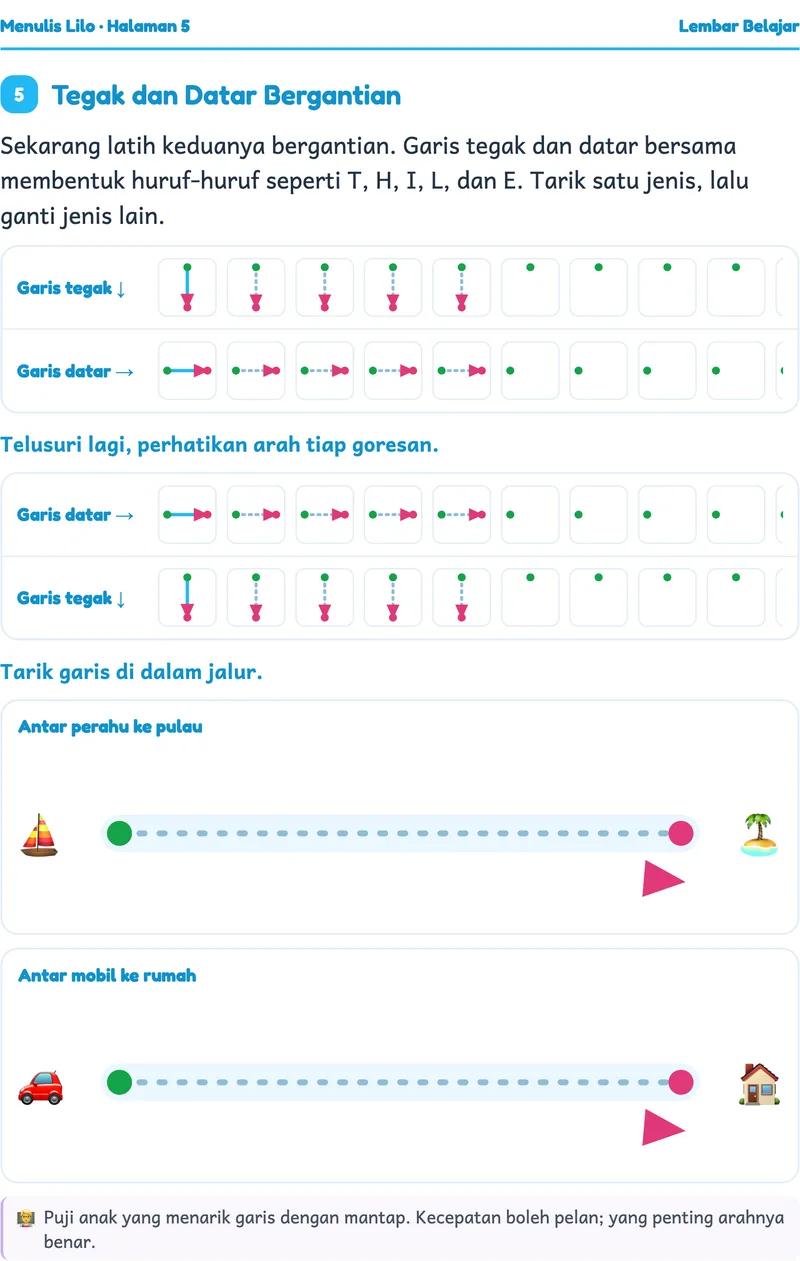
Little hands need strength before they can write letters. This Introduction Level sheet from the writing module invites children to draw vertical and horizontal strokes in turn until their hand movements feel steady and controlled.
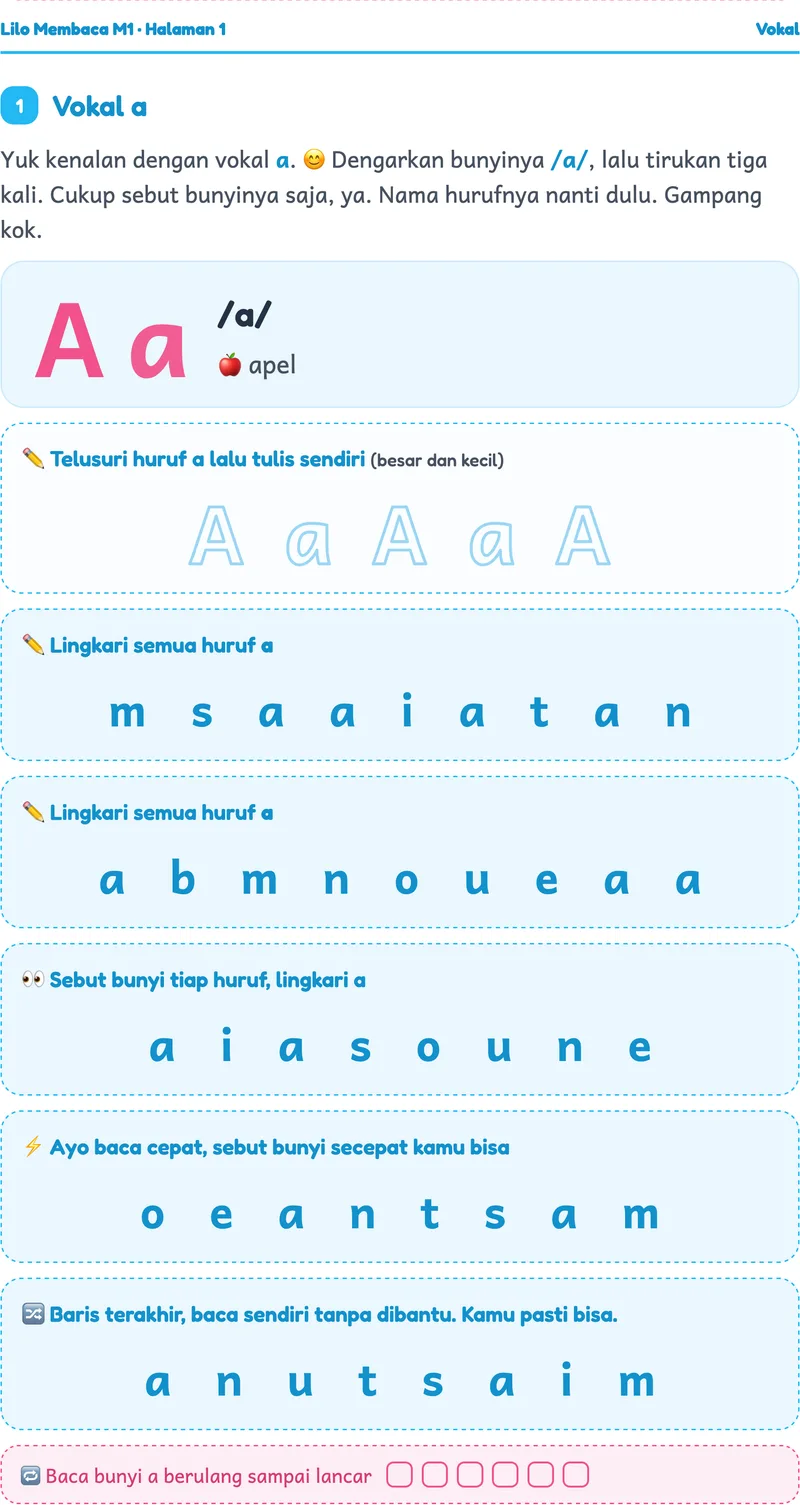
Through cards and point-and-read practice, Introduction Level children get to know the vowel sound a on this reading-module sheet. One small sound that starts the whole journey toward loving to read.
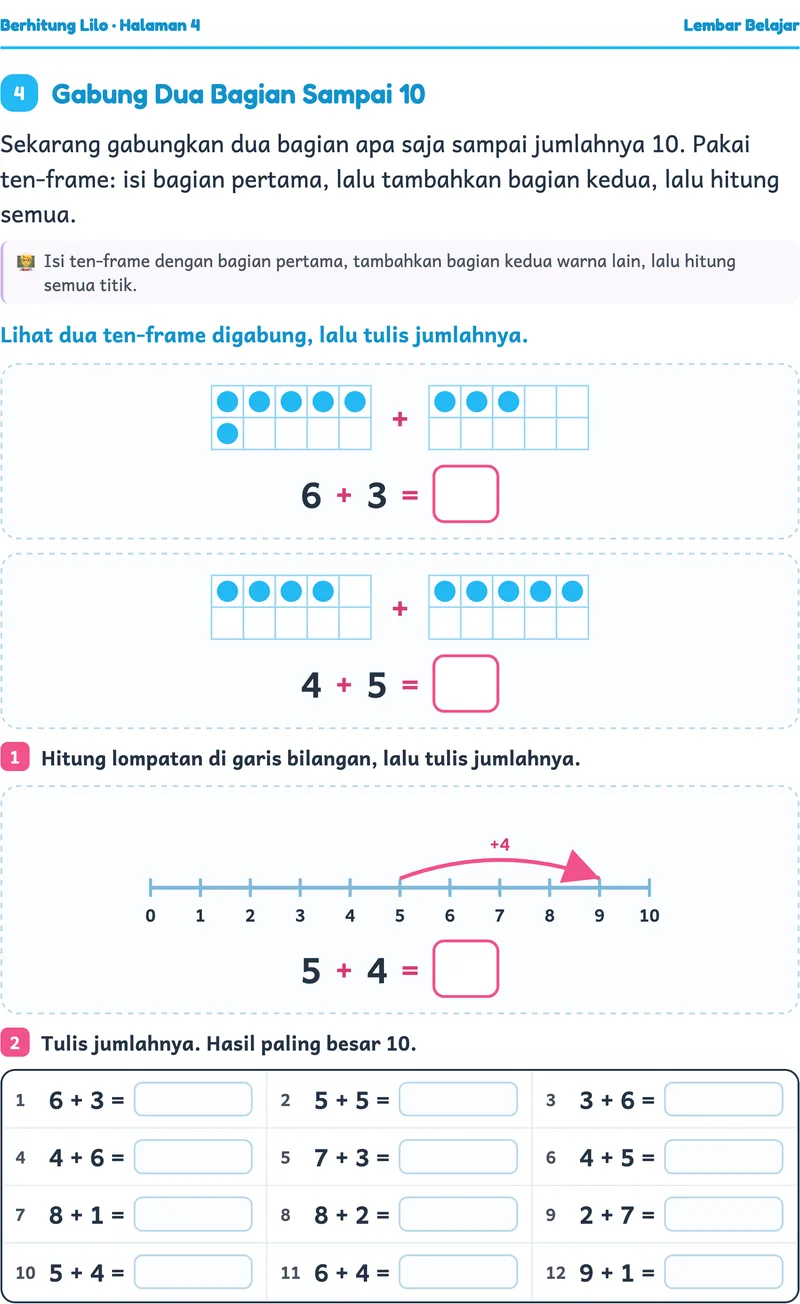
Look first, then count. That is how children learn addition on this counting-module sheet at Intermediate Level. The ten-frame and the number line help them see addition in a concrete, sensible way.
Each sheet you see here comes from Lilo's progressive curriculum, one connected journey built from 122 modules.

Start with a free consultation, then let the first lesson show the level that fits today. Your child begins there and climbs only when each skill is genuinely mastered.
Each child starts at their own level