


Little explorers aged 3 to 4
Your child meets letters and numbers through play. Small hands trace lines and patterns, building the finger strength that neat writing will need later, with zero pressure and plenty of smiles.
One lesson weaves reading, writing and counting together for children aged 3 to 8. Your child climbs four clear levels and brings home pages of neat handwriting worth showing the whole family.
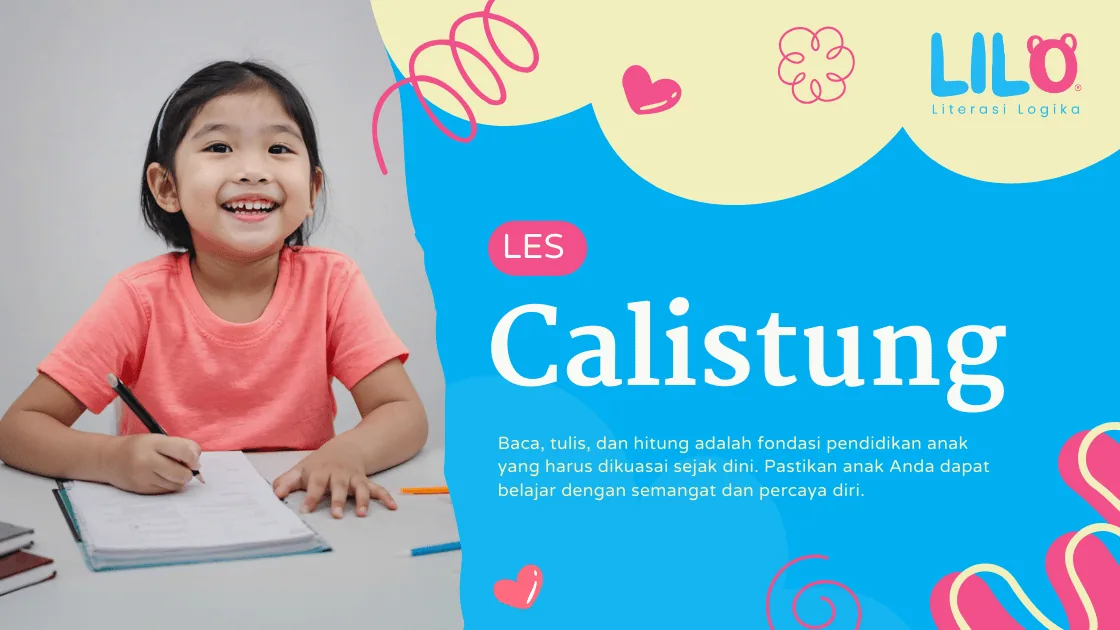
Reading, writing and counting in Solo is one integrated lesson from Lilo Literasi Logika for children aged 3 to 8, taught in English as the language of instruction. The three skills are learned together as a single journey. Your child starts with real objects, reads through letter sounds, and practices handwriting stroke by stroke until every page becomes something to show off.
Every child joins at the level that fits, so lessons feel encouraging from the very first meeting instead of overwhelming.
Your child meets letters and numbers through play. Small hands trace lines and patterns, building the finger strength that neat writing will need later, with zero pressure and plenty of smiles.
Your child is getting ready for primary school. Lessons blend syllables into words, count real things up to twenty, and shape letters carefully, so school feels familiar before day one.
Your child already attends school and now strengthens all three skills together. Reading grows into comprehension, counting grows into word problems, and handwriting becomes tidy work your child signs with pride.
If your child has fallen behind, the placement assessment finds the exact right starting point. Learning restarts at a level that feels doable, and confidence returns one mastered page at a time.
Understanding comes first in every session. Your child touches, sees, and only then writes, so each new letter and number carries real meaning.
Your child begins with real objects like beads or blocks, then moves to pictures, and finally to letters and numbers on paper. This is the Singapore Math way, and it makes symbols make sense.
Instead of chanting letter names, your child learns the sound each letter makes and blends those sounds into words. Reading becomes a skill your child can use on any new word.
Word problems are sketched as simple bars, the Singapore bar model, so your child sees what the question is really asking. Reasoning grows alongside counting.
Sessions end with short, friendly practice built level by level. Your child moves up a level only after truly mastering the current one, so progress is solid and proudly earned.
Your child moves to the next stage once the current one is truly mastered.
Readiness shows in four small skills you can spot at home, and the tutor starts from whichever ones are already there.
Solo and its surroundings have 140+ calistung tutors.
Some still studying, others graduated.
Application screening
Our team reads every application.
Documents verified
The team checks identity and education.
Teaching profile completed
We know when each tutor is free.
Trained before teaching
Teaching starts after training.
Matched to your child
Candidates answer questions about the child.
Not the right fit? Free tutor replacement, here is how
Young children show what they truly know while playing, so the first session in Solo has no written test.
Facing a page of questions, many young children go quiet or guess, and the result ends up measuring nerves.
Guessing objects from their first sound shows whether your child knows letters, blends syllables or reads whole words.
While your child draws freely, the tutor watches the grip, the leading hand and how steady each line is.
A child who recites numbers to twenty may still be unsure that seven buttons outnumber five, and blocks bring it to light.
Most of what you need is already at home, so the first session in Solo can flow from the first minute.
Start with a free WhatsApp consultation, share your child's age and writing hand, and view the tutor's profile before day one.
Use a table at elbow height and place the lamp opposite the writing hand so no shadow falls across the line.
Fill a container with buttons, bottle caps or blocks, because counting in every session starts with real objects.
The link and worksheets arrive before class through app.lilo.id. Print the sheets and let the camera show the hand and paper.
From recognizing single letters to understanding whole stories, your child builds reading step by step, sounding out words and growing into a reader who enjoys the page.
Writing starts with lines and patterns, grows into tidy print letters, and ends with full sentences. Every stage produces pages your child is genuinely proud to show you.
Numbers begin as things your child can hold and count. Addition, subtraction, and word problems then arrive with real understanding instead of empty memorized answers.
Alongside the three skills, your child practices sitting with a task, finishing it independently, and trusting their own work. These habits carry into every classroom.
This picture follows a five-year-old in Solo with a home tutor on the Intensive package, 12 sessions a month, so each stage returns before it fades.
Letter sounds attach to objects around the house, alongside lines and circles.
Sounds blend into ba, bu and bo, then into words like buku and bola.
Your child reads word cards unprompted and learns that seven splits into three and four.
Straight-lined capitals and numbers that follow the arrows settle into a neatly signed name.
Your child reads short sentences, answers questions about them and writes one alone.
Every child moves at their own pace, and the tutor adjusts this order session by session.
A left-handed child can write as neatly as anyone once paper position, pencil grip and stroke direction are set up early.
Latin script runs left to right, which suits the right hand because fresh words stay in view. A left hand pushes the pencil rightward, and the palm covers what was just written. Many left-handers then bend the wrist into a hook, which tires the hand quickly and smudges the graphite.
The first fix is the paper. It sits slightly left of the body's midline and tilts clockwise, so the left end of each line sits higher than the right. The forearm runs parallel to the paper's edge, the hand stays below the line, and every letter stays visible.
The second fix is the grip. Holding the pencil a little further from the point keeps the tip in view, with the wrist straight below the line. Some left-handers draw the crossbar of a capital T from right to left, which is fine when the shape is right. The weekly report usually tracks this grip until it becomes habit.
Your kitchen and toy box already hold materials children love for short practice.
| Activity | Time | What you need |
|---|---|---|
A picture recipe to readWrite a drink recipe in short words with pictures, such as sugar, water and ice, for your child to read and fetch. | 10 minutes | paper, marker, drink ingredients |
Spoon counting with riceThree spoons of rice go in one bowl and two in another, then everything is poured together and counted again. | 5 minutes | spoons, two bowls, rice |
The half-hidden tower of tenCover part of a ten-block tower with a cloth and let your child work out how many blocks are hidden. | 10 minutes | stacking blocks or plastic cups |
Word-part blocksTape sun, set, cup and cake onto blocks, then join two into sunset or cupcake, read it aloud and write it down. | 15 minutes | blocks, masking tape, marker |
Lilo teaches from 122 leveled modules we wrote ourselves, so every lesson in Solo follows a tested, carefully ordered path.
Every new idea begins as something your child can touch and move. Once the idea lives in their hands, pictures and symbols follow naturally and stick for good.
Your child learns what each letter sounds like and blends sounds into words. This unlocks new words independently, so reading keeps growing between sessions without you drilling spellings.
Story problems get drawn as simple bars so your child can see the answer taking shape. It turns counting practice into genuine thinking practice.
Short daily portions, built level by level, warm and encouraging, build mastery without tears. Your child levels up only when a skill is truly owned.
These stages come directly from the modules your child will actually work through, page by page.
Most struggles with early reading, writing and counting come from a handful of well-meaning mistakes. Here is how Lilo steers around them.
Why it happensFacts memorized without meaning fade quickly, and the sour experience can make a child dread lessons long after the facts are forgotten.
How Lilo helpsLilo builds every concept from real objects first, so what your child learns is understood, remembered, and enjoyed.
Why it happensSmall hands need strength and control before they can shape letters. Pushing too early produces frustration and messy pages that discourage the child.
How Lilo helpsWe begin with lines, patterns, and playful tracing, so by the time real letters arrive, your child's hand is ready and the results feel like a win.
Why it happensA child who chants numbers without handling real quantities is reciting, and the recital collapses the moment a problem looks unfamiliar.
How Lilo helpsCounting starts with objects your child can hold and move. Symbols come after the quantity is understood, so arithmetic rests on solid ground.
Why it happensSkills rushed under deadline pressure stay shallow, and the child enters school anxious instead of ready.
How Lilo helpsSteady practice in small portions over time builds skills that hold. Starting earlier and going gently beats a last-minute sprint every time.
Why it happensWhen reading, writing and counting never meet, progress turns lopsided. A child may read well yet freeze at a written word problem.
How Lilo helpsLilo weaves the three together in every session, so each skill reinforces the others and progress stays balanced.
duration of 60, 90, or 120 minutes
Contact us
60, 90, or 120 minutes
Contact us
60/90/120 minutes
Contact us
Here is an honest look at how guided Lilo lessons compare with learning at home alone or with an app.
| Aspek | Lilo | Learning at Home Alone | Learning Apps |
|---|---|---|---|
| Who guides the child | A verified tutor who adjusts every session live | A parent, when time and energy allow | The app's fixed script, the same for every child |
| How concepts are introduced | Real objects first, then pictures, then symbols | Depends on the materials the family finds | Mostly on-screen pictures and taps |
| Handwriting | Practiced on paper every session, stroke by stroke | Possible with patience and the right worksheets | Rarely covered, since screens replace pencils |
| Matching the child's level | Placement assessment, then level up only after mastery | Hard to judge without a measuring stick | Adaptive in parts, but progress can be skipped through |
| Keeping the child motivated | A warm tutor who celebrates every mastered page | Works well when routines hold steady | Fun at first, though attention can drift to games |
"How often each week should my child study?" comes up more than any other question at sign-up. The answer depends on the monthly package you choose, and the Regular package, the most popular, costs IDR 604,782. Payment goes per package, and in every session your child practises reading, writing and sums with one tutor.
About once a week, easing your child into a learning rhythm with the tutor.
IDR 307,460Roughly twice a week, the rhythm most often chosen at sign-up.
IDR 604,782About three times a week, so practice comes nearly every other day.
IDR 891,965Around six times a week, making calistung practice part of each day.
IDR 1,692,684From the very first session.
No extra fee, whenever you ask.
The steps:
Plus a monthly progress report.
For in-person lessons, a verified tutor travels to your home anywhere in Solo, from Laweyan and Banjarsari to Jebres and Pasar Kliwon, so learning happens where your child is most comfortable.
Reading, writing and counting are taught together, so a story your child reads becomes a sentence to write and a problem to count. Nothing is learned in isolation.
Lessons follow 122 leveled modules written by Lilo, so your child climbs a path that was designed as a whole, with every page building on the last.
We treat neat handwriting as a real achievement. From first traced lines to full written sentences, your child finishes each stage with work worth putting on the fridge.
Lessons run in English for bilingual and national-plus families, and bilingual tutors can bridge into Indonesian whenever your child needs it.
A placement assessment starts the journey, and your child moves up only after mastering each level. You always know exactly where your child stands and what comes next.
Solo, whose official name is Surakarta, sits in Central Java Province and is known as the home of two royal courts: the Kasunanan Palace and the Mangkunegaran Palace. People admire the city for its gentle manners, for batik that is loved around the world, and for good courtesy handed from parents to children over many generations. Solo takes pride in patience, in respect for a slow process, and in work done with care. Children learn well in that same spirit, a little at a time. Lilo teaches young learners across Solo, from Laweyan to Pasar Kliwon, through home visits by a tutor and live online classes. Each child gets kind, clear guidance at every step.
Your child studies in the place they know best, right at home. The tutor comes at a time you pick, carries lesson materials that follow a clear plan, and leads your child through each step anywhere in Lilo's Solo service areas.
Lessons build in levels, starting from the first basics. Your child goes on to the next level once each one makes real sense to them. Each small success gets praise, so self belief rises as skills grow.
Sessions are short, focused, and full of encouragement. Your child practices with engaging worksheets, and you receive regular progress reports so improvement stays clear and easy to follow.
Two questions often get skipped at sign-up: can a small child learn through a screen, and what happens after a mistake?
| Question to ask | Why it matters |
|---|---|
How does an online class keep small hands busy? | Young children learn by touching and writing on paper, so worksheets should arrive ahead. Lilo keeps one tutor per child online too. |
How long must a child watch a screen without a break? | Screens drain young attention quickly. Every Lilo session switches between short activities, a movement break included. |
How does the teacher respond to a mistake? | The first reaction decides whether a child dares to try again. Lilo tutors point to what is right before anything else. |
Are repeated mistakes read as a sign of the stage? | Swapped b and d point to a stage needing support, and Lilo's coded curriculum shows exactly where to step back. |
What if my child and the teacher are a poor fit? | The bond decides whether a child tries. At Lilo a new tutor comes at no cost, as a firm service promise. |
Elzio used to struggle to focus while studying. Now he can sit calmly and finish his worksheets on his own. His numbers and letters look much neater too.
Within a few weeks, my child started recognizing letters and numbers. The tutor always gives progress reports that are very helpful.
The sheets below come straight from Lilo's original materials. Reading, writing, and counting move forward side by side at every level, helping children develop evenly in all three.
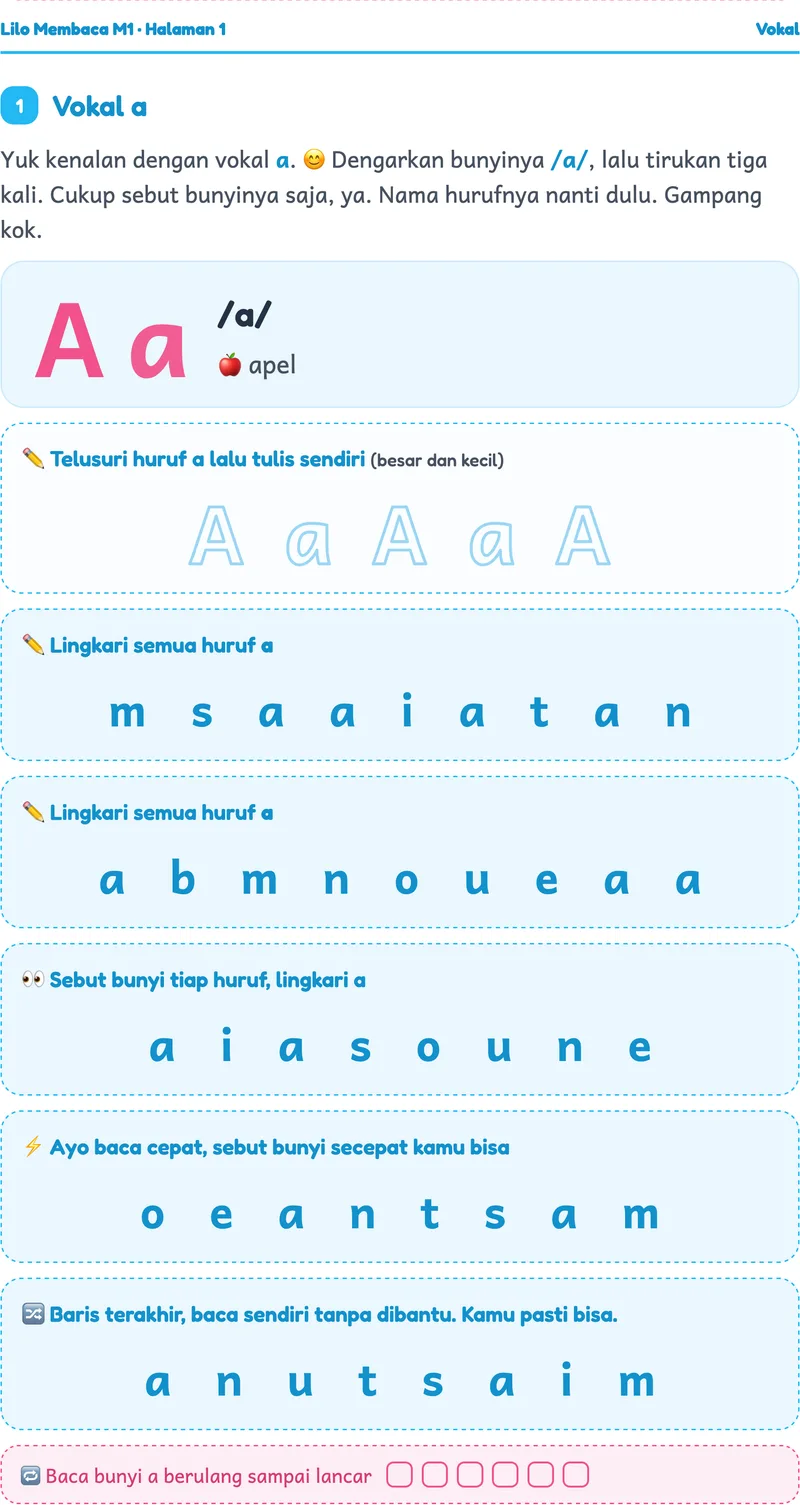
A real reading-module page: your child sounds out the vowel a with cards and point-and-read practice, the first door into reading.
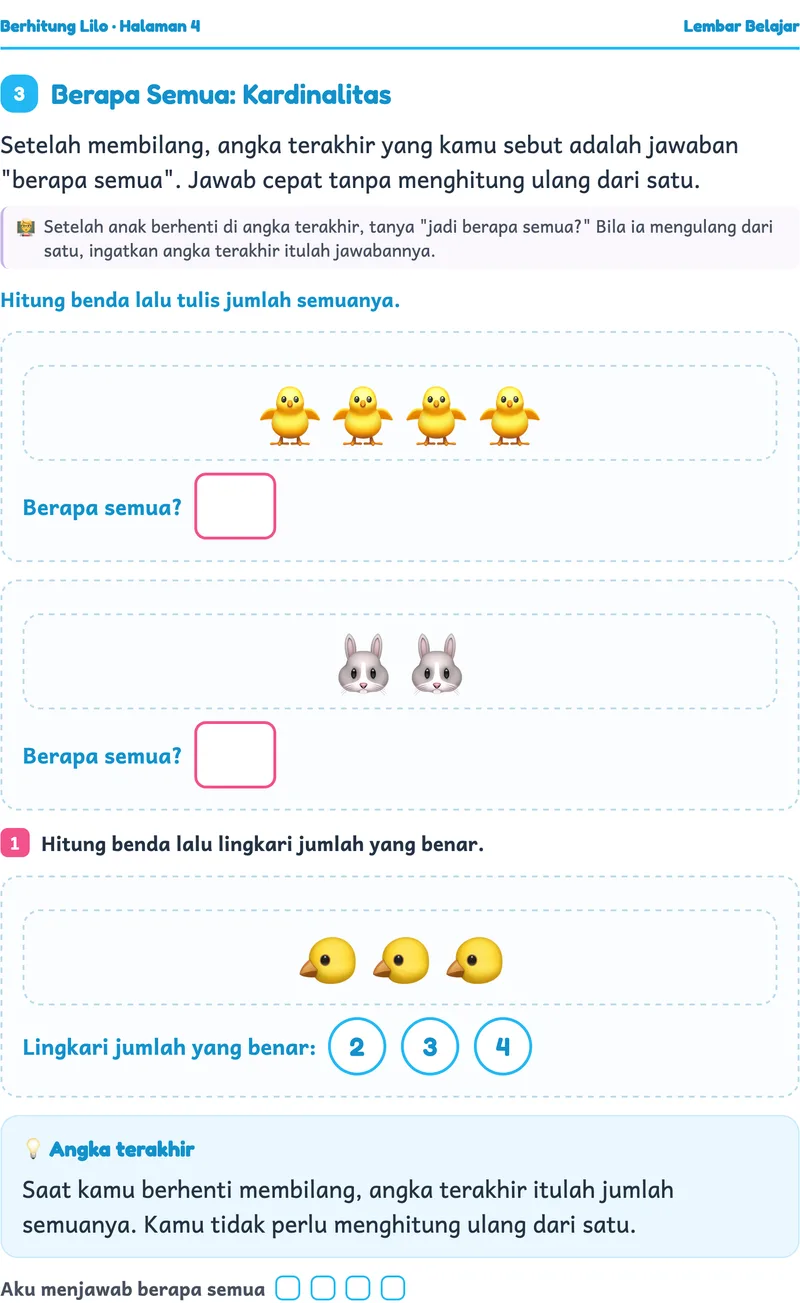
On this sheet, Introduction Level children learn to count with real objects. Each object is counted one by one, and the child then says how many there are in all. Everything starts from the concrete.
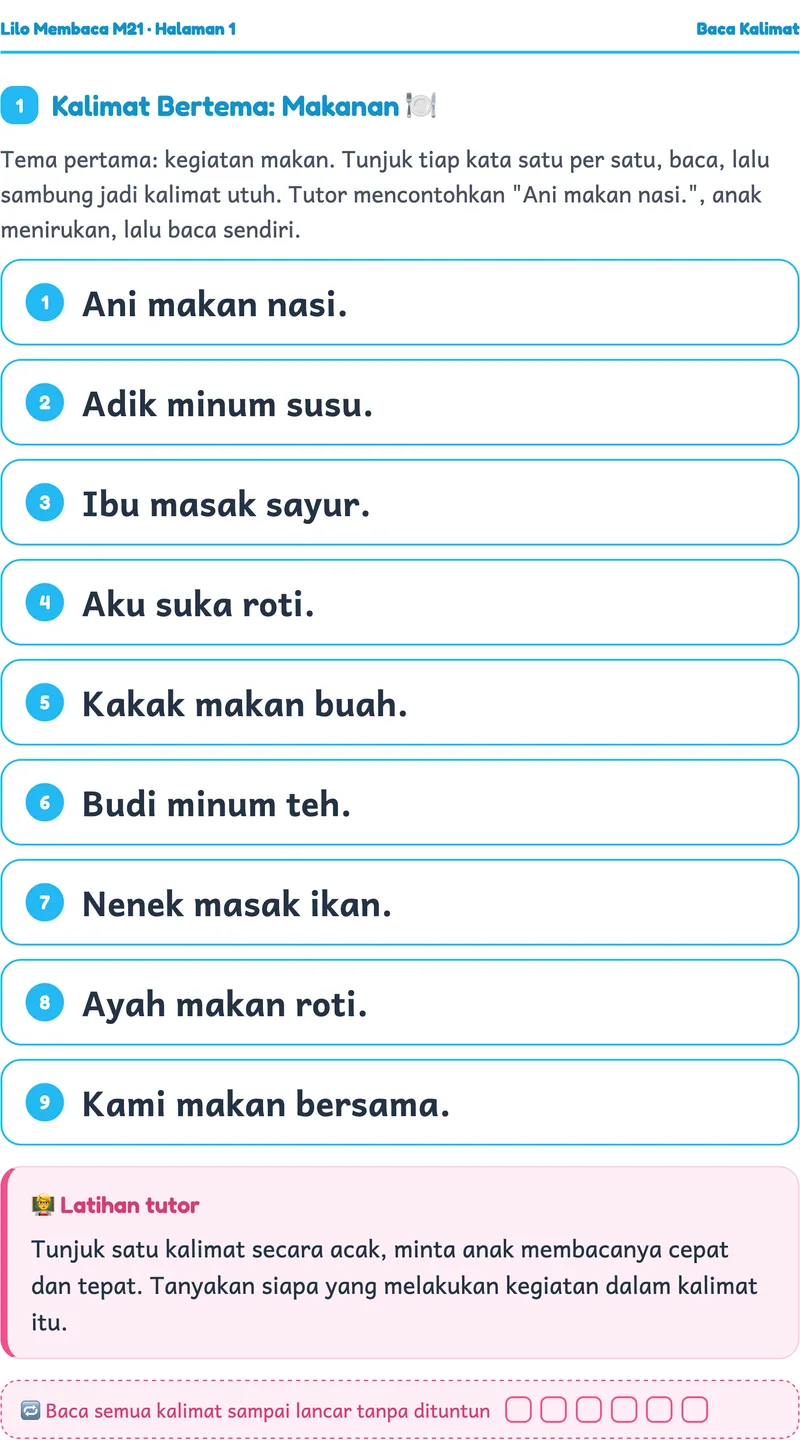
Here is where sound practice and syllable practice meet their result. On this Intermediate Level sheet from the reading module, children read short food-themed sentences in full, from the first word to the final period.
Every sheet above is part of Lilo's own progressive curriculum, a complete set of 122 modules.

Start with a free consultation on WhatsApp. Tell us about your child, and we will recommend the right level and service for your family in Solo.
Free consultation for children across Solo