



Little explorers aged 3 to 4
Your child is meeting letters and numbers for the very first time. Everything happens through play and real objects, with zero pressure, so curiosity stays bright and learning feels like a game.
Every child begins with a friendly placement check, so lessons start exactly where your child is today. From there, reading, writing and counting grow together, one small mastered step at a time.
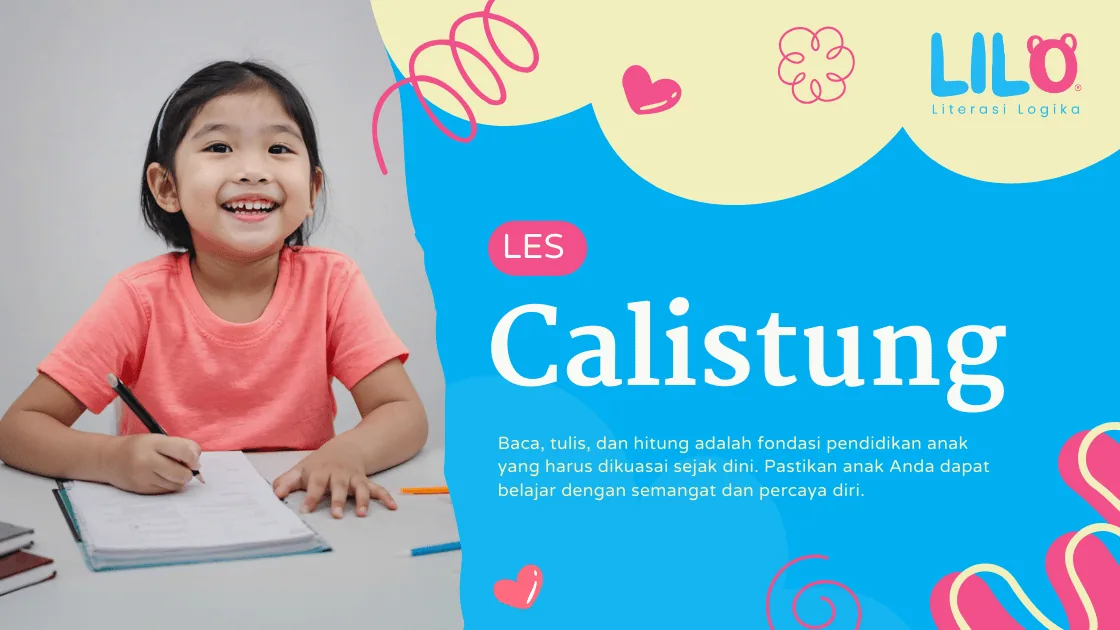
Reading, writing and counting in Sorong is a guided Lilo program for children aged 3 to 8 that teaches the three skills together as one journey. Your child takes a friendly placement check first, begins at the level that truly fits, and moves up only after each step is mastered with confidence.
The placement check meets your child wherever they are. These are the stages we welcome most often, from first letters to full sentences.
Your child is meeting letters and numbers for the very first time. Everything happens through play and real objects, with zero pressure, so curiosity stays bright and learning feels like a game.
Your child is getting ready for primary school. Lessons build blending syllables, counting with understanding, and steady handwriting, so the first day of school feels calm and familiar.
Your child can already read a little and now needs strength. We deepen comprehension, sharpen writing, and grow counting skills so all three abilities support schoolwork every day.
Your child feels behind at school and confidence has dipped. The placement check finds the exact gap, and lessons rebuild from that point, so progress is real and self-belief returns.
Your child moves to the next stage once the current one is truly mastered.
Our method follows how young children naturally understand the world: touch first, see next, then symbols. A placement check opens the journey.
Before any lesson, the tutor sits with your child and gently maps what they already know in reading, writing and counting. This decides the exact level where lessons begin.
Your child holds real things first, then works with pictures, and only then meets letters and numbers. This is the Singapore Math way, and it makes ideas truly stick.
Your child learns the sounds letters make and blends them into words. There are no letter-name spelling drills, so reading grows naturally from sound to word to sentence.
Word problems are drawn as simple bars, so your child can see the story inside the numbers. Steady practice in small portions, built level by level, keeps every skill warm.
From recognizing letters to understanding whole passages, your child climbs one sound and one sentence at a time until reading feels natural and enjoyable.
Hands are trained gently, starting with lines and patterns, moving to print letters, then words, then full sentences written with pride.
Your child meets numbers through real objects, then learns addition, subtraction, and word problems that train careful thinking, never empty recital.
Woven through every session, your child practices sitting with a task, finishing it independently, and feeling proud of honest effort.
These signatures come straight from our own curriculum of 122 leveled modules, and they shape how every tutor teaches, in Sorong and everywhere else.
Every new idea begins in your child's hands. Counting starts with things they can touch and move, then pictures, then number symbols, so understanding is built and never faked.
Your child learns what each letter says, then blends those sounds into words. This gives them a key that opens any new word, even ones they have never seen.
Story problems become simple drawings of bars, so your child sees the relationship before touching the numbers. This trains calm, clear reasoning from an early age.
Short, steady portions of practice, built level by level, always warm, keep skills fresh without tears. Your child levels up only after true mastery.
The placement check tells us exactly which rung your child stands on today.
Most early-learning struggles come from well-meant shortcuts. Knowing these patterns helps you protect your child's love of learning from the start.
Why it happensA child can chant letters and numbers without knowing what they mean. The knowledge fades fast, and learning starts to feel sour.
How Lilo helpsWe build every concept from real objects first, so your child understands before they memorize, and the knowledge stays.
Why it happensLittle hand muscles need time to grow strong. Pushing letters before the hand is ready creates frustration and messy habits.
How Lilo helpsOur Introduction Level trains hands with lines and patterns first, so writing letters later feels natural and satisfying.
Why it happensWithout real objects to touch and count, numbers become empty recital. The child says the words but cannot use them.
How Lilo helpsCounting always begins with things your child can hold and move, then pictures, then symbols, in that order.
Why it happensSqueezing years of foundation into a few rushed months pressures the child and produces shaky, fragile skills.
How Lilo helpsStart earlier with small, friendly portions. The placement check finds the right entry point at any age from 3 to 8.
Why it happensWhen reading, writing and counting live in separate boxes, progress turns lopsided and one weak skill drags the others down.
How Lilo helpsLilo weaves the three skills into one journey, so each new ability reinforces the other two.
This picture follows a four year old who knows no letters or numbers yet. They start on the Starter package, about once a week, and move to Regular once a learning rhythm settles in.
Your child learns the opening sound of their own name, and the weekly lesson becomes something to look forward to.
Little hands practise upright lines, flat lines and circles, while new letter sounds keep arriving through games.
Now learning twice a week, your child counts to ten while pointing at each object with a finger.
The sounds m and a fuse into ma, and more short syllables follow with cards and your child's own voice.
Your child reads two syllable words such as mata and sapu unaided, and that pride powers the next stage.
Each move up follows what your child has mastered, and this calendar maps the journey for a four year old starting from zero.
Tracing teaches the hand a letter's path. Free writing asks the mind to hold that path alone, and the timing of the switch decides whether letters stay.
When your child traces dots, the eyes do the guiding, so the result often looks neat. That neatness has yet to prove the movement is stored. The letter b starts with a downward stroke and then curves right, and a child following dots can easily begin with the curve. So the tutor watches the starting point and the direction of each stroke. Numbers get the same care, since 5 follows its arrows too.
The switch happens in steps. Thick dotted lines give way to thin ones, then only a start dot and a small arrow remain, then a model letter sits beside an empty box. Finally the tutor says the sound and your child writes from memory. Straight capitals such as L, T and E are released first because their strokes are short, so your child may write T freely while still tracing the curved S.
You can see readiness at home. Your child starts each letter at the right point without glancing at a model, strokes flow one way, and letter sizes even out. Tidy tracing alongside reversed free letters means movement memory is just forming, so a few more in between steps help. Boredom with tracing often signals a child ready to let go. The weekly report tracks this letter by letter, such as d written freely while b still needs an arrow.
Road time and easy chats can turn into practice. All you need is your voice and whatever you can see around you.
| Activity | Time | What you need |
|---|---|---|
Guess the Object from Its First SoundSay the first sound of something outside, such as p, and let your child guess: pohon, pagar or pasar. Then swap roles. Listening for sounds like this builds stage H. | 5 minutes | Things seen through the car window |
Counting Red MotorbikesYour child counts passing red motorbikes up to ten, raising one finger for each. The raised fingers keep every spoken number tied to one object, a stage B basic. | 10 minutes | A busy road and ten fingers |
Making Ten at the Traffic LightWhen the car stops, hold up three fingers and ask how many more make ten. Seen again and again, these pairs settle in as groundwork for stage B. | 5 minutes | Fingers and one spoken question |
Syllable ChainSay sapi, and your child finds a word starting with its last syllable: pisang. Keep going until someone is stuck. The ear learns to cut words into syllables, ready for stage S on paper. | 10 minutes | Voices and memory only |
Stop while your child is still laughing, so tomorrow they are the one asking to play.
Readiness rarely looks like reading. It shows up in small habits around the house and in the way your child plays, alone or with others.
From Sorong, your child connects to 5,000+ selected tutors.
Graduates and current students alike.
Application screening
Suitable applicants move forward.
ID card and diploma verified
Identity and diploma are matched.
Tutor profile filled in
Teaching experience and hours are recorded.
Learning the Lilo method first
Lilo guides and materials are provided.
Matched to your child
Questions come from the child’s needs.
Want a different tutor? Read the tutor replacement guarantee
To your child, the first session is simply play. With no written test, the tutor reads the starting point from how your child touches, names and draws things.
While your child guesses objects by their first sound, the tutor notes which sounds are known and which are still new.
Drawing a road for a toy car shows the tutor the grip, the direction of each line, and the moment the hand starts to tire.
As your child counts buttons, the tutor checks that each spoken number lands on one button, with no words racing ahead of the finger.
The tutor notices when fidgeting begins and how your child reacts to a hard task, which sets the length of each activity next time.
Together, these observations place your child on the first rung of the curriculum ladder.
duration of 60, 90, or 120 minutes
Contact us
60, 90, or 120 minutes
Contact us
60/90/120 minutes
Contact us
In Sorong, lessons begin online. The class link and worksheets arrive through app.lilo.id beforehand, so your child just sits down and says hello.
The tutor greets your child by name and opens with a quick game, so even a quiet child relaxes within the first minutes.
Spoons or bottle caps within reach become tools for counting and shaping letters, so understanding starts in the hands.
Your child hops or copies an animal for a moment, which refreshes attention before the return to the table.
The sheet printed at home matches the module your child is on, so paper practice locks in the game they just played.
The tutor sums up the day's progress together with your child and sets one small home task, ten minutes or so.
Sorong, a harbour city in Papua Barat Daya, is often called the western door to Papua. Many trips into the wider Papuan land set off from here, so people all over Indonesia have known the city's name for a long time. Its neighbourhoods run through Remu, Klademak, Tanjung Kasuari, Kampung Baru, Malanu, Sorong Manoi, Klaurung, and Maladum Mes. Standing at the entrance to eastern Indonesia, Sorong is still growing, and learning for young children grows with it. Here Lilo teaches your child in 1-on-1 online lessons, led by a teacher from its nationwide network. Home lessons can follow later, after the Lilo team confirms a teacher who lives close to your address.
First your child handles real things they can hold. Next come pictures, and after that numbers and letters. Learning in this order lets real understanding take root, so the skills last for years.
Every session has a clear goal and carefully graded exercises. Your child moves up a level once they are truly ready, so confidence grows together with real skill.
The teacher works with your child personally, learns how they think, and adjusts the pace to match. This full attention makes progress visible from week to week in Sorong.
A placement check inside the first lesson means your child never sits through material that is too easy or drowns in material that is too hard.
Lilo teaches from an original curriculum of 122 leveled modules built in-house, so every session follows a clear, tested ladder from first letters to fluent reading.
Reading, writing and counting are woven together and reinforce each other, so progress in one skill lifts the other two along with it.
Children across Sorong, from Remu and Klademak to Malanu and Kampung Baru, meet a verified tutor from Lilo's national network in live online lessons. Home lessons can follow once the Lilo team confirms a tutor living nearby.
Lessons can run in English or Indonesian, a natural fit for bilingual and national-plus families who want strong foundations in both languages.
Your child's calistung tutor is matched from Lilo's national network by age, learning needs and schedule. Payment covers one monthly package at a time, and the Regular package holds 8 sessions for IDR 604,782. Classes in Sorong begin online, and home lessons open once a nearby tutor is confirmed.
By the end, counting ten objects while pointing to each one in turn.
IDR 307,460Writing their own name with a steady, comfortable pencil grip.
IDR 604,782Adding two small numbers with pictures and writing down the answer.
IDR 891,965Reading a short story problem, drawing a Bar Model and finding the answer.
IDR 1,692,684Included in every lesson package.
We find a replacement for free. Valid for as long as the package runs.
The steps:
A full report follows each month.
You can put these questions to any tutoring provider. The answers show how lesson time is spent and who sits beside your child.
| Question to ask | Why it matters |
|---|---|
How much of each session goes to play, movement and desk work? | Young children absorb most when activities change in short pieces, and long sitting drains their attention. A Lilo session moves from real objects to a movement break, then on to a worksheet. |
Where do my child's worksheets come from? | Random sheets make a child jump around without direction, so ask to see the order of stages. Lilo worksheets come from your child's current module, one of Lilo's own 122 coded modules. |
Can I see the tutor's profile before the first lesson? | Knowing a tutor's background brings peace of mind, especially before home lessons. Lilo tutor profiles are open to you before the first session, and many tutors studied primary teaching, early childhood education, psychology or mathematics. |
How are home lessons arranged so my child feels safe and comfortable? | Ask who will come, when the schedule is confirmed, and where in the house your child will learn. In Sorong, Lilo starts online, and home lessons follow once a nearby tutor is confirmed. |
What happens if my child and the tutor do not click? | A good match decides whether your child wants to come back, so a provider should have a clear answer. With Lilo you simply ask for another tutor when the fit is wrong, and the switch is free. |
I never expected Katrisha to actually enjoy learning to count. At home she often plays number guessing games with her little brother. Her handwriting is starting to stay on the lines too.
Razka wrote his own name for the first time on his grandma's birthday card. I even kept the card. His counting is getting more confident too, we are so grateful.
The sheets below come straight from Lilo's original materials. Reading, writing, and counting move forward side by side at every level, helping children develop evenly in all three.
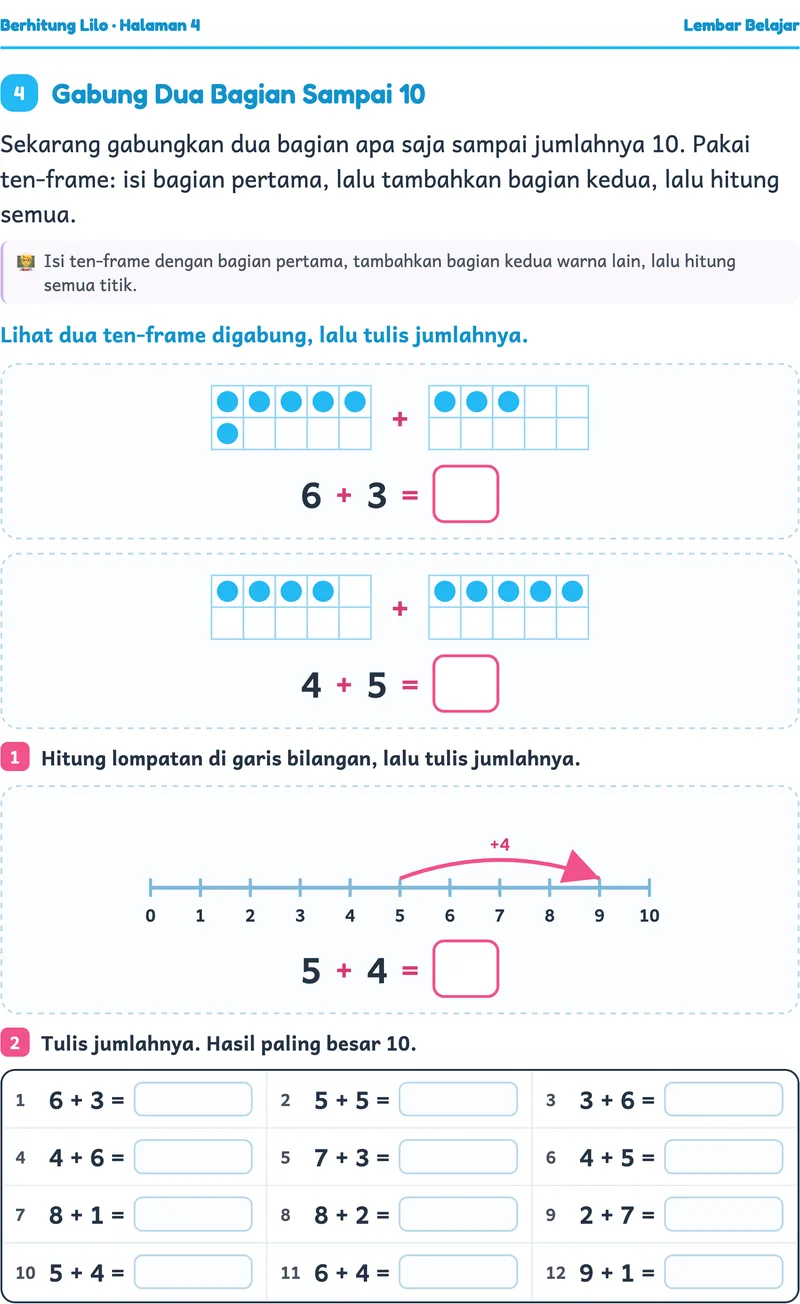
Look first, then count. That is how children learn addition on this counting-module sheet at Intermediate Level. The ten-frame and the number line help them see addition in a concrete, sensible way.
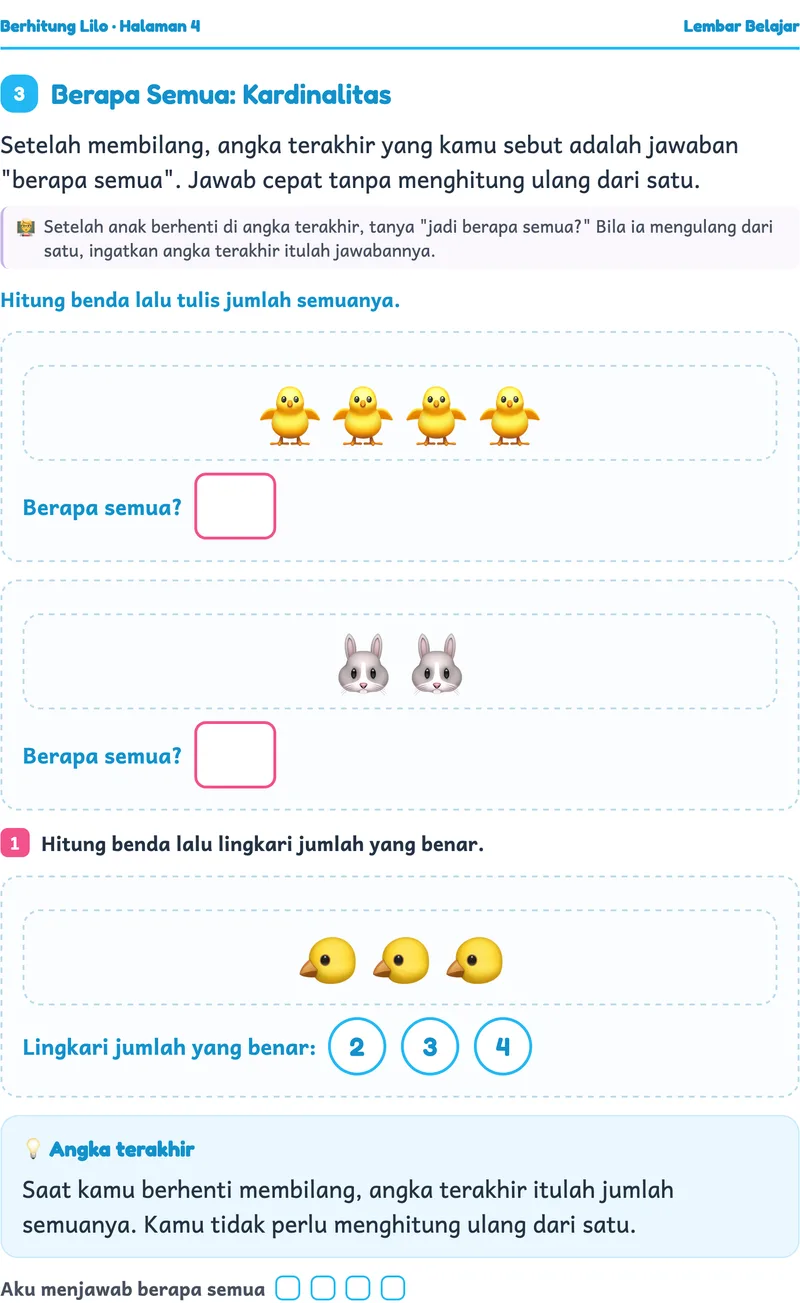
One, two, three. Children count real objects one at a time on this counting-module sheet at Introduction Level, then name the total. From this simple activity, a feel for quantity begins to grow.
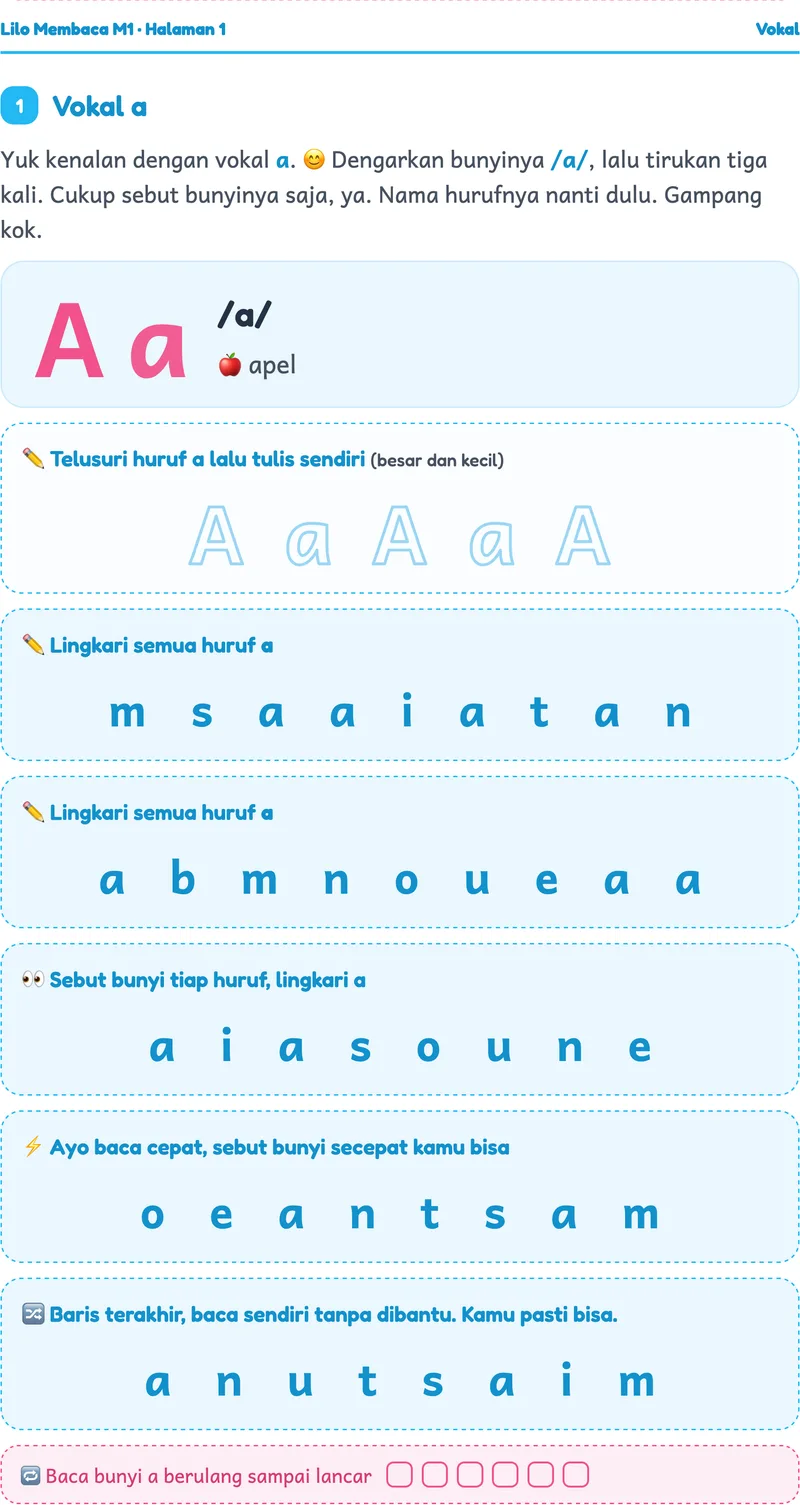
A real reading-module page: your child sounds out the vowel a with cards and point-and-read practice, the first door into reading.
These sheets are a small glimpse of Lilo's own progressive curriculum, carefully arranged across 122 modules.

Message us on WhatsApp for a free consultation. We will listen to your child's story, match a tutor, and plan a first lesson that shows exactly where the journey begins.
Ask on WhatsApp first, the consultation is free