

Ages 3 to 4, first meetings with letters and numbers
Your child is just starting to notice letters and numbers around them. Sessions feel like guided play, with zero pressure, so curiosity stays bright while the first foundations quietly form.
Every Lilo session gives your child a tutor's full attention. Reading, writing and counting grow together through real objects, pictures and calm, steady practice, one level at a time.
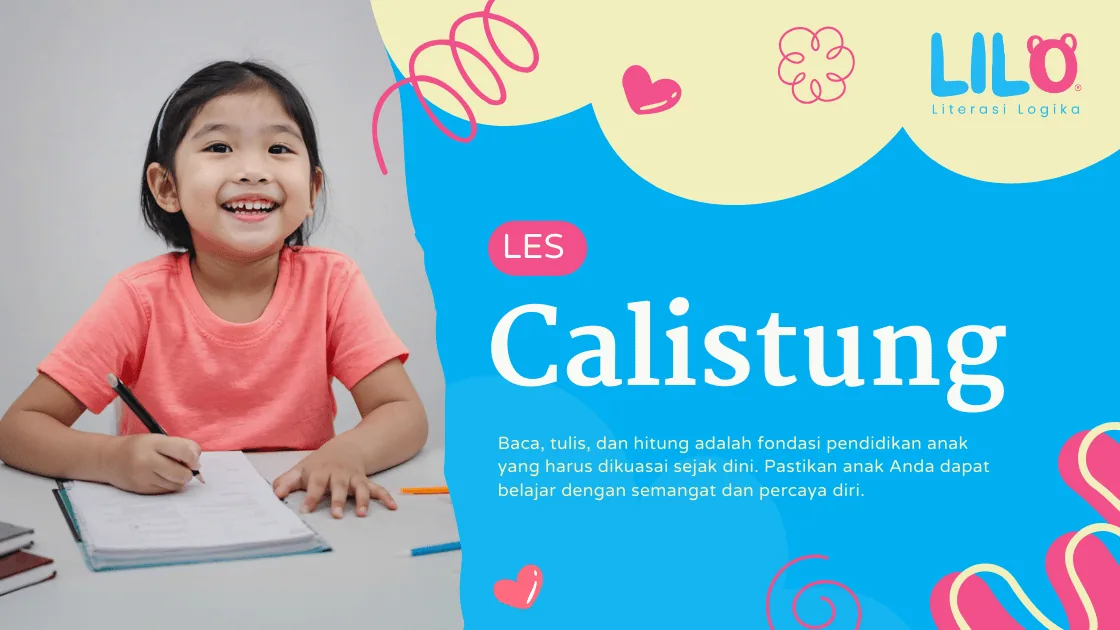
Reading, writing and counting in Surabaya is Lilo's private program for children aged 3 to 8, where one tutor guides one child through all three skills as a single journey. Lessons start with objects your child can hold, move to pictures, then to letters and numbers, so understanding comes first and confidence follows at every level.
Children arrive at letters and numbers on their own timelines. Your tutor meets your child exactly where they are today and builds gently from there.
Your child is just starting to notice letters and numbers around them. Sessions feel like guided play, with zero pressure, so curiosity stays bright while the first foundations quietly form.
Kindergarten years are the ideal window to build all three skills calmly. Your child learns to blend syllables, count with real things, and shape letters, arriving at primary school ready and confident.
Your child has started school and now needs the three skills to hold firm. A tutor spots the wobbly spots, fills them in, and turns homework time into something your child can handle alone.
If your child has fallen behind, the assessment finds the exact level where learning feels doable again. Working one on one, your child rebuilds skills and self-belief at the same time.
Because the tutor works with your child alone, every step can wait for real understanding. This is the path each session follows.
Before any lesson, your tutor checks what your child already knows about letters, sounds and numbers. Your child then begins at a level that feels comfortable instead of overwhelming.
Every new idea starts with objects your child can hold, moves to pictures, and only then becomes letters and numbers on paper. This is the Singapore Math way, and it makes ideas stick.
Your child learns to read through letter sounds instead of spelling drills, and solves word problems by drawing them as simple bars. Both habits train real thinking, session after session.
Each session ends with short, friendly practice built level by level. Your child moves up a level only after truly mastering the current one, so progress never stands on shaky ground.
The sequence is tight, so nothing gets skipped as your child moves up.
These four signatures come from Lilo's own curriculum of 122 leveled modules, and your tutor applies them personally to your child.
New ideas arrive as things your child can pick up and move around. Only after the hands understand do pictures appear, and only then the letters and numbers themselves.
Your child learns what each letter says, then blends those sounds into syllables and words. Reading becomes something your child figures out alone instead of a chant to recite.
Story problems turn into simple drawn bars, so your child can see the question before solving it. This trains reasoning that lasts far beyond a single worksheet.
Short, warm practice built level by level keeps skills fresh without tears. Small daily portions beat long weekend marathons, and your child ends each session wanting more.
Each rung is a real stage in Lilo's own modules, and your child climbs them one mastered step at a time.
Loving parents fall into these traps every day, usually while trying their best. Knowing them early saves your child months of frustration.
Why it happensFacts memorized without meaning fade within weeks, and the sour taste of chanting drills can make a child dread lessons altogether.
How Lilo helpsLet your child handle real objects and pictures first. When understanding arrives before the symbols, the knowledge stays and learning keeps its sweetness.
Why it happensSmall hand muscles develop on their own schedule. Pushing letter writing too early produces cramped grips, messy strokes and tears over the page.
How Lilo helpsStart with lines, curves and patterns that build strength playfully. Letters come easily once the hand can already steer the pencil.
Why it happensA child who chants one to ten without touching real things is reciting sounds. The numbers carry no meaning, so addition later becomes guesswork.
How Lilo helpsCount real objects together first, then pictures of them, and only then the written numbers. Meaning must arrive before the symbol.
Why it happensSqueezing three skills into a few rushed months piles pressure on a young child, and hurried foundations crack under the weight of first grade.
How Lilo helpsBegin gently a year or two ahead with short regular sessions. Steady small steps build both skill and confidence without the panic.
Why it happensReading, writing and counting feed each other. Taught apart, one skill races ahead while another lags, and the child's progress grows lopsided.
How Lilo helpsChoose a program that weaves the three together, where a reading lesson strengthens writing and a counting story builds comprehension.
From recognizing single letters to understanding whole passages, your child climbs step by step, sounding out syllables, reading sentences, and finally grasping what the words truly say.
Writing begins in the hand before it reaches the page. Your child practices lines and patterns first, then shapes print letters, writes words, and builds full sentences.
Your child gets to know numbers through real objects, then learns addition and subtraction with understanding, and finishes by solving word problems drawn as simple bars.
Alongside the three skills, every session quietly trains concentration, independence and confidence, the habits that carry your child through school long after the lessons end.
Two digit numbers are a big leap. Here your child begins to see that where a digit sits changes what it is worth.
A child who counts smoothly to twenty will often write twenty three as 203. They write exactly what they hear: twenty, then three. In their mind each digit still stands alone, and the idea that a 2 at the front means two groups of ten has yet to form. This idea is called place value. Indonesian number names help, since tiga puluh empat literally says three tens and four.
The tutor builds it with ice cream sticks and rubber bands. Your child counts ten sticks and ties them together. Two bundles and three loose sticks make twenty three, and your child feels that one bundle equals ten single sticks. Thirty five sticks become three bundles with five left over. Your child then moves to drawings of bundles, and only then to the symbol 35, so the number on paper carries meaning.
The hundred chart lays out 1 to 100 in ten rows of ten. One square right adds one, one row down adds ten, and each column ends in the same digit: 4, 14, 24, 34. The tutor hides a square under a bottle cap and your child guesses it from its neighbours. At home you will see it when your child counts from 38 to 41 without restarting at one, and knows thirty is more than thirteen.
Readiness shows up in small daily habits. These clues help you see when your child can begin, when a stage is done, and when big numbers start to make sense.
Children in Surabaya learn from 500+ selected early literacy and numeracy tutors.
Graduates and current students alike.
Application screening
Each file is read by our team.
Identity and degree checked
ID card, diploma and photo are checked.
Experience and hours recorded
Available hours are noted down.
Learning the Lilo method first
Teaching starts after training.
Matching per child
The team scores every answer.
Want a different tutor? Free tutor replacement, here is how
The Lilo team arranges each early step. Here is the path from your first message to the tutor's first hello.
The consultation is free. Share your child's age, what they already know, and your choice in Surabaya: a tutor at home or an online class.
The team picks from over 5,000 active tutors nationwide, many trained in primary teaching, early childhood, psychology or maths, to fit your child's stage.
You read the tutor's profile, choose a monthly package and set the schedule. Online classes get the link and worksheets beforehand through app.lilo.id.
The tutor brings letter games and counting objects. Your child sits no written test, and play shows the tutor where learning should begin.
After the first session, the tutor writes down what they saw while your child played. These notes become the opening map.
The notes open with a stage code, such as S for blending syllables, which points to the next module and the worksheets your child brings home.
The tutor lists what your child did unaided, like reading 'bola' or counting seven marbles. These are footholds that need only a quick revisit.
Hesitant moments go here, perhaps mixing up b and d or stalling after twelve. These are the first things the tutor works on.
Some children learn through movement, others through pictures. The tutor notes what lights your child up and shapes the next sessions around it.
From here on, your tutor's weekly report follows each step forward.
choose 60, 90, or 120 minutes
Contact us
60, 90, or 120 minutes per session
Contact us
duration of 60, 90, or 120 minutes
Contact us
This picture follows a six year old about to start primary school on the Intensive package, twelve sessions a month, about three a week. The child knows letters and is starting to blend syllables.
Your child blends open syllables like ma, mi and mu with confidence, then joins them into short words such as 'mata' and 'sapu'.
Your child reads words ending in a consonant, like 'ikan' and 'pintu', then three word sentences about things nearby.
The pencil grip settles. Your child writes their name, then words from their reading, with straight lined capitals and numbers that follow the arrows.
Your child bundles sticks into tens, builds two digit numbers and finds them on the hundred chart. Pairs that make ten turn small sums into easy work.
Your child reads a one paragraph story, answers who, where and what happened, then draws a simple word problem as a bar model.
Three sessions a week keep the gap between lessons short, so new sounds and numbers are still fresh at the next session.
Clean laundry and everyday shopping hold plenty of learning. Each activity below trains one clear stage.
| Activity | Time | What you need |
|---|---|---|
Pairing socks and counting by twosYour child finds the partner for each sock, then counts the pairs: two, four, six, eight. This builds basic counting and the skip counting that later makes the hundred chart easy to read. | 10 minutes | clean socks from the washing line |
Folding a handkerchief into halves and quartersYour child folds the cloth exactly in the middle, presses the crease, then folds again. One cloth becomes two equal parts, then four, and pressing the folds strengthens fingers for neat writing. | 5 minutes | a handkerchief or clean napkin |
Writing a warung shopping listBefore heading out, your child writes three items, maybe telur, gula and sabun, copying the letters from empty packets. At the warung, they tick off each item as it goes into the bag. | 10 minutes | paper, pencil and empty packets |
Bundling market vegetables in tensBack from the market, your child reads labels like 'tahu' or 'tomat' and counts what is in the bag. Chillies or green beans get bundled in tens with a rubber band, just like the sticks in class. | 15 minutes | market shopping and rubber bands |
These two things reveal a great deal about the quality of any lessons. Ask any provider the questions below before you decide.
Good homework is light, continues that day's lesson and leaves a child feeling capable. At Lilo, the tutor sums up what your child has mastered, then leaves home practice that takes roughly ten minutes.
A coded sequence makes sure every stage is covered and a child moves up after mastering it. Lilo's own curriculum has 122 coded modules, and worksheets always come from the module in progress.
Young children often freeze in front of a test paper, so the result understates what they can do. At Lilo, the starting point is found through play in the very first session.
Early skills grow strongest when a child meets them again in the cupboard and at the shop. Lilo tutors start every idea with real objects, so you can continue with everyday things.
A good match keeps a child keen, so the way forward should be clear from day one. If the fit is poor, Lilo swaps in a new tutor at no cost, a service promise we keep.
One tutor, one child, sixty focused minutes. Questions get answered the moment they appear, and shy children find their voice quickly when nobody else is watching.
Lessons come from 122 leveled modules built by Lilo, so every session follows a tested sequence instead of improvised worksheets pulled from the internet.
Verified tutors visit homes across Surabaya, from Gubeng and Tegalsari to Rungkut and Wiyung, so your child learns in the place they feel safest.
Real objects and pictures come before letters and numbers, so your child grasps each idea deeply. Skills built this way stay solid through the school years.
Sessions can run in English, Indonesian, or a blend of both, a natural fit for bilingual and national plus families anywhere in Surabaya.
Four named levels and a mastery rule mean you always know where your child stands and what comes next, with no vague promises along the way.
Families in Surabaya have several honest options. Here is how a one on one Lilo tutor compares with two common paths.
| Aspek | Lilo | Learning Apps | Learning at Home Alone |
|---|---|---|---|
| Who guides the child | One verified tutor working with one child, live | The app's automated prompts | A parent fitting lessons around the day |
| How new ideas are introduced | Real objects first, then pictures, then symbols | Screens and animations from the start | Depends on the materials at hand |
| Adjusting to the child | Tutor slows down or speeds up in the moment | Fixed pathways with limited flexibility | Parent adjusts, though judging the level is hard |
| Knowing the child's level | Placement assessment plus mastery before level up | In-app scores without a human read | No formal measure of progress |
| Building writing by hand | Pencil and paper practice every session | Mostly tapping and swiping | Possible with consistent daily effort |
A month of lessons usually leaves something your child can show you: practice sheets of self-written letters, sums understood through real objects, and the pride of reading a first word. One online session costs IDR 76,865, and the Regular package of eight sessions a month costs IDR 907,172. Payment is made per monthly package, with a visiting tutor or an online class.
Just testing whether your child feels comfortable learning with a tutor.
IDR 461,190Already convinced and keen on steady practice about twice a week.
IDR 907,172Working toward a set goal, with meetings around three times weekly.
IDR 1,337,947Wanting the basics fully covered through sessions about six times a week.
IDR 2,539,026From the very first session.
We find a replacement for free. Ask at any point in your package.
Here is how:
And a progress report every month.
Surabaya is the capital of East Java Province and one of the largest cities in Indonesia. It is widely known as the City of Heroes, an honored title born from the courage of its people and still a source of pride today. Surabaya has also long grown as a major trading and port city, with the historic Jalan Tunjungan among its most storied streets.
Your child learns at home with a teacher experienced in guiding young learners. Schedules are agreed together, and you can watch your child's progress directly from session to session in Surabaya.
Lessons climb in small steps that begin at the simplest point. Your child moves to the next level once the current one truly makes sense, which keeps reading, writing, and counting firmly grounded from day one.
Your child first handles real objects, then looks at pictures, and later meets numbers and letters. Each idea arrives in an order that feels natural, so every lesson makes sense and stays fun for your child.
I never expected Katrisha to actually enjoy learning to count. At home she often plays number guessing games with her little brother. Her handwriting is starting to stay on the lines too.
Latifah really looks forward to her lessons, she says they are fun. She is starting to understand addition using things around the house, like counting spoons while helping set the table.
See for yourself the original sheets children work on in Lilo's calistung classes. Every level trains reading, writing, and counting side by side, climbing one step at a time.
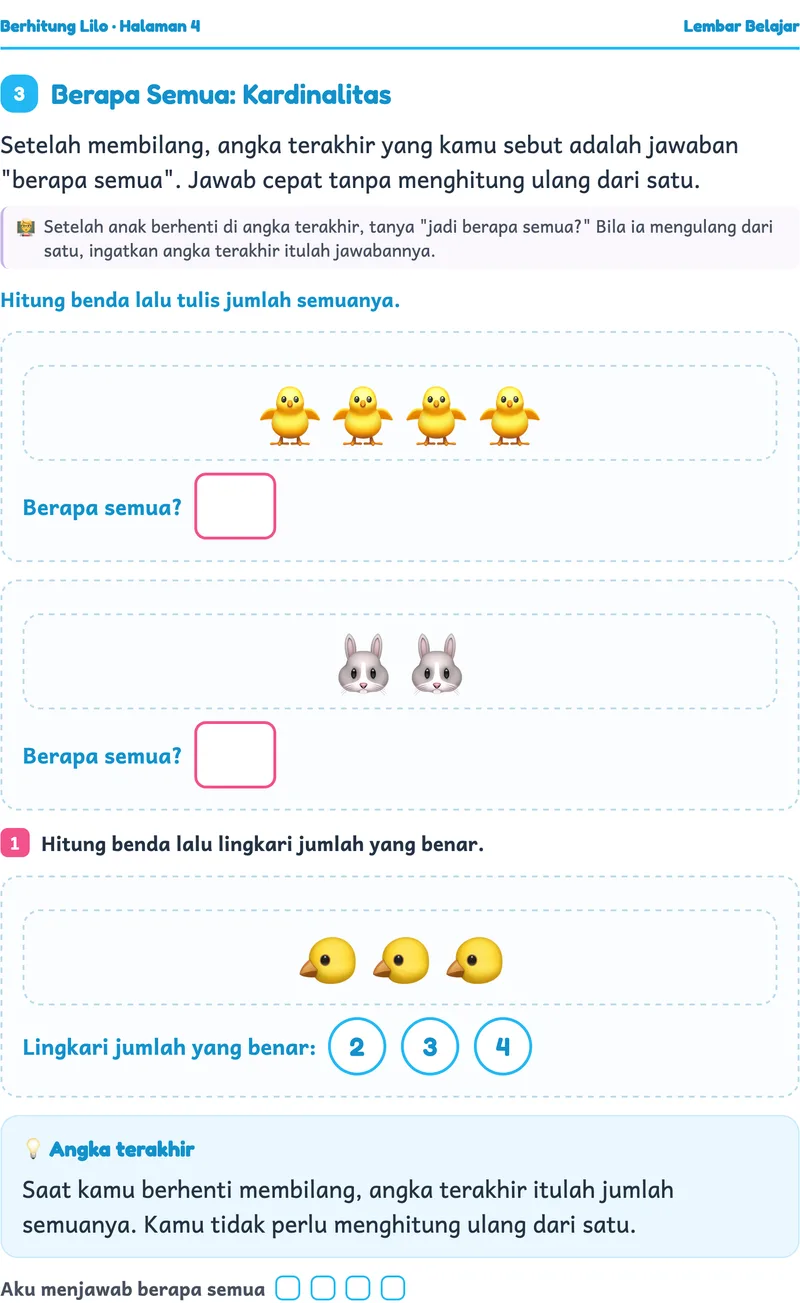
One, two, three. Children count real objects one at a time on this counting-module sheet at Introduction Level, then name the total. From this simple activity, a feel for quantity begins to grow.
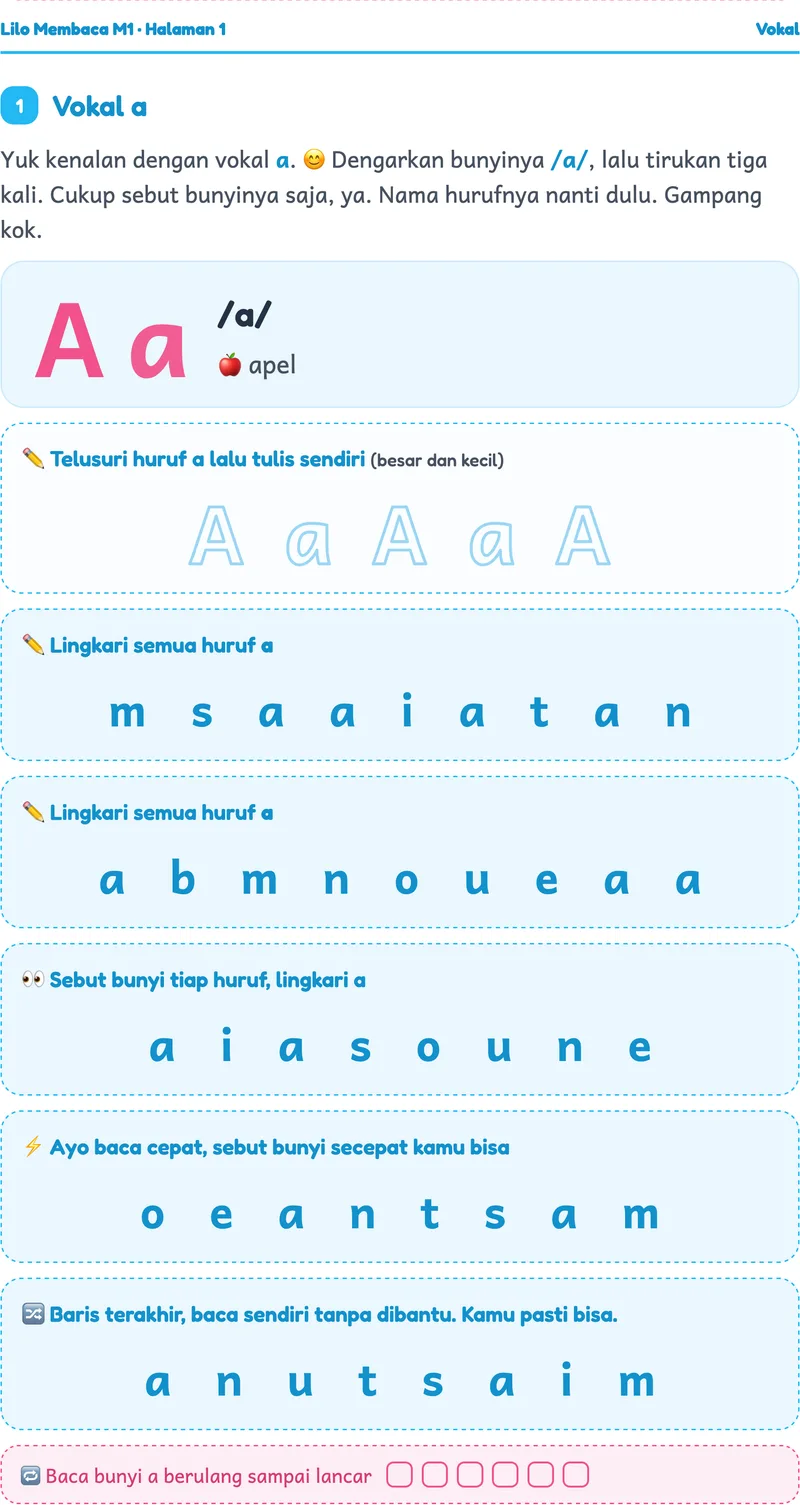
Through cards and point-and-read practice, Introduction Level children get to know the vowel sound a on this reading-module sheet. One small sound that starts the whole journey toward loving to read.
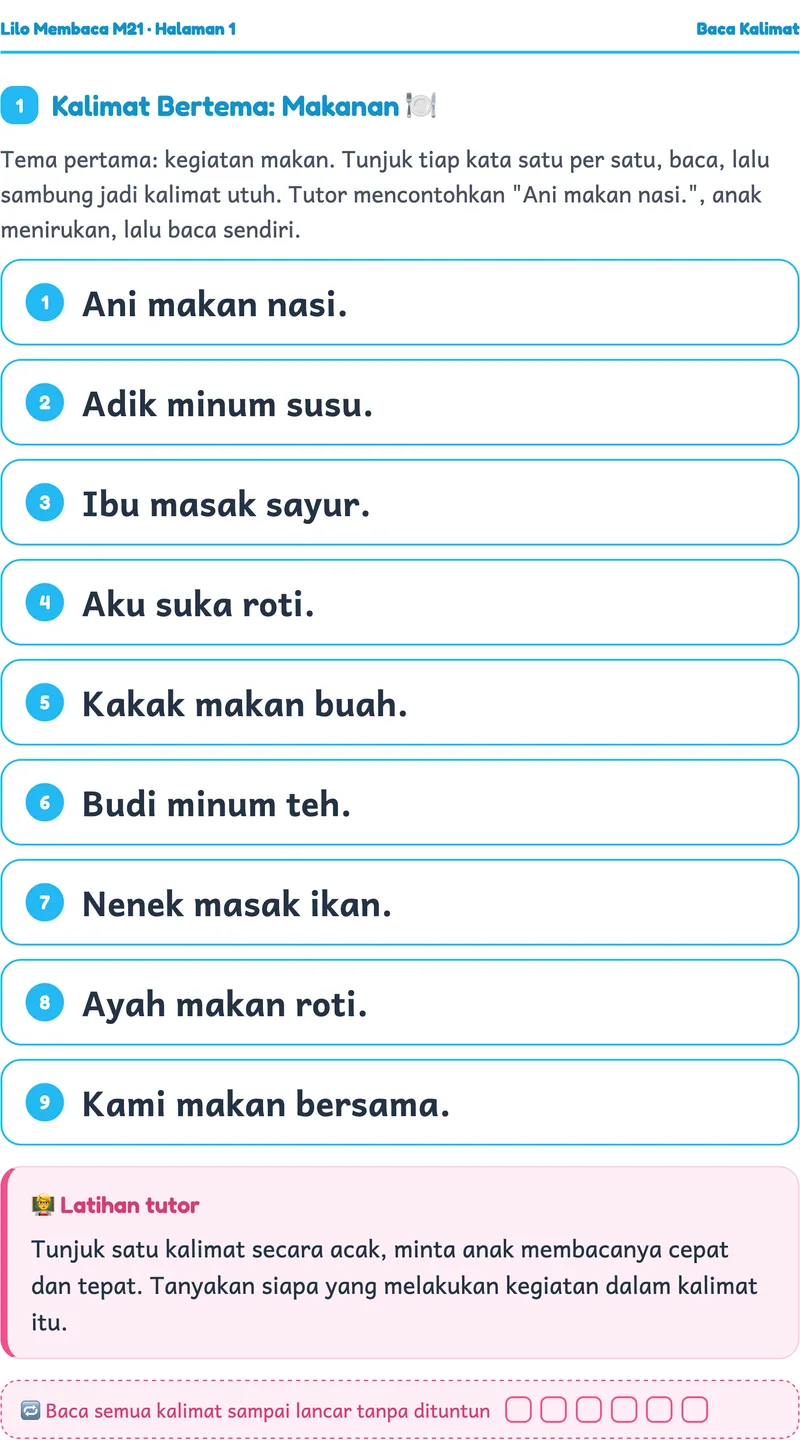
A real reading-module page: short food-themed sentences read in full, combining everything from letter sounds to syllables.
Every sheet above is part of Lilo's own progressive curriculum, a complete set of 122 modules.

Tell us about your child in a free WhatsApp consultation. We will suggest a starting level, match a tutor near your home in Surabaya, and let you decide calmly from there.
Free consultation, honest answers
More to explore, from Mulyorejo to Tegalsari and online.