



Little explorers aged 3 to 4
Your child is meeting letters and numbers for the very first time. Sessions feel like guided play with objects to touch and sort, so curiosity grows while tiny hands get ready to write.
Before your child writes a single number, they count beans, buttons and blocks they can hold. Lilo tutors in Tasikmalaya build reading, writing and counting on that solid, touchable start.
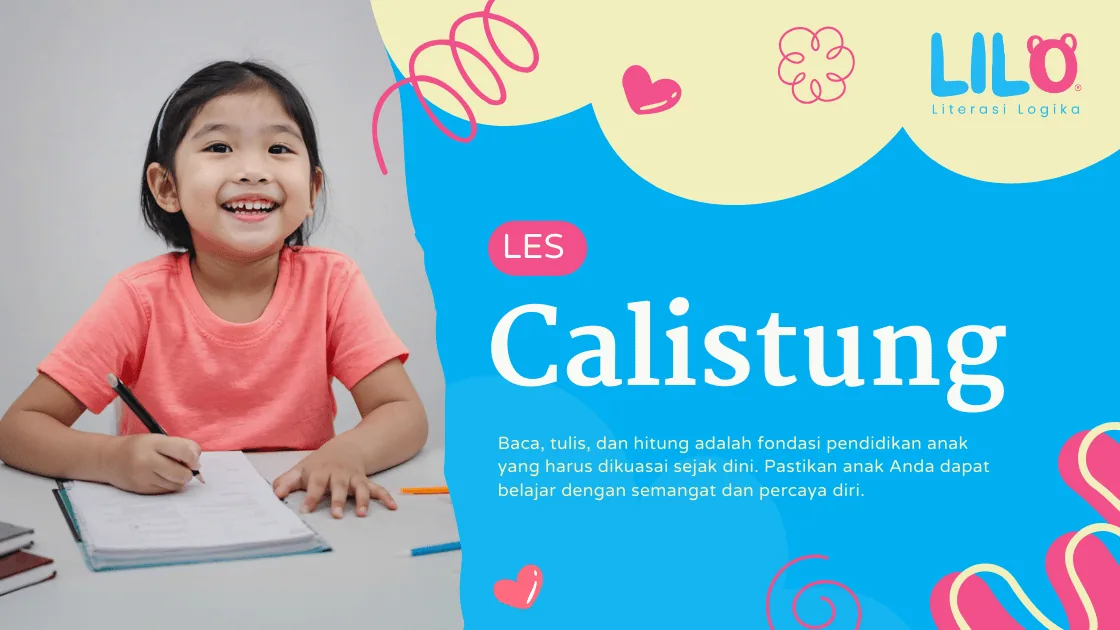
Reading, writing and counting in Tasikmalaya is a home tutoring program from Lilo where children aged 3 to 8 learn all three skills as one connected journey. Your child begins with real objects held in the hand, moves on to pictures, and only then meets letters and numbers, so every new symbol carries real meaning.
Every child arrives at letters and numbers on their own timetable. We meet your child exactly where they are and walk forward from there, one steady step at a time.
Your child is meeting letters and numbers for the very first time. Sessions feel like guided play with objects to touch and sort, so curiosity grows while tiny hands get ready to write.
Your child is preparing for primary school. We build blending, counting and letter writing in small daily portions, so the first day of school feels familiar instead of frightening.
Your child already reads and counts a little and now needs all three skills to grow strong together. We deepen comprehension, extend counting and make writing flow with confidence.
Some children fall behind because earlier steps were rushed. The placement assessment finds the exact gap, and your child rebuilds from the right level with patient, encouraging guidance.
Our method follows one simple promise: your child touches an idea before naming it. Understanding built with the hands lasts far longer than anything memorized by chant.
Every new idea starts as something real on the table. Your child counts actual objects, groups them and moves them around, so quantity becomes something felt before it becomes a written number.
Once the real objects feel familiar, the tutor draws them. Word problems become simple bar drawings your child can point at, which quietly trains reasoning while the counting still feels friendly.
Letters and numbers arrive last, when they already have meaning. Reading grows from letter sounds instead of spelling drills, so your child sounds out new words independently and with pride.
Each session ends with short, doable practice built level by level. Small daily wins stack into real mastery, and your child levels up only after the current step is secure.
The sequence is tight, so nothing gets skipped as your child moves up.
From recognizing single letters to understanding whole stories. Your child learns through letter sounds, blends syllables into words, and grows into a reader who enjoys asking what happens next.
Little hands warm up with lines and patterns before forming print letters. Step by step your child moves from single letters to words, then to full sentences written with pride.
Numbers begin as objects your child can hold and move. Addition and subtraction grow from that touchable base, and word problems become puzzles your child genuinely enjoys solving.
Alongside the three skills, every session gently builds concentration, independence and confidence. These habits carry your child through school long after any single worksheet is finished.
Young children tend to treat their first answer as final. Looking back over work is a habit that can be taught early, and carefulness grows from it.
For a child of five or six, a task feels finished once an answer is on the page. Monitoring one's own work is just forming at this age, and it grows through a small action repeated every session. A child who writes 6 + 3 = 8 usually understands adding. What is missing is a pause before moving on, and that pause can be taught as concretely as a letter sound.
In counting, the tutor teaches a check that travels a different route from the answer. After 6 + 3, your child recounts with buttons, starting at six and stepping on three. Once numbers are written, they try the reverse: 9 take away 3 should land on 6. A second route matters, because repeating the same method often repeats the same slip.
In reading, checking means asking whether the word makes sense. A child who reads kopi as kapi touches each syllable, KO then PI, and listens again. The tutor holds back the word wrong and says something on line two needs another look, so your child finds it. At home you will see them point to each answer before handing a sheet over.
This picture describes a five-year-old who already knows some letters or numbers and learns on the Regular plan, about twice a week. The tutor tunes each step to your child's rhythm.
Known letters get clear sounds, new ones arrive through games, and your child counts objects to twenty while touching each once.
Your child blends sounds into BA, BI and MA, while the pencil grip steadies and drawn circles close neatly.
Your child writes their name in capitals, forms numbers along the arrows, and glances back over the writing before saying done.
Your child splits ten into pairs such as seven and three, with buttons then pictures, and checks small sums by counting back.
Words like buku, sapi and meja are read whole, and short sentences about nearby things are written independently.
Next comes stage P, understanding short texts, alongside place value with bundled sticks.
These four activities use what you already have at home, and each trains one clear stage.
Your child pegs each leaf as it is counted, then counts again from the other side and announces the total only when both agree. This trains stage B and the checking habit.
a pot plant and clothes pegs
Your child writes the cat's or fish's name in capitals, or a plant's name if there is no pet, matching each letter against your model before taping it up. This trains stage T.
card, pencil, tape
Write gula, susu and tahu. Your child reads each syllable by syllable and fetches the item. If the wrong one appears, read the word again together. This trains stages S and K.
paper, pencil, kitchen items
Your child splits ten beans between two bowls, names the pair such as six and four, then tips them together and recounts to check. This trains pairs that make ten in stage B.
ten beans, two bowls
These four signatures come straight from our own curriculum of 122 leveled modules, and every tutor in Tasikmalaya teaches with them.
New ideas enter through the hands. Your child counts, sorts and compares real things on the table, so numbers and letters arrive later as names for something already understood.
We teach the sounds letters make, so your child can sound out brand new words alone. That independence is the moment reading stops being a chore and becomes a door.
Story problems are drawn as simple bars your child can see and compare. The picture does the heavy lifting, and quiet reasoning skills grow with every problem solved.
Short, warm, regular practice built level by level. Portions stay small enough to finish with a smile, and the steady rhythm turns effort into a habit your child owns.
Each rung is a real stage in our own modules, and your child climbs them one secure step at a time.
Most struggles with early reading, writing and counting trace back to a few well-meaning shortcuts. Knowing them early saves your child months of frustration.
Why it happensChanted facts sit in short-term memory with nothing underneath. They fade within weeks, and the child concludes that learning itself is sour and pointless.
How Lilo helpsBuild every idea from real objects first. When your child can show 4 plus 3 with actual things, the written fact has roots and stays.
Why it happensA child who chants one to twenty without ever grouping real objects is reciting a song. Ask what seven means and there is nothing behind the word.
How Lilo helpsLet quantity live in the hands before it lives on paper. Counting real things makes every later number sentence meaningful.
Why it happensWriting needs finger strength and control that develop gradually. Pushing letter drills too early produces cramped grips, tears and a child who dreads the pencil.
How Lilo helpsStart with lines, patterns and tracing that build the hand muscles. Letters come next and arrive far more easily.
Why it happensSkills built in a panic are shallow and stressful. The child meets school already tired of studying, which is the opposite of a strong start.
How Lilo helpsBegin earlier with short, friendly sessions. A gentle year of small portions outperforms a frantic final sprint every time.
Why it happensReading, writing and counting reinforce each other. Trained in isolation, one skill races ahead while another lags, and the gap widens quietly.
How Lilo helpsWeave them together the way our curriculum does. A story read becomes a sentence written and a problem counted.
choose 60, 90, or 120 minutes
Contact us
60, 90, or 120 minutes per session
Contact us
duration of 60, 90, or 120 minutes
Contact us
These five questions are fair to ask any provider. The answers show whether progress will be visible and whether lessons connect with your child's school.
Early reading and counting move in small steps that are easy to miss when news is rare. At Lilo, updates come from the tutor who teaches your child, on a fixed rhythm.
A line like doing great is pleasant and hard to act on. A named stage tells you how to support practice at home. At Lilo every stage has a code, so your child's position stays clear.
Children gain confidence when lesson practice shows up in class. At Lilo, what you share about school is noted at consultation, and the tutor links it to the current module.
A child can get confused sounding letters in one place and naming them in another. Lilo reads through sounds and whole syllables, and counts from objects to pictures to numerals.
A good match shapes how bravely your child tries and admits confusion. Lilo finds a new tutor at no cost whenever the fit is wrong, and that is a firm service promise.
Tasikmalaya is a city in West Java widely known by its honored nickname, the city of santri. A living tradition of Quranic study gives daily life here a warm and devout atmosphere. The city is also proud of its reputation as a city of artisans, home to the famous payung geulis umbrellas and mendong woven crafts admired far beyond the region. Its areas include Cihideung, Cipedes, Tawang, Mangkubumi, Kawalu, Indihiang, Cibeureum, and Tamansari.
A Lilo teacher visits your house anywhere in our Tasikmalaya service areas. Your child settles in at the spot where they feel most at ease, and each session lets you see their growth up close.
Lessons are arranged in careful stages from the very basics. Children start with real objects, then pictures, then symbols, so they truly understand each step before moving up to the next one.
Each session uses structured worksheets with just the right amount of practice. Children build a steady learning habit, grow in confidence, and enjoy the process without ever feeling overwhelmed.
Lilo teaches from 122 original leveled modules built in house. Every session follows a mapped path, so you always know which step your child is on and what comes next.
Real objects come first in every new topic. Your child grasps the idea with their hands before meeting the written form, which makes learning stick for the long run.
Verified tutors teach one on one at your home across Tasikmalaya, from Cihideung and Tawang to Kawalu and Indihiang, so learning happens where your child feels safest.
The placement assessment finds your child's true level on day one. Progress is measured against clear level goals, and your child advances only after real mastery.
Sessions can run in English, in Indonesian, or a comfortable blend of both. Families raising bilingual children get lessons that match the language of their home.
Level codes such as L1 or L2 mark the phonics stage your child is practising, and they appear in the weekly report alongside notes on writing and arithmetic. In one meeting your child switches between reading, writing and sums, at home with a tutor or in an online class. Payment goes by monthly package, and the Regular package of 8 sessions costs IDR 604,782.
By month's end, your child is used to sitting calmly with a tutor weekly.
IDR 307,460Your child gets used to opening the workbook without repeated reminders.
IDR 604,782Checking answers again before handing them in becomes a settled habit.
IDR 891,965Daily study becomes routine, and your child starts practising independently.
IDR 1,692,684At home or online, the same.
We find a replacement for free. Request it whenever you need.
How it works:
Plus a monthly progress report.
Reading, writing and counting tutoring in Tasikmalaya really helped my child understand letters and numbers in a fun way. The tutor is very patient and creative in teaching.
Gracia was so proud when she finished reading a whole thin book and counted the pictures on every page. Her tutor always cheers her on, so she is never afraid of making mistakes.
Readiness shows up in ordinary moments. When a few of these appear, calistung sessions in Tasikmalaya will feel like an extension of your child's own games.
Tasikmalaya belongs to our West Java network: 800+ early literacy and numeracy tutors. Some of them already live in Tasikmalaya.
Graduates and current students alike.
Applications screened
Each file is read by our team.
Identity and degree checked
Identity and diploma are matched.
Experience and hours recorded
Available hours are noted down.
Trained in the Lilo method
Teaching starts after training.
Matched to your child
Questions come from the child’s needs.
Want a different tutor? See our free tutor replacement promise
Young children show what they know most fully when relaxed. So the first session is a game, and the tutor notes what your child shows.
Many children recognise letters long before writing them feels easy. A written test would record an unready hand and hide what your child genuinely knows.
The tutor says a sound, your child finds the card, then joins two cards into a syllable. This shows whether your child sits at stage H or is ready for S.
Your child counts buttons while pointing, then takes three more. The tutor watches whether each item is counted once and counting carries on without restarting.
Your child draws lines, circles and their name if they can. Pencil grip and stroke direction decide where stage T begins.
The path is short. You tell us about your child, your child plays with a tutor, and within the first week you can see where learning stands.
The free consultation begins with your child's age, the letters and numbers already familiar, and whether home visits or online classes suit you.
You see the tutor's profile before the first session and pick a monthly plan. For online classes, the link and worksheets arrive beforehand through app.lilo.id.
The tutor visits your home in Tasikmalaya or appears on screen, plays with sound cards and buttons, then closes with a recap and a short piece of home practice.
The first report places your child on the stage codes, for example secure in H and starting to blend syllables in S, so you know what is being practised.
See for yourself the original sheets children work on in Lilo's calistung classes. Every level trains reading, writing, and counting side by side, climbing one step at a time.
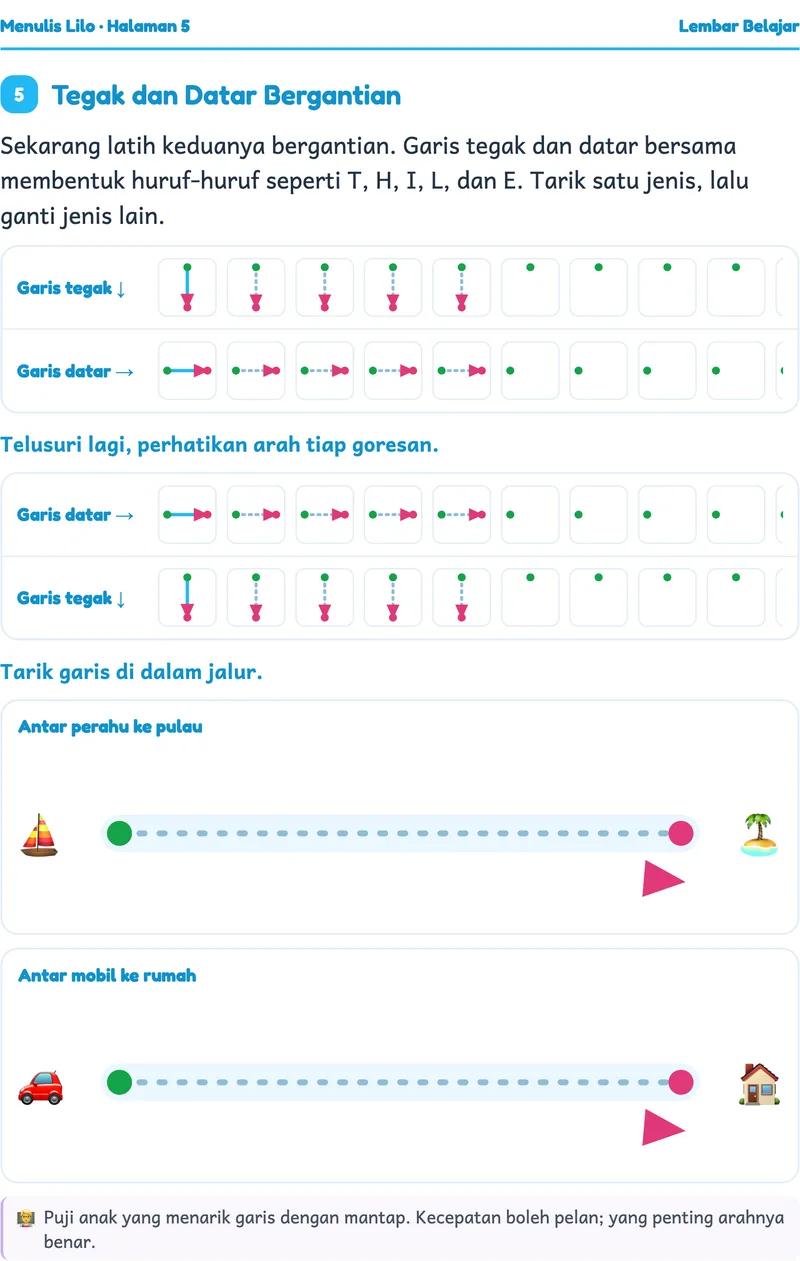
Little hands need strength before they can write letters. This Introduction Level sheet from the writing module invites children to draw vertical and horizontal strokes in turn until their hand movements feel steady and controlled.
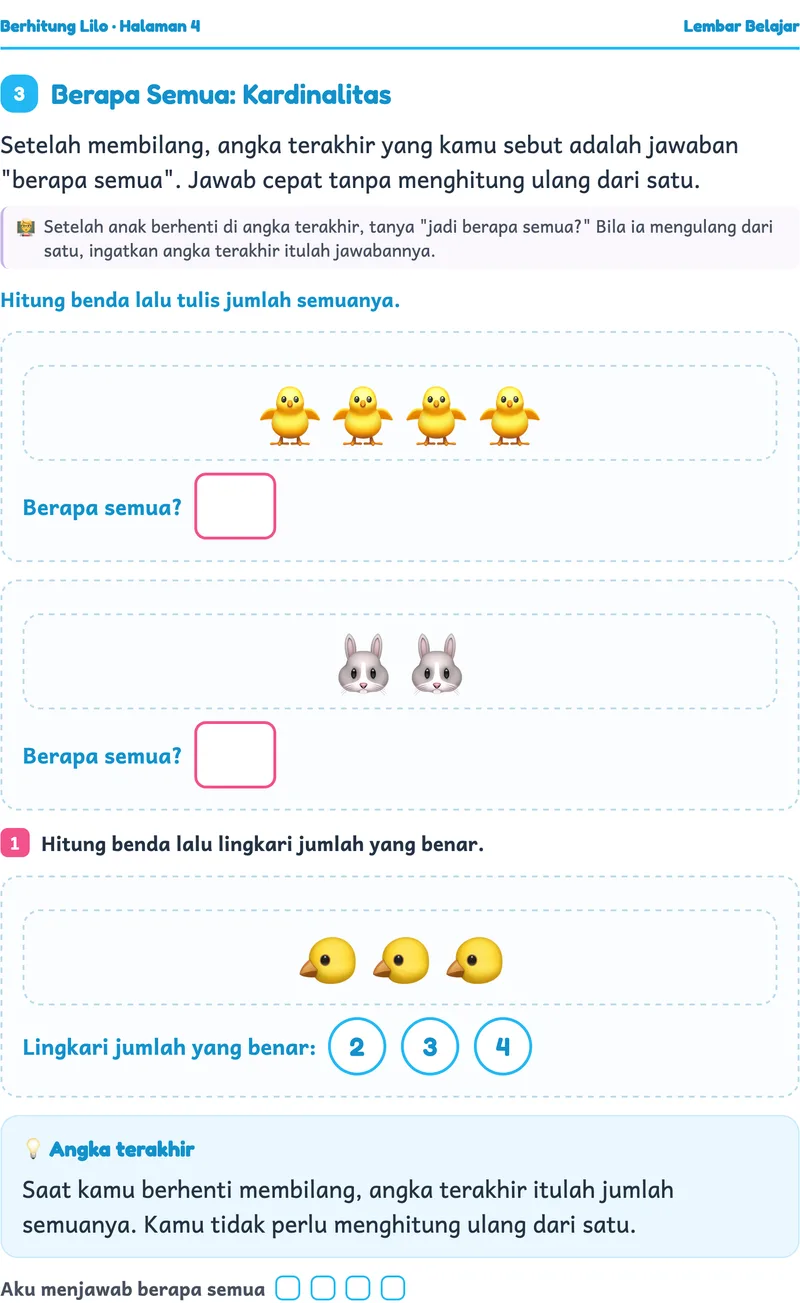
On this sheet, Introduction Level children learn to count with real objects. Each object is counted one by one, and the child then says how many there are in all. Everything starts from the concrete.
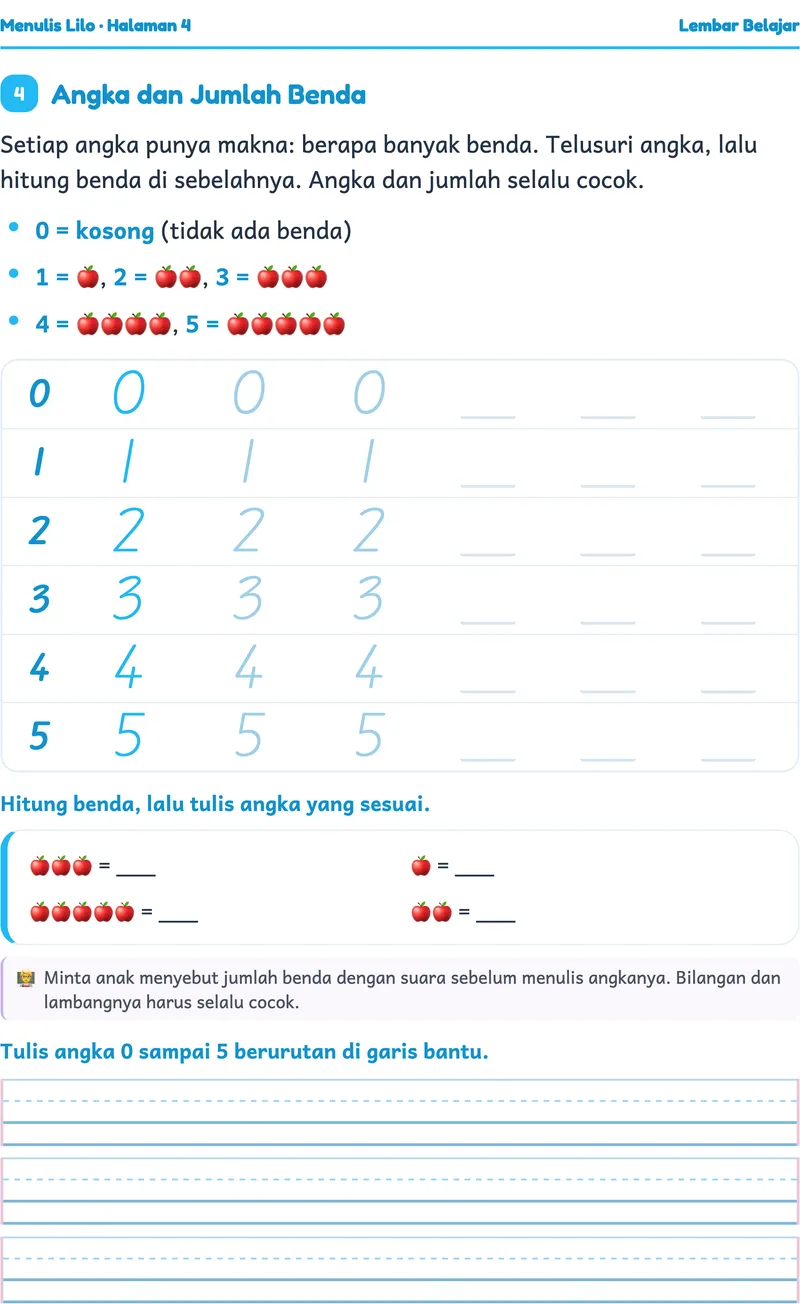
At Basic Level, children grow familiar with numerals through this writing-module sheet. They match each numeral to the matching count of objects, then write it neatly along its guide path.
These sheets are a small glimpse of Lilo's own progressive curriculum, carefully arranged across 122 modules.

One free WhatsApp consultation is all it takes to begin. Tell us about your child, meet a tutor who reads their level honestly in the first lesson, and watch reading, writing and counting grow from things their own hands understand.
Free consultation, free tutor replacement