




Little explorers, ages 3 to 4
Your child is meeting letters and numbers for the very first time. Sessions feel like play with real things to touch and sort, so curiosity grows and there is no pressure at all.
A gentle program for children aged 3 to 8 where short, regular practice sessions slowly build real skill in reading, writing and counting, guided by a tutor who starts from objects your child can hold.
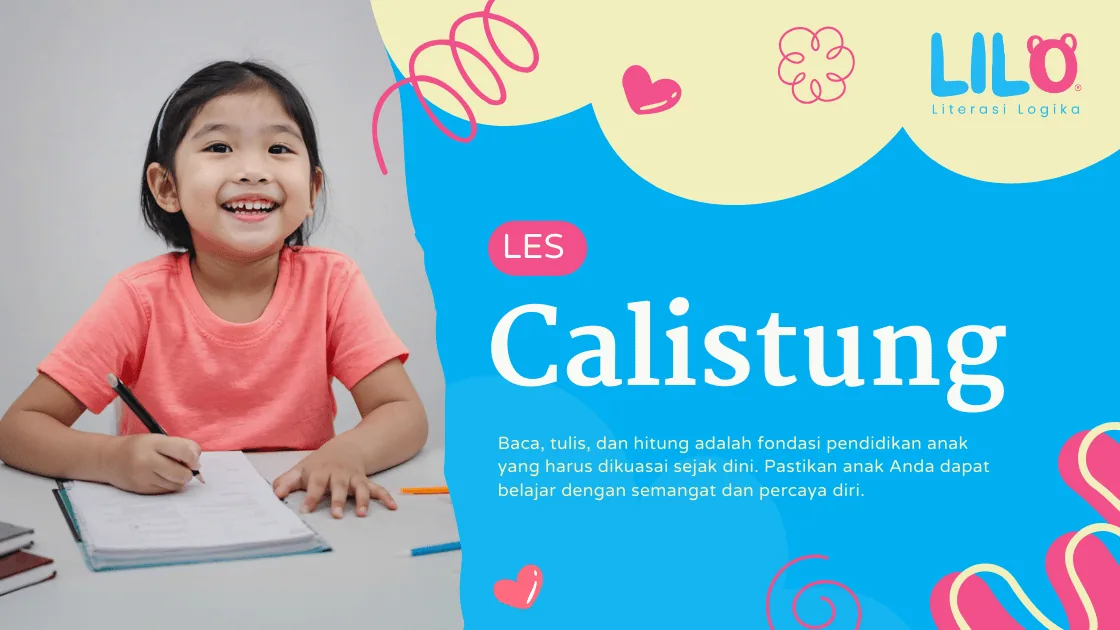
Reading, writing and counting lessons in Tegal from Lilo teach the three skills together as one journey for children aged 3 to 8. A tutor meets your child at their current level, then grows their ability through short, friendly sessions that add up day by day. Understanding always comes first: real objects before pictures, and pictures before letters and numbers.
Every child arrives at letters and numbers on their own timetable. These are the stages we welcome, and the placement assessment finds the exact starting point.
Your child is meeting letters and numbers for the very first time. Sessions feel like play with real things to touch and sort, so curiosity grows and there is no pressure at all.
Your child is getting ready for primary school. Short daily practice quietly builds the habit of sitting, focusing and finishing a small task, while syllables, counting and writing take shape.
Your child already reads and counts a little, and now needs all three skills to grow strong together: reading with understanding, writing clearly and solving simple problems with confidence.
Some children fall behind their classmates and start to feel small about it. We restart at the level where your child truly succeeds, so confidence returns before the pace picks up.
Our method turns learning into a routine your child can actually keep. Each step is small on purpose, because small steps repeated well become lasting skill.
Before any lesson, the tutor runs a placement assessment. Your child begins exactly where they are today, which means the first sessions already feel doable and encouraging.
Your child first holds real objects, then works with pictures, and only then moves to letters and numbers. This is the Singapore Math way, and it makes symbols mean something.
Reading grows from letter sounds instead of spelling drills, so words unlock naturally. Word problems are drawn as simple bar models, so your child learns to think a problem through.
Sessions serve practice in small friendly portions built level by level. Your child moves to the next level only after truly mastering the current one, never before.
The teacher holds your child at one stage until the foundation is solid, then opens the next.
From recognizing letters to understanding whole passages, your child climbs one small rung at a time, sounding out syllables and sentences until reading feels natural.
Writing begins with lines and patterns that train little hands, then grows into print letters, words and finally full sentences your child is proud of.
Your child first truly knows what numbers mean, then adds and subtracts with understanding, and finally solves word problems by reasoning through them.
Alongside the three skills, each session quietly trains concentration, independence and confidence, the habits that make every future lesson easier for your child.
These four signatures shape how each lesson runs, whether the tutor sits at your table in Tegal or meets your child online.
New ideas arrive in your child's hands before they arrive on paper. Counting beans, arranging cards, tracing shapes: the concrete comes first, so the abstract makes sense later.
We teach the sounds letters make, so your child can unlock new words alone. There are no spelling drills that recite letter names without meaning.
Story problems are drawn as simple bars, the Singapore way. Your child sees what the question is really asking and learns to reason instead of guessing.
Small portions, kept up regularly, level by level. The routine stays light and kind, so your child keeps showing up gladly and the gains keep adding up.
Each rung comes from our own leveled modules, and your child steps up only after the current rung is mastered.
Most struggles with early reading, writing and counting come from a few well-meaning habits. Here is what we see often, and how the program corrects course.
Why it happensFacts learned by rote have nothing to hang on to, so they fade fast and the lessons start to feel sour to the child.
How Lilo helpsWe build understanding first with real objects and pictures, so every fact your child keeps is anchored to something they truly grasp.
Why it happensWhen hand muscles are still developing, pushing letter writing leads to cramped grips, messy results and a child who dreads the pencil.
How Lilo helpsThe Introduction Level trains hands gently with lines and patterns first, so writing letters later feels like a natural next step.
Why it happensA child who chants numbers without handling real quantities is reciting, and the recital collapses the moment a real problem appears.
How Lilo helpsCounting starts with objects your child can hold and group, so the symbols that follow carry real meaning.
Why it happensA few rushed months cannot replace a habit built over time, and the pressure often leaves a child anxious about school before it begins.
How Lilo helpsWe favor small regular sessions started early, so readiness grows calmly and your child walks into primary school settled.
Why it happensWithout bridges between reading, writing and counting, one skill races ahead while another stalls, and progress turns lopsided.
How Lilo helpsOur sessions weave the three together on purpose, so each skill keeps reinforcing the other two.
60, 90, or 120 minutes per session
Contact us
duration of 60, 90, or 120 minutes
Contact us
60, 90, or 120 minutes
Contact us
The profile: a seven-year-old who knows the letters and reads short words, now aiming for fluency on the Intensive package, about three times a week. Here is the general shape of that journey.
Your child practises reading two-syllable words in one breath. The pause in the middle shrinks, and new words start opening up unaided.
Capitals are written with straight lines and numbers follow the arrows. Short sentences appear with steady spaces between the words.
Ten sticks are bundled into one ten. Carrying and borrowing in two-digit sums now make sense, because your child can watch them happen.
Your child reads a short paragraph and answers questions about it. Attention moves from saying the words to following the story.
Your child reads a word problem alone, draws it as a bar model, then calculates. All three skills now work together on one problem.
Three sessions a week give a child in Tegal enough repetition for each stage to settle before the next one begins.
The bathroom and the yard of your Tegal home are full of materials children love. Each of these four activities trains one clear stage.
You say a sound and your child writes its letter with a finger on the wet tiles. Rinse it away, then call a new sound. This trains letter recognition and the writing motion.
wet bathroom tiles or soap foam
Float ten toys, then cover some with foam. Your child counts the ones in sight and works out how many are hiding. Pairs that make ten become a bath game.
ten small bath toys and soap foam
Gather twigs in the yard together and band every ten into a bundle. Two bundles and three loose twigs read as twenty-three, so place value becomes something to hold.
small twigs and rubber bands
Your child writes a plant's name, such as chilli or jasmine, and tapes it to the pot. Next day they read the tag while watering, practising words they wrote themselves.
small paper, a pencil and tape
Reading, writing and counting prop each other up inside a child's head. The tutor's notes help most when you read them as one picture.
When a child reads, most of their attention goes into turning letters into sounds. If that step still takes effort, little attention remains for meaning. That is why a slow word reader often looks weak at word problems, even though they can add 8 and 5 with objects. The snag sits in reading the question, and placing the reading notes beside the counting notes usually reveals it.
Writing works the same way. A child still wrestling with capital letters loses the sentence idea halfway. They might describe the neighbour's cat happily, then write down only three words. The tutor treats this as a matter of the hand and adds practice with lines and arrow directions. Once the hand moves on its own, the sentences your child writes usually grow longer too.
So when this week's notes arrive, look for the one skill holding the other two back. Ask three questions: does your child read words in one breath, does the hand write without stopping often, and is the problem drawn before it is solved? The answer that lags shows where the tutor will aim next week's materials. At home in Tegal, ask your child to read a word problem aloud and listen for the stumble.
Readiness shows up in small everyday habits. These three groups help you in Tegal judge when to begin and when a stage has truly settled.
Children in Tegal draw on 750+ early literacy and numeracy tutors across Central Java. Home visits in Tegal follow the nearest tutor.
Some still studying, others graduated.
Every application reviewed
Role and city are checked first.
Documents verified
The team checks identity and education.
Experience and hours recorded
Available hours are noted down.
Trained before teaching
The step-by-step method is learned first.
Chosen for your child
Questions come from the child’s needs.
Want a different tutor? Read the tutor replacement guarantee
Your child's starting point is found through play, with no written test. While the game runs, the tutor notes small details that reveal the real stage.
The tutor says a sound and your child hunts for its card. This shows which letters are known by their sound and which only by their shape.
Your child counts a row of bottle caps. The tutor watches whether each cap is touched once, and whether the total is known without recounting.
While your child draws a road for a toy car, the tutor checks the grip, the pressure and whether the line turns where it was meant to.
Some children laugh and try again, others go quiet. The tutor notes this reaction to judge how much challenge the next session should carry.
For a child in Tegal, it simply feels like playtime. Every observation shapes how the tutor builds session two.
Preparation is light, and most of it is already at home. These four steps make the first session in Tegal feel easy from the start.
During the free consultation, share your child's age, what they can already do and how they act when bored. This helps the team pick a fitting tutor.
You can view the tutor's profile before the first session. Tell your child a little about who is coming, so the first meeting feels familiar.
Choose a low table with good light and a seat where your child's feet rest on the floor. Keep a handful of bottle caps, buttons or spoons nearby.
The class link and worksheets arrive before class through app.lilo.id. Print the sheets or lay them out, then set the screen level with your child's face.
The first session is a game, so your child can simply arrive cheerful with nothing to study beforehand.
Lessons draw on 122 leveled modules of Lilo's own original curriculum, so every session has a clear place in a bigger, carefully ordered journey.
Reading, writing and counting are taught as one connected path. What your child reads, they write; what they write, they count with. Progress stays balanced.
Our verified tutors come to homes across Tegal, from Tegal Barat and Tegal Timur to Margadana and Mejasem, bringing the materials and the patience each session needs.
Sessions can run in Indonesian or English as the language of instruction, a natural fit for bilingual and national-plus families in Tegal.
Your child levels up only after truly mastering the current step. Nothing is rushed, so nothing has to be relearned later, and confidence stays intact.
Each session is short and steady on purpose. Small daily habits compound quietly into fluent reading, tidy writing and counting your child truly understands.
A free WhatsApp consultation comes first: the Lilo team asks where your child stands in reading, writing and arithmetic, then suggests a rhythm that suits. You pay for one monthly package at a time, with sessions starting at IDR 76,865, while the most requested Regular package, roughly twice a week, totals IDR 604,782 a month.
Four sessions a month, about once a week, to map where your child starts with letters and numbers.
IDR 307,460Eight sessions a month, about twice a week, enough to start writing short words and adding with pictures.
IDR 604,782Twelve sessions a month, about three times a week, close practice that firms up sentence reading and simple subtraction.
IDR 891,965Twenty-four sessions a month, about six times a week, to build the whole foundation up to solving word problems.
IDR 1,692,684From the very first session.
Just tell us, any time.
How it works:
Topped up by a monthly report.
These questions are fair to ask any lesson provider in Tegal. The answers show how carefully planned your child's journey will be.
| Question to ask | Why it matters |
|---|---|
Is the material arranged in a coded sequence I can see? | A coded sequence tells you where your child stands today and what comes next, so sessions follow one plan week after week. Lilo uses a ladder of codes from recognising letters to understanding what is read. |
Where do the learning materials come from? | Materials written by one team tend to connect from week to week. At Lilo, worksheets come from the module your child is studying, part of 122 coded modules we wrote ourselves. |
How is my child's starting point decided at the first meeting? | A written test can make a small child tense and hide what they truly know. A relaxed setting gives a more honest picture. At Lilo, the starting point is found through play. |
Is reading taught through letter sounds or letter names? | A child who knows the sounds can blend words they have never seen. Reciting letter names often confuses children when they try to join them. Lilo teaches letter sounds, then whole syllables. |
What happens if my child and the tutor do not click? | The fit shapes whether a child is willing to sit down and try. A good provider has a clear way forward. At Lilo, a tutor who is not the right match is swapped free, a service promise we keep. |
Tegal is a city on the northern coast of Central Java, sitting along the pantura route, one of the key roads that links cities across Java. It is widely known for its warm poci tea tradition and its distinctive, friendly ngapak dialect. The city covers Tegal Barat, Tegal Timur, Tegal Selatan, and Margadana, with familiar areas such as Kejambon, Kraton, Pacul, and nearby Mejasem. Pasar Pagi remains one of the city's best known landmarks.
Your child learns at home within Lilo's Tegal service areas. A familiar setting helps children stay calm, and you can watch their progress up close in every single session.
Every lesson sits on a ladder of levels built for ages 3 to 10. Your child begins on the rung that suits them today and moves up slowly, so each idea settles in firmly.
Your child handles real things and looks at pictures first, then meets the numbers and letters. Seeing why a skill works helps it stay with them for good.
Barra started primary school feeling well prepared. His teacher said he already knows his letters and numbers well. We are thankful we began lessons before school started.
Gracia was so proud when she finished reading a whole thin book and counted the pictures on every page. Her tutor always cheers her on, so she is never afraid of making mistakes.
These sheets come straight from Lilo's original modules. Reading, writing, and counting are trained side by side, step by step at your child's level.
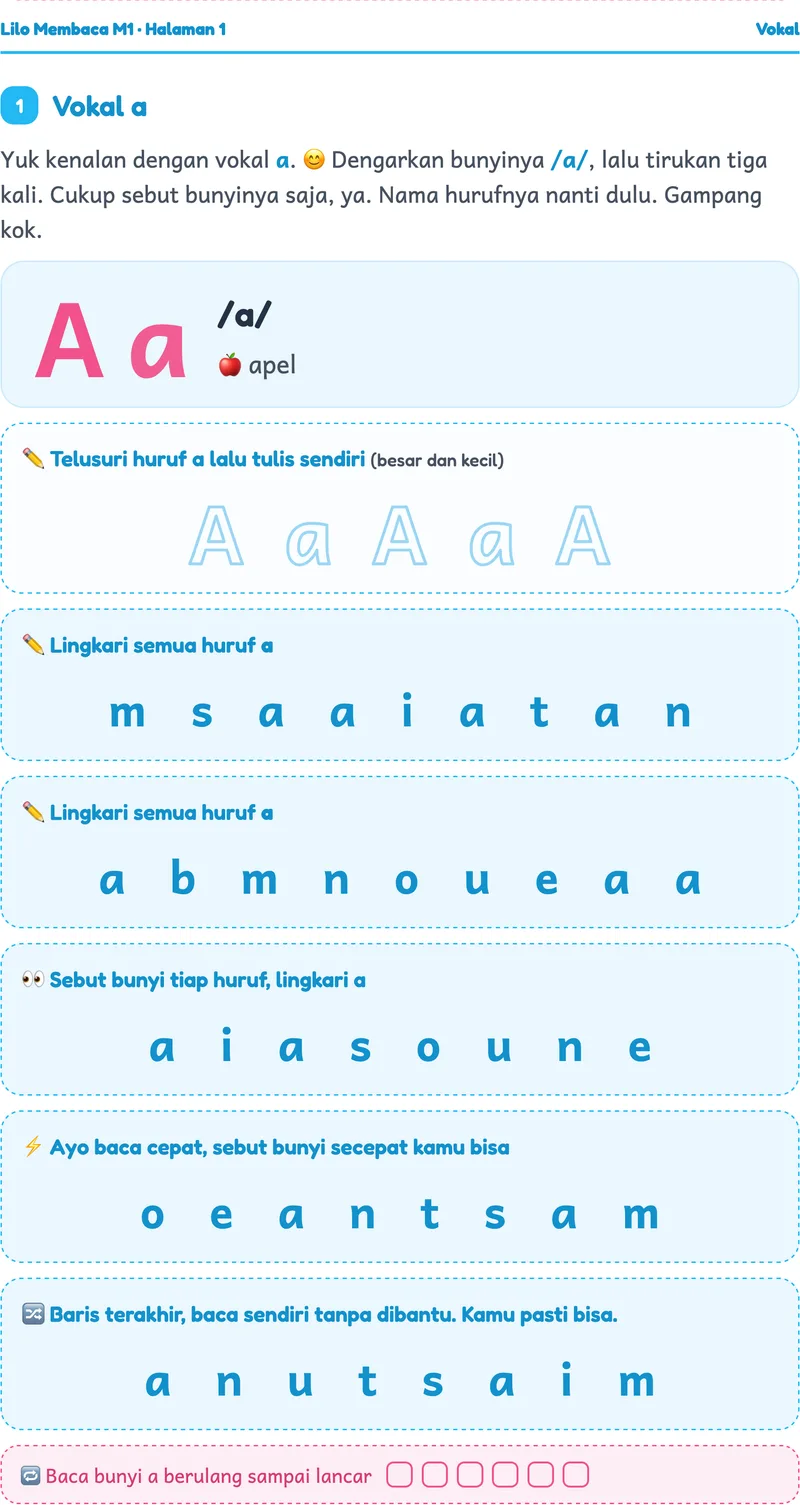
Through cards and point-and-read practice, Introduction Level children get to know the vowel sound a on this reading-module sheet. One small sound that starts the whole journey toward loving to read.
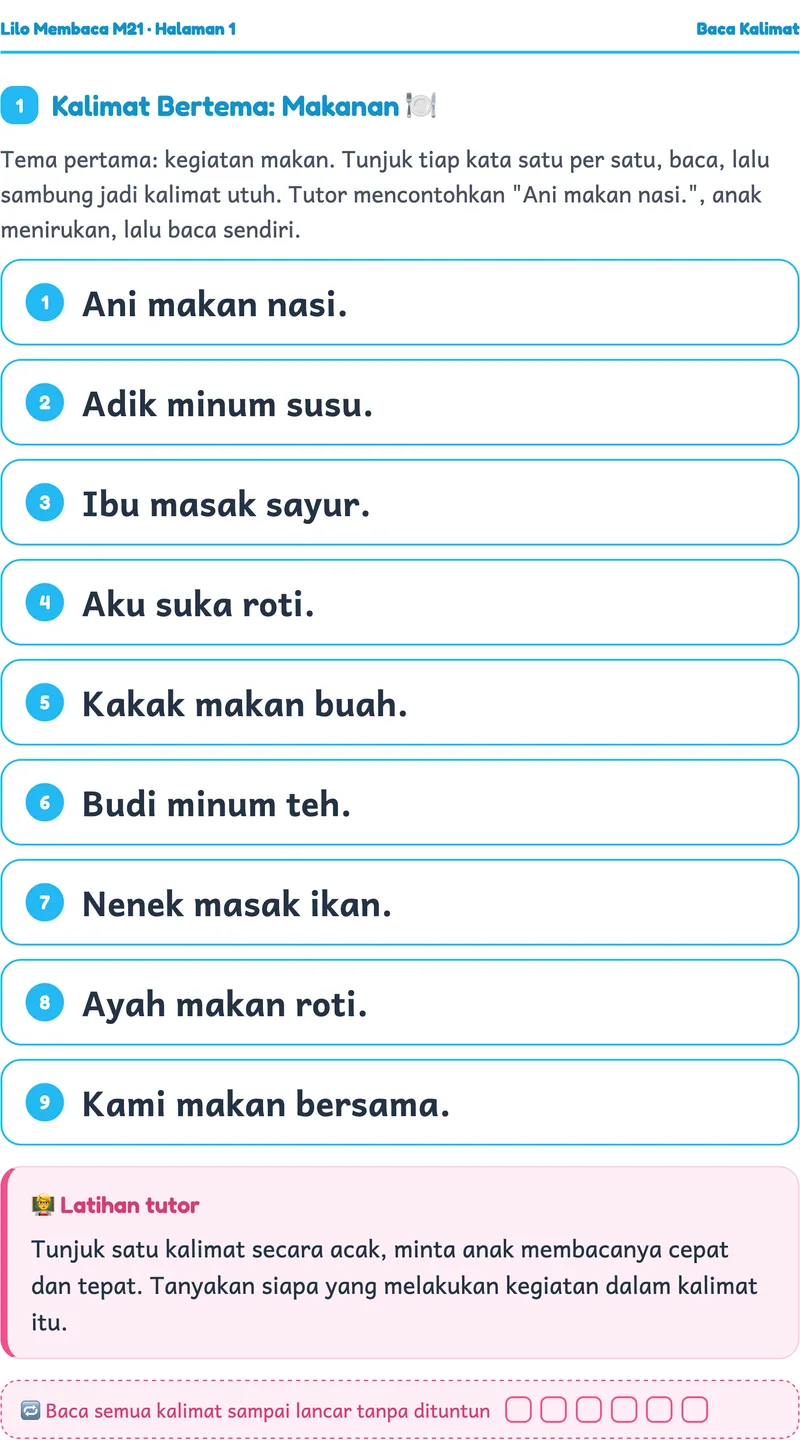
Here is where sound practice and syllable practice meet their result. On this Intermediate Level sheet from the reading module, children read short food-themed sentences in full, from the first word to the final period.
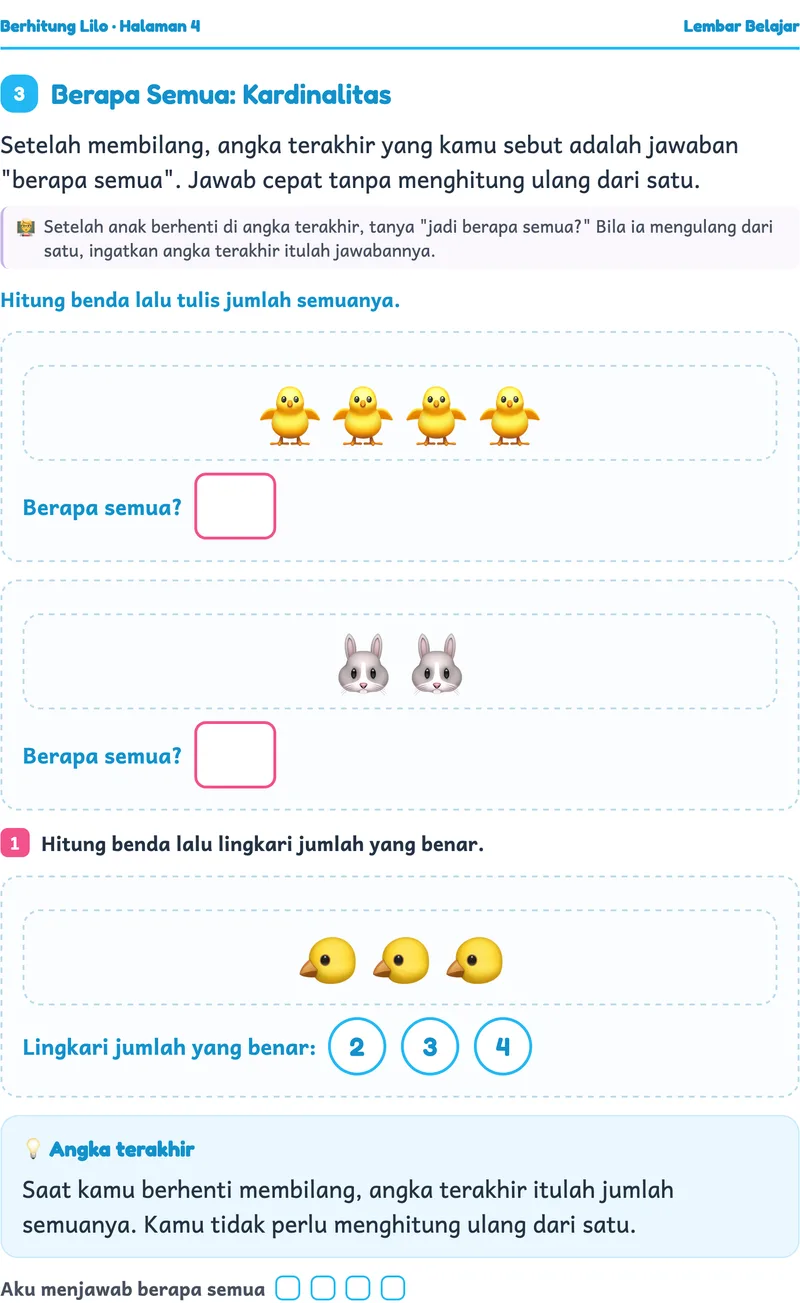
This Introduction Level sheet from the counting module invites children to count real objects one by one, then say the total out loud. It is the most natural way for a child to meet numbers.
Each sheet you see here comes from Lilo's progressive curriculum, one connected journey built from 122 modules.

Big skills grow from small daily habits, and the first habit is simply beginning. Chat with us on WhatsApp for a free consultation, and your child's first lesson will find the right level.
Free consultation on WhatsApp