Little explorers, ages 3 to 4
Your child is meeting letters and numbers for the very first time. Everything happens through play and touch, without pressure, so curiosity stays bright and learning feels like a favorite game.
Your child learns to read, write and count as one connected journey. A verified tutor guides each small step at home, and every new skill makes the other two stronger.
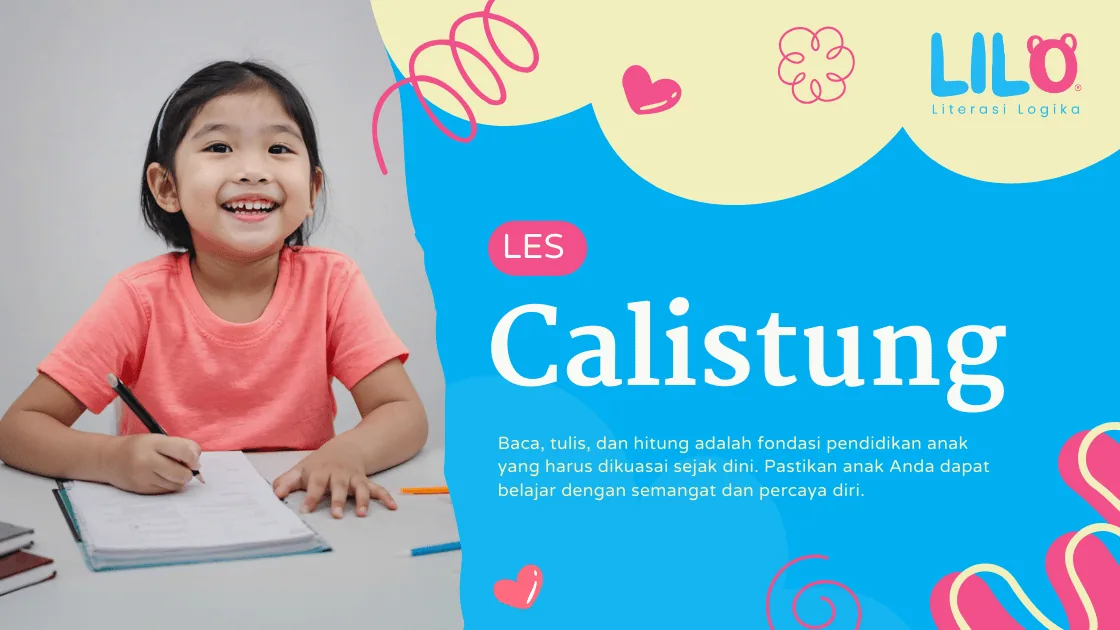
Reading, writing and counting in Yogyakarta is a guided learning program for children aged 3 to 8 in which the three foundation skills are taught together as one connected journey. A Lilo tutor starts with real objects, moves to pictures, then to letters and numbers, so your child truly understands each step before climbing to the next level.
Every child arrives at letters and numbers on their own timetable. We meet your child exactly where they are today and build upward from there, one confident step at a time.
Your child is meeting letters and numbers for the very first time. Everything happens through play and touch, without pressure, so curiosity stays bright and learning feels like a favorite game.
Your child is getting ready for primary school. Sessions gently connect syllables, counting to twenty, and early writing, so the first day of school feels familiar instead of frightening.
Your child already knows the basics and now needs all three skills to firm up together: reading with understanding, writing full words and sentences, and counting that makes real sense.
Your child has fallen a little behind classmates and needs a fresh start at the right level. The placement assessment finds the exact gap, and the tutor rebuilds confidence from solid ground.
Readiness shows in small daily habits. Match these signals to your child's age and share them at the consultation, so your tutor in Yogyakarta arrives with a first picture.
Our Yogyakarta network holds 1,400+ calistung tutors.
Some still studying, others graduated.
Every application reviewed
Role and city are checked first.
Identity and degree checked
ID card, diploma and photo are checked.
Experience and hours recorded
Teaching experience and hours are recorded.
Trained before teaching
Phonics and CPA come first.
Matched to your child
Each candidate answer is reviewed.
Tutor not quite right? Free tutor replacement, here is how
Our method follows the way young children naturally understand the world: hands first, then eyes, then symbols. Each skill lends its strength to the other two along the way.
Before any lesson, the tutor checks what your child already knows about letters, sounds, strokes and numbers. Learning begins at the level where your child feels capable, never lost.
Your child holds beads, blocks and cards first, then works with pictures, and only then with written numbers and letters. This is the Singapore Math way, and it makes ideas stick.
Reading grows from letter sounds, writing grows from lines and patterns, and counting grows from things your child can touch. Each session connects them, so progress in one lifts the others.
Level by level, your child practices a little at a time and moves up only after truly mastering a level. Word problems are drawn as simple bars, which trains calm reasoning.
These four signatures shape every session, whether your tutor comes to your home in Yogyakarta or meets your child online.
Every new idea begins as something your child can hold: beads for counting, cards for letters. Understanding built by hand lasts far longer than anything memorized from a page.
Your child learns what each letter says, then blends those sounds into syllables and words. Reading becomes a skill your child owns, usable on any new word they meet.
Story problems are drawn as simple bars, so your child can see what the question is really asking. This trains calm, step by step reasoning from an early age.
Short, steady portions of practice keep progress moving without tears. Your child levels up only after real mastery, so confidence is always built on solid ground.
Each rung comes from our own leveled modules, so you can always see exactly where your child stands and what comes next.
Most of these mistakes come from love and hurry mixed together. Knowing them early saves your child months of frustration and keeps the joy in learning.
Why it happensA child can chant letters and numbers perfectly yet grasp none of it. Memorized answers fade fast, and the sour feeling of empty drilling often lingers much longer.
How Lilo helpsLet every idea begin as something real your child can hold and explore. Understanding built by hand becomes memory that stays.
Why it happensWriting needs small hand muscles that develop gradually. Pushing a pencil too early produces shaky letters, cramped grips and a child who dreads the writing book.
How Lilo helpsStart with lines, patterns and playful tracing to build strength first. Proper letters come easily once the hand is prepared.
Why it happensWhen a child meets the symbol 5 before ever counting five real things, counting turns into empty recital. The numbers are spoken but nothing is truly understood.
How Lilo helpsCount beads, buttons and snacks first, then pictures, then symbols. The written number should arrive as an old friend, already understood.
Why it happensThe three skills are natural partners. Kept apart, progress turns lopsided, and a child may read well yet freeze whenever numbers or a pencil appear.
How Lilo helpsWeave the skills together in every session, the way this program does, so each new ability reinforces the other two.
Why it happensFoundations need time to settle. A rushed final sprint piles pressure on a small child and often produces anxiety instead of readiness.
How Lilo helpsBegin gently a year or more ahead, with short regular sessions. Steady small steps beat one stressful sprint every time.
The sequence is tight, so nothing gets skipped as your child moves up.
Your child learns the sound each letter makes, blends sounds into syllables and words, then reads sentences and understands the story behind them.
Hands get ready first with lines and patterns, then your child shapes print letters, writes whole words, and finally puts thoughts into full sentences.
Numbers begin as things your child can hold and count. Addition and subtraction grow from there, and word problems become puzzles your child can picture and solve.
Alongside the three skills, every session quietly builds concentration, independence and confidence, the habits that carry your child through school and far beyond it.
The first meeting in Yogyakarta is a game with no written test, and the tutor's first note grows from it.
Short, changing activities keep attention fresh, in the same order whether the tutor visits your home in Yogyakarta or teaches online.
The tutor chats about your child's day and checks the last home task, settling your child before new work begins.
Syllable cards, sticks bundled in tens and buttons come first, while the tutor watches where the hands hesitate.
A quick hop while saying sounds, then a worksheet from the current module, writing what was just held and spoken.
Together they name what went smoothly today, and the tutor leaves one short practice of around ten minutes.
The big leap into primary school is often how your child sits and works at a desk.
Kindergarten learning happens on mats and in play corners. Grade 1 asks your child to sit on a chair, find the right page and finish one sheet before moving on. Back and shoulder muscles are still strengthening at six or seven, and focus on one task grows through habit, so readiness includes posture and stamina.
The tutor builds that habit through the shape of each session. Objects are used on the table where writing will later happen, and the movement break comes before the worksheet, because a body that just moved settles easily. During writing, the tutor checks a three finger grip, a slightly tilted page and the other hand steadying the paper.
You will see it in small things: pencil and eraser laid out unasked, one sheet finished to the last line, writing checked before saying done. At home, keep one fixed study spot, the dining table works, with feet resting on the floor or a stool. Short, regular practice builds the strongest habit for Grade 1 in Yogyakarta.
An 8 year old in early primary who already reads and counts, now making it all solid at home in Yogyakarta on Regular, eight sessions a month.
Your child splits perpustakaan into syllables and joins it back without stumbling.
Letters rest on the line, spacing stays even, and numbers follow the arrows.
Seeing 34 as three bundles and four sticks makes carrying in 27 plus 15 clear.
For 42 minus 17, one bundle opens into ten sticks, then the same move goes onto paper.
Your child answers questions on a short story and draws word problems as bar models.
The tutor reshapes this order whenever your child shows readiness for the next stage.
Practice sticks in familiar places. These four use the yard or garden and the dining table, with things any home in Yogyakarta has.
Your child finds things starting with one sound, like batu, bunga and bola, says it aloud and chalks the letter on the ground.
stones, leaves, chalk
Bundle garden twigs in tens. Call out 46 and your child builds it from bundles and loose twigs, firming place value.
twigs, rubber bands
Your child writes the dishes on the table, like tahu and tempe, with letters on the line, then reads the list back to you.
scrap paper, pencil
Seven fruit pieces, three get eaten. Your child draws a bar, splits it, writes the sum, then invents a story for you to solve.
plate, fruit, paper, pencil
choose 60, 90, or 120 minutes
Contact us
60, 90, or 120 minutes per session
Contact us
duration of 60, 90, or 120 minutes
Contact us
Yogyakarta serves as the capital of DI Yogyakarta, and across Indonesia people call it the City of Students. The name comes from a long history of schooling. The Tamansiswa movement began here, and it treats knowledge as something a person carries for life. Students from every corner of the country have come to Yogyakarta for decades, and that love of learning still runs through its streets. You can see it each day in Gondokusuman, Umbulharjo, Kotagede, and Depok Sleman. Lilo helps your child in Yogyakarta grow in reading, writing, and math. A teacher can visit you at home, or your child can learn in online lessons.
Children in Yogyakarta learn through a steady sequence: real objects first, then pictures, then letters and numbers. This order helps a child grasp the reason behind each idea, so the learning truly sticks.
Lessons are arranged in levels from the simplest skills to more challenging ones. A child moves up only when truly ready, so every step feels light and confidence grows naturally along the way.
Each meeting includes short, structured practice, pitched at your child's current level and delivered with warmth. Small daily portions help a child's skills grow steadily and comfortably.
Families in Yogyakarta have several good ways to help a child learn. Here is a fair picture of how they differ, so you can choose calmly.
| Aspek | Lilo | Learning at Home Alone | Learning Apps |
|---|---|---|---|
| How new ideas are introduced | Real objects first, then pictures, then letters and numbers | Depends on the books and materials you happen to have | Mostly pictures and taps on a screen |
| Who guides the child | A verified tutor, live and responsive, one on one | A parent, with love but often limited time | An automated system with preset responses |
| Finding the right starting level | A placement assessment before the first lesson | Guesswork based on age or school grade | A quick in-app quiz, if one exists |
| How the three skills connect | Reading, writing and counting woven into one journey | Usually practiced separately, book by book | Separate apps or separate game modes |
| When the child gets stuck | The tutor sees it immediately and adjusts the approach | Frustration can build before anyone notices | The same hint repeats until the child moves on |
A weekly report from the tutor comes with every calistung package, naming your child's stage code, what they have mastered and what comes next. Payment is made per monthly package, and Regular, eight sessions a month at roughly two a week and the most chosen, costs IDR 604,782. Each session blends reading, writing and sums, at home or online.
Your child is curious about letters and numbers but new to sitting down to study.
IDR 307,460Your child settles into lessons happily and thrives on a twice-weekly routine.
IDR 604,782Your child loses the thread when gaps between lessons grow long and loves fresh challenges.
IDR 891,965Your child enjoys learning nearly every day and wants all three foundations together.
IDR 1,692,684From the very first session.
No extra fee, whenever you ask.
How it works:
Plus a monthly progress report.
Fair questions for any provider in Yogyakarta, showing how much attention your child gets and how clearly you can follow progress.
| Question to ask | Why it matters |
|---|---|
Does one teacher stay with one child all session? | A b swapped for a d must be caught as it happens. At Lilo, a private session means one tutor for one child throughout. |
What happens when a child gets stuck? | Stuck children need another route, often back to objects or pictures. Lilo tutors always keep that clear step back ready. |
How often is progress reported? | End of term is too late to fix a habit. Lilo tutors report weekly, for instance that carrying tens now flows. |
Are the stages clearly named? | Coded stages show where your child stands and what comes next. Every Lilo worksheet traces to one of 122 coded modules. |
Can I see the teacher before the first session? | Children learn best beside someone familiar. Lilo tutor profiles are open beforehand, many from early childhood or primary education, psychology or maths. |
Lilo runs on 122 original leveled modules built by our own team. Your child follows a tested ladder, and you can see the whole path from first letters to fluent reading.
Reading feeds writing, writing feeds counting, and counting feeds reasoning. Teaching them together means every session pays into all three accounts at once.
Our tutors are carefully vetted before they ever meet your child, and they teach at your home in areas such as Gondokusuman, Umbulharjo and Kotagede.
Sessions can run in Indonesian or English, which suits bilingual and national-plus families who want strong foundations in the language their child will study in.
Because every child starts from a placement assessment and levels up only after mastery, you always know exactly what your child has conquered and what comes next.
Concentration, independence and confidence are built into every session, so your child gains study habits that keep working long after the letters and numbers are mastered.
Aisyah loves counting our groceries when she comes along to the shop. Her reading is starting to flow too, she sounds out the names of items on the shelves one by one.
Hamish can now write his letters neatly and is starting to read short words. His tutor patiently taught him the proper way to hold a pencil.
These are original sheets from Lilo's calistung materials. Reading, writing, and counting are trained side by side at each level, so all three grow together from first steps to mastery.
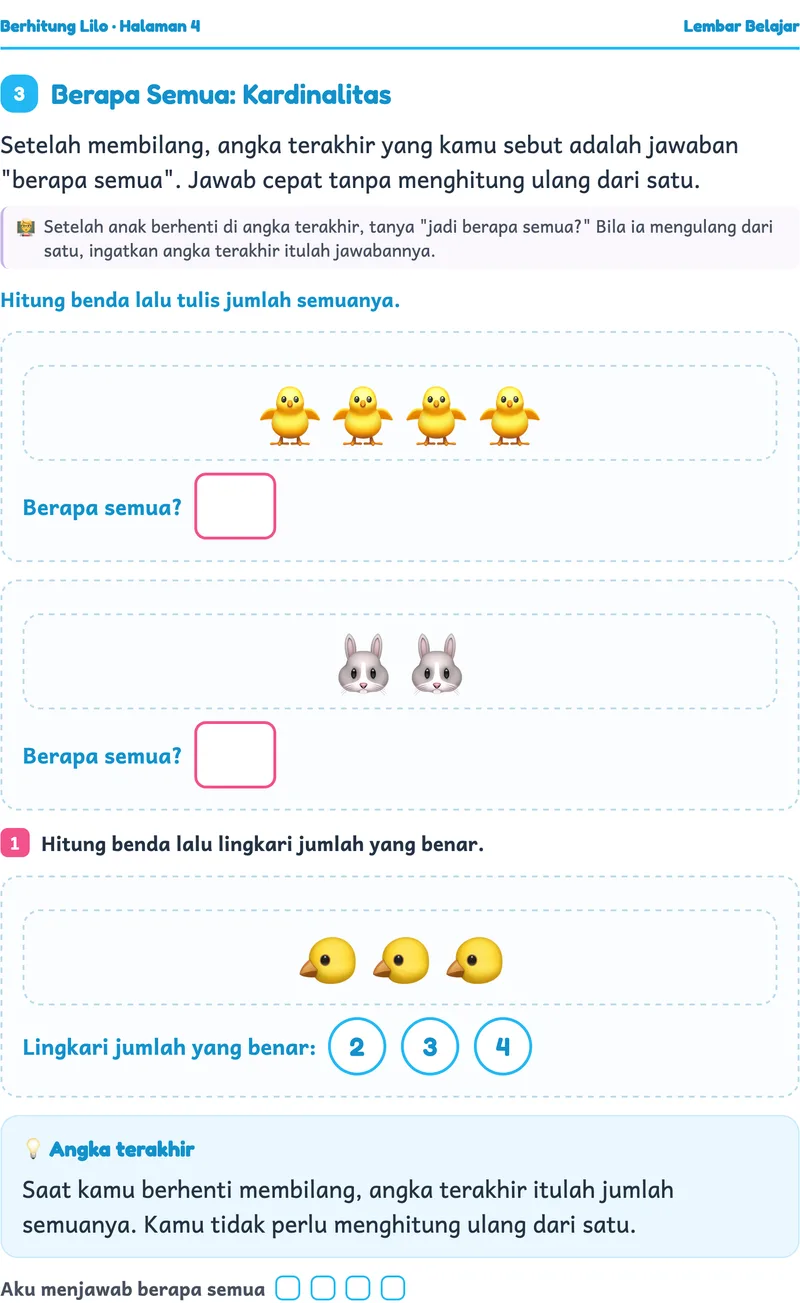
A real counting-module page: your child counts real objects one by one and names the total, a solid, concrete feel for numbers from the very start.
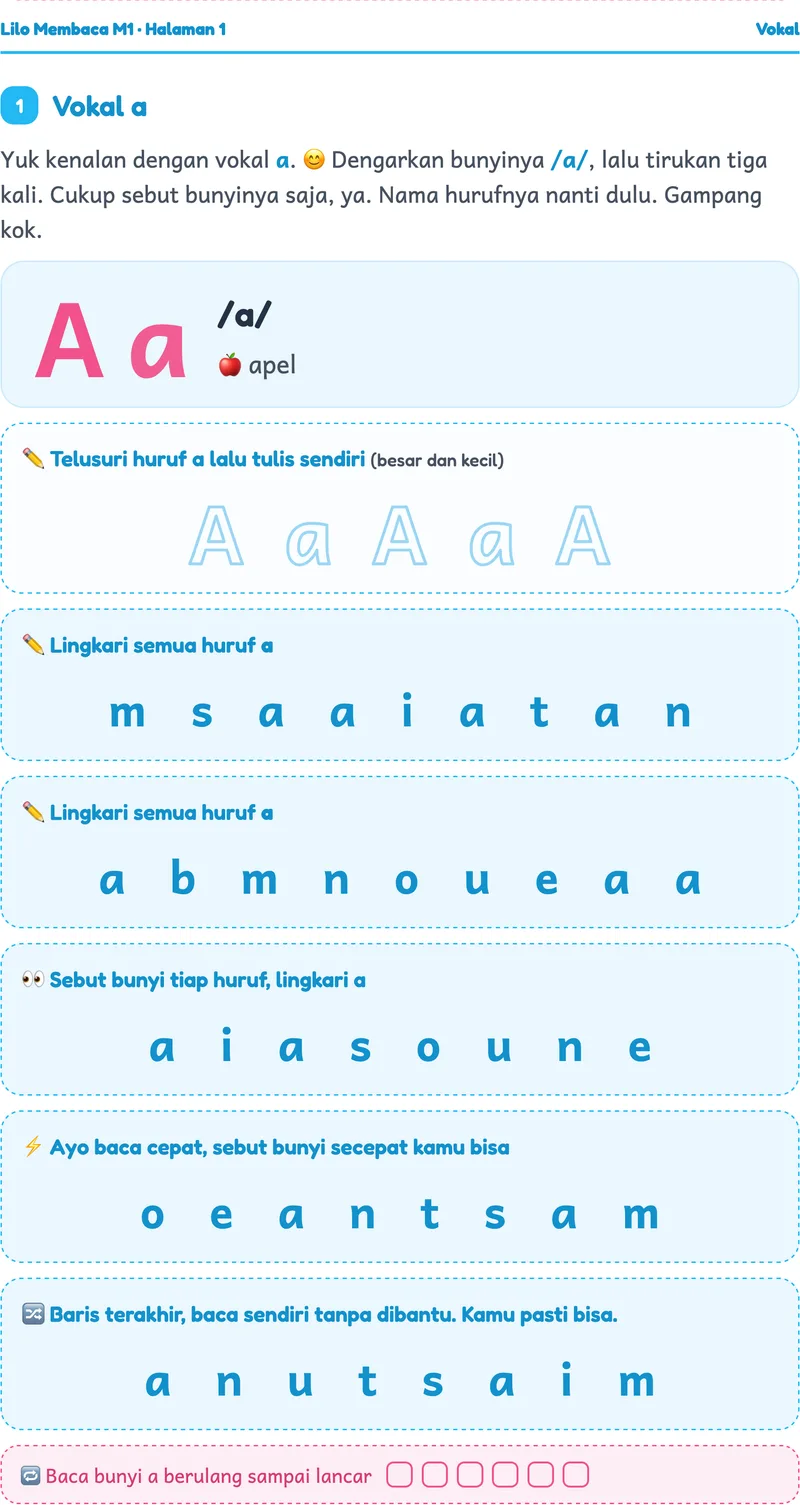
The vowel sound a opens the very first door to reading. On this Introduction Level sheet from the reading module, children meet it through cards, then point and read it again and again until it sticks.
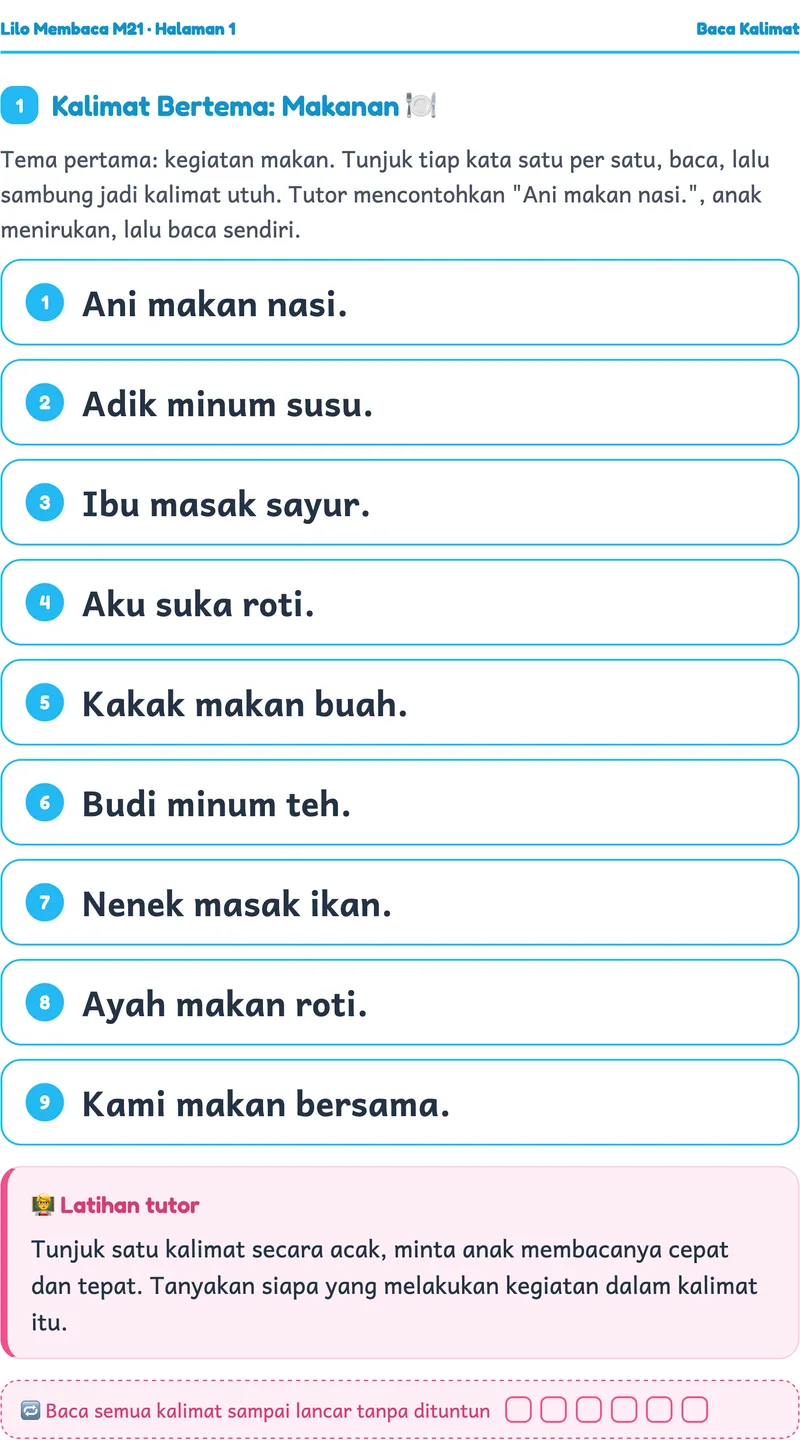
Short sentences about food are waiting on this reading-module sheet at Intermediate Level. Each sentence is read whole, the reward of all the sound and syllable practice the child has gathered so far.
These sheets are a small glimpse of Lilo's own progressive curriculum, carefully arranged across 122 modules.

Tell us about your child in a free WhatsApp consultation. We will recommend the right level and the right way to learn, and you decide the rest calmly.
Free consultation on WhatsApp