Ages 3 to 4: Meeting Sounds Through Play
Before any reading begins, your child gets to know sounds through songs, cards, and play. Short, cheerful sessions build the ear for letter sounds that everything else rests on.
Your child learns to read step by step, from single letter sounds to whole stories, moving up through seven clear levels with a tutor who checks real mastery at every stage.
Reading classes for kids in Bandung are guided reading lessons from Lilo for children ages 3 to 10, built on seven measured levels. Your child starts with letter sounds, blends them into syllables and words, and grows into reading whole passages with real understanding. A placement assessment finds the right starting level, and your child moves up only after mastering each stage.
Every child steps onto the ladder at a different rung. The placement assessment shows exactly where your child stands, so lessons feel doable from day one.
Before any reading begins, your child gets to know sounds through songs, cards, and play. Short, cheerful sessions build the ear for letter sounds that everything else rests on.
Kindergarten years are the sweet spot for learning to read. Your child works through vowel sounds, first consonants, and early syllables, arriving at primary school able to read simple words with confidence.
Early primary children who already read a little now work on longer sentences, punctuation, and intonation, then move into short passages they can retell in their own words.
If your child is past the usual age and reading still feels hard, the levels make catching up calm and shame-free. We start where your child truly is and climb steadily from there.
The path is simple and proven: hear the sound, blend the sound, read the word, understand the story. Each step is small enough to master and clear enough to measure.
Your child learns the sound each letter makes, like /m/ and /a/, through songs and sound cards. Knowing the sounds unlocks everything that follows.
We skip letter-name spelling drills completely. Your child glides sounds together into syllables right away, so reading feels like one smooth motion instead of a puzzle of letter names.
Your child moves up only after truly mastering a stage. Steady practice built level by level, in small daily portions, keeps progress calm and visible to you.
At the upper levels your child reads full sentences with natural rhythm, then short passages, answering who, what, when, where, and why questions and retelling stories in their own words.
Every stage stands on the one before it, so the foundation has no gaps.
Readiness shows up in how your child plays and talks. These signs help you see when to begin, and when the next rung is waiting.
Children in Bandung learn from 500+ selected tutors for young readers.
Graduates and current students alike.
Applications screened
Our team reads every application.
Identity and degree checked
Diploma and ID are reviewed.
Tutor profile filled in
Available hours are noted down.
Trained before teaching
Teaching starts after training.
Matching per child
Questions come from the child’s needs.
Tutor not quite right? See our free tutor replacement promise
Young children show their real ability when relaxed. So the first session is a game with no written test, and the tutor observes while playing along.
The result places your child on the L0 to L6 ladder, so the second session opens with the right practice.
Many everyday Indonesian words are built from open syllables, which end in a vowel. This shape lets your child read whole words early on.
Say buku, sapu, mata and kuda aloud. Each has two syllables, and each syllable follows one pattern: a consonant sound, then a vowel sound. That pattern runs through the words your child hears all day. Once a handful of letter sounds can be joined, a huge number of real words opens up, which is why L1 Open Syllables follows L0 Letter Sounds.
For a young mind, the syllable is the easiest slice of sound to grab. Preschoolers can usually clap along to ba-ju long before they can pull single sounds apart. When m and a join into ma, your child stores ma as one solid piece and reuses it in mama, mata and mati, leaving memory free for meaning.
The tutor builds this habit with syllable cards, sliding a consonant toward a vowel while stretching the sounds, mmm then a, until they merge into ma. Early readings use only mastered syllables, such as sapu and bola. At home you can watch the pause in sa, pu shrink until your child simply says sapu. Closed syllables like pintu wait at L3.
Your child meets the sounds of the vowels and consonants, plays with sound cards, and traces letters, building a sure ear before any word reading begins.
Sounds glide together into open syllables, then into words of two and three syllables, with timed reading sheets that let you see fluency grow week by week.
Your child conquers syllables that end in consonants, then the trickiest patterns in reading: digraphs, clusters, and diphthongs, taken slowly and with plenty of practice.
Reading turns into real speech. Your child reads sentences of 4 to 10 words with punctuation, intonation, and a steady rhythm that sounds natural aloud.
Mini stories bring everything together. Your child answers who, what, when, where, and why questions, finds the main idea, and retells stories with confidence.
A measured ladder only works when each rung is built with care. These are the signatures that make every level of the Lilo reading journey solid.
A child who knows letter sounds and blends them confidently will read almost anything; the ladder simply makes sure no rung is ever skipped.
Your child learns what each letter says, like /m/ and /a/, before anything else. Sounds are the true keys to reading, and we hand them over first, through songs and cards.
Sounds flow straight into whole syllables in one smooth motion. Your child never chants letter names to spell out a word, so reading feels fast, natural, and satisfying from the start.
Every reader your child opens contains only patterns already learned. That means every page ends in success, and success is what keeps a young reader coming back for more.
Patterns like ng, ny, and tr trip up more children than any other stage, so Level 4 gets the most patient treatment in the whole program, with extra practice and extra encouragement.
Seven rungs, each one mastered before the next, so you always know exactly where your child stands.
Most reading struggles come from a handful of well-meaning habits. Knowing them early saves your child months of frustration and keeps the joy in reading.
Why it happensChanting b, a, ba forces the child to translate names into sounds mid-word, which stalls blending and makes reading feel like heavy lifting.
How Lilo helpsTeach the sound each letter makes first, then blend sounds directly into syllables. The letter names can come later, once reading already flows.
Why it happensA child who recognizes the shape of m yet has no idea it says /m/ holds a key that opens nothing. Words stay locked.
How Lilo helpsPair every shape with its sound from day one, using sound cards and songs, so recognizing a letter always means hearing it too.
Why it happensA book full of unlearned patterns turns reading time into guessing time, and repeated guessing quietly teaches a child that reading is scary.
How Lilo helpsUse leveled readers that contain only patterns already mastered. Every page read alone becomes a small victory, and victories build readers.
Why it happensPatterns like ng, ny, and tr are the most common sticking point in the whole journey, and many programs rush past them.
How Lilo helpsSlow down on purpose at this stage. In Lilo, Level 4 receives extra care, extra practice, and extra patience until the combinations feel easy.
These are real A5 pages from Lilo's own curriculum, the very sheets your child will hold: sound cards, syllable builders, timed reading, and a passage with comprehension questions, each with a generous portion of practice.
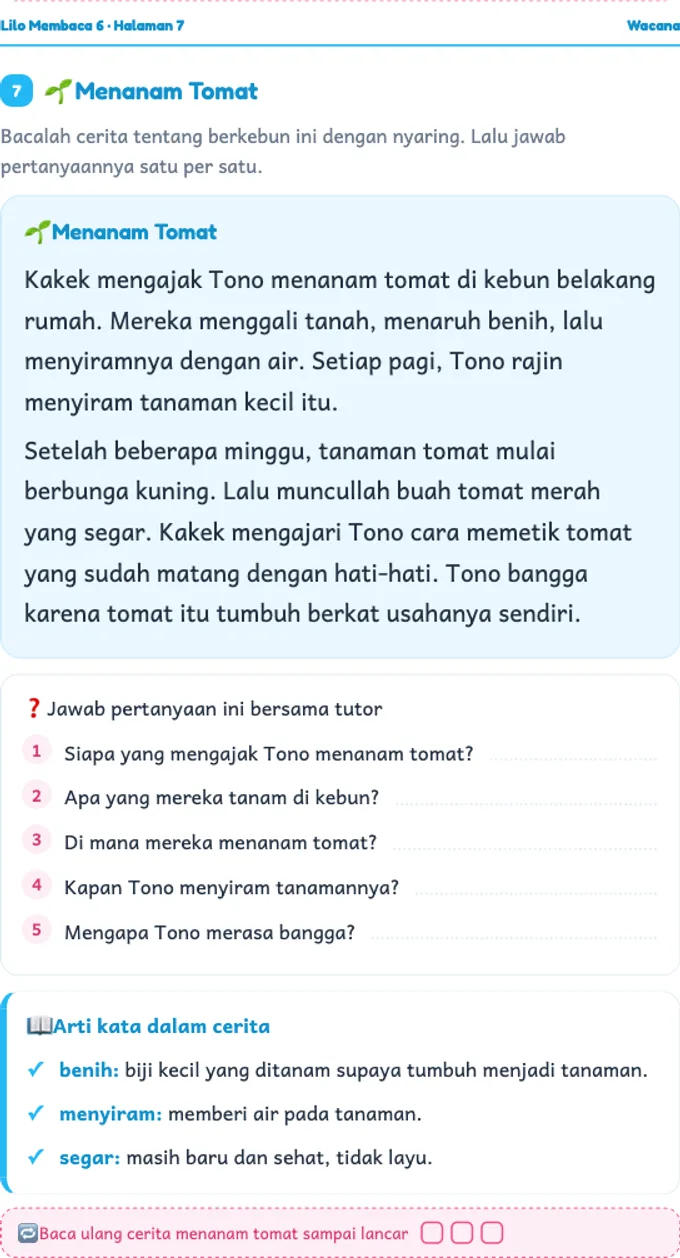
Grandma's Garden
That morning Tono went to the garden with Grandma. Grandma planted spinach and tomatoes. Tono watered the plants. They garden every Sunday. Tono is happy because Grandma's garden is thriving.
A short story sits beside 5W comprehension questions at Level 6. After reading, children work through what happened, who was involved, where, when, and why, then practice retelling the whole passage clearly.
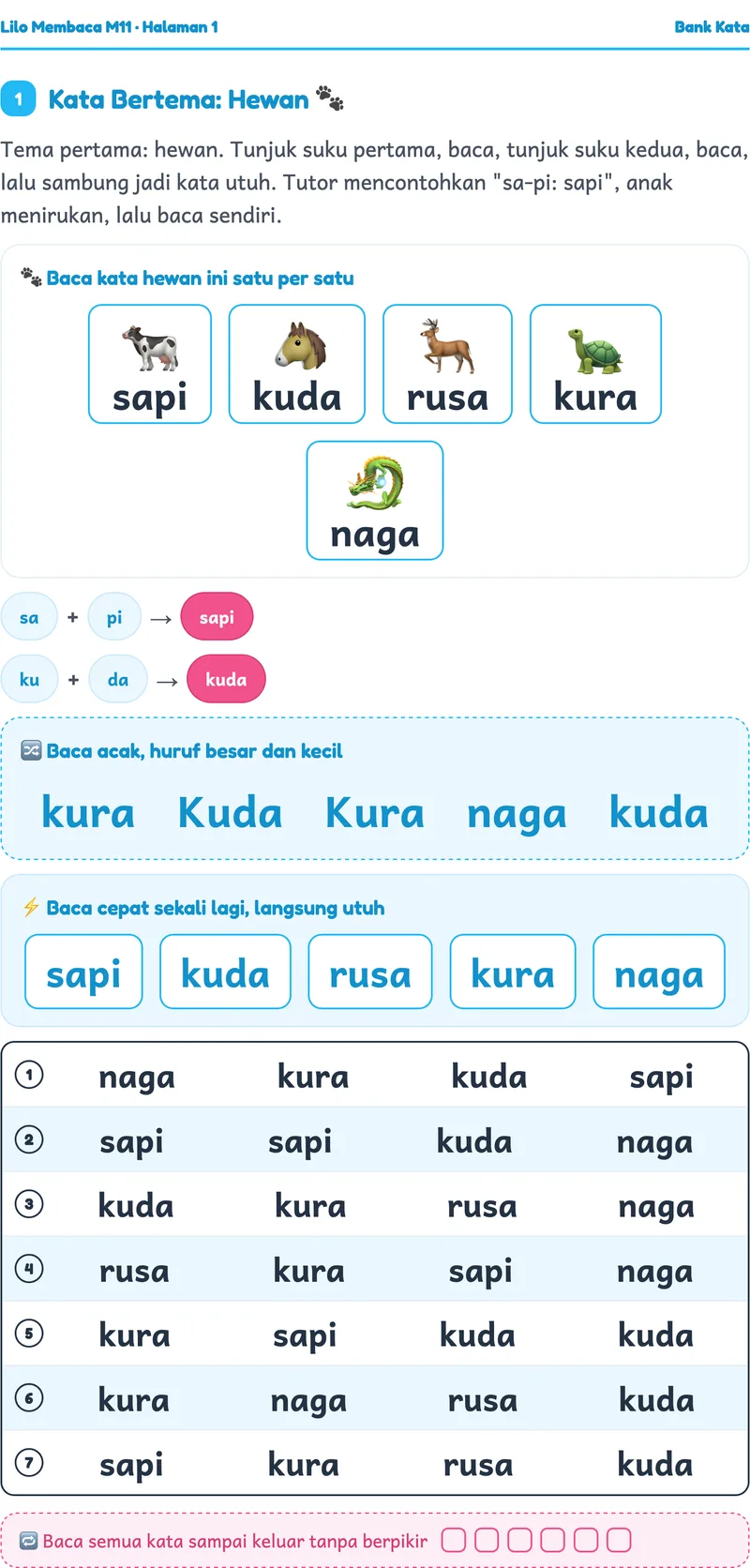
Sa-pi joins up to become sapi. That is how children work through this Level 1 sheet from module 11: pointing to each syllable, reading it aloud, then blending the pieces into whole themed words, with a speedy reading round at the end.
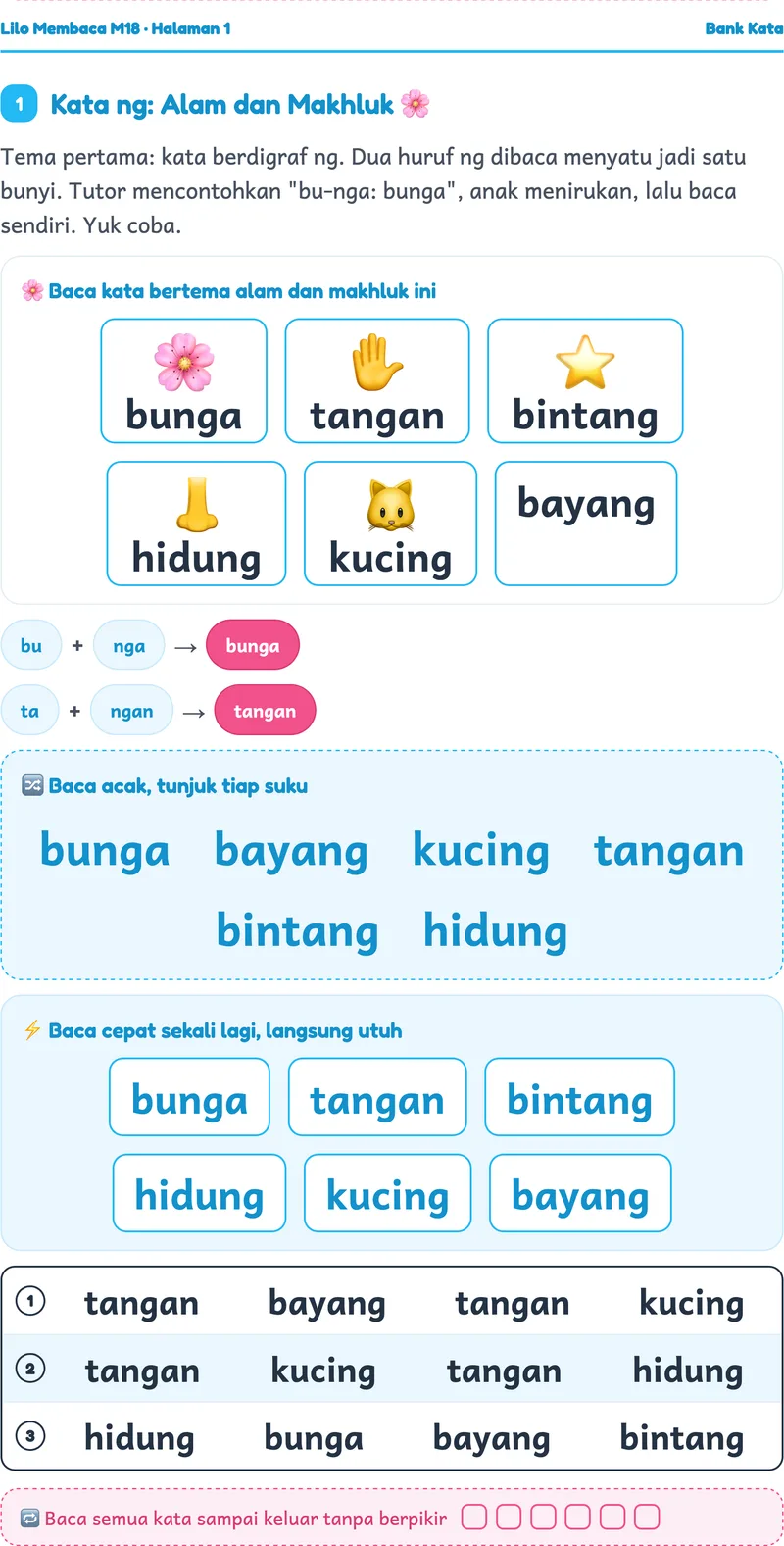
The letter pairs ng and ny trip up more young readers than any other stage. On this module 18 sheet at Level 4, extra support is built in, so children can work through each word calmly until it flows.
Every sheet belongs to Lilo's original leveled curriculum of 122 modules, with hearty practice portions that grow with each child.
Here is the journey for a 5 year old in Bandung learning face to face at home on the Intensive package, about three sessions a week, which keeps new sounds fresh.
Vowels and first consonants arrive through cards and songs, and your child starts joining ma and ba.
Sapu, bola and mata come out whole, and the pause between syllables shrinks week by week.
With the full consonant set, your child reads ibu beli roti and starts grasping what it means.
Closed syllables arrive in makan and pintu, and your child listens closely for final sounds.
Your child practises ng, ny, kh and sy in words like bunga and nyanyi, with extra practice.
This timeline is a general picture for this profile. Every child keeps a personal pace, and the tutor tunes practice to the current stage.
Folding clothes and a trip to the market or corner shop can become gentle reading practice, and your child gets to help out.
As you fold each item, clap its syllables: ba-ju, ce-la-na, ka-os. Your child claps along and counts, training the ear to split words.
clean clothes waiting to be folded
Write baju and kaos in big letters. Your child reads each card and places it on the matching pile, ideal practice at L1.
scrap paper, a marker, folded clothes
Write three open-syllable items such as gula, roti and susu. At the shop your child reads each one and ticks it off.
paper, a pencil, a shopping bag
Say: I spy something that starts with mmm. Your child guesses mangga or melon, then sets the next riddle, strengthening L0 sounds.
just eyes and ears
choose 60, 90, or 120 minutes
Contact us
60, 90, or 120 minutes per session
Contact us
duration of 60, 90, or 120 minutes
Contact us
Preparation is light, and a few small things make the first session comfortable, at your home in Bandung or online.
In the free consultation, share your child's age, the letters or words already known, and how you want to learn.
You can view the tutor's profile before the first session. Tell your child a little about the tutor to spark curiosity.
For home sessions, prepare a low table, good light and a spot away from the television, with room for the cards.
The link and worksheets arrive before class through app.lilo.id. Print the sheets and set the screen at your child's eye height.
Bandung is the capital of West Java Province, set in the cool Priangan highlands. The city has long carried proud nicknames such as the City of Flowers and Paris van Java, and it is widely recognized as a creative city where curiosity and new ideas flourish. Its reputation as one of Indonesia's respected centers of learning is a source of pride for its people, and the fresh mountain air makes it a pleasant place to grow and study.
Your Lilo teacher travels to your house anywhere in our Bandung service areas. At a familiar desk in a quiet corner, your child settles in to learn, and you see up close how each session goes.
Online sessions run live with a teacher, using the same materials and levels as face-to-face lessons. This option gives your child's study schedule in Bandung more room to flex.
Your child begins where their skills stand today and climbs gently, one small step after another, with regular practice that feels like fun. Every stage is built so the idea is fully clear to your child before the next one opens.
Families in Bandung have several honest options. Here is how they compare, so you can pick what truly fits your child.
| Aspek | Lilo | Learning Apps | Big Group Classes |
|---|---|---|---|
| How progress is measured | Seven measured levels with a placement assessment and mastery checks | Points and streaks inside the app | One shared pace for the whole class |
| Attention on your child | A live tutor, one on one or in a small group | The screen responds, and a grown-up nearby helps when stuck | One teacher shared among many children |
| When your child gets stuck | The tutor notices right away and adjusts the lesson on the spot | The app repeats the exercise | Help arrives when the teacher can reach your child |
| Reading materials | Leveled readers containing only patterns already learned | Digital exercises chosen by the app | One shared book for the whole class |
| Fit with your schedule | Sessions arranged around your family, at home or online | Anytime, as long as screen time allows | Fixed class timetable |
Each weekly report from the tutor records the sounds and words your child has mastered, so you can watch them climb the phonics levels from L0 through L6. Sessions take place in an online class from IDR 76,865 a session or in your home from IDR 107,611, and payment is made in one go for the package you choose.
Your child points at letters and wonders how they sound.
IDR 430,444Some letter sounds are already familiar, and steady progress through levels feels next.
IDR 846,694Reading aloud still stumbles, and closer, more frequent practice would help.
IDR 1,248,751Your child wants to climb every phonics level until reading flows.
IDR 2,369,758From the very first session.
Just tell us, any time.
Here is how:
A full report follows each month.
A reading class rests on a clear sequence and on materials written for it. These questions work with any provider you are weighing.
Coded stages tell you where your child stands and what comes next. At Lilo the ladder runs from L0 Letter Sounds to L6 Passages.
Materials written for one sequence stay in step with your child's stage. Lilo teaches from its own 122 coded modules.
Unfamiliar sounds force guessing, and wrong guesses wear down confidence. Lilo readers use only sounds your child already owns.
Progress shows in small changes. Your Lilo tutor notes them in a weekly report, for example that open-syllable words now flow without pauses.
Children read best with someone who puts them at ease. At Lilo the tutor is replaced free of charge, and that is our service promise.
Progress is never a vague feeling. Your child climbs a named ladder from Letter Sounds to Passages, and you know the exact level at every moment.
Lilo teaches from its own curriculum of 122 leveled modules across its programs, so every worksheet your child touches was designed for this exact journey.
New ideas arrive the Singapore Math way: something your child can touch, then a picture, then the written form. Understanding comes before memorizing.
Lilo tutors are verified before they ever meet your child, and they travel to homes across Bandung, from Dago and Sukajadi to Buah Batu and Antapani.
Lessons can run in English or Indonesian, whichever suits your family. This is a reading program taught in English, with the same seven levels underneath.
Small daily portions, built level by level, turn reading into a calm routine. Your child practices a little every day and the levels take care of the rest.
Alesha is the type of child who gets bored easily. Somehow with her Lilo tutor she stays engaged, she says learning feels like playing. Now she sounds out every bit of writing she sees on the street.
Keira now loves pointing at shop signs and sounding them out slowly. Her tutor is so patient, and there is a report after every session so I always know how far along she is.

A free consultation on WhatsApp is all it takes to begin. Tell us about your child, arrange the placement assessment, and watch the climb through seven levels start.
Start with a free consultation