


Ages 3 to 4, meeting sounds through play
Your child is curious about books but has never studied letters. Lessons feel like play: songs, sound cards, and short cheerful activities that plant the first vowel and consonant sounds gently.
A structured reading program for children aged 3 to 10. Your child starts with letter sounds, climbs through seven clear levels, and finishes able to read a passage and answer who, what, when, where, and why.
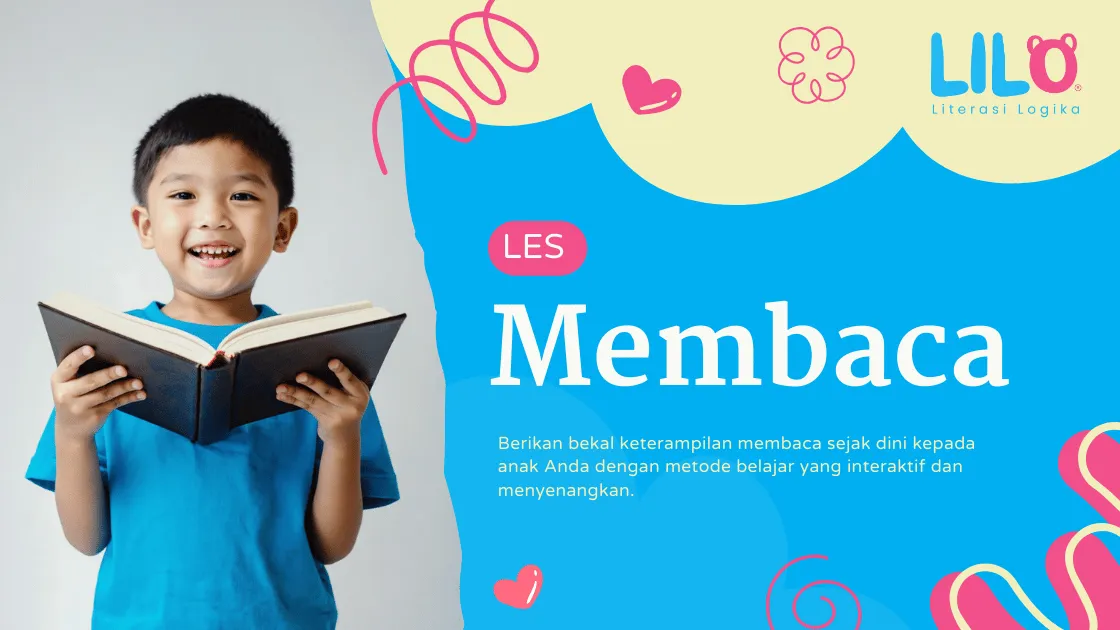
Reading classes for kids in Bekasi are guided lessons from Lilo that take a child from first letter sounds to reading a short passage and answering the 5W questions: who, what, when, where, and why. Lessons run at home, in small groups, or online, follow seven measured levels, and begin with a placement assessment so your child starts exactly where they are.
Every child arrives at reading on their own schedule. The placement assessment finds the right starting level, so lessons feel doable from day one and confidence grows with every page.
Your child is curious about books but has never studied letters. Lessons feel like play: songs, sound cards, and short cheerful activities that plant the first vowel and consonant sounds gently.
Kindergarten years are the heart of the reading journey. Your child blends sounds into syllables, builds first words, and walks into primary school already comfortable with short sentences.
Your child can read but stumbles on longer sentences or tricky letter combinations. Lessons strengthen fluency, add punctuation and intonation, and open the door to real stories.
Some children reach school age before reading clicks. The program meets them at their true level and moves forward calmly, with no shame and no comparison to classmates.
Every lesson follows the same honest logic: master the sounds, blend them, read whole sentences, then talk about what the story actually says.
Your child learns what each letter says, like /m/ and /a/, before anything else. We skip letter-name spelling drills entirely, because names of letters do help a child sing the alphabet but sounds are what unlock reading.
The sounds slide straight together into syllables, then into real words. Because your child already owns each sound, blending feels like a small satisfying click, and new words open up quickly.
At the upper levels your child reads full sentences with punctuation and natural intonation. Reading starts to sound like talking, which is exactly when children begin to enjoy it.
The journey ends in understanding. Your child reads short passages, answers who, what, when, where, and why, finds the main idea, and retells the story in their own words.
The pace of moving up follows your child, so learning stays calm.
Reading readiness shows up in small moments of play and talk. These three groups of signs help you guess a starting point and notice when your child is ready for the next stage.
Bekasi and its surroundings have 80+ tutors for young readers.
Some still studying, others graduated.
Applications screened
Suitable applicants move forward.
ID card and diploma verified
ID card, diploma and photo are checked.
Experience and hours recorded
We know when each tutor is free.
Trained before teaching
The step-by-step method is learned first.
Chosen for your child
The team scores every answer.
Tutor not quite right? Free tutor replacement, here is how
The first session feels like play, with no written test. While playing, the tutor listens to the sounds your child makes and settles on the stage code where practice begins.
The tutor picks up something on the table, a ball or a spoon, and invites your child to guess its first sound. Answering /b/ for bola shows L0 is already in place.
Two cards, ma and ta, wait to be joined. If mata comes out smoothly, the tutor tries sapi and topi to see whether L1 and L2 are secure.
Next come words like ikan, lampu, bunga and nyamuk. The tutor listens for a stumble on the final sound or on ng and ny, which point to L3 and L4.
A child who reads comfortably this far reads two short sentences, then retells them in their own words. Fluency and understanding decide between L5 and L6.
The code chosen is the last stage your child handles comfortably, so the next session continues straight from there.
Your child meets the vowel and consonant sounds through sound cards and letter tracing, building the ear and the hand at the same time.
Sounds join into open syllables and grow into words of two to three syllables, with timed reading sheets that make progress visible and fun.
Your child masters syllables that end in consonants, then the trickier digraphs, clusters, and diphthongs, the patterns where most young readers need patient help.
Sentences of 4 to 10 words, read with punctuation, rhythm, and intonation, so reading aloud starts to sound smooth and confident.
Mini stories with 5W questions, main idea work, and retelling. This is where reading turns into understanding, the true finish line of the program.
Understanding grows once the eyes and mouth work easily. Here is what happens in your child's head while reading, and how the tutor shapes practice around it.
While reading, a child's mind uses a small workspace to hold sounds, words and meaning at once. A child still building every syllable with effort spends nearly all of that space on decoding. Take the sentence Adik makan pisang di bawah pohon. By the time your child struggles through pohon, adik has faded from memory. Every word gets read, and the question of who was eating draws a blank, because meaning found no room.
Fluency frees that space. When syllables like ma, kan and sang are recognised instantly, attention moves from sounds to story. Fluent reading is accurate, with a natural rhythm and pauses at punctuation, at a comfortable pace. That is why Lilo's texts use only sounds already mastered, so almost every word on a numbered reading sheet reads without a stop. Your child rereads the same sheet until it sounds like talking.
The tutor keeps fluency and understanding walking together. After a short story, your child answers questions about the characters, the setting and why someone acted as they did. A child who reads smoothly and then goes quiet when asked learns to pause at each full stop and picture the scene. At home the signs are easy to spot: the voice rises at a question mark, rests at a comma, and laughs at the funny part unprompted.
Lilo teaches reading from its own original curriculum, 122 leveled modules across our programs, written so every page matches exactly what a child has already mastered.
Lessons start with what letters say, never with reciting their names. Because the sound is the working part of a letter, your child can attack unfamiliar words independently instead of freezing.
Sounds blend directly into whole syllables, so reading feels like flowing speech from the very beginning. Your child hears words come alive early, which keeps motivation high.
Our leveled readers contain only patterns your child has already learned. Every book is a book they can genuinely finish, and finishing books is how young readers fall in love with reading.
Combinations like ng, ny, and tr are the hardest stage for nearly every child, so our curriculum slows down there on purpose, with extra practice and extra patience.
Your child moves up only after truly mastering each rung, so the climb is steady and confidence never cracks.
Most reading struggles come from a handful of well-meaning habits. Knowing them early saves your child months of frustration and keeps the joy in learning.
Why it happensReciting b, e, b, e leaves the child assembling names, and names carry no clue to how a word actually sounds, so blending stalls.
How Lilo helpsTeach the sounds first. A child who knows /b/ and /e/ slides them together naturally, and reading starts to flow.
Why it happensA child can point to every letter on a poster yet stay unable to read, because recognition without sound is a picture quiz, never reading.
How Lilo helpsPair every shape with its sound from the first meeting, using sound cards and tracing so the ear and eye learn together.
Why it happensA book with patterns the child has never learned turns every page into guesswork, and repeated guessing quietly teaches a child that reading is scary.
How Lilo helpsUse leveled readers that contain only mastered patterns. Finishing an easy book builds the confidence that carries a child to harder ones.
Why it happensPatterns like ng, ny, and tr are the most common sticking point for young readers, because two letters suddenly make one new sound.
How Lilo helpsSlow down at this stage on purpose. Lilo gives Level 4 extra practice and extra patience, so the hardest step gets the gentlest handling.
Why it happensA bored child stops trying long before they stop being able. Repetition without warmth drains the fun that fuels early learning.
How Lilo helpsKeep portions small and lively: songs, cards, short wins every session. Steady daily practice works best when the child enjoys showing up.
These are real A5 pages from Lilo's original curriculum, the exact sheets your child will work through. Each one gives a generous portion of practice, from first sound cards to a full passage with 5W questions.
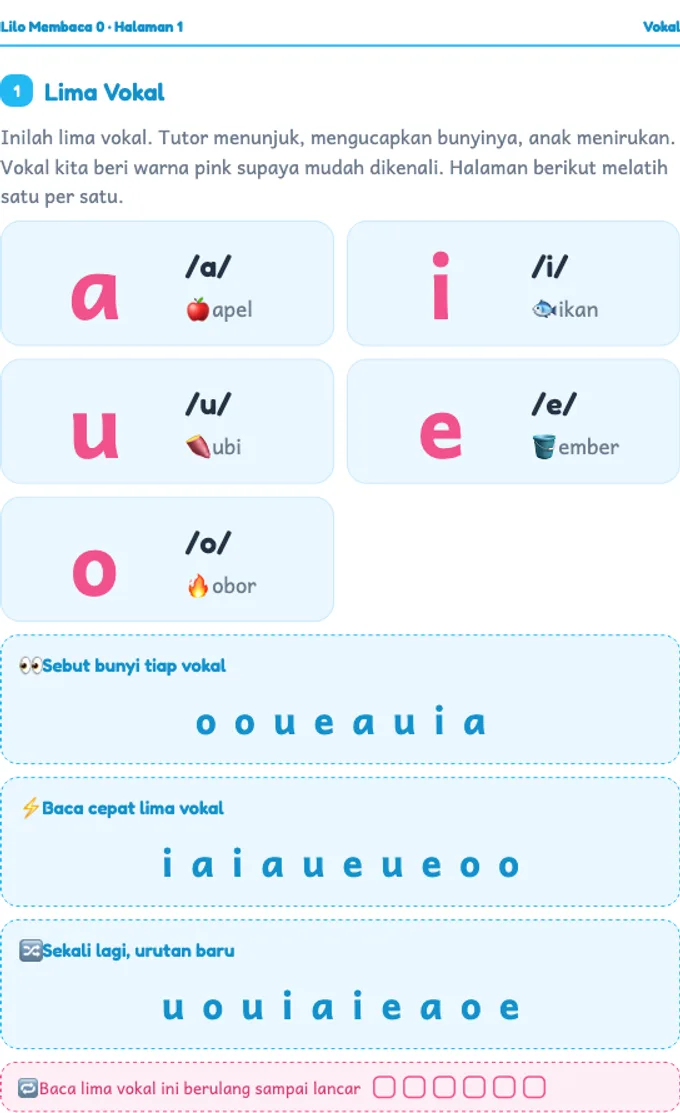
At Level 0, children meet letter sounds through simple cards: the vowels a i u e o and the consonants m, b, s. Each card is voiced again and again until it flows, then a quick reading drill locks it in.
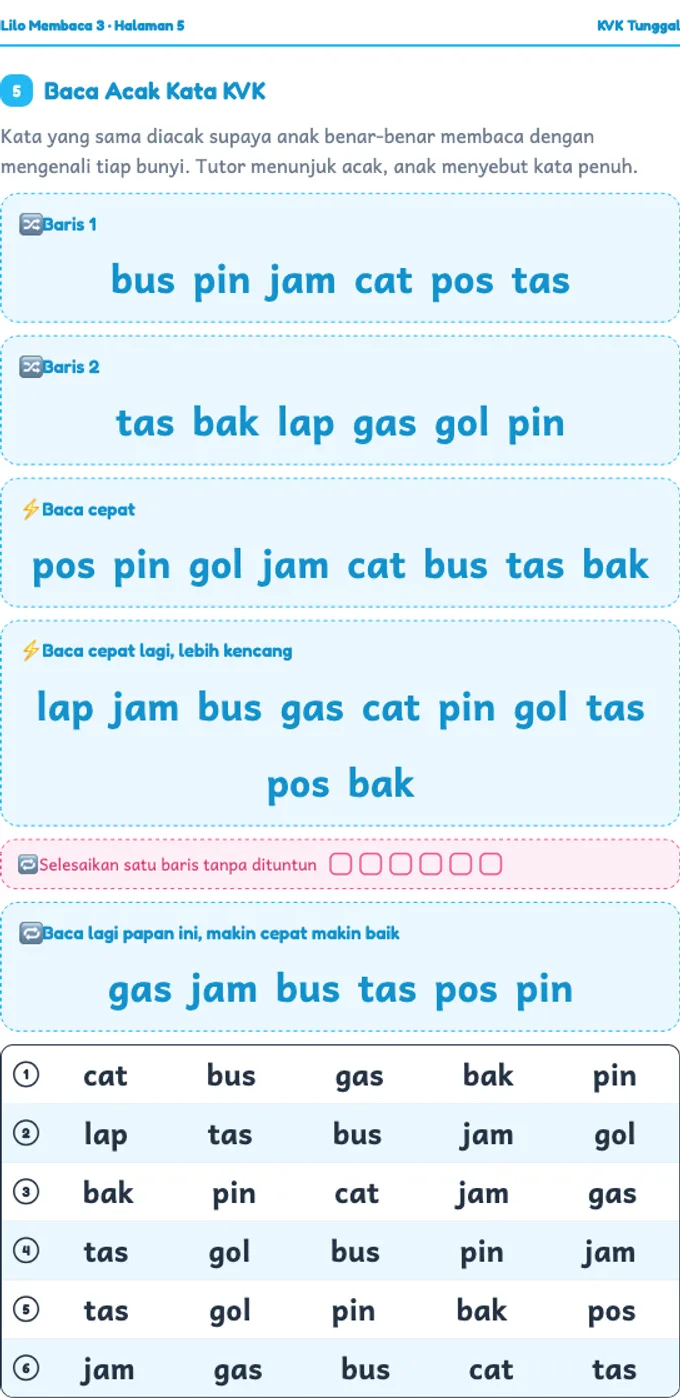
At Level 3, children work through rows of short words with a timer, including words that close with a consonant. Timed repetition builds fluency and trains the eye to catch every final letter accurately.
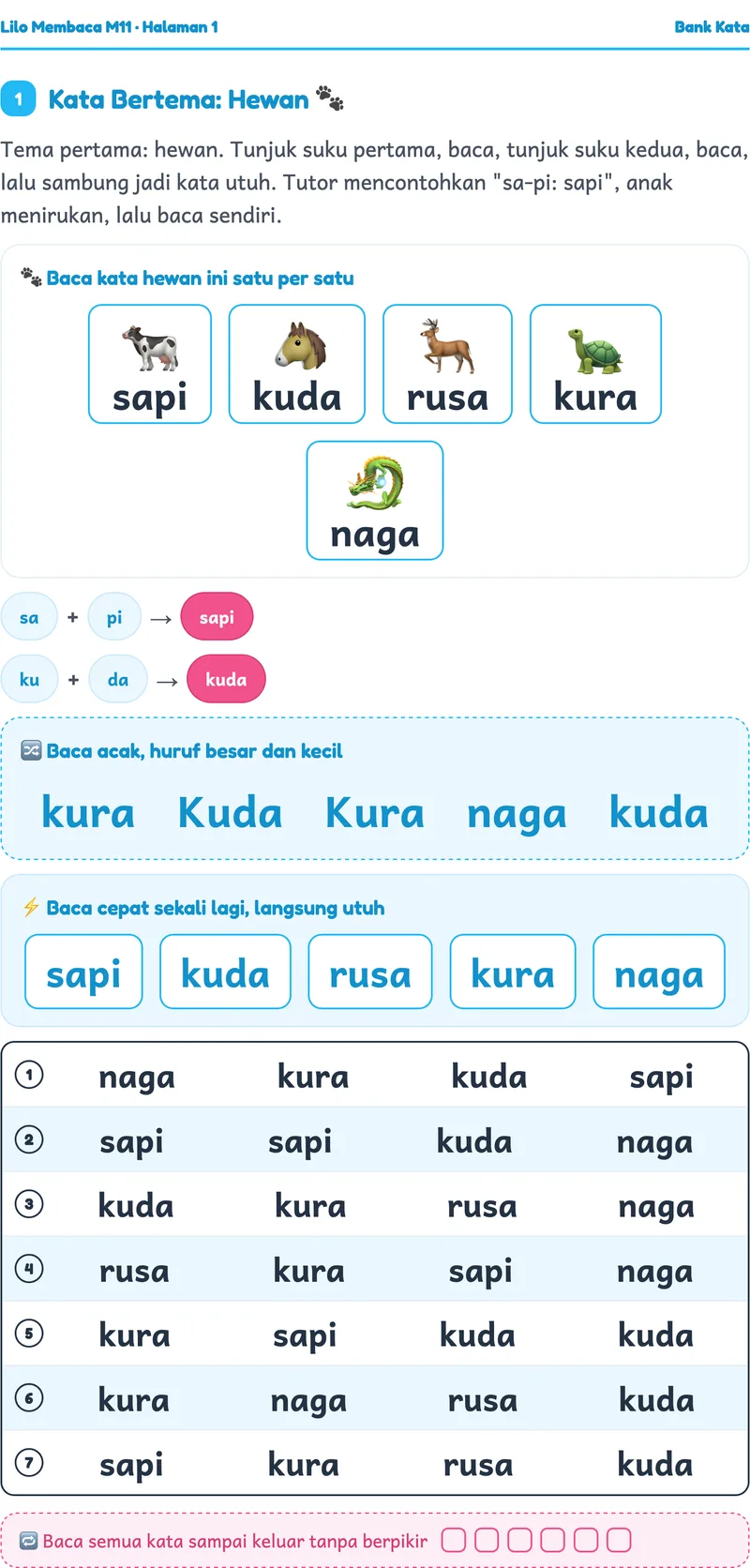
This Level 1 sheet from module 11 works on themed two-syllable words. Children point to each syllable, read it, then join the parts into a whole word, like sa-pi becoming sapi. A quick-read round wraps it up.
Samples from Lilo's original curriculum. The full A5 materials are prepared by the tutor at each session.
The bathroom and the garden are places children love. These activities bring reading practice there without a book, each one working on a clear stage.
For L0. At bath time, hold up one toy and say its first sound clearly: bebek, /b/. Ask your child to find something else in the bathroom with the same sound, like busa or baskom. Say the sound only, leaving the letter name aside.
a rubber toy or shampoo bottle
For L1. Once the mirror fogs, write ka and ki with a fingertip, ask your child to read them, then join them into kaki. Try su and su for susu, and let your child write one syllable for you to read.
the bathroom mirror after a warm bath
For L0 to L2. Choose one sound, say /d/, then hunt for daun, dahan or anything else starting with it and drop it in the basket. A child at L2 can read a short word you write for each find.
a small basket and garden finds
For L4. Write plant names holding letter pairs, such as bunga, pisang or kangkung, on ice cream sticks. Your child reads each stick and pushes it in beside the right plant. Model ng slowly as one single sound.
ice cream sticks, a marker, pots or beds
This picture fits a three-year-old meeting guided learning for the first time, on the Starter package of four sessions a month, roughly once a week. The rhythm stays light, matched to how long a child this age can sit.
Your child learns there is a special time for sound games with the tutor, copies animal and object sounds, and sits a little longer each week.
Your child recognises /a/, /i/ and /u/ on sound cards and happily points out the same letters on book covers and packaging at home.
Your child names the first sound of everyday words, /m/ for mama and /b/ for bola, and begins hearing separate sounds inside a word.
Through songs and games your child tries sliding /m/ and /a/ into ma. Small praise after each success keeps the game irresistible.
Around age four, with sounds feeling secure, your child starts building ba, bi and bu, then short words such as bola, with portions growing gently.
Every child travels these stages at their own pace. What matters most is the delight your child feels at each meeting with the tutor.
duration of 60, 90, or 120 minutes
Contact us
60, 90, or 120 minutes
Contact us
60/90/120 minutes
Contact us
How well tutor and child click decides how freely your child reads aloud. That is why matching starts carefully from your very first message.
The consultation is free. Share your child's age, the sounds or words they already know, how they warm up to new people, and whether you want home visits in Bekasi or online classes.
The team weighs your child's needs across a network of 5,000+ active tutors, many trained in primary teaching, early childhood education, psychology or mathematics. A three-year-old, for example, is paired with someone at ease teaching through play.
You can view the chosen tutor's profile before the first session. You know who will sit beside your child, and you can mention the tutor's name to your child the day before.
The first meeting opens with a relaxed sound game. The tutor finds your child's starting point while you watch whether your child feels comfortable following along.
Every path has honest strengths. Here is a fair look at what each one offers a young reader.
Seven measured levels with a placement assessment at the start
A verified tutor, live, adjusting to the child in the moment
The tutor hears the exact error and fixes it on the spot
Leveled readers containing only patterns already learned
A child who reads a passage and answers the 5W questions
The starting point is the phonics level code your child is working on now, such as L1 or L4, so the first session picks up right where their skills stand. Payment covers a whole package at once, at IDR 76,865 or more per session. Lessons happen at home with a tutor or in an online class, and your child moves up once sounds and blending feel secure.
A short opening package to meet the tutor and gauge the phonics level.
IDR 584,174Twice the length of the opener, paced to climb one level steadily.
IDR 1,149,085Denser than Regular, giving extra help where blending sounds still stalls.
IDR 1,694,733The longest stretch, with time to travel the phonics levels in order to fluency.
IDR 3,216,100At home or online, the same.
Just tell us, any time.
Here is how:
Topped up by a monthly report.
The quality of reading lessons shows most clearly in what your child holds during a session and what comes home afterwards. Ask any provider in Bekasi these questions.
General books often contain letter pairs a child has never met, so reading turns into guessing and quick discouragement. Texts built step by step keep every page finishable. Lilo teaches from its own curriculum of 122 coded modules, ordered from first sounds to passages.
One worksheet for every child leaves some bored and others overwhelmed. Ask where the sheets come from and how their level is chosen. At Lilo, worksheets come out of whichever module is in progress that week, so they always match the lesson.
Piles of homework make reading feel like a punishment, and vague tasks rarely get done. Good homework is short with a clear purpose. Every Lilo session closes with a summary of what was mastered and one small task of about ten minutes.
Reading progress arrives in small steps that are easy to miss without a written record. Ask to see a sample report. Lilo tutors send one every week, noting for example that bunga now reads without a pause and ny comes next.
Reading aloud needs a sense of safety, and a child uneasy with a tutor tends to go quiet. Make sure there is a clear way forward from day one. Lilo replaces the tutor free of charge whenever the fit is wrong, and the team handles the search.
The program is finished when your child reads a passage and answers who, what, when, where, and why. Sounding out words is the start; grasping meaning is the destination.
Lilo teaches from its own 122 leveled modules, moving from concrete objects to pictures to symbols, the same careful sequence used in Singapore Math.
Verified tutors teach one on one at home for families across Bekasi, from Bekasi Selatan and Pondok Gede to Harapan Indah and Tambun.
Your child moves to the next level only when the current one is truly solid. Steady practice built level by level, delivered with warmth and play.
Lessons can run in Indonesian or English, a natural fit for bilingual and national-plus families who want reading taught in the language of their home.
Bekasi sits in West Java Province, right on the Jakarta border, and is a key piece of the wider Greater Jakarta region. People here proudly call it Kota Patriot, the Patriot City, a title earned through a long history of struggle that residents still hold close. The city spreads across Bekasi Selatan, Bekasi Timur, Pondok Gede, Jatiasih, Harapan Indah, Mustikajaya, Rawalumbu, and Tambun. Here, a love of learning passes forward and grows stronger with each new generation.
Lessons happen where your child feels most at ease: at home. A Lilo tutor travels to your part of Bekasi at the times you pick, so your child settles in calmly and opens up to learning fast.
Lessons are arranged in clear stages, starting from the simplest. Children begin with real objects, move to pictures, then to letters and numbers. Each stage is mastered first, so understanding and confidence grow together.
Every session is recorded carefully. You receive regular progress reports, so you know exactly which skills are already strong and which parts your child is currently practicing with the tutor.
Sharon loves having us read the first page, then she reads the next one herself. It is so sweet to see her that confident now.
Lilo Reading Classes made such a difference for my child. The method really works, and their reading has come on so much. We're so happy with it.

Start with a free consultation on WhatsApp. Tell us about your child, and we will suggest the right level and format, at home in Bekasi, in a small group, or online.
Starting level found in the first lesson