
Ages 3 to 4, meeting sounds through play
Before reading begins, your child plays with sounds. Songs, sound cards, and playful games build a friendly first bond with letters, with no pressure to perform.
Every child starts with a short placement assessment, so lessons begin at the stage that fits. From there, seven measured levels carry your child from letter sounds to reading whole passages with understanding.
Reading classes for kids in Bogor are guided lessons that teach children aged 3 to 10 to read through letter sounds, taught in English by verified tutors. Lilo opens with a placement assessment, places your child on one of seven levels, and moves up only after each stage is mastered. Lessons are available at home, online, or in a small group.
The placement assessment means there is no single starting line. Wherever your child is today, that is exactly where the lessons begin.
Before reading begins, your child plays with sounds. Songs, sound cards, and playful games build a friendly first bond with letters, with no pressure to perform.
Kindergarten years are the heart of the reading journey. Your child learns letter sounds, blends them into syllables, and reads first words with growing confidence before school starts.
Early primary children polish longer sentences, punctuation, and intonation, then step into short passages with real understanding. Reading turns from effort into enjoyment.
A child who reads below their grade catches up quietly and kindly. The assessment finds the true starting point, and steady wins rebuild confidence without shame.
Bogor sits in West Java Province and proudly carries the name Rain City. Its air stays cool, its streets feel green and calm, and its best-known treasure is the Bogor Botanical Gardens, counted among the oldest and most respected botanical gardens in Southeast Asia. Mount Salak rises gently behind the city and can be seen from many neighborhoods. The city covers Bogor Tengah, Tanah Sareal, Bogor Utara, Bogor Selatan, Bogor Barat, and Bogor Timur, and it extends to Sentul and Cibinong. Lilo welcomes every young learner in Bogor. A teacher can visit your child at home, and online classes are open whenever your child learns better on a screen.
Across Bogor's service areas, a Lilo teacher comes straight to your door. Your child learns in familiar surroundings, and you settle the schedule with the teacher right at the start.
Lessons follow a clear order. Your child starts with things to hold, moves on to pictures, and then works with symbols. Each stage is secure before the next one begins, so understanding runs deep and confidence grows.
You receive regular notes on your child's development from the teacher. What has been mastered, what is being practiced, and the next step, all explained in language that is easy to follow.
The method is simple to describe and careful in practice: find the right stage, teach the sounds, blend them, then read for meaning.
In the first meeting, the tutor observes what your child already knows about sounds, syllables, and words. That picture decides the starting level, so no lesson is ever too hard or too easy.
Your child learns the sound each letter makes, like /m/ and /a/, through songs and sound cards. Lilo skips letter-name spelling drills, because sounds are what actually join together into words.
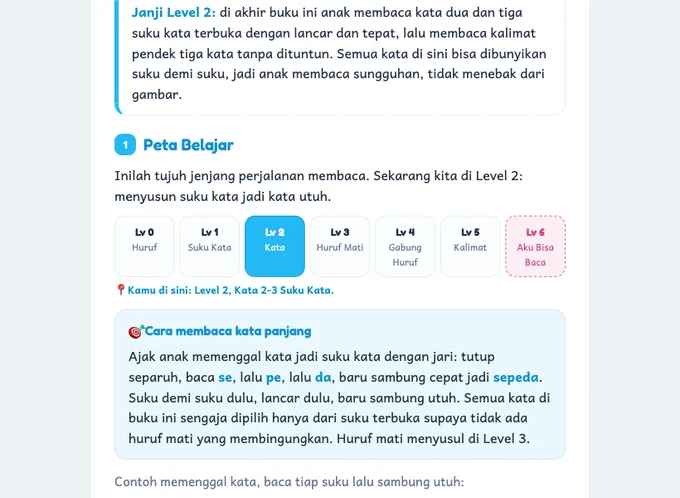
Once the sounds are secure, your child slides them together into syllables, then into two and three syllable words. Blending feels natural because every piece was mastered beforehand.
At the upper levels your child reads full sentences with punctuation and expression, then short passages. Questions about who, what, when, where, and why turn reading into thinking.
The sequence is tight, so nothing gets skipped as your child moves up.
Lilo controls the order of reading texts tightly. Your child only meets words they can decode alone, and the reason lies in how reading takes hold.
Early reading is the work of blending. Seeing susu, your child says /s/ and /u/, merges them into su, then repeats it, and that effort takes all their attention. When every sound is secure, the blend succeeds and the word is stored. After many successes it is recognised at a glance, freeing attention for meaning.
Picture a child who knows a, i, u, b, s, and k meeting the word nyanyi. The sound ny was never taught, so the blend breaks and the child guesses from the picture. A lucky guess feels like success, and the habit grows into a reader who manages picture books and stalls on full pages.
So the tutor builds texts only from mastered sounds. That same child reads Bibi suka susu, decoding every word alone, and each new sound enters the texts once it is secure. Try it at home: cover the picture with your hand, and a child reading by sound still reads the sentence.
These signatures come from our own curriculum of 122 leveled modules, refined so each stage prepares the next one exactly.
A child who starts at the right level learns faster than a child who starts at the front of someone else's book.
Your child learns what each letter sounds like before learning what it is called. Sounds are the working parts of words, so this order makes blending feel obvious instead of mysterious.
Our leveled readers contain only the patterns your child has already learned. Every page is readable without help, which is where real reading confidence is born.
Combinations like ng, ny, and tr trip up more young readers than anything else. Our curriculum treats this stage as the hardest one and slows down deliberately to secure it.
The placement assessment tells us which rung your child stands on today, and the ladder shows exactly where the journey goes next.
Most reading struggles come from well-meant habits. Knowing these early saves months of frustration for you and your child.
Why it happensA child who chants the alphabet can still be unable to read, because names like 'em' and 'ay' never appear inside words. Sounds do.
How Lilo helpsTeach the sound first: /m/, /a/. Once sounds are secure, blending into syllables happens almost by itself, and letter names can follow later without harm.
Why it happensRecognizing shapes is a memory trick, and memory runs out fast when words get longer. Reading needs the sound behind each shape.
How Lilo helpsPair every letter shape with its sound from the very first meeting, using sound cards and songs, so shape and sound are learned as one thing.
Why it happensA book full of patterns your child has never learned turns reading into guessing, and repeated guessing turns into avoidance.
How Lilo helpsUse leveled texts that contain only patterns already mastered. Each finished book becomes proof of ability, and the next level is always one small step away.
Why it happensCombinations are the most common sticking point in the whole journey. Treated as a quick footnote, they resurface as stumbles for years.
How Lilo helpsGive this stage extra time and extra patience. Our curriculum marks it as the hardest level on the ladder and slows the pace on purpose.
Why it happensA bored child stops trying, and then the problem looks like ability when it is really motivation.
How Lilo helpsKeep portions small and moods light. Songs, cards, and short daily practice do far more than long, joyless sessions ever will.
The foundation of everything. Your child meets vowel and consonant sounds through sound cards and letter tracing, building an ear for language before reading begins.
Sounds join into open syllables, then into words of two and three syllables. Timed reading sheets add gentle momentum as recognition grows quicker.
Closed syllables, digraphs, clusters, and diphthongs are the trickiest patterns in reading, so this module gives them the most patient and thorough treatment.
Your child reads sentences of 4 to 10 words with punctuation, intonation, and rhythm, so reading aloud starts to sound like natural speech.
Mini stories bring everything together. Your child answers 5W questions, finds the main idea, and retells the story in their own words.
These are real pages from our own curriculum, printed on friendly A5 sheets with generous practice portions. From first sound cards to a full passage with comprehension questions, you can see the whole ladder in paper form.
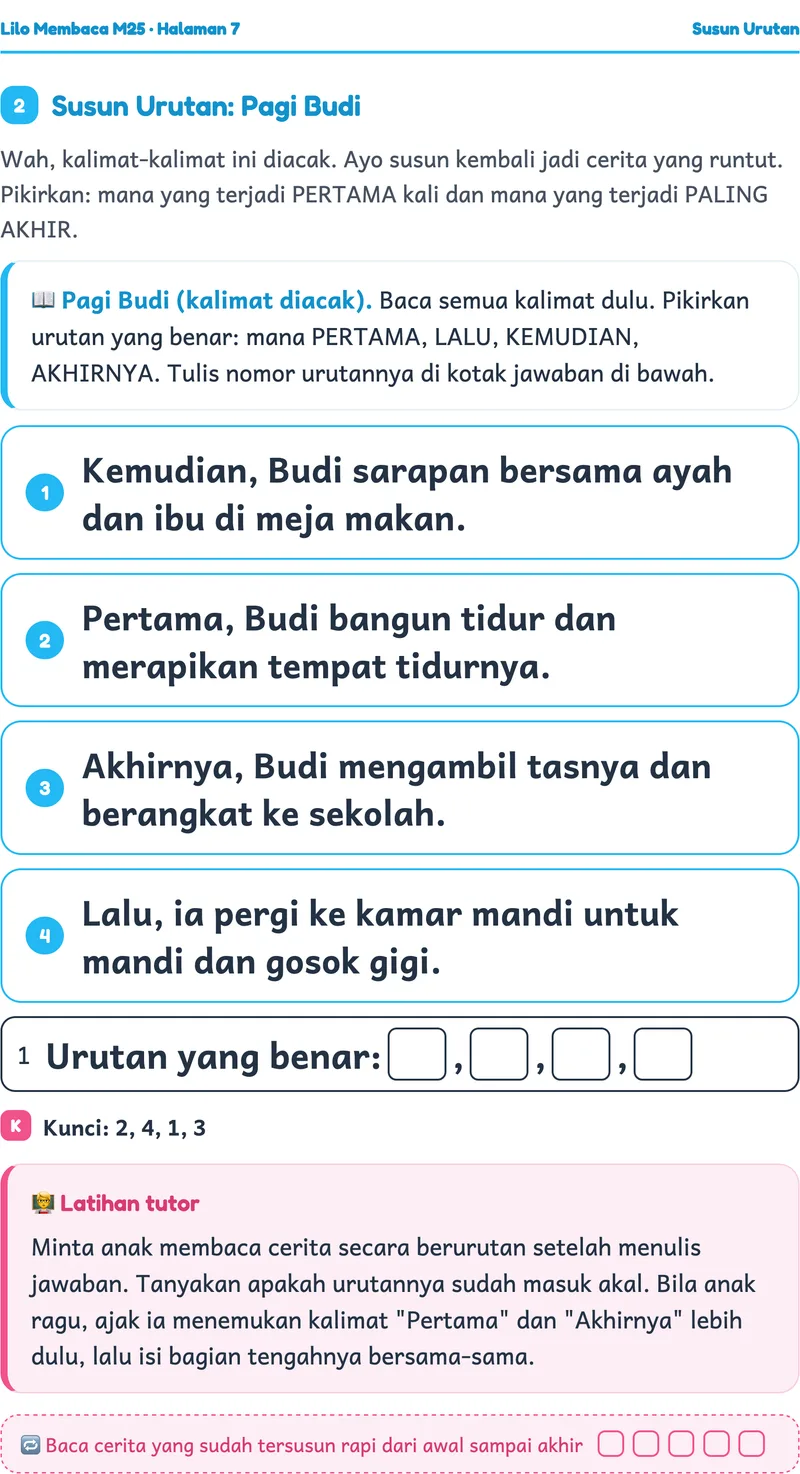
This Level 6 sheet from module 25 asks children to put the events of a short story back in order. The exercise sharpens their grasp of what they read, arriving just before they graduate into independent reading.
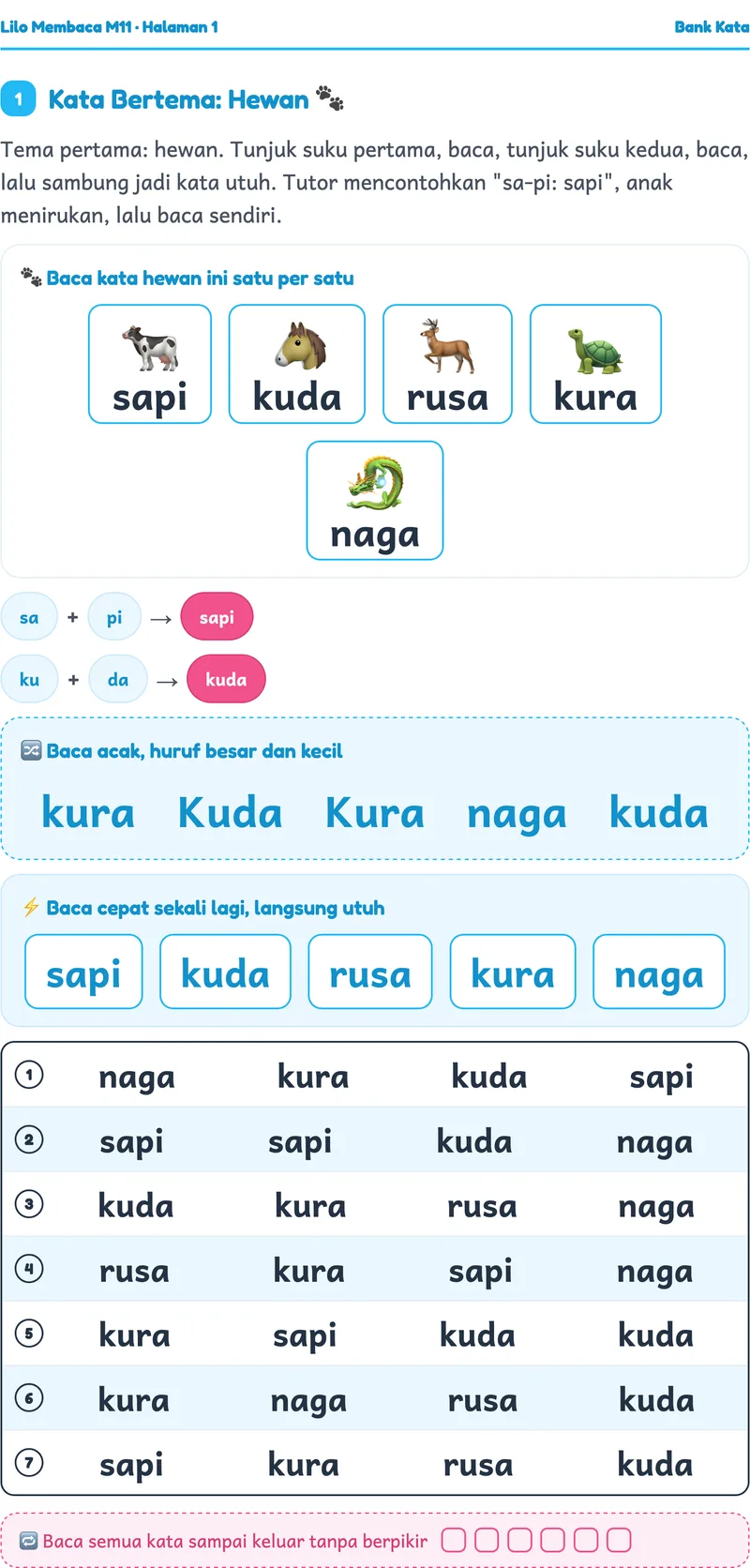
A real page from module 11: your child points at each syllable, reads it, then blends it into a whole word. A fast-read round makes the words come out smoothly.
Children split and join open syllables, turning ma-ma into mama and bo-la into bola. The tutor models each whole syllable first, then the child blends them into a meaningful word, reading it straight through without spelling letter by letter. Level 1 practice.
Samples from Lilo's original curriculum. The full A5 materials are prepared by the tutor at each session.
This picture fits a five-year-old who knows some letters or numbers, learning on the Regular package of 8 sessions a month, about twice a week, and usually starting at the very first stage.
Letters your child knew only by shape now have a voice. Your child says /b/, /s/, and the vowels with confidence the moment a card appears.
Your child blends sounds into bo, la, and su without spelling them out, and starts reading two-syllable words like bola and susu alone.
With every consonant in use, your child reads short sentences like ibu beli roti, a finger tracking each word.
Your child reads closed words like makan and kebun, then learns to tell apart close pairs like kaki and kakak.
The sounds ng and ny get slow, generous practice. Words like bunga and nyanyi show your child is ready for longer sentences.
Your child moves up once a stage is secure, and the tutor tunes the pace after every session. The months show the usual path for this profile.
Each age shows readiness in its own way. If a few of these signs fit your child, the first session simply finds the stage where lessons should begin.
50+ early reading tutors live in and around Bogor.
Some still studying, others graduated.
Applications screened
Role and city are checked first.
Identity and degree checked
Identity and diploma are matched.
Teaching profile completed
Teaching history goes into the portal.
Trained before teaching
Teaching starts after training.
Matching per child
Questions come from the child’s needs.
Not the right fit? See our free tutor replacement promise
Young children often freeze when they sense a test. Through play they show what they can really do, and the tutor reads it from how they answer.
The tutor says a sound like /s/ or /m/ and your child points to the matching card, showing which sounds are secure and which letters are only known by name.
Your child joins two cards into ba or mi and says it aloud. Smooth blending tells the tutor your child is ready for whole words.
Your child reads a few short lines that step up in difficulty. The line where reading starts to stall marks the stage to build first.
Many children read syllables well before their hands write smoothly, so the reading level comes from your child's voice and pointing finger, with no written test.
The result becomes your child's first level on the L0 to L6 ladder.
Five steps lead from your first message to the tutor's first report, and each one has a clear, simple purpose.
The free consultation starts with your child's age, the letters they already know, and where you live in Bogor. We then suggest the way of learning that fits best.
The tutor is chosen for your child's age, reading needs, and the schedule you want, then stays with your child week after week.
The tutor can come to your home. For online classes, the link and worksheets arrive before each lesson, all managed in app.lilo.id.
Your child plays with sound cards and syllables. Every session then ends with a recap of what was mastered and one small task of about ten minutes.
At the end of week one, the report shows, for example, which sounds your child now blends alone and which syllables come next.
duration of 60, 90, or 120 minutes
Contact us
60, 90, or 120 minutes
Contact us
60/90/120 minutes
Contact us
Sounds and words are all around the house. These four short games use the yard, the garden, and the dinner table, each for one clear stage.
| Activity | Time | What you need |
|---|---|---|
Sound hunt in the yardFor L0. Say one sound, such as /b/, and let your child find things that start with it, like batu or bunga, saying the sound as each one goes into the basket. | 5 minutes | things in the yard, a small basket |
Syllable hopscotch in the gardenFor L1. Scratch sa, si, and su into the soil with a stick. Your child hops onto the syllable you call, then joins two hops into a word like susu or sisa. | 10 minutes | a stick, garden soil or sand |
Dish name cards at dinnerFor L2. Write nasi, tahu, and roti on slips of paper. Before the meal, your child reads each card and places it beside the right dish. | 10 minutes | paper slips, a pencil, dinner plates |
Your child reads the dinner menuFor L3. Write tonight's menu, such as ikan bakar and sayur bayam, and your child reads it aloud to the table, minding the consonants that close each word. | 15 minutes | a sheet of paper and a marker |
Instead of guessing, we assess. Your child begins at the level the placement assessment reveals, so early lessons feel winnable and momentum builds from day one.
Lilo teaches from its own library of 122 leveled modules. Every worksheet, story, and sound card was designed to fit its exact place on the ladder.
Your child advances only after a stage is truly secure. Steady practice built level by level means gaps never quietly pile up beneath the surface.
New ideas arrive through things your child can touch and see before they become letters on a page, the same careful path used in Singapore Math.
Our tutors are verified and can teach at your home across Bogor, from Bogor Tengah and Tanah Sareal to Sentul and Cibinong, or online if you prefer.
Lessons can be delivered in English or Indonesian, so families who want English as the language of instruction get a genuine reading program in it.
After a month, your child usually brings home the next-level reader and a list of words they can now read without stumbling. That progress runs through seven phonics levels, L0 through L6, with a tutor visiting your home or in an online class. You pay for one package at a time, with sessions priced from IDR 76,865 each, and longer packages make every session lighter on the wallet.
The tutor maps which letter sounds your child knows and sets their starting level.
IDR 584,174The tutor practises voicing and blending sounds with letter cards every week.
IDR 1,149,085The tutor moves your child up several phonics levels in a row with fresh readers.
IDR 1,694,733The tutor guides your child from the first letter card to reading storybooks alone.
IDR 3,216,100Written into the Lilo Terms of Service.
No extra fee, whenever you ask.
The steps:
A full report follows each month.
Home lessons bring someone new into your house. These five questions are worth asking any provider before the first session in Bogor.
Knowing a tutor's name and background before the door opens settles you and your child. At Lilo, you can view the tutor's profile before the first session.
An open, visible spot such as the living area or the porch keeps lessons comfortable for everyone, and a fixed table away from the television protects focus.
Young children learn to read through trust, and a tense child stalls. At Lilo, the tutor is replaced free of charge whenever the match is not right yet.
A stage set too high pushes a child into guessing, and one set too low breeds boredom. Ask how the starting point is measured before regular lessons begin.
Teaching reading takes patience and an understanding of how children grow. Many in Lilo's network of 5,000+ tutors studied primary teaching, early childhood education, psychology, or mathematics.
At first I was unsure about online lessons for a child Mazaya's age. It turns out she stays focused and clicks with her tutor. Now she knows her letter sounds and is starting to blend simple words.
After classes here my child can now read fluently thanks to patient and professional guidance, and their confidence has grown too.

Tell us your child's age and where you are in Bogor, and we will arrange a free consultation and a tutor match. The right level is found in the first lesson, and the first step is a message.
Free consultation via WhatsApp