

Ages 3 to 4, meeting sounds through play
Before any reading begins, your child plays with the sounds of language. Songs, sound cards, and games build a warm first friendship with letters, with no pressure to perform.
Your child learns to read through short, steady portions of practice. Letter sounds come first, then syllables, then real sentences, one mastered step at a time, guided by a verified Lilo tutor.
Reading Classes for Kids in Cilegon are Lilo lessons that teach children aged 3 to 10 to read through letter sounds, seven measured levels, and short daily practice built level by level. A placement check finds your child's starting point, and each stage is mastered before the next begins, at home, in a small group, or online.
Every child arrives at reading on a different day. A placement check at the start means your child begins exactly where their skills are today.
Before any reading begins, your child plays with the sounds of language. Songs, sound cards, and games build a warm first friendship with letters, with no pressure to perform.
Kindergarten years are the heart of the reading journey. Your child moves from single sounds to syllables to first words, arriving at primary school confident and prepared.
Your child can already read a little and now needs smoothness. Longer sentences, punctuation, and real short passages turn careful decoding into comfortable, expressive reading.
Some children reach school before reading clicks. Our tutors meet them with patience and zero shame, rebuilding the foundations quietly so progress feels like winning.
Readiness for reading grows from a few small skills you can spot at home. The tutor starts with the skills already there and strengthens the ones just forming.
Children in Cilegon draw on 110+ reading tutors across Banten. Online classes in Cilegon are always open.
Graduates and active students.
Every application reviewed
Suitable applicants move forward.
Documents verified
Diploma and ID are reviewed.
Experience and hours recorded
Available hours are noted down.
Learning the Lilo method first
Lilo guides and materials are provided.
Matching per child
Questions come from the child’s needs.
Not the right fit? See our free tutor replacement promise
The first session is a game with no written test. While playing, the tutor notices small details that decide which level your child starts on.
During a sound card game, the tutor sees which letters your child voices instantly and which ones need a longer think.
While building syllables, the tutor listens for whether your child says ma straight away or recites letter names like em and a first.
Words such as kambing, nyamuk and tangan slip into the game. Where your child pauses shows whether practice begins at L3 or L4.
Some children guess from the picture, some go quiet, some fix the word themselves. That reaction guides how the tutor will offer corrections.
The method is simple to describe and careful in practice: sounds before names, small portions before big books, and mastery before moving on.
Your child learns what each letter says, like /m/ and /a/, through songs and sound cards. Because the sound comes first, blending into syllables later feels like a natural next step.
Sounds flow straight into whole syllables, then into simple words. We skip letter-name spelling drills entirely, so your child never gets stuck reciting names instead of reading.
Each session gives a generous but bite-sized portion of practice, steady and structured built level by level. Short, regular repetition builds skill without tears or burnout.
A placement assessment sets the starting level, and your child only advances after truly mastering the current stage. At the top levels, whole sentences grow into real comprehension.
Every stage stands on the one before it, so the foundation has no gaps.
These signatures come straight from our own 122-module curriculum, refined level by level so each child climbs on solid ground.
Children who master each small stage before moving up read with a confidence that rushed learners rarely find.
Your child learns what letters say before what they are called. This single choice removes the biggest roadblock in early reading, because sounds are what actually blend into words.
Sounds glide directly into whole syllables with zero spelling recitation in between. Reading becomes one smooth motion instead of a stop-and-start puzzle of letter names.
Our leveled readers contain only the patterns your child has already learned. Every page is genuinely readable, so independent reading arrives early and confidence grows with it.
Combinations like ng, ny, and tr are where most children stumble. Our curriculum treats this as the hardest stage and gives it the slowest pace and richest practice.
Seven rungs, each mastered before the next, from a child's first sound to their first whole story.
Most reading struggles trace back to a few well-meaning habits. Knowing them early saves your child months of frustration.
Why it happensLetter names refuse to blend. A child chanting names before every word builds a habit that actively blocks smooth reading.
How Lilo helpsTeach the sound each letter makes and blend sounds directly into syllables. This is the heart of every Lilo lesson.
Why it happensA child can point to every letter on a poster and still be unable to read, because shape recognition alone carries no sound to blend.
How Lilo helpsPair every shape with its sound from day one, through songs, sound cards, and tracing that link the two together.
Why it happensA book full of unlearned patterns turns reading into guessing, and repeated guessing quietly teaches a child that reading is scary.
How Lilo helpsUse leveled readers containing only patterns already mastered, so every book your child opens is one they can genuinely conquer.
Why it happensYoung children learn through delight. Endless identical worksheets drain the joy out, and a bored child stops trying long before they stop attending.
How Lilo helpsKeep portions small and vary the practice with songs, cards, and games, the way our curriculum is deliberately built.
Why it happensCombinations like ng, ny, and tr are the most common sticking point in all of early reading, and speeding through them leaves permanent gaps.
How Lilo helpsSlow down exactly here. Lilo marks this as the hardest level and gives it extra care, extra time, and extra practice.
The foundation stage where your child meets every vowel and consonant sound, plays with sound cards, and traces letters until sound and shape belong together.
Sounds join into open syllables and then into words of two and three syllables, with timed reading sheets that make growing speed feel like a game.
Your child conquers syllables with consonant endings, then the trickiest territory in reading: digraphs, clusters, and diphthongs, taken slowly with plenty of support.
Sentences stretch from 4 to 10 words while punctuation, intonation, and rhythmic reading teach your child to read with expression and ease.
Mini stories bring everything together. Your child answers 5W questions, finds the main idea, and retells stories in their own words, reading to understand.
Almost every child learns to read out loud first. The move to silent reading happens gradually, and a tutor can tell when your child is ready.
Early on, the voice is your child's working tool. Reading the word sapu, they turn letters into sounds, and their own ears check whether the blend sounds like a word they know. That is why children at L1 to L4 need to read aloud. For the tutor, the voice is a window: a swapped letter or a dropped final consonant is heard at once and fixed on the spot.
The switch usually begins once blending feels automatic, often around L5 and L6. You can hear the signs: the voice follows full stops and question marks, pauses inside words become rare, and your child fixes slips unaided. A whispering stage follows, lips still moving as the voice fades. This stage is healthy, because your child is moving the sound from the mouth into the head.
The tutor guides the switch in small steps. One paragraph is read aloud, the next in a whisper, then one in silence, followed by a question about what it said. A correct answer shows real silent reading. A missed answer sends your child back to reading aloud with no sense of failure. At home, a child who reads quietly and grins at the funny part is following the story.
This picture fits a seven-year-old who already reads simple words and wants fluency. The child takes the Intensive package, twelve sessions a month, about three a week.
Near pairs such as batu and batuk, or jala and jalan, train your child to read every word right to its end.
Letter combinations get the most patient pace. Your child reads bunga, nyamuk and khusus again and again until two letters sound as one.
Your child reads longer sentences, pauses at full stops and lifts the voice at question marks, so reading flows close to speech.
Your child reads short passages, then answers questions about the characters and why things happened. Whisper reading begins to appear.
Your child reads a whole story silently, then retells it in their own words, ready to pick books of their own.
The weekly report shows the rung your child is on, so you can celebrate each stage as it is passed.
These are real pages from Lilo's original curriculum, shown exactly as your child would use them: compact A5 sheets with generous practice portions, from first sound cards all the way to full passages with comprehension questions.
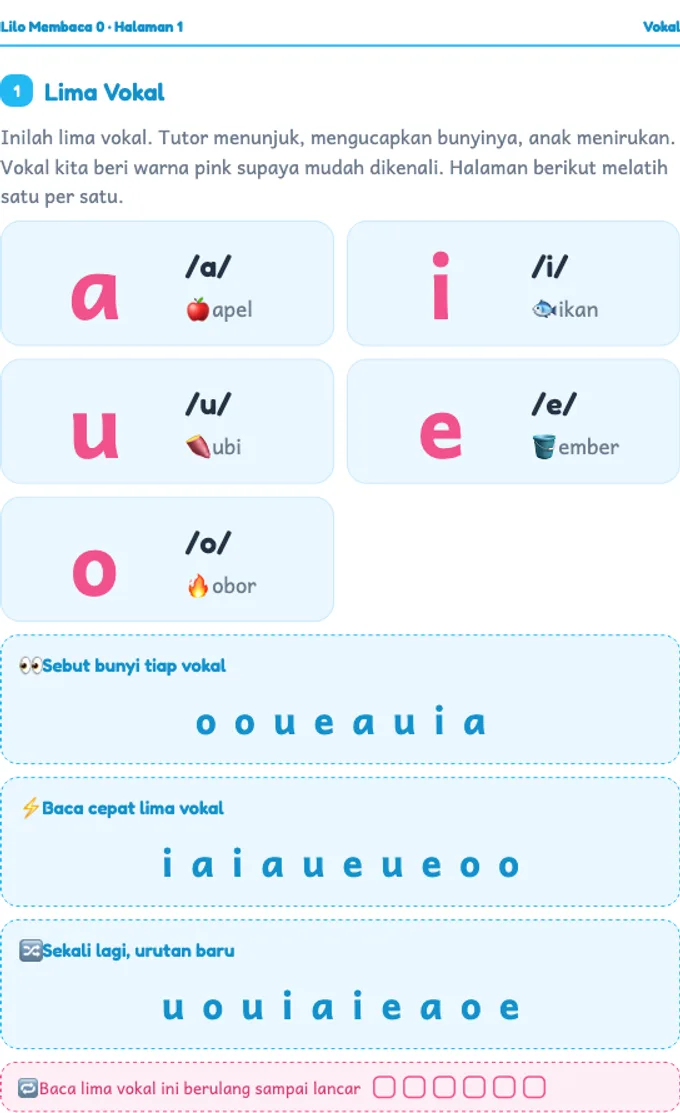
Simple cards on an A5 page introduce vowel sounds and early consonants like m, b, and s. A fast reading exercise follows so each new sound is used right away. This is where the phonics journey begins at Level 0.
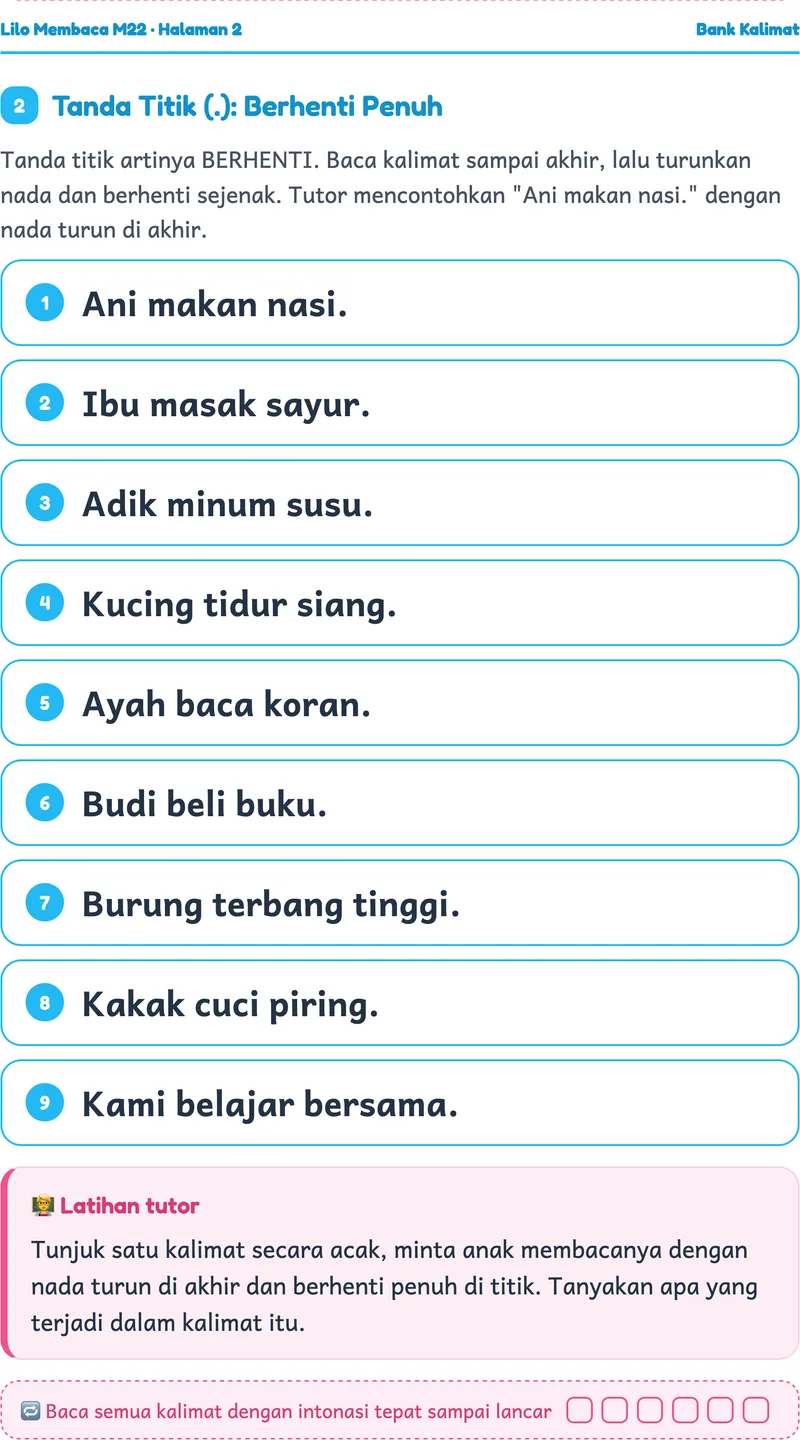
A real page from module 22: your child practices a full stop at each period and reads sentences with lively intonation, the bridge to fluent reading.
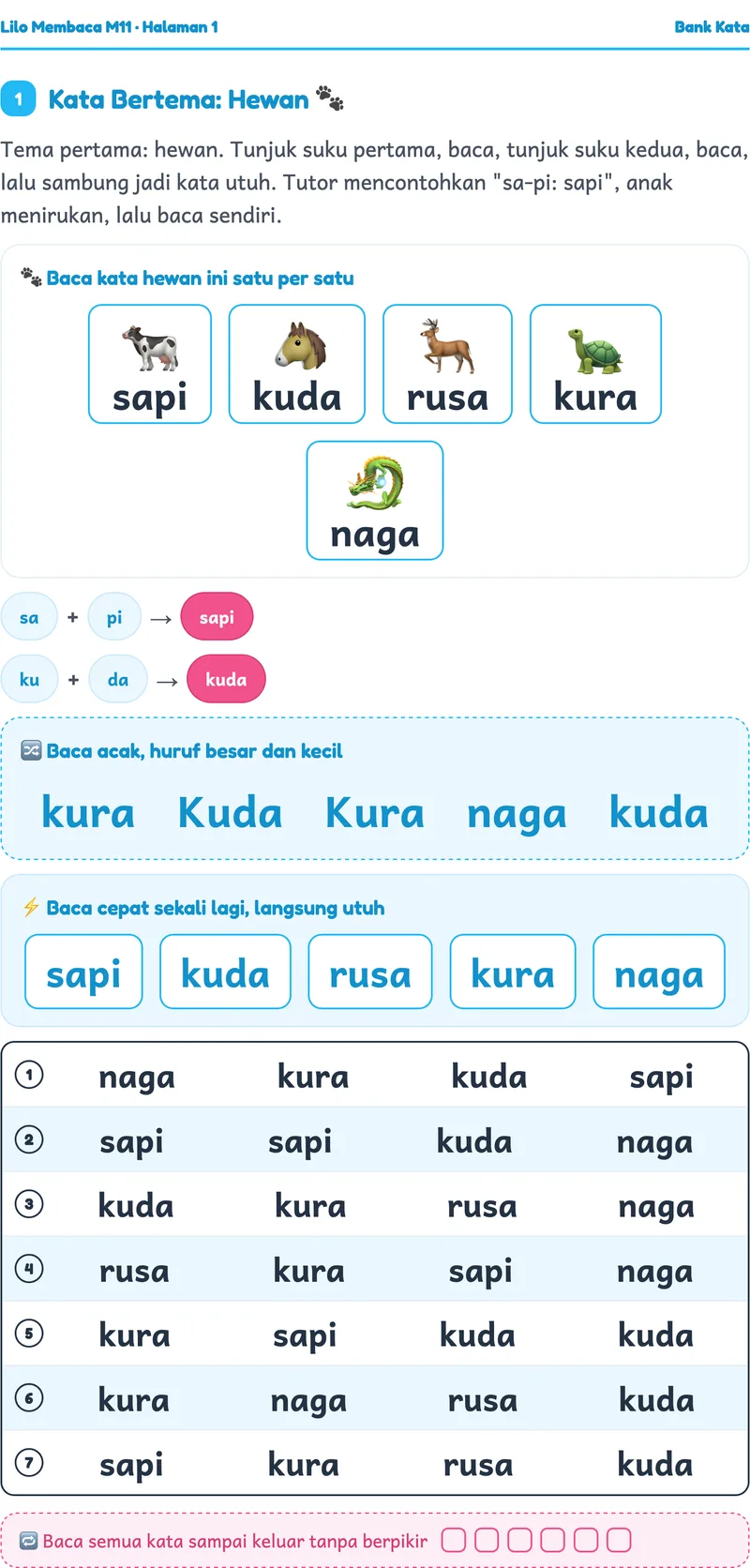
Sa-pi joins up to become sapi. That is how children work through this Level 1 sheet from module 11: pointing to each syllable, reading it aloud, then blending the pieces into whole themed words, with a speedy reading round at the end.
All four sheets come from Lilo's own leveled curriculum, 122 modules packed with generous practice on every A5 page.
Old boxes, potted plants and the animals at home make practice your child enjoys. Pick the activity that matches their current stage.
Cut palm-sized cards and write open syllables such as ku, da, ma and ta. Your child joins two cards into kuda or mata and reads them aloud. Suits L1 and L2.
an old cardboard box, scissors, a marker
Write bunga, nyanyi, pisang and nyiur on the cards. Your child reads each one and drops it into the ng or the ny container, which strengthens L4.
cardboard cards, a marker, two containers
Write plant names such as sirih, kemangi or lidah buaya on sticks and push them into the pots. At each watering, your child reads the tags, practising the closing consonants of L3.
ice cream sticks, a marker, plant pots
Your child reads a few sentences aloud to a cat, a fish or a favourite doll. A listener who never corrects gives them courage to read with lively expression. Suits L5.
a short storybook, a pet or a doll
60/90/120 minutes
Contact us
choose 60, 90, or 120 minutes
Contact us
60, 90, or 120 minutes per session
Contact us
Preparation is light and fits into one afternoon. The aim is simple: your child meets the tutor calm, with a table and materials ready.
In the free WhatsApp consultation, share what your child already reads, the words that make them stop, and the hour when they feel freshest.
You can view the tutor's profile before the first session. Tell your child the tutor's name, so the first lesson feels like meeting a new friend.
Choose a bright table away from the television. If the tutor is coming to your home in Cilegon, place two chairs side by side with pencils ready.
The class link and worksheets arrive through app.lilo.id before class. Print the sheets, set the device at your child's eye height, and test the sound early.
Cilegon is a city on the western tip of Java, located in Banten Province. It is widely known as Indonesia's steel industry city and serves as the gateway between Java and Sumatra through Merak Port on the shore of the Sunda Strait. Its districts stretch from Cibeber to Pulomerak, making Cilegon one of the key cities in western Banten. The city continues to grow with a proud spirit and a strong regard for education.
A tutor visits you in Cilegon, so your child can learn in the comfort of home. Surrounded by familiar things, children find the courage to ask questions, and each session lets you see closely how far they have come.
Each lesson moves through clear stages. Your child first handles real objects, then looks at pictures, and finally works with letters and numbers. A new idea is added once the last one is fully grasped.
Prefer to learn on a screen? Online classes are live two way sessions, and the teachers give the same close attention. Times stay flexible, so lessons slot easily into your child's week in Cilegon.
For young children, two things matter most: whether online classes suit their age, and how the teacher reacts to a misread word. Ask any provider these questions.
| Question to ask | Why it matters |
|---|---|
What does the teacher do when my child misreads a word? | A child corrected harshly tends to stop trying. A good teacher points to the swapped sound and leaves time for a self-fix, which is how Lilo tutors work. |
Do online classes use materials my child can hold? | Children aged four to seven learn through hands and eyes, and a screen alone soon makes them restless. In Lilo online classes, the worksheet is already on the table when class begins. |
How does the teacher keep a young child focused on screen? | Young attention moves quickly, so activities should change every few minutes. Lilo tutors move from sound cards to building syllables, then on to reading sentences. |
How is my child's starting level decided? | A child placed too high keeps failing, while one placed too low gets bored. Lilo finds the starting point through play, with no test sheet at all. |
What happens if my child does not click with the teacher? | The match shapes how bravely a child reads aloud in front of someone. Lilo replaces the tutor free of charge when the fit is wrong, choosing from a national network of 5,000+ tutors. |
Every path can work for some families. Here is a fair look at how guided, leveled lessons compare with two common alternatives.
| Aspek | Lilo | Learning Apps | Big Group Classes |
|---|---|---|---|
| Who guides the child | A verified tutor who listens, corrects gently, and adjusts every session | The app itself, with feedback limited to what the screen can detect | One teacher shared across many children at once |
| Starting point | A placement assessment finds your child's exact level | Usually a fixed sequence the same for every child | The class starts wherever the group happens to be |
| Pace of progress | Your child moves up only after mastering each stage | The child can tap ahead past material they have shaky grasp of | The group's pace decides, whether your child is ahead or behind |
| When reading gets hard | Extra care and slower portions at letter combinations, the toughest stage | Hard spots repeat the same exercise until the child loses interest | A struggling child can quietly fall behind without being noticed |
| Screen time | Practice happens on paper at a real table, a healthy balance to screens | All learning adds to daily screen time | Mostly off-screen, which is a genuine plus |
Your weekly session schedule can be arranged with the Lilo team around school hours and your child's rest time. One phonics session is priced from IDR 76,865, and payment covers a whole package of sessions at once. Your child climbs levels L0 through L6 with a tutor at home or in an online class, and a weekly report tells you which level they are on.
By the end, your child is used to sitting calmly and listening to sounds.
IDR 307,460This package builds a daily habit of reading a few words alone.
IDR 604,782By the last session, blending sounds without waiting for help feels natural.
IDR 891,965A habit of reading small books alone at bedtime forms by the end.
IDR 1,692,684Included in every lesson package.
Just tell us, any time.
How it works:
Topped up by a monthly report.
Our verified tutors travel to families across Cilegon, from Cibeber and Jombang to Citangkil and Grogol, so lessons happen where your child is most comfortable.
Lilo teaches from its own 122 leveled modules, built on the concrete, then pictures, then symbols approach that Singapore Math made famous. Nothing is improvised.
Structured practice built level by level means every session is a small, finishable portion. Your child ends each lesson feeling successful, which keeps them coming back happily.
Seven named levels tell you exactly where your child is and what comes next. Progress stops being a mystery and becomes something the whole family can celebrate.
Lessons can be taught in English or Indonesian, a natural fit for bilingual and national-plus families who want reading skills to grow in step with both languages.
Reading classes at Lilo helped my child understand the content of a book really well. Their reading skills improved, very satisfying.
Yusuf used to refuse whenever we asked him to read. Now he is the one grabbing a book before bedtime. I never expected such a real change. Thank you to his tutor for always being so attentive.

A free WhatsApp consultation takes a few minutes. Tell us about your child, and we will suggest a starting level and a learning mode that fits your family in Cilegon.
Free consultation for readers at every stage