



Ages 3 to 4, meeting sounds through play
Your little one is far from reading, and that is exactly right for this age. Sessions feel like playtime with sound cards and songs, quietly planting the sounds that reading will grow from.
Your child starts with the sounds letters make, practices them through cards, songs, and short games, then climbs seven clear levels until whole stories open up. Lessons come to your home anywhere in Cirebon.
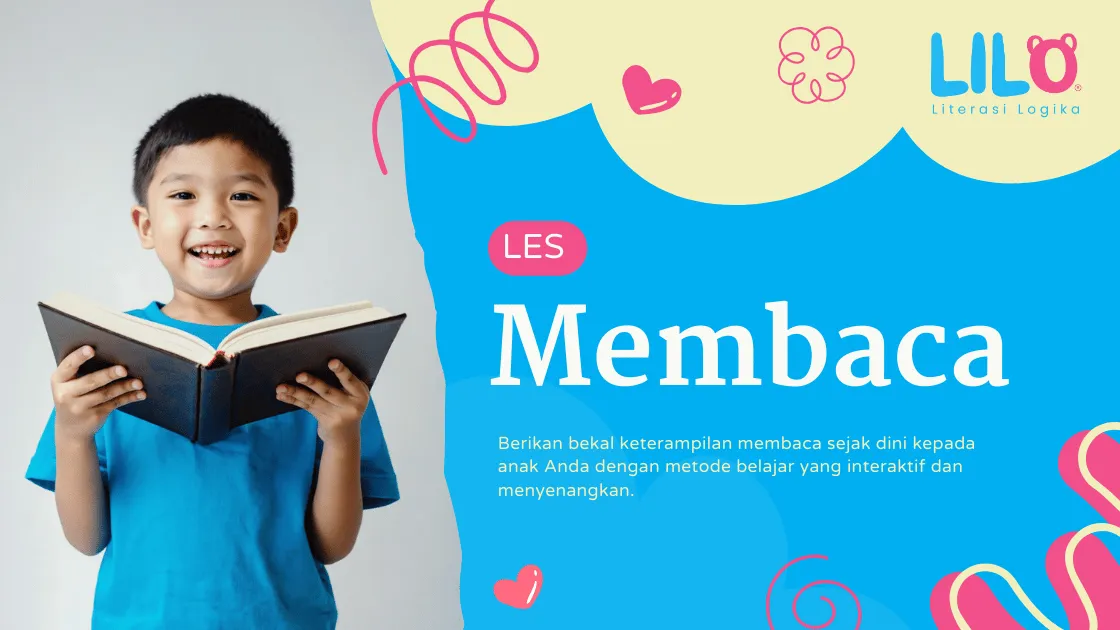
Reading classes for kids in Cirebon are guided lessons where a Lilo tutor teaches your child to read through sound cards, songs, and short games, at home or online. The program follows seven measured levels, from first letter sounds around age 4 to reading whole passages by age 8, and every child begins with a placement assessment so lessons start at the right point.
Lilo welcomes children aged 3 to 10 at every point of the reading journey. The placement assessment finds where your child stands, and lessons grow from there.
Your little one is far from reading, and that is exactly right for this age. Sessions feel like playtime with sound cards and songs, quietly planting the sounds that reading will grow from.
Kindergarten years are the sweet spot for learning to read. Your child moves from single sounds to syllables and short words in small, cheerful steps, arriving at primary school confident and prepared.
Your child can sound out words but reading still feels slow or choppy. Lessons at this stage strengthen fluency, expression, and understanding, so books become something your child reaches for gladly.
Some children reach school before reading clicks. Lilo meets your child warmly at their true level, with kind one-on-one guidance and steady wins that rebuild confidence without any shame.
Readiness shows up in small everyday moments. Match the signs below with what you notice in your child, then share them during the free consultation. One sign in each group is enough to begin.
Cirebon belongs to our West Java network: 800+ early reading tutors. Online classes in Cirebon are always open.
Graduates and current students alike.
Application screening
Role and city are checked first.
Identity and degree checked
The team checks identity and education.
Tutor profile filled in
We know when each tutor is free.
Trained before teaching
The step-by-step method is learned first.
Chosen for your child
Candidates answer questions about the child.
Not the right fit? See our free tutor replacement promise
Every lesson follows the same gentle logic: hear the sound, play with it, blend it, and read it. Games and cards carry the hard work so your child barely notices the effort.
Your child learns the sound each letter makes, like /m/ and /a/, through sound cards, songs, and short games. Sounds arrive as something fun to say and hear, so they stick.
Once a few sounds are solid, they flow together into syllables and simple words right away. There are no letter-name spelling drills, so reading feels natural from the very start.
Short, steady practice built level by level keeps skills fresh without tiring your child. Each worksheet gives a generous portion of exercises at exactly the level your child has reached.
A placement assessment sets the starting point, and your child only climbs to the next level after truly mastering the current one. Progress is real, visible, and built to last.
Your child moves to the next stage once the current one is truly mastered.
The first session runs on games, with no written test. Afterwards the tutor writes a short note, and here is how to read it so you know where your child sets off.
Your child plays with sound cards, builds syllables, then reads short sentences. The games keep climbing until hesitation appears, and that is where the starting point sits.
The note opens with a level code such as L4. It tells you every earlier stage is already secure, so lessons begin right at that level.
This part lists what your child reads without pausing, for example closed-syllable words like pintu and lampu. It is the ground the next lessons stand on.
The tutor writes down the sound or habit that makes your child stop, such as ny in nyanyi, or a voice that stays flat before a question mark. That becomes the focus of week one.
Every session follows the same shape, so your child knows what is coming and settles in quickly, whether at home in Cirebon or in an online class.
The tutor greets your child and opens with a quick sound-card game, so mouth and ears are awake before any reading begins.
Your child rereads the previous sheet while the tutor listens for what now flows and what still catches, then shapes the plan for the day.
New material comes from a worksheet in the current module. It is built from sounds your child already owns, plus one new thing to conquer.
The tutor reads a sentence with clear expression, your child echoes it, then reads the next one alone. A short movement break midway keeps energy fresh.
To close, the tutor names what your child mastered today and leaves one task of about ten minutes to try at home.
These are the signatures our tutors bring to every session in Cirebon, drawn from Lilo's own leveled curriculum and years of teaching young readers.
Lessons begin with what letters say, like /m/ and /a/, taught through cards and songs. Because your child owns the sounds, reading words later feels like a game they already know.
Sounds slide directly into whole syllables, so your child reads 'ma' as one smooth piece. This keeps reading fluid from day one and skips the stall of spelling drills.
Our leveled readers contain only patterns your child has already learned. Every page is winnable, so each little book finished becomes proof that says, I can read this myself.
Combinations like ng, ny, and tr are the hardest stage for most children, so our curriculum slows down there on purpose, with more practice, more games, and more patience.
Seven steps, each mastered before the next, carry your child from first sounds to whole stories.
Many well-meaning habits quietly slow a young reader down. Here are the ones we see most often in new students, and how Lilo handles each one.
Why it happensA child who spells 'em-a' has to translate names into sounds before reading, and that extra step stalls blending for months.
How Lilo helpsLilo teaches the sound itself first, /m/ then /a/, so the two slide straight into 'ma' with nothing in between.
Why it happensA child can point to every letter on a poster and still be unable to read, because shapes alone carry no sound to blend.
How Lilo helpsEvery shape at Lilo arrives glued to its sound through cards, songs, and tracing, so recognition and reading grow together.
Why it happensA book full of patterns your child has never learned turns reading into guessing, and repeated failure teaches a child to avoid books.
How Lilo helpsOur leveled readers contain only patterns already mastered, so every book is winnable and confidence compounds.
Why it happensRepetition works only while a child keeps showing up for it. Monotony makes practice a battle, and battles end with a child who dislikes reading.
How Lilo helpsLilo wraps steady practice in games, cards, and songs, keeping portions small and sessions something your child looks forward to.
Why it happensCombinations like ng, ny, and tr are the most common sticking point of the whole journey, and rushing them leaves gaps that surface later.
How Lilo helpsOur Level 4 slows down on purpose, with extra practice and extra patience, until these combinations feel as easy as single letters.
Your child gets to know the sound behind every letter through cards, songs, and tracing, building the ear that all later reading rests on.
Familiar sounds join into open syllables and grow into words of two and three syllables, with timed reading sheets that make progress visible and fun.
Your child conquers syllables that end in consonants, then the trickier paired letters, clusters, and glides, with plenty of patient repetition at the toughest spots.
Reading stretches into full sentences of 4 to 10 words, with punctuation, intonation, and rhythmic reading so your child sounds natural and confident aloud.
Mini stories invite your child to answer who, what, when, where, and why, find the main idea, and retell what happened in their own words.
Many children who sound out words smoothly still read in a flat voice. Punctuation is a set of instructions for the voice, and those instructions can be taught.
When a child reads aloud, the eyes have to travel a little ahead of the voice. The eyes spot the mark at the end of a sentence first, and the voice gets ready: dropping at a full stop, pausing briefly at a comma, rising at a question mark. A child who has only just mastered words tends to read word by word, so the eyes never glance ahead. That is why "Ibu pergi ke pasar?" and "Ibu pergi ke pasar." come out sounding identical, although one asks and the other tells.
The right tone also protects meaning. "Adik, makan dulu." invites a younger sibling to eat first, while "Adik makan dulu." simply reports who is eating. When a child groups words by their punctuation, the sentence breaks into meaningful pieces, and its content becomes easier to hold in mind. Reading that sounds like natural speech usually travels together with better understanding.
In the session, the tutor works in three moves. First, the tutor reads a sentence with clear expression and your child echoes it. Next, your child circles each mark with a coloured pencil and adds a hand signal: hand down for a full stop, palm held still for a comma, hand up for a question mark. Finally, your child reads alone without signals. At home you will hear pauses at full stops and questions that truly sound like questions.
These are real A5 pages from Lilo's own curriculum, the very sheets your child will hold: sound cards for first letters, syllable building, fast reading practice, and a passage with comprehension questions. Each page carries a generous portion of practice.
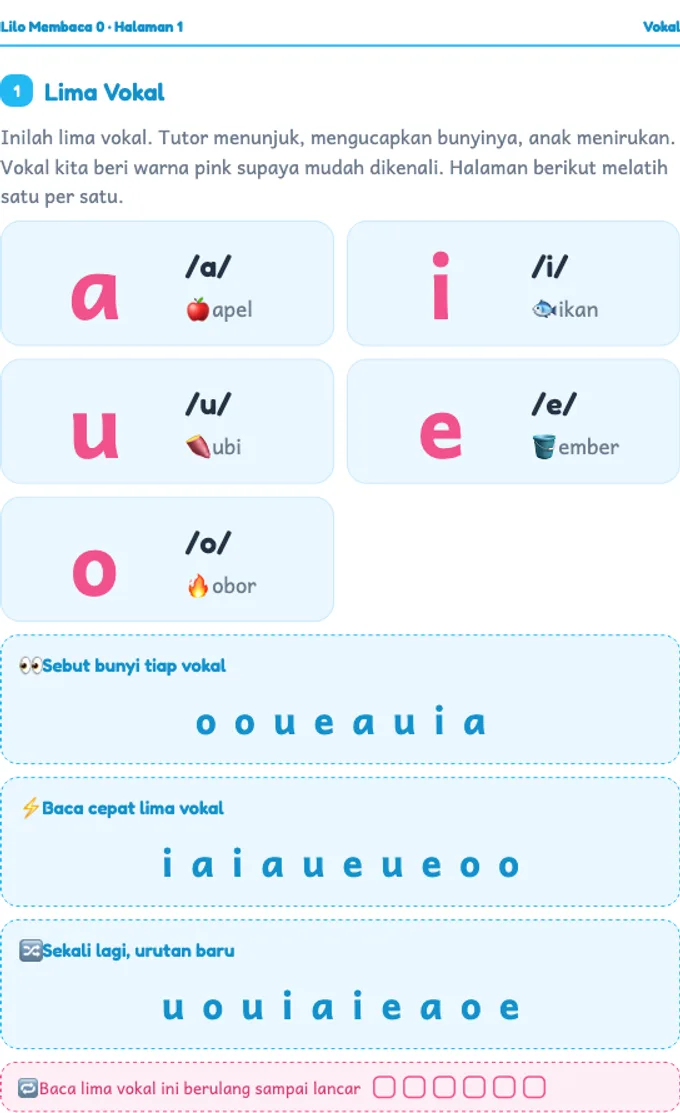
This Level 0 sheet shows cards for the vowels a, i, u, e, o plus the starting consonants m, b, and s. Children say each letter sound out loud, then practice quick reading. It is the foundation of our phonics method.
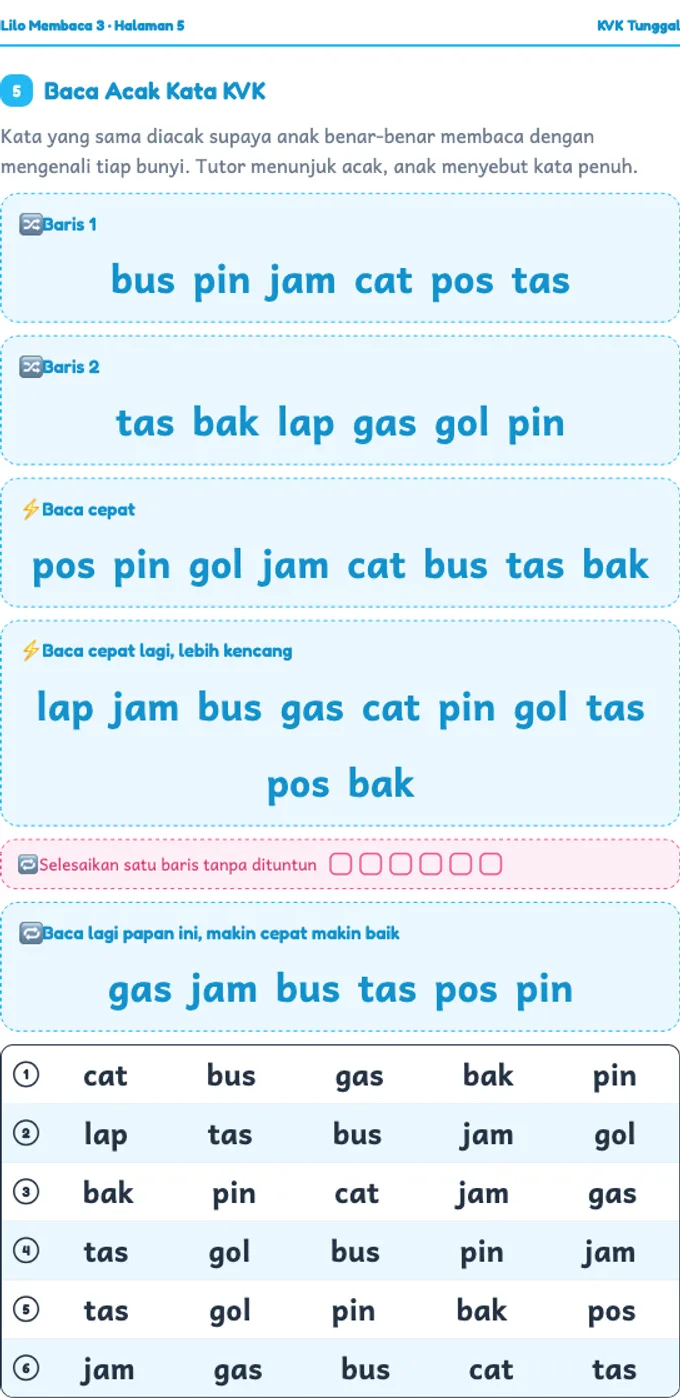
A grid of short words that children read again and again against the clock. Some words end in a consonant, like tas, so the exercise sharpens attention to final letters while building smooth, confident reading. Level 3 practice.
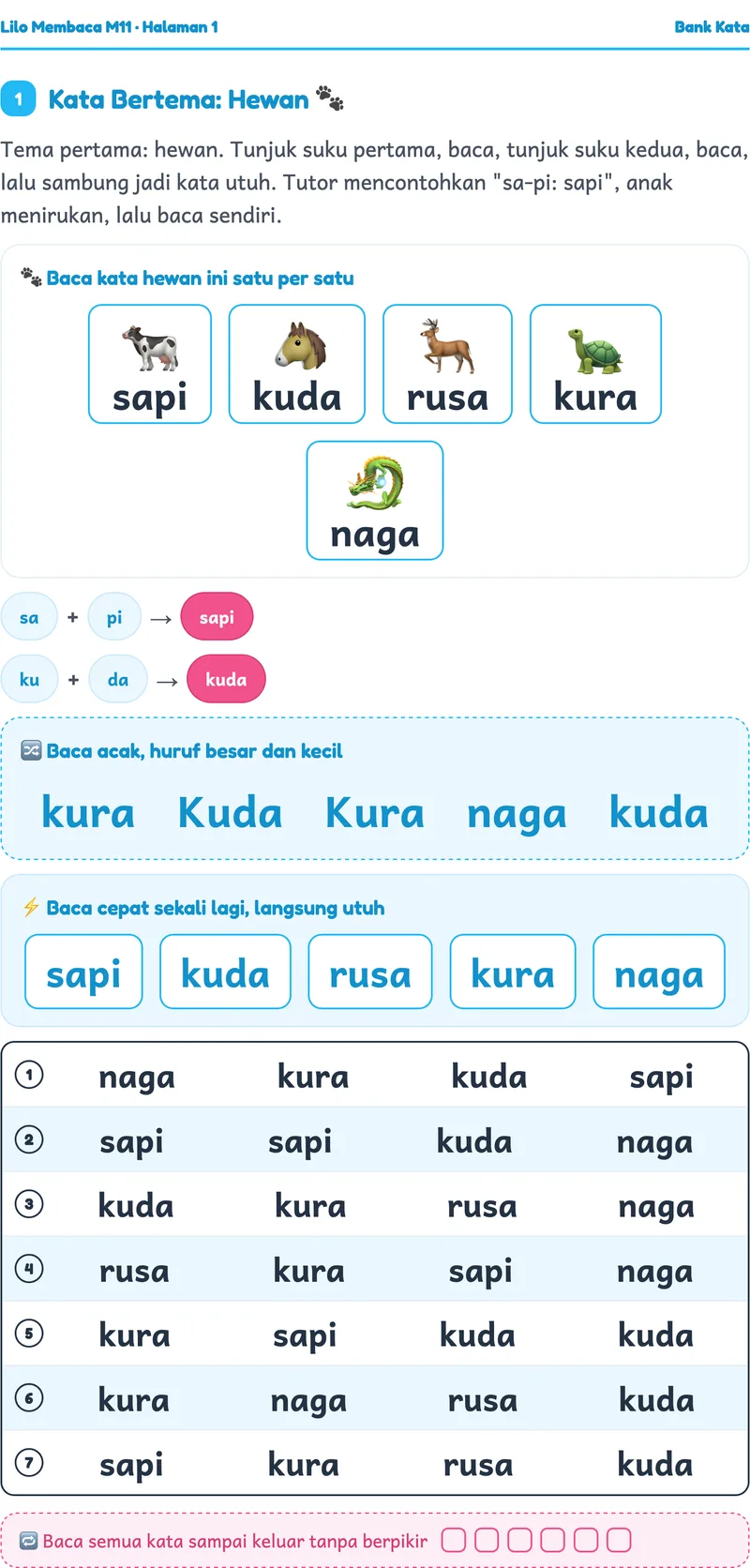
Sa-pi joins up to become sapi. That is how children work through this Level 1 sheet from module 11: pointing to each syllable, reading it aloud, then blending the pieces into whole themed words, with a speedy reading round at the end.
Every sheet belongs to Lilo's original leveled curriculum of 122 modules, with hearty practice portions that grow with each child.
This picture follows an 8-year-old who already reads and wants that reading to feel solid. Your child learns on the Regular package of eight sessions a month, roughly twice a week.
The tutor revisits ng, ny, kh, and sy until words like nyamuk and syukur come out in one smooth piece.
Your child reads sentences of four to ten words, stopping at each full stop and taking a short breath at each comma.
Question sentences join the reading, and your child learns to lift the voice at the end of a question on purpose.
Your child reads a one-page story unaided, then answers questions about its characters and what happened in it.
Your child picks a book, reads it silently, and retells the story to you in the right order.
Every child keeps a personal pace. The order of stages stays fixed, and the tutor shifts the timing to match what your child has mastered.
Punctuation makes sense fastest when your child writes to someone they love and reads in a calm moment. These four activities fit into an ordinary day.
| Activity | Time | What you need |
|---|---|---|
A sticky note on the fridgeYour child writes a two-sentence note to someone at home, one ending in a full stop and one in a question mark, such as "What time will you be home?" Then your child reads it aloud in the right tone. This practises L5. | 10 minutes | sticky notes and a pencil |
A little letter to a relative far awayYour child writes three or four sentences about the day, using commas to list a few things. Before folding the letter, your child reads it aloud while you listen for pauses that land in the right places. | 15 minutes | paper, an envelope, and crayons |
Taking turns at bedtimeYou read one page and your child reads the next. At every question mark, your child borrows the character's voice. Finish with one easy question about the story. This practises L6. | 10 minutes | a picture storybook |
Guess the mark in the darkAs the lights go down, you say one sentence in either a flat or a rising tone. Your child guesses the mark at its end, full stop or question mark. The ear learns the tone before the eye meets it in print. | 5 minutes | just your voice and a dim lamp |
Cirebon is a coastal city on the northeastern edge of West Java, long known as a meeting point of Javanese and Sundanese culture. The city preserves a living palace heritage, including Keraton Kasepuhan and Keraton Kanoman, along with a batik tradition that gave the world the celebrated mega mendung motif. The patient craft of the batik makers of Trusmi reflects a spirit of careful learning passed down through generations. From Kejaksan to Harjamukti, Cirebon holds its traditions with pride while staying open to progress.
Your child learns in the space they know best. A Lilo teacher comes to your home in Cirebon, brings printed step by step materials, and guides your child until each concept truly makes sense.
Every child starts at the point that fits their ability. Materials move up in small, careful steps, so your child advances with confidence and you can follow their progress through a report after each session.
Your child handles real objects, looks at pictures, then meets the written symbols. This gradual sequence helps children understand each concept fully and enjoy every learning session at home.
60, 90, or 120 minutes
Contact us
60/90/120 minutes
Contact us
choose 60, 90, or 120 minutes
Contact us
You can put these questions to any lesson provider. The answers show whether your child will enjoy the sessions and whether your home stays comfortable while they happen.
Young children learn best when movement and seated work take turns. Too long at the table tires them, and nonstop games can drift without direction. At Lilo, every game carries one clear reading goal.
Someone coming into your home should feel a little familiar before the door opens. A profile helps you weigh their background and experience. At Lilo, you can view the tutor's profile before the first session.
An open space such as the living or dining room helps a child feel safe and lets you hear how the session is going. A good provider welcomes an adult at home who listens in now and then.
Progress is hard to see when nothing is written down. A report with real examples, such as your child now lifting the voice on questions, tells you far more. Lilo sends one like that every week.
Rapport shapes how willing a child is to read aloud in front of someone. Ask whether a replacement is possible and what it costs. At Lilo, the tutor is replaced free of charge whenever the match feels wrong, as a firm service promise.
Every path can work for some children. Here is an honest look at what each one offers, so you can choose well.
| Aspek | Lilo | Learning Apps | Learning at Home Alone |
|---|---|---|---|
| How reading is taught | Letter sounds first, through cards, songs, and games with a live tutor | Interactive screens, usually with letter names and taps | Whatever method the family happens to know |
| Levels and progress | Seven measured levels with a placement assessment and mastery checks | In-app levels, though progress can be tapped through without mastery | Hard to know which stage comes next or when to move on |
| Guidance when a child is stuck | A tutor hears the exact mistake and fixes it on the spot | The app repeats the exercise but cannot hear your child read | Depends fully on a parent's time and patience that day |
| Screen time | Learning happens at the table with cards, sheets, and real books | Every session adds more screen time | Varies from home to home |
| Fit for your child | Lessons adjust to your child's pace, mood, and level each session | One program for millions of children | Warm and personal, though structure is hard to keep up |
A free WhatsApp consultation comes first: tell us how far your child has come with letters, and we choose a tutor to match. Each session is priced from IDR 76,865, and you settle the whole package in one payment. Your child learns with a tutor at home or in online classes, working up step by step from level L0 toward L6.
With one session a week, your child finds a learning rhythm and first letter sounds.
IDR 307,460In roughly a month, your child starts joining letter sounds into short words.
IDR 604,782With three sessions a week, halting reading grows noticeably smoother and more confident.
IDR 891,965With six sessions a week, your child climbs several phonics levels toward flowing reading.
IDR 1,692,684At home or online, the same.
One WhatsApp message is enough. Request it whenever you need.
The steps:
And a progress report every month.
Lilo teaches from its own original curriculum of 122 leveled modules. Your child follows a tested path, and you can see exactly which step comes next.
The Singapore Math way, told simply: your child handles real things, then pictures, then letters and words. Understanding comes first, so nothing is empty memorization.
Sound cards, songs, and short games do the heavy lifting. Children look forward to sessions, and a child who enjoys reading practices far more willingly.
Our tutors are checked and trained before they teach, and they come to homes across Cirebon, from Kejaksan and Kesambi to Harjamukti and Sunyaragi.
Lessons are available with English or Indonesian as the language of instruction, a comfortable fit for bilingual and national-plus families in Cirebon.
A placement assessment starts the journey, mastery checks mark each level, and leveled readers let your child prove to themselves, page by page, that reading is theirs.
Haziel now dares to read out loud in front of his older sister. The other day he read a food stall menu all the way through. Our whole family was so happy watching him.
Keira now loves pointing at shop signs and sounding them out slowly. Her tutor is so patient, and there is a report after every session so I always know how far along she is.

Tell us about your child on WhatsApp and we will suggest a starting level, explain the options in Cirebon, and answer every question before you decide anything.
Free WhatsApp consultation today