
Ages 3 to 4: First Meetings with Sounds
Before reading begins, your child plays with sounds through songs and cards. There is no pressure to read yet, only joyful listening games that make letters feel like friends.
Your child starts with letter sounds, climbs seven clear levels, and finishes reading short passages independently. Lessons run live online with a verified tutor from our national network, with home lessons in Denpasar once a nearby tutor is confirmed.
Reading Classes for Kids in Denpasar is Lilo's guided reading program for children aged 3 to 10, taught in English, where a child climbs seven measured levels from first letter sounds to reading short passages alone. Every child starts with a placement check, practices in small daily portions, and finishes the journey with a reading graduation.
The program meets your child at their current stage. A short placement check at the start shows exactly where to begin, so every lesson lands at the right level of challenge.
Before reading begins, your child plays with sounds through songs and cards. There is no pressure to read yet, only joyful listening games that make letters feel like friends.
Your child in kindergarten learns letter sounds and blends them into syllables and first words, building a calm, confident start before the demands of primary school arrive.
Early primary readers move from single words to smooth sentences and short passages, learning punctuation, expression, and how to understand what they read, headed for their reading graduation.
If your child can already recognize letters yet still struggles to read, the placement check finds the missing steps and rebuilds them patiently, with zero shame and plenty of encouragement.
Every step is designed so your child truly understands what they read. The path is simple and structured, moves in small portions, and stays gentle enough for very young learners.
Before the first lesson, the tutor sees which sounds and stages your child has already mastered. Your child begins exactly where they are, never too far ahead or behind.
Your child learns the sound each letter makes, like /m/ and /a/, through songs and sound cards. Sounds are the raw material of reading, so they come before anything else.
Sounds flow directly into syllables such as ma and bu. We skip letter-name spelling drills entirely, because naming letters one by one slows the leap into real reading.
At the upper levels your child reads whole sentences and short passages, answers who-what-where questions, and retells stories. Steady practice built level by level keeps each day light and consistent.
Your child moves to the next stage once the current one is truly mastered.
Readiness shows in small daily habits. These signs help you see when your child is ready to begin and when they are ready for the next stage.
Online classes bring 5,000+ Lilo tutors to Denpasar. Some of them already live in Denpasar.
Some still studying, others graduated.
Every application reviewed
Each file is read by our team.
Identity and degree checked
Identity and diploma are matched.
Tutor profile filled in
Teaching experience and hours are recorded.
Trained in the Lilo method
Teaching starts after training.
Matched to your child
Questions come from the child’s needs.
Tutor not quite right? Read the tutor replacement guarantee
The first session feels like play, with no written test. Behind each game, the tutor notes which stages are already solid.
The tutor holds up sound cards one by one and your child says each sound. Answers that come out as letter names show that L0 Bunyi Huruf needs building first.
Cards b and u sit side by side. A child who says bu at once is ready for L1 Suku Terbuka, while a child who splits it into letter names needs more practice there.
Your child reads from two-syllable words to tas and ikan, then on to bunga and nyanyi. The number where hesitation starts marks the edge of their stage, somewhere between L2 and L4.
A child who already reads sentences gets a short story, then questions about who, what, where, when and why. The answers place them at L5 Kalimat or L6 Wacana.
These are the habits our tutors bring to every session in Denpasar, drawn from Lilo's own curriculum of 122 leveled modules built across all our programs.
A child who hears the sound inside a letter will one day read a whole book alone; that is the entire journey in one sentence.
Letters are taught by the sounds they make. Your child hears /b/ and /a/, then discovers they can build ba all by themselves, a small moment of real reading.
Sounds glide straight into whole syllables, so reading feels like one smooth motion. This keeps the flow of a word intact and makes early reading feel natural from day one.
Our leveled readers contain only the patterns your child has already learned. Every page is readable on their own, which quietly builds the confidence that carries them to graduation.
Combinations like ng, ny, and tr are the toughest stretch for most children. Level 4 gives them extra time, extra practice, and extra patience so the hurdle becomes a milestone.
Each code marks a stage your child masters before moving up, all the way to the reading graduation at L6.
Many reading struggles come from well-meant habits at home. Here are the patterns our tutors see most often, and the gentler paths around them.
Why it happensReciting letter names before every word forces the child to translate names into sounds first, which stalls blending badly.
How Lilo helpsTeach the sound each letter makes and blend sounds directly into syllables. The word appears in one smooth step.
Why it happensA child can point to every letter on a poster and still be unable to read, because shapes alone carry no sound to blend.
How Lilo helpsPair every shape with its sound from the first day, using cards and songs, so recognition and reading grow together.
Why it happensA book full of unlearned patterns turns reading into guessing, and repeated guessing quietly teaches a child that reading is scary.
How Lilo helpsUse leveled readers that contain only patterns your child has mastered. Success on every page keeps courage high.
Why it happensYoung children learn through delight. Monotonous repetition drains attention fast and turns the reading table into a battleground.
How Lilo helpsKeep portions small and mix in songs, cards, and games. Short, happy sessions beat long, tearful ones every time.
Why it happensCombinations like ng, ny, and tr are the most common sticking point in the whole journey, and speed here creates gaps later.
How Lilo helpsGive this stage extra time and patience, as our Level 4 does. A hurdle crossed slowly stays crossed.
Your child meets vowel and consonant sounds through cards, songs, and letter tracing. This module builds the ear for sounds that every later reading skill stands on.
Sounds join into open syllables, then into words of two to three syllables. Short timed reading sheets help your child move from careful sounding out to comfortable recognition.
Your child tackles syllables that end in consonants, then the trickier combinations, clusters, and vowel pairs. This is where we slow down and give the most patient support.
Reading grows from single words into sentences of 4 to 10 words, with punctuation, intonation, and rhythmic reading, so your child sounds natural and confident aloud.
Mini stories bring everything together. Your child answers who, what, when, where, and why questions, finds the main idea, and retells the story in their own words.
Many children sound fluent with picture books while their eyes are working on the pictures. The habit is natural early on and can be straightened patiently.
The page shows a boat, the print says perahu, and your child confidently says kapal, another word for boat. The meaning is close, and that is the sign of guessing: meaning comes from the picture, then your child picks a familiar word. Another sign is reading bola, ball, for boneka, doll, because both begin with b and both pictures show toys.
For a child, guessing is a sensible shortcut. Joining sounds takes effort, a picture answers instantly, and in early books the guess is often right. The trouble arrives at L5 and L6, where sentences lengthen, pictures thin out, and words like pergi, to go, or kemarin, yesterday, cannot be drawn. A habitual guesser starts stalling mid-sentence.
Tutors straighten the habit gently. The picture is covered with a slip of paper, your child reads through the sounds, pe, ra, hu, perahu, and the picture is revealed as a reward for checking meaning. When your child guesses, the tutor points to the first letter and asks them to listen for its sound. Pictures stay valuable for understanding stories at L6, and only the order changes. At home, watch for a finger pausing under a word and lips shaping its sounds before any glance at the picture.
These are real pages from our curriculum: Letter Sound Cards from Level 0, Build a Syllable from Level 1, a Fast Reading Sheet from Level 3, and Passage and 5W Comprehension from Level 6, printed as A5 pages with generous practice portions.
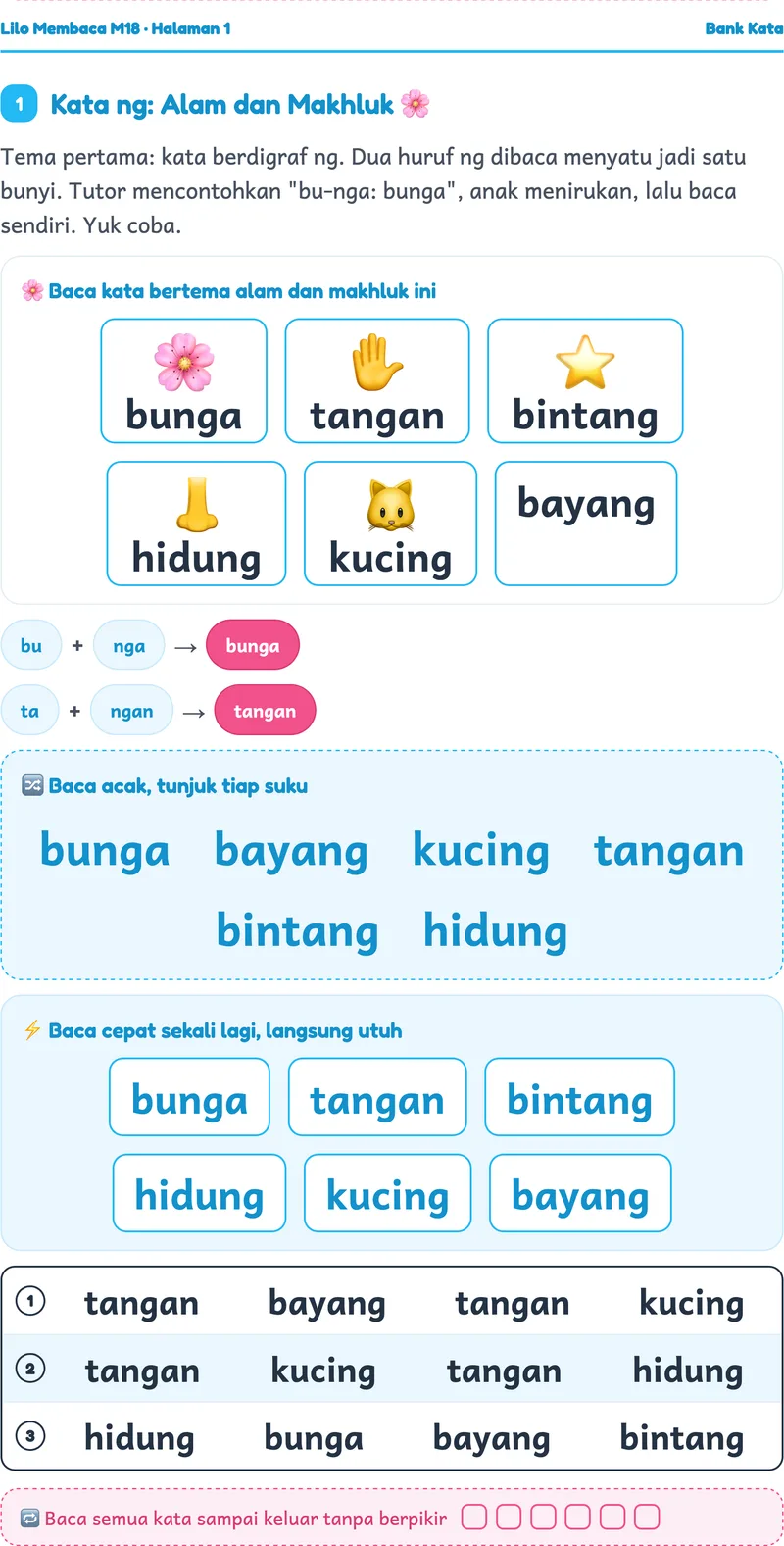
At Level 4, children meet words that combine the letters ng and ny through this module 18 sheet. Because this stage famously causes stumbles, we add extra support so every child gets past it with confidence.
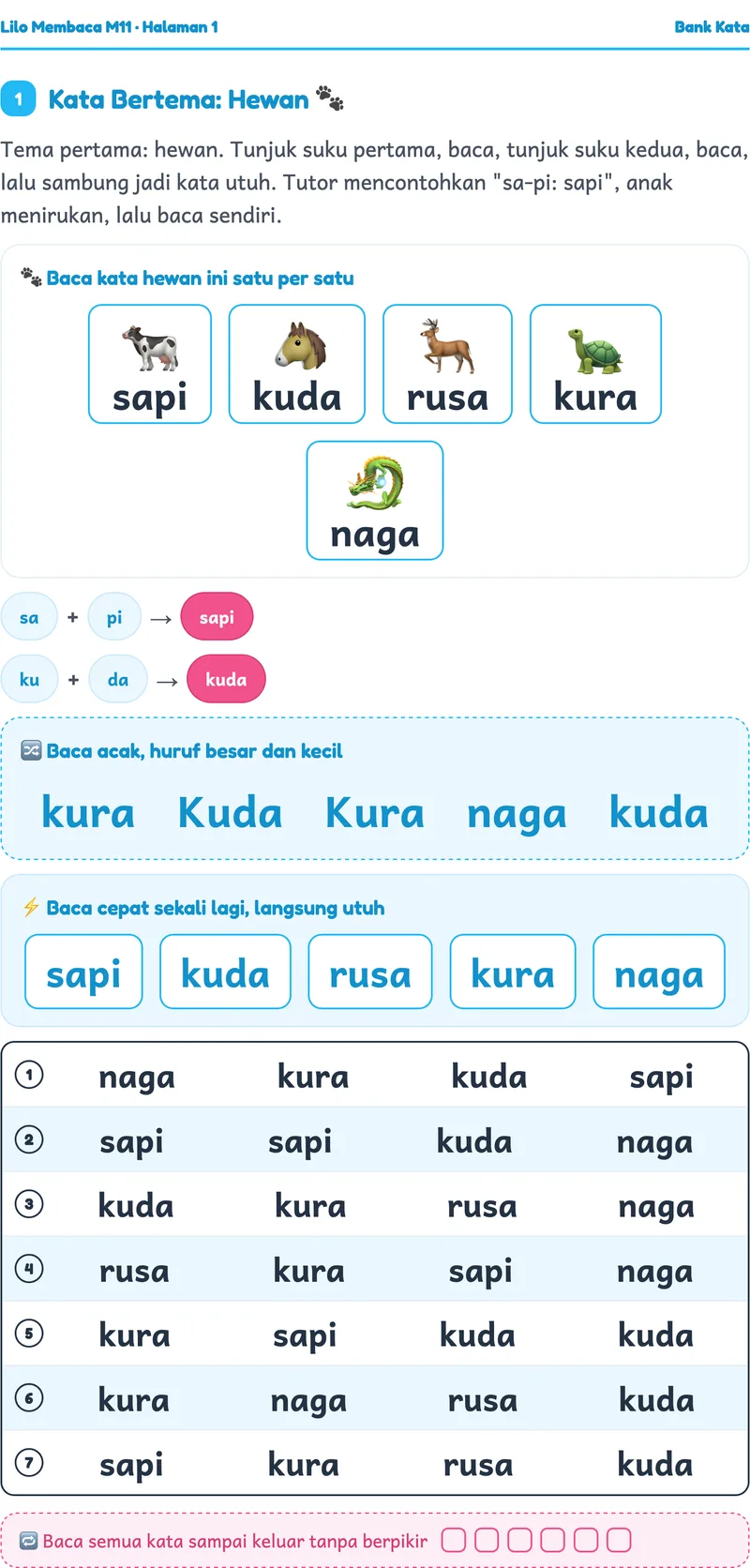
This Level 1 sheet from module 11 works on themed two-syllable words. Children point to each syllable, read it, then join the parts into a whole word, like sa-pi becoming sapi. A quick-read round wraps it up.
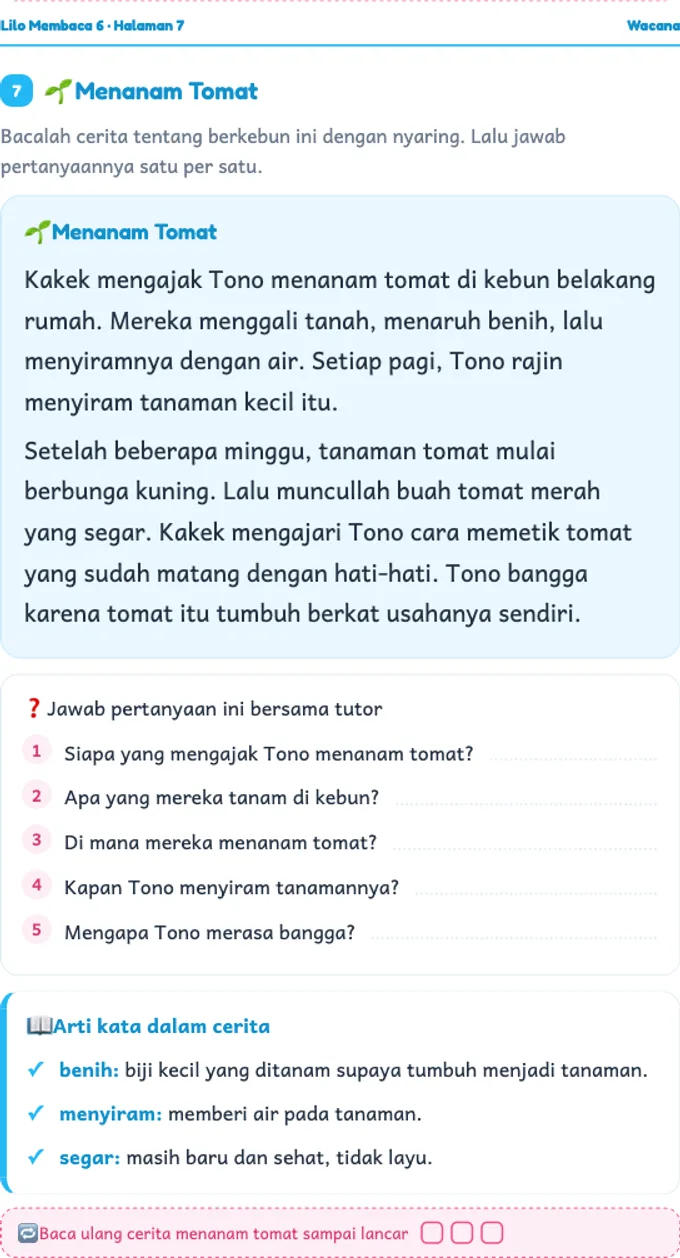
Grandma's Garden
That morning Tono went to the garden with Grandma. Grandma planted spinach and tomatoes. Tono watered the plants. They garden every Sunday. Tono is happy because Grandma's garden is thriving.
Children read a short passage, then answer five questions: what, who, where, when, and why. This Level 6 exercise builds real understanding of the text and the ability to retell the story in their own words.
All four sheets come from Lilo's own leveled curriculum, 122 modules packed with generous practice on every A5 page.
A calendar, a wall clock and a stick of chalk are enough for short activities, each one training a single stage.
For L3. Each morning, your child finds today's date and reads the day's name by syllables: se, nin, Senin. Kamis and Sabtu practise syllables that close with a consonant. Add a tick once they read it alone.
a wall calendar and a marker
For L2 to L4. Write pagi, siang, sore and malam and tape them near the clock. At mealtimes or bedtime, your child picks and reads the right card. Siang also practises ng.
four slips of paper and tape
For L1. Draw six boxes holding ma, ta, bu, ku, sa and pi. Your child hops into two boxes and says the word they make, like mata, buku or sapi. Moving the body helps two sounds feel like one word.
chalk and a patch of porch floor
For L4. Write bunga, nyanyi and angsa. Your child traces the ng or ny with a finger while humming it as one nasal sound, then reads the whole word. This keeps ng reading as a single sound.
a small chalkboard and chalk
One activity a day is plenty. Stop while your child is still enjoying it.
A picture for a five-year-old who knows no letter sounds yet and learns on the Regular package, 8 sessions a month or about twice a week. Each stage is mastered before the next one opens.
Through sound cards and songs, your child learns the five vowels and the first consonants. By the end of the month, the letter m brings out /m/ every time.
Sounds join into open syllables like ma, bu and ti. When your child links ma and ta into mata, they feel what reading is for the very first time.
With every consonant in place, words like sepatu and kelapa open up, then sentences like ibu beli roti. Readers use only mastered sounds, so whole pages get finished alone.
Your child reads tas, ikan and pasir. The pair kapal and kapan trains the ear to catch the final sound and the eyes to read right to the last letter.
Your child begins meeting ng and ny. This stage gets extra care and more practice, and it is exactly where a child approaching six naturally belongs.
The pace follows your child's mastery, so every stage is solid before the next one begins.
60, 90, or 120 minutes
Contact us
60, 90, or 120 minutes per session
Contact us
duration of 60, 90, or 120 minutes
Contact us
You tell us about your child. The Lilo team handles tutor matching, scheduling and class materials until the first session begins.
The consultation is free. Share your child's age, the letters they know and where they get stuck, so the team can estimate their starting point.
Choose Starter with 4 sessions, Regular with 8, the most popular, Intensive with 12 or Complete with 24. You pay per package, and larger packages cost less per session.
The team matches your child with a tutor whose profile you can view before the first session, so your child meets a face you already recognise.
In Denpasar, learning starts online. The class link and worksheets arrive before each session and are organised in app.lilo.id. You print the sheets and set them out with a pencil.
Home lessons follow once a nearby tutor in your area is confirmed.
Denpasar is the capital of Bali Province and a center of government and education on the island. The city is widely known for its banjar community tradition that keeps neighbors closely connected, and for a rich calendar of ceremonies that colors everyday life. Its districts stretch from Denpasar Selatan with the well known Sanur area, through Renon, Sesetan, and Panjer, to Denpasar Barat, Denpasar Timur, and Ubung. Learning in Denpasar grows side by side with a strong cultural tradition passed down through generations.
In Denpasar, your child begins with one-to-one lessons on screen, guided by a teacher drawn from Lilo's network across Indonesia. Each session lets you see how they grow. Hoping for a teacher at your home? Our team will first find one who lives close by.
Online classes still feel face to face through the screen, guided by the same patient teachers. Schedules follow your child's activities, including seasons full of ceremonies and community events.
Materials build up gradually from the very basics, so your child moves up each level with real understanding. Every session uses structured worksheets and steady practice suited for children aged 3 to 10.
These questions are fair to put to any reading provider, and the answers show how purposeful your child's learning will be.
Young children learn through short, frequent repetition, and long tasks without a clear aim make reading feel like a punishment. At Lilo, homework always comes from the stage being practised.
A skipped stage usually resurfaces later as a sticking point. Lilo uses a ladder from L0 Bunyi Huruf to L6 Wacana, drawn from the 122 coded modules of its own curriculum.
A child placed too high starts guessing, and one placed too low gets bored. At Lilo, the starting point comes from card games and short readers.
Sheets full of unfamiliar patterns push a child towards guessing. Lilo worksheets come from the module your child is studying, so every line is within reach.
Teaching young children to read calls for an understanding of how children grow. Lilo's national network has more than 5,000 active tutors, many from primary teaching, early childhood, psychology and mathematics programmes.
Your child works toward a reading graduation at Level 6, reading short passages and retelling stories. Progress is visible, celebrated, and easy for you to follow.
Lilo teaches from 122 leveled modules we wrote ourselves, moving from concrete objects to pictures to symbols, the same path Singapore Math is famous for.
Verified tutors from Lilo's national network teach your child live online, wherever you are in Denpasar. For areas such as Sanur and Renon, home lessons can be added after our team finds a tutor who lives nearby. Every child gets the same leveled curriculum.
Your child learns what letters say, then blends those sounds into syllables right away, so reading clicks early and spelling drills never get in the way.
Lessons are available with English or Indonesian as the language of instruction, a comfortable fit for bilingual and national-plus school families.
Families in Denpasar have several good ways to help a child read. Here is an honest look at how they differ.
| Aspek | Lilo | Learning Apps | Learning at Home Alone |
|---|---|---|---|
| Learning path | Seven measured levels ending in a reading graduation | Levels vary by app, often loosely ordered | Depends on whichever books are at hand |
| Guidance | A live tutor who hears and corrects each sound | Automated feedback from the screen | A parent's time and energy, which varies day to day |
| Hard stages like letter combinations | Extra care and a slower pace at Level 4 | The app moves on even when the child is unready | Easy to get stuck with no clear next step |
| Practice rhythm | Small daily portions, steady and levelled | Often depends on the child's screen motivation | Irregular, easy to skip on busy days |
| Progress checks | Placement at the start, mastery before moving up | Scores and streaks inside the app | Hard to measure without a framework |
During the first week, your child meets the tutor online and begins working through phonics level L0. You settle the fee for a whole package of sessions up front, and a lesson starts at IDR 76,865. Worksheets arrive ahead of class, and home lessons follow once a nearby tutor in Denpasar is confirmed.
Points at letters on shop signs and asks what sound they make.
IDR 430,444Knows a handful of letter sounds and is eager to climb one level.
IDR 846,694Often halts mid-sentence and benefits from more frequent practice sessions.
IDR 1,248,751Loves picture books and dreams of reading whole stories alone.
IDR 2,369,758Written into the Lilo Terms of Service.
One WhatsApp message is enough. Valid for as long as the package runs.
Here is how:
Plus a monthly progress report.
Oliver read the writing on a cereal box by himself the other day, then gave the proudest smile. Little moments like that make me feel the lessons truly matter.
Reading classes at Lilo helped my child understand the content of a book really well. Their reading skills improved, very satisfying.

Start with a free consultation on WhatsApp. Tell us your child's age and what they can read today, and we will suggest the right level and a schedule that fits your family in Denpasar.
Free consultation via WhatsApp