

Ages 3 to 4: Playing With Sounds
Your child is still before reading, and that is a lovely place to be. Lessons feel like play, with songs and sound cards that introduce the sounds letters make, long before any book appears.
Lilo teaches your child to read through seven measured levels, drawn from our own library of 122 original modules. Letter sounds come first, then syllables, then whole stories your child can finish alone.
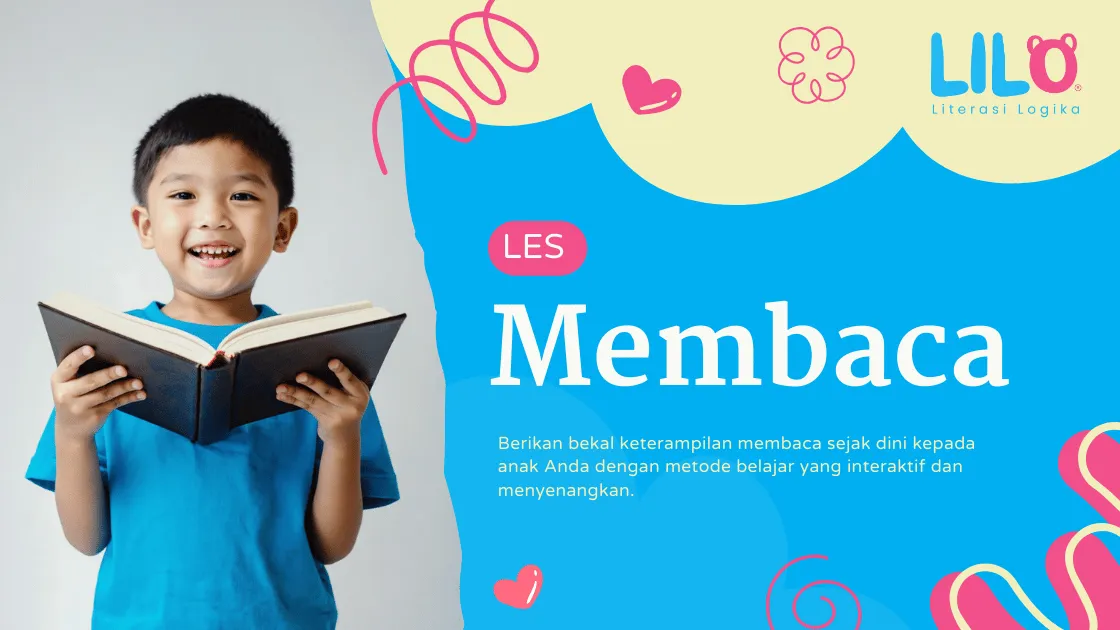
Reading Classes for Kids in Jakarta is Lilo's guided reading program for children aged 3 to 10, taught with English as the language of instruction, at home, in small groups, or online. Every lesson comes from our own curriculum of 122 leveled modules. Your child starts with letter sounds, blends them into syllables, and climbs seven clear levels until reading whole passages feels natural.
Every child arrives at reading from a different place. A short placement assessment at the start shows us exactly where your child stands, so lessons begin at the right level.
Your child is still before reading, and that is a lovely place to be. Lessons feel like play, with songs and sound cards that introduce the sounds letters make, long before any book appears.
Kindergarten years are the natural window for learning to read. Your child learns letter sounds, blends them into syllables, and builds the calm confidence that makes the first year of school feel easy.
Your child can read a little and now needs steady mileage. We work on longer sentences, tricky letter combinations, punctuation, and expression, so reading aloud starts to sound smooth and alive.
Some children reach school before reading clicks. Our placement assessment finds the exact gap, and your child catches up step by step in private sessions, without shame and without skipping the basics.
Our method rests on a simple idea: children read well when they master sounds first and move up only when a stage is truly theirs.
Before the first lesson, a placement assessment shows which of the seven levels fits your child today. Lessons then begin exactly there, never too easy and never overwhelming.
Your child learns what each letter says, like /m/ and /a/, through songs and sound cards. Knowing sounds makes the next step, blending, feel almost automatic.
Sounds flow straight into syllables, syllables into words, and words into sentences. There are no letter-name spelling drills to slow this down, so reading builds momentum early.
Small daily portions, in a steady, levelled rhythm, turn new skills into habits. Your child moves up only after mastering a stage, so confidence stays intact.
Every stage stands on the one before it, so the foundation has no gaps.
Readiness shows up in small everyday habits. Watch your child through these skills and share what you see in the consultation, so the Lilo team in Jakarta starts with a clear picture.
Jakarta and its surroundings have 350+ early reading tutors.
Graduates and active students.
Applications screened
Our team reads every application.
Documents verified
ID card, diploma and photo are checked.
Experience and hours recorded
We know when each tutor is free.
Trained in the Lilo method
The step-by-step method is learned first.
Matching per child
Questions come from the child’s needs.
Tutor not quite right? Read the tutor replacement guarantee
Four and five year olds show their best when they feel they are playing, so Lilo's first session runs on games.
Many young children cannot yet grip a pencil comfortably or read instructions. A written test ends up measuring handwriting, while the real question is which sounds they already know.
A tense child goes quiet or answers at random. With sound cards and syllable building, your child answers freely and their true ability shows.
Letter sounds come first, then open syllables like ma and bu, then numbered reading sheets. Where hesitation appears, perhaps at ng, the tutor marks the spot.
The starting point sets the modules and worksheets for the next sessions, and you see it laid out in the first weekly report.
The first session carries no score. The tutor records which rungs already stand firm.
Lilo's team runs the whole match. You describe your child, and the team weighs reading stage, address and schedule.
The consultation is free. Share your child's age, how they get on with books, and where they seem stuck, such as naming each letter aloud.
The choice comes from a national network of more than 5,000 active tutors. For home sessions your Jakarta address is part of the match, and timing follows your child's day.
The profile is open before the first session. Many Lilo tutors studied primary teaching, early childhood education, psychology or mathematics.
Each week the tutor reports the stage practised, what is mastered, what needs another round, and one small home activity, so you can sense how well they click.
A free tutor change is a Lilo service promise. If the fit feels off, tell us and the team arranges a new match.
These are the working habits our curriculum team built into all 122 modules, and they show up in every single session your child attends.
From the very first session your child learns what letters say, like /m/ and /a/. Sounds are the keys that unlock every word, so we teach them first and teach them well.
Sounds flow directly into whole syllables. Because we skip letter-name spelling drills, your child reads syllables in one smooth breath instead of stopping to name each letter.
Our leveled readers contain only patterns your child has already learned. Every page can be finished without help, which is exactly how a child starts believing they are a reader.
Combined sounds like ng, ny, and clusters like tr are the hardest stage for most children. Our modules slow down here on purpose, with extra practice and extra patience.
Every rung on this ladder is a real stage in our own 122 module library, and your child climbs it one mastered step at a time.
Most reading struggles we see in Jakarta come from a handful of well-meaning habits. Knowing them early saves your child months of frustration.
Why it happensNaming letters one by one, like saying b-u-k-u, forces the child to hold names in memory and then translate them into sounds, which stalls blending.
How Lilo helpsTeach what each letter says first. When your child knows /b/ and /u/, the syllable bu comes out in one breath, no translation needed.
Why it happensA child who recognizes the shape of m but does not know it says /m/ has learned a picture. Pictures do not blend into words.
How Lilo helpsPair every letter shape with its sound from day one, using sound cards and songs, so shape and sound are learned as one thing.
Why it happensA book full of patterns the child has never learned turns reading into guessing, and repeated guessing quietly teaches the child that reading is scary.
How Lilo helpsUse leveled texts that contain only patterns already mastered. Success on every page builds the appetite for the next, slightly harder page.
Why it happensRepetition builds skill, but repetition without play drains the joy out of it, and a bored child starts avoiding practice altogether.
How Lilo helpsKeep portions small and daily, and wrap practice in songs, cards, and timed games, so steady work stays something your child looks forward to.
Your child meets the sounds of vowels and consonants through sound cards and letter tracing, building the ear for sounds that all later reading rests on.
Sounds join into open syllables and then into words of 2 to 3 syllables, with timed reading sheets that make practice feel like a friendly game.
Your child tackles syllables with consonant endings, then the combined sounds, clusters, and paired vowels that trip up most young readers, with plenty of patient repetition.
Sentences grow from 4 to 10 words while your child learns punctuation, intonation, and rhythmic reading, so reading aloud starts to sound like natural speech.
Mini stories invite your child to answer who, what, when, where, and why questions, find the main idea, and retell the story in their own words.
A child who reads aloud smoothly may still miss the meaning. Five questions after a short story show what has stayed.
Reading asks for two jobs at once: turning letters into sounds, then drawing meaning from them. Early on, nearly all of a child's effort goes to the first job, so a sentence can slip away the moment it ends. That is why L6 texts use only mastered sounds. Once sounding out feels light, effort moves to meaning.
The questions climb in difficulty. Who and what are easiest because the answer is written. Where and when need small details such as that morning. Why is hardest because the answer is rarely written. Take this: That morning the sky was dark. Dodi took an umbrella to school. To explain the umbrella, your child must connect the two sentences alone.
The tutor starts with the easiest questions so your child succeeds early. When an answer misses, your child traces the line with a finger and fixes it. For why, the tutor lays a bridge: what usually happens when the sky turns dark? At home, progress shows when your child answers in full sentences and uses the word because.
These are real A5 pages from our own 122 module curriculum, exactly as children use them in sessions. Notice the generous practice portions on each sheet: that steady, hands-on repetition is where reading skill quietly takes root.
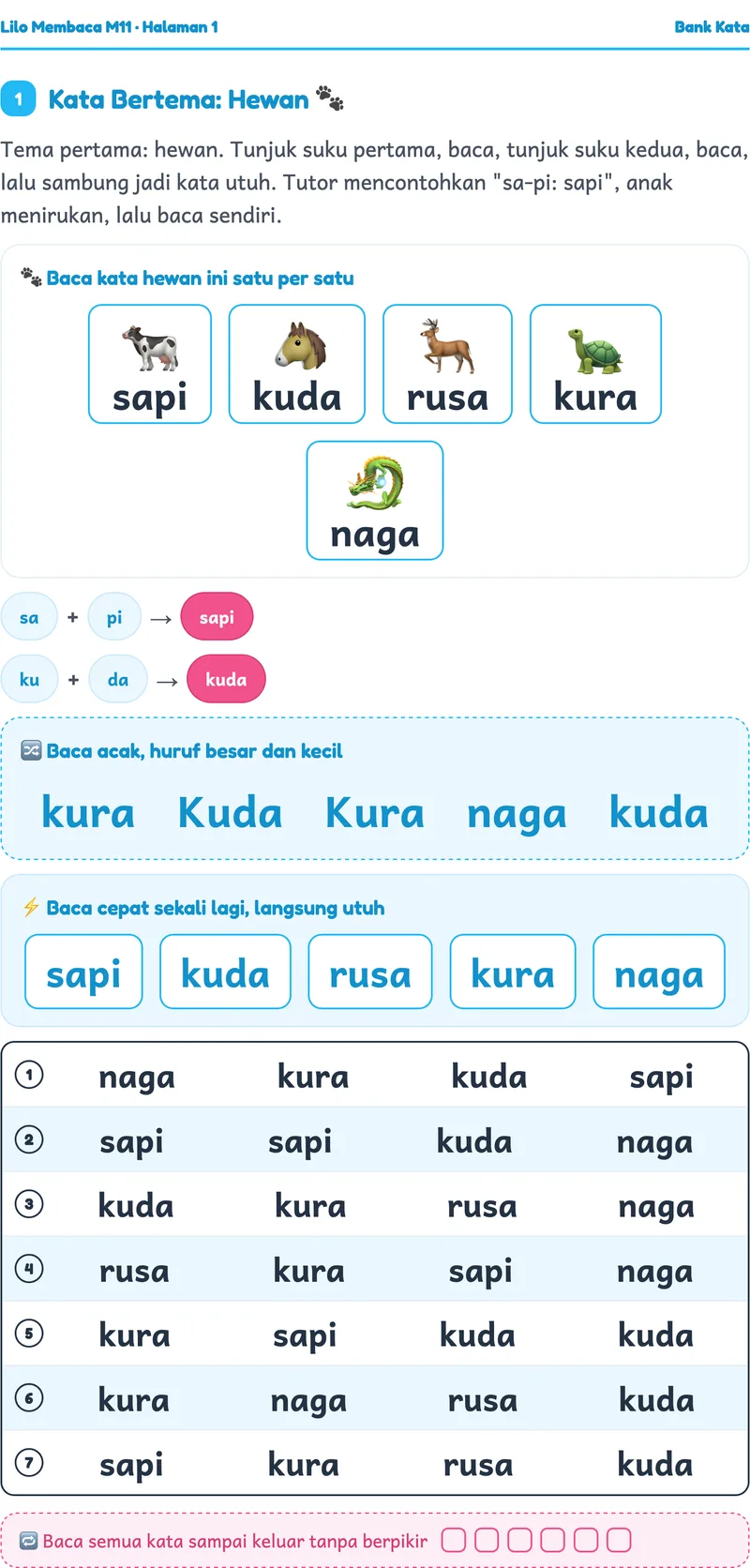
Here children meet themed two-syllable words taken from module 11 at Level 1. They point to a syllable, read it, then connect both parts into one full word. A fast reading round closes the sheet on a cheerful note.
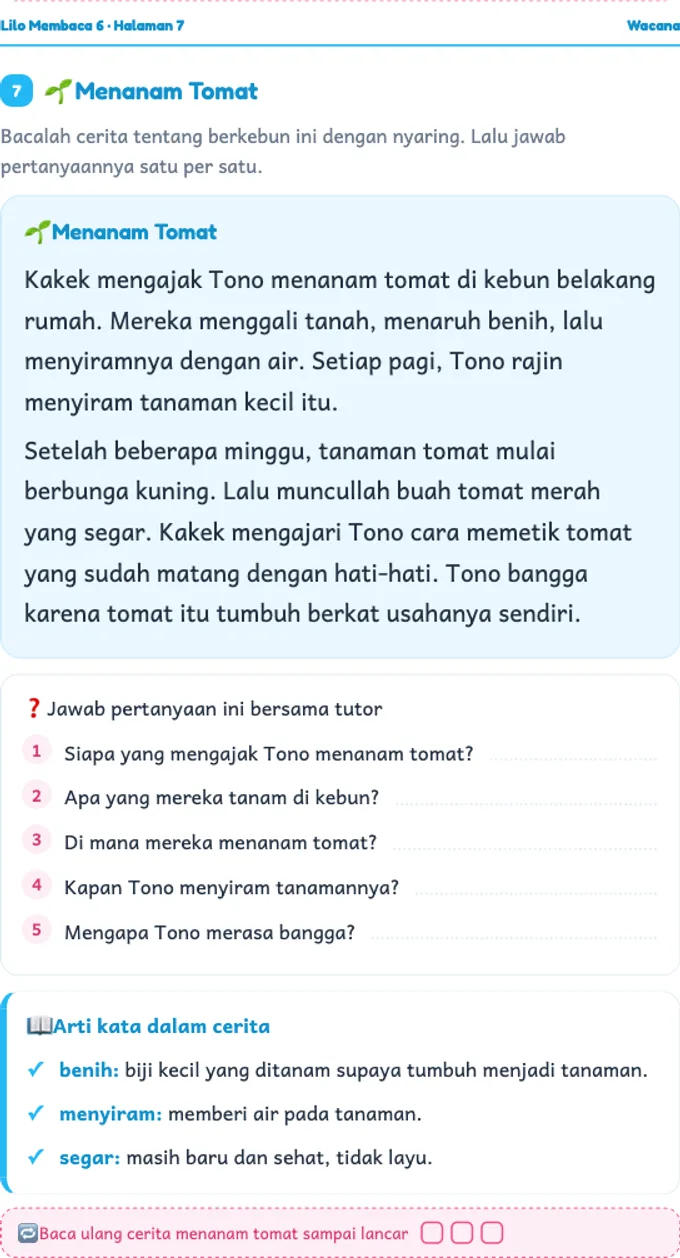
Grandma's Garden
That morning Tono went to the garden with Grandma. Grandma planted spinach and tomatoes. Tono watered the plants. They garden every Sunday. Tono is happy because Grandma's garden is thriving.
One of 18 short stories with its questions and word meanings. Your child reads the passage then answers 5W questions, building comprehension until they can retell it.
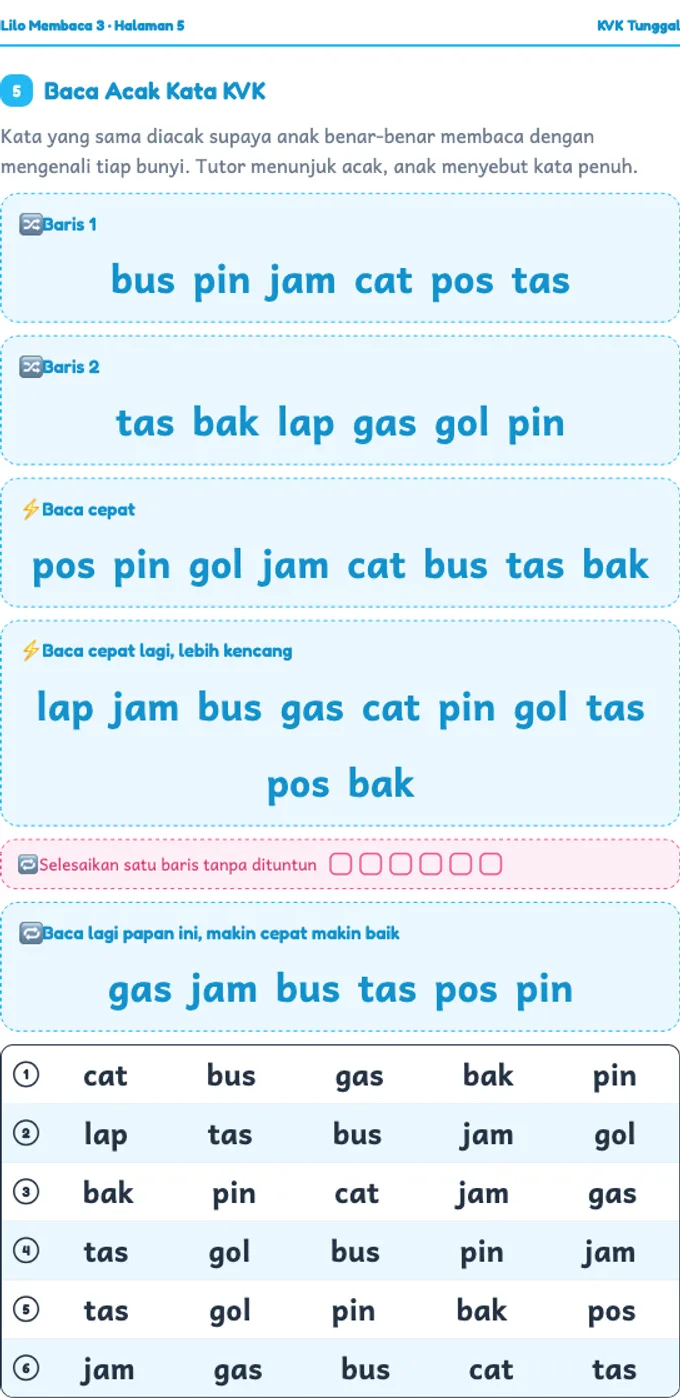
This Level 3 sheet challenges children to read a word grid quickly and repeatedly, with time recorded. Words such as tas end in a consonant, so children learn to notice the last letter while their reading grows smoother.
Samples from Lilo's original curriculum. The full A5 materials are prepared by the tutor at each session.
Bedtime and car rides, perhaps in Jakarta traffic, are two moments already in your child's day that suit short sound games.
| Activity | Time | What you need |
|---|---|---|
One page and one question before sleepAfter reading a page together, ask one question, rotating nightly through who, what, where, when and why. Your child points to the sentence holding the answer, which builds L6. | 10 minutes | a picture storybook from the shelf |
Guess the first sound before lights outSay /b/ and let your child find something starting with it, such as bantal or boneka, then swap roles. This trains the ear at L0. | 5 minutes | objects in the bedroom |
Syllable spotting on street signsWhen the car stops, point to a sign and ask your child to find a known syllable such as ma or ra. A child at L2 can read the whole word, always while the car is still. | 10 minutes | shop signs and road signs |
One finger for ng, two fingers for nySay bunga, nyanyi and pisang in random order. Your child raises one finger for ng and two for ny, preparing the ear for L4. | 5 minutes | your voice and your child's fingers |
Stop while your child is still enjoying it. The tutor's ten minute task stays the main practice.
This picture follows a 5 year old taught at home in Jakarta on the Intensive package of 12 sessions a month, about three a week, starting from letter sounds.
Three meetings a week help vowels and first consonants settle fast. Your child says /m/ or /s/ the moment the letter appears on a card.
Sounds blend into ma, bu and sa without naming letters, then into two-syllable words such as mama and buku.
Words stretch to three syllables and your child reads sentences like ibu beli roti, using sheets built only from sounds already learned.
Your child practises makan and bantal. Close pairs such as kata and katak train the eye to check the final letter.
The sounds ng, ny, kh and sy are practised as single sounds, as in bunga and nyanyi, at a gentler pace, with the weekly report tracking each one.
The weekly report is your map, and your child moves up once the stage before is truly their own.
60, 90, or 120 minutes
Contact us
60/90/120 minutes
Contact us
choose 60, 90, or 120 minutes
Contact us
Every path can work for some children. Here is an honest look at how guided, leveled lessons differ from two common alternatives.
| Aspek | Lilo | Learning Apps | Big Group Classes |
|---|---|---|---|
| How levels work | Seven measured levels from our own curriculum, entered by placement assessment | Levels set by the app, often skipped by tapping ahead | One pace for the whole class, whatever each child's stage |
| Who guides the child | A live, verified tutor who hears every sound your child makes | The screen responds, but nobody hears mispronounced sounds | One teacher shared among many children |
| When lessons get harder | Only after your child has truly mastered the current stage | Whenever the child taps next | When the class schedule says so |
| Reading material | Leveled readers containing only patterns already learned | Varies widely by app and level design | One shared textbook for all |
| Feedback for parents | You hear from the tutor after sessions and can see the worksheets yourself | Automated progress screens | Report cards at term end |
Your tutor's weekly report shows which phonics level your child is on, so you can follow the climb from L0 toward L6 here in Jakarta. Payment covers one package of sessions at a time, with sessions beginning at IDR 76,865 each. Lessons run at home with the tutor or online, and a longer package brings the cost of each session down.
By the end, your child voices several letter sounds with confidence.
IDR 584,174Your child finishes this package reading two-syllable words without sounding out.
IDR 1,149,085The package closes with your child reading simple picture-book sentences alone.
IDR 1,694,733Once complete, your child reads a one-page story and retells it.
IDR 3,216,100Written into the Lilo Terms of Service.
One WhatsApp message is enough. Valid for as long as the package runs.
How it works:
Topped up by a monthly report.
When comparing reading lessons in Jakarta, ask any provider these questions, especially about mistakes and pace.
| Question to ask | Why it matters |
|---|---|
What does the teacher do when my child misreads a word? | Children quickly decide they are bad at reading when mistakes meet a sharp voice. Lilo tutors guide your child back to the letter sounds, then celebrate the blend. |
When does my child move up a level? | A skipped level leaves a gap in every harder text. Ask whether moving up follows the calendar or your child's skill. At Lilo, it follows mastery. |
How is the pace adjusted when my child is tired or stuck? | Healthy pressure stretches a child a little, while too much makes them refuse. Lilo breaks hard stages down and gives extra care at ng, ny, kh and sy. |
How often will I hear about progress, and what will it say? | A vague note gives you nothing to act on. Lilo tutors report weekly on the stage practised and what needs repeating, with one small home activity. |
What happens if my child and the teacher do not click? | The bond with a teacher shapes a child's willingness to open a book. Lilo replaces the tutor free of charge, and the team handles the new match. |
All 122 modules are Lilo originals, leveled and tested, so every worksheet your child touches was designed to fit the exact stage they are on.
Your child moves up only after mastering a stage. Progress is honest and visible, and gaps never get quietly carried forward into harder material.
Because letter sounds come before anything else, blending arrives quickly and your child experiences early wins that make them want the next session.
We follow the Singapore Math way of teaching: real objects first, then pictures, then symbols. Applied to reading, it means your child understands before memorizing.
Every tutor is verified by Lilo, and instruction is available in English or Indonesian, a natural fit for bilingual and national-plus families.
For in-person sessions, tutors travel to homes in Menteng, Kebayoran Baru, Kemang, Pondok Indah, Kelapa Gading, and nearby areas, and online sessions reach every corner of DKI Jakarta.
Jakarta sits on the northwest coast of Java and serves as Indonesia's capital, anchoring the Province of DKI Jakarta. Government and education for the whole nation are run from here, so the city holds a wide spread of schools, starting with early childhood classes and reaching all the way to university. Many of the country's most respected places of learning have called Jakarta home for generations. You can feel that love of study in Menteng, in Kebayoran Baru, and out in Kelapa Gading. Lilo serves every child in Jakarta two ways: a teacher who visits your home, or online lessons with the same careful guidance. Whichever part of the city you live in, your child learns in comfort at home.
In Jakarta, your child sits at their own table while the teacher arrives with materials sorted by level. Each step is guided, and the speed of every lesson follows what your child can do.
Your child begins at a level that fits what they already know, then moves up in small, steady steps. Their growth is easy for you to follow, from the first look at an idea to handling it on their own.
Your child meets each idea with objects to hold and pictures to see, and only then turns to numbers and letters. Learning this way helps your child really understand each lesson.
Kinan has started reading short stories on his own. He often refuses to stop at one page and keeps asking to continue until the story is finished.
Lilo Reading Classes made such a difference for my child. The method really works, and their reading has come on so much. We're so happy with it.

Start with a free WhatsApp consultation. We will listen to where your child is and match a verified tutor anywhere in Jakarta, at home or online, who reads your child's level in the first lesson.
Free consultation, no obligation