


Little explorers, ages 3 to 4
Your child is meeting sounds for the very first time. Lessons feel like play, with songs and sound cards, so curiosity about letters grows long before any reading begins.
Your child learns the sound each letter makes, then glides those sounds together into whole syllables and words, climbing seven clear levels until short stories feel easy and enjoyable.
Reading Classes for Kids in Jambi is Lilo's leveled reading program where a child learns letter sounds first, then blends them directly into syllables, words, and real sentences, with English as the language of instruction. Every child begins with a placement assessment, practices in small daily portions, and moves up only after truly mastering a stage.
Every reader starts somewhere different. These are the stages we meet most often, and each one gets its own path through our levels.
Your child is meeting sounds for the very first time. Lessons feel like play, with songs and sound cards, so curiosity about letters grows long before any reading begins.
Your child is getting ready for primary school. We build the habit of blending sounds into syllables and simple words, so the first year of school starts with confidence.
Your child can read a little and now needs smoothness. We strengthen longer sentences, tricky letter combinations, and understanding, so reading becomes something your child enjoys alone.
Your child is past the usual starting age and reading still feels hard. The placement assessment finds the exact gap, and your child catches up steadily, without shame and at a kind pace.
choose 60, 90, or 120 minutes
Contact us
60, 90, or 120 minutes per session
Contact us
duration of 60, 90, or 120 minutes
Contact us
Many children get stuck reciting letter names. At Lilo, sounds do the work instead, so blending happens naturally from the first weeks.
Your child learns the sound each letter makes, like the hum of m or the open a, through songs and sound cards. Letter names can wait, because sounds are what reading is built from.
Two sounds slide together and a syllable appears. There is no reciting of letter names in between, so your child hears the syllable as one smooth piece and reads it that way.
At the upper levels, whole sentences take the lead. Your child reads with natural rhythm, follows punctuation, and answers questions about what a story actually says.
Small daily portions build steady practice built level by level. Your child moves to the next level only after mastering the current one, so nothing wobbly gets carried forward.
The pace of moving up follows your child, so learning stays calm.
Readiness for reading shows up quietly, in small habits at home and in the way your child plays. When several of these signs appear, your child is ready to begin.
Tutors for Jambi are chosen from 200+ teachers in Sumatra. Some of them already live in Jambi.
Some still studying, others graduated.
Application screening
Role and city are checked first.
ID card and diploma verified
The team checks identity and education.
Tutor profile filled in
Teaching history goes into the portal.
Trained in the Lilo method
Phonics and CPA come first.
Chosen for your child
The team scores every answer.
Want a different tutor? See our free tutor replacement promise
For your child, the first session feels like play, with no written test. While laughing along, the tutor notes the few things that decide where your child starts.
A guessing game with objects in the room shows whether your child hears that sapu and sepatu both open with /s/, the earliest marker for L0.
As letter cards flip over, the tutor listens closely. A child who calls b by its name, be, is gently guided toward the sound that letter makes.
Inside a little train game, the tutor offers /m/ and /a/. A child who says ma straight away is ready to build syllables at L1.
With a picture book, the tutor covers the picture for a moment to see whether your child is sounding out words or reciting a story known by heart.
The first steps are light. Here is how your child's start in Jambi unfolds, from your first message to the first progress note.
In a free WhatsApp consultation, you share your child's age and habits with books. You can read the matched tutor's profile before the first session.
A tutor comes to your home in Jambi, or your child joins an online class, with the link and worksheets sent ahead through app.lilo.id.
The starting point is found through games. At the end, the tutor sums up what your child mastered and leaves a ten minute task, like finding three things that start with /b/.
At the end of the week the tutor's report lands. It might say /m/, /a/ and /i/ are now solid, and next week your child starts blending them into ma and mi.
Your child gets to know each letter by its sound and hand, tracing letters while saying them, so eyes, ears, and fingers all learn together.
Sounds glide together into open syllables, then into words of two and three syllables, until reading a new word feels like something your child simply does.
Syllables with consonant endings, paired letters, clusters, and gliding sounds get patient, focused practice, because this is where most young readers need the most support.
Your child reads sentences of 4 to 10 words with rhythm and expression, learning what a comma asks for and what a full stop means.
Mini stories become conversations. Your child answers who, what, where, when, and why, finds the main idea, and retells the story in their own words.
These are the signatures our tutors bring to every session in Jambi, drawn from Lilo's own curriculum of 122 leveled modules.
Every letter is introduced by the sound it makes. Your child says it, hears it, and traces it, so reading grows from sound upward instead of from memorized shapes.
Sounds join directly into syllables in one smooth breath. Your child skips the detour of reciting letter names, which is exactly the habit that stalls so many beginning readers.
Our leveled readers contain only patterns your child has already learned. Every page can be finished independently, and finishing a whole page alone is what builds a reader's confidence.
Combinations like ng, ny, and tr are the hardest stage in the whole journey, so our curriculum slows down here on purpose, with more practice and more patience.
Each rung is a real stage in Lilo's own modules, and your child climbs one rung at a time after mastering the one below.
Most reading struggles we meet in Jambi trace back to a handful of well-meant habits. Here is what they look like and how we undo them.
Why it happensSaying be-a-ba forces the child to translate names into sounds mid-word, and that pause breaks the blend every single time.
How Lilo helpsWe teach sounds first, so syllables come out whole. Letter names arrive later, once reading already works.
Why it happensA child can point to every letter on a poster and still be unable to read, because shapes alone carry no sound to blend.
How Lilo helpsEvery letter is learned as shape and sound together, through cards, songs, and tracing, so recognition always comes with something to say.
Why it happensA book full of unlearned patterns turns reading into guessing, and repeated guessing teaches a child that books are frightening.
How Lilo helpsOur leveled readers contain only patterns already mastered, so every book your child opens is a book your child can finish.
Why it happensThese letter pairs behave differently from single letters, and they are the most common sticking point in the entire journey.
How Lilo helpsLevel 4 is built around exactly these combinations, with a slower pace and extra care until they feel ordinary.
Many children can recite a favourite book page by page. That skill is valuable, and a few simple checks show whether your child is remembering or reading.
Children of four or five have a strong memory for sound. After ten bedtime readings, a story about a hiding cat sits whole in your child's head, rhythm included. The picture of the cat under the table calls up its sentence, and out it comes with confidence. The eyes read the picture while memory supplies the words, and that is a healthy stage.
Real reading takes another road. The eyes catch letters, the brain turns them into sounds, and the sounds blend into syllables and words. That road lets a child read a word nobody has read aloud yet. To check at home, cover the picture with your hand and point to one word in the middle of a sentence. A reader can still sound it out.
A Lilo tutor uses that memory as a bridge. Words from the favourite book made of mastered sounds, like bola or mata, go onto cards with no picture. Your child also reads invented syllables such as mabo or tibu, which nobody can memorise, so practice lands on blending itself. Soon a brand new book can be read alone.
These are real pages from Lilo's original curriculum, printed on friendly A5 sheets with generous practice portions. From Letter Sound Cards at Level 0 to Passage and 5W Comprehension at Level 6, this is exactly what your child will hold.
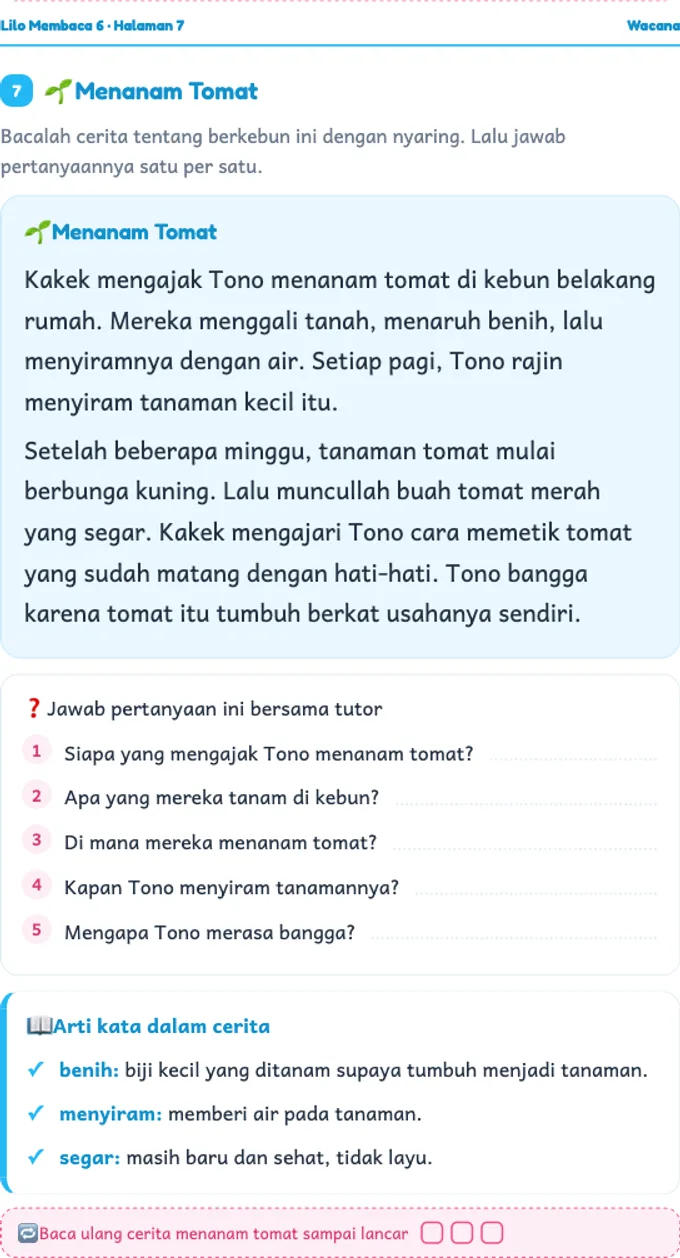
Grandma's Garden
That morning Tono went to the garden with Grandma. Grandma planted spinach and tomatoes. Tono watered the plants. They garden every Sunday. Tono is happy because Grandma's garden is thriving.
A short story sits beside 5W comprehension questions at Level 6. After reading, children work through what happened, who was involved, where, when, and why, then practice retelling the whole passage clearly.
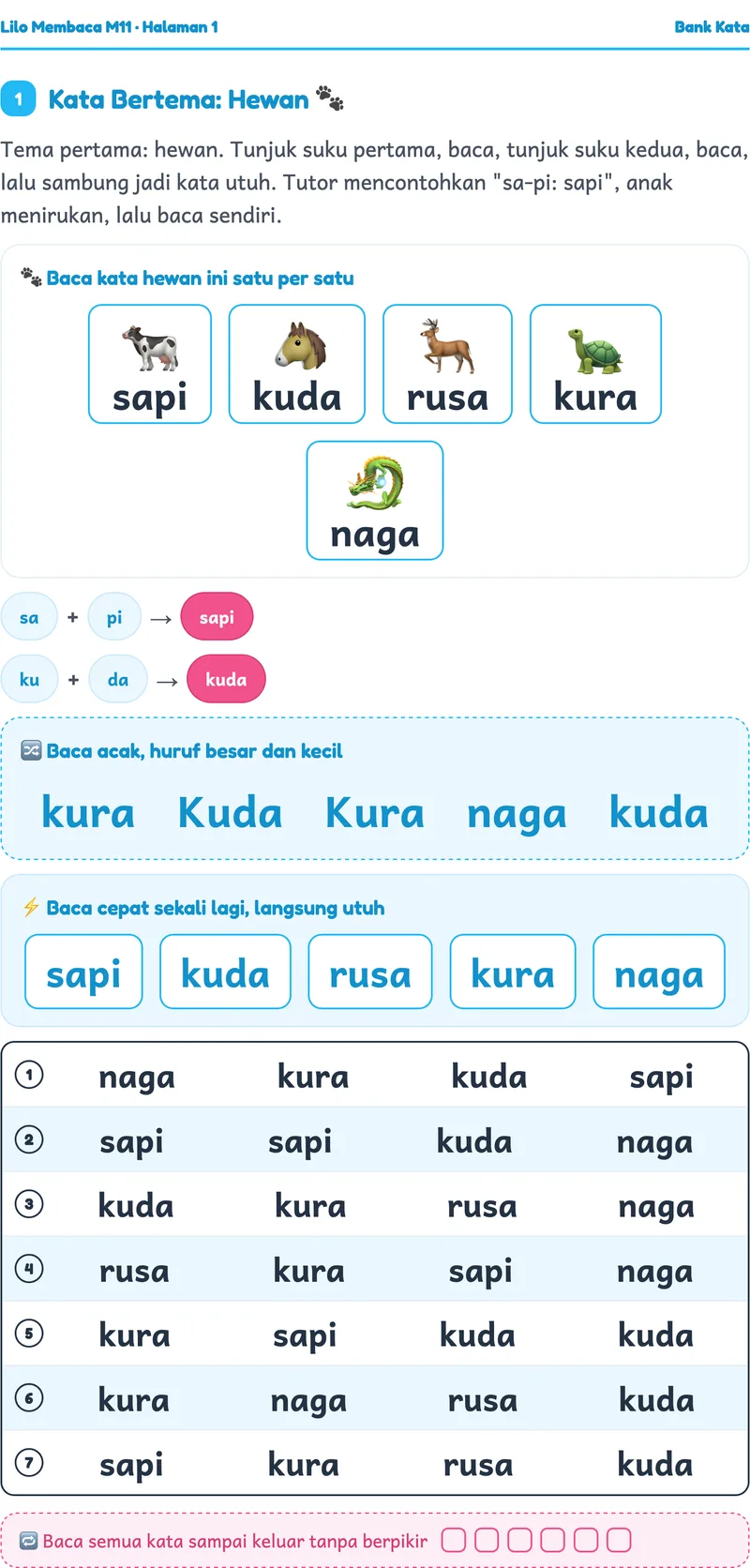
A real page from module 11: your child points at each syllable, reads it, then blends it into a whole word. A fast-read round makes the words come out smoothly.
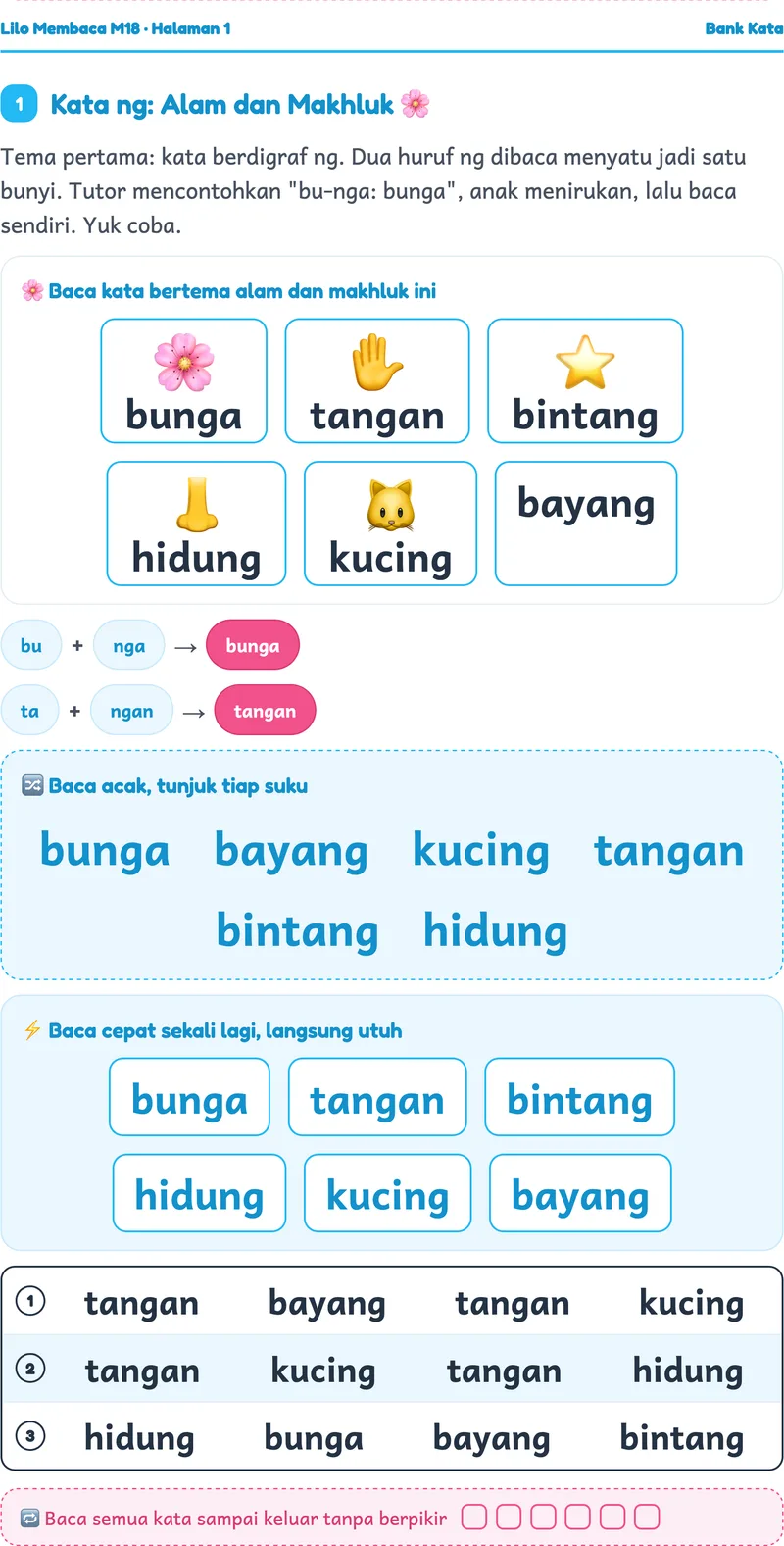
This Level 4 sheet from module 18 practices words with the letter pairs ng and ny. This stage is where children most often get stuck, so the exercises come with extra support to carry them through.
These samples are a small slice of 122 original modules, arranged step by step from letter sounds to full comprehension.
The best practice materials are often already on your child's bedroom floor. These four games use blocks, stacking toys and old cardboard, each for one clear stage.
Cut palm-sized cards from a box and write one big letter on each. Spread them on the floor, call out a sound, and your child jumps onto the matching card. Ideal for L0.
old cardboard box, scissors, thick marker
Tape one letter to each block. Your child stacks m, then a, saying each sound, and blends them into ma. Every new tower is a new syllable, the heart of L1.
stacking blocks, masking tape, marker
Each carriage carries one syllable. Ma and ta make mata, then the front carriage swaps to ka and the train reads kata. One changed syllable makes a new word at L2.
stacking toys, small paper slips
Make cards for ba and ka plus single letters n and k. Your child builds ban, bak, kan and kak, listening for the change at the end. Closing consonants come alive at L3.
homemade cardboard cards, a small tub
This picture follows a 4 year old who knows no letters yet. The child begins with the Starter package, about once a week, then moves to Regular once a learning rhythm settles in.
Through songs and sound cards, your child meets a, i, u, m and b in a playtime they look forward to.
Your child notices that bola, buku and bebek share one opening sound, and the pile of sound cards keeps growing.
With about two sessions a week, blending speeds up, and ma, mi, ba and bu come out as single smooth sounds.
Your child reads mama, buku and bola from numbered reading sheets, and each word feels like a small prize.
The consonant set fills out, and your child proudly reads short sentences like ibu beli roti.
The stage codes show the order your child climbs, and the tutor adjusts each step from week to week.
Every option below can help a child. Here is an honest look at how they differ, so you can choose with clear eyes.
A verified tutor works with your child live and adjusts on the spot
A placement assessment finds your child's exact level
Your child moves up only after mastering a stage
The tutor notices the exact stumble and gives extra care
Leveled readers built from patterns already learned
The Regular package is the one chosen most often: 8 sessions a month, roughly twice a week, enough to keep your child's phonics rhythm steady from level to level. Each session begins at IDR 76,865, and payment covers one whole package at a time. Lessons happen with a tutor at home or in an online class, with a reading level report every week.
A first step while you are still seeing whether phonics suits your child.
IDR 307,460Chosen once you feel sure and your child is ready for a steady rhythm.
IDR 604,782Picked when your child is chasing a particular reading level fairly soon.
IDR 891,965When you want your child to travel the whole phonics path to fluent reading.
IDR 1,692,684Included in every lesson package.
One WhatsApp message is enough. Valid for as long as the package runs.
The steps:
Plus a monthly progress report.
These are fair questions for any lesson provider. The answers show how clearly you will be able to follow your child's progress.
Regular news lets you reinforce practice at home while a stage is still fresh. At Lilo, that news arrives on a steady rhythm without you having to ask.
Phrases like getting smarter are hard to act on. Coded stages give you the tutor's own yardstick, and at Lilo your child's place is written as a code from L0 to L6.
Entry to grade 1 asks for no reading, writing and counting test, since selection follows age. Lilo's ladder matches the early primary years, so class feels comfortable.
A good match shapes how bravely your child tries new sounds. At Lilo, the tutor is replaced free of charge until the fit feels right, as a firm service promise.
Readers that jump to new sounds push a child into guessing. Ask to see a sample worksheet. Lilo's worksheets are drawn from whichever module is being studied right now.
Lilo teaches from 122 leveled modules of our own making. Every worksheet your child touches was designed for this exact method, level by level.
New ideas start with things your child can touch, move to pictures, and only then become letters and words. It is the Singapore Math way of teaching, applied to reading.
Our tutors are verified before they ever meet a child, and they come to homes across Jambi, from Telanaipura and Kotabaru to Jelutung and Alam Barajo.
Lessons can run in English, in Indonesian, or in a mix of both, whichever helps your child feel at ease while the reading skill itself grows.
Your child advances only after a stage is truly solid. That single rule keeps confidence high, because the next level always feels reachable.
Jambi serves as the capital of Jambi Province and sits along the Batanghari, among the longest rivers on the island of Sumatra. People here value a quiet pace of life and a courtesy passed down over generations. Across the water, Seberang Kota keeps a cultural legacy that locals hold dear. With its roomy streets and tidy layout, the city gives children a relaxed setting in which to grow up and study.
Your child starts at the point that fits them, then climbs one level at a time. Every session in Jambi follows a clear ladder, so progress is visible and easy for you to track.
The teacher works with your child personally, observes how they learn, and adjusts the pace of each session. This full attention helps children grow confident and willing to try.
Your child first handles real objects, moves on to pictures, and only then meets written symbols. Each step rests on the one before it, so the understanding runs deep and lasts for years.
Sharon loves having us read the first page, then she reads the next one herself. It is so sweet to see her that confident now.
Kinan has started reading short stories on his own. He often refuses to stop at one page and keeps asking to continue until the story is finished.

Tell us about your child on WhatsApp and get a free consultation. We will suggest a starting level, a schedule, and the service that fits your family in Jambi.
Free consultation, friendly answers