
Little Listeners, Ages 3 to 4
Your child is still before reading, and that is a lovely place to be. Through songs, games, and sound cards, they meet the sounds of letters playfully, so reading later feels like a friend they already know.
Your child learns to read sound by sound, from the first vowels all the way to whole stories, with special care given to consonant endings and tricky letter pairs, one confident step at a time.
Reading Classes for Kids in Jayapura are guided lessons from Lilo that teach children aged 3 to 10 to read through letter sounds, with English as the language of instruction, in live 1-on-1 online lessons. Your child climbs 7 clear levels, and the stages many children stumble on, consonant endings and letter combinations, are practiced until fully mastered before anything new begins.
Every child arrives at reading on a different day and in a different way. We meet your child exactly where they are and build from there.
Your child is still before reading, and that is a lovely place to be. Through songs, games, and sound cards, they meet the sounds of letters playfully, so reading later feels like a friend they already know.
Your child is getting ready for primary school. We build the full path from letter sounds to short sentences, so they walk into their first classroom already comfortable with words on a page.
Your child can read a little and now needs to read smoothly. We strengthen fluency, tackle letter combinations with extra care, and grow real understanding of what a passage actually says.
Your child is school age and reading has been slow to click. Our tutors find the exact stage where things got stuck, rebuild it gently, and let your child catch up with zero shame.
Reading grows in a fixed order: hear the sound, blend it, master the hard endings, then read whole sentences with meaning. We follow that order faithfully.
Your child first learns what each letter says, sounds like /m/ and /a/, using songs and sound cards. Hearing and saying the sound comes before anything else, because sounds are what words are made of.
Sounds join directly into syllables, so a child who knows /b/ and /a/ can read "ba" right away. We skip letter-name spelling drills entirely, since they slow this natural gluing down.
Closed syllables, consonant endings, and pairs like ng and tr get their own dedicated stages with extra care. Your child moves up only after a stage is mastered, so nothing shaky gets carried forward.
At the upper levels your child reads full sentences with rhythm and punctuation, then short passages with real understanding. Steady practice built level by level, in small daily portions, keeps every gain permanent.
Your child advances one stage at a time, with a check at every move.
Our reading method comes from Lilo's own original curriculum of 122 leveled modules, built around one promise: master each stage fully before the next.
Your child learns what letters say before what they are called. Sounds like /m/ and /a/ come first, because a child who knows sounds can build words, starting from the very first lesson.
Sounds merge straight into syllables in one smooth motion. There are no letter-name spelling drills to unlearn later, so reading feels natural instead of mechanical from the beginning.
Every reader we hand your child contains only patterns they have already mastered. That means real success on every page, and a child who starts to believe "I can read this myself".
Pairs like ng, ny, and clusters like tr are the hardest stage in the whole journey, so our curriculum slows down here on purpose, giving extra practice until these patterns feel easy.
Seven real levels from our own modules, each one mastered before the next begins.
Most reading struggles come from well-meaning habits at home. Knowing these five patterns early can save your child months of frustration.
Why it happensLetter names sit between the child and the actual sound, so blending stalls and reading feels like a puzzle with a missing piece.
How Lilo helpsTeach the sound each letter makes and let your child glue sounds together right away. This is exactly how every Lilo lesson begins.
Why it happensA child can name every letter on a poster and still read nothing, because reading is built from sounds, and shapes alone stay silent.
How Lilo helpsPair every letter with its sound from day one, using sound cards and songs, so shape and sound arrive together.
Why it happensA book full of unmastered patterns turns reading into guessing, and repeated guessing quietly teaches a child that reading is scary.
How Lilo helpsUse leveled readers that contain only patterns already learned. Success on every page builds the appetite for the next level.
Why it happensEndings like ng, ny, and tr are the most common sticking point of the whole journey, and skimming them leaves cracks in everything built afterward.
How Lilo helpsSlow down at these stages on purpose. Our curriculum gives closed syllables and letter combinations their own levels with extra care.
Why it happensDrilling with zero play drains the joy out of reading, and a bored child starts avoiding books altogether.
How Lilo helpsKeep portions small and varied: sound cards, timed sheets, mini stories. Short, lively practice beats long, tired practice every time.
Before your child's eyes learn letters, their ears need to discover that words are made of small sounds. This listening skill quietly holds up fluent reading.
Children hear each spoken word as one stream of sound. Your child knows what "kopi" means without realising it is built from /k/, /o/, /p/, and /i/. Letters stand for those small sounds, so a child who cannot hear them yet sees letters as hard-to-remember pictures. That is why a Lilo tutor trains the ear first, and letters later give a shape to sounds your child already knows.
Practice moves from large chunks of sound to small ones. Rhyme comes first, because young ears catch matching endings easily: the tutor says "topi, kopi, buku" and asks which ends differently. Next come first sounds. Sapu, susu, and sendok all begin with /s/, so what else does? A child who answers "sepeda" can lift the first sound away from the rest of a word.
The finest stage is breaking a word into single sounds. The tutor says "ikan" slowly, /i/, /k/, /a/, /n/, while your child slides four bottle caps, one per sound. The reverse is practised too, joining separate sounds into a word. Breaking and joining is the engine of reading. Online, your child moves the caps on their own table while the tutor watches, and the sounds are then paired with letter cards at L0.
Your child meets the sounds of vowels and consonants through sound cards and letter tracing, building the ear and hand together before words appear.
Sounds are glued into open syllables and then into words of 2 to 3 syllables, with timed reading sheets that make progress visible and fun.
The heart of our program. Closed syllables, digraphs, clusters, and diphthongs each get patient, repeated practice until your child reads them without thinking.
Your child reads sentences of 4 to 10 words with punctuation, intonation, and rhythm, so reading aloud starts to sound smooth and alive.
Mini stories with who, what, when, where, and why questions teach your child to find the main idea and retell what they read in their own words.
These are real A5 pages from our own curriculum, with the generous practice portions your child will actually work through: sound cards from Level 0, syllable building from Level 1, a fast reading sheet from Level 3, and a passage with 5W questions from Level 6.
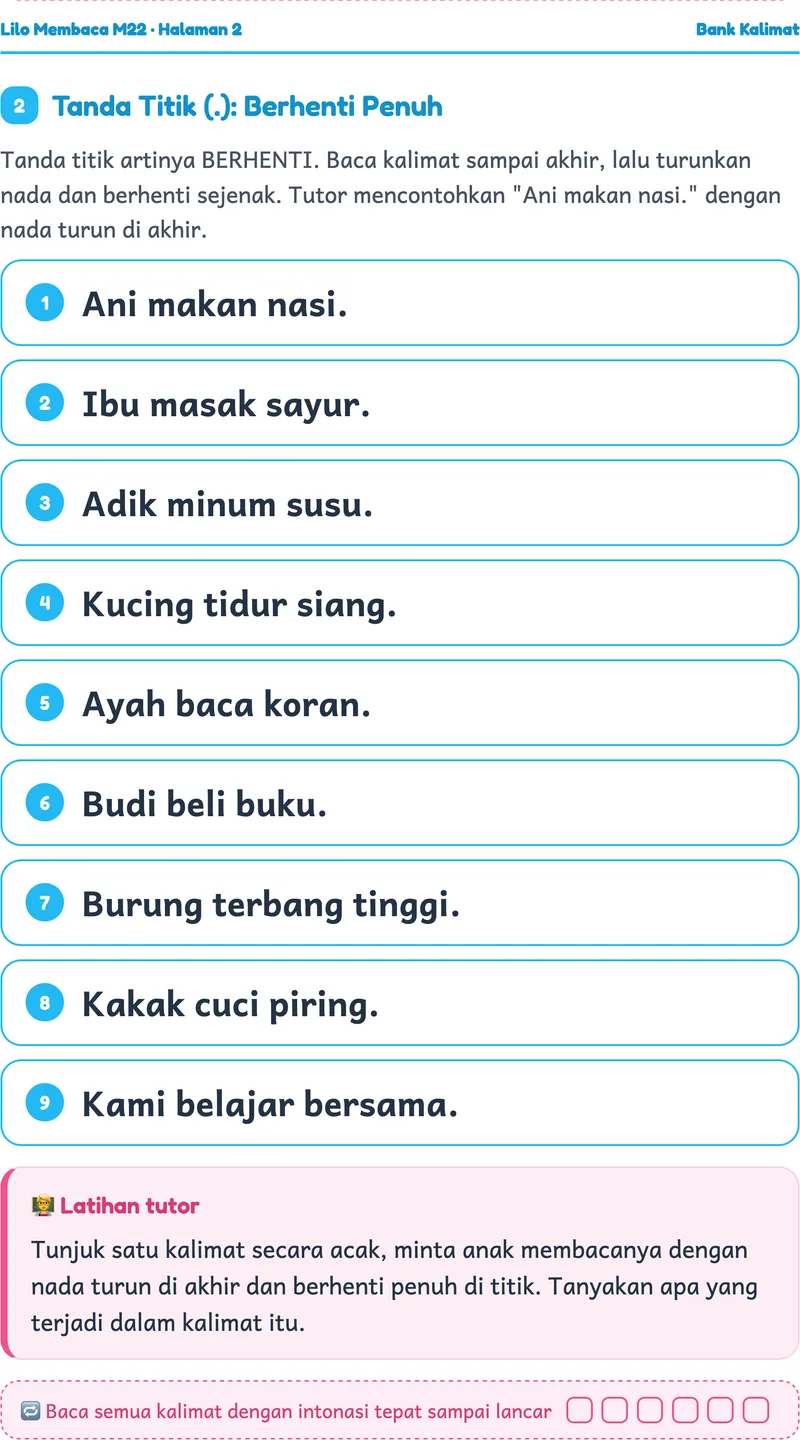
A real page from module 22: your child practices a full stop at each period and reads sentences with lively intonation, the bridge to fluent reading.
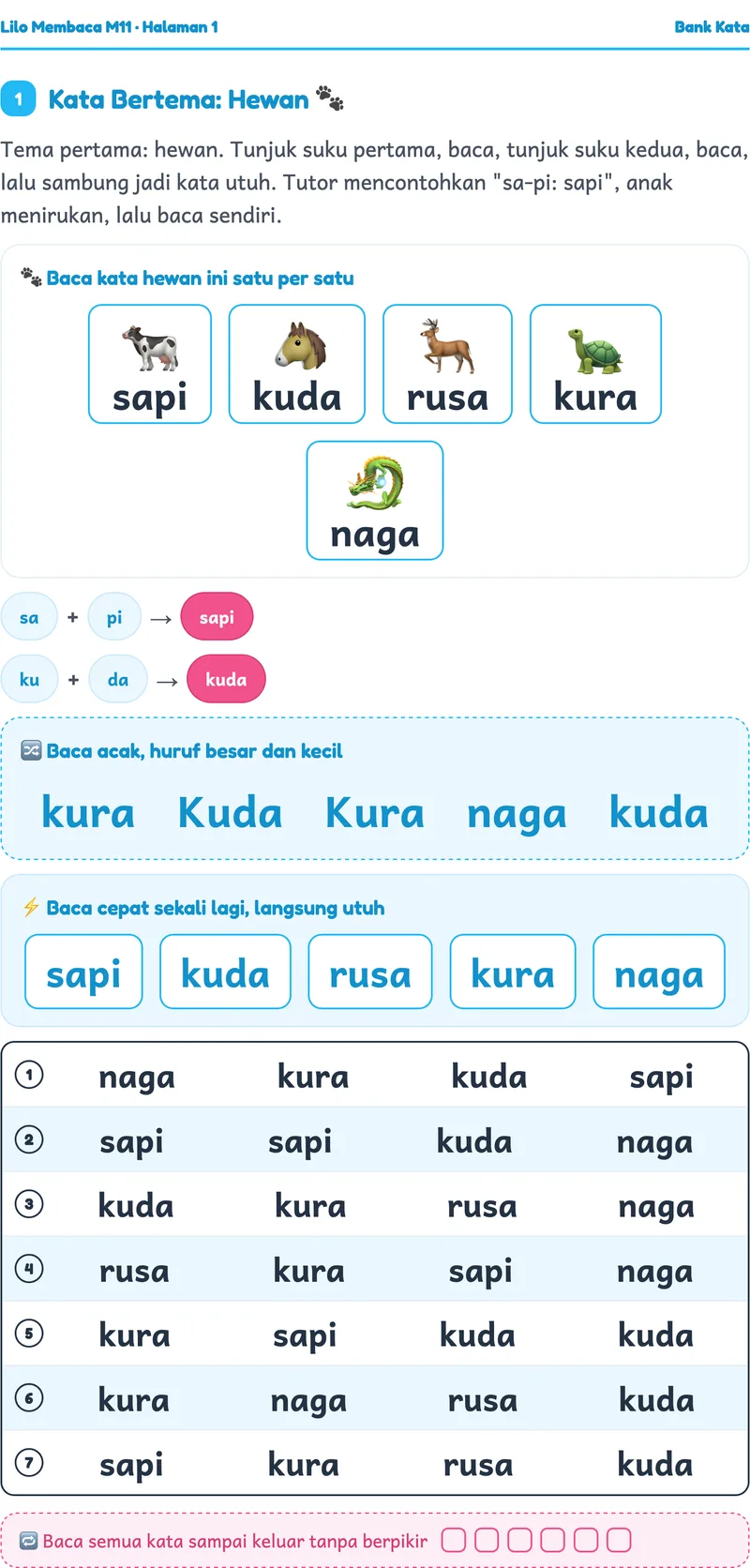
Here children meet themed two-syllable words taken from module 11 at Level 1. They point to a syllable, read it, then connect both parts into one full word. A fast reading round closes the sheet on a cheerful note.
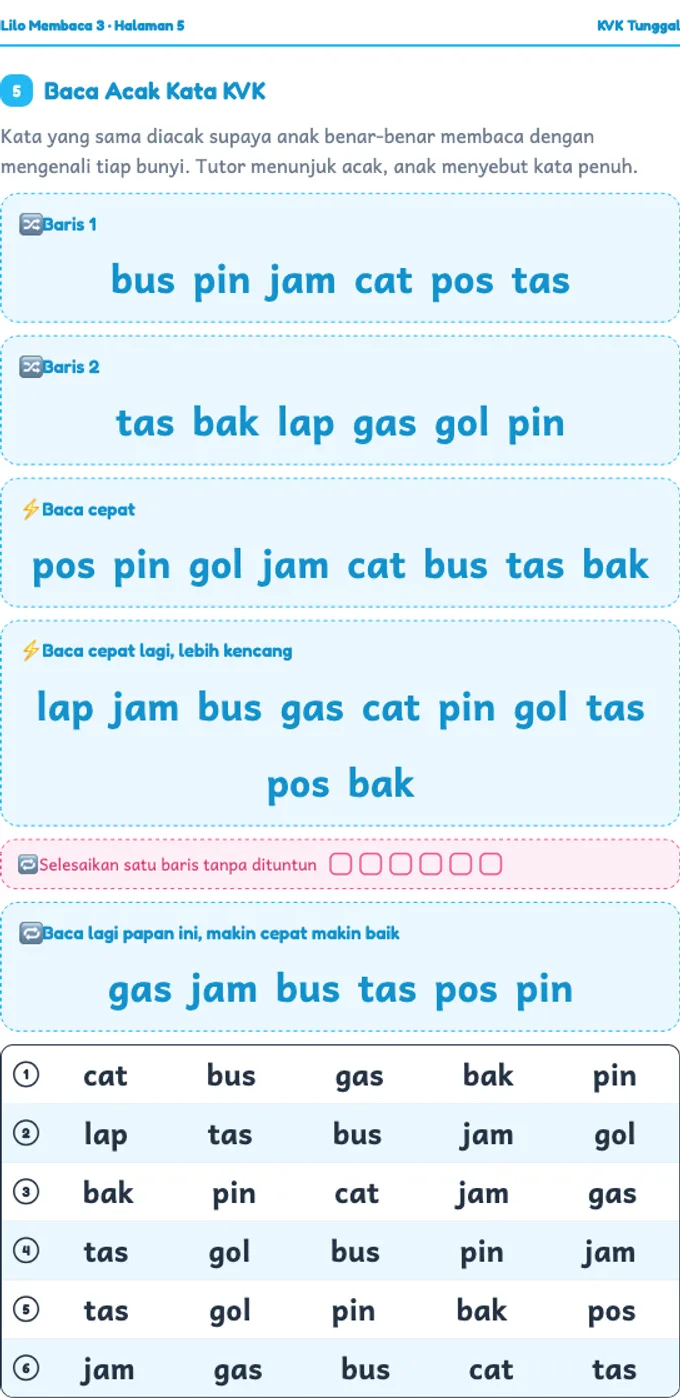
At Level 3, children work through rows of short words with a timer, including words that close with a consonant. Timed repetition builds fluency and trains the eye to catch every final letter accurately.
Every sheet belongs to Lilo's original leveled curriculum of 122 modules, with hearty practice portions that grow with each child.
This picture fits a 6-year-old who knows some letter sounds and starts primary school soon, learning on the Intensive plan of 12 sessions a month, about three a week.
Shaky sounds firm up, then your child builds "sa", "pi", and "bu" and reads a first two-syllable word.
Every consonant is in hand. Words like "sepatu" and short three-word sentences start to open up.
Your child reads "ikan" and "kapal" and tells close pairs apart, like "pagi" and "pagar".
The pairs ng, ny, kh, and sy get small, frequent practice until "nyanyi" and "bunga" flow.
Sentences of four to ten words are read with pauses at full stops and a rising voice at question marks.
Entering Grade 1 requires no reading or counting test, since selection uses age. These skills give your child confidence on the first school day.
The dinner table and the packages in your kitchen hold plenty of sound practice. Choose one game that fits your child's stage and keep it short.
| Activity | Time | What you need |
|---|---|---|
Guess the first sound of a dishSay one opening sound, such as /s/, and let your child guess: sayur, sambal, or sendok? Then swap so your child sets the riddle. This trains the L0 ear to catch first sounds. | 5 minutes | Dishes and cutlery on the table |
Clap the syllables of a foodClap each syllable together: pi, sang, two claps; se, mang, ka, three claps. Then join the claps back into the word. This habit prepares your child to build syllables at L1. | 5 minutes | Hands and the names of foods |
Letter hunt on kitchen packagesPick a sound your child just learned, such as /k/, and hunt for its letter on the labels. Each find gets its sound said out loud, tying the letter's shape to its sound. | 10 minutes | Milk carton, tea packet, soy sauce bottle |
Read the label, fetch the itemFor a child at L2 or L3, choose labels built from known sounds, like "gula" or "garam". Your child reads, you fetch the item. Reading that makes something happen feels wonderful. | 10 minutes | Packages labelled with short words |
60, 90, or 120 minutes
Contact us
60/90/120 minutes
Contact us
choose 60, 90, or 120 minutes
Contact us
Reading classes in Jayapura begin online, and home lessons follow once a nearby tutor is confirmed. Four small steps make the first session feel easy.
Share your child's age and the letters they already know, so the team can match them with the right tutor.
Read the tutor's profile before the first session and tell your child a little about them, so the face on screen feels familiar.
The class link and worksheets arrive before class through app.lilo.id. Set the sheets on the table with a pencil before your child sits down.
Young ears work hard when learning sounds, so pick a bright table in a calm part of the house.
The order of the material and the source of what your child holds reveal the quality of reading classes most honestly. Ask any provider these questions.
A written sequence shows where your child is now and what comes next, so gaps become easy to spot. Lilo uses the L0 to L6 ladder from its own curriculum.
Materials written for one sequence connect from page to page. Lilo worksheets come from 122 coded modules Lilo wrote itself, matched to your child's current stage.
New sounds in a reader push a child into guessing, and frequent wrong guesses wear down their spirit. Lilo builds readers from sounds your child already holds.
Placement too low breeds boredom, and placement too high leads to giving up. At Lilo, the starting point is found through sound games in the first session.
The fit between a child and their teacher matters greatly in the early reading years. At Lilo, a free tutor replacement when the fit is wrong is a service promise.
Reading readiness shows in your child's ears first and in their eyes later. These signs help you notice when your child can begin and when they are ready for the next stage.
From Jayapura, your child connects to 5,000+ selected tutors.
Graduates and current students alike.
Application screening
Role and city are checked first.
ID card and diploma verified
Diploma and ID are reviewed.
Tutor profile filled in
Available hours are noted down.
Trained in the Lilo method
Phonics and CPA come first.
Chosen for your child
The team scores every answer.
Want a different tutor? See our free tutor replacement promise
The first session is made of sound and word games, with no written test. From those games the tutor writes first notes that map your child's learning.
The notes open with sounds your child said confidently during the card games. This is the base every next lesson builds on.
For example, reading "bola" easily and then stopping at "kebun". That pause becomes the practice target, and every child has one.
The notes name one code on the ladder, such as L1 Open Syllables, so you know the current module and the worksheets ahead.
The notes end with one small task of about ten minutes. Think of it as the bridge between the session and home.
At the far eastern edge of Indonesia, Jayapura serves as the capital of Papua Province and rests along the quiet waters of Yos Sudarso Bay. Green hills slope straight down into a deep blue sea here, and the well-loved Lake Sentani lies close by, which gives the city views that visitors rarely forget. Often called the eastern doorway of the archipelago, Jayapura has become a key hub for schooling and government in Papua, and a hopeful, future-minded energy runs through its streets. Lilo welcomes every child in Jayapura who is eager to discover the joy of learning. One-on-one online lessons with a tutor from Lilo's nationwide network can begin wherever you live in the city, and in-person lessons at your home follow as soon as the Lilo team confirms a tutor based near you.
In Jayapura, your child climbs a clear series of levels. The tutor begins at your child's current point, then adds one small step after another, so each idea settles firmly before the next arrives.
Every session includes short, regular practice that climbs one level at a time and stays warm and friendly. Children work on engaging worksheets, so a steady learning habit grows naturally.
Updates on your child's growth reach you often. The tutor shares which skills your child now handles with ease and which ones come up in the next sessions, so the whole path stays easy for you to follow.
Lilo teaches from its own original curriculum of 122 leveled modules. Every worksheet your child touches was designed for its exact stage, so practice always matches ability.
Consonant endings and letter combinations get their own full levels with extra care. Your child leaves these stages solid, which is where most reading confidence is won or lost.
Following the Singapore Math way of teaching, new ideas start with things your child can touch, move to pictures, and only then become letters and words on a page.
Verified tutors from Lilo's national network teach children across Jayapura online, from Jayapura Utara and Jayapura Selatan to Abepura and Waena, in English or Indonesian as your child needs.
Every child starts with a free WhatsApp consultation, and the first lesson finds the level that fits, so you know precisely what you are choosing.
Practice comes in small daily portions, steady practice built level by level, so progress is calm, visible, and kind to your child's confidence.
We choose your child's phonics tutor from our national network after a short chat about which letters your child already knows and how they like to learn. Payment works by monthly package, with each session priced from IDR 76,865. Classes run online first through phonics levels L0 through L6, and home lessons in Jayapura follow once a nearby tutor is assigned.
An opening step once a week, enough to settle in with the tutor.
IDR 307,460Twice as frequent as Starter, keeping each phonics level fresh between sessions.
IDR 604,782Denser again than Regular, leaving more room to build full sentences.
IDR 891,965The longest and densest plan, enough to move through several phonics levels.
IDR 1,692,684Written into the Lilo Terms of Service.
No extra fee, whenever you ask.
How it works:
And a progress report every month.
Kinan has started reading short stories on his own. He often refuses to stop at one page and keeps asking to continue until the story is finished.
Yusuf used to refuse whenever we asked him to read. Now he is the one grabbing a book before bedtime. I never expected such a real change. Thank you to his tutor for always being so attentive.

Tell us about your child on WhatsApp and we will suggest the right level, the right service, and a schedule that fits your family in Jayapura. The consultation is free and friendly.
Free consultation, then lessons at home or online