
Little Explorers, Ages 3 to 4
Your child is at the pre-reading stage, meeting sounds through songs, cards, and play. Lessons feel like games, and the goal is a happy first friendship with letters and their sounds.
Your child learns to read step by step, starting with letter sounds and growing into full sentences read with feeling. Verified tutors guide every session at home, online, or in a small group.
Reading classes for kids in Kediri are guided lessons from Lilo that teach children aged 3 to 10 to read through letter sounds, climbing seven measured levels until they read sentences with punctuation, intonation, and real understanding. Every child begins with a placement assessment, then practices in small steady portions at home, online, or in a small group.
Every child arrives at reading from a different place. These are the four stages we meet most often, and each one gets its own starting point in our program.
Your child is at the pre-reading stage, meeting sounds through songs, cards, and play. Lessons feel like games, and the goal is a happy first friendship with letters and their sounds.
Your child is getting ready for primary school. We build the letter-sound foundation, blend sounds into syllables, and grow toward first words and short sentences at a pace your child can master.
Your child can decode words and now needs smoothness. We work on longer sentences, punctuation, and intonation, so reading aloud starts to sound like natural, expressive speech.
Some school-age children read below their grade and feel embarrassed about it. The placement assessment finds the exact gap, and your child fills it quietly, with kindness and zero shame.
Kediri sits in East Java Province, and the city took shape along the banks of the Brantas River. People know it for a quiet, unhurried pace and for a long love of learning. Lirboyo is one example: the name has been honored for generations as a home of study and scholarship. Here, patient daily study is a habit that parents hand down to their children, year after year. Lilo teaches young learners across Kediri, from Mojoroto to Ngronggo, with tutors who come to your home and with online classes. Your child, aged 3 to 10, builds reading, writing, counting and reasoning skills gently, one small stage at a time.
Your child begins with real things to touch and hold, moves on to pictures, and only then meets numbers and letters. A stage is fully mastered before the next one opens, so every skill rests on real understanding.
The teacher works with your child personally, watches how they learn, then adjusts the pace and the practice. A child who is shy in a big class becomes brave enough to try at home in Kediri.
Sessions are designed to be short, regular, and enjoyable, a friendly daily routine that moves up step by step. Little by little, day by day, your child's skills grow strong and lasting.
Reading readiness shows up in small behaviours you can spot at home. These signs help you guess where your child will start before the first session in Kediri.
Kediri belongs to our East Java network: 1,100+ early reading tutors. In-person tutors in Kediri are available too.
Graduates and current students alike.
Every application reviewed
Role and city are checked first.
Identity and degree checked
Diploma and ID are reviewed.
Teaching profile completed
We know when each tutor is free.
Trained before teaching
Teaching starts after training.
Matching per child
Candidates answer questions about the child.
Not the right fit? Read the tutor replacement guarantee
Each stage carries its own mark of completion, so progress stays visible.
The first session feels like play, with no written test. A few short games show the tutor which sounds and patterns your child already owns.
The games stop right where your child starts to hesitate, so the first session always ends on a win.
Our method follows how children actually learn to read: sounds first, then blending, then whole sentences read with feeling and understood in full.
Your child learns the sound each letter makes, like /m/ and /a/, through songs and sound cards. We skip letter-name spelling drills entirely because they slow blending down later.
Sounds flow straight into syllables and simple words. Because your child already knows what each letter says, joining them together feels natural, like humming a tune they already know.
At the upper levels your child reads full sentences, learns what commas and periods ask of the voice, and practices intonation until reading aloud sounds alive and expressive.
A placement assessment sets the starting level, and your child only moves up after truly mastering a stage. Steady practice built level by level keeps each portion small and daily.
The letter m has two faces. Its name is em, and its sound is a short hum, /m/. Whichever face your child meets first shapes how easily words come together.
Reading asks the brain to turn each symbol into a sound, then fuse those sounds into a word. Letter names carry extra sounds along with them. M is called em, s is called es, k is called ka. A child who only knows names will say em, then a, when meeting the syllable ma, and what comes out is ema. That stray e has to be discarded before the syllable appears, and this extra step is where many children stall.
Letter sounds join without any leftovers. The hum /m/ followed by /a/ glides into ma in a single breath. So the tutor trains your child to say each sound as short and clean as possible, with no e trailing behind. Sounds that can be held, like /m/, /s/ and /n/, are stretched a moment and then slide into the vowel. Popping sounds like /b/ and /k/ are said briefly and joined at once.
Letter names are still learned, because children need them to talk about letters and to sing the alphabet. The order is what matters: sounds first as the tool for reading, names afterwards as labels. You can hear the difference at home. When your child meets the word sabun, listen for a murmured sa, then bun, then the whole word. That murmur means your child is blending from sounds. If it stops at es and a, the sound cards are the place to return to.
These signatures come from our own 122-module original curriculum, refined level by level so each lesson lands exactly where your child is.
Every letter is introduced by its sound first, through songs and sound cards. When blending begins, your child already hears the word forming, so reading feels like a discovery instead of a chore.
Sounds glide straight into whole syllables without any letter-name spelling detour. This keeps the flow of reading smooth from day one and prepares the natural rhythm that later becomes expressive sentences.
Our leveled readers contain only the patterns your child has already learned. Every page is fully readable without help, which builds the confidence that fuels the whole journey.
Combinations like ng, ny, and tr form the hardest stage in learning to read, so our curriculum slows down here on purpose, with extra sheets, extra patience, and extra celebration.
Each rung is a real stage in our published modules, and your child climbs one rung at a time, only after mastering the one below.
Most reading struggles trace back to a handful of well-meaning habits. Knowing them early saves your child months of frustration and keeps the joy in reading.
Why it happensReciting 'em-a, ma' forces the child through an extra translation step, and that detour stalls the moment when sounds should flow together.
How Lilo helpsTeach the sound each letter makes and let sounds blend straight into syllables. The word simply appears, and reading starts to flow.
Why it happensA child who can name every letter but has never heard what it says holds a key with no door. Blending becomes guesswork.
How Lilo helpsPair every shape with its sound from the very first meeting, using sound cards and songs until the connection is automatic.
Why it happensA book full of patterns the child has never learned turns every page into a wall, and confidence crumbles fast.
How Lilo helpsUse leveled readers that contain only patterns already mastered, so your child reads every page alone and finishes proud.
Why it happensMonotony teaches a child that reading is a chore, and a bored learner stops trying long before the skill arrives.
How Lilo helpsKeep portions small and daily, vary the games, and celebrate each level climbed, so practice stays light and motivation stays warm.
Your child meets each letter through its sound, using sound cards, songs, and letter tracing, so every letter becomes a sound the ear already recognizes.
Sounds join into open syllables and then into words of 2 to 3 syllables, with timed reading sheets that make progress visible and fun.
Your child conquers closed syllables, digraphs, clusters, and diphthongs, the patterns most children stumble on, with generous practice and patient guidance.
Reading grows into sentences of 4 to 10 words, where punctuation, intonation, and rhythmic reading turn word-by-word decoding into smooth, expressive speech.
Mini stories bring everything together. Your child answers 5W questions, finds the main idea, and retells the story in their own words.
These are real A5 pages from Lilo's original curriculum, exactly as children use them in class. Each sheet gives a generous portion of practice, from first sound cards all the way to passages with 5W questions.
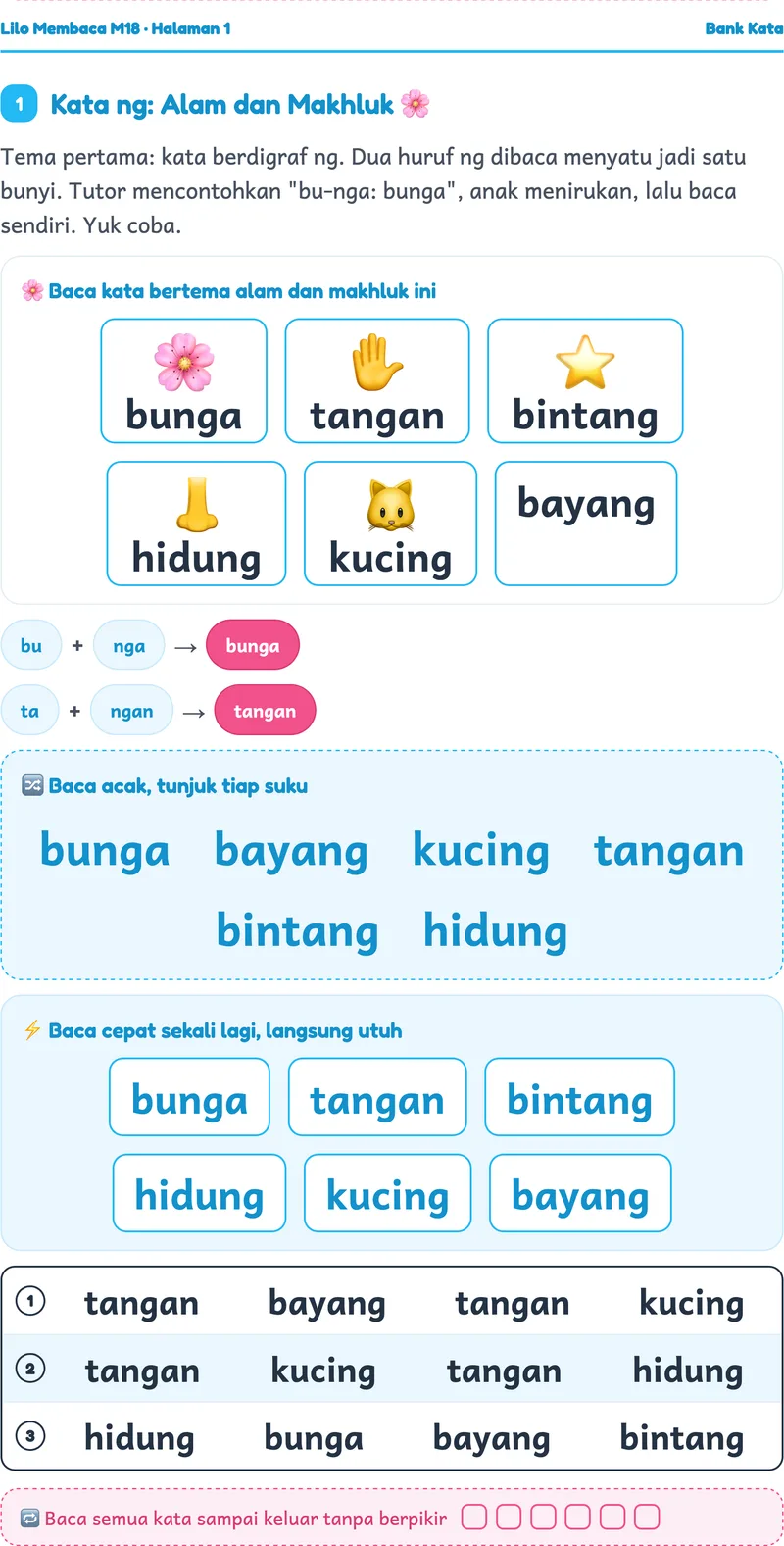
At Level 4, children meet words that combine the letters ng and ny through this module 18 sheet. Because this stage famously causes stumbles, we add extra support so every child gets past it with confidence.
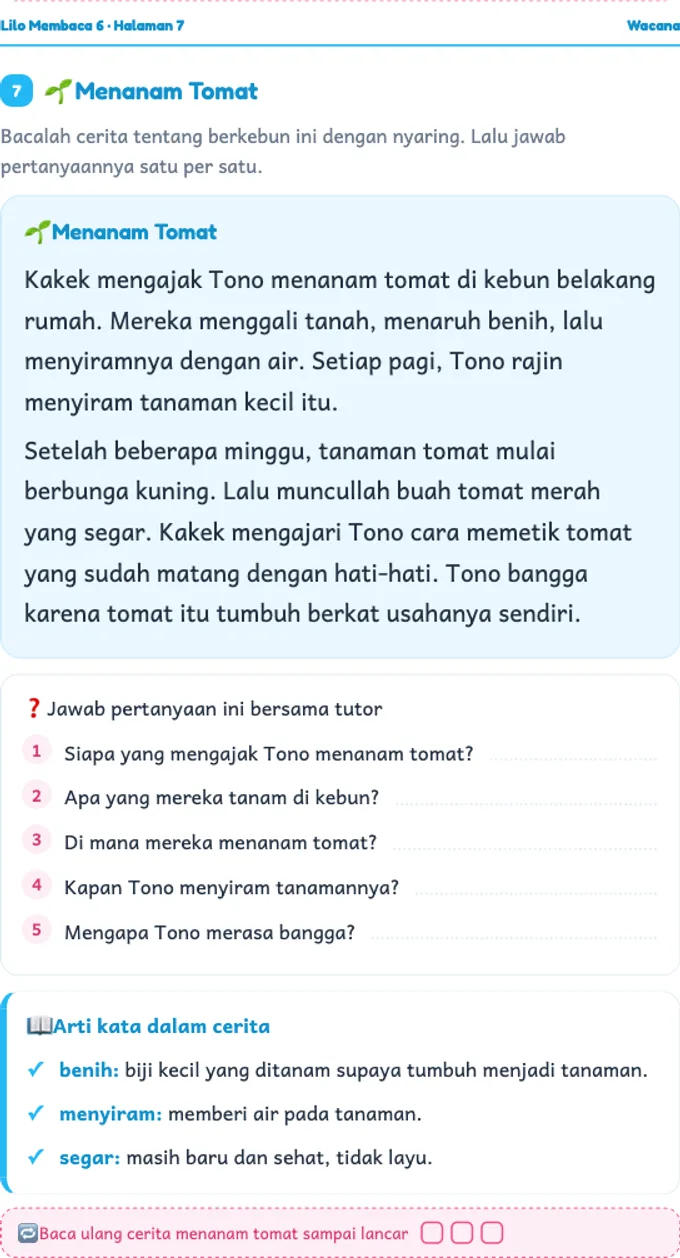
Grandma's Garden
That morning Tono went to the garden with Grandma. Grandma planted spinach and tomatoes. Tono watered the plants. They garden every Sunday. Tono is happy because Grandma's garden is thriving.
This sheet pairs a brief passage with who, what, where, when, and why questions. Children read to the end, answer each one, and retell the story in order. It is the peak of comprehension practice at Level 6.
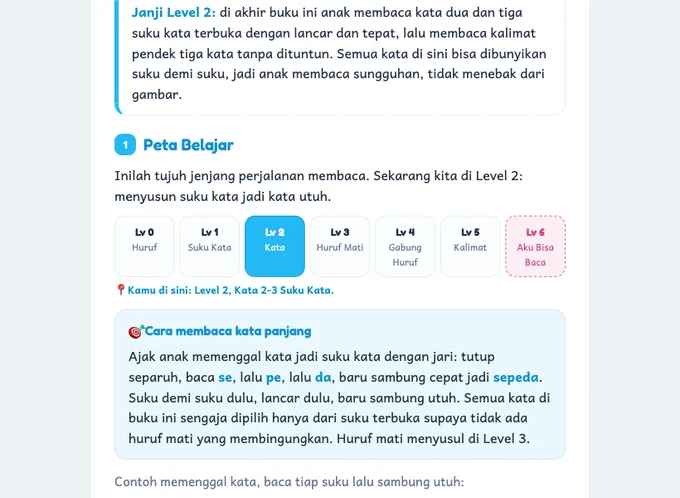
The seven-level map and how to break a word into syllables. The tutor models the whole syllable, your child joins them into a meaningful word without spelling out.
All four sheets come from Lilo's own leveled curriculum, 122 modules packed with generous practice on every A5 page.
Every session follows the same rhythm, so your child knows what comes next and feels settled from the very first minute.
The tutor greets your child, then revisits the sounds from last time with cards or a quick guessing game. This short warm-up wakes up memory before anything new arrives.
Your child meets exactly one new thing, such as the sound /k/ or a closed syllable like an. The tutor models it, your child copies, then tries it alone several times.
Your child reads a worksheet from the coded module in progress, built only from sounds already known. Every finished line feels like a small victory.
Near the end, the tutor sums up which sounds are now secure and leaves one task of about ten minutes to finish before the next meeting.
This picture follows a four-year-old in Kediri who learns online on the Regular package, eight sessions a month or about twice a week, starting from zero.
Your child meets a, i, u, e, o and a few early consonants through sound cards on screen. The class link and worksheets arrive in app.lilo.id before each session.
Your child catches the first sound of everyday object names and points to the matching letter on the worksheet. The screen feels familiar because every session runs the same way.
Sounds start fusing into open syllables like ma, pa and bu. Words such as mama and papa come out whole, with no spelling aloud.
Your child reads bola, sapu and topi from numbered reading sheets, with shorter and shorter pauses between syllables.
The full set of consonants is in place, and your child reads three-syllable words and three-word sentences, standing firmly ready for closing consonants.
Every child moves at their own rhythm, and the tutor opens the next stage once the current one is truly mastered.
Kitchens and bathrooms are full of words and sounds. These four short activities use things already in your home, each aimed at one stage.
Line up three packages. Say the sound /g/ and ask your child to point to the one whose label begins with it. Gula and garam both fit, and finding the pair is a small thrill. Good for L0.
sugar, salt and milk packages
Choose a two-syllable word printed large, like kopi. Cover the second syllable with a finger, let your child read ko, then reveal the rest and join it into kopi. This strengthens L1 and L2.
a package with a short printed word
Before the bath, name the bathroom objects one by one in Indonesian. Your child looks for two that begin with the same sound, like sabun and sikat. The ear learns to sort first sounds at L0.
soap, toothbrush, water scoop, towel
While rinsing, say a word in separate syllables, such as han and duk. Pour one scoop per syllable, then your child says the whole word. Words like sabun and handuk practise closing consonants at L3.
a water scoop and rinse water
60, 90, or 120 minutes per session
Contact us
duration of 60, 90, or 120 minutes
Contact us
60, 90, or 120 minutes
Contact us
Our lessons come from Lilo's own leveled modules, written and tested by our team, so every worksheet fits precisely into the seven-level reading journey.
Your child learns what punctuation asks of the voice and how intonation carries meaning, so reading aloud becomes lively, confident, and genuinely understood.
Verified tutors serve families across Kediri, from Mojoroto and Bandar Lor to Ngronggo and Pesantren, bringing one-on-one lessons right to your living room.
We teach the Singapore Math way: real objects first, then pictures, then symbols. Applied to reading, it means your child understands each step before moving on.
Lessons can run in English or Indonesian, whichever suits your family. This English edition keeps the same curriculum, levels, and warmth of every Lilo class.
When comparing reading lessons in Kediri, these five questions show how closely a tutor follows your child and how clearly progress reaches you.
Learning to read depends on the tutor's ear. A /b/ swapped for /p/ is only caught when the tutor listens to one child with undivided attention. In Lilo private lessons, the tutor's focus belongs entirely to your child.
Rare reports mean a sticking point surfaces weeks late. Look for reports that name your child's stage clearly. Lilo reports every week, noting for example that ny is now secure while ng wants more practice.
This order decides how quickly your child can join letters into words. Ask for a concrete example, such as how they would teach the word mama. Lilo tutors always begin with sounds.
Knowing the tutor ahead of time brings peace of mind, especially for a child taking lessons for the first time. With Lilo, you can view the tutor's profile before the first meeting.
A good match shapes how bravely a child reads aloud. A solid provider has a clear answer here. Lilo replaces the tutor free of charge whenever the fit is not right yet.
Every path can work. Here is an honest look at what each one gives your child, so you can choose with clear eyes.
| Aspek | Lilo | Learning Apps | Learning at Home Alone |
|---|---|---|---|
| Learning path | Seven measured levels with a placement assessment at the start | Game levels that follow the app's sequence | Whatever books happen to be at home |
| Guidance | A live, verified tutor who hears every sound your child makes | Automated feedback from the screen | A parent doing their loving best between other duties |
| When your child gets stuck | The tutor slows down, adds practice, and adjusts on the spot | The app repeats the same exercise | The sticking point can go unnoticed for months |
| Reading with expression | Punctuation and intonation are taught explicitly at Level 5 | Rarely covered by apps | Depends on how the parent models reading aloud |
| Reading material | Leveled readers containing only patterns already learned | Mixed digital texts of varying difficulty | Books that may jump levels too fast |
One reading session lasts an hour, an hour and a half or two hours, and sessions start at IDR 76,865. Payment covers one monthly package at a time, giving your child a fixed schedule through the month. Phonics runs from L0 up to L6 with a tutor at home or in an online class, and the weekly report shows which sounds are secure and which need more practice.
Once a week, the tutor finds your child's phonics level and picks matching sound cards.
IDR 307,460Twice a week, the tutor works one phonics level until the sounds feel solid.
IDR 604,782Three times a week, the tutor pairs word cards with thin readers.
IDR 891,965Six times a week, the tutor guides your child through several levels toward fluent reading.
IDR 1,692,684At home or online, the same.
We find a replacement for free. Request it whenever you need.
The steps:
Plus a monthly progress report.
After classes here my child can now read fluently thanks to patient and professional guidance, and their confidence has grown too.
Reading classes at Lilo helped my child understand the content of a book really well. Their reading skills improved, very satisfying.

Tell us about your child in a free WhatsApp consultation. We will suggest a starting level, explain the options in Kediri, and answer every question with zero pressure.
Free consultation, gentle start
Keep exploring while we teach around Banjaran and Dandangan.