


Little Explorers, Ages 3 to 4
Your child is in the pre-reading stage, meeting sounds through play. Songs, sound cards, and playful games introduce the music of letters long before any formal reading begins.
Your child climbs seven clear reading levels, from the first letter sounds to whole stories. Every level mastered is a moment your child can feel proud of, guided by a verified Lilo tutor.
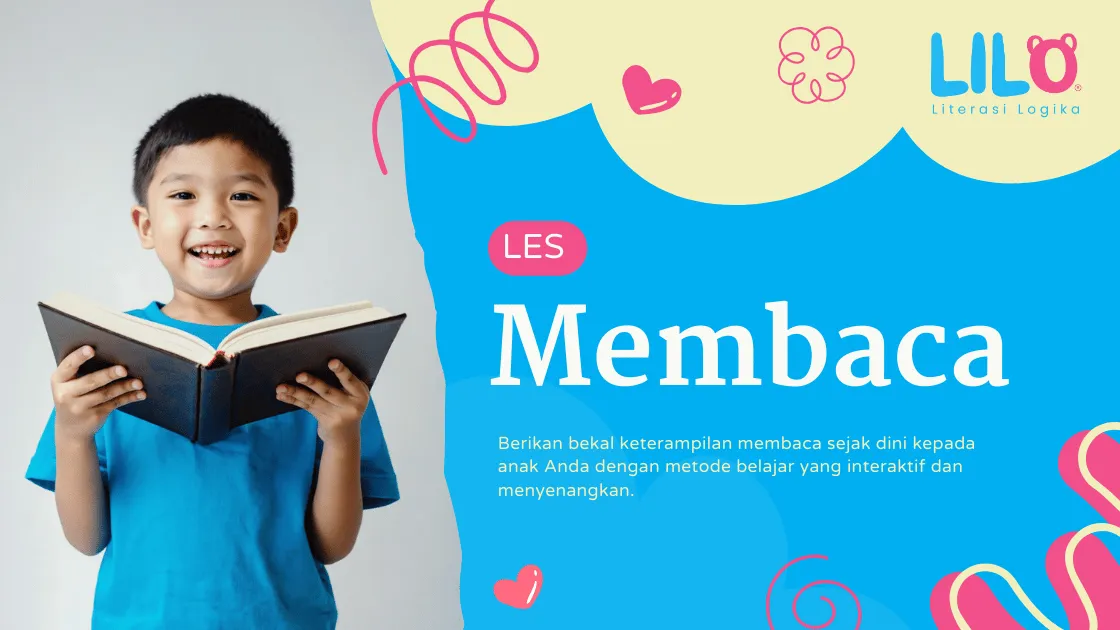
Reading Classes for Kids in Kendari is Lilo's leveled reading program for children aged 3 to 10, taught with English as the language of instruction. Your child starts with letter sounds, blends them into syllables and words, and climbs seven clear levels until short passages feel easy. Each level mastered adds a visible layer of confidence.
Every child arrives at reading from a different place. The program meets your child exactly where they are and builds up from there, one mastered level at a time.
Your child is in the pre-reading stage, meeting sounds through play. Songs, sound cards, and playful games introduce the music of letters long before any formal reading begins.
Your child is getting ready for primary school. This is the heart of the reading journey, where letter sounds turn into syllables, words, and the first proud sentences read aloud.
Your child can read a little and now needs smooth, comfortable fluency. Longer sentences, punctuation, and real short passages turn careful reading into confident reading.
Your school-age child is behind classmates in reading. The placement assessment finds the true starting point, and your child rebuilds the foundation calmly, privately, and with kindness.
Readiness shows in small daily habits, and the tutor builds whatever is yet to appear.
Kendari belongs to our Sulawesi network: 100+ tutors for young readers. Home visits in Kendari follow the nearest tutor.
Graduates and active students.
Application screening
Our team reads every application.
ID card and diploma verified
The team checks identity and education.
Teaching profile completed
We know when each tutor is free.
Learning the Lilo method first
The step-by-step method is learned first.
Matched to your child
Questions come from the child’s needs.
Want a different tutor? Read the tutor replacement guarantee
Your child's starting point is found through play, with no written test.
Your child names the sound on each card the tutor lifts, and any sound that brings a pause points to L0.
Your child joins sound pieces into words like bola or kuda. How smoothly that goes shows L1 or L2.
Your child reads lines with closing consonants and pairs like ng or ny, and the tutor hears where reading stumbles.
A fluent child reads a mini story and talks about its characters, showing how deeply it was understood.
The teacher holds your child at one stage until the foundation is solid, then opens the next.
The method is simple to explain and careful in practice: sounds before letter names, mastery before promotion, and small steady portions your child can win every single day.
Every child begins with a placement assessment. Your tutor listens, observes, and places your child at the level where practice feels challenging yet winnable, so confidence starts on day one.
Your child learns the sound each letter makes, like /m/ and /a/, instead of drilling letter names. Sounds blend straight into syllables, which is exactly how real reading works.
Sounds join into syllables, syllables into words, words into sentences. At the upper levels your child works with whole sentences and real passages, reading for actual meaning.
Practice comes in small daily portions, steady practice built level by level. Your child moves to the next level only after truly mastering the current one, so nothing wobbles later.
One Indonesian letter, e, hides two sounds, and the pause it causes is a good sign.
Say ember, a bucket, and enak, tasty, slowly. The first e in ember sounds open, as in sate. The e in enak is short and soft, as in beras. Linguists call them e taling and e pepet. Everyday writing never marks the difference, yet ember holds both: an open e, then a soft one.
A child who has just learned to blend gives every e one sound. They read telur with an open e and stop, because the word sounds strange. In that pause your child is matching the sounds they built against words known from conversation, the heart of reading for meaning.
The tutor teaches one short strategy: when a word sounds odd, try the other e. Your child practises it on familiar words, then on look-alike pairs such as apel the fruit and apel the school assembly. Hearing a word said twice at home means your child is checking their own reading.
The very beginning of reading: your child hears, says, and plays with vowel and consonant sounds using sound cards, and traces letters to connect sound with shape.
Sounds join together into open syllables, then into words of two and three syllables. Timed reading sheets make progress visible and turn practice into a game your child wants to win.
Your child conquers closed syllables and the trickiest patterns in reading: digraphs, clusters, and diphthongs. This is where the tutor slows down and gives generous extra care.
Sentences grow from 4 to 10 words, and your child learns to honor punctuation and read with natural rhythm and intonation, so reading aloud becomes something to enjoy.
Mini stories with 5W questions teach your child to find the main idea and retell what happened. Reading becomes understanding, the true finish line of the whole journey.
These are the specific choices inside Lilo's original curriculum that make the levels work, refined across 122 leveled modules built by our own team.
A child who reads a whole page alone, even a simple one, believes something new about themselves.
Your child meets letters as sounds first. The sound /m/ slides naturally into /ma/, so reading starts as blending, never as reciting an alphabet list from memory.
Instead of spelling drills, your child grabs whole syllables and joins them. Words appear faster, effort drops, and the joy of getting it right arrives much earlier.
Our leveled readers contain only the patterns your child has already learned. Every book is winnable on purpose, and every finished page tells your child, you can do this.
We know from thousands of practice sheets that ng, ny, and tr are where children stumble most. Level 4 is deliberately slower, gentler, and richer in practice.
Each rung is a real stage in our published modules, and your child climbs them one mastered step at a time.
Most reading struggles come from a handful of well-meaning habits. Knowing them early saves your child months of frustration and protects the joy of learning.
Why it happensLetter names are a detour. The child must silently translate names back into sounds before blending, which stalls reading and drains confidence.
How Lilo helpsTeach sounds from the start. At Lilo, /b/ and /a/ blend directly into /ba/, so the path from letters to words is one straight line.
Why it happensA child can name every letter on a poster and still read nothing, because reading is built from sounds, and shapes alone carry no sound.
How Lilo helpsPair every shape with its sound using sound cards and tracing, the way Level 0 does, so recognition and sound arrive together.
Why it happensBooks full of unlearned patterns force guessing. Guessing becomes a habit, and the child concludes that reading is confusing and unpleasant.
How Lilo helpsUse leveled readers that contain only patterns already mastered. Winnable books build the mileage and the confidence that hard books require.
Why it happensYoung children learn through variety and play. Endless identical drills teach one lesson above all: reading time is boring time.
How Lilo helpsKeep portions small and mix the formats: songs, cards, timed sheets, and stories. Steady daily practice works best when it stays lively.
Why it happensCombinations are genuinely the hardest part of learning to read, and most children stumble here. Many programs rush past it anyway.
How Lilo helpsSlow down on purpose. Level 4 exists precisely for this stage, with extra practice, extra patience, and extra celebration when it clicks.
These are real pages from Lilo's original curriculum, printed as A5 sheets with generous practice portions. Have a look at what your child will actually hold, from first sound cards to a full passage with 5W questions.
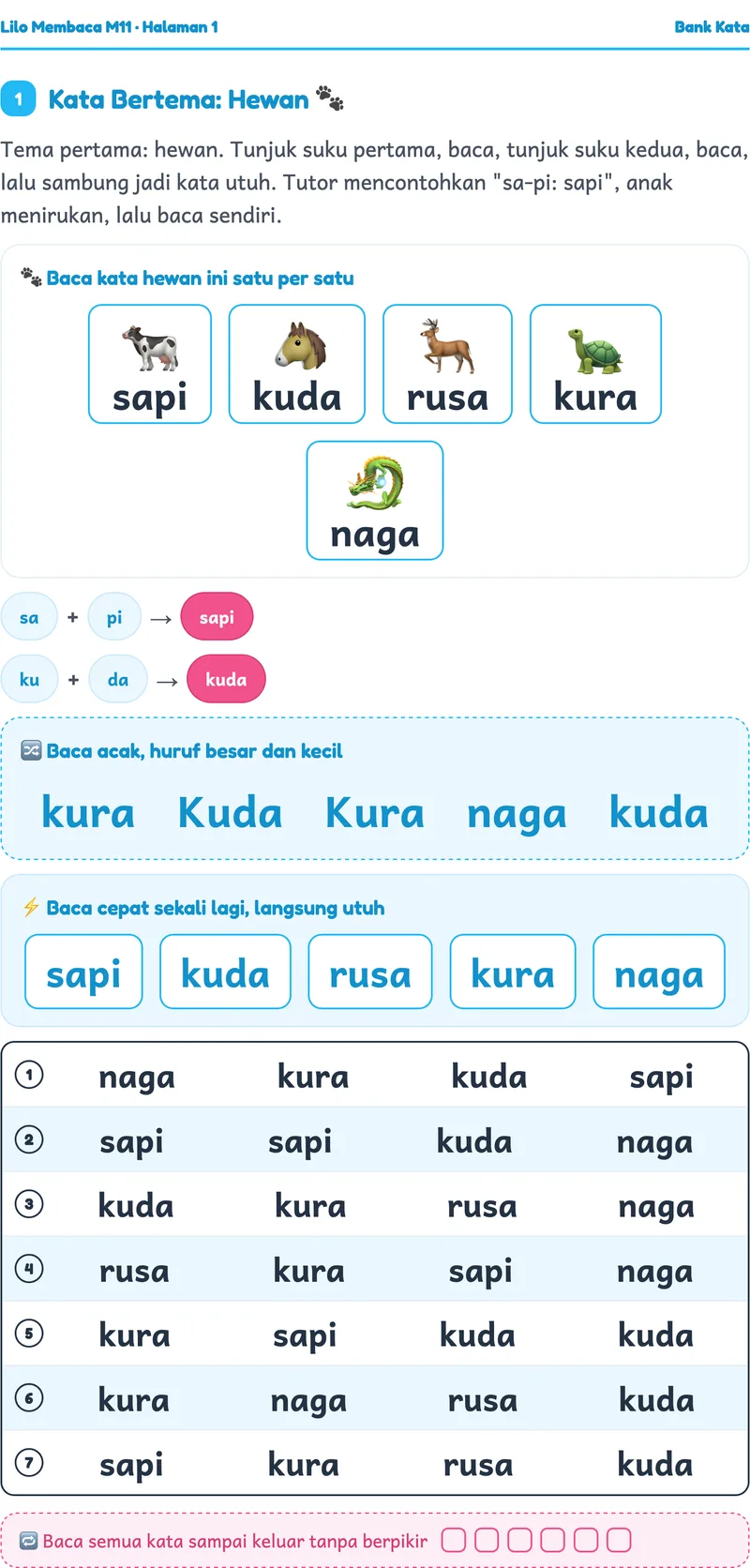
Sa-pi joins up to become sapi. That is how children work through this Level 1 sheet from module 11: pointing to each syllable, reading it aloud, then blending the pieces into whole themed words, with a speedy reading round at the end.
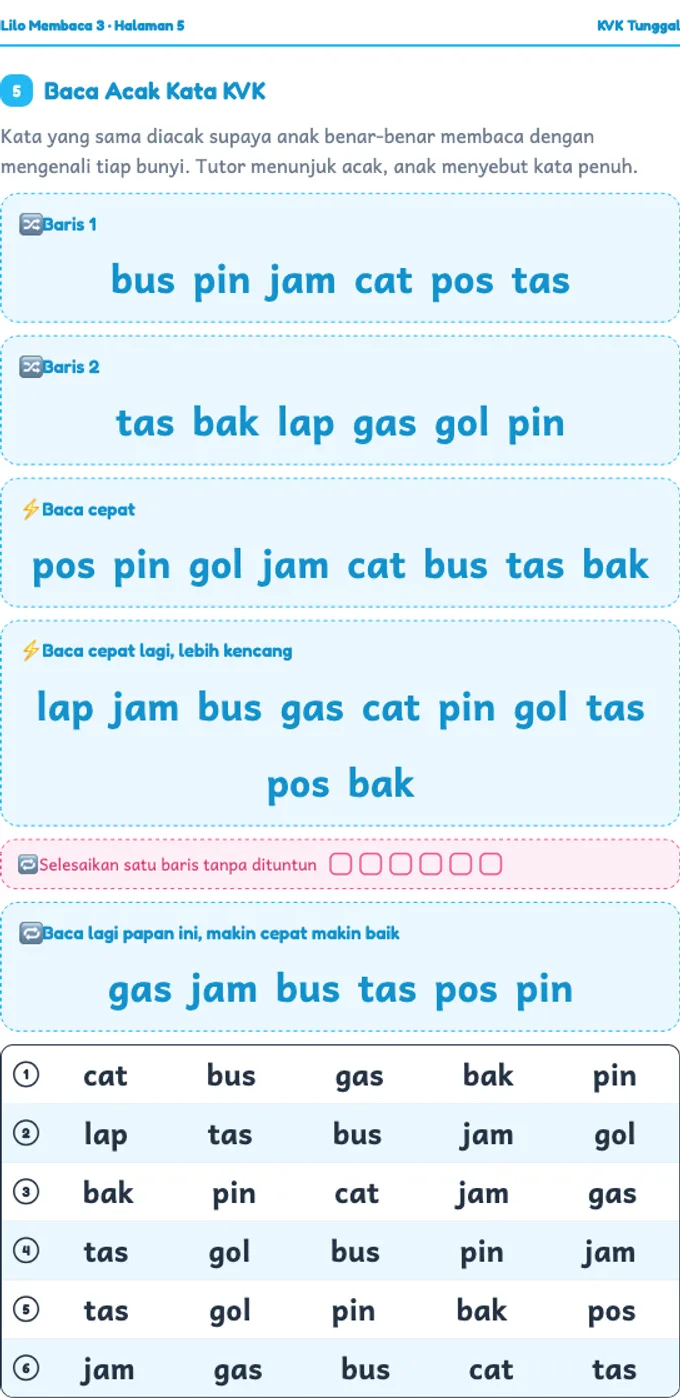
A grid of short words that children read again and again against the clock. Some words end in a consonant, like tas, so the exercise sharpens attention to final letters while building smooth, confident reading. Level 3 practice.
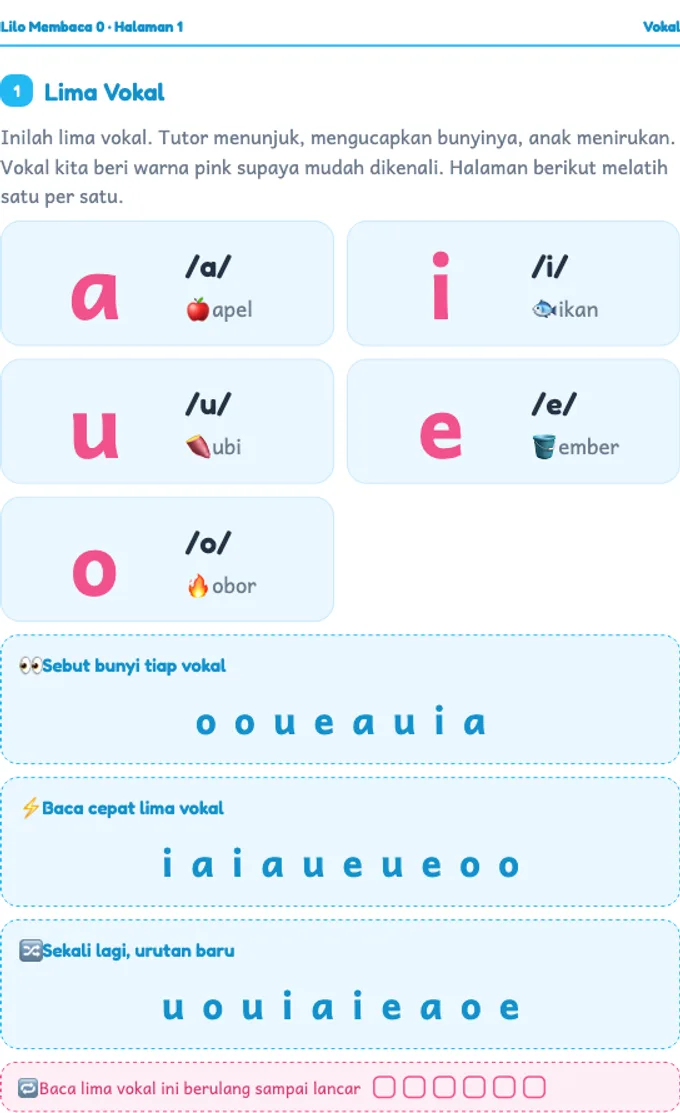
This Level 0 sheet shows cards for the vowels a, i, u, e, o plus the starting consonants m, b, and s. Children say each letter sound out loud, then practice quick reading. It is the foundation of our phonics method.
Samples from Lilo's original curriculum. The full A5 materials are prepared by the tutor at each session.
Kitchen words and stacking blocks make ideal practice for small hands.
For L0. While cooking, hold up an onion, say bawang slowly, and your child names the first sound, b.
onion, salt, eggs
For L1. Stick gu and la slips on the sugar jar, and your child reads each one, then joins them into gula.
paper slips, sugar jar
For L1 and L2. Tape ku, da, bo, and la onto blocks, and your child stacks two into a word.
blocks, tape, marker
For L2 and up. Your child reads sate, tempe, beras, and telur, stacking a block on the ember or enak tower by each e sound.
blocks, dish name cards
Picture a 3-year-old new to guided learning, on the Starter package of four sessions a month, at a gentle pace.
Singing and picture cards with the tutor become something your child looks forward to.
Through songs and cards, your child echoes the first vowels and points to their letters.
Your child knows all five vowels, including e, sounding as in ember or as in enak.
The sounds m, b, and p arrive through familiar words like mama, bola, and piring.
Your child hears m and a and says ma alone, a step toward L1 around age four.
The weekly tutor report even names each newly known vowel, so gentle progress stays visible.
60, 90, or 120 minutes per session
Contact us
duration of 60, 90, or 120 minutes
Contact us
60, 90, or 120 minutes
Contact us
Tell us about your child, and the Lilo team handles the rest.
Share your child's age and what makes them hesitate around written words. The consultation is free.
A tutor visits your home in Kendari, or your child joins an online class suited to their age.
Once a tutor is matched, you can read their profile before the first session begins.
Your child plays with sound cards and syllable pieces as the tutor finds the starting stage.
Families in Kendari have several good ways to help a child read. Here is a fair comparison so you can choose with open eyes.
| Aspek | Lilo | Learning Apps | Big Group Classes |
|---|---|---|---|
| Starting point | A placement assessment finds your child's exact level | Usually one starting path for every child | The class starts where the group starts |
| Attention on your child | One tutor watching, listening, and adjusting live | The screen responds, yet cannot truly listen to reading aloud | Attention is shared among many children |
| Reading materials | Leveled readers built only from patterns already mastered | Fun and colorful, level fit varies by app | One set of materials for the whole class |
| Pace | Your child moves up only after mastering a level | The child can tap ahead past shaky skills | The group's schedule sets the pace |
| When your child gets stuck | The tutor slows down, especially at letter combinations | Hints help, and some knots need a human ear | The teacher helps when the schedule allows |
The level code your child is working on, such as L1 or L3, is where the tutor picks up in the first lesson, so reading carries on from the exact point it paused. Payment covers a whole monthly package at once, from IDR 76,865 for each session, and a weekly note on your child's reading level reaches you.
By month's end, opening a picture book each week feels routine.
IDR 307,460Twice a week builds the habit of reading aloud unprompted.
IDR 604,782Three sessions weekly make sounding out new words second nature.
IDR 891,965Near-daily practice leaves your child reading alone before bed.
IDR 1,692,684At home or online, the same.
No extra fee, whenever you ask.
The steps:
And a progress report every month.
Progress is visible and honest. You always know which level your child is on, what was just mastered, and what comes next on the ladder.
Lilo teaches from 122 leveled modules built by our own team, so every worksheet, reader, and sound card fits the level your child is actually on.
The Singapore Math way of building understanding, applied to reading. Your child touches and sees an idea before meeting it as letters on a page.
Our verified tutors come to homes across Kendari, from Kambu to Anduonohu, bringing the materials and the patience each session needs.
Instruction is available in English and Indonesian, a natural fit for bilingual and national-plus families. This is a reading program taught in English, so reading remains the goal.
Every mastered level is a small graduation. Children who feel successful practice more, and children who practice more read better. The cycle feeds itself.
Fair questions for any provider, revealing the pace your child will feel.
| Question to ask | Why it matters |
|---|---|
When does a child move up a stage, and by what measure? | Moving up by the calendar leaves gaps that trip reading later. At Lilo, a stage code is passed once it is mastered. |
What happens when a child is tired or refusing? | Fair pressure helps a child try. A Lilo tutor shortens practice for a tired child and ends on a success. |
How long can a 3- or 4-year-old learn on screen? | Young children learn best with busy hands, and their screen attention is brief. At this age, lessons at home often feel easier. |
What is prepared before an online class begins? | Classes run smoothly with materials already in hand. At Lilo, the link and worksheets arrive early through app.lilo.id. |
What if my child and the teacher do not click? | Children dare to make mistakes around someone who feels safe. Lilo replaces the tutor free whenever the match is off. |
Kendari is the capital of Southeast Sulawesi Province, standing on the shore of Kendari Bay, the beautiful bay that has become the face and pride of the city. Rising above the bay is Al-Alam Mosque, a landmark known far beyond the region. As the center of government and education in Southeast Sulawesi, Kendari keeps growing and is home to many schools and universities. Its districts stretch from Kendari Barat to Poasia, including Kambu, Anduonohu, Mandonga, Kadia, Wua-Wua, and Baruga.
A Lilo teacher visits your home anywhere in our Kendari service areas. Your child sits at a familiar desk in a room they know, so settling in is easy and attention stays on the lesson from the first minute.
The first lesson finds where your child is today, and that becomes the starting point. Each small step comes when they are ready, each worksheet is one they can finish, and their belief in themselves rises with every new skill.
Real things and pictures come first, and numbers and letters follow once the idea makes sense. Your child builds a solid grasp of each concept, and quick, easy recall grows out of that understanding.
Nadhira is getting fluent at sounding out syllables. What puts me at ease is that the lessons go step by step without pushing her. She actually looks forward to her lesson every week.
Reading classes at Lilo helped my child understand the content of a book really well. Their reading skills improved, very satisfying.

Start with a free consultation on WhatsApp. We will listen to your child's story, run a placement assessment, and show you exactly which level the journey begins on.
The first lesson shows where to begin