


Ages 3 to 4: Meeting Sounds Through Play
Your child is at the pre-reading stage, so lessons feel like play. Songs and sound cards introduce the first vowel and consonant sounds gently, planting the seed of a daily habit around books and sounds.
Lilo teaches your child to read through letter sounds and seven clear levels, with small daily practice portions that slowly turn reading into a habit your child looks forward to.
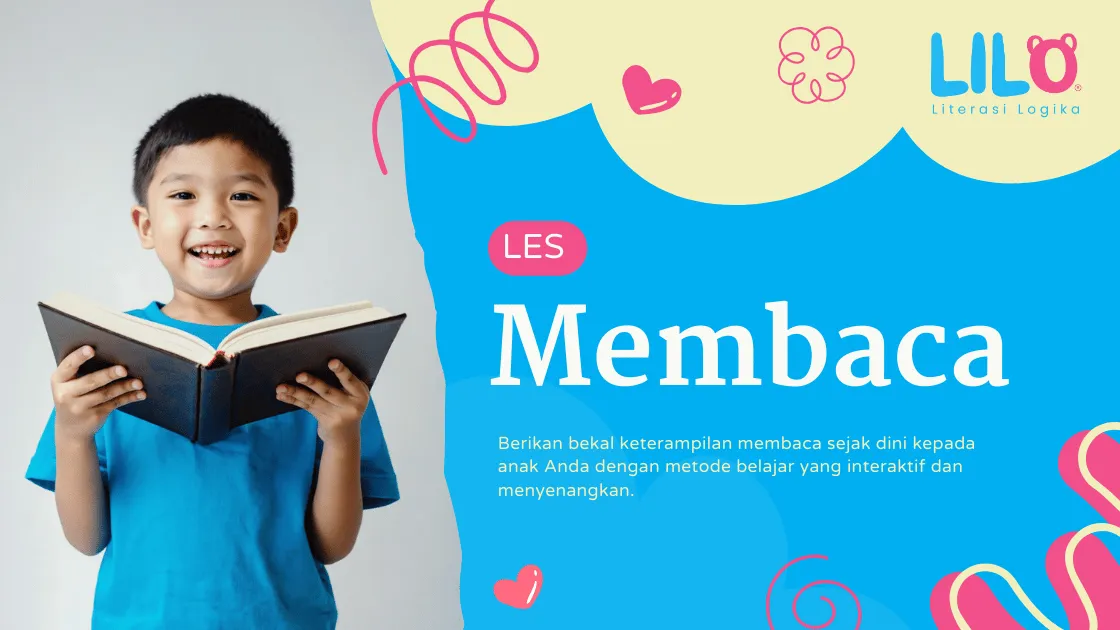
Reading classes for kids in Makassar are guided lessons from Lilo that teach children aged 3 to 10 to read through letter sounds, with English as the language of instruction and a verified tutor at home, online, or in a small group. Each child starts with a placement assessment, climbs seven clear levels, and practices a small portion every day so reading grows into a happy habit.
Every child arrives at reading on their own timeline. The placement assessment finds where your child is today, and the lessons meet them exactly there.
Your child is at the pre-reading stage, so lessons feel like play. Songs and sound cards introduce the first vowel and consonant sounds gently, planting the seed of a daily habit around books and sounds.
Kindergarten years are the heart of the reading journey. Your child blends sounds into syllables, reads first words and short sentences, and builds the confidence to walk into primary school as a reader.
Your child can already read a little and now works on the trickier letter combinations, longer sentences, and short passages, until reading feels smooth, natural, and genuinely enjoyable every single day.
If your child is at school and reading still feels hard, the placement assessment finds the exact gap. Your child catches up step by step, privately and kindly, with zero shame and steady wins.
The method is simple to explain and careful in practice: sounds come first, blending comes next, and a small portion of practice happens every day.
Every child begins with a placement assessment. The tutor listens to what your child already knows about letters and sounds, then places them at the level where lessons feel doable and encouraging.
Your child learns that the letter m says /m/ and a says /a/. Lessons skip letter-name spelling drills entirely, because sounds are what blend into real words on a page.
Sounds join into syllables, syllables into words, and words into sentences. At the upper levels your child reads whole sentences and short passages and truly understands what they say.
Steady practice built level by level, kept small and friendly. A few minutes daily beats one long weekly session, and this rhythm is exactly how the reading habit takes root.
Your child moves to the next stage once the current one is truly mastered.
These signatures come straight from Lilo's own curriculum of 122 leveled modules, refined so each daily portion lands at exactly the right difficulty.
Your child learns what each letter says before anything else. Because sounds are the true building blocks of words, reading clicks earlier and spelling drills become unnecessary.
Sounds flow straight into whole syllables in one smooth motion. Your child reads ma and mi as units, which makes two-syllable words feel like an easy, natural next step.
Our leveled readers contain only patterns your child has already learned. Every page is readable without help, so daily practice ends in success and your child asks for more.
Combinations like ng, ny, and tr form the hardest stage for nearly every child. Lilo slows down here on purpose, with extra portions and extra patience until it sticks.
Your child climbs one rung at a time and moves up only after truly mastering the stage below.
Most reading struggles come from well-meant habits at home. Here are the ones we see most often, and how Lilo handles each one.
Why it happensLetter names like em and bee refuse to blend into words, so the child can recite the alphabet yet stays stuck at actual reading.
How Lilo helpsTeach the sound first. In Lilo lessons the child says /m/ and /a/, then slides them together into ma right away.
Why it happensRecognizing shapes is visual memory. Reading needs the ear and mouth too, and a shape without a sound leads nowhere on the page.
How Lilo helpsSound cards, songs, and letter tracing tie each shape to its sound from the very first lesson.
Why it happensA book full of unlearned patterns turns reading time into guessing time, and repeated failure teaches the child to avoid books.
How Lilo helpsLilo's leveled readers contain only patterns already mastered, so every reading session ends in success.
Why it happensA bored child stops paying attention, and practice without attention builds very little, however long it lasts.
How Lilo helpsPortions stay short and varied: songs, cards, timed games, and stories keep the daily habit something to look forward to.
Once your child reaches full sentences, words like membaca, dipukul and bermain appear everywhere. This is where many young readers stumble, and the reason is clear.
At L5 Sentences, your child meets long Indonesian words such as menyapu. Reading syllable by syllable means holding me, nya and pu in mind before the meaning arrives, and a six-year-old's memory holds only a little at once. The prefix me- also changes shape: baca becomes membaca, tulis becomes menulis, sapu becomes menyapu.
The tutor teaches your child to see these words in two parts. A finger covers the prefix, your child reads the root lari, then the finger slides away and ber joins it to make berlari. For me-, the tutor pairs cards such as tulis and menulis, and your child hunts for the missing letter. Discovering that t melts into n makes it stick.
You can hear the change at home. At first your child reads di, pu, kul with a pause after each syllable. A few weeks later, di comes out in a flash and slides into pukul, and the sentence sounds like storytelling. Meaning follows too: dipukul means someone did the hitting. This prepares your child for L6 Passages, where a story makes sense once you know who did what.
The very first step: your child hears and says vowel and consonant sounds, plays with sound cards, and traces letters, connecting each shape to the sound it makes.
Sounds join into open syllables and syllables into words of 2 to 3 syllables. Short timed reading rounds make daily practice feel like a friendly game.
Your child masters syllables that end in a consonant, then the trickier digraphs, clusters, and diphthongs. This module receives the most patient, careful guidance.
Reading grows from single words into sentences of 4 to 10 words. Your child learns punctuation, natural intonation, and a pleasant rhythm when reading aloud.
Mini stories bring everything together. Your child answers 5W questions, finds the main idea, and retells the story in their own words, reading with real understanding.
These are real A5 sheets from Lilo's original curriculum, from Letter Sound Cards at Level 0 to Passage and 5W Comprehension at Level 6. Generous practice portions on every page make the daily habit easy to keep.
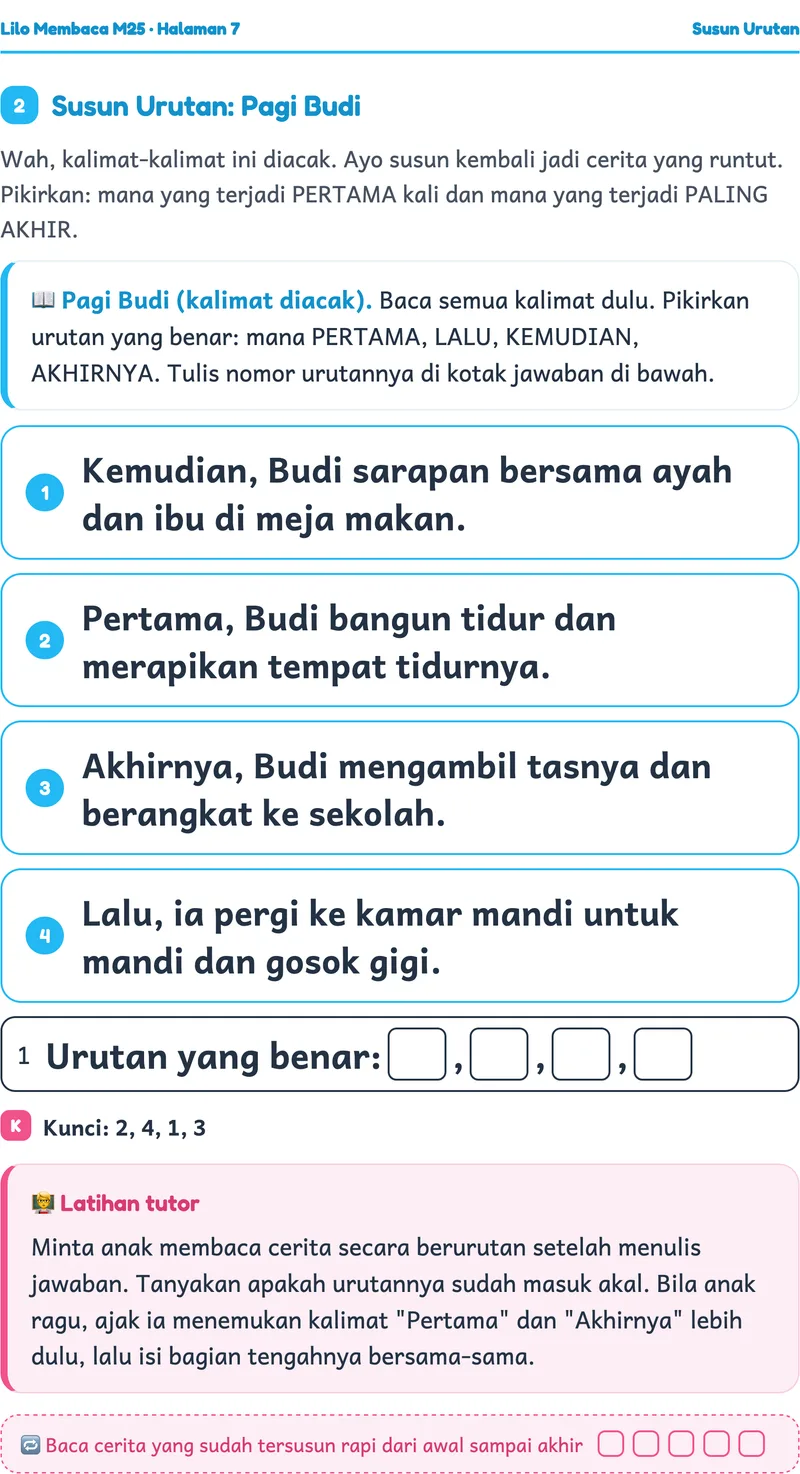
This Level 6 sheet from module 25 asks children to put the events of a short story back in order. The exercise sharpens their grasp of what they read, arriving just before they graduate into independent reading.
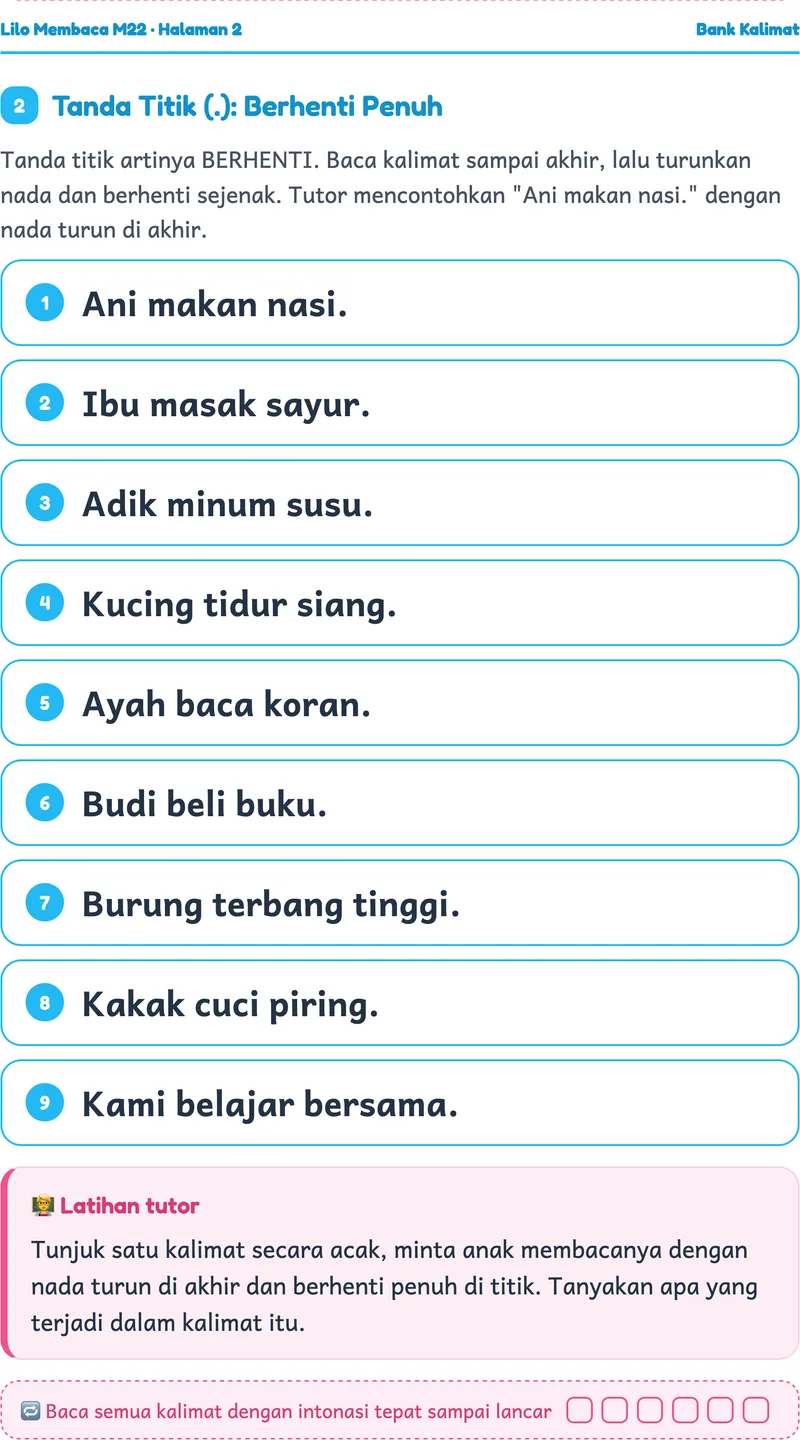
On this sheet, Level 5 children practice reading sentences with lively expression and stopping completely whenever a period appears. Drawn from module 22, the exercise bridges them toward reading that truly flows.
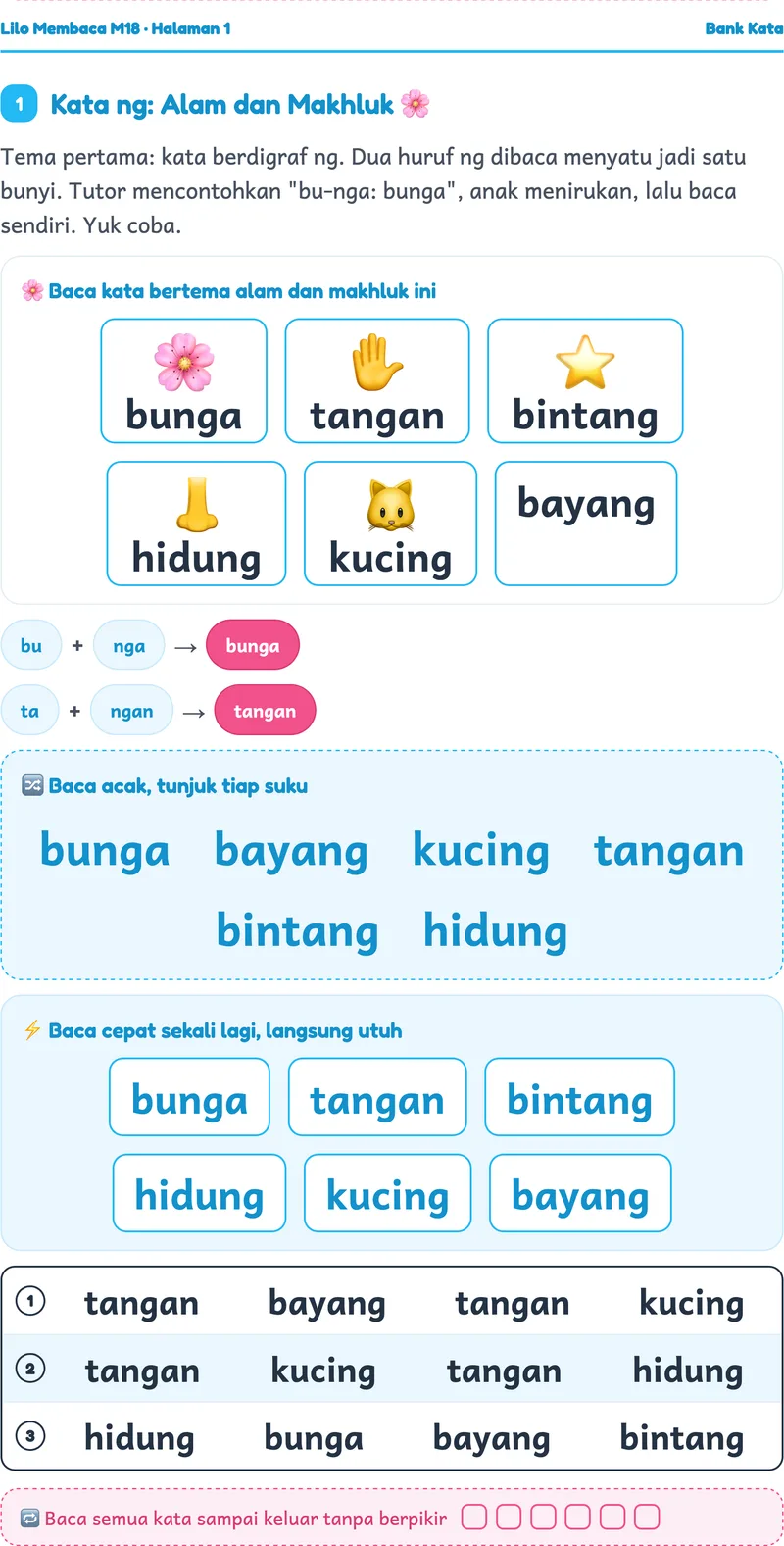
The letter pairs ng and ny trip up more young readers than any other stage. On this module 18 sheet at Level 4, extra support is built in, so children can work through each word calmly until it flows.
Every sheet belongs to Lilo's original leveled curriculum of 122 modules, with hearty practice portions that grow with each child.
Reading readiness rarely arrives in a single day. It shows in small signs you can spot yourself, at home and while your child plays.
Makassar and its surroundings have 90+ tutors for young readers.
Graduates and current students alike.
Every application reviewed
Role and city are checked first.
Documents verified
ID card, diploma and photo are checked.
Teaching profile completed
Teaching experience and hours are recorded.
Learning the Lilo method first
Lilo guides and materials are provided.
Matching per child
Candidates answer questions about the child.
Tutor not quite right? Read the tutor replacement guarantee
Young children show their best when they feel safe, and a game gives the tutor an honest picture of what your child already knows.
Many young children go quiet in front of a question sheet, even when they know the answers, so the result ends up measuring nerves.
The tutor flips sound cards one by one and your child calls out each sound, showing which sounds are secure and which are half known.
Your child builds words from syllable pieces while the tutor listens for smooth blending, or for letter names recited one at a time.
From the game, the tutor sets the start at L0, L1 or a higher stage, and the very next lesson begins right there.
Here is how the opening week unfolds, whether the tutor comes to your home or your child joins an online class.
You share your child's age, the letters they know, and whether home or online suits you. This free consultation guides the tutor search.
The profile of the tutor matched to your child is yours to read before the first session, so you know who will sit beside your child.
Your child plays with sound cards while the tutor notes the starting stage, then the tutor recaps what was mastered and sets one task of about ten minutes.
Worksheets now come from the module for your child's own stage, so every page can be finished and the session closes on success.
This picture fits a five-year-old who already recognises some letters or numbers and learns on the Regular package: eight sessions a month, about twice a week, the most popular rhythm.
Letters your child already recognises are tied to their sounds, so bee gives way to a confident /b/.
Your child blends /s/ and /a/ into sa without spelling aloud, then reads words like sapi and bola alone.
With every consonant known, your child reads sentences such as adik minum susu, and the tutor's weekly report flags words that cause a pause.
Your child reads closed syllables in makan and tikus and tells similar pairs apart, such as kapal and kapan.
Words like nyanyi and bunga get longer practice, and the tutor gives this hardest stage extra time until reading flows again.
Your child moves up once the stage below is solid, and the tutor sets the pace to match how your child learns.
Time on the road and an easy chat can turn into cheerful practice. All your child needs are open ears and curious eyes.
Pick one sound, such as /s/. Your child spots a sign that starts with it and says it aloud, tying shape to sound at L0.
shop signs along the road
Say a word with a pause, such as sa... pi, and your child guesses it whole. That is blending, the heart of L1, done by ear.
just your voice
Give a clue: it ends with /t/ and flies in the sky. Your child guesses pesawat, and the ear learns to catch the final consonant needed at L3.
anything visible from the window
Point at someone busy and let your child name the action in Indonesian, such as menyapu or bersepeda, so prefixes feel familiar by L5.
people and vehicles on the street
60, 90, or 120 minutes per session
Contact us
duration of 60, 90, or 120 minutes
Contact us
60, 90, or 120 minutes
Contact us
Families in Makassar have several good paths to reading. Here is a fair comparison so you can choose what fits your child best.
| Aspek | Lilo | Learning Apps | Learning at Home Alone |
|---|---|---|---|
| Who guides the child | A live, verified tutor who listens and adjusts every session | The app follows its programmed path | You guide with whatever materials you can find |
| Clear levels | Seven measured levels with a placement assessment at the start | Levels exist, though pacing is set by the app | Levels depend on your own planning |
| When your child gets stuck | The tutor spots it in the moment and reteaches a different way | The app repeats the same exercise | You troubleshoot on your own |
| Building a daily habit | Small daily portions designed to become a routine your child enjoys | Depends on screen-time rules at home | Depends fully on family consistency |
| Screen time | Practice happens mostly on paper, at a real desk | All practice happens on a screen | You decide the mix |
After one month, your child brings home new letter sounds they can blend into words, plus weekly notes from the tutor on what needs another pass. Payment covers a whole monthly package at once, with sessions priced from IDR 76,865 each. Lessons happen at home with the tutor or in an online class through app.lilo.id.
Four weeks of meeting first letter sounds through songs and picture cards.
IDR 307,460Over four weeks, your child starts blending sounds into short words regularly.
IDR 604,782Four busy weeks that can lift your child one phonics level.
IDR 891,965Four weeks of near daily practice, ending with your child reading sentences alone.
IDR 1,692,684Included in every lesson package.
No extra fee, whenever you ask.
How it works:
A full report follows each month.
These five questions are fair to ask any provider of reading lessons. The answers show what happens to your child when things go less smoothly.
| Question to ask | Why it matters |
|---|---|
What happens if the first tutor is a poor fit for my child? | Young children learn from people they trust, so the path to a new tutor should be clear from day one. Lilo replaces the tutor free of charge until the fit is right. |
Does one tutor stay with one child for the whole session? | While a child blends sounds, small slips need correcting in the moment, before they settle into habits. Lilo's private lessons give one tutor to one child, with full attention. |
How is my child's starting stage found? | A child placed too high gives up quickly, and one placed too low gets bored. Lilo finds the right stage through play in the first session. |
Do the practice readers use only sounds my child has mastered? | Unfamiliar sounds push children to guess from pictures, a habit that is hard to undo. Lilo's numbered reading sheets use only sounds your child knows. |
What background do the tutors come from? | Teaching reading calls for an understanding of how children develop. Lilo's national network of 5,000+ active tutors draws many from primary teaching, early childhood, psychology and mathematics degrees. |
Lilo teaches from its own curriculum, built level by level. Every worksheet your child touches was designed to fit exactly where they are on the seven-level path.
New ideas start with real objects, move to pictures, and only then become letters and symbols, the Singapore Math way. Your child understands instead of memorizing.
Each practice portion is short enough to finish happily. Finishing daily builds momentum, and momentum is what turns lessons into a lifelong reading habit.
Our verified tutors teach at your home across Makassar, including Panakkukang, Rappocini, Tamalate, and Biringkanaya, or meet your child online in a lively interactive session.
Lessons can run in English or Indonesian as the language of instruction. Families aiming for bilingual schools get an English-speaking reading journey from day one.
Makassar, capital of South Sulawesi Province, is a busy harbor city that has served for generations as the doorway to eastern Indonesia. People here are known for a sailor's spirit, a readiness to try what is new, and a friendly, open way with others. Losari Beach and the Tanjung Bunga area carry the city's name well past Sulawesi. Its districts run from Panakkukang, Rappocini, and Tamalate out to Biringkanaya, Tamalanrea, Manggala, Mariso, and Ujung Pandang. Lilo helps each child in Makassar aged 3 to 10 lay a firm base in reading, writing, and math. Your child can learn at home with a teacher who visits, or join an online class.
Each level has a clear aim, starting with naming letters and numbers and ending with word problems, so your child in Makassar climbs one small rung at a time and feels surer with every lesson.
Your child first handles real objects, then reads pictures, and only after that works with numbers and letters. Following this order, the ideas really sink in, and school tasks start to feel easier and plainer.
Sessions run on a steady schedule with structured worksheets and warm guidance from the teacher. Children in Makassar practice a little at a time until each skill truly sticks.
Keira now loves pointing at shop signs and sounding them out slowly. Her tutor is so patient, and there is a report after every session so I always know how far along she is.
Lilo Reading Classes made such a difference for my child. The method really works, and their reading has come on so much. We're so happy with it.

Start with a free consultation on WhatsApp. Tell us about your child, and we will suggest a starting level and a schedule that fits your family in Makassar.
Seven levels, one right starting point