

Ages 3 to 4: Meeting Sounds Through Play
Your child is still far from books, and that is fine. At this age we play with sounds, songs, and cards, so letters become friendly long before reading begins.
Your child starts with letter sounds, blends them into syllables and words, and finishes reading whole stories with understanding. Each of the seven levels has a clear goal, so you always know where your child stands.
Reading classes for kids in Medan are Lilo lessons that guide children aged 3 to 10 through seven measured levels, from hearing letter sounds to reading short passages on their own. A tutor teaches in English, checks your child's starting point first, and moves up only when a level is truly mastered, at home, online, or in a small group.
Every child arrives at reading on a different day. The placement check finds the right level, so lessons feel doable from the very first session.
Your child is still far from books, and that is fine. At this age we play with sounds, songs, and cards, so letters become friendly long before reading begins.
Kindergarten years are the sweet spot for letter sounds and first syllables. Your child builds real reading foundations calmly, without pressure and without racing ahead.
Your child can read a little but stumbles on longer words or sentences. We strengthen fluency, expression, and understanding until reading feels smooth and enjoyable.
Some children reach school before reading clicks. The placement check finds the exact gap, and your child catches up step by step, with zero shame and plenty of encouragement.
Reading readiness shows up while your child plays and chats. These signs help you see when your child can begin and when a new stage is near.
Medan and its surroundings have 90+ reading tutors.
Some still studying, others graduated.
Every application reviewed
Our team reads every application.
ID card and diploma verified
Diploma and ID are reviewed.
Experience and hours recorded
We know when each tutor is free.
Trained before teaching
Phonics and CPA come first.
Matching per child
Candidates answer questions about the child.
Tutor not quite right? Free tutor replacement, here is how
Young children show what they truly know when they feel they are playing. So the tutor takes notes while joining the game in the first session.
The method is simple to explain and careful in practice: sounds before names, small steps before big books, and mastery before moving on.
Before the first real lesson, the tutor sits with your child and finds which of the seven levels fits today. Lessons then begin exactly where your child is, never where a syllabus assumes.
Your child learns what each letter says, like /m/ and /a/, through songs and sound cards. We skip letter-name spelling drills because sounds are what actually glue into words.
Sounds slide straight into syllables, syllables into words, words into short sentences. Each step uses only patterns your child has already mastered, so reading always feels possible.
Small daily portions build the habit, steady practice built level by level. Your child moves up only after mastering a stage, which is why progress holds instead of fading.
Every stage stands on the one before it, so the foundation has no gaps.
This picture follows a five-year-old learning face to face at home in Medan on the Intensive package, 12 sessions a month or about three a week.
Your child says vowel and first consonant sounds from cards, then spots them in the names of things nearby.
Sounds blend into 'pa' and 'bu', then into two-syllable words such as 'papa' and 'buku'.
More consonants arrive, and your child finishes short sentences like 'ibu beli roti' without help.
Your child reads closed syllables like 'tas' and tells close pairs apart, such as 'batu' and 'bantu'.
Practice on ng, ny, kh and sy gets denser until 'nyanyi' and 'bunga' come out whole.
After L4 your child moves on to longer sentences at L5. A stage that needs more time gets extra practice until it is solid.
These are the habits our tutors keep in every lesson, drawn from Lilo's own curriculum of 122 leveled modules across our programs.
A child who reads texts built only from patterns already mastered succeeds every time they open a page, and success is what makes readers.
Lessons begin with what letters say, never long recitals of letter names. Your child hears /m/ meet /a/ and discovers that reading is simply listening with your eyes.
We skip the old habit of spelling out letter names one by one. Sounds glide directly into whole syllables, so words come out smooth instead of chopped into pieces.
Our leveled readers contain only patterns your child has already learned. Every page is winnable, which keeps confidence high and makes your child ask for the next story.
Combinations like ng, ny, and tr trip up more children than any other stage. Our tutors slow down here on purpose, with extra practice and extra encouragement.
Seven rungs, one ladder: your child climbs one step at a time and never skips a rung.
Most reading struggles come from a handful of well-meaning habits. Knowing them early saves your child months of frustration.
Why it happensNaming letters one by one breaks a word into pieces the child then has to reassemble, which stalls blending and makes reading feel like a puzzle with missing parts.
How Lilo helpsTeach the sound each letter makes and let sounds flow straight into syllables. The word comes out whole on the first try.
Why it happensA child who recognizes every letter but has never heard what it says holds a set of keys with no doors. The shapes carry no meaning yet.
How Lilo helpsPair every shape with its sound from day one, through songs and sound cards, so seeing a letter instantly triggers hearing it.
Why it happensA book full of patterns your child has never learned turns every page into guesswork, and repeated guessing quietly teaches a child that reading is scary.
How Lilo helpsUse leveled texts that contain only patterns already mastered, then climb one level at a time. Confidence grows with every finished page.
Why it happensRepetition without variety makes a child associate reading with boredom, and a bored child stops trying long before the skill arrives.
How Lilo helpsKeep portions small and mix them with games, songs, and stories. Short, lively, steady practice beats long dull sessions every time.
Why it happensCombinations like ng, ny, and tr are the most common sticking point in the whole journey, and skimming over them leaves a crack under everything built afterward.
How Lilo helpsGive this stage extra time and extra patience on purpose. At Lilo it has its own level, with careful practice until it is solid.
Your child learns the sound each letter makes and hears sounds inside words, using sound cards and letter tracing that turn listening into early reading.
Sounds join into open syllables, then into words of two and three syllables, with timed reading that gently builds smoothness without pressure.
Your child tackles syllables that end in consonants, then the tricky letter combinations, the part of reading where careful practice matters most.
Reading grows from single words to sentences of 4 to 10 words, with punctuation, intonation, and rhythmic reading so sentences sound alive.
Mini stories bring everything together. Your child answers 5W questions, finds the main idea, and retells the story in their own words.
These are real pages from Lilo's original curriculum, printed on A5 with generous practice portions. Have a look at a Letter Sound Card, a Build a Syllable sheet, a Fast Reading Sheet, and a Passage with 5W questions.
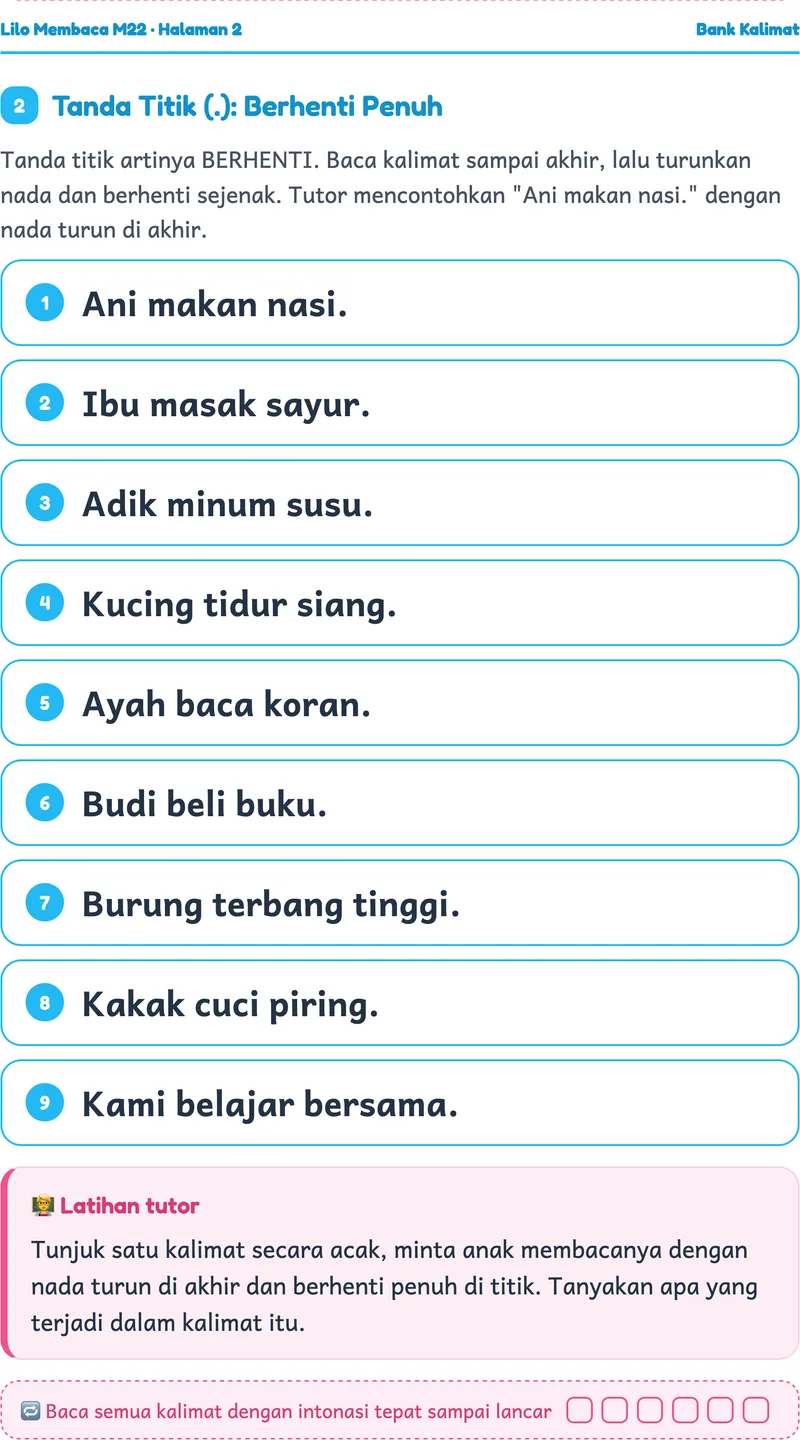
On this sheet, Level 5 children practice reading sentences with lively expression and stopping completely whenever a period appears. Drawn from module 22, the exercise bridges them toward reading that truly flows.
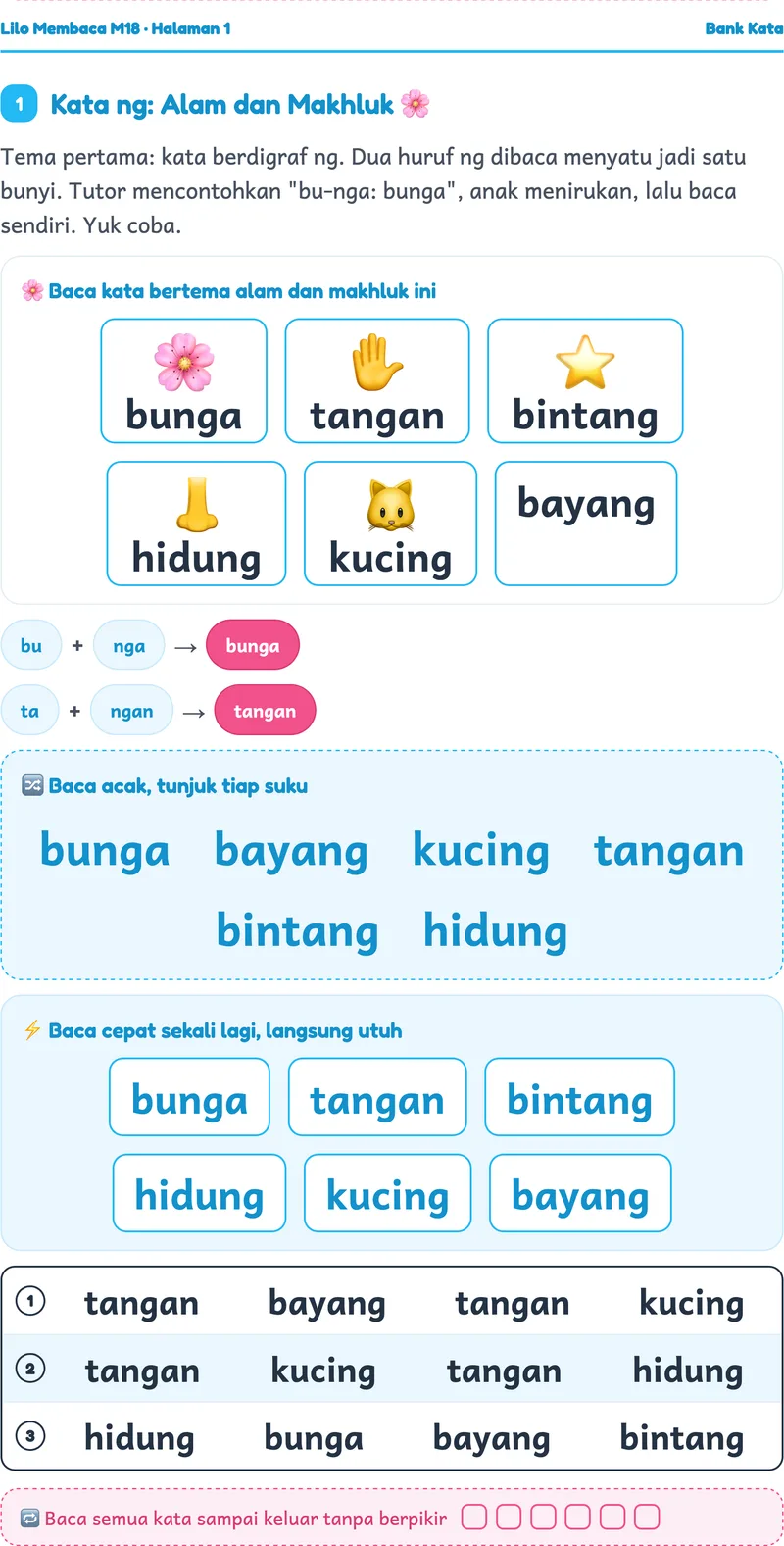
The letter pairs ng and ny trip up more young readers than any other stage. On this module 18 sheet at Level 4, extra support is built in, so children can work through each word calmly until it flows.
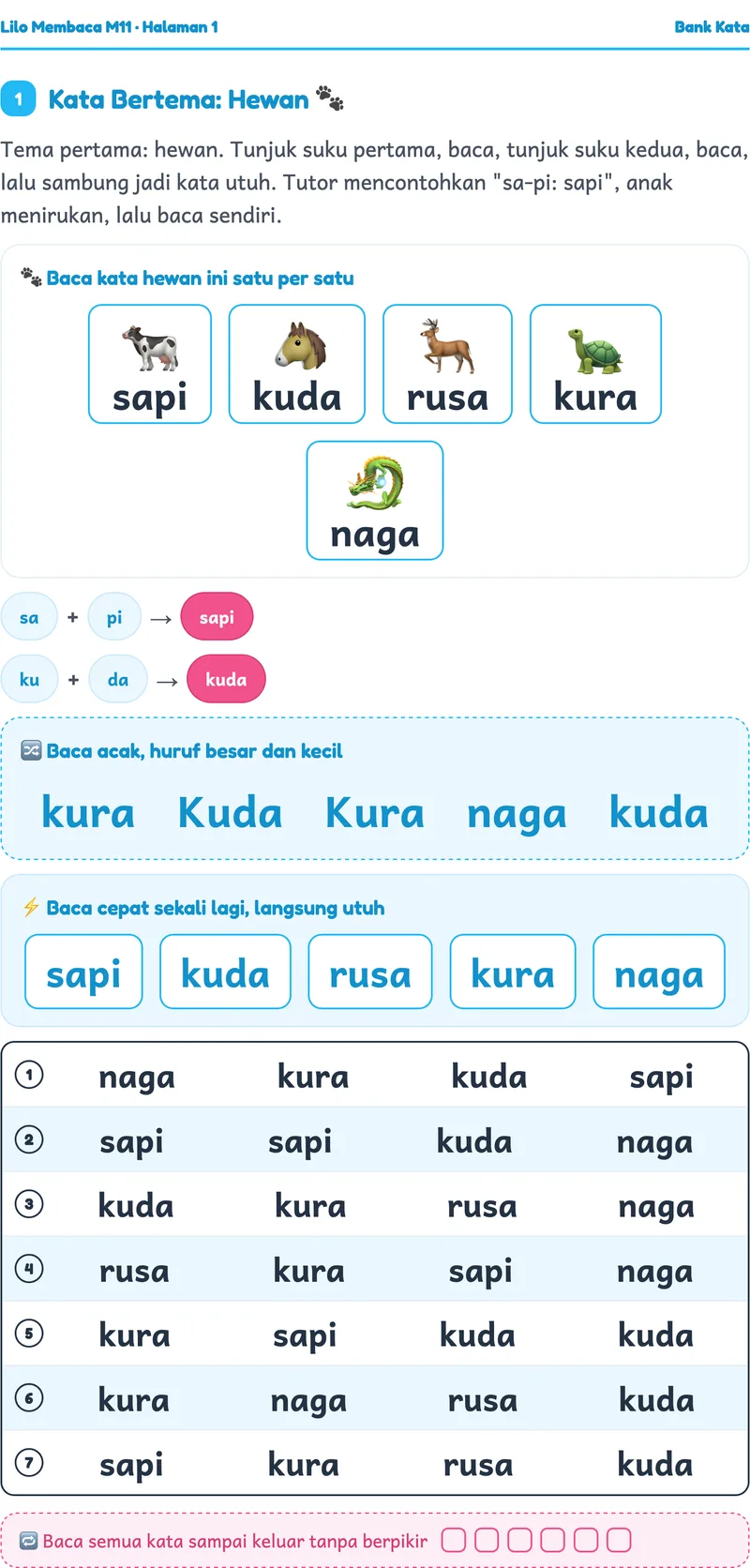
A real page from module 11: your child points at each syllable, reads it, then blends it into a whole word. A fast-read round makes the words come out smoothly.
Every sheet belongs to Lilo's original leveled curriculum of 122 modules, with hearty practice portions that grow with each child.
The bathroom and the yard are full of sound practice. These four short games carry the tutor's lesson forward with no desk needed.
| Activity | Time | What you need |
|---|---|---|
Foam letters on the bathroom wallWrite one letter in foam and say its sound, such as /s/. Your child copies the sound while wiping the letter away, then you move to the next L0 sound. | 5 minutes | soap foam and a tiled wall |
Floating toys in syllablesSay a toy's name in parts, like 'bo... la' or 'pe... ra... hu'. Your child blends it into the whole word, then sinks the toy. This game builds L1 blending. | 10 minutes | rubber toys or small bottles |
Syllable stones in the yardWrite 'ma', 'ta', 'ku' and 'da' on a few stones. Your child pairs two stones into 'mata' or 'kuda' and reads the word aloud. A good fit for L2. | 15 minutes | flat stones and chalk |
Ending sound hunt in the gardenName things in the garden together and listen for the last sound. An L3 child finds /t/ in 'rumput', and an L4 child catches /ng/ in 'selang'. | 10 minutes | leaves, grass and a garden hose |
A bilingual child meets the same letters carrying different sounds. How the tutor handles this shapes how smoothly your child reads.
Indonesian spelling stays loyal to its sounds. The letter c always sounds like the start of 'cari'. English spelling shifts far more: a sounds different in 'cat', 'cake' and 'car', and c says /k/ in 'cat' and /s/ in 'city'. A bilingual child is storing two sound maps for one set of letters.
So it is natural for a child who knows English letter sounds to read 'cuci' as 'kuki'. That slip shows the brain sorting two systems. The tutor names the language clearly, for example 'in Indonesian, c sounds like cari', and gives texts built only from sounds your child has mastered.
Letter combinations need extra care. English words almost never begin with ng, while Indonesian has 'ngantuk', and sy in 'syukur' matches sh in 'ship'. You can see progress at home when your child pauses, says 'oh, this is Indonesian', and rereads the word with the right sound.
Medan is the capital of North Sumatra Province and the largest city on the island of Sumatra. It is widely known as the main gateway to western Indonesia, with the historic Kesawan district preserving traces of its storied past. Medan is also known for its warm atmosphere, a place where families of many backgrounds live side by side with high hopes for their children's education. From Medan Baru to Medan Marelan, the spirit of learning grows in many homes.
In Medan, your child can study at home with a teacher who comes by at times you pick. A room they already know helps a child relax, ask freely, and keep practicing until each idea finally makes sense.
Lessons are arranged in clear levels, starting from the very basics. Your child moves up after mastering each stage, so every bit of progress is easy for you to see and rewarding for your child.
If you prefer learning through a screen, Lilo online classes run as a live two way session. The teacher guides practice directly, gives examples, and tracks your child's progress from meeting to meeting.
60, 90, or 120 minutes
Contact us
60/90/120 minutes
Contact us
choose 60, 90, or 120 minutes
Contact us
It all begins with one short message. These four steps carry your child from that message to sitting beside a tutor, at home or on screen.
The consultation is free. Share your child's age, the words they can already read, and whether home lessons or online classes suit them better.
A tutor can visit homes in areas such as Medan Selayang or Medan Marelan, or your child joins online. Packages are chosen and paid month by month.
The tutor is matched to your child's needs, and you can view their profile before the first session. Many tutors trained in primary teaching, early childhood education or psychology.
The tutor plays sound games with your child to find the right starting point. For online classes, the link and worksheets arrive beforehand through app.lilo.id.
There are many good ways to help a child read. Here is how a leveled program with a live tutor compares, honestly.
A placement check finds your child's exact level first
Moves up only after your child masters a stage
A live tutor hears the exact error and fixes it on the spot
Every session includes reading aloud with feedback on sounds
Seven named levels tell you exactly where your child is
Each week the tutor's report shows which letter sounds your child has mastered and which phonics level is in progress, which helps you pick the right rhythm. A session starts at IDR 76,865 in an online class and IDR 115,298 when the tutor comes to your home, and you settle a whole monthly package at once. A denser package lowers what each session costs.
A first step, roughly once a week, to see how phonics practice feels.
IDR 461,190Twice as dense as Starter, with phonics practice about twice a week.
IDR 907,172One step denser than Regular, about three sessions every week.
IDR 1,337,947The fullest and densest month, around six sessions a week.
IDR 2,539,026At home or online, the same.
No extra fee, whenever you ask.
Here is how:
Topped up by a monthly report.
Two things are easy to check with any provider before you sign up: the order of the material and the task your child brings home.
| Question to ask | Why it matters |
|---|---|
Is there a coded sequence of material I can see before enrolling? | A coded sequence tells you your child's position without guessing. At Lilo the ladder runs from L0 Bunyi Huruf, letter sounds, to L6 Wacana, passages. |
How long is the homework after each lesson, and what is it for? | A short task that practices that day's lesson keeps your child coming back to books happily. At Lilo the tutor closes each session with one task of about ten minutes. |
Where do the worksheets come from? | Worksheets full of unfamiliar sounds push a child into guessing. Lilo draws every sheet from its own 122 coded modules, matched to the one in progress. |
How will I follow my child's progress each week? | Regular news helps you continue practice at home. A weekly Lilo tutor report might read: 'nyanyi' is now fluent, and this week the focus is the kh sound. |
What happens if my child and the teacher are a poor match? | The right teacher shapes a young child's enthusiasm for lessons. At Lilo, the tutor is replaced free of charge whenever the match is off. |
Seven named levels replace vague promises. After every stage you know what your child just mastered and what comes next, in plain words.
Lilo lessons come from original materials built in-house, following the concrete to pictures to symbols path used in Singapore Math. Ideas are touched and seen before they become print.
Every tutor is verified before teaching. For home lessons in Medan, the tutor comes to your door in areas like Medan Baru, Medan Johor, and Medan Selayang.
Lessons are taught in English for bilingual and national-plus families, and bilingual instruction in Indonesian and English is available. The subject stays reading, always.
Your child never gets pushed to the next level to keep a schedule. A stage is finished when it is truly mastered, which is why the skill stays.
Private lessons at home, a small group class, or private online sessions. You choose the setting that fits your family, and the seven levels stay the same.
Haziel now dares to read out loud in front of his older sister. The other day he read a food stall menu all the way through. Our whole family was so happy watching him.
Alesha is the type of child who gets bored easily. Somehow with her Lilo tutor she stays engaged, she says learning feels like playing. Now she sounds out every bit of writing she sees on the street.

Message us on WhatsApp for a free consultation. Tell us your child's age and what reading looks like at home today, and we will suggest the right starting level and the best way to learn in Medan.
Free consultation, no obligation