



A device with camera and microphone
A laptop, tablet or phone. The tutor needs to see your child's face and finger and hear each sound clearly.
Seven levels of phonics over a video call, one tutor for one child. Your child reads from cards and sheets printed at their own table, and the tutor corrects each sound on the spot. The schedule, class link and reading sheets arrive through the Lilo app before each session.
Lilo online reading lessons are one-to-one phonics sessions by video for children aged 4 to 10. The tutor hears and corrects every sound, your child reads from sound cards and sheets sent before class, and the levels match home lessons exactly. Lessons start from IDR 76,865 per session.
Online reading lessons are reading support delivered over a video call. At Lilo your child climbs the same 7 phonics levels as in home lessons, from letter sounds to comprehension, with one tutor who hears and corrects their reading directly.
Reading is a spoken activity, and speech comes through clearly on video. So each session is built for your child to speak a lot and the tutor to listen a lot.
Your child and the tutor play a first-sound guessing game or sing the vowel sounds. Ears and mouth are ready before the eyes start reading.
Your child reads the cards from the previous session. The tutor notes which sounds are steady and which still wobble.
The tutor models a new pattern, such as open syllables or final consonants, and your child copies it while pointing at the card.
Your child reads a row of syllables or words racing against their own best time. Fun, and a strong fluency builder.
Your child reads a short text that uses only patterns already learned, then answers questions about it.
The tutor gives one card or word list to read for ten minutes at home and notes it in the weekly report.
A session runs 60, 90 or 120 minutes. We recommend 60 minutes with changing activities for young children, while older children can choose a longer block.
| Age | Recommended length | Usual levels | What to have at home |
|---|---|---|---|
| Age 4 | 60 minutes | Level 0: letter sounds through songs, cards and finger tracing. | An adult beside your child, printed sound cards, a small mirror to see mouth shapes. |
| Ages 5-6 | 60 minutes | Levels 1 to 3: whole syllables, words, then final consonants. | An adult in the same room, printed reading sheets, a pencil to mark words. |
| Ages 7-8 | 60 or 90 minutes | Levels 4 to 6: blends, fluent sentences, comprehension. | Your child can learn alone. A thin storybook nearby for shared reading practice. |
| Ages 9-10 | 60 or 90 minutes | Levels 5 and 6 for children who still stumble: fluency, intonation and main ideas. | A quiet room and a headset if the house is busy. |
Prices in the Fees section are for 60-minute sessions. 90 and 120 minute sessions are available and priced accordingly.
Reading rests on sound, so a clear voice matters most.
A laptop, tablet or phone. The tutor needs to see your child's face and finger and hear each sound clearly.
Television off and background noise low, so the tutor can tell apart the /b/ and /p/ your child says.
The Lilo team sends cards and sheets from the current module before class. Your child reads from paper on the table.
Enough for a video call. The Lilo team sends the class link before each session.
Optional. A headset helps children aged 7 and above focus on the tutor's model sounds.
A real curriculum arranged level by level, neat and complete. Here are actual practice sheets from several reading levels.
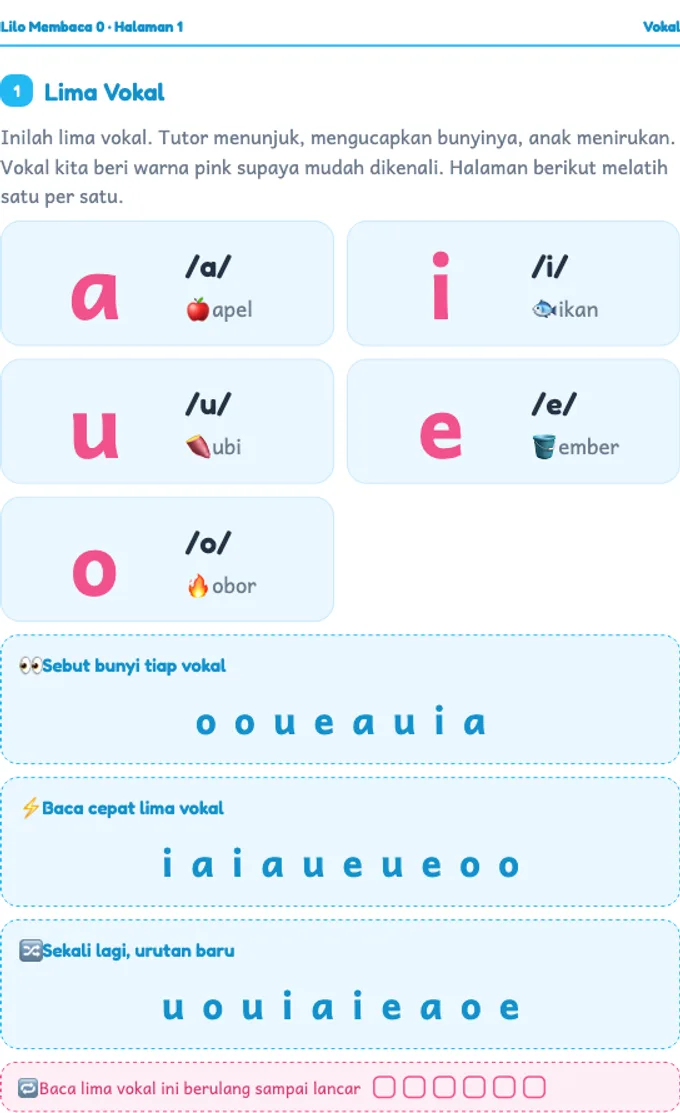
Five vowels with their sounds plus fast reading. Your child learns each letter's sound, /a/ and /m/, before its name. This is the heart of the phonics method.
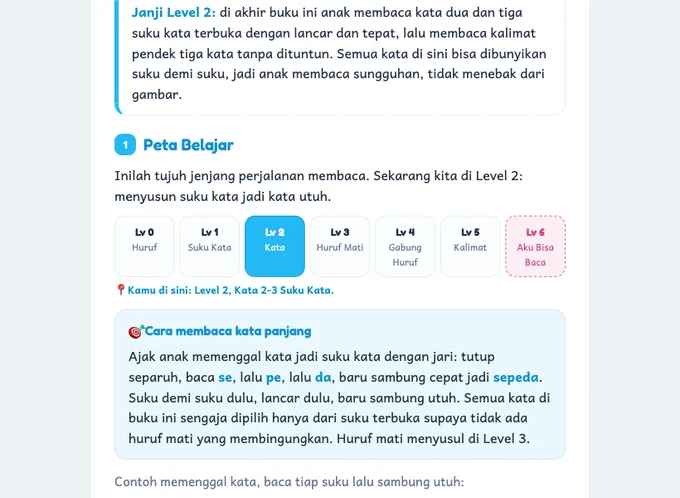
The seven-level map and how to break a word into syllables. The tutor models the whole syllable, your child joins them into a meaningful word without spelling out.
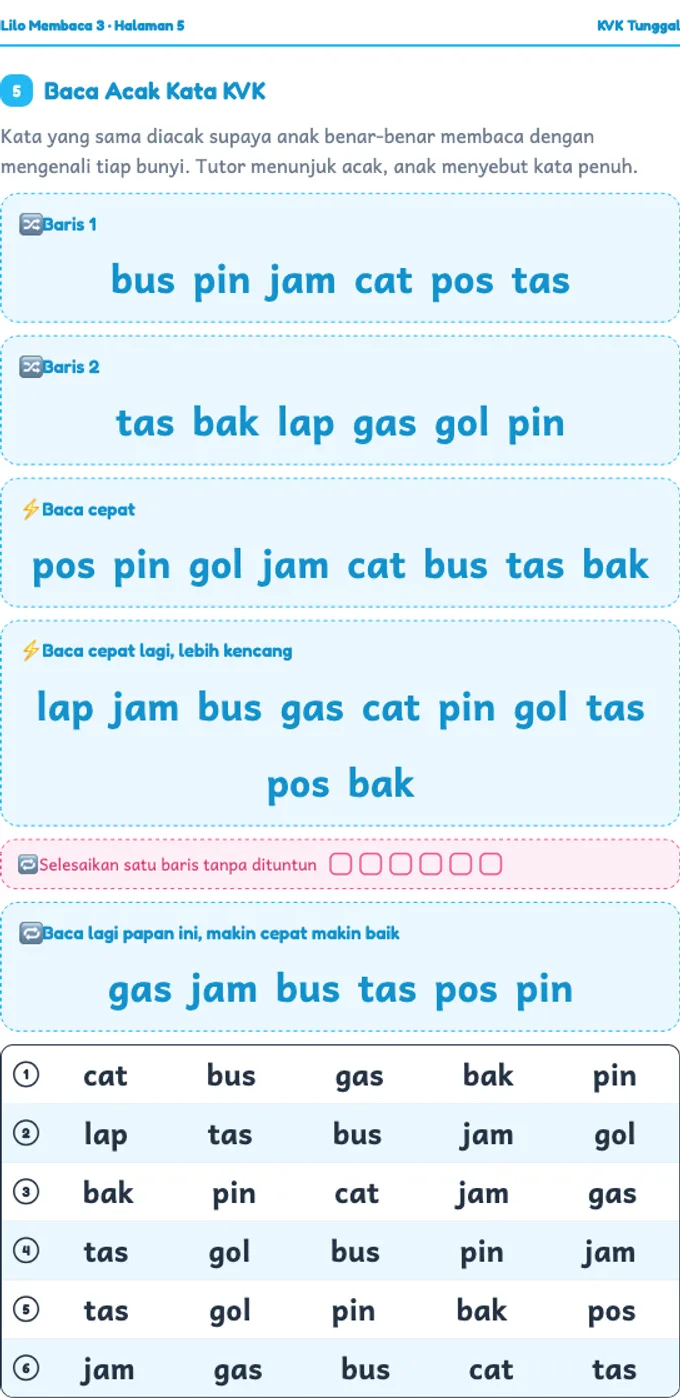
Random word reading and fast reading. Steady, regular practice with timed reading as a game trains your child to read the final letter of a word with care.
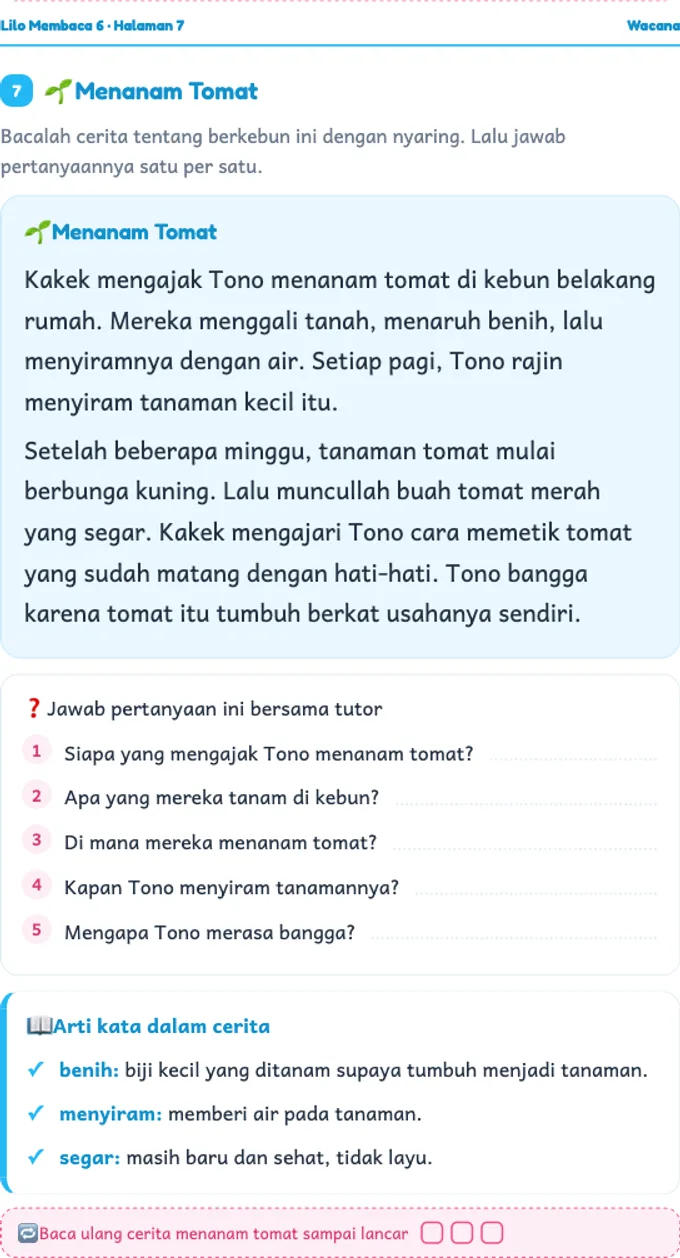
Grandma's Garden
That morning Tono went to the garden with Grandma. Grandma planted spinach and tomatoes. Tono watered the plants. They garden every Sunday. Tono is happy because Grandma's garden is thriving.
One of 18 short stories with its questions and word meanings. Your child reads the passage then answers 5W questions, building comprehension until they can retell it.
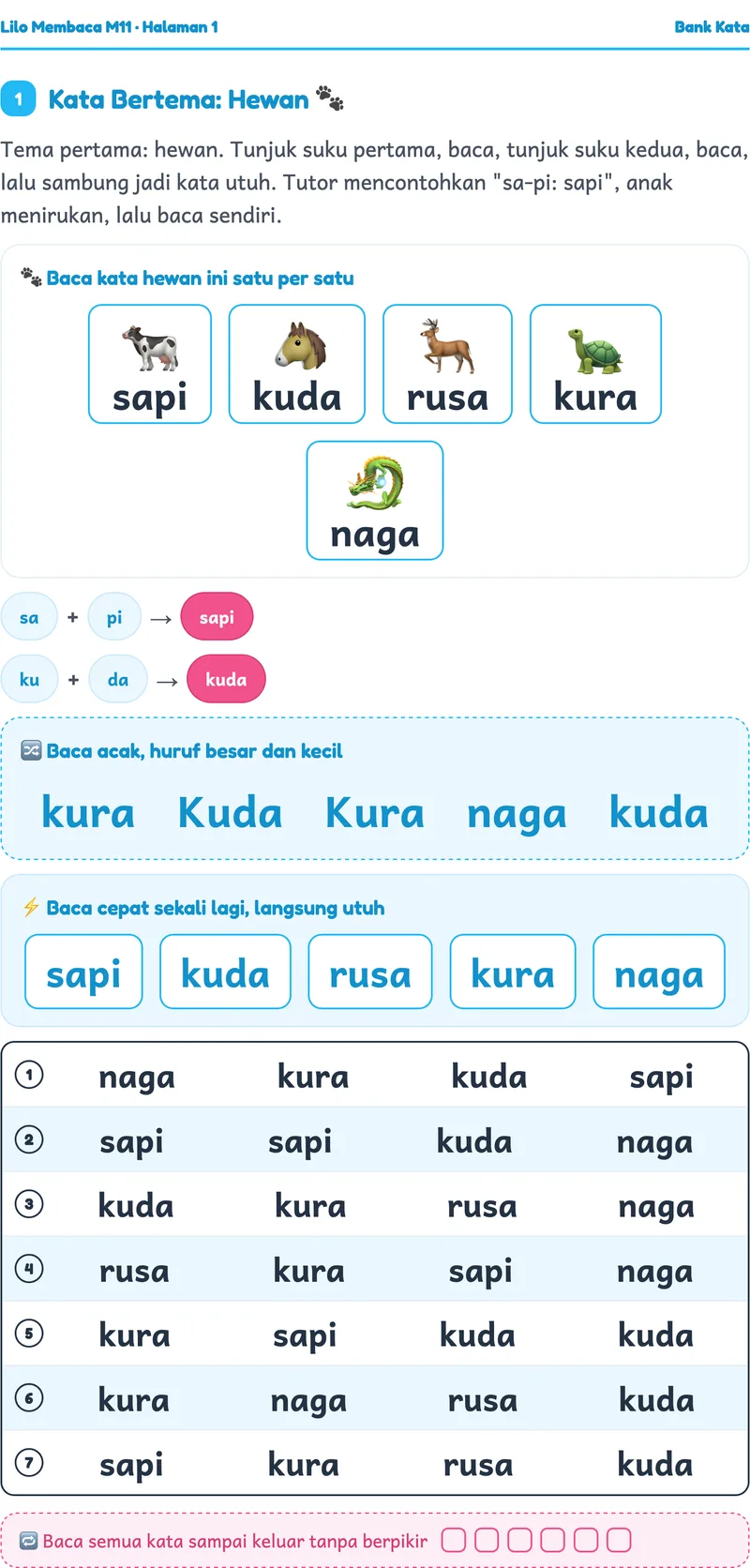
A real page from module 11: your child points at each syllable, reads it, then blends it into a whole word. A fast-read round makes the words come out smoothly.
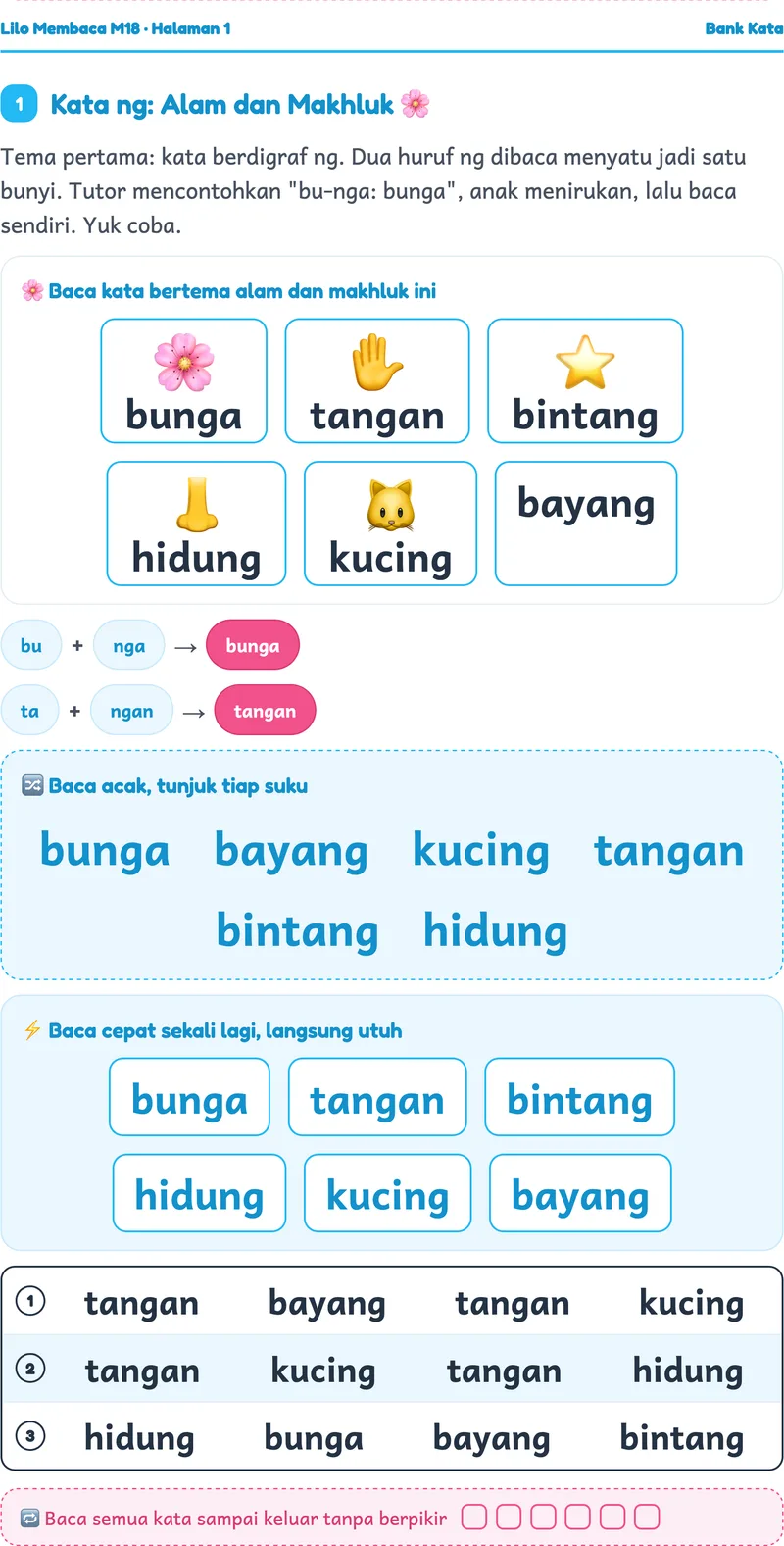
A real page from module 18: words with the ng and ny combinations, the stage where most children get stuck. Lilo gives extra care right here.
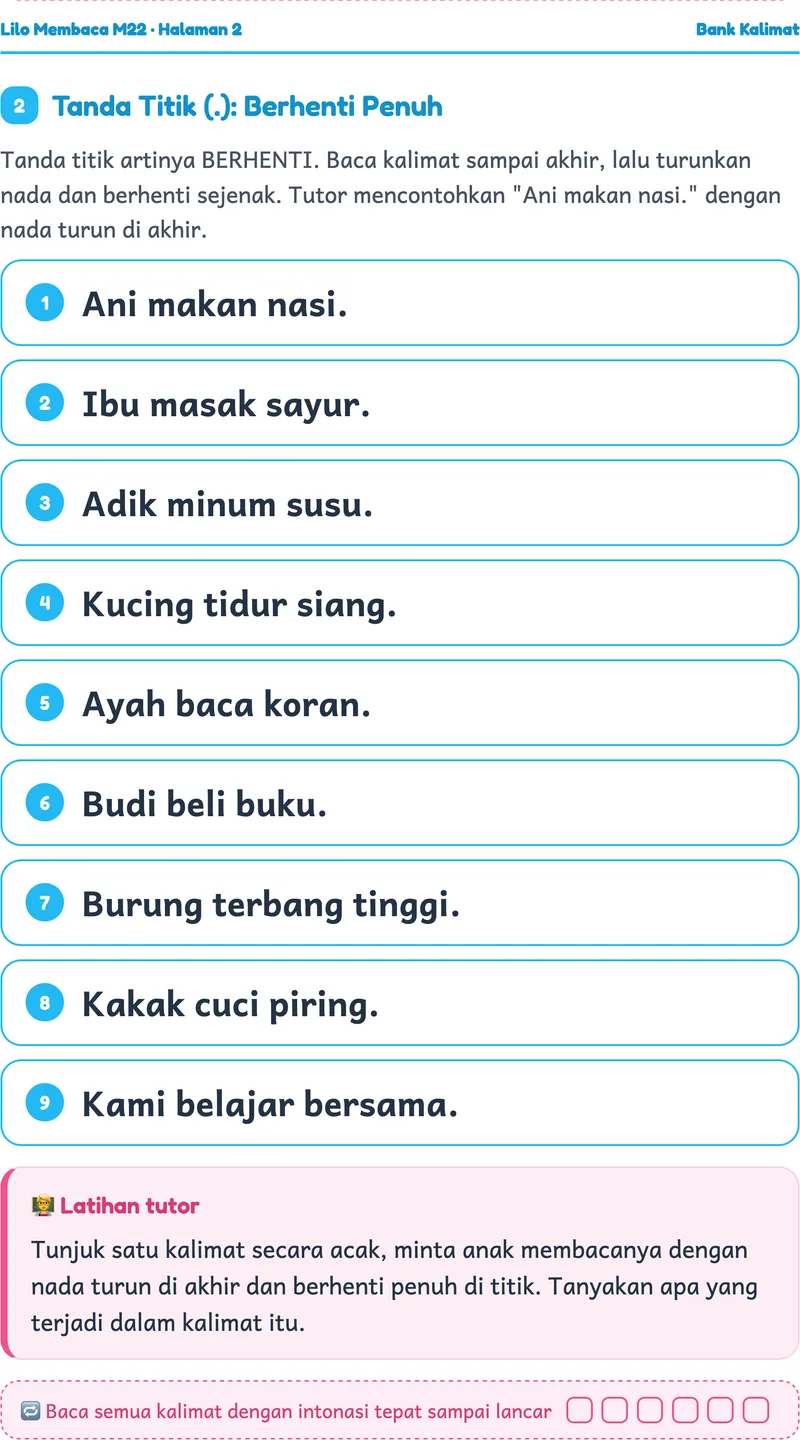
A real page from module 22: your child practices a full stop at each period and reads sentences with lively intonation, the bridge to fluent reading.
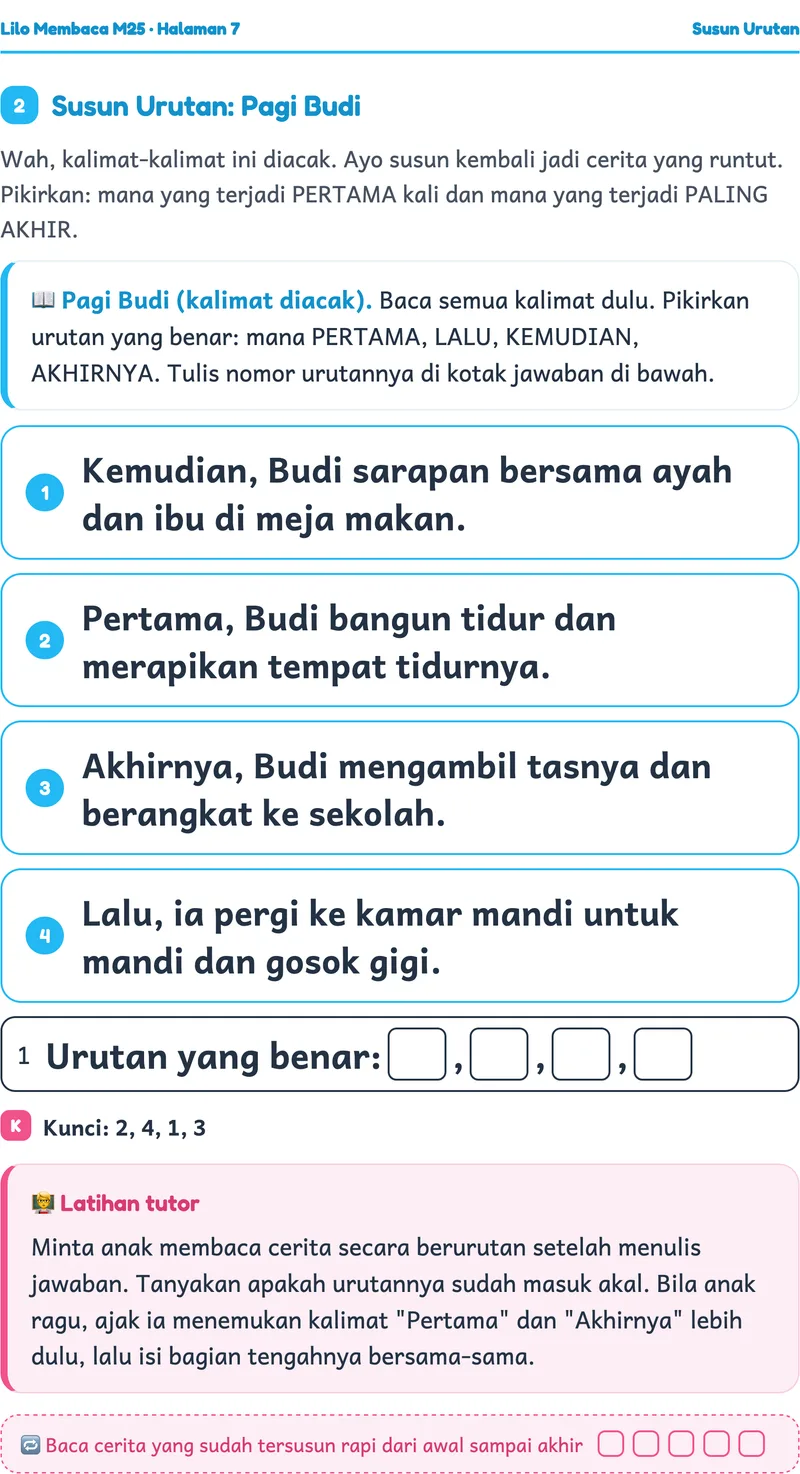
A real page from module 25: your child puts the events of a short story in order, training real comprehension before the independent reading graduation.
Samples from Lilo's original curriculum. The full A5 materials are prepared by the tutor at each session.
The tutor teaches and you keep the setting right. These four small things make sessions far livelier.
Arrange the sound cards and reading sheets in the order they were sent, so your child is never searching mid-session.
For ages 4 and 5, help your child point to the card the tutor names. Children aged 7 and above are usually independent.
Hold back from whispering the answer. A wrong sound is the clue the tutor needs to correct it.
On lesson-free days, read the tutor's card or word list together. This small habit keeps the sounds fresh.
Every week you receive a report with the current level, the sounds that are secure and the sounds still in practice.
Verified tutors ready to teach online, trained in reading, writing, counting, and finger math for young children.
Diligently opens letters, then syllables, then whole pages for children until confidence grows.
Faithfully opens letters, then syllables, then whole pages for children using materials children can hold.
Patiently builds reading up from single sounds to short stories with friendly, regular practice.
Thoughtfully opens letters, then syllables, then whole pages for children in a warm classroom.
Faithfully builds reading up from single sounds to short stories with plenty of encouragement.
Thoughtfully uses finger counting to build concentration and accuracy until confidence grows.
A session runs 60, 90, or 120 minutes. The prices above are for 60 minute sessions, and longer sessions are priced accordingly. Lessons happen at your home or online. Larger packages cost less per session.
Each session works out to IDR 76,865 for online or private in-home sessions. Payment is made per package.
From the very first session.
We find a replacement for free. Request it whenever you need.
Here is how:
Topped up by a monthly report.
Alesha is the type of child who gets bored easily. Somehow with her Lilo tutor she stays engaged, she says learning feels like playing. Now she sounds out every bit of writing she sees on the street.
Kinan has started reading short stories on his own. He often refuses to stop at one page and keeps asking to continue until the story is finished.
At first I was unsure about online lessons for a child Mazaya's age. It turns out she stays focused and clicks with her tutor. Now she knows her letter sounds and is starting to blend simple words.
Oliver read the writing on a cereal box by himself the other day, then gave the proudest smile. Little moments like that make me feel the lessons truly matter.
After classes here my child can now read fluently thanks to patient and professional guidance, and their confidence has grown too.
Learning to read by video goes smoothly when your child's ears, attention and table are ready. These signs help you weigh it up, and a first session that opens with games shows the rest.
Here is what happens from your first question until your child reads from their own cards in front of the camera. The schedule, links and worksheets all live neatly in app.lilo.id.
The free consultation starts with a short WhatsApp chat. You share your child's age, the sounds or letters they already know, and the time of day your home is quietest. From that, the Lilo team matches a tutor who is used to teaching reading by video. Before the first session you can view the tutor's profile and tell your child their name.
Before the first session, the Lilo team sends the class link and worksheets through the app. You print them and set them on your child's table. The sheets come from a coded module in the Lilo curriculum, so your child holds exactly the page the tutor sees on the other side of the screen, and the tutor always knows where your child is reading.
There is no written test. The tutor invites your child to play a sound guessing game, name things around the room, then read cards that slowly get harder. While playing, the tutor listens for which sounds come out firmly and which still waver, then decides the level where your child begins. It feels light, so your child dares to speak from the first minutes.
While reading, the camera points at your child's sheet and hands. The tutor watches your child's finger move under each syllable, which shows whether eyes and mouth are travelling together. If the finger lags or jumps to another word, the tutor asks your child to go back to the start of the line and read slowly until voice and finger move in step again.
At the end of the session the tutor sums up the sounds your child mastered that day, in words a young child understands. Then the tutor gives one small task of about ten minutes to do at home. Sheets for the next session follow through the app, so all you need to do is print them before the next session comes round.
Reading begins with sound, and that sound has to reach the tutor's ear whole. Here is how tutors make sure every sound your child says is right while they sit in different places.
A laptop, tablet or phone microphone picks up your child's voice clearly enough to learn reading. Even so, an internet connection flattens some sounds that already sit close together. Pairs such as b and p, d and t, or m and n can sound almost the same through the tutor's speaker, especially when a child speaks softly. Lilo tutors know these risky pairs by heart, so for those sounds they use eyes and ears together. The tutor asks your child to bring their face closer to the camera and say the sound once more, slowly. Lips pressing shut then opening point to b or p, while the tongue tip behind the top teeth points to d or t.
A second tool tutors use often is the echo back. After your child reads a sound or syllable, the tutor repeats exactly what they heard and asks whether it matches. If your child meant ba and the tutor heard pa, the tutor echoes pa, and a child whose ear is warming up quickly corrects themselves. This habit gives two results. The tutor gains certainty about the sound your child really made, and your child learns to listen closely to their own reading. Over time your child fixes a sound before the tutor even asks, a sign their ears are now working every time they read.
Distance and delay are also set up from the first minute. At the start of the session the tutor plays a sound check game: your child says their name, one vowel and one syllable, and the device is moved until the voice comes through full and free of echo. A child's mouth is usually about a hand span from the microphone, and older children can wear a headset with a microphone. Video calls carry a small delay, so the tutor waits until your child finishes a whole line before responding. For a correct answer the tutor uses a thumbs up or a nod, which keeps their voice from covering your child's and leaves the next sound clean.
When a sound is still uncertain after watching and echoing, the tutor moves it to the eyes. The tutor says a word, and your child points to the letter card they heard at the start of that word and lifts it to the camera. Another way is for your child to write that letter large on paper. This tells the tutor where the difficulty sits: in the mouth, in the ear, or in remembering the letter's shape. Sound pairs that still wobble become the small task at the end of the session. There is a quieter benefit too: a child who learns to read through a speaker gets used to saying every sound clearly, which serves them well when they later read aloud in class.
Every child has their own rhythm, so this timeline is only a picture for a child starting from letter sounds. A child who already knows more will pass some stages earlier, and another child may take longer.
Your child starts to feel at ease talking with the tutor through the screen. They learn to point at a card while saying its sound, and the tutor gets to know their voice: how loud, how clear, and which letters tend to swap over the microphone. Pointing while speaking becomes the habit every later session builds on.
Your child says vowel sounds clearly and begins joining first consonants into syllables such as ma, bi or su. By now the tutor usually knows which sound pairs need watching for this child, such as b with p or d with t, and gives practice aimed at exactly those pairs.
Your child reads two syllable words from the sheet without spelling out each letter. On screen, the tutor hears the gaps between syllables slowly disappear. Your child also spots the same word on different sheets, a sign the sounds have settled in memory, and starts reading them out proudly.
Your child reads simple sentences and pauses at each full stop. Final consonants and the letter pairs ng and ny get extra care, because they are soft sounds that easily fade through a speaker. The tutor asks your child to say them a little more clearly until the habit sticks.
Your child reads a short passage at their level, then answers who, what, where, when and why. Over video, the tutor asks your child to retell the story in their own words. At this stage your child reads to understand, and you can hear the confidence in their voice.
This timeline is a picture with no promised dates. Your child's real progress is recorded in the weekly report, and you can talk it through in a WhatsApp consultation.
These short activities keep your child's ears and mouth in shape on days without a session. Each one uses things already at home or the sheets you have printed.
Your child sits in one room with their sound cards while you go to another room and call them on the phone. You say one sound, your child finds the matching card and reads it back. The game trains your child to hear sounds through a speaker, just like in lessons, and gets them used to speaking clearly for someone who is far away.
Two phones for a voice call, printed sound cards
Your child sits in front of a mirror and says sound pairs that often swap, such as ba and pa or da and ta. They watch their lips close and open, and feel the tip of the tongue touch behind the top teeth. Your child learns that every sound has its own mouth shape, and can show that shape when the tutor asks them to lean closer to the camera.
A small mirror
Your child reads one line of words from their latest sheet while you record it on a phone. Then the two of you listen back together. Many children are surprised to hear their own voice and immediately catch a sound that came out unclear. Let your child choose which words to record again, so they learn to check their reading with their own ears.
A phone with a voice recorder, the latest reading sheet
Choose one sound your child is learning, for example s. Your child walks around the kitchen looking for things whose names start with that sound, then says them out loud: sendok, saringan, sabun. When they find something whose first sound is close, say both words slowly together and listen for the difference. Letter sounds move off the paper and onto real things nearby.
Things in the kitchen, one sound card
Your child reads their latest card or sheet to a soft toy propped in front of a laptop or tablet, as if the toy were the tutor. They practise sitting up straight, holding the paper towards the camera and speaking loudly enough. This small habit makes the real session feel familiar, and a shy child grows braver about speaking when the tutor is listening.
A soft toy, a laptop or tablet with no call running, the latest sheet
Reading lessons by video stand on sound that is heard clearly and material that is arranged with care. These questions help you see whether both are really there.
| Question to ask | Why it matters |
|---|---|
How does the tutor make sure my child's sounds are right on screen? | Letter sounds are the base of reading, and a sound learned wrong at the start follows a child all the way to sentences. Over video some sounds blur together, so ask what the tutor does when unsure. A good answer names something concrete, like watching the shape of the lips and asking the child to repeat slowly. Lilo tutors use ears and eyes together for every risky sound. |
Will my child read from paper on the table or from the screen? | A child reading from paper can point at words with a finger, hold the sheet close and rest their eyes from the screen. The tutor can also see that finger and know which word is being read. Ask how the material reaches your home and when. At Lilo, sheets from the current module are sent before each session through app.lilo.id and printed at home. |
Is the reading material arranged in steps from one curriculum? | Material pulled from many sources with no order makes a child jump around and leaves gaps. A stepped curriculum makes sure your child reads only patterns already learned, so they feel capable in every session. Ask whether the sheets follow a clear sequence. Lilo uses its own curriculum of 122 coded modules, and your child's sheets always come from the module they are working through. |
How is my child's starting point decided? | A child who starts too high gets frustrated quickly, and a child who starts too low gets bored quickly. The way the starting point is set also shapes your child's first impression of lessons. A written test can make a young child tense in front of a camera. At Lilo, the first session is made of sound and card games, and from those the tutor sets the right level with no written test. |
What happens if my child and the tutor do not click? | Learning to read by video depends heavily on comfort, because your child has to speak out loud in front of someone new. A good match sometimes only shows after a few sessions. Ask whether changing tutors costs anything and who handles it. At Lilo, the tutor is replaced free of charge when the match is not right yet, and the Lilo team finds the new tutor. |
Can I get to know the tutor before the first session? | Knowing who will listen to your child read helps you prepare them, for example by saying the tutor's name and sharing a little about them. A child who has already heard the tutor's name is usually more relaxed when the screen lights up. Ask whether tutor profiles can be viewed in advance. At Lilo you can view the tutor's profile before the first session, and many tutors come from primary teaching, early childhood, psychology or mathematics backgrounds. |

Tell us how far your child has come with letters. The Lilo team places them at the right phonics level, matches a tutor and sends the first sound cards. The consultation on WhatsApp is free.
We will help you set an online schedule that suits your child.