


Ages 3 to 4: Meeting Sounds Through Play
Your little one is at the pre-reading stage. Lessons feel like play, with songs and sound cards that introduce the sounds of letters gently, long before any formal reading begins.
A verified Lilo tutor comes to your home and works with your child alone, one full session at a time. Your child learns letter sounds first, then climbs seven clear levels toward reading real stories with understanding.
Reading classes for kids in Padang are private lessons where a Lilo tutor comes to your home and teaches your child to read, one child with one teacher. Lessons begin with the sounds letters make, grow into syllables and words, and finish with your child understanding whole stories. The program welcomes children aged 3 to 10 and follows Lilo's own leveled curriculum.
Every child arrives at reading from a different place. A placement assessment at the very start shows where your child stands, and lessons begin exactly there.
Your little one is at the pre-reading stage. Lessons feel like play, with songs and sound cards that introduce the sounds of letters gently, long before any formal reading begins.
Your child is in kindergarten and primary school is coming. This is the heart of the reading journey, where letter sounds turn into syllables, words, and the first proud sentences.
Your child already reads a little and now needs flow. Lessons work on longer sentences, punctuation, natural intonation, and understanding what a passage actually says.
Some children reach school age before reading clicks. With one patient teacher at home, your child fills the gaps quietly and catches up without shame and without an audience.
Readiness for reading shows up in small daily habits, and each age reveals it differently. Match your child against the signs below, then share what you notice during your free WhatsApp consultation.
Children in Padang draw on 200+ early reading tutors across Sumatra. In-person tutors in Padang are available too.
Some still studying, others graduated.
Applications screened
Suitable applicants move forward.
ID card and diploma verified
The team checks identity and education.
Experience and hours recorded
Teaching experience and hours are recorded.
Learning the Lilo method first
Teaching starts after training.
Chosen for your child
Candidates answer questions about the child.
Tutor not quite right? See our free tutor replacement promise
Our tutors follow one clear path, proven across Lilo's own curriculum: sounds first, blending second, mastery before moving on, and real understanding at the top.
Your child learns the sound each letter makes, like /m/ and /a/, through songs and sound cards. We skip letter-name spelling drills entirely, because sounds are what actually build words.
Once the sounds are solid, they flow straight together into syllables and simple words. Your child discovers the wonderful moment of reading a word nobody had to teach.
Lessons come in small daily portions, steady practice built level by level. Your child moves to the next level only after truly mastering the current one, so confidence never cracks.
At the upper levels your child works with complete sentences and short stories, answering who, what, when, where, and why, and retelling the story in their own words.
Every stage stands on the one before it, so the foundation has no gaps.
To your child, the first session feels like a card game. To the tutor, every giggle and pause is a clue about the right level to begin.
The tutor also notes when attention starts to drift, so the next session balances sitting and movement well. Your child never feels tested.
Once you contact Lilo, the first week follows a clear sequence, from your first message to the arrival of the first progress report.
You tell us your child's age, how they get along with books, and where you live in Padang. The consultation is free, and together we choose a tutor at home or online classes.
The tutor comes from a national network of more than 5,000 active tutors, many trained in primary teaching, early childhood education, psychology, or mathematics. You can read their profile before the first session.
The session opens with sound cards and guessing games, with no written test. At the end, the tutor sums up what your child has mastered and sets one small task of about ten minutes.
Your child does the small task at home at a relaxed hour, so the practised sounds ring out again. The first weekly report then shows where your child stands on the ladder from L0 to L6.
The foundation of everything. Your child meets vowel and consonant sounds through sound cards and traces letters, connecting each shape to the sound it makes.
Sounds join into open syllables, then into words of two and three syllables. Timed reading sheets make practice feel like a game your child wants to win.
The trickiest terrain of Indonesian reading: syllables that end in consonants, digraphs, clusters, and diphthongs. Your child gets extra time and extra patience here.
Your child reads sentences of four to ten words with proper punctuation and natural intonation, so reading aloud starts to sound like real speech.
Mini stories bring it all together. Your child answers who, what, when, where, and why, finds the main idea, and retells the story confidently.
Parents ask this as soon as letters enter the picture. The answer lies in which letters your child actually meets, and in how a young brain recognises shapes.
Count the letters in the Indonesian sentence Ibu pergi ke pasar: fifteen, and only the I is a capital. Storybooks, practice sheets, and packaging are filled with lowercase, so small letters are the most useful doorway for letter sounds. A child who knows small m, a, and b reads mama and bola on almost any page. Capitals look bold and are easy to write, yet a child who knows only capitals reads shop signs and then freezes in front of a storybook.
The human brain treats a flipped object as the same object, so a cup with its handle on the left is still a cup. Among lowercase letters that habit causes confusion, because b and d are mirror images, and so are p and q, while capital B and D look clearly different. A careful tutor spaces b and d apart in time and anchors each to a key word: b for bola, d for daun.
Capitals arrive with a reason your child can feel. First comes the initial of their own name, such as R in Rani, because a name is the word every child most wants to read. Next comes the capital that opens a sentence. Look-alike pairs such as s and S or o and O settle quickly, while a and A or g and G need dedicated practice. At home, you will see progress when your child points out their initial on a packet.
Lilo built its own reading curriculum, 122 leveled modules across all its programs, and every signature below comes straight from that original work.
Your child learns what each letter says before learning what it is called. This single choice unlocks independent reading, because sounds can be blended and letter names cannot.
Sounds glide directly into syllables with zero spelling detours. Your child reads ma as one smooth piece, and whole words follow naturally soon after.
Our leveled readers contain only the patterns your child has already learned. Every page is readable without help, and that daily taste of success builds a reader who wants more.
Combinations like ng, ny, and tr are the hardest stage for nearly every child, so our curriculum slows down there on purpose, with more practice and more encouragement.
Each rung is a real stage in Lilo's original modules, and your child climbs them one mastered step at a time.
Most reading struggles we meet in Padang trace back to a handful of well-meant habits. Knowing them early saves your child months of frustration.
Why it happensLetter names refuse to blend. A child chanting em-a-em-a cannot hear the word mama inside it, so reading stalls right at the doorway.
How Lilo helpsTeach the sound each letter makes and let sounds flow straight into syllables. This is exactly how every Lilo lesson begins.
Why it happensA child can point to every letter on a poster and still read nothing, because shapes alone carry no sound to build words from.
How Lilo helpsPair every shape with its sound from day one, using sound cards and songs until the connection is automatic.
Why it happensA book full of patterns the child has never learned turns reading into guessing, and guessing quietly turns into avoiding.
How Lilo helpsUse leveled texts that contain only what the child has mastered. Success on every page keeps the appetite for reading alive.
Why it happensMonotony teaches a child that reading is a chore, and a bored child stops trying long before they stop complying.
How Lilo helpsKeep portions small and vary the activity: cards, songs, timed sheets, little stories. Short and lively beats long and dull.
Why it happensCombinations like ng, ny, and tr are the most common sticking point in the whole journey, and rushing them leaves cracks in everything above.
How Lilo helpsSlow down at this stage on purpose. Our curriculum gives Level 4 extra practice and extra patience by design.
These are real A5 pages from Lilo's original curriculum, the same sheets your child will hold at home: sound cards from Level 0, syllable building from Level 1, a fast reading sheet from Level 3, and a passage with 5W questions from Level 6.
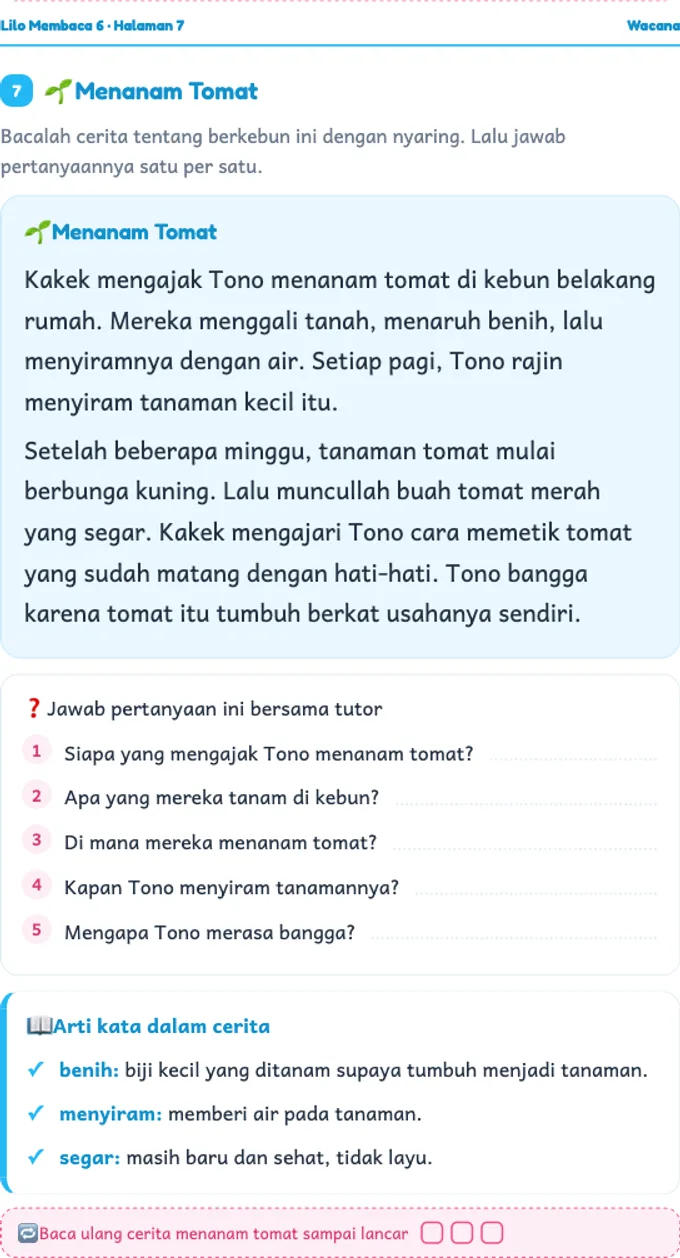
Grandma's Garden
That morning Tono went to the garden with Grandma. Grandma planted spinach and tomatoes. Tono watered the plants. They garden every Sunday. Tono is happy because Grandma's garden is thriving.
One of 18 short stories with its questions and word meanings. Your child reads the passage then answers 5W questions, building comprehension until they can retell it.
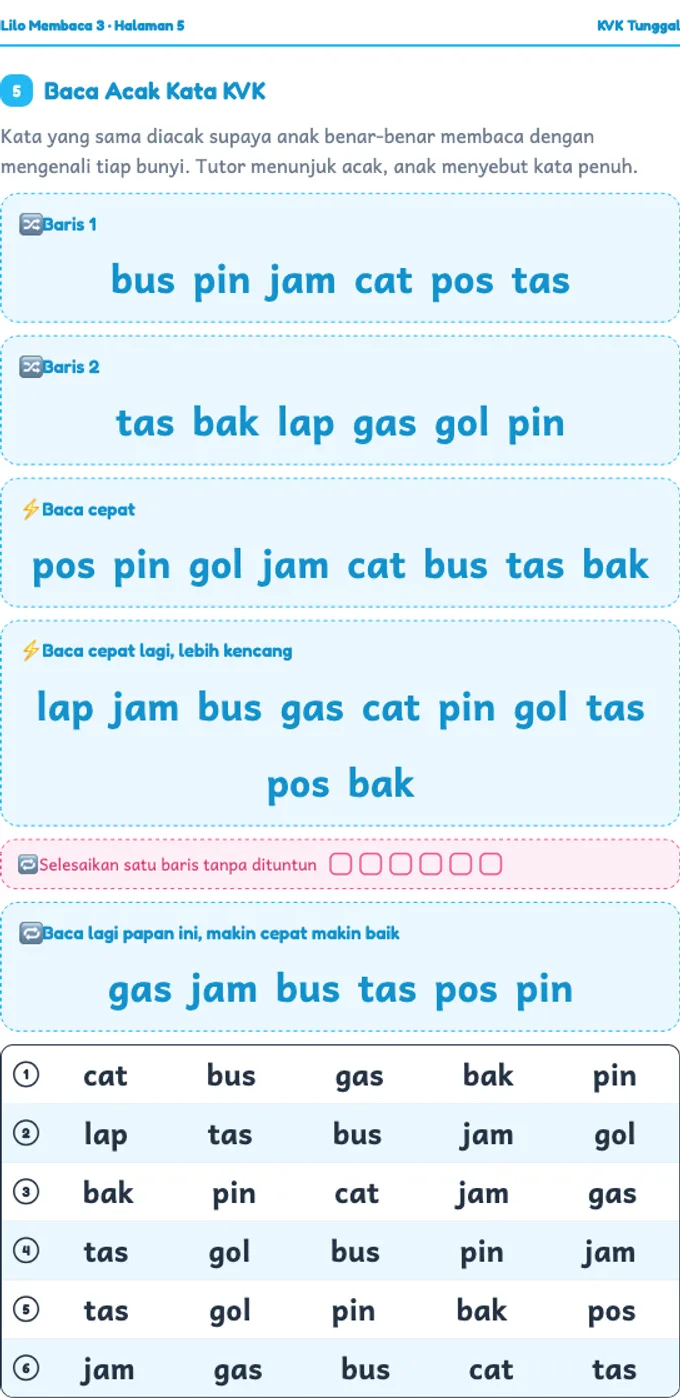
This Level 3 sheet challenges children to read a word grid quickly and repeatedly, with time recorded. Words such as tas end in a consonant, so children learn to notice the last letter while their reading grows smoother.
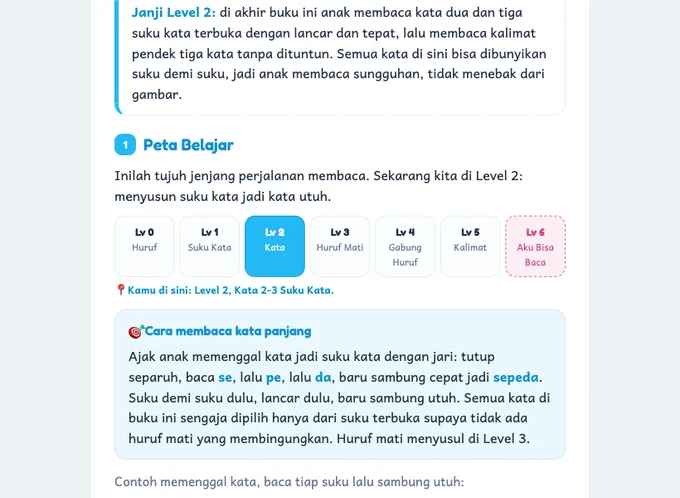
The seven-level map and how to break a word into syllables. The tutor models the whole syllable, your child joins them into a meaningful word without spelling out.
Samples from Lilo's original curriculum. The full A5 materials are prepared by the tutor at each session.
This profile follows a four-year-old in Padang who knows no letters yet. The child starts on the Starter package of four sessions a month, then moves up to the Regular package of eight once a learning rhythm takes hold.
Once a week your child plays sound-card games. The five vowel sounds grow familiar, and spotting objects that share a first sound, like sapu and sendok, becomes a favourite game.
Sounds like /m/, /b/, and /p/ arrive one at a time, and your child starts pairing each letter shape with its sound, leaving letter names aside.
Two sessions a week tighten the practice. Your child blends /m/ and /a/ into ma, then reads mama, kaki, and topi in one smooth breath.
The consonant set is complete, three-syllable words like sepatu appear, and Adi suka bola becomes the first sentence your child reads alone to the full stop.
Approaching age five, your child reads makan, ikan, and pintu. The twice-weekly rhythm keeps progress steady toward letter combinations at L4.
These months describe the general path for this profile. Your child moves up each time the stage before it is truly mastered.
Leaves in the yard, stones in the garden, and glasses on the dining table are all your child needs. Each activity trains one clear stage.
| Activity | Time | What you need |
|---|---|---|
First-sound hunt in the yardYour child collects three things, and you say the first sound of each Indonesian name: /d/ for daun, /b/ for batu. Your child then finds another object with the same first sound. Keep each sound short, with no extra e, just like L0 practice. | 5 minutes | leaves, stones, and twigs from the yard |
Stepping-stone syllablesWrite ba, bu, ma, mi, and ku on the stones. Your child hops across reading each one aloud, then joins two stones into buku or mama. Moving the body keeps a four-year-old happily practising L1 for longer. | 10 minutes | chalk and five flat stones |
The ng hunt in the gardenWrite bunga, pisang, kangkung, and singkong on slips. Your child reads each one, then finds the plant. Show how n and g melt into one new sound, practice that keeps L4 company. | 10 minutes | paper slips, a pencil, and garden plants |
Dining-table word labelsLabel gelas, sendok, garam, and ikan on the table. Before the meal, your child reads each label and places it beside the right object. Every word ends in a consonant, which suits L3 perfectly. | 10 minutes | sticky notes and a marker |
60/90/120 minutes
Contact us
choose 60, 90, or 120 minutes
Contact us
60, 90, or 120 minutes per session
Contact us
Padang is the capital of West Sumatra Province, a coastal city facing the Indian Ocean, with Padang Beach and the Batang Arau River among its best known landmarks. The city is widely respected for its surau learning tradition and its spirit of merantau, two legacies that place knowledge as a person's most valuable provision in life. Respect for knowledge and for teachers has long been part of everyday life here. Its districts stretch from Koto Tangah in the north to Lubuk Begalung and Padang Selatan in the south.
A Lilo teacher visits your home anywhere in our Padang service areas. Your child learns at a desk they know, in a setting that feels safe, and you can watch their progress up close at every session.
Online sessions run live on screen with a teacher, using the same curriculum as home lessons. This option suits a child in Padang who needs a more flexible schedule.
Your child begins by handling real objects, then moves to pictures, and later works with numbers and letters. Every stage follows a careful order, so each idea is fully grasped before the next one begins.
Families in Padang have several ways to help a child learn to read. Here is a fair look at how they differ.
A verified tutor, live and 1-on-1
The full session belongs to your child
Seven measured levels, advance on mastery
At your home, or online if you prefer
The tutor notices immediately and adjusts
The Regular package is the one most often chosen: eight sessions a month, roughly two a week, for IDR 604,782. That steady rhythm carries your child in Padang through the phonics codes from L0 toward L6, at home or online through app.lilo.id. Payment is made package by package, and a weekly report shows which sounds and words your child now reads with ease.
The tutor listens for the sounds your child knows and sets a starting code.
IDR 307,460Twice a week, the tutor guides your child in joining sounds into whole words.
IDR 604,782Three sessions a week let the tutor revisit halting passages until they flow.
IDR 891,965Six sessions a week, the tutor walks your child up several phonics codes in a row.
IDR 1,692,684At home or online, the same.
Just tell us, any time.
Here is how:
Plus a monthly progress report.
When you compare reading lessons in Padang, two things are easy to overlook: how well the method sits with your child's school, and the balance between play and desk time.
When the sequences at lessons and at school clash, a child feels unsure which to follow. Lilo builds from sounds to whole syllables and then sentences, and you can bring the reports along when you talk with the class teacher.
First grade entry requires no reading, writing, and arithmetic test under Permendikdasmen 3/2025, Article 11 paragraph 5, and selection is based on age. Good lessons build reading for your child's own sake, and Lilo aims for an independent reader at L6.
A four-year-old learns through movement and games, while a seven-year-old can stay with a reading sheet much longer. At Lilo, sound cards and syllable building sit beside numbered reading sheets, in a mix that follows your child's age.
Sheets gathered at random often skip stages your child has yet to secure. Lilo uses its own curriculum of 122 coded modules, and every worksheet comes from the module your child is currently studying.
The bond matters greatly for a young child still learning to trust adults outside the home. At Lilo, the tutor is replaced free of charge whenever your child is a poor fit, a service promise held firmly.
Our tutors travel to families across Padang, from Padang Barat and Padang Utara to Kuranji and Koto Tangah, so your child learns in the calmest place there is.
Every session is fully 1-on-1. The tutor sees exactly where your child hesitates, adjusts on the spot, and never has to split attention with anyone else.
Lilo wrote its own materials across all its programs. Your child's lessons follow a real, tested ladder instead of loose worksheets gathered from everywhere.
We teach the Singapore Math way, said simply: your child touches and sees an idea before meeting it on paper, so understanding comes before memorization.
Every tutor is verified before teaching, and instruction is available in English or Indonesian, whichever fits your family best.
Lilo Reading Classes made such a difference for my child. The method really works, and their reading has come on so much. We're so happy with it.
Alesha is the type of child who gets bored easily. Somehow with her Lilo tutor she stays engaged, she says learning feels like playing. Now she sounds out every bit of writing she sees on the street.

Chat with us on WhatsApp for a free consultation. We will listen to where your child is today and match a tutor who can come to your home in Padang and set the right level in the first lesson.
Free consultation, no obligation