

Ages 3 to 4: meeting sounds through play
Your child is at the very beginning. Songs, sound cards, and playful games introduce the sounds of letters gently, long before any formal reading is expected of them.
Lilo guides children aged 3 to 10 from their first letter sounds to whole passages, one clear level at a time, with little leveled books they can proudly read on their own.
Reading classes for kids in Palembang are guided lessons from Lilo where children aged 3 to 10 learn to read step by step, from letter sounds all the way to whole passages they understand. Every level comes with little books that use only the patterns your child has already mastered, so reading on their own feels like a win from the very first weeks.
Every child arrives at reading from a different place. A short placement assessment at the start tells us exactly where your child is, so lessons begin at the level that fits.
Your child is at the very beginning. Songs, sound cards, and playful games introduce the sounds of letters gently, long before any formal reading is expected of them.
Kindergarten years are the heart of the journey. Your child learns to blend sounds into syllables and simple words, building calm confidence before the first day of primary school.
Your child can read words and now works toward smooth sentences, natural intonation, and short passages they truly understand, ending in a proud reading graduation.
Some children reach school before reading clicks. The placement assessment finds the exact gap, and your child catches up quietly and kindly, with zero shame and steady wins.
The method is simple to explain and careful in practice: sounds before names, small steps before big books, and mastery before moving up. Here is how a Lilo journey unfolds.
Before the first lesson, a friendly assessment shows which of the seven levels fits your child today. Lessons then start exactly there, never too easy and never overwhelming.
Your child learns the sound each letter makes, like /m/ and /a/, and blends those sounds straight into syllables. Old-style letter-name spelling drills are left out entirely.
Short, steady practice built level by level builds real skill without tears. Each sheet gives a generous portion of practice at exactly the right difficulty.
At every level your child receives leveled readers that contain only patterns already learned. That means real books read alone, which is where reading confidence is truly born.
Every stage stands on the one before it, so the foundation has no gaps.
Behind every friendly lesson sits a curriculum built with real care: 122 original leveled modules, and a few signature choices that shape how your child experiences reading.
Every leveled reader contains only patterns your child has already mastered. So even a five-year-old can finish a real book independently, and that first solo book changes how a child sees themselves.
Children learn what each letter says before what it is called. Sounds like /m/ and /a/ blend directly into syllables, which makes reading feel logical from the very start.
Whole syllables become the natural reading unit, so words are read in smooth chunks. Two-syllable words arrive early and feel easy because the pieces are already familiar.
Combinations like ng, ny, and tr are where most children get stuck. Lilo treats this stage as the hardest one and slows down there on purpose, with extra practice and patience.
These seven rungs come directly from Lilo's own published modules, and your child climbs them one mastered step at a time.
Many well-meaning habits at home actually slow reading down. Here are the ones we see most often in new students, and what works instead.
Why it happensLetter names like 'em' and 'be' are extra baggage. A child who spells 'em-a' before saying 'ma' has to translate twice, and blending stalls.
How Lilo helpsTeach the sound each letter makes and blend sounds straight into syllables. In Lilo lessons, /m/ and /a/ become 'ma' in one smooth breath.
Why it happensA child can point at every letter and still be unable to read, because shapes alone carry no sound to blend. Reading starts in the ear.
How Lilo helpsPair every shape with its voice from day one, using songs, sound cards, and tracing until each letter speaks by itself.
Why it happensA book full of unlearned patterns turns reading into guessing. Repeated failure teaches a child that books mean frustration.
How Lilo helpsGive leveled readers that contain only mastered patterns. Your child finishes them alone, and each finished book funds courage for the next level.
Why it happensRepetition without play makes practice feel like punishment, and a bored child starts avoiding reading altogether.
How Lilo helpsKeep portions small, mix sheets with songs, games, and little books, and stop while it is still fun. Steady beats long every single day.
Why it happensLetter combinations are the most common sticking point in the whole journey. Rushed here, children stall for months without anyone knowing why.
How Lilo helpsSlow down on purpose. Lilo treats Level 4 as the hardest stage and gives it extra practice, extra patience, and extra celebration.
Readiness grows across several skills at once. Watch for these signs at home in Palembang; a child showing only some can already start at a fitting stage.
Palembang belongs to our Sumatra network: 200+ reading tutors. Some of them already live in Palembang.
Graduates and current students alike.
Every application reviewed
Our team reads every application.
ID card and diploma verified
The team checks identity and education.
Experience and hours recorded
We know when each tutor is free.
Trained in the Lilo method
Teaching starts after training.
Matching per child
Each candidate answer is reviewed.
Tutor not quite right? Free tutor replacement, here is how
The first session is a game with no written test, ending in a note that sets your child's starting rung.
A note like "vowels solid, /p/ and /b/ swapped" means the ear is ready and those two sounds need extra practice.
A note saying "blends well, still names letters" means the spelling habit must fade before your child moves up.
Your child reads numbered sheets from the easiest. The sheet where guessing begins marks the highest stage already mastered.
For example, "L2 fluent, L3 shaky, start L3", so the next session goes straight to words ending in a consonant.
Your child meets the sound of every letter through songs, sound cards, and tracing, so letters become familiar friends with voices instead of silent shapes.
Sounds join into open syllables and grow into words of two and three syllables, practiced until reading them feels smooth and natural.
The trickier building blocks of reading, from syllables that end in a consonant to combined sounds like ng and ny, taught patiently and in the right order.
Your child reads sentences of 4 to 10 words with punctuation and expression, so reading aloud starts to sound like natural talking.
Mini stories bring everything together. Your child answers who, what, when, where, and why, finds the main idea, and retells the story confidently.
These are real pages from Lilo's own curriculum, printed on friendly A5 sheets with generous practice portions. From first sound cards to a full passage with comprehension questions, this is exactly what your child will hold.
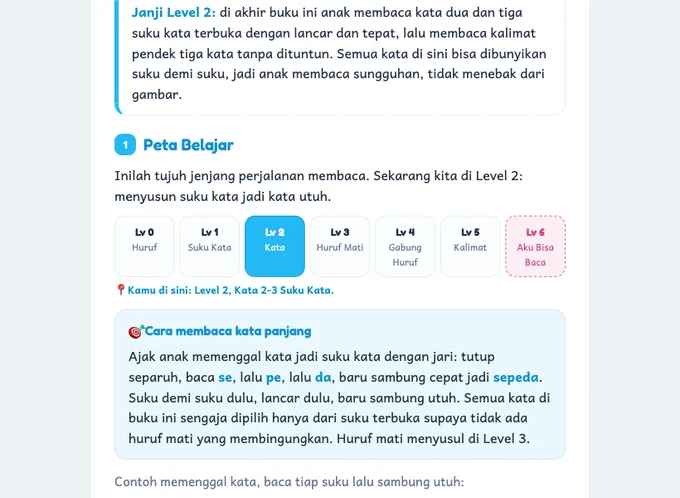
After the tutor demonstrates a whole syllable, the child assembles open syllables into everyday words like mama and bola. Each word is read as one complete unit, so meaning arrives quickly. A core exercise at Level 1.
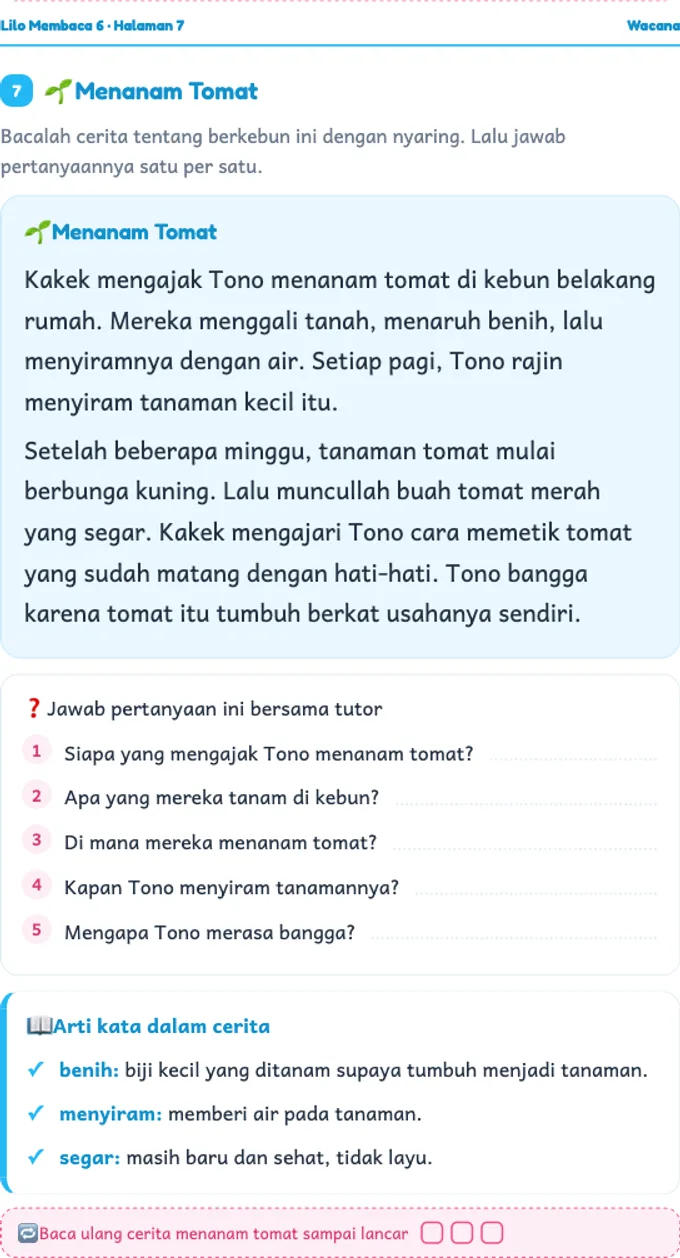
Grandma's Garden
That morning Tono went to the garden with Grandma. Grandma planted spinach and tomatoes. Tono watered the plants. They garden every Sunday. Tono is happy because Grandma's garden is thriving.
This sheet pairs a brief passage with who, what, where, when, and why questions. Children read to the end, answer each one, and retell the story in order. It is the peak of comprehension practice at Level 6.
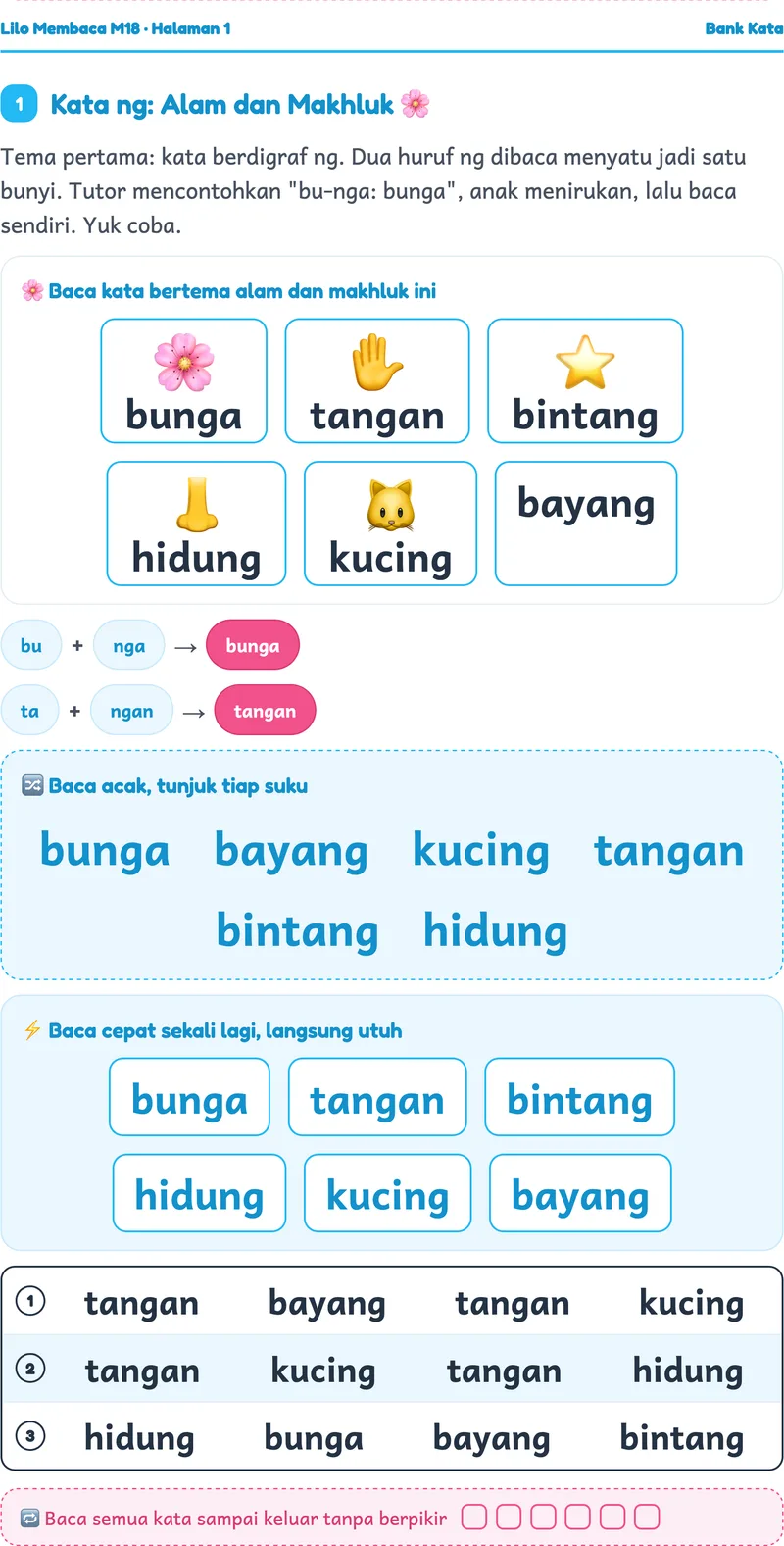
This Level 4 sheet from module 18 practices words with the letter pairs ng and ny. This stage is where children most often get stuck, so the exercises come with extra support to carry them through.
Every sheet belongs to Lilo's original leveled curriculum of 122 modules, with hearty practice portions that grow with each child.
Every misread word shows how your child is thinking, and the pattern of mistakes decides the tutor's next step.
While your child reads, the tutor writes the printed word beside the word your child said. Reading "ikan" as "ika" shows a child who has yet to close syllables, a typical L3 slip. Reading "nyamuk" as "n-yamuk" shows the pair ny split into two sounds, a sign that L4 needs more time.
Other slips come from the eyes. Reading "dola" for "bola" swaps b and d, mirror-image letters early readers often confuse, so the tutor adds a lip anchor for /b/. Reading "burung" for the printed "ayam" is guessing from the picture, so the tutor covers it and asks for the first sound.
The happiest mark is self-correction: your child reads "ruma", pauses, and fixes it to "rumah". That is checking by ear, the core habit of an independent reader, so tutors wait a moment before helping. A weekly report noting "ny still split, self-corrections rising" places your child at L4.
For a six-year-old who knows some letter sounds and starts primary school soon, three Intensive sessions a week settle about one stage a month.
Your child builds ma, bu, and ki from cards and reads bola and sapi without spelling.
Every consonant is known, and your child reads "ibu beli roti" with pride.
Ikan, rumah, and pasar are read whole, and kata and katak are told apart.
The hardest stage gets extra time until nyanyi, bunga, and khusus read smoothly.
Your child reads sentences of four to ten words, pausing at full stops and rising at questions.
Grade 1 admission uses age, with no reading, writing, or counting test, so your child starts school calm and moves on to L6 later.
Cardboard, potted plants, and pets at home make fine material, with each activity training one clear stage.
Write ba, ju, ku, and da on palm-sized cards. Your child pairs two into baju or kuda and reads them aloud. Trains L1.
old cardboard, scissors, marker
Write pandan, bayam, or jeruk and push each tag into its pot. Your child reads them while watering. Trains L3.
cardboard strips, ice cream sticks, marker
Make a name card for the cat, say Belang. Your child circles ng first, then reads the whole name. Trains L4.
cardboard, marker
Tape cardboard by the food bowl and write one sentence daily, like "Belang makan ikan." Your child reads it with expression. Trains L5.
large cardboard, marker, tape
Palembang is the capital of South Sumatra Province and one of the oldest cities in Indonesia, heir to the Srivijaya era when the city was a center of learning and trade. The Musi River divides the city into two banks, Ilir and Ulu, joined by the Ampera Bridge, a landmark its residents are proud of. Malay culture places family at the heart of daily life, giving Palembang a warm and familiar feel.
Lessons happen where your child already feels at ease. A Lilo teacher visits your home anywhere in Palembang's service areas, carrying structured materials and shaping every session around what your child needs.
Each new idea arrives in a clear order. Your child handles real objects, moves on to pictures, and then meets numbers and letters. Understanding sinks in, confidence builds, and practice turns into something your child looks forward to.
When you would like your child to learn from home with no teacher visiting, Lilo's online classes are live sessions where talk flows both ways. A teacher guides your child in real time, and worksheets get finished right at the desk.
60, 90, or 120 minutes
Contact us
60/90/120 minutes
Contact us
choose 60, 90, or 120 minutes
Contact us
Matching starts with your story about your child's reading stage, temperament, and preferred way of learning.
A free WhatsApp consultation opens the way: you share how far your child has come and which words cause pauses.
A shy child suits a patient, playful tutor, chosen from 5,000+ active tutors, many trained in early childhood or psychology.
Home lessons go to a tutor covering your area, like Kemuning or Plaju. Online classes run through app.lilo.id.
View the tutor's profile before the first session and introduce them to your child ahead of time.
There are many good ways for a child to meet reading. Here is a fair comparison so you can choose what fits your child best.
A verified tutor works with your child live and adjusts every lesson on the spot
Seven measured levels, and your child moves up only after mastering a stage
Leveled readers built so your child can read them alone from early on
Letter combinations get deliberate extra care and slower pacing
Clear level placement and progress you can follow sheet by sheet
Lilo picks your child's reading tutor from its Sumatra network, weighing where you live in Palembang and which phonics level your child has reached. Once matched, every session runs 1-on-1, at home or online, along the L0 to L6 phonics path. Payment is made one package at a time, with sessions priced at IDR 76,865 and up, and a progress report reaches you each week.
Once a week for a month builds the habit of opening a reader with a tutor.
IDR 307,460Twice a week leaves your child used to reading aloud every few days.
IDR 604,782Three sessions a week turn reading into a near daily routine, one level made solid.
IDR 891,965Six sessions a week make reading a daily habit your child looks forward to.
IDR 1,692,684Included in every lesson package.
We find a replacement for free. Request it whenever you need.
How it works:
Plus a monthly progress report.
Fair questions for any provider, showing how your child is treated after a slip or a tired moment.
| Question to ask | Why it matters |
|---|---|
What does the teacher do when my child misreads a word? | A short pause and a first-sound hint teach self-checking. Lilo tutors record each slip as a clue. |
Are my child's mistakes recorded and explained to me? | Error notes show whether your child stalls at consonant endings, letter pairs, or understanding. |
Who decides when my child moves up, and by what measure? | Moving up by calendar leaves gaps. At Lilo, your child moves up once a stage is solid. |
How does the teacher keep pressure healthy when my child tires? | A fair stretch helps a child grow. Lilo tutors end each session with a recap of what was mastered and one ten-minute task. |
What happens if my child and the teacher are a poor fit? | Temperament matters for shy children. Lilo replaces the tutor free of charge whenever the fit is wrong, as a firm promise. |
Leveled readers use only mastered patterns, so your child experiences the joy of finishing a real book independently early in the journey. That pride is what keeps children asking to read.
Lessons come from Lilo's own library of 122 original leveled modules, built on a concrete to pictures to symbols approach, the same way Singapore Math teaches understanding.
Your child advances only when a stage is truly solid. Gaps never pile up silently, and every new level rests on ground your child already stands firmly on.
Our tutors are verified and can teach at your home across Palembang, from Ilir Barat I and Kemuning to Plaju and Sako, or meet your child in an interactive online room.
Lessons can be delivered with English or Indonesian as the language of instruction, a natural fit for bilingual and national-plus families in Palembang.
Nadhira is getting fluent at sounding out syllables. What puts me at ease is that the lessons go step by step without pushing her. She actually looks forward to her lesson every week.
After classes here my child can now read fluently thanks to patient and professional guidance, and their confidence has grown too.

Tell us about your child in a free WhatsApp consultation. We will suggest a starting level, a schedule, and the learning mode that fits your family in Palembang.
Free consultation on WhatsApp