
Ages 3 to 4: meeting sounds through play
Your child is still far from books, and that is fine. At this stage the goal is simply to enjoy sounds, songs, and sound cards, so letters feel like friends long before school asks anything of them.
Your child starts with letter sounds, blends them into syllables and sentences, and finishes able to read a short passage and answer the 5W questions about it. Every step is guided by a tutor who checks real mastery.
Reading classes for kids in Pekanbaru are guided lessons from Lilo that take children aged 3 to 10 from their first letter sounds all the way to understanding a passage and answering who, what, when, where, and why. The journey follows 7 measured levels, opens with a placement assessment, and moves up only when your child has truly mastered a stage.
Every child arrives at reading from a different door. The placement assessment finds your child's door, and the levels take it from there.
Your child is still far from books, and that is fine. At this stage the goal is simply to enjoy sounds, songs, and sound cards, so letters feel like friends long before school asks anything of them.
Kindergarten years are the heart of the journey. Your child learns letter sounds, blends them into syllables, and builds first words and short sentences, arriving at primary school calm and prepared.
Your child can read but still stumbles or reads without expression. Here the work moves to longer sentences, punctuation, intonation, and finally short passages your child can retell in their own words.
Some children reach school age before reading clicks. The tutor meets your child exactly where they are, without shame or comparison, and rebuilds the steps quietly until reading feels normal again.
Pekanbaru, the capital of Riau Province, sits along the Siak River and ranks among the larger cities on the trans Sumatra road. Trade keeps it growing, while its Malay heritage runs deep, carried in a courteous and refined way of speaking that elders hand down to the young. Old quarters like Senapelan and Pasar Bawah remain a source of local pride. Here, Lilo welcomes every young learner in Pekanbaru. Your child can study in person with a teacher who visits your home, or take part in online lessons wherever you are.
A Lilo teacher travels to your house anywhere in Pekanbaru. Your child studies in familiar surroundings where they feel at ease, and you can see how they are doing after each lesson.
Each child begins at a point that matches what they can already do. Lessons climb in gentle steps, moving from real objects to pictures and then to symbols, so every idea settles firmly before the next one arrives.
If you would like your child to study at home without a teacher visiting, live online lessons with a teacher are ready. You choose the schedule together with us, so each session slots neatly into your child's day.
The method is simple to describe and careful in practice: sounds first, small steady steps, and no move upward until the current step is solid.
Before lessons begin, the tutor sits with your child to find their exact starting point. A child who already blends syllables should never repeat sound cards, and a beginner should never be rushed.
Your child learns the sound each letter makes, like /m/ and /a/, then blends those sounds straight into syllables. We skip letter-name spelling drills, because sounds are what actually turn into reading.
Each session adds a small, winnable portion, in a steady, levelled rhythm. Short daily repetition builds confidence gently, and your child ends every session having succeeded at something.
Your child climbs to the next level only after the current one is truly mastered. At the top levels, whole sentences grow into real comprehension: main ideas, retelling, and the 5W questions.
Reading readiness shows in simple things your child already does, long before letters appear. The same signs tell the tutor when your child has earned the next level code.
Pekanbaru belongs to our Sumatra network: 200+ early reading tutors. Online classes in Pekanbaru are always open.
Graduates and active students.
Application screening
Suitable applicants move forward.
ID card and diploma verified
Identity and diploma are matched.
Teaching profile completed
Teaching experience and hours are recorded.
Trained in the Lilo method
The step-by-step method is learned first.
Chosen for your child
The team scores every answer.
Want a different tutor? Free tutor replacement, here is how
The first session feels like play, with no written test. Behind the games, the tutor notes what your child already knows and settles on one level code as the starting point.
The tutor makes a sound and your child finds the matching card. This shows whether your child is still at L0 or already knows letter sounds well.
Your child arranges cards into ma, bo, or ku and reads them aloud. If that flows, the tutor moves on to whole words and closed syllables such as lampu.
Words such as nyanyi and bunga test readiness for L4. The tutor notes the exact letter where your child pauses, because that pause reveals the most.
A child who reads words comfortably gets a sentence and a short story, then retells it. This tells the tutor whether L5 or L6 fits best.
The level code set that day decides the module and worksheets for the sessions that follow.
Your child advances one stage at a time, with a check at every move.
The foundation: your child hears and says the sound of each letter, traces its shape, and plays with sound cards until every letter has a voice.
Sounds join hands here. Your child blends open syllables, builds words of 2 to 3 syllables, and practices timed reading to make blending feel effortless.
The trickiest patterns in reading, handled patiently: syllables with consonant endings, combined letters, clusters, and vowel pairs, each practiced until it feels ordinary.
Your child moves from single words to sentences of 4 to 10 words, learning punctuation, intonation, and rhythm, so reading aloud starts to sound like talking.
The destination of the whole journey: mini stories your child reads alone, then answers the 5W questions, names the main idea, and retells the story with confidence.
At L5, many children read words smoothly yet lose the meaning halfway through a long sentence. The answer lies in cutting the sentence into meaningful groups of words.
Reading word by word, a child holds each word in short term memory, which carries only a few items at once. In the sentence Kakak membawa payung biru ke sekolah karena langit mendung, the first words have faded by the time your child reaches the end. You hear it plainly: a flat, robotic voice, and silence when asked what it meant. The letter skills are fine; what needs training is the size of the piece your child holds.
A phrase is a group of words carrying one idea. That sentence splits into Kakak membawa / payung biru / ke sekolah / karena langit mendung. Four chunks are light to carry, and each one turns straight into a picture: a big brother, an umbrella, the walk to school, a grey sky. The pictures then link into one whole story.
In the sentence fluency module, the tutor first marks the chunks with light pencil slashes. Your child reads one chunk, pauses, then moves to the next. Later the marks are erased and your child learns to find the cuts alone, with commas as the first clue. The tutor also reads examples aloud at a natural pace, so your child's ear learns where a voice usually rests. This habit carries your child into L6.
These are the signatures we refuse to compromise on, built into every lesson your child receives in Pekanbaru.
A child who understands what they read has gained a skill for life; a child who only sounds out words has gained a party trick.
Your child learns what each letter says before what each letter is called. Sounds are the raw material of reading, so we start there and let the names follow naturally.
Sounds flow straight into syllables in one smooth motion. There is no detour through letter-name spelling drills, which is exactly the detour that leaves many children stuck.
Our leveled readers contain only the patterns your child has already learned. Every page is winnable, so your child finishes reading feeling capable instead of corrected.
Combinations like ng, ny, and tr are the hardest stage in the whole journey, so our curriculum slows down there on purpose, with extra practice and extra patience.
Seven rungs, one direction: from the first sound to a passage your child understands.
Most reading struggles come from well-meaning habits at home. Here are the ones we see most often, and what to do instead.
Why it happensReciting letter names forces your child to translate names into sounds before blending, and that extra step is exactly where many children stall.
How Lilo helpsPractice the sounds themselves, /m/ and /a/, and blend them straight into syllables. The names can come later, once reading already works.
Why it happensA child can name every letter on a poster and still be unable to read, because shapes alone carry no sound to blend.
How Lilo helpsPair every shape with its voice from day one. Sound cards and songs make this feel like play instead of study.
Why it happensA book full of patterns your child has never learned turns reading into guessing, and guessing turns into frustration.
How Lilo helpsUse leveled texts that contain only patterns already mastered. Each finished page then builds confidence for the next one.
Why it happensMonotony teaches a child that reading is a chore, and a child who dislikes reading practices less, which slows everything down.
How Lilo helpsKeep portions small and vary the format: cards, songs, timed sheets, mini stories. Short, playful, and daily beats long and dull.
These are real pages from Lilo's original curriculum, printed on generous A5 sheets: Letter Sound Cards from Level 0, Build a Syllable from Level 1, a Fast Reading Sheet from Level 3, and a Passage with 5W Comprehension from Level 6.
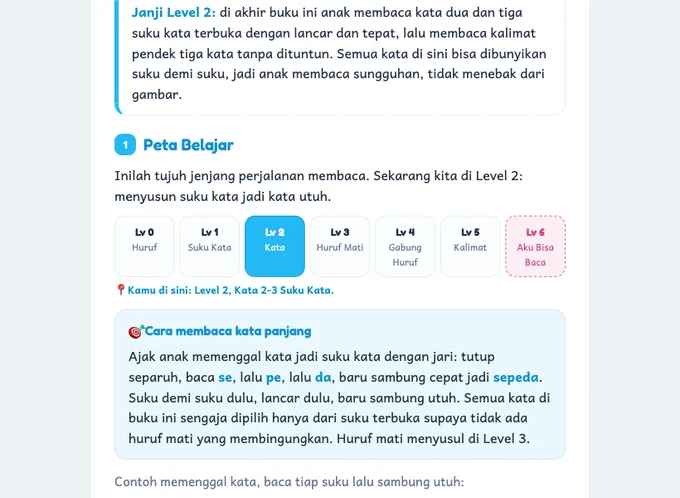
Children split and join open syllables, turning ma-ma into mama and bo-la into bola. The tutor models each whole syllable first, then the child blends them into a meaningful word, reading it straight through without spelling letter by letter. Level 1 practice.
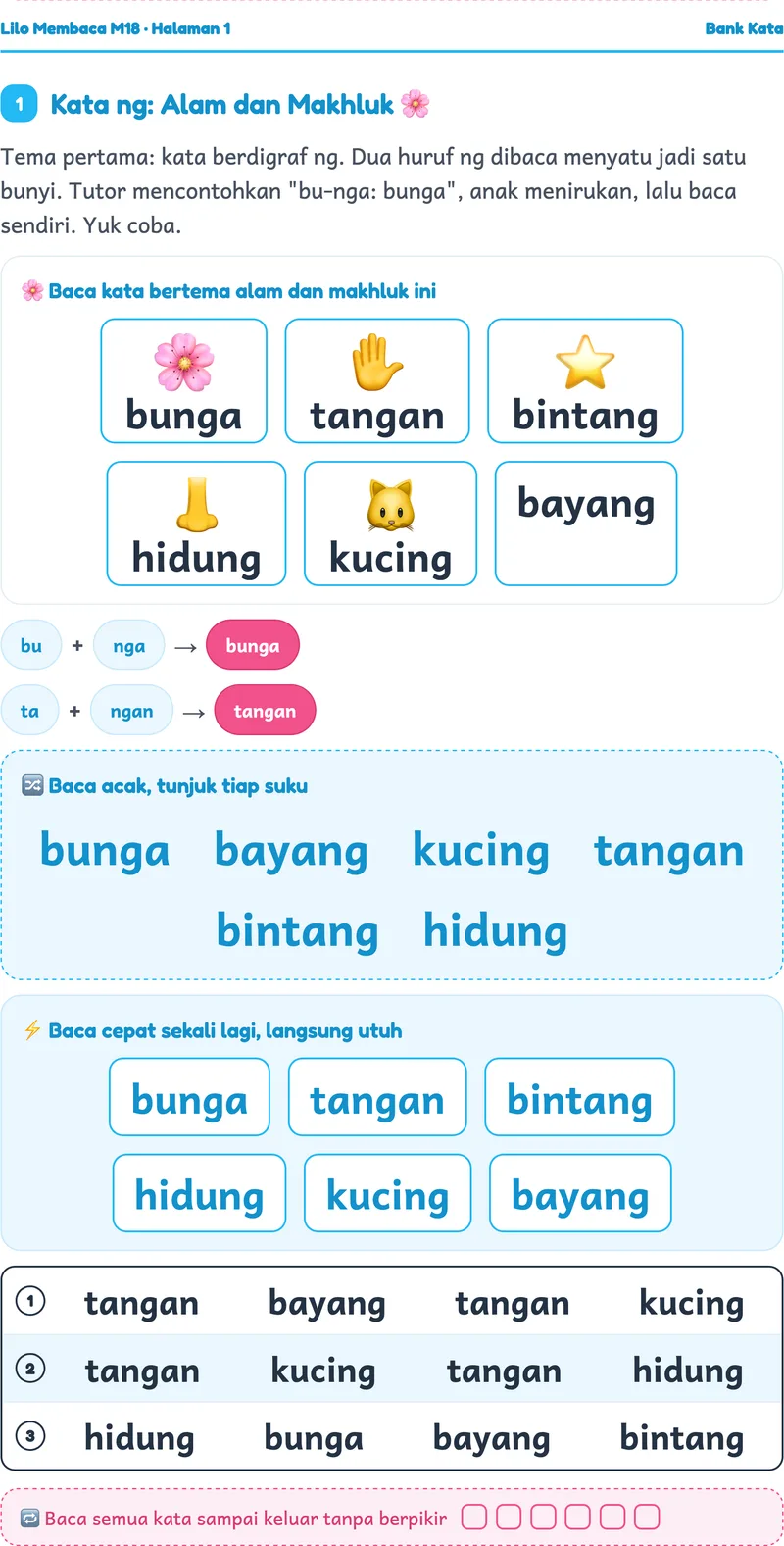
At Level 4, children meet words that combine the letters ng and ny through this module 18 sheet. Because this stage famously causes stumbles, we add extra support so every child gets past it with confidence.
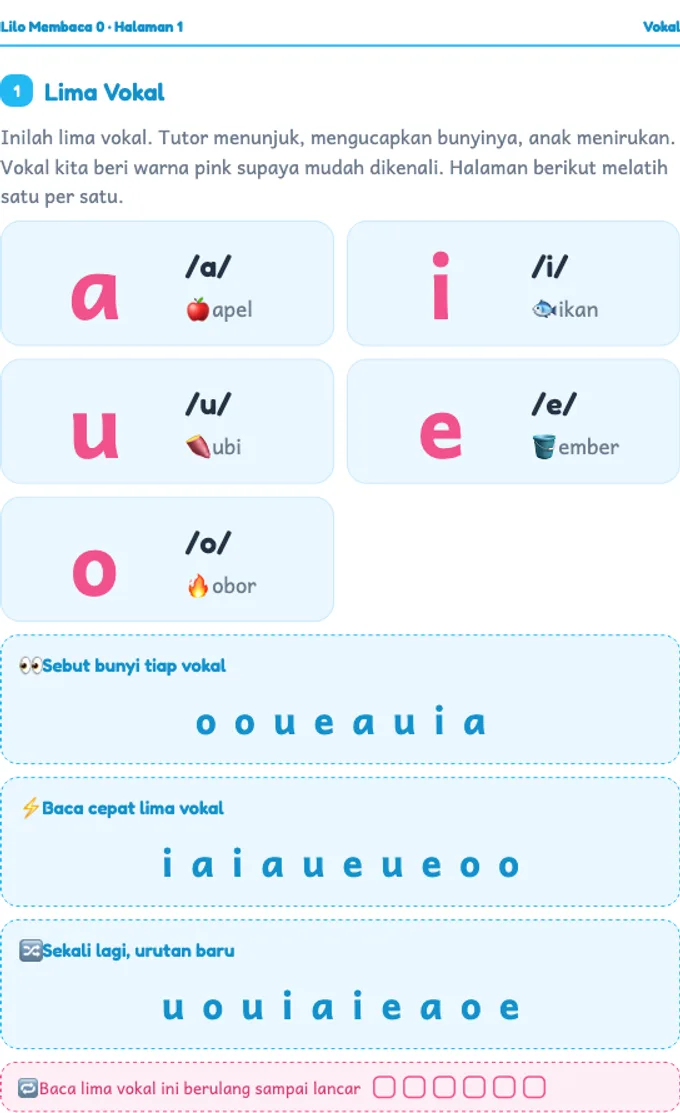
At Level 0, children meet letter sounds through simple cards: the vowels a i u e o and the consonants m, b, s. Each card is voiced again and again until it flows, then a quick reading drill locks it in.
All four sheets come from Lilo's own leveled curriculum, 122 modules packed with generous practice on every A5 page.
This picture fits a 3 year old meeting guided learning for the first time, on the Starter package of four sessions a month, roughly once a week. The pace is gentle and suited to the age.
Your child learns to sit and play with the tutor and sings the vowel sounds. This month builds joy in every session.
Your child points to a, i, u, e, o when each sound is called, then copies them during play between sessions.
Consonants arrive one at a time. Your child delights in finding the /m/ at the start of mama and makan.
Your child traces letter shapes with a finger while saying each sound, tying every shape firmly to its sound.
Close to age four, your child begins to blend two sounds into ma or pa in a single smooth breath.
The tutor raises the level code once a sound is secure. When your child is hungry for more, a fuller package can be chosen for the following month.
A calendar, a wall clock, and a stick of chalk are reading tools most homes already have. Each activity trains a clear level and extends the tutor's small task.
| Activity | Time | What you need |
|---|---|---|
Reading the day on the calendarEach morning, help your child find today's name on the calendar and read it syllable by syllable, se-nin or ka-mis. Good for L1 and L2, finished by crossing off yesterday. | 10 minutes | wall calendar and a pencil |
First sounds on the wall clockPoint to a number on the clock and say its first sound, /s/ for satu and /d/ for dua. A child at L0 repeats it with a clap, and the ear grows sharper. | 5 minutes | wall clock or desk clock |
Chalk syllable hopscotchWrite ka, ki, bu, and ku in big letters on the porch. Your child hops and sounds out each syllable, then joins two hops into kaki or buku. This builds L1. | 15 minutes | chalk and a porch floor |
Cutting a sentence with coloured chalkWrite a long sentence such as Adik menyiram bunga mawar di halaman setiap sore. Your child marks each meaningful chunk in colour, reads chunk by chunk, then reads it whole. Suits L5. | 10 minutes | small chalkboard and two chalk colours |
choose 60, 90, or 120 minutes
Contact us
60, 90, or 120 minutes per session
Contact us
duration of 60, 90, or 120 minutes
Contact us
A little preparation lets the first minutes of every session go straight to reading, whether the tutor comes to your home in Pekanbaru or your child joins online.
During the free WhatsApp consultation, mention your child's age, favourite books, and the words that trip them up. This helps the team match the right tutor.
You can view the tutor's profile before the first session. Mention the tutor's name to your child early, so the first visit feels like greeting a familiar friend.
Choose a low, well lit table away from the television. For online classes, print the worksheets sent through app.lilo.id and place the screen at your child's eye height.
Children read best when they are fed and wide awake. Keep the same slot each week so your child's body learns when it is time to read.
Families in Pekanbaru have several good paths to reading. Here is a fair look at how they differ.
7 named levels with mastery checks before each move up
A live tutor, in the same session it happens
Built in at the top levels: 5W questions, main idea, retelling
Placement assessment first, then lessons at the exact right level
Paper, cards, and a person at the table
Whichever phonics code your child is working on, anywhere from L0 through L6, becomes the starting point of each session, and the tutor guides them up one level at a time. Sessions start at IDR 76,865, and a single online session costs IDR 76,865. Payment covers a whole monthly package at once, and a reading progress report arrives every week.
Your child points at letters on signs and asks what sound they make.
IDR 307,460Your child reads short syllables and is ready to practise twice a week.
IDR 604,782Your child eagerly finishes reading books and asks for extra practice each week.
IDR 891,965Your child loves reading daily and is ready for a tutor almost every day.
IDR 1,692,684From the very first session.
We find a replacement for free. Request it whenever you need.
The steps:
Topped up by a monthly report.
Two things shape your child's reading path most: the order of the material and where the learning materials come from. Ask any provider in Pekanbaru these questions.
A written sequence shows where your child stands today and what comes next, so the hard stages stay protected. Lilo follows a ladder of seven codes, running from L0 to L6.
Materials written in house follow the teaching order, so each worksheet fits your child's stage. Every Lilo material grows out of Lilo's own 122 coded modules.
Unfamiliar sounds push a child into guessing. Texts built from mastered sounds give a win on every page, which is exactly how Lilo's numbered reading sheets are arranged.
Letter pairs are the most common sticking point, so they deserve their own practice time. At Lilo, the L4 stage receives extra care before your child moves on to sentences.
A clear ending helps your child remember the lesson and gives you something to build on. Lilo tutors recap what was mastered and set one small task of about ten minutes.
The program is built so your child ends able to read a passage and answer who, what, when, where, and why about it. Comprehension is the finish line, and every level points at it.
Lilo teaches from its own library of 122 leveled modules across its programs. Your child's reading materials were written for these exact levels, page by page.
We teach the Singapore Math way: real objects first, then pictures, then symbols. Applied to reading, ideas become touchable before they become abstract, so understanding comes before memorizing.
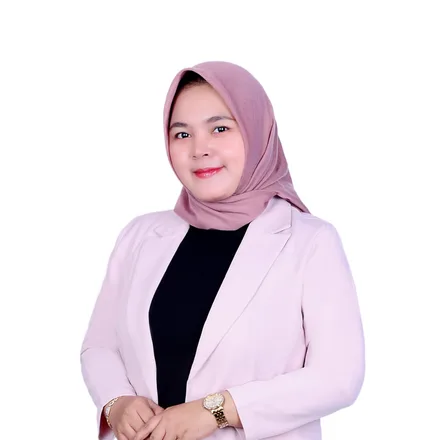
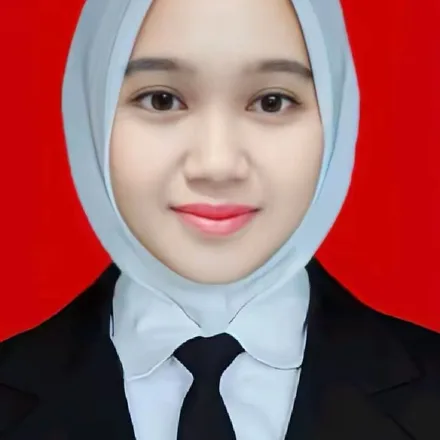
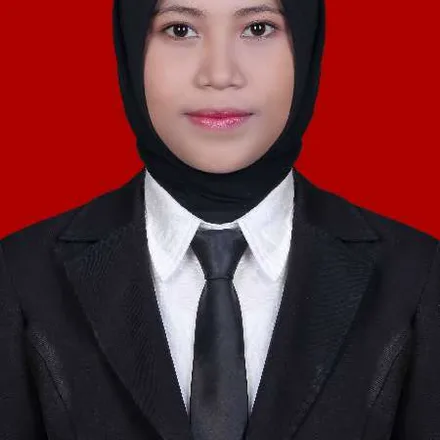
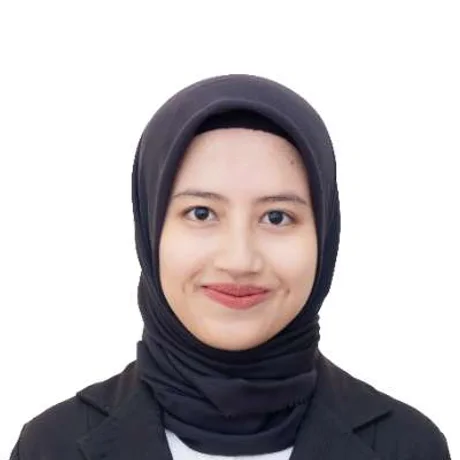
Our tutors are verified before they ever meet your child, and they teach at homes across Pekanbaru, from Sukajadi and Marpoyan Damai to Tampan and Rumbai.
Lessons can be delivered with English as the language of instruction, or in Indonesian, whichever fits your family. The reading method underneath stays exactly the same.
Alesha is the type of child who gets bored easily. Somehow with her Lilo tutor she stays engaged, she says learning feels like playing. Now she sounds out every bit of writing she sees on the street.
Reading classes at Lilo helped my child understand the content of a book really well. Their reading skills improved, very satisfying.

Message us on WhatsApp for a free consultation. We will listen to where your child is now, explain the placement assessment, and help you choose between home, online, or small group lessons.
Free consultation, no obligation