


Ages 3 to 4, Meeting Sounds Through Play
Before any reading begins, your child gets to know the sounds of language through songs, sound cards, and games. Everything happens through play, so curiosity grows long before the first syllable.
Your child begins with the sounds letters make, plays with sound cards and songs, then climbs seven clear levels until short stories feel easy. A Lilo tutor guides every step, at home or online.
Reading Classes for Kids in Semarang are guided lessons from Lilo that teach children aged 3 to 10 to read through letter sounds, sound cards, and playful games. A tutor works with your child at home, in a small group, or online, moving through seven levels that start at the first vowel sounds and end with reading short passages with real understanding.
Every child arrives at reading on their own timeline. The placement assessment finds the right starting point, so lessons feel doable from the very first session.
Before any reading begins, your child gets to know the sounds of language through songs, sound cards, and games. Everything happens through play, so curiosity grows long before the first syllable.
Kindergarten years are the sweet spot for learning to read. Your child blends sounds into syllables and simple words step by step, arriving at primary school calm and confident.
Your child already knows some reading and now works on longer sentences, punctuation, and understanding what a story says. Reading turns from effort into something they reach for on their own.
If your child is past the usual age and reading still feels hard, the tutor starts exactly where they are. Progress comes quietly and kindly, with zero shame and plenty of small wins.
Our lessons are built on a simple idea: children learn to read fastest when the sounds come first and the practice feels like play.
Your child learns the sound each letter makes, like /m/ and /a/, instead of reciting letter names. Knowing the sounds is what actually unlocks reading, and it starts with the five vowels.
Sound cards, songs, and short games turn each new sound into something your child can touch, sing, and win. Play keeps attention warm, so practice happens gladly instead of under protest.
Sounds flow directly into whole syllables, then into words. There are no spelling drills along the way, because naming letters one by one is exactly what makes many children stall.
Practice comes in small daily portions, steady practice built level by level. Your child moves to the next level only after truly mastering the current one, so confidence never cracks.
The teacher holds your child at one stage until the foundation is solid, then opens the next.
Your child meets the sounds of language through vowel and consonant work, plays with sound cards, and traces letters until sound and shape belong together.
Sounds join into open syllables, syllables join into words of two to three parts, and timed reading games make the blending quick and cheerful.
Your child tackles syllables that close with a consonant, then the trickier combinations, clusters, and double sounds, with patient repetition at the hardest points.
Reading grows from single words into sentences of 4 to 10 words, with punctuation, intonation, and rhythmic reading so it sounds like real speech.
Mini stories invite your child to answer who, what, when, where, and why, find the main idea, and retell the story in their own words.
Years of building our own leveled curriculum taught us where children soar and where they stumble. These signatures are our answer to both.
Every letter is introduced by the sound it makes, carried by sound cards and songs. Your child hears /m/ and /a/ and can slide them together, which is the true doorway into reading.
We skip letter-name spelling entirely. Sounds merge straight into whole syllables, so your child reads ma as one smooth piece instead of stopping to recite em then a.
Our leveled readers contain only patterns your child has already learned. That means every page can be finished without help, and finishing a page alone is the fuel confidence runs on.
Combinations like ng, ny, and tr are where most children get stuck. Our curriculum slows down here on purpose, with more games and gentler portions until the tricky sounds feel ordinary.
Each rung is a real stage in our own leveled modules, and your child steps up only after the current rung feels easy.
Most reading struggles are made at home with the best intentions. Knowing these few traps early can save your child months of frustration.
Why it happensLetter names are labels, and reciting them puts a wall between the child and the actual sound. Many children stall at blending for exactly this reason.
How Lilo helpsStart from sounds. When a child knows /m/ and /a/ as sounds, they slide together into ma naturally, with no spelling detour.
Why it happensRecognizing shapes feels like progress, so the gap hides until real words appear and nothing connects.
How Lilo helpsPair every letter shape with its sound from day one. Sound cards and tracing keep shape and sound glued together.
Why it happensA book full of patterns the child has never met turns reading into guessing, and guessing quickly turns into avoiding.
How Lilo helpsUse leveled texts that contain only patterns already mastered. Finishing a whole page alone is what builds the appetite for the next one.
Why it happensYoung children learn through play. Practice with no game in it drains attention, and a bored child stops absorbing anything.
How Lilo helpsKeep portions small and playful. Cards, songs, and tiny challenges deliver the same repetition wrapped in something a child wants to do.
Why it happensLetter combinations are genuinely the hardest stage of reading, so a struggle here is normal, expected, and temporary.
How Lilo helpsSlow down and shrink the steps. Our curriculum gives this stage extra care on purpose, and children come through it.
Reading one sheet three times can look like wasted effort. That repetition is exactly where fluency grows, and the reason is simple to see.
On a first reading of kuda itu lari ke kota, your child sounds out each syllable, holds it in mind, and blends. Decoding takes all their attention, so the meaning slips past. By the third reading, the words are recognised at a glance, and that freed attention turns to meaning and to an expressive voice.
Lilo tutors use numbered reading sheets built only from sounds your child has mastered. The tutor reads a sentence, your child echoes it, then reads alone two or three times: first for accurate sounds, then for shorter pauses, then for the lift of a question. Once a sheet runs smoothly, the next number comes out.
At home you can hear it happen. The finger stops tapping each word, pauses shrink, and the voice rises at a question mark. The weekly tutor report often names this, such as sheet seven now read whole without stopping. When your child asks for the same bedtime story again, say yes, because that is fluency practice they enjoy.
These are real A5 pages from Lilo's original curriculum, the same sheets your child will hold. Each one carries a generous portion of practice, from first sound cards to a full passage with questions.
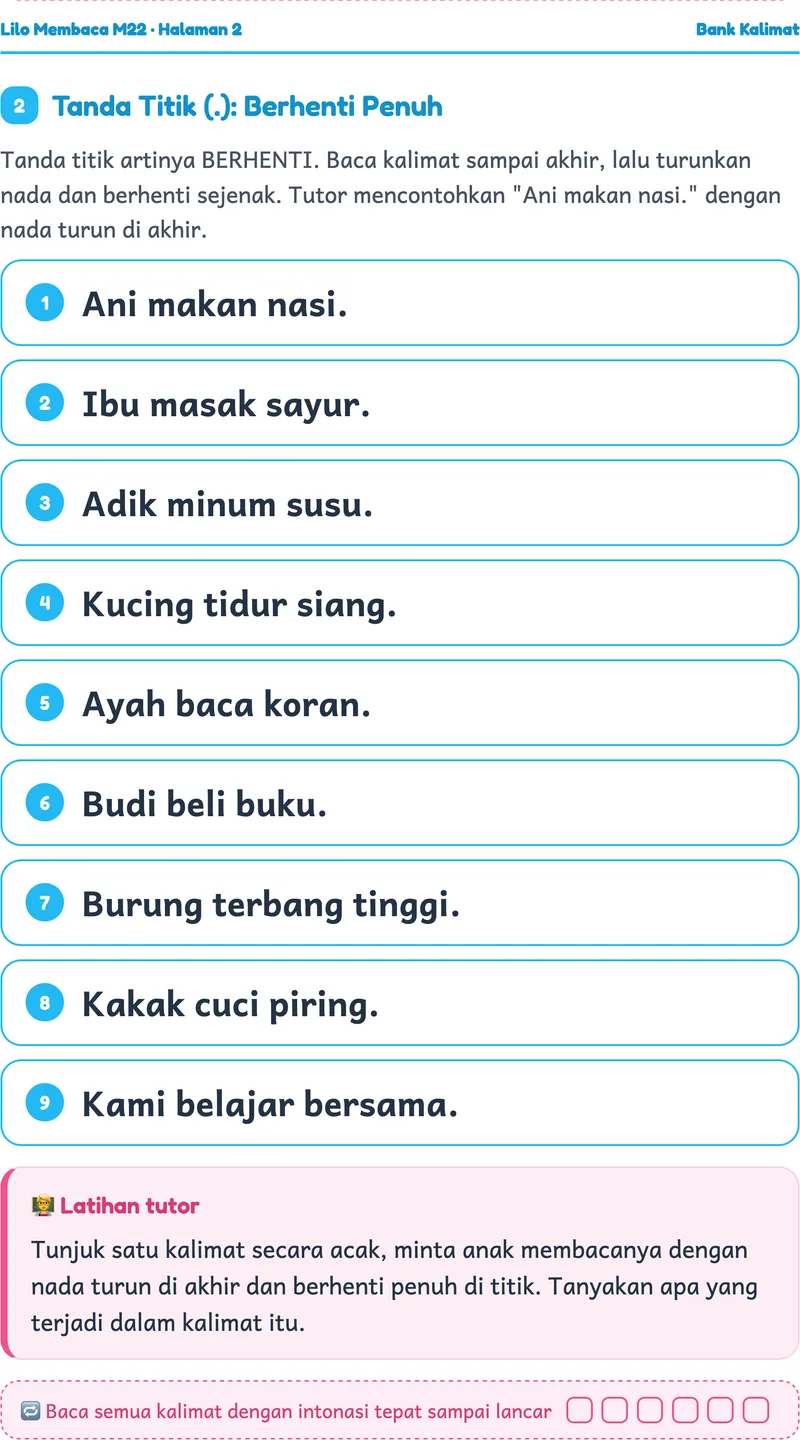
This Level 5 sheet from module 22 teaches children to come to a full stop at every period and to read sentences with lively expression. It works as a bridge toward smooth, fluent reading.
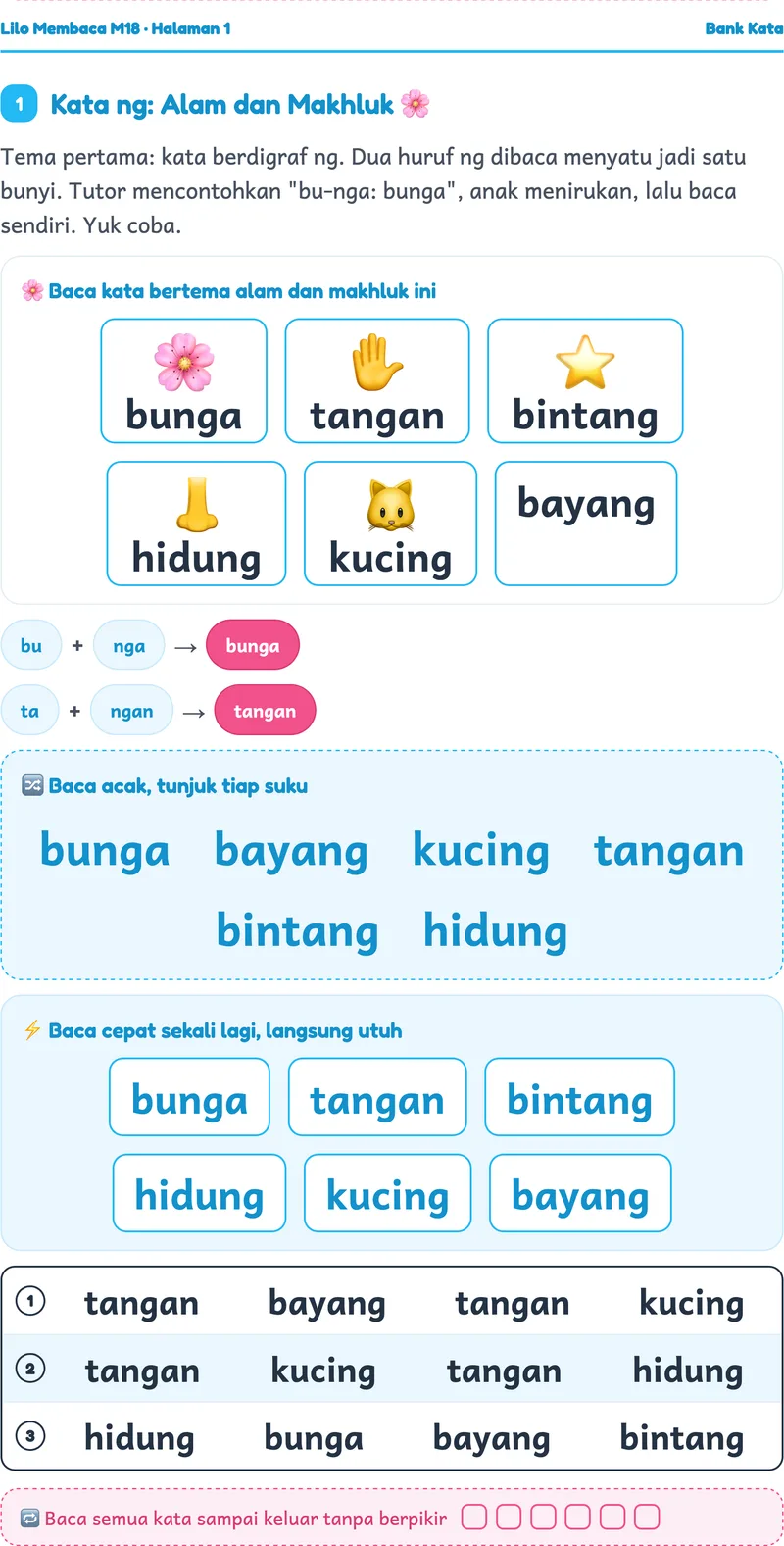
A real page from module 18: words with the ng and ny combinations, the stage where most children get stuck. Lilo gives extra care right here.
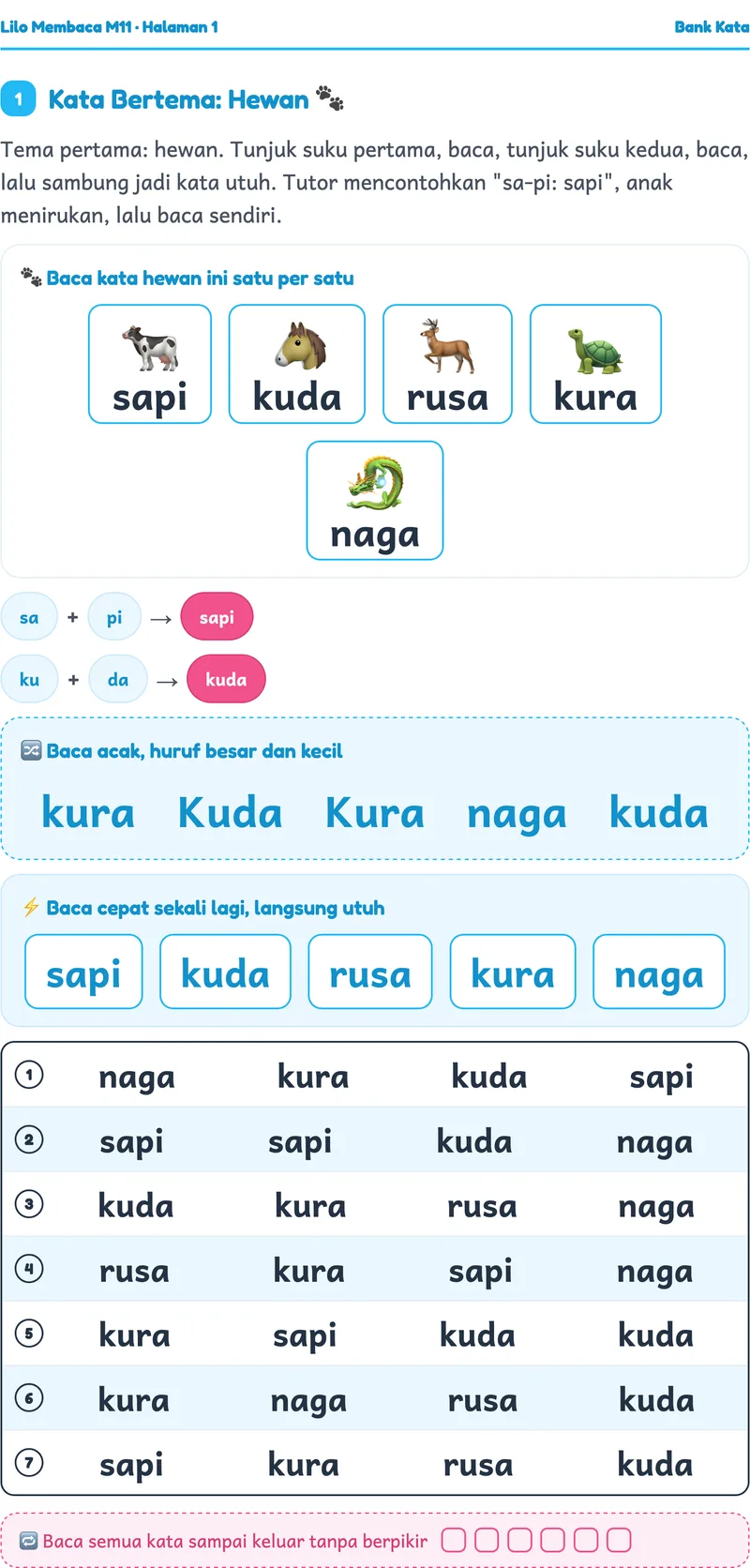
This Level 1 sheet from module 11 works on themed two-syllable words. Children point to each syllable, read it, then join the parts into a whole word, like sa-pi becoming sapi. A quick-read round wraps it up.
Every sheet belongs to Lilo's original leveled curriculum of 122 modules, with hearty practice portions that grow with each child.
The first session is play, with no written test. While your child plays, the tutor notes the level where reading starts to wobble, and lessons begin right there.
The tutor flips sound cards one at a time and your child says each sound, /m/ or /a/. Confident players move straight to the next game.
Cards b and u slide together and your child blends them into bu. This shows whether two-syllable words are already within reach.
Your child reads kapal and pintu from a numbered reading sheet while the tutor listens for whether the closing sound comes out whole.
Words like nyanyi and bunga appear on cards. A child who says ny and ng as single sounds is ready for short sentences.
This picture follows a five-year-old who starts with no letters, on the Regular package of 8 sessions a month, about two a week. Short gaps between lessons keep each new sound fresh.
Your child meets a, i, u, e, o and a few early consonants through sound cards and songs.
Sounds join into ma, bu, and ki, and your child reads first two-syllable words such as buku and mata.
The set of consonants fills out. Your child reads three-syllable words and short sentences like ibu beli roti.
Your child learns to close syllables and hear near pairs apart, such as batu and bantu, until the final sound rings clear.
The tutor adds practice at this hardest stage. Your child works on bunga, nyamuk, and khas until all three flow.
After L4, your child, now around six, continues into L5 and L6, from fluent sentences to understanding short stories alone.
Your home is full of free reading material. Pick one short game a day that fits your child's stage.
| Activity | Time | What you need |
|---|---|---|
Guess the dish by its first soundSay a first sound, like /t/, and your child finds the matching dish, tempe or tahu. It trains the ear at L0, before letters are needed. | 5 minutes | dishes on the dinner table |
Clap tonight's menuYour child claps once per syllable, na-si, so-to, sa-yur, then reads those syllables from a slip of paper you write. A good fit for L1. | 5 minutes | dish names and a slip of paper |
Hunt for ng and ny in the kitchenYour child finds ny in minyak and ng in goreng on the oil bottle, says each as one sound, and circles it with a finger. It strengthens L4. | 10 minutes | cooking oil bottle and spice sachets |
One label every breakfastChoose one short label and ask your child to read it at breakfast for a week. You will hear it grow smoother each day, ideal at L2 and L3. | 5 minutes | a milk or tea carton |
Readiness shows in small daily habits. Once lessons begin, similar signs tell the tutor when your child has finished a level.
Semarang and its surroundings have 450+ tutors for young readers.
Graduates and active students.
Applications screened
Role and city are checked first.
ID card and diploma verified
Identity and diploma are matched.
Teaching profile completed
We know when each tutor is free.
Trained before teaching
Teaching starts after training.
Matched to your child
Questions come from the child’s needs.
Tutor not quite right? See our free tutor replacement promise
duration of 60, 90, or 120 minutes
Contact us
60, 90, or 120 minutes
Contact us
60/90/120 minutes
Contact us
Matching starts with what you share about your child. The team then picks a tutor who fits the reading stage, your area, and your preferred format.
The consultation is free. Share your child's age, what they know about letters, and whether home visits or online classes suit you better.
Lilo has 5,000+ active tutors, many from primary teaching, early childhood, psychology, and mathematics programmes. The team picks one who reaches your part of Semarang.
You can view the tutor's profile before the first session, so you and your child already know who is coming to read together.
Your child plays sound games with the tutor, and you can see early on whether the two of them settle in comfortably.
If the match does not click, Lilo replaces the tutor free of charge. That is a firm service promise.
Families in Semarang have several ways to help a child read. Here is a fair side-by-side, so you can choose with clear eyes.
A verified tutor, live and responsive, at home or online
Seven levels with a placement assessment and mastery checks
The tutor hears the exact sound that slipped and fixes it right away
Leveled readers built from patterns the child has already mastered
Cards, worksheets, and books at a real table
In the first week, your child meets the tutor and the opening sounds of phonics level L0, at home or in an online class. Payment is made by monthly package, with sessions priced from IDR 76,865 each. Every week after that you receive a note on which reading stages are now fluent and which still need another round.
The lightest package, once a week to meet the tutor and first sounds.
IDR 307,460Twice as frequent as Trial, so new sounds get repeated before they fade.
IDR 604,782One more meeting each week than Regular, useful for climbing several phonics levels.
IDR 891,965Double the Intensive pace, reading with the tutor almost daily until stories flow.
IDR 1,692,684Written into the Lilo Terms of Service.
Just tell us, any time.
How it works:
And a progress report every month.
Lilo teaches from its own library of 122 leveled modules built across our programs. Your child follows a path that was designed as one whole journey, from first sounds to first stories.
New ideas arrive as things your child can touch, then as pictures, then as letters on a page. It is the Singapore Math way of teaching, applied gently to reading.
Sound cards, songs, and timed reading games are woven into the curriculum itself. The play is the practice, so your child looks forward to lessons instead of dreading them.
Every Lilo tutor is verified before teaching. Instruction is available in Indonesian or English, a natural fit for bilingual and national-plus families in Semarang.
In-person tutors travel to homes across Semarang, from Banyumanik and Tembalang to Ngaliyan and Pedurungan. If online suits your family better, the same curriculum runs through live interactive sessions.
Semarang is the capital of Central Java Province and ranks among the oldest port cities along Java's northern coast. People call it Kota Atlas with pride. The old Kota Lama quarter keeps its history close, and the busy Simpang Lima square beats at the centre of city life. The land rises from coastal lowlands up to the Gombel hills, so Semarang has a shape and character of its own. Because the Central Java government sits here, the city holds a long and respected tradition of learning. Lilo is ready for your child in Semarang. A teacher can visit your home for face to face lessons, or your child can join lively classes online.
Your child learns at home with an experienced teacher. Our teachers visit service areas across Semarang on a schedule you choose, so your child can learn in comfort and stay focused.
Your child begins with real objects to touch and hold, moves on to pictures, and then meets letters and numbers. Each step builds on the last, so ideas truly settle in, confidence grows, and daily practice feels like fun.
If learning at home on a screen suits your child best, live online classes are ready. Your child keeps one on one guidance, works on the same worksheets, and you receive progress reports at regular times.
Two things are easy to overlook: where the materials come from, and how heavy the homework is. These questions work with any provider.
| Question to ask | Why it matters |
|---|---|
Are the reading materials written in-house or taken from general books? | Materials built in steps let your child meet only sounds already learned, so success comes often. Lilo teaches from its own curriculum of 122 coded modules. |
Do the take-home worksheets match what was covered in the session? | Worksheets that follow the lesson make home practice feel familiar. At Lilo, every worksheet comes from the module currently in progress, so its content is already known. |
How much homework is there, and what is it for? | Long assignments tire young children quickly, while one short task with a clear aim keeps them keen. Each Lilo session ends with a recap of what was mastered and one small task of about ten minutes. |
Will my child learn letter sounds or letter names first? | A child who knows sounds can blend /b/ and /u/ into bu straight away. Lilo tutors always begin with sounds and join them into whole syllables. |
How long is a session, and can it fit my child's attention span? | A four-year-old and a seven-year-old focus for different stretches. Lilo offers sessions of 60, 90, or 120 minutes, and the tutor weaves play into each one. |
Keira now loves pointing at shop signs and sounding them out slowly. Her tutor is so patient, and there is a report after every session so I always know how far along she is.
Nadhira is getting fluent at sounding out syllables. What puts me at ease is that the lessons go step by step without pushing her. She actually looks forward to her lesson every week.

Tell us about your child in a free WhatsApp consultation. We will suggest a starting level and the service that fits your family, at home in Semarang or online.
Lessons start at your child's real reading level