



Little Explorers (Ages 3 to 4)
Your child meets sounds through songs, cards, and play. Sessions feel like games, so the first steps toward reading are joyful and pressure free. Listening games build the ear that reading will later need.
A tutor guides your child from first letter sounds to reading whole stories, through seven measured levels. Choose lessons at your home in Solo or live online sessions, whichever fits your family best.
Reading classes for kids in Solo are guided lessons from Lilo that teach children aged 3 to 10 to read, at home with a visiting tutor or live online. Your child starts with letter sounds, blends them into syllables and words, and climbs seven clear levels until short passages feel easy. A placement assessment finds the right starting point.
Every child arrives at reading in their own time. We meet yours exactly where they are, whether that is playing with first sounds or building steady, confident fluency.
Your child meets sounds through songs, cards, and play. Sessions feel like games, so the first steps toward reading are joyful and pressure free. Listening games build the ear that reading will later need.
Before primary school begins, your child learns to blend letter sounds into syllables and simple words. They walk into first grade already comfortable and curious about the printed page.
Your child can read a little and now needs smoothness. We work on longer sentences, tricky letter combinations, punctuation, and understanding, so reading turns from effort into enjoyment.
If reading came late, your child joins at the level that truly fits, moves at their own pace, and gains confidence without shame or comparison to classmates.
60, 90, or 120 minutes per session
Contact us
duration of 60, 90, or 120 minutes
Contact us
60, 90, or 120 minutes
Contact us
Our method follows a simple promise: sounds before names, small steps before big leaps, and mastery before moving on. Each session builds quietly on the last.
Your child learns what each letter says, like /m/ and /a/, through songs and sound cards. Knowing the sounds makes blending feel natural later, so we skip letter-name spelling drills entirely.
Sounds flow straight into syllables, then into two and three syllable words. Because every piece is already familiar, reading a new word feels like solving a small, winnable puzzle.
At the upper levels your child reads full sentences with expression, then short passages with real understanding, answering who, what, when, where, and why about what they read.
Steady practice built level by level, served in small daily portions, keeps skills fresh without tiring your child. They move up only after truly mastering each stage.
Young children show what they truly know when they feel they are playing. So the first session is a set of games, and the tutor reads your child's level from them.
A four or five year old still grips a pencil with effort. An exam mood makes them tense, and nerves easily hide what they know about sounds.
The tutor names objects around the table and your child finds the opening sound. A child who quickly answers /m/ for meja already holds the core of L0, letter sounds.
Sound cards are built into syllables, then short words. The word where your child starts to stumble shows whether they begin at L1 open syllables, L2 words or L3 closing consonants.
A child who already reads gets a short story and a few pictures in sequence. How they retell it shows readiness for L5 sentences or L6 passages.
Even grade 1 entry asks for no reading, writing or counting test under the 2025 new student admission rules, since age decides selection.
The pace of moving up follows your child, so learning stays calm.
The foundation stage. Your child sings, listens, and traces while learning vowel and consonant sounds with sound cards, building an ear for language before formal reading begins.
Familiar sounds join into open syllables, then into words of two and three syllables. Gentle timed reading rounds help your child read smoothly without rushing.
The trickiest patterns, handled patiently. Syllables with consonant endings, paired letters like ng and ny, clusters like tr, and vowel pairs like ai each get careful practice.
Your child reads sentences of 4-10 words with correct pauses and expression. Punctuation, intonation, and rhythmic reading turn word-by-word effort into flowing, confident sentences.
Mini stories with questions about who, what, when, where, and why. Your child finds the main idea and retells stories in their own words, proof of real understanding.
These lessons come from Lilo's own curriculum of 122 leveled modules, refined so every child moves along the same trusted path, at home or online.
Your child learns what letters say before what they are called. Blending /m/ and /a/ into 'ma' happens naturally, free of the spelling drills that slow so many young readers down.
Sounds merge directly into whole syllables, and syllables into words. Each new word becomes a small victory your child earns on their own, and those victories add up fast.
Our leveled readers contain only patterns your child has already mastered. Every page is readable without help, which builds the quiet confidence that keeps children coming back for more.
Combinations like ng, ny, and tr trip up more children than any other stage. We slow down here on purpose, with extra practice and patience, so Level 4 becomes a proud milestone.
Seven steps, each one earned before the next begins.
Most reading struggles trace back to a handful of well-meant habits. Knowing them early saves months of frustration for you and your child.
Why it happensSaying 'bee-ay, ba' forces the child to translate names into sounds every single time, which stalls blending and makes reading feel like a code with two locks.
How Lilo helpsTeach the sound each letter makes and blend sounds directly. In our lessons, /b/ and /a/ become 'ba' in one natural step.
Why it happensA child can name every letter on a poster and still freeze at a new word, because shapes alone carry no sound to blend.
How Lilo helpsPair every shape with its sound from day one, using sound cards and songs until the connection is automatic.
Why it happensA book full of unlearned patterns turns reading into guessing, and repeated guessing quietly teaches a child that reading is scary.
How Lilo helpsFollow leveled readers that contain only patterns already mastered, so every book your child opens is a book they can win.
Why it happensChildren learn through joy and variety. Monotonous repetition makes even a capable child dread the reading table.
How Lilo helpsKeep portions small and vary the activity: a song, a card game, a timed round, a story. Short and lively wins over long and dull.
Why it happensThese combinations are the most common sticking point in the whole reading journey, and rushing them leaves gaps that surface for years.
How Lilo helpsTreat this stage as the one that deserves the most patience. We plan extra practice at Level 4 deliberately.
Before reading sentences smoothly, your child can already train half of reading comprehension with a picture book that has no words. Here is how it works.
Understanding a text rests on two abilities. The first turns print into sounds, which is the work of L0 to L4. The second is understanding language itself: putting events in order, seeing cause and effect, and guessing how a character feels. This second ability grows through the ears and eyes long before a child can read, so a wordless picture story can train it today.
Picture three panels. A kitten sits beside a glass of milk, then the glass tips over, then the kitten laps milk from the floor. A beginner names the objects: kitten, glass, milk. A few weeks later the same child says the kitten knocked the glass and the milk spilled. That sentence holds something the pictures never show, namely who caused it. Inferring the unseen is the heart of passage comprehension.
The tutor guides with open questions. They point at the kitten's face and ask how it feels, or cover the last panel and ask what comes next. Then, because and finally are modelled again and again until your child uses them unprompted. At home you can hear stories grow longer and hold their order. By L6, your child already knows how stories work, so their energy goes into the reading.
These pages come straight from the modules your child will use: A5 sheets with generous practice portions, from first sound cards to a full passage with comprehension questions. Have a look before you decide.
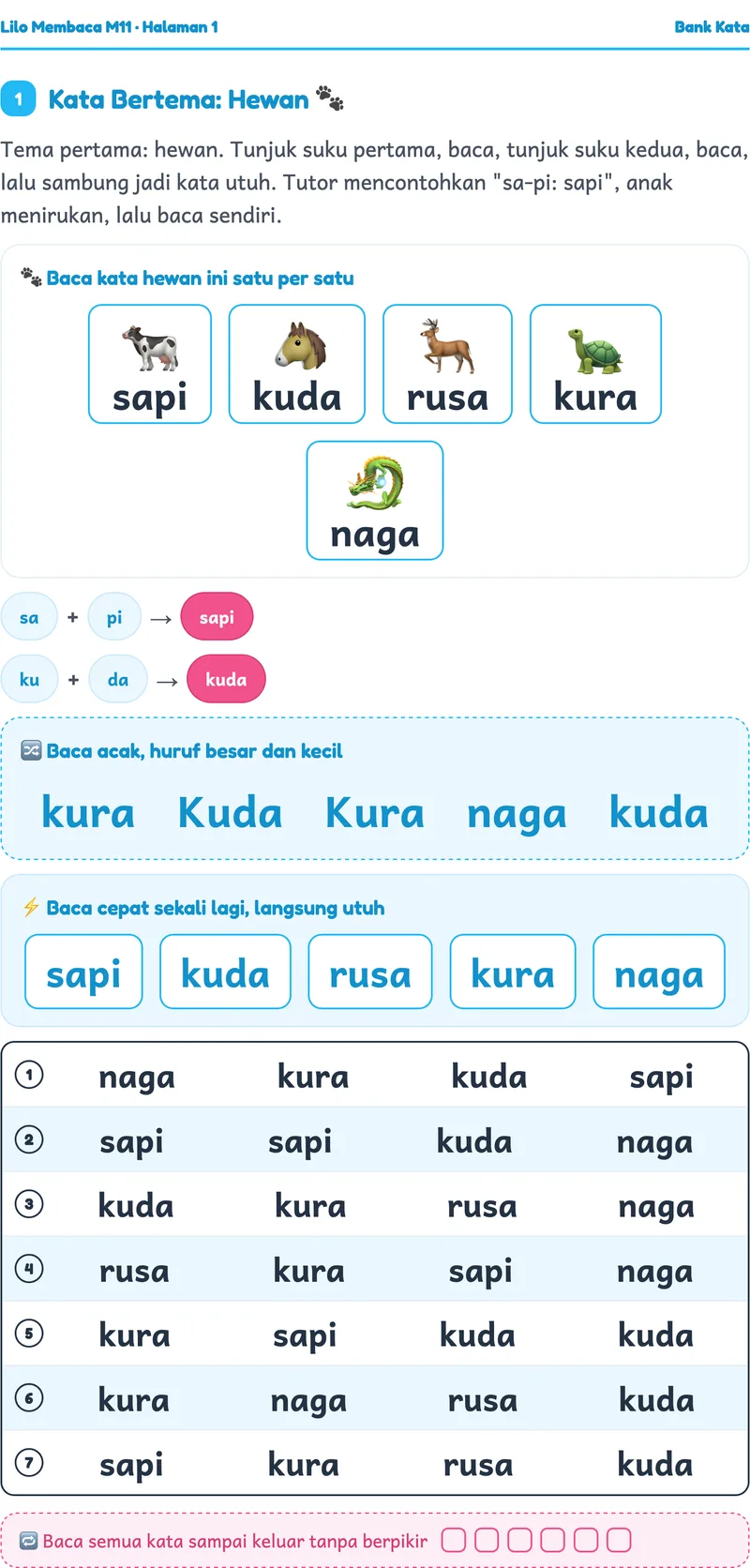
This Level 1 sheet from module 11 works on themed two-syllable words. Children point to each syllable, read it, then join the parts into a whole word, like sa-pi becoming sapi. A quick-read round wraps it up.
Grandma's Garden
That morning Tono went to the garden with Grandma. Grandma planted spinach and tomatoes. Tono watered the plants. They garden every Sunday. Tono is happy because Grandma's garden is thriving.
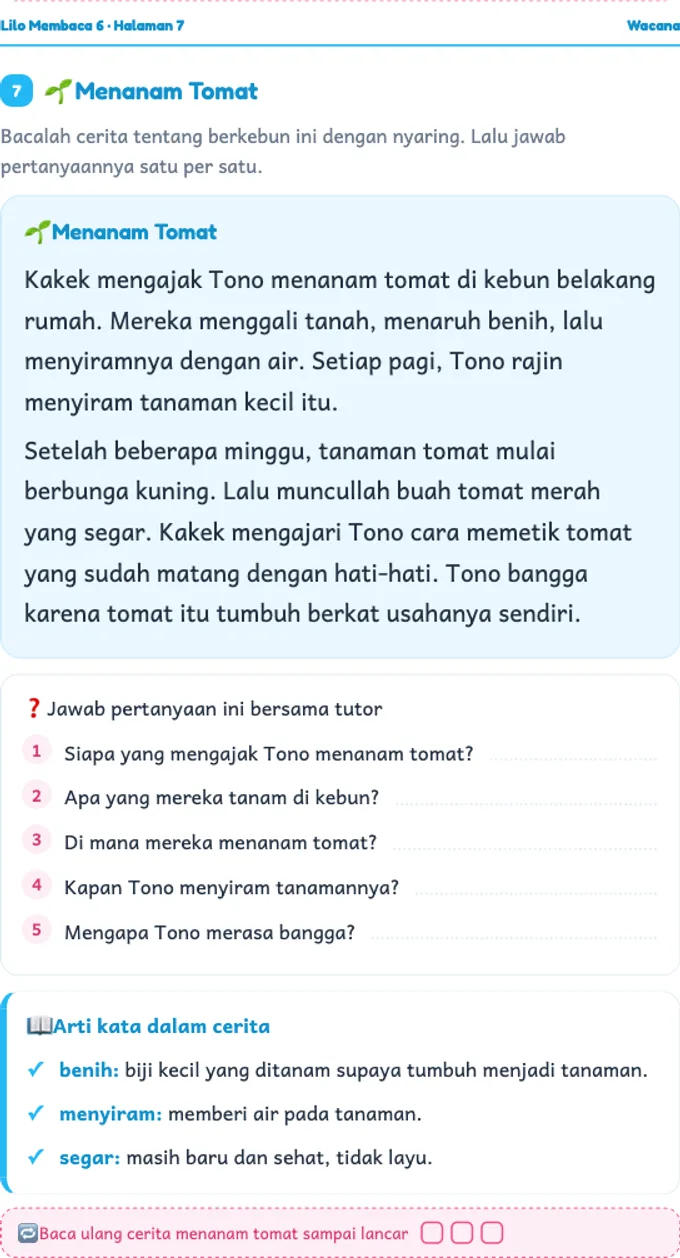
One of 18 short stories with its questions and word meanings. Your child reads the passage then answers 5W questions, building comprehension until they can retell it.
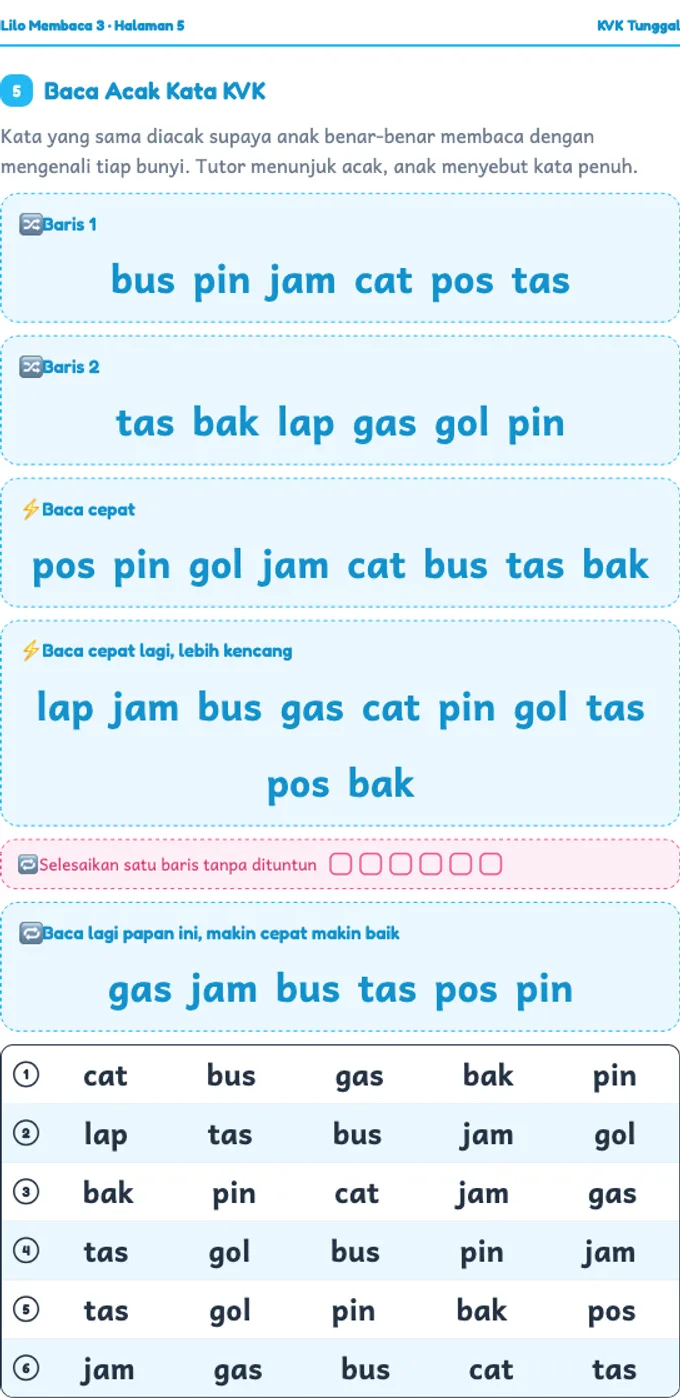
A grid of short words that children read again and again against the clock. Some words end in a consonant, like tas, so the exercise sharpens attention to final letters while building smooth, confident reading. Level 3 practice.
Every sheet belongs to Lilo's original leveled curriculum of 122 modules, with hearty practice portions that grow with each child.
Solo, whose official name is Surakarta, sits in Central Java Province and is known as the home of two royal courts: the Kasunanan Palace and the Mangkunegaran Palace. People admire the city for its gentle manners, for batik that is loved around the world, and for good courtesy handed from parents to children over many generations. Solo takes pride in patience, in respect for a slow process, and in work done with care. Children learn well in that same spirit, a little at a time. Lilo teaches young learners across Solo, from Laweyan to Pasar Kliwon, through home visits by a tutor and live online classes. Each child gets kind, clear guidance at every step.
Your child studies in the place they know best, right at home. The tutor comes at a time you pick, carries lesson materials that follow a clear plan, and leads your child through each step anywhere in Lilo's Solo service areas.
Lessons build in levels, starting from the first basics. Your child goes on to the next level once each one makes real sense to them. Each small success gets praise, so self belief rises as skills grow.
Sessions are short, focused, and full of encouragement. Your child practices with engaging worksheets, and you receive regular progress reports so improvement stays clear and easy to follow.
These two things shape a young child's reading lessons most. Put the five questions below to any tutoring provider in Solo.
A four or five year old stays with a screen more easily when sessions feel lively and well paced. A choice of lengths lets you start gently. Lilo sessions run 60, 90 or 120 minutes.
Young children understand letters through paper they can point at and mark. Lilo sends worksheets from the module in progress before each class.
A misread word points to a sound that is still shaky. A good teacher points back at the letter, voices its sound and gives your child another try. Lilo texts use only sounds already mastered, so every slip is easy to trace.
Hearing wrong too often makes a young reader give up. Lilo tutors close each session by summing up what your child has mastered, so every lesson ends on a feeling of can do.
The bond with a teacher shapes how bravely a child reads aloud. Ask whether a change costs anything. Lilo replaces the tutor free of charge whenever the fit is wrong, and that promise holds firmly.
Switch between home visits and online sessions as your week changes. Tutors reach homes across Laweyan, Jebres, Banjarsari, and Pasar Kliwon, and the online classroom reaches every corner of Solo.
Lilo teaches from its own leveled materials, built module by module. Your child follows a tested path, and you can see exactly where they stand on it at any time.
The Singapore Math way of teaching, applied to reading. Your child touches and hears ideas first, then meets them in pictures, then in letters and words.
Every tutor is verified before they teach. Lessons are available with Indonesian or English as the language of instruction, matching how your family speaks at home.
Your child advances only after truly owning a level. A placement assessment at the start finds the right entry point, so every session lands exactly where it should.
Every week the tutor sends a short report that shows how your child is moving: which sounds are secure, which words now flow, and which phonics level comes next. Lessons run with one tutor, at home or online. Payment is made for one monthly package at a time, with each session priced from IDR 76,865 upward.
By month's end, sitting with the tutor to hear letter sounds feels routine.
IDR 307,460Two short reading sessions a week settle into a habit your child looks forward to.
IDR 604,782Three sessions a week leave your child used to opening a book unprompted.
IDR 891,965Near-daily sessions grow a habit of reading stories alone at bedtime.
IDR 1,692,684Written into the Lilo Terms of Service.
Just tell us, any time.
The steps:
A full report follows each month.
Readiness shows up in small habits you can notice this week. The signs are grouped by skill, so you can see which ones are already growing in your child.
Children in Solo learn from 140+ selected reading tutors.
Graduates and active students.
Applications screened
Our team reads every application.
Identity and degree checked
Diploma and ID are reviewed.
Teaching profile completed
We know when each tutor is free.
Trained in the Lilo method
Lilo guides and materials are provided.
Matching per child
The team scores every answer.
Want a different tutor? Read the tutor replacement guarantee
Preparation is light and fits into one afternoon. These four steps let your child's first session in Solo go straight to learning.
The consultation is free. Share your child's age, what they already recognise and when they feel freshest, so the team can match the right tutor.
You can see the tutor's profile before the first session. Mention the tutor's name to your child a few days ahead, and the new visitor already feels familiar.
For home visits, a low table, two chairs and good light are enough. Move the television away so your child's ears are free to catch each letter sound.
The class link waits in app.lilo.id. Open it a day early, check the sound, and set the screen at your child's eye height so the tutor's face is easy to watch.
This picture follows a five year old in Solo who learns with a home tutor on the Intensive package, 12 sessions a month, roughly three a week. The journey starts at L0.
Your child voices vowels and first consonants from the sound cards. Three visits a week keep yesterday's sounds warm.
The sounds /b/ and /a/ melt into ba without a pause. Your child reads bola and sapi from cards they assemble themselves.
Two and three syllable words are read whole, and a first three word sentence appears, such as ibu beli roti.
Your child reads syllables ending on a consonant, as in sendok and pintu, and tells near pairs like batu and bantu apart.
The tutor gives ng, ny, kh and sy the most repetition of any stage, until nyanyi and bunga come out in a single breath.
A holiday or a week of illness shifts this path naturally, because your child moves up only once a stage is secure.
Almost every home has a kitchen and a box of blocks. These four activities extend the stage your child is working on with the tutor.
While you cook, hold up one ingredient and say its Indonesian name slowly. Your child answers with the opening sound: /t/ for telur, /g/ for garam. It strengthens L0, and your child feels part of the cooking.
whatever ingredients you are cooking with
Tape syllables onto the sides of blocks, such as ba, ju, bo and la. Your child stacks two and reads the result: baju, bola. A tower that topples invites laughter. It suits L1 and L2.
toy blocks, small paper slips, tape
Write kitchen tool names on cards. Your child taps a block once for each syllable: sen, dok. The ear learns to catch the closing consonant that often gets swallowed. This trains L3.
spoon, wok, word cards
After cooking together, ask your child to retell the steps with first, then and finally. If a step goes missing, point at the pan and ask what happened before it.
one simple recipe, such as an omelette
Sharon loves having us read the first page, then she reads the next one herself. It is so sweet to see her that confident now.
Reading classes at Lilo helped my child understand the content of a book really well. Their reading skills improved, very satisfying.

Message us on WhatsApp for a free consultation. We will talk about your child, run a gentle placement assessment, and set up lessons at your home in Solo or online, whichever suits you.
Free consultation, no obligation